ZK Rollup Risks: Provers, Keys and Exits
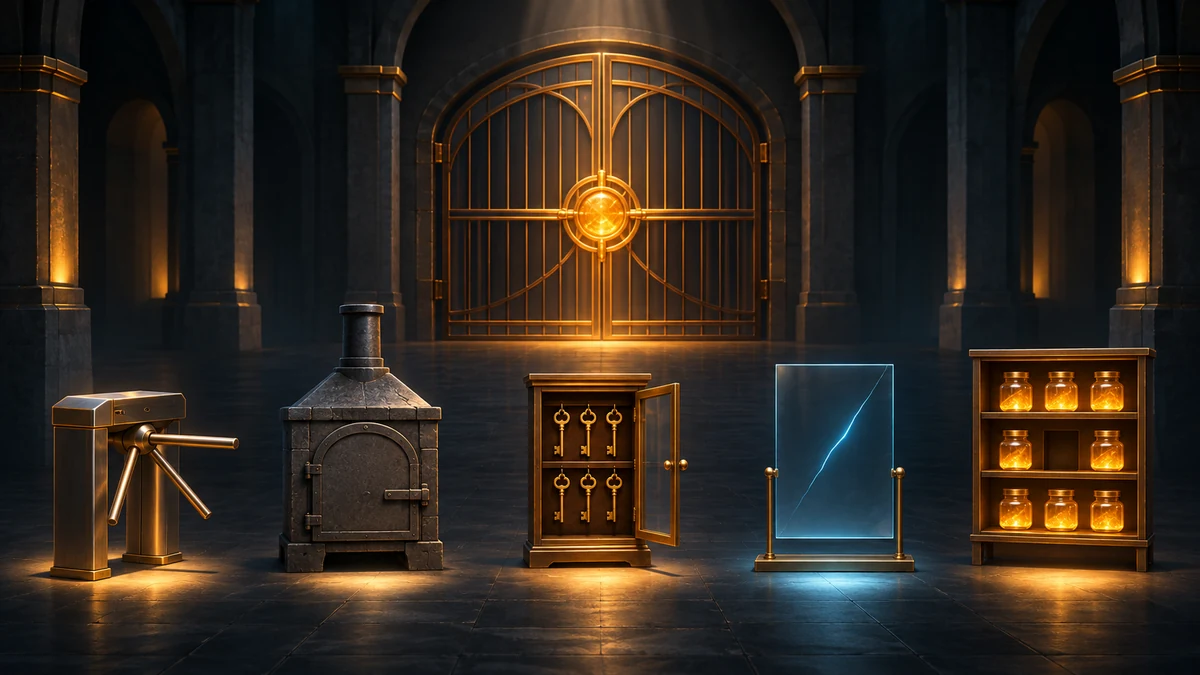
If a ZK rollup's validity proof checks out on Ethereum, what can still go wrong? Five things the proof does not cover: the sequencer that orders your transaction, the provers that keep withdrawals moving, the keys that can upgrade the contracts, bugs in the proof system itself, and where the data lives.
Introduction
Our guide to how ZK rollups work follows a transaction from your wallet to a withdrawal you can complete on Ethereum. This page takes the same four networks, ZKsync Era, Starknet, Linea and Scroll, and asks a narrower question: once a validity proof has been checked on Ethereum, what is still left to people?
ETHBEAT (formerly L2BEAT), which tracks Ethereum's layer-2 networks, publishes a risk analysis for each of the four (read 18 November 2026). It names the sequencer, the parties that propose new state, the keys that can upgrade the contracts and the way each network publishes its data (read 18 November 2026). This page reads those entries side by side, with each network's own documentation and, for bugs, the projects' own reports.
The answers differ by surface. Of ETHBEAT's four entries on sequencer failure, only Scroll's says users can force a transaction in, after up to seven days (read 18 November 2026). On ZKsync Era, Starknet and Linea, ETHBEAT says withdrawals are frozen if the whitelisted proposers fail (read 18 November 2026). On each of the four networks, it lists at least one upgrade path that leaves users no window to exit (read 18 November 2026).
The table on this page lists nine published documents or records, read on 18 and 19 November 2026, in which the projects disclose fixes to their proof systems, two of which group fixes made on several dates: ZKsync's notice of five circuit patches and Linea's record of four verifier entries. ETHBEAT says all four networks post their data to Ethereum (read 18 November 2026). On 18 November 2026 it placed Starknet at Stage 1 and ZKsync Era, Linea and Scroll at Stage 0, and it says its stages measure decentralisation, not security (read 18 November 2026). ETHBEAT's milestones record a later change: ZIP-19 dissolved ZKsync's Guardians on 20 November 2026, and the ZK Foundation multisig took over their upgrade roles (read 24 November 2026).
The five surfaces are taken in turn: the sequencer that orders your transaction, the provers whose proofs keep the chain moving, the keys that can change the contracts, bugs in the proof system itself, and where the data lives. A dated table then puts the four networks side by side, and the page closes with rules for reading any rollup's risk page.
Every state on this page is ETHBEAT's or a project's own statement, with the date it was read. Where ETHBEAT and a network's documentation say different things, both are given. For ETHBEAT's forced-inclusion heading on ZKsync Era, its two exit-window figures for ZKsync Era's regular path and its account of Starknet's Security Council fallback, both statements are given and neither is chosen.
What a Valid Proof Guarantees
ETHBEAT's glossary describes a layer 1 as a blockchain that relies on its own validator set for its security and consensus, with Ethereum as its example (read 18 November 2026). A ZK rollup settles on that layer 1 by posting data and a proof to it.
ethereum.org describes the validity proof as a cryptographic assurance that the state change a rollup proposes is the result of executing the given batch of transactions (read 18 November 2026). A verifier contract on Ethereum checks the proof, and if the proof is valid, the new state root becomes the rollup's canonical state root, in ethereum.org's description of the mechanism (read 18 November 2026).
That check is strong. ethereum.org says it eliminates the risk of malicious operators corrupting the chain, for example by stealing rollup funds, because every transaction must be approved on Mainnet (read 18 November 2026). It adds that transactions on the rollup are final only once the contract on Ethereum accepts the validity proof (read 18 November 2026). Our comparison of optimistic and ZK rollups explains how validity proofs differ from the fraud proofs that optimistic rollups rely on.
What the check leaves open
The same page names what the proof does not settle. A rollup's operators can censor users by refusing to include their transactions in batches, ethereum.org says, and centralised sequencers can influence the order of transactions (read 18 November 2026). It also lists the hardware a prover needs as a drawback: requirements that may reduce the number of parties able to force the chain to make progress, which raises the risk of operators freezing the rollup's state and censoring users (read 18 November 2026).
ethereum.org also states the general escape route: ZK rollups allow users to submit transactions directly to the rollup contract on Mainnet if they think the operator is censoring them, so that they can force an exit to Ethereum without the operator's permission (read 18 November 2026). Whether a given network offers that route today, and on what terms, is a question for that network's own records. The next section takes them one by one.
Two more limits come from the design itself. Some proving systems need a trusted setup, and ethereum.org warns that one which is mishandled could compromise a rollup's security model (read 18 November 2026). And the proof system itself can be built wrong: ETHBEAT's risk summary for ZKsync Era says funds can be lost if the proof system is implemented incorrectly (read 18 November 2026).
One withdrawal, five points where it can be held up or lost
- Point 1, the sequencer: ethereum.org says a rollup's operators can censor users by refusing to include their transactions in batches (read 18 November 2026).
- Point 2, the proof: on ZKsync Era, Starknet and Linea, ETHBEAT says withdrawals are frozen if the whitelisted proposers fail (read 18 November 2026).
- Point 3, the upgrade key: ETHBEAT's risk summary lists the same first risk for each network, that funds can be stolen if a contract receives a malicious code upgrade (read 18 November 2026).
- Point 4, the delay: ZKsync's documentation says each block committed to Ethereum has a time lock before it is executed and finalised (read 18 November 2026).
- Point 5, the data: ethereum.org says that without access to state data, users cannot query their balance or start transactions such as withdrawals that rely on it (read 18 November 2026).
Sequencers: Censorship and Forced Inclusion
ETHBEAT describes a centralised operator on ZKsync Era, centralised sequencers controlled by StarkWare on Starknet and a centralised sequencer on Linea and on Scroll (all read 18 November 2026). What differs is what you can do if that operator ignores your transaction, and how long it takes.
ZKsync Era: the queue on Ethereum
ETHBEAT's entry on sequencer failure for ZKsync Era says users can submit transactions to a queue on Ethereum but cannot force them in (read 18 November 2026). The sequencers cannot skip queued transactions selectively, but they can stop processing the queue entirely, so if they censor or are down, they are so for everyone (read 18 November 2026). ZKsync's own documentation calls these queued transactions priority operations, which any user can create, and says the sequencer picks them up from the queue (read 18 November 2026).
The same ETHBEAT page carries a heading that reads "Users can force any transaction via L1" (read 18 November 2026). The text beneath that heading says that right now there is no mechanism that forces the sequencer to include transactions from the queue in a block (read 18 November 2026).
Execution has a second gate. ETHBEAT says batches are executed by permissioned accounts, and that each batch also needs approval from a validator multisig with a 3/8 threshold before it can be executed on Ethereum (read 18 November 2026). ETHBEAT lists four ways ZKsync Era users can be censored: the validator multisig does not approve batch execution, the operator refuses to include their transactions, the operator implements a transaction filterer, or the chain admin pauses the queue on Ethereum (read 18 November 2026). The last two, it says, are possible without delay (read 18 November 2026). An ETHBEAT entry dated 5 November 2026 records a further admin power that rejects all new priority transactions, deposits and forced transactions until the admin unpauses (read 18 November 2026).
ETHBEAT also describes Priority Mode, an escape hatch that anyone can activate once the oldest unprocessed priority transaction is more than four days old, which requires a permanent rollup whose admin has permanently allowed Priority Mode, and its entry of 5 November 2026 states that Priority Mode cannot be activated on ZKsync Era (both read 18 November 2026).
Starknet: the Security Council minority
ETHBEAT says Starknet v0.14.3 uses five equal-weight, permissioned consensus sequencers controlled by StarkWare, which provides redundancy in the process but no independence from StarkWare for ordering (read 18 November 2026). It states that there is no user-callable forced-inclusion function: a user whose transaction is stuck can contact a minority of the Security Council, but that contact and response process has no protocol deadline (read 18 November 2026).
The minority ETHBEAT means is 3 of the 12 Security Council members, which it says can enforce censorship resistance by including transactions that the regular operators do not include (read 18 November 2026). ETHBEAT's table on the same page gives the inclusion delay and the exit delay as unbounded, and says Starknet provides no deterministic eventual censorship-resistance guarantee (read 18 November 2026). Its exit-window entry for the regular upgrade path, also on that page, assumes that the Security Council minority's process takes one day, leaving users seven days to exit (read 18 November 2026).
Two of Starknet's own incident reports describe outages. The first, published on 11 September 2025, says that on 2 September 2025, shortly after the upgrade to version 0.14.0, block production was halted and two chain reorganisations were needed (read 19 November 2026). The first reorganisation reverted roughly one hour of transactions and the second roughly 20 minutes (read 19 November 2026). The report gives the downtime as approximately nine hours of degraded or halted service (read 19 November 2026).
Starknet's incident report published on 8 January 2026 says that on 5 January 2026 block production was halted, the activity between 09:24 and 09:42 UTC was dropped, and the network was unavailable between 09:42 and 14:17 UTC (read 18 November 2026). It says sequencing was intentionally paused for safety, and that the incorrect execution behind the incident never saw finality on Ethereum thanks to Starknet's proving layer (read 18 November 2026). Starknet's status page also publishes postmortems: the one for 8 May 2024 gives roughly two hours of mainnet sequencer downtime (read 27 November 2026).
Linea: forced transactions
ETHBEAT says only Linea's sequencer may submit transaction batches, that a mechanism for users to submit their own batches is currently disabled, and that users cannot force any transaction (read 18 November 2026). Its risk summary marks as critical that funds can be frozen if the sequencer refuses to include an exit transaction (read 18 November 2026).
Linea's documentation describes forced transactions and opens with a notice: they are not yet live, and the page describes the intended design (read 18 November 2026). In that design a user sends a signed transaction to a gateway contract on Ethereum, and if the sequencer does not process it before a deadline, the proof verification for the batch reverts and the batch cannot be finalised on Ethereum. The documentation adds that a forced transaction is guaranteed processing, not inclusion or successful execution (read 18 November 2026).
ETHBEAT's list of Linea's contracts already describes a blocklist consulted by the rollup's forced-transaction path, under which a listed address cannot force-include transactions from Ethereum (read 18 November 2026). The documentation, read the same day, still calls the feature not yet live. This page reports both and does not treat the contract entry as the feature being available.
Scroll: enforced mode
ETHBEAT's entry on sequencer failure for Scroll says that if the sequencer fails, users can force transactions to be included by sending them to Ethereum, and that there can be up to a seven-day delay on this operation (read 18 November 2026). Its description of the mechanism is that enforced mode switches on when a message from Ethereum or a batch has not been finalised for more than seven days; then anyone can include the transactions posted to the contract (read 18 November 2026).
ETHBEAT also names who can change that path. A team multisig with a 3/4 threshold can disable enforced batch mode through a timelock whose current minimum delay is 0s, and a 2/4 multisig can pause the chain in its permissioned mode and the queue of messages from Ethereum (read 18 November 2026).
Scroll's documentation on enforced transactions says a user can start a transaction from their wallet on Ethereum and withdraw tokens or call contracts on Scroll even if the sequencer is unresponsive (read 18 November 2026). That page does not mention the seven-day trigger or the multisig that can disable the mode, which ETHBEAT's page gives (both read 18 November 2026).
When Proofs Stop: Frozen Withdrawals
A withdrawal can be completed on Ethereum only once the batch that holds it has been proven there, which ethereum.org states as exits executing once the rollup contract verifies the validity proof (read 18 November 2026). So the question for each network is who submits new state and proofs, and what happens to withdrawals if they stop. Our guide to ZK proofs and provers covers who runs the provers; this section covers what their absence does.
ETHBEAT's entry on proposer failure gives the answer for each network (read 18 November 2026). On ZKsync Era, Starknet and Linea, it says withdrawals are frozen if the whitelisted proposers fail (read 18 November 2026). The fallbacks differ: on ZKsync Era, ETHBEAT says a decentralised governance system can attempt to replace the proposers with an upgrade; on Starknet, a minority of the Security Council can act as a permissioned operator; on Linea, the operator role becomes public after six months without finalised blocks (all read 18 November 2026).
ETHBEAT qualifies the Linea fallback twice. It says the open role theoretically allows anyone to propose state with valid proofs, and that users would need to run the required software, which is currently not made available (both read 18 November 2026). For Scroll, ETHBEAT's entry says that if the proposer fails, users can use the source-available prover to submit proofs themselves (read 18 November 2026).
Gaps ETHBEAT has recorded on ZKsync Era
ETHBEAT's liveness record for ZKsync Era shows how this looks in practice. It records no proof submissions for 23 hours and 34 minutes from 12:40 UTC on 3 November 2026, and no state updates for a day from 11:42 UTC on 4 November 2026, against typical intervals of about 12 minutes and about 56 minutes (read 18 November 2026). An ETHBEAT entry dated 5 November 2026 records that, at block 26348083 after the upgrade, 95 batches had been committed and 93 proven but none executed (read 18 November 2026). ETHBEAT's entry of 10 November 2026 records that batch execution resumed after the upgrade (read 18 November 2026).
ETHBEAT's milestones also list a separate event: on 30 July 2025, it says, ZKsync Era's proof system was manually paused because of a vulnerability, causing a partial liveness failure (read 18 November 2026). The bug table below lists the ZKsync disclosures; ETHBEAT's entry for this pause links a post on X, not one of them, so this page keeps the two as separate dated facts.
The delay before a withdrawal can execute
Proof is not the only wait. ZKsync's documentation says each block committed to Ethereum has a time lock before it is executed and finalised (read 18 November 2026). An ETHBEAT entry dated 8 October 2026 records that ZKsync Era's delay was raised from three hours to one day, following governance proposal ZIP-17 (read 18 November 2026). ZKsync's documentation page on the withdrawal delay still gives the lock as a three-hour minimum, and says this does not guarantee that batches will be finalised within three hours (read 18 November 2026). ZKsync's update on ZIP-17, posted on the ZK Nation forum, says the execution delay is a minimum, not a guarantee (read 18 November 2026). Our Ethereum layer 2 guide sets ZK rollup withdrawal times beside the challenge windows of optimistic rollups.
Upgrade Keys: Who Can Change the Contracts
The contracts on Ethereum that hold the bridge's funds, run the verifier and decide which state is accepted can all be upgraded on the four networks, in ETHBEAT's records (read 18 November 2026). ETHBEAT's risk summary lists the same first risk for each: funds can be stolen if a contract receives a malicious code upgrade (read 18 November 2026). What differs is who holds the key, how many of them must sign, and whether users get time to leave first.
ZKsync Era: two paths, and the change ZIP-19 made
ETHBEAT describes two upgrade paths for ZKsync Era. On the regular path a proposal of ZK token delegates goes through timelocks and is approved by 4 of the 8 Security Council members or, failing that, by the ZK Foundation multisig (3 of 6), with an exit window of five days (ETHBEAT, read 24 November 2026). ETHBEAT's section on upgrades and governance for ZKsync Era puts the exit window at about four days after the vote closes when the Security Council approves promptly, against the five days of its risk entry (read 24 November 2026). On the emergency path the Security Council (6 of 8) and the ZK Foundation multisig (3 of 6) together push an upgrade through the Emergency Upgrade Board, which takes effect at once, with no exit window (ETHBEAT, read 24 November 2026).
The emergency path is not theoretical. The ZKsync Security Council's report for August 2024 to September 2025 says it was activated four times in emergency conditions, three of which required emergency upgrades (read 18 November 2026). ETHBEAT says the Matter Labs Multisig, with a 4/7 threshold, applied ZKsync Era's v31 upgrade as chain admin, and that users can be censored if the chain admin pauses the queue on Ethereum, which is possible without delay (read 18 November 2026).
Until 20 November 2026 a third body, the Guardians, sat on both paths. Five of its 8 members could approve a regular upgrade if the Security Council did not, and an emergency upgrade needed them too (ETHBEAT, read 18 November 2026). ZIP-19, a proposal the Guardians posted on 7 October 2026, set out to transfer their on-chain roles to the ZKsync Foundation (ZK Nation forum, read 19 November 2026). ETHBEAT's milestones record that it dissolved the Guardians on 20 November 2026 and that the ZK Foundation multisig took over their upgrade roles (read 24 November 2026).
Starknet: an eight-day queue and an instant council
ETHBEAT splits governance of Starknet's main rollup contract and its core bridge escrows between two groups. The 2/6 StarkWare Multisig 1 forms the normal path, routing actions through a timelock with an eight-day on-chain delay, and the 9/12 Security Council can upgrade instantly and is intended for emergencies only (ETHBEAT, read 18 November 2026). ETHBEAT gives an exit window of seven days on the regular path and none on the emergency path, and its risk summary marks as critical that there is no delay on code upgrades (read 18 November 2026).
One more key reaches beyond Starknet. ETHBEAT says the shared SHARP verifier used for Starknet's state validation can be changed by the 2/4 SHARP Multisig with an eight-day delay, and that a change affects all rollups sharing it (read 18 November 2026). Starknet's documentation describes its Security Council as a 12-member body that holds administrative control over the core contracts on Starknet and Ethereum, and names the 12 organisations its members are affiliated with (read 18 November 2026).
Linea: a council with no delay
ETHBEAT says Linea's main rollup contract can be upgraded by the Linea Security Council, a 5/9 multisig, with no delay, and that there is no window for users to exit before an unwanted upgrade because the contracts are instantly upgradable (read 18 November 2026). It adds that the council can pause the rollup indefinitely (read 18 November 2026). Who sits on it is not public: among the requirements Linea misses for Stage 1, ETHBEAT lists that its Security Council members are not publicly known (read 18 November 2026). A key held by a council whose members cannot be named is a key whose holders a reader cannot weigh.
Linea publishes its own record of Security Council transactions. On 7 November 2026, the record says, the council added a verifier at index 0, replacing an unused one, to fix issues preventing the generation of proofs in some cases; on 14 July 2026, it upgraded the rollup contract to an implementation containing future forced transaction support (both read 18 November 2026).
Scroll: a team multisig since 1 June 2026
ETHBEAT records that on 1 June 2026 Scroll replaced its independent 9-of-12 Security Council with a 3-of-4 multisig of Scroll team members, and dropped to Stage 0 (read 18 November 2026). That multisig, it says, can upgrade all core contracts and update the rollup's zero-knowledge proof verifier through a timelock whose current minimum delay is 0s, and ETHBEAT gives no exit window (read 18 November 2026).
Scroll's documentation page on upgrades says upgrades are executed after a two-week timelock period (read 18 November 2026).
Pauses, freezes and a throttle
An upgrade changes the rules; a pause stops them for a while. ETHBEAT records that ZKsync Era's Security Council can freeze the protocol on its own: a soft freeze of 12 hours with 3 of its 8 members, or a hard freeze of seven days with 6 of 8 (read 18 November 2026). It adds that the council cannot bypass the DAO to upgrade on its own: emergency upgrades also require the ZK Foundation multisig (read 24 November 2026).
On Linea, ETHBEAT lists accounts that can pause the rollup for two days, followed by a two-day cooldown during which only the Security Council can pause it, and says the Security Council itself can pause the rollup indefinitely (read 18 November 2026). On Scroll, it says each pause is subject to a cooldown of one month, during which the team's admin multisig can unpause (read 18 November 2026).
On Starknet the limit ETHBEAT records is on the bridge rather than the chain: it says all of Starknet's bridge escrows allow a withdrawal throttle of 5% of the locked funds per 24 hours to be switched on, that a multisig can enable it, and that in the core bridge escrows a minority of 3 of the 12 Security Council members can switch it off (read 18 November 2026).
Bugs in the Proof System: What the Projects Disclosed
A proof checks a computation against a circuit, and a circuit can be wrong. The table lists defects in the proof system itself, in a circuit, a prover or a verifier contract, that the projects disclosed in their own words. It has one row per published document or record, newest first, and a row may list several fixes; the ZKsync Security Council's periodic reports, which repeat fixes already listed, are not separate rows. Each row gives what the project says happened, its own account of the impact where it gives one, and what it says about funds where it says anything.
The table has nine rows, from the reads of 18 and 19 November 2026. Two of them group fixes made on several dates: the ZKsync Security Council's notice of 1 September 2026, which lists five circuit patches, and Linea's Security Council record, with four entries. The places read were Scroll's governance forum, the ZK Nation forum, Scroll's and ZKsync's documentation, Starknet's blog index (read 19 November 2026), its incident reports of 11 September 2025 and 8 January 2026 and its documentation, Linea's documentation and its Security Council record, and ETHBEAT's milestones and change logs for all four networks. For Starknet those reads held no project disclosure of a defect in the proof system; that is a statement about the reads, not about the network.
| Published | Network | What the project says happened | What it says about funds |
|---|---|---|---|
| 11 November 2026 | Scroll | A bug in "the bundle proof verifier deployed on Ethereum mainnet", reported on 3 November; a fixed verifier was registered on 10 November 2026. Scroll says the bug "would allow finalizing an arbitrary state root and withdraw root", and that "Exploiting the bug required either the permissioned prover role or enforced batch mode" | Not stated. Scroll says: "We verified that the bug was not exploited on Scroll mainnet." |
| 21 April to 7 November 2026 | Linea | Four entries in Linea's Security Council record, each adding a verifier: on 21 April 2026, "fixing 2 correctness issues preventing the generation of proofs in some cases"; on 3 September, 7 October and 7 November 2026, "replacing existing unused verifier to fix issues preventing the generation of proofs in some cases" | Not stated. The record says nothing about exploitation. |
| 15 September 2026 | Scroll | An announcement of Scroll's OpenVM v2.0.0 upgrade, which "brings in the security fixes shipped in OpenVM v1.7.0". The announcement says v1.7.0 "fixes three security advisories affecting v1.6.0 and earlier, including two in the Solidity verifier wrapper", among them "OpenVmHalo2Verifier self-call can bypass proof verification". It does not say whether Scroll's deployed verifier was affected | Not stated. The announcement says nothing about exploitation. |
| 1 September 2026 | ZKsync Era | Five circuit patches signed between 23 January and 15 August 2026; the first "addressed three reported ZKsync Era ZK circuit vulnerabilities, including one soundness issue". The notice says the Security Council "is not aware of any material effect on transactions, deposits, withdrawals, finalization or other protocol operations arising from the issues addressed by these patches" | "User funds were not believed to be actively at risk in connection with any of these Security Patches." |
| 6 March 2026 | Scroll | An emergency upgrade on 23 February 2026: "A missing check in the ecPairing precompile implementation could lead to diverging execution results on the sequencer and prover, leading to finalization failure" | Not stated. The report says nothing about exploitation. |
| 28 August 2025 | ZKsync Era | A bug in the EcPairing circuit's commitments, reported on 27 July 2025 and patched on 1 August 2025, which "could have allowed a malicious validator to forge the precompile execution to accept invalid inputs as valid" | "No funds were lost and there was no disruption to users during the incident." |
| 19 August 2025 | Scroll | "A guest program completeness bug in the EuclidV2 version of the prover"; a new verifier was deployed on 8 August and the upgrade executed on 9 August 2025 | "The issue prolonged finality and delayed withdrawals, but no user funds were at risk." |
| 3 June 2025 | Scroll | "Two bugs in the FRI verifier" in Plonky3, a dependency of the prover; the fix of 26 May 2025 changed the on-chain verifier | Not stated. Scroll says the bug "could not be meaningfully exploited on Scroll because the sequencer and provers are not permissionless." |
| 2 May 2025 | Scroll | "A soundness issue in OpenVM 1.0.0", fixed by an emergency upgrade on 25 April 2025; the report says it allowed "a colluding sequencer and prover to generate invalid proofs while still being able to pass the onchain verifier". Its impact assessment: "The exact exploit scenario is unclear. But any circuit soundness bug has a potentially severe impact." | "Scroll took immediate action to pause the affected gateway contract and secure funds before anyone exploited the bugs" (the report's overview, which covers both bugs it describes). Of the OpenVM issue, the report says it "cannot be exploited by third parties because both the sequencer and the provers are operated by Scroll." |
ETHBEAT describes three of these events differently from the projects. ETHBEAT's change log for Scroll, in an entry dated 11 August 2025, calls the update of 9 August 2025 a "soundness bug and verifier emergency update", while Scroll's own report calls the defect a completeness bug (both read 18 November 2026). For the update of 23 February 2026, ETHBEAT's milestone gives a bug in the guest prover program, while Scroll's report names the ecPairing precompile implementation (both read 18 November 2026). For the fix of 10 November 2026, ETHBEAT's entry of 16 November describes refactored verifier code with unchanged zk logic, while Scroll's report describes a bug (both read 18 November 2026).
The rows differ in what they say about funds, and the table keeps the difference. "Not exploited" and "not at risk" are separate statements: the first says what happened, the second what could have happened. Two of Scroll's reports tie their bugs' exploitability to how the sequencer and the provers are run: one says its bug cannot be exploited by third parties because both are operated by Scroll, the other that its bug could not be meaningfully exploited on Scroll because they are not permissionless (both read 18 November 2026). That is the same centralisation the earlier sections describe.
Trusted setups, and whether the verifier can be checked
ETHBEAT says that on ZKsync Era the proofs are verified on Ethereum by a smart contract, and that the system requires a trusted setup; it says the same of Scroll, and that Linea's final proof is a PLONK proof, which requires a trusted setup (all read 18 November 2026). ethereum.org explains the risk: if the information used to create a SNARK's public parameters falls into the hands of malicious actors, they may be able to generate false validity proofs (read 18 November 2026). It describes STARKs, the proofs ETHBEAT lists for Starknet, as transparent, because they can work without that trusted setup (read 18 November 2026). Our provers guide sets out the two families in full.
A second check is whether anyone can rebuild the verifier contract from its source. ETHBEAT's entry of 28 September 2026 records an upgrade of Scroll's OpenVM verifier to version 2.0.0, with its programs and verifiers successfully reproduced (read 18 November 2026). For Linea, an ETHBEAT entry dated 16 November 2026 records an updated verifier that was not yet regenerated, and ETHBEAT lists among the requirements Linea misses for Stage 1 that not all of its on-chain verifiers can be independently regenerated from the source code (both read 18 November 2026).
Data Availability: Where the Data Lives
A proof shows that the new state follows from the old one; it does not hand you the state. ethereum.org says that without access to state data, users cannot query their balance or start transactions such as withdrawals that rely on it, and that a ZK rollup publishes the data needed for anyone to reconstruct its state independently (read 18 November 2026).
A validium is the case where that data stays off Ethereum. ethereum.org says validium users can have their funds frozen and withdrawals restricted if the parties managing the data withhold it, because without the data users cannot compute the Merkle proof that a withdrawal needs (read 18 November 2026). A volition, it says, lets users choose between the two for some transactions (read 18 November 2026).
What each network publishes
ETHBEAT says all four networks post their data to Ethereum, in blobs or calldata (all read 18 November 2026). ETHBEAT says ZKsync Era and Starknet publish state differences, the changes to the state rather than the transactions that caused them (read 18 November 2026). Linea, unlike most ZK rollups in ETHBEAT's words, posts transaction data instead of state differences (read 18 November 2026). Starknet's documentation says blobs are the default and that in extreme situations, when blob prices far exceed those of calldata, the sequencer can switch to calldata (read 18 November 2026).
Publishing is not the same as being easy to use. ethereum.org says blob data is not permanent storage: the protocol defines a minimum window of roughly 18 days over which the network must serve it, and longer-term access depends on archival services (read 18 November 2026). ETHBEAT notes that there is currently no straightforward method to inject the state into ZKsync Era's main node, and that state derivation from Ethereum is unsupported in the other node implementations that can sync Linea (both read 18 November 2026).
For Starknet, ETHBEAT says the full state can be recovered from the published differences but that contracts' code is not published on Ethereum (read 18 November 2026). For Scroll, it says consistency with the data on Ethereum can be checked by running Scroll's node with a verification flag (read 18 November 2026).
The Four Networks in One Table
The table puts ETHBEAT's entries for the four networks side by side, in the terms the sections above use. Each cell is ETHBEAT's record on the read date, except where a cell names a network's own documentation. Our comparison of ZKsync, Linea and Starknet covers three of these networks on fees, EVM equivalence and security maturity.
| Network | ETHBEAT stage | Forcing a transaction in | Upgrade path and exit window |
|---|---|---|---|
| ZKsync Era | Stage 0 | A queue on Ethereum that users can submit to but cannot force; Priority Mode cannot be activated | Regular: a proposal of ZK token delegates, approved by 4 of 8 Security Council members or, failing that, the ZK Foundation multisig (3 of 6), exit window 5 days. Emergency: Security Council (6 of 8) and ZK Foundation multisig (3 of 6) together, no exit window. Read 24 November 2026, after ZIP-19 dissolved the Guardians on 20 November 2026 |
| Starknet | Stage 1 | No user-callable function; a request to a Security Council minority, with no protocol deadline | Normal: 2/6 StarkWare Multisig 1 through an eight-day timelock, exit window 7 days. Emergency: 9/12 Security Council, instant, no exit window |
| Linea | Stage 0 | None; Linea's documentation says forced transactions are not yet live (read 18 November 2026) | 5/9 Security Council, no delay, no exit window |
| Scroll | Stage 0 | Yes, after seven days without finalisation; a 3/4 team multisig can disable the mode | 3/4 team multisig through a timelock with a current minimum delay of 0s, no exit window |
What a stage measures
ETHBEAT's stages framework describes Stage 0 as a project fully controlled by a few entities, Stage 2 as one fully controlled by code and Stage 1 as something in between (read 18 November 2026). At Stage 1, compromising at least 75% of the Security Council must be the only way, other than bugs, to indefinitely block or forge a withdrawal, and upgrades from outside the council must give users at least seven days to exit (read 18 November 2026).
ETHBEAT says plainly that the framework discusses maturity in terms of decentralisation, not security, and that it is easy for a team to deploy a very unsafe Stage 2 project, for example with an experimental proof system or contracts that have not been properly audited (read 18 November 2026). It names what keeps each network where it is. ETHBEAT says Starknet does not pass the walkaway test: "users are not able to exit in the presence of malicious operators if the Security Council disappears" (read 18 November 2026). On ZKsync Era, ETHBEAT says a compromised quorum-blocking minority of the council can prevent users from exiting (read 18 November 2026). Our guide to L2 security trade-offs explains the stages framework across the major rollups.
Rules for Reading a Rollup's Risk Page
These records change. An ETHBEAT entry dated 8 October 2026 records ZKsync Era's execution delay raised from three hours to one day, and Scroll's report says it registered a fixed verifier on 10 November 2026 (both read 18 November 2026). These rules travel better than any single row of the table.
- Read the date before the entry. A risk entry describes the network on the day it was read. If a page shows a notice that its information may be out of date, treat every entry on it as provisional.
- Read the text under a heading, not only the heading. On ETHBEAT's page for ZKsync Era, a heading says users can force any transaction via Ethereum, and the text beneath it says there is no mechanism that forces their inclusion (both read 18 November 2026).
- Ask who can change the verifier, and how fast. An exit window of none means an upgrade can take effect before you can leave. A council or multisig with a 0s timelock is a key, whatever it is called.
- Ask what happens to withdrawals if proofs stop. "Frozen" with a fallback that needs a governance vote or unreleased software is a different answer from users being able to submit proofs themselves.
- Keep the project's words on bugs. "Not exploited" and "no funds at risk" are different claims, and a report that rests one of them on the operator being trusted tells you about the operator too.
- Separate the plan from the record. A proposal, a roadmap or a design document says what may happen. The network's state is what the contracts on Ethereum do today.
Conclusion
A validity proof checked on Ethereum settles one question well: whether the new state follows from the transactions in the batch. On ZKsync Era, Starknet, Linea and Scroll, the reads of 18 and 19 November 2026 leave the other questions to the records this page has quoted, network by network. ETHBEAT describes a centralised operator or sequencers on each network, and of its four entries on sequencer failure, only Scroll's says users can force a transaction in, after up to seven days (read 18 November 2026).
Withdrawals depend on proofs continuing, and ETHBEAT says they are frozen on three of the networks if the proposers fail (read 18 November 2026). On each of the four networks, ETHBEAT lists at least one upgrade path that leaves users no window to exit (read 18 November 2026). The nine documents and records in the table show that proof systems are code, with bugs found, patched and reported. Two of Scroll's reports tie their bugs' exploitability to how the sequencer and the provers are run (both read 18 November 2026). ETHBEAT says all four post their data to Ethereum (read 18 November 2026), which is what makes reconstruction possible, though not effortless.
The records show these surfaces in use. ETHBEAT recorded no proof submissions on ZKsync Era for 23 hours and 34 minutes from 12:40 UTC on 3 November 2026 (read 18 November 2026). The ZKsync Security Council's report for August 2024 to September 2025 says it was activated four times in emergency conditions, three of which required emergency upgrades (read 18 November 2026). Starknet's own incident report says its network was unavailable between 09:42 and 14:17 UTC on 5 January 2026 (read 18 November 2026).
None of this makes a ZK rollup a good or a bad place for your money, and this page does not rank the four networks. It tells you where to look. Before you move funds, read the network's current risk entries with their date, find who holds the upgrade keys and what a withdrawal waits for, and decide from those. Our guide to using ZK rollups covers the withdrawal steps and waits on each of the four networks.
Sources
The sources below were read on 18 November 2026 with our verification client, except Starknet's blog index and its incident report of 11 September 2025, which were read on 19 November 2026, and Starknet's status page, read on 27 November 2026. ETHBEAT's ZKsync Era, Linea and Scroll pages, the ZIP-19 thread and the seven forum reports and notices behind the bug table were read again on 19 November 2026. ETHBEAT's ZKsync Era page was read once more on 24 November 2026, after ZIP-19 was executed, and all four of its network pages on 25 November 2026. Each entry names the document and what it supports on this page.
- Zero-knowledge rollups, on ethereum.org — what a validity proof guarantees, the verifier contract, censorship and forced exits, data publication, blob retention and trusted setups. ethereum.org
- Validium, on ethereum.org — data kept off Ethereum, frozen funds and volitions. ethereum.org
- ETHBEAT (formerly L2BEAT), Stages framework — what Stage 0, Stage 1 and Stage 2 require, and that stages measure decentralisation rather than security. ethbeat.org
- ETHBEAT, ZKsync Era — its glossary's definition of a layer 1, stage, the risk summary, the operator, the queue on Ethereum, censorship, Priority Mode, proposer failure, liveness gaps, the 30 July 2025 pause, upgrade paths, the Guardians' dissolution on 20 November 2026, the Security Council's freezes, the chain admin, the execution delay, the trusted setup and data availability. ethbeat.org
- ETHBEAT, Starknet — stage and the walkaway test, the sequencers, the Security Council minority, inclusion and exit delays, proposer failure, upgrade paths, the SHARP verifier, the withdrawal throttle and data availability. ethbeat.org
- ETHBEAT, Linea — stage and the requirements it misses for Stage 1, the sequencer, disabled user batches, the forced-transaction blocklist, proposer failure, the 5/9 Security Council, the pauses, the verifier entry of 16 November 2026, the trusted setup and data availability. ethbeat.org
- ETHBEAT, Scroll — stage, enforced mode after seven days, the multisigs that can disable it or pause the queue, self-proposing, the 1 June 2026 Security Council change, the timelocks, the pause cooldown, the change log of 11 August 2025, the 23 February 2026 milestone, the entries of 28 September and 16 November 2026, the trusted setup and data availability. ethbeat.org
- ZKsync documentation, Withdrawal delay — the time lock before execution, and the three-hour minimum the page still gives. docs.zksync.io
- ZKsync documentation, L1 to L2 communication — priority operations and the priority queue. docs.zksync.io
- Update on ZIP-17: ZKsync Era execution delay increasing to 24 hours, ZK Nation forum — that the execution delay is a minimum, not a guarantee. forum.zknation.io
- [ZIP-19] Dissolution of the ZKsync Guardians, ZK Nation forum, posted 7 October 2026 — the proposal's terms (read 18 and 19 November 2026). forum.zknation.io
- ZKsync Security Council report, August 2024 to September 2025, ZK Nation forum — its activations in emergency conditions. forum.zknation.io
- ZKsync Security Council, Notice of 2026 Instant Upgrades: Security Patches, ZK Nation forum, posted 1 September 2026 — the five circuit patches and the statement on funds. forum.zknation.io
- Incident report: EcPairing commitment binding failure, ZK Nation forum, posted 28 August 2025 — the circuit bug and the statement on funds. forum.zknation.io
- Starknet, blog index (all posts) — the listing read for incident reports and security posts published since May 2025 (read 19 November 2026). starknet.io
- Starknet, Incident Report — September 2, 2025, published 11 September 2025 — the outage, the two reorganisations and the downtime (read 19 November 2026). starknet.io
- Starknet status page, Starknet mainnet – slow block creation alert, 8 May 2024, and its postmortem — the roughly two hours of sequencer downtime (read 27 November 2026). status.starknet.io
- Starknet, Incident Report – January 5, 2026, published 8 January 2026 — the outage, the dropped activity and the role of the proving layer. starknet.io
- Starknet documentation, Security Council — the council's 12 members and its control of the core contracts. docs.starknet.io
- Starknet documentation, Data availability — blobs by default and the switch to calldata. docs.starknet.io
- Linea documentation, Forced transactions — that they are not yet live, and the intended design. docs.linea.build
- Linea documentation, Security Council record — the council's transactions of 14 July and 7 November 2026, and its four verifier entries of 21 April, 3 September, 7 October and 7 November 2026. docs.linea.build
- Scroll documentation, Enforced transactions — sending a transaction to Scroll from Ethereum when the sequencer is unresponsive. docs.scroll.io
- Scroll documentation, Scroll upgrades — the two-week timelock the page describes. docs.scroll.io
- Scroll, Announcement: OpenVM v2.0.0 Upgrade on Scroll, Scroll governance forum, posted 15 September 2026 — the security fixes of OpenVM v1.7.0 and the advisory on the verifier wrapper. forum.scroll.io
- Scroll, Report: Scroll Mainnet Emergency Upgrade on 2026-11-10, Scroll governance forum, posted 11 November 2026 — the bundle proof verifier bug. forum.scroll.io
- Scroll, Report: Scroll Mainnet Emergency Upgrade on 2026-02-23, Scroll governance forum, posted 6 March 2026 — the ecPairing precompile implementation. forum.scroll.io
- Scroll, Security Council Report: Scroll Mainnet Emergency Upgrade on 2025-08-08, Scroll governance forum, posted 19 August 2025 — the guest program completeness bug and the statement on funds. forum.scroll.io
- Scroll, Security Council Report: Scroll Mainnet Emergency Upgrade on 2025-05-26, Scroll governance forum, posted 3 June 2025 — the FRI verifier bugs. forum.scroll.io
- Scroll, Report: Scroll Mainnet Emergency Upgrade on 2025-04-25, Scroll governance forum, posted 2 May 2025 — the OpenVM soundness issue. forum.scroll.io
Frequently Asked Questions
- Can I get my funds out if the sequencer stops?
- It depends on the network. On Scroll, ETHBEAT (formerly L2BEAT) says users can force transactions in through Ethereum, with up to a seven-day delay, and that a 3/4 team multisig can disable that mode (read 18 November 2026). On ZKsync Era, it says users can submit to a queue on Ethereum but cannot force it (read 18 November 2026). On Starknet, the only route it describes is a request to a minority of the Security Council, with no protocol deadline (read 18 November 2026). On Linea, its entry on sequencer failure says there is no mechanism, and Linea's documentation says forced transactions are not yet live (both read 18 November 2026).
- What happens to my withdrawal if the prover stops?
- ETHBEAT (formerly L2BEAT) says withdrawals are frozen on ZKsync Era, Starknet and Linea if the whitelisted proposers fail (read 18 November 2026). Its fallbacks are an attempt through ZKsync's governance to replace the proposers with an upgrade, a minority of Starknet's Security Council acting as operator, and on Linea an operator role that becomes public after six months without finalised blocks (read 18 November 2026). On Scroll, ETHBEAT says users can submit proofs themselves with the source-available prover (read 18 November 2026).
- Who can upgrade a ZK rollup's contracts?
- On each of the four networks, ETHBEAT (formerly L2BEAT) names a council or multisig that can upgrade the contracts without giving users a window to exit (read 18 November 2026). On ZKsync Era it is the Security Council and the ZK Foundation multisig together, since ZIP-19 dissolved the Guardians on 20 November 2026 (read 24 November 2026); on Starknet, its 9/12 Security Council; on Linea, its 5/9 Security Council; on Scroll, a 3/4 team multisig (all three read 18 November 2026). ZKsync Era and Starknet also have regular paths, with exit windows of five and seven days in ETHBEAT's record (read 18 November 2026).
- Have ZK rollup proof systems had bugs?
- Yes. The table on this page lists nine published documents or records, read on 18 and 19 November 2026, in which the projects disclose fixes to their proof systems, published between May 2025 and November 2026; two of them group fixes made on several dates, ZKsync's notice of five circuit patches and Linea's record of four verifier entries. The most recent of the nine, posted by Scroll on 11 November 2026, concerns its bundle proof verifier, and Scroll says the bug was not exploited on Scroll mainnet (read 18 November 2026). The table on this page gives each one in the project's words.
- Does a higher ETHBEAT stage mean a network is safer?
- Not by itself. ETHBEAT (formerly L2BEAT) says its stages framework discusses maturity in terms of decentralisation, not security, and that a team can easily deploy a very unsafe Stage 2 project (read 18 November 2026). On 18 November 2026 it placed Starknet at Stage 1 and ZKsync Era, Linea and Scroll at Stage 0.
- What is the difference between a ZK rollup and a validium?
- Where the data lives. ethereum.org says a ZK rollup publishes the data needed to reconstruct its state, while a validium keeps it off Ethereum, so validium users can have funds frozen if the parties managing the data withhold it (read 18 November 2026). ETHBEAT (formerly L2BEAT) says all four networks on this page post their data to Ethereum (read 18 November 2026).
- What is ZIP-19?
- ZIP-19 is a proposal posted by the ZKsync Guardians on 7 October 2026. It set out to transfer the Guardians' on-chain roles to the ZKsync Foundation and to replace the Emergency Upgrade Board with one that needs approval from the Security Council and the Foundation only (ZK Nation forum, read 19 November 2026). ETHBEAT's milestones record that ZIP-19 dissolved the Guardians on 20 November 2026 and that the ZK Foundation multisig took over their upgrade roles (read 24 November 2026).
← Back to Crypto Investing Blog Index
Financial Disclaimer
This content is not financial advice. All information provided is for educational purposes only. Cryptocurrency investments carry significant investment risk, and past performance does not guarantee future results. Always do your own research and consult a qualified financial adviser before making investment decisions.