L2 Security Tradeoffs Guide 2026
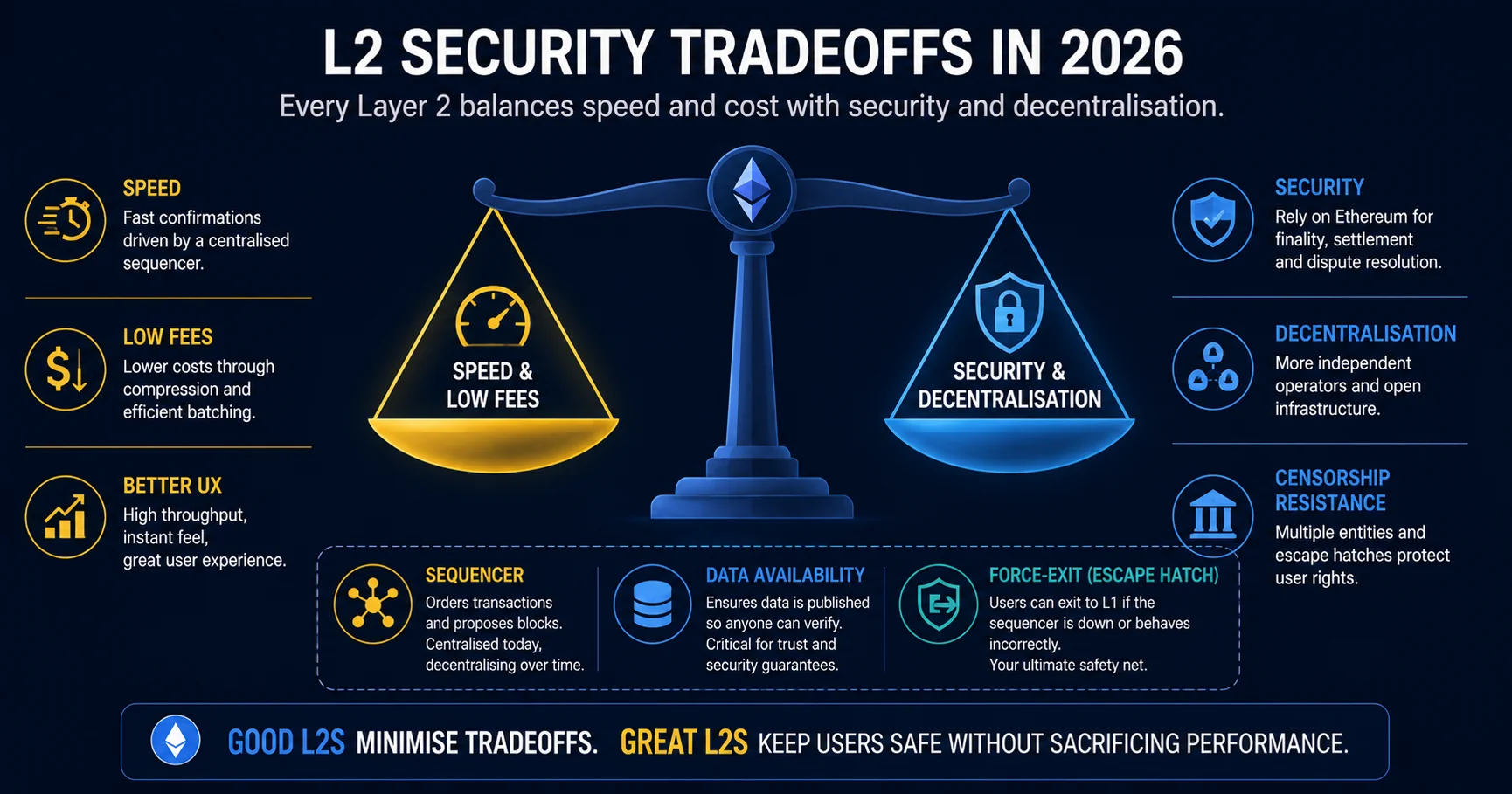
"L2 inherits Ethereum security" is true — partially. Different L2s sit at different points on the security spectrum, and the practical implications matter when you deploy capital. This guide explains L2BEAT's maturity-stage framework, the sequencer-trust assumptions that vary across chains, the data-availability tradeoffs between Ethereum DA and alt-DA layers, and force-exit mechanics. Four 2026 case studies — Arbitrum's May state-update lag, Starknet's Grinta meltdown, the Kelp/LayerZero exploit, and the Polygon zkEVM sunset — make the abstract concrete.
Introduction
What this guide covers:
- The L2BEAT three-stage maturity framework that classifies every L2 by operational decentralisation
- Sequencer trust assumptions and where each major L2 sits on the centralised-to-decentralised spectrum
- Data availability tradeoffs — Ethereum DA versus alt-DA layers (Celestia, EigenDA, Avail) and the cost-security implication
- Force-exit mechanisms: the structural escape hatch every L2 must provide and how usable each implementation actually is
- Four 2026 case studies — Arbitrum's May state-update lag, Starknet's Grinta meltdown, the Kelp/LayerZero exploit, and the Polygon zkEVM sunset
"L2 inherits Ethereum security" is the phrase you see everywhere — in marketing material, in technical documentation, in the sales pitch for the rollup-centric roadmap. It is true in an important sense: rollups post their state and (post-EIP-4844) their data to Ethereum, and the cryptographic verification mechanism (fraud proofs for optimistic rollups, validity proofs for ZK rollups) means the rollup state cannot diverge from a valid Ethereum-anchored history without being detectable on L1.
But the phrase is also misleading in three specific ways that matter for anyone deploying meaningful capital on an L2. First, the sequencer model varies — every major L2 today runs a centralised sequencer that can reorder transactions, extract MEV, and (in principle) censor specific addresses. Second, the data availability layer varies — Ethereum DA is the highest-trust default, but several active chains use alternative DA layers (Celestia, EigenDA, Avail) with different security models. Third, the force-exit mechanism varies — every major L2 has one, but the user-flow quality and the timing differ in ways that matter when you actually need to invoke it.
The cleanest framework for thinking about all of this is L2BEAT's three-stage maturity model, which classifies each L2 by the strength of its security guarantees and the residual operator authority. The framework has wide adoption in 2026 — including from Ethereum co-founder Vitalik Buterin, whose February 2026 reframing of the rollup-centric roadmap explicitly endorsed the L2BEAT stages as the right benchmark for "real" rollups versus "L1 with a bridge". This guide walks through the framework, the per-component analysis (sequencer, data availability, force-exit), and four 2026 case studies that ground the abstract concepts in observed events.
Why this matters in practical terms: capital you deploy on an L2 inherits the worst-case of these three variables, not the best case. A chain with a brilliant proof system but a weak force-exit user experience puts your funds at meaningful risk during sequencer downtime. A chain at L2BEAT Stage 1 with a centralised proposer can still process censorship-resistant exits, but only if you know the mechanism before the situation arises. Treat the framework below as the checklist you run through before sizing any position, not as an academic taxonomy.
For the broader L2 selection framework — which chain to use for which application — see our Ethereum L2 complete guide. For the technical mechanics of optimistic versus ZK rollups, see our optimistic vs ZK rollups guide.
L2BEAT Maturity Stages
L2BEAT is the industry-standard tracker for L2 security and maturity. Its three-stage framework is the practical benchmark for measuring how much trust a given L2 places in operator honesty versus cryptographic proof. Understanding the framework is the foundation for every other security discussion in this guide — sequencer, data availability and force-exit are all components of how a given L2 earns its stage.
Stage 0 — operator-authority baseline
Stage 0 means the rollup operator retains broad authority over the system. The sequencer is centralised, state-validation is centralised (no live fraud or validity proofs in production), and user funds ultimately depend on operator honesty plus the force-exit mechanism. Most ZK rollups currently sit at Stage 0 — not because the cryptography is unsound, but because the surrounding operational infrastructure (proof submission, security council, upgrade authority) has not yet reached the strict Stage 1 bar.
Stage 0 is not the same as "unsafe". The cryptographic verification on a ZK rollup (validity proof verified on L1) is mathematically sound regardless of stage classification. What Stage 0 signals is that the operator could, in principle, freeze upgrades, withhold data, or otherwise act adversarially against users — and the recovery path depends on the security council and the force-exit mechanism rather than on a pure cryptographic guarantee. The practical implication: match the stage to the value at stake. Stage 0 is acceptable for transactional capital, less obviously acceptable for long-term high-value positions where the worst-case operator-failure scenario matters more.
Stage 1 — fault or validity proofs live, security council with delays
Stage 1 means fault proofs (for optimistic rollups) or validity proofs (for ZK rollups) are live in production, and the security council can override the system but only with documented delays and full transparency. Live fault proofs are the hard requirement: anyone can submit a fraud proof challenging an invalid state transition, and the system must accept the challenge through a permissionless interface. Live validity proofs serve the equivalent role on ZK rollups — every state transition is cryptographically verified on L1 before finalisation.
As of mid-2026, four of the seven major L2s sit at Stage 1: Arbitrum (BoLD permissionless fraud proofs live since early 2026), Optimism (Cannon fault proofs live since 2024), Base (inherits Optimism's Cannon), and Starknet (permissionless exits and validity proofs live, corrected from earlier Stage 0 framing). zkSync Era and Linea remain Stage 0 — not for lack of underlying ZK soundness but because the operator retains upgrade authority that the strict Stage 1 framework does not allow. Polygon zkEVM was Stage 0 and has been sunset.
The security-council override is the key Stage 1 nuance. A Stage 1 chain still has a security council that can pause or override the system in emergencies, but the override is publicly documented, time-delayed (typically a 7-30 day window), and transparent. This is a deliberate design choice, not a flaw — the council exists as a backstop against discovered bugs in the proof system, and the delay-plus-transparency ensures users can react if the council acts adversarially.
Stage 2 — fully permissionless, no override
Stage 2 means fully permissionless operation: no security council override, no upgrade authority retained by any party, the rollup runs purely on its on-chain rules. Stage 2 is aspirational as of mid-2026 — no major L2 has reached it. The path from Stage 1 to Stage 2 requires either eliminating the security council entirely or proving (over years of operation) that the council is structurally unable to act adversarially. Most L2 teams view Stage 2 as a multi-year roadmap milestone rather than a near-term target.
The practical implication for users: do not wait for Stage 2 to deploy capital. Stage 1 already provides cryptographic verification with a documented backstop, which is meaningfully stronger than Stage 0 and good enough for the large majority of use cases. The Stage 2 distinction matters more for protocol designers and for institutional capital with strict no-override governance requirements.
Per-L2 stage snapshot
The stage assignment for each major L2 as of mid-2026: Arbitrum (Stage 1, BoLD fraud proofs live), Optimism (Stage 1, Cannon fault proofs live), Base (Stage 1, inherits Optimism's), Starknet (Stage 1, permissionless exits and validity proofs live), zkSync Era (Stage 0, operator retains upgrade authority), Linea (Stage 0, operator retains upgrade authority), Polygon zkEVM (Stage 0 and sunsetting). The picture is not static — L2BEAT updates assignments as chains progress, and the four current Stage 1 chains all advanced to Stage 1 within the past 18 months. Check L2BEAT directly for the current state before any decision that depends on it.
The PoS finality of Ethereum itself is the security base layer that makes every stage meaningful — without Ethereum's finality, no L2 stage assignment provides the guarantees it claims. For the underlying Ethereum staking economics that anchor L2 security, see our PoS security guarantees guide.
Vitalik 2026 framework reinforcement
Ethereum co-founder Vitalik Buterin's February 2026 reframing of the rollup-centric roadmap explicitly endorsed the L2BEAT stage framework. The thrust of his analysis: L2s should advance to Stage 1 minimum — chains that remain at Stage 0 for extended periods should be viewed as "L1 with a bridge" rather than as true Ethereum extensions, because they retain operator authority that breaks the rollup-as-Ethereum-extension promise. This was a re-evaluation of how the rollup-centric roadmap should be measured, not an abandonment of the roadmap itself. It is also useful to read it as authority-validation of the L2BEAT framework rather than as a new framework introduction. Buterin's February 2026 analysis on The Block documents the full reframing.
Sequencer Trust
Every major L2 today runs a centralised sequencer — a single party that orders transactions, batches them, and posts the batch to Ethereum L1. The centralised model is operationally efficient and produces fast soft-confirmations on the L2, but it is also the largest residual trust assumption in the rollup architecture. Understanding what the sequencer can and cannot do is the foundation for understanding the practical security boundaries of any L2.
What a sequencer can do
A centralised sequencer can reorder transactions within a batch — and when it does, it can extract MEV by frontrunning user trades, sandwiching swaps on shallow-liquidity pairs, or selling priority position to searchers. The sequencer can also delay posting batches to L1, which delays canonical finality and (in extreme cases) creates a window for short-term reorganisation. The sequencer can refuse to include a specific user's transaction — censorship — though the user always retains the force-exit escape hatch (next section) to bypass the sequencer entirely.
What the sequencer cannot do is steal funds outright. The cryptographic verification on the rollup — fraud proof for optimistic, validity proof for ZK — would catch any state transition that violates the rollup rules. A sequencer that tried to mint unbacked tokens or move funds from one address to another without authorisation would produce an invalid state root that the verifier on L1 would reject (ZK) or that any honest watcher would challenge through a fraud proof (OP). The sequencer's adversarial power is bounded by ordering and inclusion, not by direct fund control.
MEV economics in practice
MEV extraction by L2 sequencers is real and quantifiable. The 2025-2026 picture: sandwich attacks on shallow-liquidity DEX pairs are the most common MEV pattern; backrunning of liquidations on lending markets is the second most common; arbitrage between L2 DEXs and CEX prices is the third. The total MEV extracted varies across L2s — Arbitrum and Optimism have been the highest absolute extractors because of their TVL, with quarterly MEV revenue often in the multi-million-dollar range.
For most retail users, the practical impact of MEV is small in dollar terms — a few basis points of slippage on routine swaps. The impact compounds for users who trade frequently, trade in size, or use pairs with thin liquidity. Several L2s have publicly committed to "private orderflow" or fair-sequencing roadmaps that would reduce MEV extraction. Implementation status varies; treat these as aspirational rather than shipped guarantees as of mid-2026.
Censorship risk and the force-exit escape hatch
A centralised sequencer can refuse to include a transaction from a specific address. The reasons could range from regulatory compliance (a sanctioned address) to operational mistake (a buggy filter) to deliberate adversarial action. The user is not without recourse — every major L2 ships a force-exit mechanism that lets the user submit a transaction directly to L1, bypassing the sequencer entirely. The mechanism is technical and slow, but it is the structural guarantee that prevents a sequencer from indefinitely freezing user funds.
Force-exit is the topic of section 2.5. The relevant point here is that the censorship risk from a centralised sequencer is bounded — there is an escape hatch — but the escape hatch is not a comfortable one to invoke. For practical purposes, you should choose L2s whose sequencer operators have a track record of neutral inclusion, and you should know your L2's force-exit mechanism before you need it.
Decentralised sequencer roadmaps
Every major L2 has some form of decentralised-sequencer roadmap, and the implementation timelines are starting to materialise in 2026. Arbitrum has explored Espresso integration — a third-party shared-sequencer protocol — with working tests in controlled environments but no full production deployment yet. Optimism's Superchain shared-sequencer roadmap targets late 2026 for an initial production cut, with Base as the natural early integration partner. zkSync Era has a validator-based decentralised-sequencer roadmap that depends on the ZK Stack maturity. Starknet has the most concrete near-term path — a planned 2026 rollout where, per Starknet's published roadmap, all Starknet validators will run their own sequencers, eliminating the single-sequencer model entirely.
The implication for users: the centralised-sequencer trust assumption is the largest residual security gap on most L2s today, and it is the assumption most likely to materially improve over the next 12-24 months. Tracking decentralised-sequencer milestones quarterly is the right cadence — this is the dimension where the security profile of every major L2 is moving fastest.
Decentralised-sequencer designs compared
The three main design directions worth understanding are based rollups, shared sequencers, and validator-set decentralisation. Based rollups (Taiko is the production example as of 2026) use Ethereum L1 validators themselves as the sequencer — the L1 proposer for each Ethereum slot includes L2 transactions. This eliminates the sequencer trust dimension entirely by inheriting Ethereum's validator-set security, at the cost of slower soft-confirmation timing (tied to Ethereum's 12-second slot cadence rather than sub-second sequencer responses). None of the major L2s covered in this guide are based rollups currently, but the design is gaining attention as a long-term path.
Shared sequencers (Optimism's Superchain plan, Arbitrum's Espresso integration tests) involve multiple L2s using a common sequencer infrastructure operated by a third-party network. The shared sequencer orders transactions across multiple chains atomically, which enables cross-L2 composability while distributing trust across the sequencer operator set rather than concentrating it in a single chain operator. The economic security depends on the sequencer operator network's bond and slashing mechanism. Validator-set decentralisation (Starknet's planned 2026 rollout, zkSync Era's validator-based roadmap) keeps the sequencer function in-chain but distributes the role across the L2's own validator set. The economic security depends on the L2's own staking economics and validator participation depth.
For users, the practical question is not which design is theoretically best but which L2 ships its design soonest with meaningful operator participation. A roadmap announcement with no production deployment is meaningfully different from a live shipped system with hundreds of independent operators. The signal worth tracking: count of independent operators participating in each L2's decentralised-sequencer testnet, time to mainnet, and how the operator economics align user incentives with honest sequencing. Watch L2BEAT and individual chain status pages for these milestones quarterly.
Data Availability
Data availability (DA) is the unglamorous but load-bearing component of L2 security. The principle: even if the rollup's state root is correct, users need access to the raw transaction data to reconstruct state, verify balances, and force-exit if necessary. If the data is unavailable, users cannot independently verify the rollup state — and a malicious operator could (in principle) freeze user funds by withholding data while keeping the state root looking correct.
Ethereum DA — the high-trust default
Every major L2 in this guide posts its data to Ethereum, primarily through EIP-4844 blob transactions since the proto-danksharding upgrade in March 2024. Ethereum DA is the strongest available guarantee — the data is replicated across Ethereum's full validator set, retention is enforced for the full fraud-proof window (and for blobs, ephemerally for ~18 days, which is sufficient because the data is checkpointed into the rollup state by then), and the security model inherits directly from Ethereum's PoS consensus.
Posting to Ethereum is also the most expensive DA option even after blobs reduced the cost by an order of magnitude. The cost is paid by the L2 and ultimately by users via fees, which is why some L2s and L3s have explored alternative DA layers that reduce the cost in exchange for a different security model.
Alt-DA layers — Celestia, EigenDA, Avail
Three alternative DA layers have meaningful adoption in 2026. Celestia is a purpose-built DA blockchain with its own validator set and TIA token economics. EigenDA inherits security from restaked ETH on EigenLayer, with operators slashed for misbehaviour. Avail is Polygon Labs' DA-focused chain with its own validator set and AVAIL token economics.
The security models differ in important ways. Celestia and Avail rely on independent token-validator economics — the security depends on the value of TIA or AVAIL respectively, which is decoupled from Ethereum. EigenDA's security is anchored to restaked ETH, which keeps the economic security tied to ETH itself but introduces the EigenLayer slashing-condition stack as an additional dependency. None of these are inherently insecure, but the trust assumptions are different from Ethereum DA, and the dependency stack is longer.
Practical implications and adoption picture
The adoption picture in 2026: the seven major L2s in this guide all use Ethereum DA. The chains that use alt-DA tend to be application-specific L3s, sovereign rollups, or projects optimising aggressively for fees. Manta Network uses Celestia for DA. Eclipse leverages Celestia. Dymension's RollApp ecosystem defaults to Celestia. EigenDA has been integrated by several L2 frameworks but is not yet the default for any major L2 with significant TVL.
The reader takeaway: Ethereum DA is the high-trust default for any chain with meaningful TVL. Alt-DA layers are a fee-versus-security tradeoff that makes sense for specific use cases — high-frequency gaming, non-financial applications, transactional capital that does not warrant Ethereum DA's cost. For the kind of capital you would worry about in a worst-case scenario, Ethereum DA is the choice that minimises the dependency stack. For deeper context on the slashing economics that underlie EigenDA's security model, see our liquid staking risks satellite.
Alt-DA economics in detail
The fee difference between Ethereum DA and alt-DA layers is meaningful at scale. Ethereum DA (post-EIP-4844) costs a chain roughly $0.01-$0.10 per kilobyte of transaction data depending on blob market conditions. Celestia advertises pricing in the $0.001-$0.01 per kilobyte range, roughly an order of magnitude cheaper. EigenDA pricing varies with operator-restaking economics but generally sits in the same low-cost range. For an L2 processing meaningful daily volume, the difference between $50,000 monthly Ethereum DA cost and $5,000 monthly alt-DA cost is the structural economic argument for alt-DA. The savings flow either to lower user fees, to chain operator margin, or both.
The security trade-off behind those savings is the substitution of Ethereum's full validator-set economic security with the alt-DA layer's own security model. Celestia's TIA has a much smaller economic security base than Ethereum's staked ETH — the protocol works as designed, but the cost of attacking it is orders of magnitude lower in dollar terms. EigenDA restakes ETH, keeping the economic security tied to Ethereum's monetary base, but introduces the EigenLayer slashing-condition stack as an additional dependency on top of native Ethereum security. Neither is structurally broken; both add risk layers that Ethereum DA avoids. For an L2 holding $100 million in user capital, the security-versus-cost calculus is straightforward and most teams choose Ethereum DA. For an L3 application-specific rollup processing high-frequency gaming transactions where individual user balances are small, alt-DA is often the better trade.
Force-Exit Mechanisms

Force-exit is the user's last-resort mechanism for recovering funds when the sequencer fails or refuses to cooperate. The principle: if the sequencer ignores your transaction or stops processing entirely, you can submit your transaction directly to an L1 contract that the rollup is required to read, forcing inclusion in the next batch (or, in extreme cases, allowing direct withdrawal without sequencer cooperation). Every major L2 ships a force-exit mechanism — the existence is a hard structural requirement of the rollup design, not an optional feature.
Per-L2 mechanism varies
Arbitrum uses a delayed inbox: a user submits a transaction directly to the Arbitrum L1 inbox contract, the sequencer is given a configurable delay window (currently set at 24 hours) to include the transaction normally, and after the delay elapses anyone can force the transaction's inclusion. Optimism uses an L1-sequencing escape hatch with a similar delay window. Base inherits Optimism's mechanism by virtue of running on the OP Stack. ZK rollups have different mechanisms per implementation: zkSync Era's force-exit is documented but technically advanced, requiring direct contract interaction; Linea and Starknet have similar mechanisms with varying user-flow quality.
The implementation differences matter for the worst-case scenario where the sequencer disappears entirely. Arbitrum's L1 contract interface is the most thoroughly documented and most-frequently invoked across the seven major L2s, with multiple community tools available to construct force-exit transactions for users who do not write Solidity. Optimism and Base share infrastructure but their force-exit user-flow documentation lags Arbitrum's polish. zkSync Era publishes a force-exit guide but the contract interaction is genuinely advanced, requiring familiarity with the Era bridgehub contract that most retail users have never touched. Linea's mechanism follows ZK rollup standard patterns but ConsenSys has prioritised normal-path UX over force-exit documentation. Starknet's permissionless-exit mechanism is the cleanest by virtue of its Stage 1 maturity requirement — Stage 1 mandates that force-exit be permissionless and adequately documented, and Starknet has invested in user-facing guides accordingly.
Practical implication for capital deployment decisions: if you are choosing between L2s where force-exit reliability matters (long-term storage of meaningful capital, custody for institutional clients), Arbitrum and Starknet have the most user-friendly force-exit infrastructure. Optimism and Base are workable but less polished. zkSync Era and Linea are technically functional but require meaningfully more developer expertise to invoke. None of the seven are broken — all ship the structural mechanism — but the user-experience gap from "documented but never invoked" to "thoroughly battle-tested" is real and worth factoring into custody decisions.
The user-experience varies from "advanced but documented with clear instructions" to "bring an Ethereum developer who has done this before". For most L2s, force-exit is not a one-click button in MetaMask; it requires interacting with a specific L1 contract, formatting the transaction correctly, and (depending on the L2) waiting through a delay window before the inclusion is guaranteed.
Worked example — Arbitrum sequencer outage
Imagine the Arbitrum sequencer goes offline for 36 hours. Your funds are sitting on Arbitrum, and you want to move them to Ethereum mainnet during the outage. The flow: you craft an L1 transaction to the Arbitrum delayed-inbox contract that contains the bridging instruction; you submit the L1 transaction (paying L1 gas at current rates); you wait through the delayed-inbox window (24 hours by default); after the window elapses, anyone can call the inclusion function on L1 to force your transaction into the next L2 batch when the sequencer recovers (or, if the sequencer remains offline, into the next batch produced by the fallback mechanism).
The total wall-clock time is at least 24 hours for the delay plus the OP rollup's seven-day canonical withdrawal window. The total cost is L1 gas for the inbox submission plus the standard withdrawal flow. The mechanism works — your funds are recoverable — but the timing is an order of magnitude slower than the normal canonical-bridge flow, and the user-experience is materially harder. Force-exit is a safety net, not a primary withdrawal path.
Reader takeaway
Before deploying significant capital on any L2, read that L2's specific force-exit documentation and confirm the mechanism is something you (or your custody provider) can actually invoke if needed. Practical defence: use canonical bridges for moves you cannot afford to delay; do not rely on the sequencer being available for time-critical operations; treat force-exit as the safety net that makes long-term capital ultimately recoverable, not as a routine withdrawal mechanism. For the canonical-bridge mechanics covered in depth, see our L2 fees and bridging satellite.
Historical Security Events (2026 Case Studies)
Four 2026 case studies make the abstract concepts concrete. Three are operational maturity events on healthy chains — Arbitrum's state-update lag, Starknet's Grinta upgrade meltdown, and Polygon zkEVM's commercial sunset. The fourth — the Kelp DAO LayerZero incident — is the rare catastrophic exploit category and is summarised here with a cross-link to the full analysis in our cross-chain bridge risks satellite.
Arbitrum state-update lag (May 2026)
On 9-10 May 2026, Arbitrum experienced a state-update lag of roughly 12 hours 58 minutes against a typical interval of about 1 hour 1 minute. On 30 April 2026, a smaller lag of roughly 1 hour 52 minutes occurred. The mechanism: the Arbitrum sequencer continued processing user transactions on the L2 normally, but the periodic posting of the L2 state root to Ethereum L1 lagged behind the usual cadence. Soft confirmations on the L2 itself were unaffected; canonical finality on Ethereum was delayed by the duration of the lag.
This was not an exploit. It was a degraded operational mode of the OP rollup's state-update cadence, and Arbitrum's status page documented the timeline transparently. The reader takeaway: even the second-largest L2 by value secured has operational events. For time-sensitive operations, check L2BEAT or the L2's status page before assuming canonical finality on the usual cadence. Build in buffer when planning capital moves around L1 deadlines (for example, expiring options or governance vote windows). For the broader Big 3 OP-stack security comparison, see our Arbitrum vs Optimism vs Base head-to-head.
Starknet Grinta upgrade meltdown (early 2026)
The Grinta upgrade triggered a roughly four-hour sequencer meltdown on Starknet in early 2026. Block production halted; user transactions queued without confirmation; the team rolled back, debugged, and restored sequencer operation through a coordinated recovery. A separate event on 5 January 2026 produced an 18-minute block-production rollback. Both events were documented in detail in Starknet's official postmortems, with root cause and remediation steps published transparently.
The reader takeaway: upgrade risk is real, particularly for chains at earlier stages of operational maturity. Postmortem quality is a useful signal — Starknet's transparent and detailed write-ups are evidence of healthy team practice, which is what you want to see in the chains you trust with meaningful capital. For the ZK trio comparison including Starknet's ongoing maturity progression, see our zkSync vs Linea vs Starknet.
LayerZero / Kelp DAO incident (April 2026)
On 18 April 2026, a forged cross-chain message drained roughly $292 million from KelpDAO's LayerZero bridge in under 46 minutes. The exploit targeted a single-attestor (1/1 DVN) configuration — one party signed the cross-chain message and the destination chain accepted it without a second independent attestation. Lazarus Group attribution per Chainalysis.
Aftermath: several major protocols moved off LayerZero in the following weeks — the named migrations are the checkable part, and no aggregate outflow figure for that period stands up to sourcing. They included Kelp DAO and Solv Protocol ($700 million-plus in tokenised Bitcoin infrastructure) migrated to Chainlink CCIP; LayerZero officially apologised and deprecated 1/1 DVN defaults. The reader takeaway: cross-chain messaging is critical infrastructure, and single-attestor configurations fail badly under sophisticated attack. For the full incident analysis — root cause forensics, recovery timeline, what changed in cross-chain messaging defaults, and which protocols moved where — see our cross-chain bridge risks case study. For the bridging-mechanics summary that pairs with this incident, see our L2 fees and bridging satellite.
Polygon zkEVM Sunset, Completed 1 July 2026
L2 mortality is real, and the completed 2026 example is the Polygon zkEVM sunset. Polygon Labs announced in 2025 that Polygon zkEVM Mainnet Beta would sunset on 1 July 2026. The sunset is a strategic commercial outcome rather than a security event — Polygon Labs pivoted product focus to the AggLayer (cross-chain settlement infrastructure) and the long-running Polygon PoS sidechain. Polygon zkEVM never adopted the EIP-4844 blob format, which left it at a structural fee disadvantage versus competing zkEVMs that did adopt blobs. By 2026 the chain ran at an estimated $1 million annual operating loss — a clear signal that continuing to fund the chain indefinitely was unlikely.
The operational lesson generalises beyond Polygon zkEVM specifically. When evaluating any L2 for long-term capital deployment, evaluate the chain's strategic positioning within its parent organisation alongside the technical security model. Chains that share strategic priority with the parent organisation's revenue-generating products tend to receive sustained investment; chains that drift into a secondary role within their parent's portfolio risk gradual deprioritisation, declining team commitment, and eventually a sunset announcement. Watch the parent's product roadmap, hiring patterns and public commentary quarterly for early warning signs. A reduced engineering headcount, slower documentation updates, or repeated postponement of roadmap commitments are all signals that warrant reassessing position size — three consecutive quarters of any of these warning signs typically precedes the eventual sunset announcement by twelve to eighteen months. Reduce position size proactively when these signals appear rather than waiting for an explicit announcement; recovery options shrink significantly once protocol sunset announcement publishes.
The funds-recovery mechanics matter for users with capital still on the chain. Externally-owned account (EOA) balances will migrate to Ethereum L1 for claim through a dedicated interface — the official claim guide is published. Funds locked in DeFi protocols, multisigs, or bridges at the sunset deadline cannot be reclaimed through the migration path because those protocols themselves will have stopped processing transactions. The reader takeaway: L2 lifecycle includes sunsets, and the recovery timeline depends on where your funds are sitting at the deadline. For long-withdrawal-period positions on any L2 (especially ones with declining TVL or unclear strategic positioning), pre-empt the worst case by reading the project's published sunset-recovery procedure.
The lesson generalises beyond Polygon zkEVM. ZK rollup technology is sound — zkSync Era, Linea and Starknet all remain healthy and continue to advance. Aztec Connect closed in March 2024 as Aztec Labs pivoted to a privacy-focused rollup. Loopring went largely dormant through 2024-2025 without a formal sunset announcement. The pattern: ZK rollups with narrower use cases or commercial under-performance can sunset or wind down faster than DeFi-broad rollups. Watch TVL trajectory, team commitment and ecosystem support quarterly. Three consecutive quarters of decline in any of those signals is the warning to reduce position before the sunset announcement arrives. For the broader L2 lifecycle case study (Polygon zkEVM section in the hub), see our Ethereum L2 complete guide.
Sunset notice (updated 18 August 2026): From a security standpoint the completed Polygon zkEVM wind-down of 1 July 2026 illustrates two recurring patterns. First, L2 mortality is structural — force-exit options narrow significantly once a chain announces sunset and operator incentives shift away from supporting recovery flows. Second, capital locked in DeFi protocols, multisigs or bridges at sunset is generally non-recoverable. Migrate EOA-held positions before the deadline through Polygon Labs' official claim guide.
Conclusion
L2s offer real Ethereum-anchored security with operational tradeoffs that vary across chains. The L2BEAT three-stage framework is the industry-standard benchmark for measuring those tradeoffs — Stage 0 retains operator authority, Stage 1 has live fault or validity proofs with security-council backstop, Stage 2 is fully permissionless and currently aspirational. As of mid-2026, four of the seven major L2s (Arbitrum, Optimism, Base, Starknet) sit at Stage 1; zkSync Era, Linea and Polygon zkEVM remain Stage 0.
The components matter individually. Sequencer trust is the largest residual security gap, with decentralised-sequencer roadmaps maturing through 2026-2027. Data availability is well-served by Ethereum DA on every major L2; alt-DA layers (Celestia, EigenDA, Avail) are reasonable choices for application-specific chains optimising for fee. Force-exit is the structural escape hatch every L2 must provide; the user-experience varies from "advanced but documented" to "bring an Ethereum developer", so understand your L2's specific mechanism before you need it.
Key takeaways:
- Stage 1 is the threshold for considering an L2 a true Ethereum extension rather than an L1-with-bridge; Stage 0 chains operate closer to the bridged-L1 trust model
- Sequencer trust is the largest residual security gap across all major L2s; decentralised-sequencer roadmaps mature through 2026-2027
- Ethereum DA is the safe default; alt-DA layers are reasonable for application-specific chains optimising fees but add a security assumption
- Force-exit usability varies from documented-but-advanced to bring-an-Ethereum-developer — learn your L2's mechanism before you need it
- Even healthy leading L2s have operational incidents; treat the 2026 case studies as the realistic baseline, not edge cases
The 2026 case studies ground the framework in observed events. Arbitrum's May state-update lag and Starknet's Grinta meltdown are operational maturity events on healthy chains — useful reminders that even leading L2s have incidents. The Polygon zkEVM sunset is the live reminder that L2 mortality is real and that strategic positioning matters independently of security model. The Kelp DAO LayerZero incident is the cross-chain messaging incident worth understanding in detail through our cross-chain bridge risks case study. For L2 selection in practice, return to our Ethereum L2 complete guide.
Sources
- L2BEAT — scaling summary: primary reference for L2 maturity stages, per-chain security analysis and stage progression history.
- L2BEAT — risk framework: structured risk classification per L2, including sequencer, state validation and data availability dimensions.
- Arbitrum status page: incident timeline including the May 2026 state-update lag documented in the case study above.
- Starknet incident report (5 January 2026): official postmortem for the 18-minute block-production rollback referenced in the Grinta case study.
- Polygon Labs — Sunsetting Polygon zkEVM Mainnet Beta in 2026: official sunset announcement, the primary citation for the Polygon zkEVM case study.
- Celestia documentation: official documentation for Celestia's DA layer, referenced in the alt-DA discussion.
- EigenLayer documentation: official documentation for EigenLayer and EigenDA, referenced in the alt-DA discussion.
Frequently Asked Questions
- What happens to my funds if an L2 sunsets?
- It depends on where your funds are at the sunset deadline. Externally-owned account (EOA) balances on the L2 typically migrate to Ethereum L1 through a dedicated claim interface — Polygon zkEVM is the completed 2026 example, sunset on 1 July 2026, with an official claim guide for EOA holders. Funds locked in DeFi protocols, multisigs, or bridges at the sunset deadline are a different story — many cannot be recovered, because the protocol itself stops processing transactions when the sequencer goes offline. Before deploying capital on any L2, understand the project's sunset risk profile and the recovery mechanism. The seven major L2s discussed in this guide all have credible commercial sustainability as of mid-2026, but L2 mortality is real and worth modelling.
- How likely is a sequencer failure?
- Not common but real. The 2026 record shows two notable events on major chains. Starknet experienced a roughly four-hour sequencer outage during the Grinta upgrade in early 2026 plus an 18-minute block-production rollback on 5 January 2026. Arbitrum experienced state-update lag of roughly 12 hours 58 minutes on 9-10 May 2026 (against a typical interval of about 1 hour 1 minute), plus a 1 hour 52 minute gap on 30 April 2026. Both chains continued processing user transactions during their incidents — these were operational events, not exploits. Treat sequencer reliability as a high but not perfect baseline; budget time for occasional events, and avoid time-sensitive operations during known upgrade windows.
- Is EigenDA safer than Celestia?
- They use different security models, and "safer" depends on what you weight. EigenDA inherits from restaked ETH — operators slash if they misbehave, and the slashing carries real economic weight tied to ETH itself. Celestia uses an independent token (TIA) with its own validator set and slashing economics. Both reduce L2 fees compared to posting full data to Ethereum. Both add a dependency: if the alt-DA layer fails, the L2 cannot function even if Ethereum is fine. For high-value capital, posting to Ethereum directly through EIP-4844 blobs remains the highest-trust default — every major L2 in this guide uses Ethereum DA for that reason. Alt-DA layers are reasonable choices for use cases where the fee saving justifies the additional dependency.
- What is the difference between Stage 0 and Stage 1 on L2BEAT?
- Stage 0 means the rollup operator retains broad authority — sequencer is centralised, state-validation is centralised, and user funds depend on operator honesty plus the force-exit mechanism. Stage 1 means fault proofs (for optimistic rollups) or validity proofs (for ZK rollups) are live in production, and the security council can override but only with documented delays and transparency. Stage 2 means fully permissionless, no security council override — aspirational, no major L2 has reached it as of mid-2026. The key practical implication: Stage 1 chains have cryptographic verification of state validity that Stage 0 chains do not. Match the stage to the value at stake.
- Can I use force-exit on any L2?
- Yes for the major L2s, but the mechanism varies by chain and the user-experience varies from "advanced but documented" to "bring an Ethereum developer". Arbitrum uses a delayed inbox model — after a configurable delay window, you can submit your transaction directly to L1 and force inclusion. Optimism and Base use an L1-sequencing escape hatch with a similar delay window. ZK rollups have different mechanisms per implementation — zkSync Era's force-exit is documented but technically advanced; Linea and Starknet have similar mechanisms with varying user-flow quality. Before deploying significant capital on any L2, read that L2's specific force-exit documentation and confirm the mechanism is something you (or your custody provider) can actually invoke if needed.
- Why was Polygon zkEVM sunset if its security was sound?
- Technology choices and commercial outcomes are independent. Polygon zkEVM's security model was sound — it was a legitimate Type-3 zkEVM with validity proofs verified on Ethereum. The sunset on 1 July 2026 is a commercial outcome. Polygon Labs strategically pivoted product focus to the AggLayer and the long-running Polygon PoS sidechain. Polygon zkEVM never adopted the EIP-4844 blob format, which left it at a structural fee disadvantage versus competing zkEVMs that did adopt blobs. By 2026 the chain ran at an estimated $1 million annual operating loss. The lesson generalises: when evaluating any L2 for capital deployment, weigh the strategic positioning of the chain within its parent organisation alongside the security model. Watch TVL trajectory, team commitment and ecosystem support quarterly.
← Back to Crypto Investing Blog Index
Financial Disclaimer
This content is not financial advice. All information provided is for educational purposes only. Cryptocurrency investments carry significant investment risk, and past performance does not guarantee future results. Always do your own research and consult a qualified financial advisor before making investment decisions.