Arbitrum vs Optimism vs Base 2026
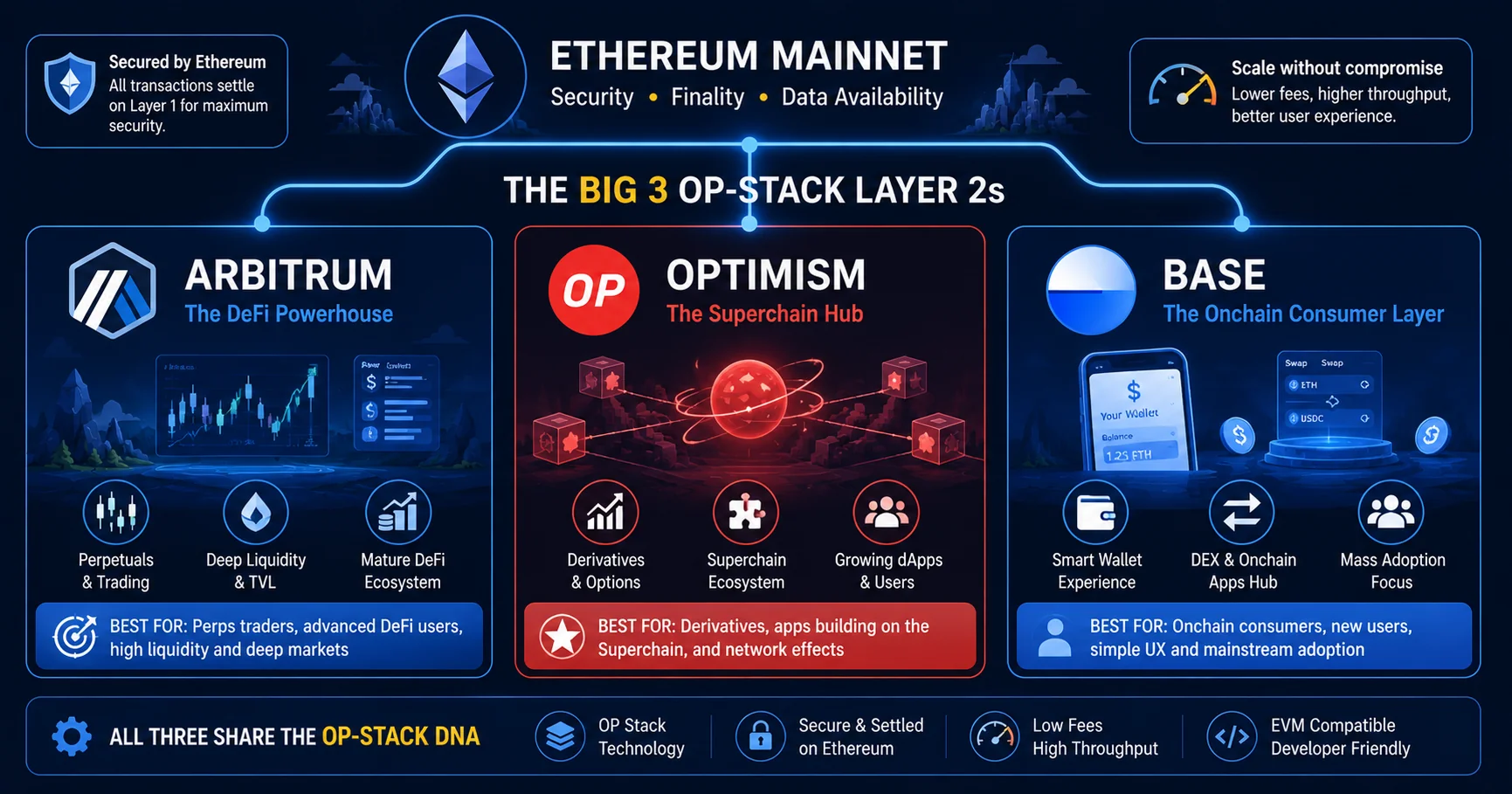
You narrowed your L2 choice to the three commercial optimistic rollups — now you want a clean head-to-head. This compare covers Arbitrum, Optimism and Base across five dimensions: architecture and governance, fees, DeFi ecosystem, security maturity and decision framework. The central comparison matrix at section 8 is the quick-reference summary. For ZK rollup comparison (zkSync Era, Linea, Starknet), see our ZK trio comparison. For the technology-level fraud-proof vs validity-proof distinction, see optimistic vs ZK rollups.
Introduction
Arbitrum, Optimism and Base are the three commercial optimistic rollups that matter in 2026, and Base is now the largest of them. L2BEAT puts Base at roughly $11.6bn of value secured against Arbitrum's $10.2bn, with OP Mainnet a distant third at about $1.4bn. What the three still share is the family resemblance: fraud proofs settled on Ethereum, transaction data posted to Ethereum blobs, a single sequencer at the front. Almost everything below that has diverged. They run three separate codebases, three separate proof systems and three different withdrawal windows, and their median transaction costs are two orders of magnitude apart.
This compare is the canonical head-to-head matrix for the three — for the broader L2 selection framework that includes ZK rollups, see our Ethereum L2 complete guide. For ZK rollup commercial comparison (zkSync Era, Linea, Starknet), see the ZK trio comparison referenced in the lead.
The structure: at-a-glance summary, architecture and governance differences, fee comparison, DeFi ecosystem density per chain, security maturity status, decision framework, and the central matrix at section 8 that lets you scan the comparison at a glance. Figures are as at 12 August 2026 and their sources are listed at the end.
At a Glance
Arbitrum is the second-largest L2 by value secured and the deepest on-chain derivatives venue of the three. GMX V2 holds around 68 per cent of the capital sitting in Arbitrum derivatives protocols. The chain runs Nitro, Offchain Labs' own stack, built around a fork of Geth rather than derived from the OP Stack. Disputes are settled by BoLD, the permissionless fraud-proof system live on mainnet since February 2025. Governance runs through the Arbitrum DAO and the ARB token. Uniswap V3 is the largest DEX by liquidity at roughly half of Arbitrum DEX TVL, and Aave V3 carries about 64 per cent of the chain's lending market. Pick Arbitrum for perps depth, for deep Aave lending, or for governance exposure through ARB.
Optimism is the OP Stack progenitor and, by some distance, the smallest of the three. About $1.4bn secured and roughly 13,000 daily active addresses puts it an order of magnitude below Arbitrum and twenty times below Base. It runs the canonical OP Stack with permissionless fault proofs in production since June 2024. Governance is the dual Token House and Citizens' House structure with the OP token, now paired with a buyback that routes half of net sequencer revenue into monthly OP purchases. Velodrome is the DEX anchor at about 58 per cent of Optimism DEX liquidity; EtherFi's borrowing market holds roughly 72 per cent of the chain's lending TVL, with Aave V3 second at about 19 per cent. Synthetix, for years Optimism's signature protocol, is gone — the deployment was wound down in August 2025.
Base is Coinbase's L2 and now the largest of the three on both value secured and usage — roughly 267,000 daily active addresses against Arbitrum's 116,000. It launched on the OP Stack in 2023, reached L2BEAT Stage 1 in April 2025 through its own governance upgrade, left Superchain governance in March 2026, and is migrating to a stack it operates itself. Its proof system is now Azul, a multiproof combining TEE attestations with SP1 ZK proofs. There is still no Base token, although Coinbase no longer rules one out. Morpho Blue dominates lending at about 86 per cent of chain TVL; Aerodrome, merged with Velodrome into Aero during 2026, handles roughly two-thirds of DEX volume whilst Uniswap holds more of the liquidity. Pick Base for the lowest-friction onboarding through Base Account, for lending at scale, or for Aerodrome emissions.
Architecture and Governance
All three are optimistic rollups. All three post their data to Ethereum blobs and settle fraud proofs on Ethereum L1. That is where the shared description ends. They run three separate codebases, three separate proof systems and three different withdrawal windows: about 6.4 days on Arbitrum, seven on Optimism, five on Base. Describing them as one family with cosmetic differences was defensible in 2024. It stopped being defensible during 2026.
Three stacks, not one codebase
Arbitrum runs Nitro. Offchain Labs built it around a fork of Geth, and the Arbitrum documentation describes that Geth fork as the core of the approach. Nitro was never an OP Stack derivative and shares no upgrade path with it, which is why Arbitrum ships features such as BoLD and Timeboost that have no OP Stack equivalent. Optimism runs the canonical OP Stack maintained by the Optimism Foundation. Base ran that same codebase until February 2026, when it announced a move to a stack it builds and operates itself.
Base is keeping compatibility with the OP Stack specification, so contracts and tooling continue to work, but it now sets its own release cadence — six smaller, tightly scoped hard forks a year, double the schedule it inherited. The governance side followed: L2BEAT records Base leaving the Optimism Superchain on 4 March 2026 with its own upgrade path. The practical effect is that Base no longer inherits anything from Optimism. Where the two once shipped the same upgrades on the same schedule, they now diverge, most visibly in the proof system.
Governance differences
Governance is the largest structural difference between the three. Arbitrum has the Arbitrum DAO governed by ARB holders, a Security Council that can act between governance cycles, and an Arbitrum Foundation that handles day-to-day operations. Optimism splits the job in two: the Token House handles protocol upgrades and parameters, whilst the Citizens' House allocates retroactive public-goods funding. Base has neither, because Base has no token and no DAO.
The OP buyback has concrete terms worth knowing before pricing it into a thesis. Optimism governance approved it in January 2026 with 84.4 per cent support. It commits 50 per cent of net sequencer revenue to monthly OP purchases, executed by the Optimism Foundation and held in the treasury. It is a twelve-month pilot that began in February 2026, not a standing policy, so the natural question to ask in early 2027 is whether it was renewed.
On the Base side, what changed is the forward guidance rather than the present position. Coinbase used to be read as having ruled a token out. It has not. Base creator Jesse Pollak said in September 2025 that the team is exploring a network token, adding in the same breath that the work was early. Nothing has launched since. The honest description is that Base is tokenless today and unresolved for the future, which is a different thing from permanently tokenless — and it means no airdrop has been announced rather than that one has been excluded.
Who orders the transactions
All three still run a single sequencer. If it stops, users fall back on forced inclusion through L1, and L2BEAT records the delay as one day on Arbitrum and twelve hours on OP Mainnet and Base. The roadmaps out of that position have stopped converging. Arbitrum has published a decentralised Timeboost specification with Espresso Systems and targets multi-party sequencing late in 2026. Optimism's interop work runs on a devnet. Base, having left Superchain governance, will not inherit a shared sequencer from anyone.
Base went a different way. Flashblocks, built with Flashbots, has given the chain 200-millisecond preconfirmations on mainnet since July 2025. That is a real improvement to how a transaction feels, and it is worth having. It is not decentralisation. The sequencer is still one party, and a preconfirmation is that party's promise rather than a settled fact. Across all three chains the single sequencer remains the largest residual trust assumption, and it is the dimension most likely to move over the next year or two.
Fees Compared
Fees on all three are now trivial in absolute terms, but they are not equal, and the ranking is not the one most comparisons report. Median transaction cost over the thirty days to 11 August 2026, measured by growthepie: about $0.00001 on Optimism, about $0.0009 on Base and about $0.0036 on Arbitrum. Arbitrum is the dearest of the three. Base is roughly four times cheaper than Arbitrum, and that held on every one of the thirty days sampled. The most recent day in the window was cheaper again on all three and identical in order.
Two upgrades did the work. Dencun moved rollup data into blobs in 2024. Fusaka, activated in December 2025, raised blob capacity well past the six-blob target Dencun set, loosening the constraint that used to push rollup fees up whenever several chains competed for the same block. Data is no longer the binding cost on any of these three chains, which is why the absolute numbers now have four zeros after the decimal point.
The ordering between the three tracks demand as much as design. Optimism has the lowest median cost and also the least traffic by a wide margin — about 13,000 daily active addresses against Base's 267,000. Reading the cheapest chain as the best-engineered one gets the causation backwards. A quiet chain is cheap partly because it is quiet.
At these levels a fee-driven chain choice does not survive arithmetic. A thousand transactions in a year, far more than most people make, costs under four dollars on Arbitrum and under a dollar on Base. What actually costs money is getting on and off: the exchange withdrawal fee, a third-party bridge fee, or the L1 gas to exit through the canonical bridge. Optimise the entry and exit route and ignore the per-swap cost.
For live figures rather than a snapshot, growthepie publishes daily median transaction costs per chain, and L2BEAT's costs page breaks the same numbers into their data and execution components. One aggregator to avoid is l2fees.info: it no longer lists Base at all, still carries rows for chains that have shut down, and its Arbitrum figure runs about thirty-five times the live median. For the component-by-component decomposition — what calldata, blobs and execution each contribute — see our L2 fees and bridging satellite.
Transaction ordering and MEV
One cost dimension does differ structurally, and it is not in the fee. All three sequencers decide the order of transactions inside a block, which is where sandwich attacks and front-running live. Arbitrum has shipped a production mechanism against it. Timeboost has run on Arbitrum One and Arbitrum Nova since April 2025: a sealed-bid, second-price auction over 60-second rounds that sells an express lane instead of leaving ordering to a first-come race. Offchain Labs positions it as protection against harmful MEV, including sandwich attacks and front-running.
Treat that for what it is. Timeboost is an ordering policy chosen by a centralised sequencer, not a trustless guarantee, and the same is true of any policy the other two adopt. For routine retail swaps the practical MEV cost on all three is negligible. For frequent trading, or for trades on shallow pairs, it can add a few basis points of effective slippage on top of the visible fee, and that compounds faster than the fee does. The protocol-level defences worth looking for are the same on every chain: private orderflow routing, batch-auction execution, and oracle-protected swaps. Check which of them the venue you actually trade on has implemented, rather than which chain it sits on.
DeFi Ecosystem
The three chains no longer host the same DeFi, and the differences are larger than the chain-level headlines suggest. Arbitrum is the derivatives venue. Optimism is small and concentrated. Base has the most capital and the most users, with a lending market dominated by one protocol to an unusual degree. The figures below are DefiLlama TVL and 24-hour volume read on 12 August 2026.
Arbitrum — derivatives and lending depth
Arbitrum's DeFi is anchored by GMX V2, which holds about 68 per cent of the capital in the chain's derivatives protocols and remains the deepest on-chain perps venue of the three. Lending is Aave V3 at roughly 64 per cent of Arbitrum lending TVL, with deep books in ETH, USDC, USDT and WBTC. Spot liquidity is Uniswap V3 at about 52 per cent of DEX TVL and 57 per cent of volume.
Camelot V3 is often described as Arbitrum's native flagship. It is not one. Camelot holds about 5 per cent of the chain's DEX liquidity and under 2 per cent of its volume, which makes it a useful venue for long-tail Arbitrum launches and nothing larger. If a guide tells you to pick Arbitrum for Camelot, it is describing 2023.
Optimism — small and concentrated
Optimism's DeFi is the smallest of the three and the most concentrated within itself. Velodrome, the ve(3,3) DEX built for the chain, holds about 58 per cent of Optimism DEX liquidity and a similar share of its volume. Lending is not Aave-led here: EtherFi's borrowing market holds roughly 72 per cent of Optimism lending TVL, with Aave V3 second at about 19 per cent. Uniswap is deployed and works, but it is not the centre of gravity here that it is on Arbitrum.
One correction belongs in the open, because the claim outlived the fact by a year. Synthetix was Optimism's signature protocol and is no longer on the chain at all. In August 2025 the team announced it was done with L2s: perps went close-only on 18 August, open positions were force-closed on 25 August, and the remaining Optimism functionality was deprecated on 31 August. Swapping Synths on Optimism ended on 31 January 2026. Synthetix V4 is an Ethereum mainnet deployment, and the debt-pool design that made the protocol distinctive was removed in V3. If you came here planning to bridge funds to Optimism for Synthetix, there is nothing left to bridge to.
Base — largest and heavily concentrated
Base holds the most DeFi capital and the most users of the three. Its lending market is roughly $3.8bn, and Morpho Blue accounts for about 86 per cent of that, with Aave V3 second at about 11 per cent. DEX liquidity splits the other way from the usual telling: Uniswap holds around 54 per cent of Base DEX TVL against Aerodrome's 37 per cent, whilst Aerodrome takes about 66 per cent of the daily volume.
Dromos Labs, which built both, has announced that Aerodrome (Base) and Velodrome (Optimism) will combine into one cross-chain ve(3,3) DEX called Aero under a single AERO token, with 94.5 per cent of the new supply going to AERO and veAERO holders and 5.5 per cent to VELO and veVELO holders. The merge has not completed. Checked on 8 September 2026, Aero's own site still says it will launch, and Aerodrome and Velodrome still run as separate protocols with separate TVL and separate tokens. That announced merger is also where a common error comes from. The frequently repeated claim that Aerodrome holds roughly 70 per cent of Base DEX liquidity is a volume figure wearing a liquidity label. It is true of trading volume and false of deposits, and the distinction matters if you are sizing a position against available depth rather than against activity.
One practical note on funding any of the three. Buying on an exchange and withdrawing straight onto the L2 avoids paying Ethereum mainnet gas to cross the canonical bridge, which is usually the largest single cost of getting started. Which L2 networks an exchange offers varies by exchange and by the jurisdiction your account sits in, and the list changes, so check the network selector on the withdrawal screen before you send — a withdrawal on the wrong network is at best a support ticket. Our reviews of Binance, OKX and Kraken cover the account-level details.
This compare covers the commercial overview of DeFi distribution; for the full per-L2 protocol detail (which specific protocols, what they do, where to deploy what kind of capital), see our Best L2s for DeFi 2026 satellite.
Concentration is the real risk
The headline numbers hide a pattern worth naming. In each chain's largest vertical, a single protocol holds most of the capital. Morpho Blue has about 86 per cent of Base lending. EtherFi has about 72 per cent of Optimism lending. GMX V2 has about 68 per cent of Arbitrum derivatives. Choosing a chain for a strategy is nearly always choosing a protocol, and the diversification you assume you get from picking the bigger chain is mostly not there. If Morpho had a bad day, most of Base's lending capital would be having it too.
That cuts against the instinct to treat chain selection as the risk decision. It mostly is not. The contract risk you carry is the risk of the specific protocol you deposit into, and it is largely independent of which of the three you sit on. Aave V3 is the deployed Aave version on all three; Aave V4 exists but runs on Ethereum and Avalanche rather than on any of these chains. Reading your protocol's audits and risk parameters is worth more than reading your chain's L2BEAT stage.
Security Maturity
All three sit at L2BEAT Stage 1: fault proofs live in production, a Security Council with documented powers, state validity checked on Ethereum L1. The stage label is where the similarity ends. The three run different proof systems with different challenge windows, and their 2026 operational records are not comparable to each other.
How each chain reached Stage 1
Arbitrum deployed BoLD, its permissionless fraud-proof system, on 15 February 2025. Optimism turned on permissionless fault proofs in June 2024. Base reached Stage 1 on 29 April 2025 — not by inheritance, but through its own Security Council and governance upgrade — and then replaced its proof system outright with the Azul multiproof in May 2026. On all three chains the proposer role is permissionless: anyone can propose a state root.
Three proof systems, not two
BoLD, on Arbitrum, resolves disputes all-versus-all rather than as a one-against-one duel. Challenges between the honest party and any number of adversaries proceed in parallel, which is what makes the design resistant to a crowd of griefers trying to delay finality. Bonds are denominated in ETH, specifically WETH, and the Arbitrum documentation is explicit that ETH was chosen over ARB for the purpose. The bonds are large: 3,600 ETH to make an assertion, 1,110 ETH to challenge one.
Optimism uses interactive fault proofs. The disputed state transition is bisected until a single step remains, and that step is re-executed on L1 inside a MIPS64 emulator. The dispute game runs 3 days 12 hours for the challenge phase and the same again for execution, which is where the seven-day withdrawal window comes from.
Base no longer uses that design at all. Azul, live since May 2026, is a multiproof: a TEE attestation and an SP1 ZK proof, each an independent arm. The challenge protocol is single-step rather than interactive, the bond is 0.05 ETH rather than thousands, and a game backed by one proof resolves in five days. When both arms commit and agree, the window collapses to about a day. Base cut the optimistic path from seven days to five in the Beryll upgrade of 25 June 2026.
Withdrawal windows now differ
The canonical withdrawal window is not seven days on all three, and has not been for some time. Arbitrum's own documentation puts a canonical withdrawal at typically 6.4 days, which matches L2BEAT's 6-day-8-hour challenge period; L2BEAT records a further two-day execution delay on top, and the BoLD documentation describes a two-day grace period for the Security Council. Budget for more than 6.4 days, not less. OP Mainnet is seven days. Base is five, or roughly one when both of Azul's proof arms agree.
None of this applies to a withdrawal routed through a third-party bridge, which pays out in minutes by fronting the capital on the other side. The canonical window is what you wait through when the bridge is unavailable, when the amount is large enough that the bridge's liquidity is the binding constraint, or when you would rather not add a bridge's contract risk to the trade. It is worth knowing the number before you need it.
Operational events in 2026
Base has had the roughest year of the three, on its own reporting. Its status page records a critical incident on 25 June 2026: an invalid block was sequenced, block production stopped after block 47806542, and nodes had to be restarted to resume syncing. The chain halted twice across two days. Between 29 and 31 May, withdrawals were delayed by a TEE enclave issue that halted proposals — the same trusted-execution component that forms one arm of the Azul proof. A further major incident on 28 July delayed the safe head, alongside five minor incidents through the year.
Arbitrum's status page shows no chain-level incidents for 2026. It records two Arbiscan outages in July, which affect the block explorer rather than the chain itself, and which are worth distinguishing: an explorer going dark is inconvenient, not a halt. Optimism's status page reports every component operational with no incidents logged for 2026 at all. On uptime, the ranking runs Optimism, then Arbitrum, then Base — which is close to the inverse of the ranking on size.
What the Security Council can do
Stage 1 does not mean nobody can move quickly. L2BEAT records Arbitrum's exit window as none, meaning users have no guaranteed period in which to withdraw before an upgrade takes effect. April 2026 showed what that means in practice. A third-party bridge, KelpDAO, was exploited on 18 April. On 21 April the Arbitrum Security Council executed an emergency action to freeze roughly 30,765 ETH held by the exploiter on Arbitrum One, by upgrading the Inbox contract so it could impersonate an address and then reverting the change. The forum post describing it is public and precise about the mechanism.
That was not an Arbitrum protocol failure. The vulnerability was in a third party's bridge, and the outcome was funds frozen rather than lost. It is still worth reading as a capability rather than as a one-off. A small council can change the rules of a Stage 1 chain within days when it decides to, and in April it did. Whether that reads as reassuring or alarming depends on what you were relying on, but either way it is the correct description of the trust model, and it applies to all three chains in some form.
Practical security ranking
For the purpose of deciding where to deploy capital, the three are close enough that security should not be the deciding factor. The gaps that do exist run against the popular ranking. Base has the shortest withdrawal window and the worst 2026 uptime record. Optimism has the cleanest record and the least activity. Arbitrum sits between them with the largest bonds and the most conservative dispute design. None of those gaps is wide enough to override a protocol-availability reason to be somewhere specific.
A realistic monitoring routine costs about twenty minutes a quarter. Check L2BEAT once a quarter for stage changes, risk-row changes and proof-system upgrades — Base replaced its proof system in May 2026 and shortened its withdrawal window a month later, so this is not a formality. Bookmark status.arbitrum.io, status.optimism.io and status.base.org, and check the relevant one before any time-sensitive operation. Watch the sequencer roadmaps too, because a single sequencer remains the largest residual gap on all three. For the deeper treatment of stages, sequencer trust and what an incident record does and does not tell you, see our L2 security tradeoffs satellite.
When to Pick Which
The decision reduces to protocol availability, the cost of entry and exit, and how much you care about governance exposure. The chains themselves are close. The protocols on them are not.
- Pick Arbitrum if perps are your primary strategy, because GMX V2's depth is the one genuinely structural advantage in this comparison; or if you want the deepest Aave V3 market of the three; or for ARB governance exposure. You accept the highest median transaction cost of the three, which at roughly $0.0036 is not a real constraint.
- Pick Optimism if you want Velodrome's ve(3,3) mechanics, EtherFi's borrowing market, or OP governance exposure including the buyback pilot. Understand what you are joining: around 13,000 daily active addresses and roughly $1.4bn secured, an order of magnitude below the other two. A quiet chain has thinner liquidity and fewer eyes on it.
- Pick Base if you want the largest lending market of the three through Morpho, Aerodrome emissions, or the lowest-friction fiat path through Coinbase and Base Account. You accept a chain that halted twice in June 2026, delayed withdrawals in May, and runs a proof system less than three months old.
- Split across two only when a specific protocol requires it. Bridging cost and operational overhead are real, and diversifying across two optimistic rollups that both settle on Ethereum is not the risk reduction it appears to be.
One misuse is worth flagging because it was true for years and then stopped being true. Optimism is no longer the place to go for synthetic assets or Synthetix-style derivatives. Guides written before mid-2025 still send readers there, and plenty of them still rank. If a strategy you have read about depends on Synths, sUSD or the Synthetix debt pool on Optimism, check the protocol's own announcements before you bridge anything — the deployment was wound down in August 2025 and Synth swaps ended in January 2026.
A sizing rule that still holds. At $1,000 to $10,000 of DeFi capital, pick the chain that hosts your primary strategy and stay on it; operational simplicity is worth more than spreading capital thin. Between $10,000 and $50,000 the same answer usually applies, unless a second protocol you genuinely want is unavailable on the first chain. Above $50,000 the fixed cost of running a second chain stops mattering relative to the position size, and concentration in a single protocol — rather than in a single chain — becomes the thing to manage.
A worked example, to make the trade-off concrete. Suppose you have $25,000 and you want two things: leveraged ETH exposure through perps, and a stablecoin lending position at scale. The perps side belongs on Arbitrum, where GMX V2 holds around 68 per cent of the chain's derivatives capital and is the deepest on-chain perps venue of the three. The lending side belongs on Base, where Morpho Blue's roughly $3.3bn is the largest single lending market on any of the three chains by a wide margin; Aave V3 on Arbitrum, the next largest, holds about $415m.
So you split: say $15,000 to Arbitrum and $10,000 to Base. Withdraw from an exchange directly onto each chain and you skip Ethereum mainnet gas entirely, so the cost to compare is the exchange's withdrawal fee rather than any L2 gas figure. Running the positions costs close to nothing: at Arbitrum's $0.0036 median and Base's $0.0009, a few hundred transactions across the year comes to under two dollars in total. The number that deserves planning is the exit. Leaving Base through the canonical bridge takes five days; leaving Arbitrum takes about 6.4 days plus L2BEAT's two-day execution delay. That is the one cost in this example you cannot pay your way out of, so decide before you enter whether you can live with it.
The flip side: if both halves of your strategy are available on one chain, do not split. The example above is justified by protocol availability and by nothing else. Bridging for the sake of diversification adds cost and two sets of operational surface for a benefit that does not survive inspection.
Comparison Matrix
The scan-friendly summary across the dimensions covered above. Use this as a quick-reference; for the reasoning behind any specific row, see the corresponding section above. Figures are as at 12 August 2026.
| Dimension | Arbitrum | Optimism | Base |
|---|---|---|---|
| Rollup type | Optimistic | Optimistic | Optimistic |
| L2BEAT stage | Stage 1 (BoLD, Feb 2025) | Stage 1 (fault proofs, Jun 2024) | Stage 1 (Apr 2025, own upgrade) |
| Codebase | Nitro (Offchain Labs) | OP Stack (canonical) | Base stack (OP Stack-compatible) |
| Proof system | BoLD, all-versus-all, WETH bonds | Interactive fault proofs, MIPS64 | Azul multiproof (TEE plus SP1 ZK) |
| Native token | ARB (governance) | OP (governance plus buyback pilot) | None so far |
| Value secured (L2BEAT) | Around $10.2bn, second | Around $1.4bn | Around $11.6bn, first |
| Daily active addresses | Around 116,000 | Around 13,000 | Around 267,000 |
| Median transaction cost | About $0.0036 | About $0.00001 | About $0.0009 |
| Canonical withdrawal | About 6.4 days plus execution delay | 7 days | 5 days, about 1 if both arms agree |
| Top DeFi anchors | GMX V2, Uniswap V3, Aave V3 | Velodrome, EtherFi, Aave V3 | Morpho Blue, Uniswap, Aerodrome |
| Recent operational events | No chain-level incidents; two Arbiscan outages in July | No incidents reported in 2026 | Critical chain stall June 2026; withdrawal delay May 2026 |
| Sequencer roadmap | Decentralised Timeboost with Espresso; multi-party targeted late 2026 | Superchain interop on devnet | Own roadmap since leaving the Superchain; Flashblocks live |
| Best for | Perps depth, deep Aave lending | Velodrome mechanics, OP governance | Onboarding, lending scale, DEX volume |
Conclusion
The three chains stopped being interchangeable somewhere in 2025. Base is now the largest by value secured and by users, runs its own stack and its own proof system, and carries both the shortest withdrawal window and the roughest 2026 uptime record. Arbitrum is the derivatives chain, with the largest bonds behind its fraud proofs and the highest median fee of the three — still under half a cent. Optimism is the OP Stack's home and the smallest of the three by a wide margin, with the cleanest operational record and the least traffic.
If you are undecided, decide on the protocol rather than the chain. Perps point to Arbitrum. Lending at scale points to Morpho on Base. Velodrome mechanics or OP governance point to Optimism. Nothing about the chains themselves should override that, because the differences between them on fee, stage label and marketing are small, whilst the differences between the protocols they host are not.
Two things are worth rechecking rather than assuming, since both changed inside the last eighteen months: which proof system your chain runs, and whether the protocol you are targeting is still deployed there. For the parallel ZK rollup commercial comparison, the broader L2 selection framework covering both rollup families, and per-L2 DeFi protocol detail beyond the commercial overview here, see the Related Resources section below.
Sources
- L2BEAT — scaling summary: primary reference for value secured, Stage 1 classifications, proof systems, challenge periods and the per-chain milestone log used throughout this comparison.
- L2BEAT — scaling costs: per-chain transaction costs split into their data and execution components; the live replacement for the abandoned l2fees.info aggregator.
- DefiLlama — L2 chains: DeFi TVL by chain and by protocol, the source for the lending, DEX and derivatives shares quoted per chain.
- Optimism — OP Stack introduction: official documentation for the canonical OP Stack, its fault-proof design and the seven-day withdrawal challenge period.
- Arbitrum — introduction: official documentation for Nitro, the BoLD fraud-proof system and bond currency, Timeboost, and the 6.4-day canonical withdrawal.
- Base — status page: Base's own incident record, the source for the June 2026 chain stall and the May 2026 withdrawal delay described above.
Frequently Asked Questions
- Are Arbitrum, Optimism and Base equally secure?
- All three sit at L2BEAT Stage 1, but that label now covers three different designs. Arbitrum runs BoLD, an all-versus-all fraud-proof system with bonds denominated in ETH — 3,600 ETH to make an assertion. Optimism runs interactive fault proofs, resolved in a MIPS64 emulator on L1. Base replaced its proof system in May 2026 with Azul, a multiproof that combines a TEE attestation with an SP1 ZK proof. The withdrawal windows differ too: about 6.4 days on Arbitrum, seven on Optimism, five on Base. On operations, 2026 favoured Optimism, whose status page reports no incidents; Base had a critical chain stall in June and a withdrawal delay in May. Treat all three as one broad tier and pick on use case rather than on a security ranking.
- Which has cheapest fees — Arbitrum, Optimism or Base?
- Optimism, by a wide margin, then Base, then Arbitrum. Median transaction cost over the thirty days to 11 August 2026 was roughly $0.00001 on Optimism, $0.0009 on Base and $0.0036 on Arbitrum, and that ordering held on every day sampled. Base is around four times cheaper than Arbitrum. Optimism is cheaper than both by two orders of magnitude, and also carries far less traffic than either. At these levels the per-transaction fee is not a real input to the decision — a thousand transactions a year costs under four dollars on the dearest of the three. The costs that matter are the exchange or bridge fee to get onto the chain and the L1 gas to exit through the canonical bridge.
- Which of Arbitrum, Optimism and Base is the biggest?
- Base, on both measures. L2BEAT puts Base at roughly $11.6bn of value secured against Arbitrum's $10.2bn, with OP Mainnet third at about $1.4bn. DefiLlama counts only DeFi deposits so its absolute figures are much smaller, but it agrees on the order. On usage the gap is wider: about 267,000 daily active addresses on Base against 116,000 on Arbitrum and 13,000 on Optimism. Base overtook Arbitrum across 2025 and 2026. Size is not the same as depth for a given strategy — Arbitrum is still the deepest on-chain perps venue of the three, whilst Base holds the largest lending market.
- Why does Base not have its own token?
- Base launched without one in 2023 and still has none. Fees are paid in ETH, there is no token-based DAO, and Coinbase makes upgrade decisions through internal product processes. What has changed is the forward guidance. Base creator Jesse Pollak said in September 2025 that the team is exploring a network token, adding that the work was early. Nothing has launched since, so the accurate reading is that Base is tokenless today rather than committed to staying tokenless — and no airdrop has been announced. If you specifically want governance exposure on an optimistic rollup, ARB and OP are the options.
- Where does Polygon zkEVM fit in this comparison?
- It does not, on two counts. Polygon zkEVM was a ZK rollup rather than an optimistic one, so it sat outside this comparison by design. It was also shut down on 1 July 2026, when Polygon Labs sunset the mainnet beta sequencer and told users to claim their funds. Polygon's focus moved to the AggLayer and to the Polygon PoS chain. We do not include Polygon zkEVM in any current comparison or recommendation. For the ZK rollup comparison covering zkSync Era, Linea and Starknet, see our ZK trio compare guide.
Financial Disclaimer
This content is not financial advice. All information provided is for educational purposes only. Cryptocurrency investments carry significant investment risk, and past performance does not guarantee future results. Always do your own research and consult a qualified financial advisor before making investment decisions.