L2 Fees and Bridging Guide 2026
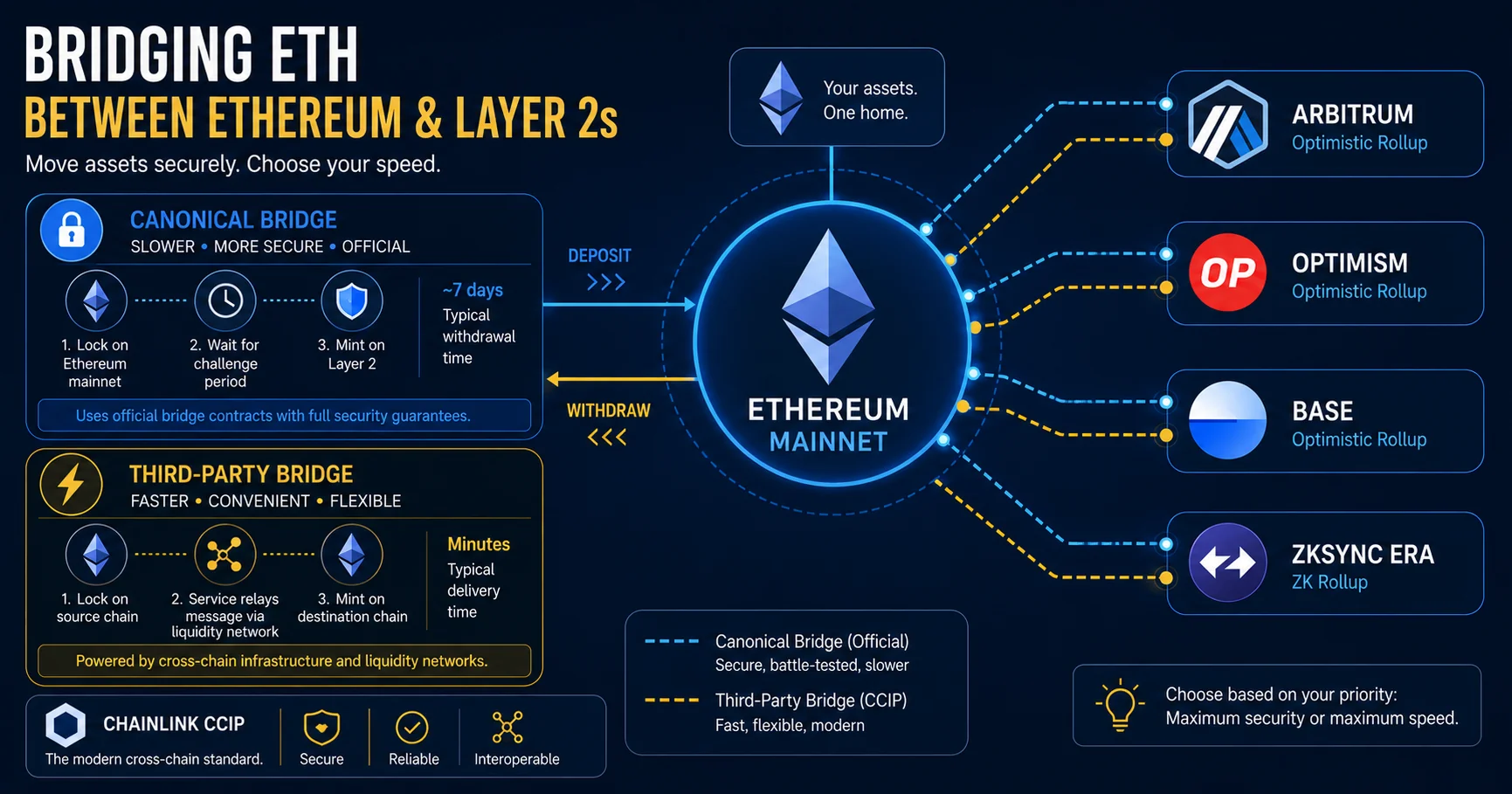
You bridged ETH to Arbitrum once, paid a fee that surprised you, and never quite worked out why. Now you want to move USDC back to Ethereum mainnet — and your wallet says it will take seven days. This guide decomposes what an L2 transaction fee is actually made of, explains the trade-off between canonical and third-party bridges (with Chainlink CCIP framed as the modern default for cross-chain messaging), walks through the seven-day withdrawal mechanism honestly, names the bridging risks worth treating seriously after the April 2026 KelpDAO incident, and finishes with a step-by-step first-bridge checklist.
Introduction
What this guide covers:
- How L2 transaction fees decompose into L1 data, L2 execution and congestion components after EIP-4844
- Canonical bridge versus third-party bridge tradeoffs, with Chainlink CCIP as the 2026 default for cross-chain messaging
- The seven-day optimistic-rollup withdrawal mechanism explained honestly — why it exists, when it bites you, what fast-bridge alternatives cost
- Bridging risks made concrete by the April 2026 KelpDAO LayerZero incident
- A step-by-step first-bridge checklist with explicit safety steps for moving meaningful capital
Layer 2 networks promised cheap and fast Ethereum transactions, and by 2026 they deliver exactly that for the operations you use most often — swaps, transfers, lending interactions and NFT mints all clear for a fraction of a cent on the major chains. The promise is real. The mechanism behind it is not transparent to most users, which produces a recurring complaint: a fee you expected to land sub-cent comes back as fifteen cents, an exit you thought was instant turns out to take a week, a bridge that worked for you last month does not work today. Why?
The fees and bridging story breaks down into four moving parts. First, what an L2 fee is actually composed of (calldata, execution, congestion) and why those components fluctuate independently. Second, the canonical-versus-third-party bridge choice — every L2 ships a canonical bridge run by the chain's own security mechanism, and dozens of third-party bridges offer different speed and cost trade-offs. Third, the withdrawal mechanism — the seven-day wait on optimistic rollups is a real architectural property, not a configuration choice, and the fast-bridge market exists precisely to let users opt out of the wait for a fee. Fourth, the risk picture — bridges have been the largest exploit category in DeFi history, and the April 2026 KelpDAO incident is the most recent textbook case worth understanding.
Throughout this guide, Chainlink CCIP is treated as the modern default for cross-chain messaging in 2026. The framing matters because cross-chain messaging is the layer underneath most third-party bridges, and the messaging-layer choice is what defines the security model. A threshold of CCIP's sixteen independent node operators must sign a cross-chain message before it executes — a configuration meaningfully harder to forge than the single-attestor (1/1 DVN) defaults that dominated cross-chain messaging through 2024. LayerZero, the predecessor protocol, appears in this guide twice: once with cautionary context, and once in a brief incident summary that links to the full case study in our liquid staking risks satellite. The full account of what changed in cross-chain messaging defaults after April 2026 — including how a forged cross-chain message drained $292 million from KelpDAO's bridge in under forty-six minutes — lives in the cross-chain bridge risks case study.
By the end of this guide you can predict an approximate L2 fee before signing a transaction, decide between a canonical and third-party bridge based on the value at stake and the time you can wait, and walk through your first bridge from an exchange to an L2 without making any of the common mistakes. For the broader L2 selection framework — which chain you should use for which application — see our Ethereum L2 complete guide.
L2 Fees Decomposed
Every L2 transaction fee is the sum of three components that move independently. Understanding the three components in isolation makes fee fluctuations far easier to predict — and makes the EIP-4844 fee reduction (the major step-change in L2 economics in 2024) intuitive rather than mysterious.
What you actually pay on an L2
The three components are L1 calldata cost, L2 execution cost and congestion premium. L1 calldata cost is what the L2 pays Ethereum mainnet to record the batch of L2 transactions. After EIP-4844, this is paid as blob data with its own fee market, much cheaper than ordinary calldata. L2 execution cost is what the L2 charges to run the transaction through its own virtual machine — sequencer fees, in practice. Congestion premium is the variable component that rises during high-demand periods on the L2 itself; when many users compete for sequencer block space, the priority fee climbs.
For a typical swap on a major L2, the L1 calldata component (post-blob) is now small enough that it is rarely the dominant cost. L2 execution dominates in normal conditions. Congestion premium dominates during airdrop claim windows, popular mint events, or any short period where everyone wants to transact at once. If you can defer a non-urgent operation by a few hours, you should — congestion windows are usually short, and waiting through one can cut your fee by a factor of five to ten.
Why fees fluctuate
Two underlying drivers explain almost every fee swing. ETH gas price drives the L1 calldata or blob cost — when general Ethereum activity surges, blob fees can climb (though far less aggressively than calldata fees did pre-EIP-4844). L2 congestion drives the execution-plus-priority cost — when the L2 itself is under heavy demand, sequencer-side fees rise even if Ethereum mainnet is quiet.
The two drivers are largely uncorrelated. Mainnet can be quiet while an L2 is congested (an Arbitrum airdrop claim window, for example), and mainnet can be busy while a specific L2 sees normal activity. This is why the same swap on the same chain can cost two cents on a Tuesday morning and twenty cents on a Saturday night — the chain has not changed, but the demand profile has.
EIP-4844 and the blob revolution
EIP-4844, also known as proto-danksharding, deployed on Ethereum mainnet in March 2024. It introduced a new transaction type: the blob-carrying transaction. Before EIP-4844, every L2 posted its compressed state-update data to Ethereum as ordinary calldata, paying the prevailing L1 gas price. Calldata is part of regular Ethereum transactions and competes for the same block space as everything else, so during high mainnet demand L2 calldata cost spiked alongside.
After EIP-4844, L2s post the same data as ephemeral blob data — a new storage class with its own fee market separate from regular L1 gas. Blobs are dropped from L1 storage after roughly eighteen days (long enough for any fraud-proof window to complete, short enough to keep node storage manageable). Blob storage costs roughly ten to one hundred times less per byte than calldata, and because the blob fee market is separate, L2 calldata posting no longer spikes when general L1 demand is high.
The fee reduction flowed directly to end users. Most L2 swaps that cost twenty to fifty cents in 2023 now cost a fraction of a cent on the major chains during normal conditions. EIP-4844 is the single largest reason L2s feel meaningfully cheaper in 2026 than they did in 2023.
Per-L2 fee ranges (qualitative)
Specific fee figures rot quickly because they depend on ETH gas price and L2 congestion at the moment of writing. The qualitative ordering is more durable. Arbitrum, Optimism and Base — the three major optimistic rollups (Optimism and Base run the OP Stack; Arbitrum runs Offchain Labs' own Nitro stack) — all sit in the sub-cent to a few cents range per swap during normal conditions, with congestion premiums occasionally pushing into the tens of cents during high-demand events. zkSync Era, Linea and Starknet, the three major ZK rollups, sit in a similar range post-EIP-4844; the ZK proving cost adds a small constant but does not dominate the fee you actually pay.
For real-time figures, the most reliable trackers are growthepie (fees.growthepie.com) and L2BEAT's cost pages — both actively maintained aggregators of per-L2 average swap and transfer costs. You should bookmark one and check it before any large operation. (Give the older l2fees.info aggregator a miss: it is no longer maintained and still shows pre-blob pricing.) That single habit avoids the "I expected sub-cent and paid fifty cents" surprise that catches new L2 users most often.
MEV and hidden costs
Beyond the visible fee, there is one less-visible cost worth naming: MEV extraction by the sequencer. The sequencer for each major L2 currently has the ability to reorder transactions within a batch — and when it does, the price you receive on a swap can shift slightly compared to the fair-market price. This is not a fee in the traditional sense; it shows up as a worse-than-expected execution price rather than a deducted amount. For routine swaps under a few thousand dollars the impact is typically negligible — you should not lose sleep over it. For larger operations or trades on shallow-liquidity pairs, MEV can be a meaningful hidden cost worth modelling explicitly.
The deeper sequencer-trust discussion — how much MEV is extracted, who keeps it, and what decentralised-sequencer roadmaps would change about the picture — lives in our L2 security tradeoffs satellite.
Worked example: anatomy of a swap on Arbitrum
Imagine a routine ETH-to-USDC swap of $500 on Arbitrum during normal conditions. As of mid-2026 the total fee comes back at roughly one to five cents. The breakdown is approximately: a fraction of a cent of L1 blob cost (the share of the batch this transaction occupies, post-EIP-4844), the bulk of the remainder as L2 execution cost (the sequencer fee), and a small congestion premium if the swap landed during a moderately busy period. The slippage on the swap itself sits at a few basis points of MEV-related execution slip, which appears as a worse-than-spot fill rather than as part of the gas fee. Check a live tracker such as growthepie for the current figure before any large operation.
The same swap during a quiet Tuesday morning might land near a single cent with negligible congestion premium. The same swap during an Arbitrum airdrop claim window might climb towards ten or twenty cents with the congestion premium becoming the dominant component. The base architecture is the same; the demand profile can shift the visible fee by an order of magnitude between the quietest and busiest hours.
Canonical vs Third-Party Bridges
Every L2 ships its own canonical bridge — operated by the chain itself, secured by the chain's own security mechanism. Third-party bridges sit on top of cross-chain messaging protocols and offer different speed-cost trade-offs. The choice between the two depends on the value at stake, the time you can wait, and the security model you find acceptable. This section is the canonical home for the bridge-type comparison; the rest of the cluster links here rather than repeating the framework.
Canonical bridges
A canonical bridge is the official lock-and-mint contract pair operated by the L2 itself. Arbitrum has the Arbitrum bridge. Optimism's canonical bridge is now reached through the Superchain Bridges interface. Base runs the standard OP-stack canonical bridge (forked from Optimism's) but has retired its own bridge.base.org front-end, so you reach the canonical contracts through aggregator interfaces such as Superbridge or Brid.gg. zkSync Era has the zkSync Era bridge. The pattern is identical across chains: you deposit ETH or an ERC-20 to the L1 bridge contract, which locks the asset and emits a deposit message; the L2 bridge contract reads the message and mints the equivalent for you on L2.
The trust model is minimal because the canonical bridge is secured by the L2's own security mechanism — the same fraud or validity proofs that secure the chain. There is no separate validator set to compromise, no extra messaging layer to exploit. The classic 2022 and 2023 bridge exploits all targeted third-party bridges with separate validator sets. Canonical bridges drop that validator set but rest on the chain's own proof system, and that has failed: two deprecated Aztec rollup contracts lost about $4.5m between them in June 2026.
The time trade-off is asymmetric. Deposits from L1 to L2 land in minutes. Withdrawals from L2 back to L1 are governed by the chain's withdrawal mechanism — seven days for optimistic rollups (Arbitrum, Optimism, Base) because of the fraud-proof challenge window, hours for ZK rollups (zkSync Era, Linea, Starknet) because the validity proof is verified on L1 in roughly an hour. The fee trade-off is small: you pay normal L1 gas to interact with the L1 bridge contract plus a token of L2 gas, with no protocol fee on top.
Pick the canonical bridge when the value at stake is high, when you can wait seven days for an OP withdrawal, or when you want the cleanest possible security model. Pick something else when speed matters more than security or when the target chain is one your exchange does not natively support.
Third-party bridges with CCIP-first framing
Third-party bridges are everything that is not the canonical bridge. They sit on top of cross-chain messaging protocols and abstract away the canonical-bridge wait. When you reach for a third-party bridge in 2026, you are most likely using one of half a dozen well-known options: Across, Hop, Stargate, Wormhole, Axelar, or a CCIP-routed alternative.
Chainlink CCIP is the modern default for cross-chain messaging in 2026. CCIP — Cross-Chain Interoperability Protocol — is secured by sixteen independent node operators, and a threshold of them must sign a cross-chain message before it executes on the destination chain. The configuration is meaningfully harder to forge than single-attestor cross-chain messaging defaults because forging a message means compromising enough independently operated nodes to meet that threshold. Adoption accelerated through 2025 and especially after the April 2026 KelpDAO incident. Solv Protocol migrated its $700 million-plus tokenised Bitcoin infrastructure to CCIP. Kelp DAO migrated its rsETH cross-chain bridge to CCIP. By mid-2026 CCIP is the messaging layer underneath an increasing share of new third-party bridges.
Across uses an intent-based architecture — a relayer market fronts the liquidity for fast OP withdrawals and is reimbursed from the canonical bridge after the seven-day window. Users get instant exits in exchange for a fee — on a typical mid-2026 exit Across quotes around 0.03 per cent, with the broader fast-bridge range running roughly 0.01 to 0.1 per cent depending on route. Across has been one of the most reliable fast-bridge services since 2023.
Hop uses an AMM-based fast-bridging design — liquidity providers pool funds on each supported L2 and earn fees from cross-chain swaps. The user-facing experience is a fast bridge with a fee similar to Across. Hop covers most major L2s and a couple of sidechains.
Stargate is the higher-volume sibling — built on a unified-liquidity model and tightly tied to LayerZero. In August 2025 the Stargate DAO voted to accept a LayerZero Foundation acquisition, and Stargate v2 now runs on LayerZero V2 messaging rather than moving away from it. Because LayerZero is the messaging layer underneath, verify the DVN configuration before bridging large amounts — the messaging layer is what defines the security model (see the LayerZero note below).
Wormhole is the long-running cross-chain messaging system that has been hardened substantially since the 2022 exploit. By 2026 CCIP has overtaken Wormhole on raw chain count (fifty-plus mainnet chains versus Wormhole's roughly thirty-five to forty), but Wormhole remains strong on non-EVM ecosystems and is acceptable where that breadth matters more than the absolute newest security primitives.
Axelar uses a validator-secured messaging model with broad chain coverage including non-EVM destinations. Axelar is the practical answer for cross-chain operations involving Cosmos-ecosystem chains alongside EVM L2s.
For a third-party bridge in 2026, you should default to a CCIP-routed option for new integrations and treat any bridge whose underlying messaging layer is unclear as needing a closer look before you trust it with a meaningful balance. The chain coverage and fee structure are visible to you — the messaging-layer security is not.
LayerZero — predecessor framing
LayerZero is an earlier-generation cross-chain messaging protocol that secured significant TVL through 2023 and 2024. Through that period it was a reasonable default for many cross-chain integrations, and it is still the messaging layer underneath several active bridges in 2026. The cautionary context is mandatory: on 18 April 2026, a forged cross-chain message drained roughly $292 million from KelpDAO's LayerZero bridge in under forty-six minutes. The exploit targeted a single-attestor (1/1 DVN) configuration — meaning one party signed the cross-chain message and the destination chain accepted it without a second independent validation.
LayerZero officially apologised, deprecated 1/1 DVN defaults, and contributed to the post-incident response. Major protocols including Kelp DAO and Solv Protocol migrated to Chainlink CCIP. LayerZero remains usable in 2026 with a properly configured multi-attestor (≥ 2/3 DVN) setup, but the protocol is no longer the modern default for new integrations. For the full incident analysis — root cause, recovery timeline, the on-chain forensic detail and what changed in cross-chain messaging defaults after April 2026 — see our cross-chain bridge risks case study.
Withdrawal Mechanics
Bridging funds onto an L2 is fast on every chain — typically a few minutes from a canonical-bridge deposit. Bridging back from an L2 to Ethereum mainnet is governed by the chain's withdrawal mechanism, and the time it takes depends on the rollup type and on whether the user is using the canonical bridge or a fast-bridge service. The mechanics matter because the seven-day OP withdrawal window is the single most surprising property of L2 economics for new users, and the architecture behind it is worth understanding rather than just memorising.
Optimistic rollup canonical withdrawal
On Arbitrum, Optimism and Base, the canonical withdrawal flow runs like this: you submit an L2 transaction marking the withdrawal; the sequencer includes it in the next batch posted to L1; the state root for that batch becomes finalised on L1 only after the seven-day fraud-proof challenge window passes; once the window closes with no successful challenge, you (or anyone) can submit an L1 transaction that releases the locked asset from the canonical bridge contract.
The seven-day window is not a configuration choice — it is the architectural property that gives optimistic rollups their security model. During the window, anyone can submit a fraud proof showing that a specific L2 state transition was invalid, forcing the L2 to revert. Without the window, there is no time for the fraud-proof system to catch malicious or buggy state transitions. Shortening the window weakens the security guarantee. Removing it would convert the chain into something with weaker security than Ethereum itself.
The practical implication: any move from an OP rollup back to mainnet through the canonical bridge takes seven days. This is fine for capital you do not need to redeploy quickly. It is painful for capital you want to redeploy on mainnet within the same week. Plan accordingly — if you know you will need the funds on L1 next Tuesday, you should initiate the withdrawal this Tuesday.
ZK rollup canonical withdrawal
On zkSync Era, Linea and Starknet, the canonical withdrawal flow is shorter. You submit an L2 withdrawal transaction; it is included in a batch; the batch is posted to L1 along with a validity proof; once the proof is verified on L1 (typically within an hour or two), the withdrawal is finalised and you can claim it.
Total wall-clock time from withdrawal request to claimable on L1 is usually a few hours rather than a week. The reduction comes from the validity-proof model — there is no need for a challenge window because the proof itself establishes that the state transition is valid. ZK rollups trade longer prover compute time for shorter withdrawal time, and post-EIP-4844 the trade has become more clearly favourable from a user-experience standpoint.
For Starknet specifically, validity-proof verification on L1 typically settles within a few hours, with the practical claimable-on-L1 time depending on Starknet's batching cadence. Linea and zkSync Era sit in similar ranges. None of the ZK chains require a multi-day wait through the canonical bridge.
Fast withdrawal services (third-party)
The market has answered the seven-day OP withdrawal wait by building a fast-bridge layer. Services like Across, Hop and Stargate front the liquidity on the destination chain — you receive funds on Ethereum mainnet within minutes, the relayer is reimbursed from the canonical bridge after the seven-day window completes. You pay a fee for the privilege, typically in the 0.01 to 0.1 per cent range of the bridged value depending on bridge and route, with Across usually at the low end.
The trade-off is straightforward. If the time-value of immediate access is greater than the bridge fee, use a fast-bridge service. If you can wait the seven days and want the cleanest possible security model, use the canonical bridge. For typical retail moves, the fast-bridge fee is a few dollars on a few-thousand-dollar transfer — usually worth the time saved. For institutional-scale moves, or when you specifically want canonical-bridge security, the wait is the right answer.
A concrete example helps. Suppose you want to move $5,000 of USDC from Arbitrum back to Ethereum mainnet. Through the canonical bridge, you pay perhaps $10 of L1 gas to claim the withdrawal seven days later — total cost roughly $10, total time seven days. Through Across, you pay roughly $1.50 in fast-bridge fees (about 0.03 per cent of $5,000 on a live mid-2026 quote) plus a small amount of L2 gas — total cost a few dollars, total time seconds to a few minutes. The fast-bridge route is both cheaper and faster for this size of move.
Crossover comes only once the percentage fee on the fast bridge outweighs the flat L1 gas cost on the canonical route — with today's sub-0.05-per-cent fast-bridge fees that sits in the mid-five-figure range, and the exact figure moves with L1 gas and the quoted bridge fee. For routine retail moves, fast-bridge wins; for large institutional moves, canonical wins. Pick based on the specific size and your time-value, not on a blanket rule.
One subtle distinction worth holding: the fast-bridge fee is not pure overhead. The relayer is taking on the risk of a successful fraud-proof challenge during the seven-day window — a small but non-zero probability. The fee compensates the relayer for that risk, plus operational cost, plus profit. Fast-bridge services with a longer track record tend to charge slightly less because their risk model is better calibrated.

Force-exit mechanism
Most major rollups provide a force-exit mechanism, but not all of them do. Arbitrum exposes a 24-hour SequencerInbox force-inclusion path, and the OP-stack chains (Optimism, Base) offer deposit-based forced inclusion; some ZK rollups, however, currently have no user-facing force-inclusion mechanism — L2BEAT flags Linea and Starknet as lacking one. The high-level idea, on the chains that support it: if the sequencer fails completely or refuses to include your transaction, you can submit a transaction directly to L1 that bypasses the sequencer and either forces inclusion in the next batch or, in extreme cases, lets you withdraw funds without sequencer cooperation.
The mechanics differ per chain, and the user-experience varies from "advanced but documented" to "bring an Ethereum developer". For the per-L2 force-exit walkthrough — including which chains have a clean user flow and which require manually crafted L1 transactions — see our L2 security tradeoffs satellite.
The takeaway for most users: where a chain provides it, the force-exit mechanism is the safety net that makes long-term capital ultimately recoverable even if the sequencer disappears — but not every L2 offers one, which is itself worth weighing when you choose where to park meaningful capital. In day-to-day use, plan capital moves with the seven-day OP window in mind, budget the fast-bridge fee when you need speed, and rely on canonical bridges for moves you cannot afford to delay.
Bridging Risks
Bridges have been the largest exploit category in DeFi history by total value lost. The pattern is consistent: a third-party bridge with a separate validator set or messaging layer is compromised, and the attacker mints unbacked tokens on the destination chain or drains locked tokens on the source chain. Canonical L2 bridges inherit the L2's own security mechanism rather than adding a separate trust assumption. That is a narrower trust model, not a clean record — Aztec's deprecated rollup contracts were drained twice in June 2026.
Historical context
Three exploits anchor the pre-2026 history. Wormhole 2022 — roughly $320 million drained from the Wormhole bridge between Solana and Ethereum after a signature verification flaw was exploited. Ronin 2022 — roughly $625 million drained from the Ronin bridge (Axie Infinity's sidechain) after attackers the FBI later identified as North Korea’s Lazarus Group compromised five of nine validator keys. Multichain 2023 — roughly $130 million drained from Multichain after the team's MPC keys were compromised.
The common thread is the validator-set or operator-key model. In every case, the attacker compromised the entity responsible for validating cross-chain messages, then forged messages that the destination chain accepted as legitimate. None of these exploits targeted canonical L2 bridges, because canonical L2 bridges do not have a separate validator set to compromise.
April 2026 KelpDAO / LayerZero incident
On 18 April 2026, a forged cross-chain message drained roughly $292 million from KelpDAO's LayerZero bridge in under forty-six minutes. The exploit targeted a single-attestor (1/1 DVN) configuration — one signing party validated the cross-chain message and the destination chain accepted it without a second independent attestation. The attacker stole rsETH (KelpDAO's restaked-ETH token), bridged the unbacked tokens to a destination chain, and used a portion of the proceeds as collateral on Aave (see our collateral on L2 lending markets for the broader context on how stolen tokens enter lending market liquidity).
LayerZero officially apologised, deprecated 1/1 DVN defaults, and contributed to the recovery process. Major protocols including Kelp DAO and Solv Protocol migrated their cross-chain messaging to Chainlink CCIP. The full incident analysis — root cause, on-chain forensic timeline, recovery, and what changed in cross-chain messaging defaults — lives in our cross-chain bridge risks case study. The summary that matters for an L2 user: the messaging-layer choice underneath a third-party bridge is the security model. CCIP became the modern default in 2026 for good reason.
Force-exit mechanism risk
Force-exit transactions are technically advanced. A malformed force-exit transaction can lock funds rather than recover them. For the per-L2 mechanism details and the user-flow quality on each chain, see our L2 security tradeoffs satellite. For most users: the force-exit mechanism is a safety net that exists and rarely needs to be invoked, not a primary withdrawal path.
Reader takeaway
Three habits cover the meaningful bridging risks. First, you should prefer canonical bridges for moves where seven days is acceptable. The narrower trust model is worth the wait when the value at stake is meaningful. Second, when you do use a third-party bridge, prefer CCIP-routed options or other multi-attestor messaging configurations over single-attestor defaults. The messaging layer underneath the bridge defines your security model. Third, verify the protocol endpoint is current before signing — many protocols changed their bridge defaults after April 2026, and an outdated front-end or stale wallet integration can route through deprecated configurations without warning you.
A concrete sizing rule helps you act on this. If you are moving less than $1,000, the fast-bridge fee is usually a couple of dollars and the messaging-layer choice underneath matters less in absolute exposure terms. If you are moving $1,000 to $50,000, you should explicitly check which messaging layer your bridge sits on — CCIP-routed is the modern default, and the fee difference between bridge providers at this size is typically small. If you are moving more than $50,000, you should split the operation across canonical bridge and a CCIP-routed third-party bridge so that no single bridge holds the full amount in flight at once — this is cheap insurance against the rare but consequential third-party bridge failure mode.
Practical Guide: Your First L2 Bridge
The following five-step walkthrough takes a user from an exchange balance to a confirmed first transaction on an L2. The steps are written in numbered prose rather than as a checklist because the reasoning behind each step matters as much as the action itself.
Step 1 — Decide your route
The first decision is exchange-native withdrawal versus DEX bridge. Exchange-native is simplest for a first bridge: most major exchanges support direct withdrawals to the popular L2s, the exchange handles the L2 deposit step internally, and the user-experience is a single confirmation rather than multiple transactions. The trade-off is that you depend on the exchange supporting your target L2; not every exchange supports every chain, and listings change. For L2 withdrawal coverage by exchange, see our Binance review.
A DEX bridge — using the canonical bridge through a wallet, or a third-party bridge such as a CCIP-routed option, Across, Hop or Stargate — gives you universal coverage of every L2. The cost is more on-screen confirmations and the requirement to hold a small ETH balance on the source chain to pay for the bridging transaction. For a first bridge with a small test amount, exchange-native is the lower-friction path. For amounts where the difference matters or for chains your exchange does not list, the wallet-based canonical bridge is the canonical answer.
Step 2 — Add the L2 network to your wallet
Whichever route you pick, you will need the L2 added to your wallet (most commonly MetaMask). The required fields are chain ID, RPC URL, currency symbol and block explorer URL. The official L2 documentation publishes the canonical values for each chain — chainlist.org is the practical aggregator that lets you add the network with a single click after wallet confirmation. Verify the chain ID matches the official value before signing anything; a malicious RPC with a spoofed chain ID can route signing requests to a fake destination.
Step 3 — Withdraw ETH from your exchange directly to the L2
For exchange-native bridging, the workflow is: select withdraw on your exchange, select the asset (ETH or a stablecoin), select the destination network (Arbitrum, Optimism, Base or zkSync Era are typically supported), paste your wallet address, confirm the amount and execute. Most exchanges show a confirmation that funds will arrive on the L2 within minutes.
One critical pitfall: addresses look identical across EVM chains. Your Arbitrum address is the same string as your Optimism address as your Base address as your mainnet address. The withdrawal network selector is what determines where the funds actually land. Withdrawing to the wrong network is generally unrecoverable unless the receiving exchange or wallet supports cross-chain recovery — and most do not. Triple-check the network selector on the exchange before confirming.
Binance, OKX and Kraken support direct withdrawals to Arbitrum, Optimism, Base and zkSync Era as of mid-2026. The list is current at writing but does change — verify on the exchange's withdrawal page that your specific source-chain to L2 route is supported before assuming.
Step 4 — Verify funds arrived on the L2
Once the exchange confirms the withdrawal, switch your wallet to the destination L2 network and check the balance. For an exchange-native withdrawal the funds typically appear within a few minutes. If they do not appear within fifteen minutes, check the exchange's withdrawal status (most exchanges show a blockchain confirmation count and a link to the destination transaction) before troubleshooting elsewhere.
The block explorer for the destination chain is the second source of truth — Arbiscan for Arbitrum, Optimistic Etherscan for Optimism, Basescan for Base, zkSync Era Explorer for zkSync. Pasting your address into the explorer shows the incoming transaction directly, which rules out wallet display issues if the balance does not show up immediately.
Step 5 — Try a small first L2 transaction
Before any meaningful operation, do a small test transaction on the L2 to confirm everything works end-to-end. The cleanest test is a small swap on Uniswap (or the L2's main DEX) — swap a few dollars of ETH for USDC and back. The total fee for both swaps will be a few cents on the major chains, and the round-trip confirms wallet, network configuration and L2 RPC are all functioning before you deploy meaningful capital.
To make the cost concrete: a $5 ETH-to-USDC swap on Arbitrum followed by a $5 USDC-to-ETH swap will cost you only a few cents in total fees during normal conditions. You lose a handful of cents to confirm the entire pipeline works. If a transaction sticks, RPC errors, or the destination wallet shows the wrong balance, you have learnt this with a few dollars at risk rather than a few thousand. You should never skip this test on a chain you have not used before, even if you have used the wallet on other L2s — chain-specific configuration issues exist and are cheaper to find at the $5 level than at the $5,000 level.
If the test swap completes cleanly, you are ready for larger operations. If anything fails — wallet not connecting, transaction stuck pending, RPC errors — diagnose with the small balance rather than with a position you care about.
Conclusion
L2 fees decompose into three components — L1 calldata or blob cost, L2 execution cost, and congestion premium. EIP-4844 (March 2024) reduced the calldata-or-blob component by roughly an order of magnitude, which is why most L2 swaps now cost a fraction of a cent during normal conditions. The remaining variability comes from L2 congestion, which can push the same swap from a few cents to a few tens of cents during airdrop windows or popular mint events.
Canonical bridges are the safer default for high-value moves: minimal trust model, no separate validator set, but seven-day withdrawal on optimistic rollups. Third-party bridges are the right pick when speed matters more than maximum security or when the target chain is not natively supported by your exchange. Within third-party bridges, Chainlink CCIP is the modern default for cross-chain messaging in 2026 — a threshold of its sixteen independent node operators must sign each message, a configuration that withstood the structural failure mode that compromised KelpDAO's LayerZero bridge in April 2026.
Key takeaways:
- Post-EIP-4844, most L2 swaps cost a fraction of a cent during normal conditions; congestion premiums during airdrop windows or popular mints are the remaining variable
- Canonical bridges minimise trust but cost seven days on optimistic rollups; pick them for high-value moves where you can wait
- Third-party bridges trade trust for speed; CCIP's threshold signing across sixteen independent operators is the 2026 modern default for cross-chain messaging
- Bridge exploits have a structural pattern (oracle compromise, validator-set capture) — the KelpDAO incident illustrates the failure mode worth modelling against
- Test transactions before moving meaningful capital — addresses look identical across EVM chains, and a wrong-network mistake is unrecoverable
For a first bridge, exchange-native withdrawal to a major L2 is the lowest-friction path — verify the destination network selector carefully (addresses look identical across EVM chains), let the funds confirm on the destination chain, and run a small test transaction before deploying meaningful capital. For the deeper security walkthrough — sequencer trust, force-exit mechanics, L2BEAT maturity stages — see our L2 security tradeoffs satellite. For DeFi protocol picks per L2, see best L2 DeFi protocols. For yield strategies that benefit from the lower L2 fees, see our yield farming on L2.
Sources
- L2BEAT — scaling summary: primary reference for L2 maturity stages, canonical bridge configurations and per-chain economics. The site's bridges section documents canonical-bridge security models per L2.
- Chainlink CCIP documentation: official documentation for the Cross-Chain Interoperability Protocol, including the threshold-consensus validation model and integration patterns.
- growthepie — L2 fees: actively maintained aggregator of per-L2 average swap and transfer costs. The most reliable real-time source for the qualitative fee ranges discussed in section two.
- EIP-4844 specification: the canonical reference for proto-danksharding, the blob-carrying transaction format and the rationale for the separate blob fee market.
- Ethereum.org — optimistic rollups: neutral foundation reference for the seven-day fraud-proof window mechanic and the canonical-bridge withdrawal flow.
Frequently Asked Questions
- Is CCIP safer than LayerZero?
- On the relevant security dimension — multi-attestor cross-chain message validation — Chainlink CCIP is meaningfully harder to forge than LayerZero's pre-2026 default configuration. A threshold of CCIP's sixteen independent node operators must sign a cross-chain message before it executes. LayerZero's default deployment for many integrations was a single-attestor (1/1 DVN) configuration through 2024 and into early 2026, which proved exploitable at scale in the April 2026 KelpDAO incident. Following that exploit, LayerZero officially apologised and deprecated 1/1 DVN defaults; major protocols including Kelp DAO and Solv Protocol migrated to Chainlink CCIP. Treat the comparison as: CCIP is the modern default for cross-chain messaging in 2026, LayerZero is acceptable only with a properly configured multi-attestor setup.
- Can I lose ETH bridging from mainnet to an L2?
- Yes, in three distinct ways, all avoidable with care. First, sending to the wrong network — Arbitrum, Optimism and Base addresses look identical to a mainnet address, and a withdrawal sent to the wrong chain is generally unrecoverable unless the receiving exchange or wallet supports cross-chain recovery. Second, third-party bridge exploits — Wormhole 2022, Ronin 2022 and Multichain 2023 are the textbook cases, and the April 2026 KelpDAO LayerZero incident is the most recent. Third, force-exit mistakes when a sequencer fails — submitting an L1 force-exit transaction is technically advanced and a malformed transaction can lock funds. Canonical bridges (the Arbitrum, Optimism, Base and zkSync Era first-party bridges) carry the lowest exploit risk because they are secured by the L2's own security mechanism rather than a separate validator set.
- How long does it take to withdraw from an L2 back to Ethereum mainnet?
- Through the canonical bridge, optimistic rollups (Arbitrum, Optimism, Base) require a seven-day challenge window before withdrawal finalises on Ethereum. ZK rollups (zkSync Era, Linea, Starknet) settle in hours after the validity proof is verified on L1. Through third-party fast-bridge services (Across, Hop, Stargate), users on optimistic rollups can exit in minutes by paying a small fee — typically in the 0.01 to 0.1 per cent range of the bridged value, with Across usually near the low end — to a relayer who fronts liquidity and assumes the seven-day risk. For routine moves under several thousand dollars, fast-bridge services are usually cheaper in time-value than waiting; for large positions, the canonical bridge is the safer default.
- Why are L2 fees so much cheaper post-2024?
- EIP-4844, deployed in March 2024, introduced a new transaction type called blob-carrying transactions. Before EIP-4844, every L2 had to post its compressed state-update data as ordinary calldata on Ethereum L1, which competed for L1 block space and inherited L1 gas pricing. After EIP-4844, L2s post the same data as ephemeral blob data with its own fee market, separate from regular L1 gas. Blob storage is roughly ten to one hundred times cheaper per byte than calldata, and the dedicated blob fee market means L2 calldata posting cost no longer spikes when general L1 demand is high. The fee reduction flowed directly to end users — most L2 swaps that cost twenty to fifty cents in 2023 now cost a fraction of a cent on the major chains.
- What happens if a sequencer fails mid-transaction?
- Soft confirmations on the L2 itself stop arriving. Recently submitted transactions that have not yet been posted to L1 are at risk of being lost or delayed if the sequencer fails permanently. To prevent funds from being stuck, most major rollups provide a force-exit mechanism — the user submits a transaction directly to L1 that bypasses the sequencer and either includes the L2 transaction in the next L1 batch or, in extreme cases, allows the user to withdraw funds without sequencer cooperation. Support is not universal: Arbitrum and the OP-stack chains (Optimism, Base) offer force-inclusion, while some ZK rollups such as Linea and Starknet currently do not, per L2BEAT's risk pages. For the full per-L2 force-exit walkthrough, see our L2 security tradeoffs satellite. The takeaway for most users: where the mechanism exists, invoking it is technically advanced and rarely needed — the practical defence is to use canonical bridges for moves you cannot afford to delay.
- Should I bridge directly from an exchange or via a DEX bridge?
- Exchange-native withdrawal is the simplest first bridge for new L2 users — Binance, OKX and Kraken support direct withdrawals to Arbitrum, Optimism, Base and zkSync Era as of mid-2026, and the exchange handles the L2 deposit step internally. The trade-off is that you depend on the exchange supporting your target L2; not every exchange supports every chain, and listings change. A DEX bridge — using the canonical bridge through a wallet, or a third-party bridge such as the CCIP-backed routes via Chainlink, Across, Hop or Stargate — gives you universal coverage of every L2 but requires more on-screen confirmations and a small ETH balance on the source chain to pay for the bridging transaction. For a first bridge with a small test amount, exchange-native is the lower-friction path. For larger amounts or chains your exchange does not list, the wallet-based canonical bridge is the canonical answer.
← Back to Crypto Investing Blog Index
Financial Disclaimer
This content is not financial advice. All information provided is for educational purposes only. Cryptocurrency investments carry significant investment risk, and past performance does not guarantee future results. Always do your own research and consult a qualified financial advisor before making investment decisions.