Optimistic vs ZK Rollups Explained 2026
If you have skimmed Layer 2 coverage in 2026, you have seen the terms optimistic rollup and ZK rollup used interchangeably and contrastingly without much guidance on which is which. This guide explains both in plain English: how the two verification approaches actually work, what the practical differences mean for users (withdrawal time, fees, EVM compatibility), and when each approach wins. It is not a "ZK is better" article — both have legitimate place in the 2026 ecosystem, and the right pick depends on your use case rather than on technology fashion.
Why Two Rollup Approaches Exist
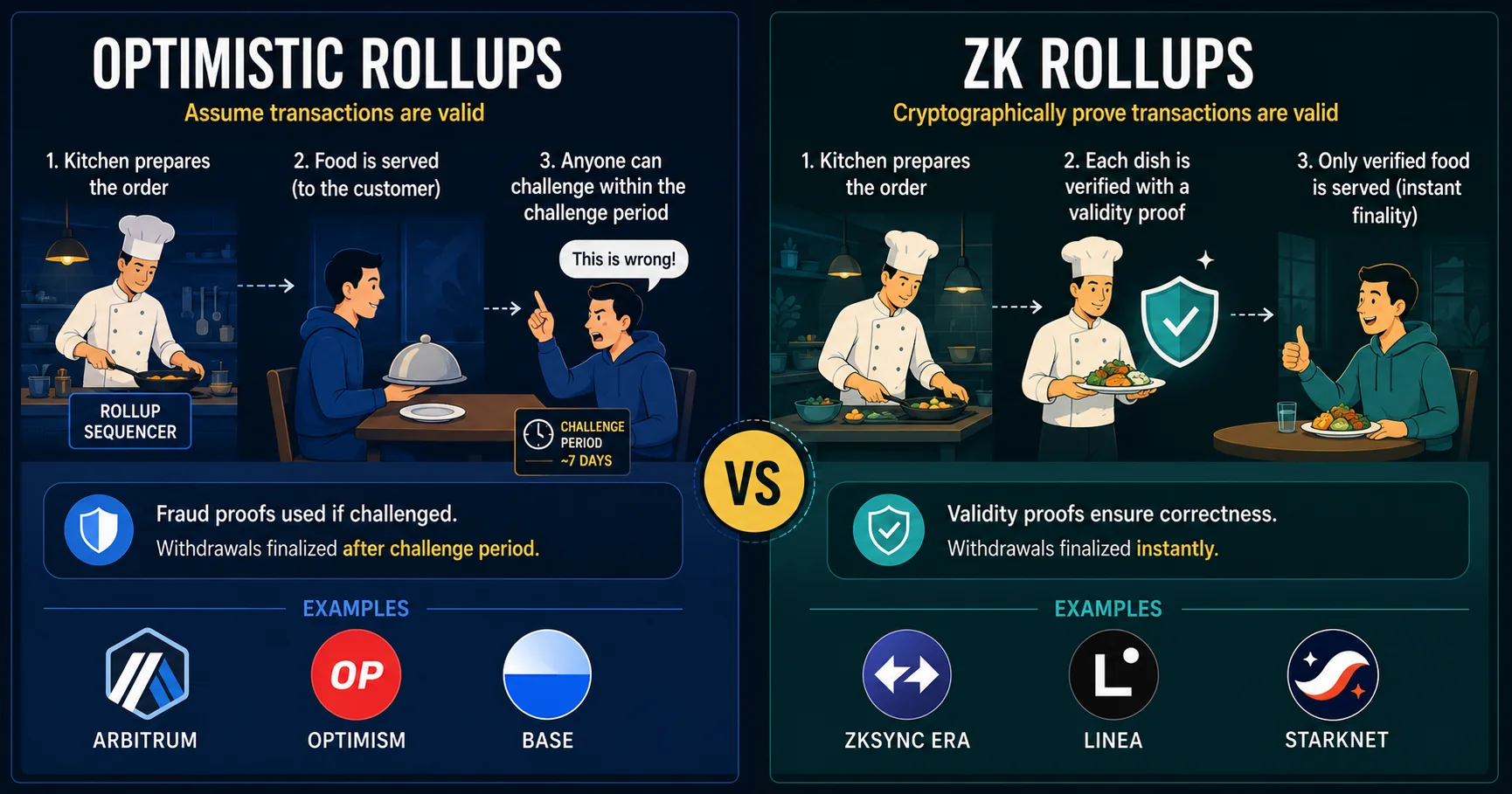
Think of optimistic rollups as a restaurant that assumes the food is good unless someone complains. ZK rollups verify each plate before serving. Both approaches deliver fed customers, both have downsides, both work in production today. The structural difference shapes everything that follows — how long withdrawals take, what fees look like, what kind of contracts you can deploy.
Optimistic rollups shipped first because the engineering was easier. Arbitrum and Optimism reached production in 2021 with fraud-proof systems that have steadily matured since. ZK rollups required cryptographic primitives that took longer to make production-grade — the maths is harder, the proving is compute-intensive, and the early systems were slow.
By 2026 both categories ship at scale. Optimistic rollups dominate TVL: Arbitrum and Base together hold around 77 per cent of all Layer 2 value. ZK rollups have caught up technically and lead on specific dimensions like withdrawal speed.
This guide walks through both mechanisms, the practical differences that actually affect users, a use-case decision framework, and a calibrated take on whether ZK gradually displaces optimistic over the rest of this decade. We do not predict; we frame the moving parts so you can track the question yourself.
As of mid-2026, L2BEAT tracks around two dozen rollups (alongside a handful of validiums and a long tail of eighty-plus smaller "Others" projects — over 100 in total) securing roughly $34 billion in total value — the bulk of practical Ethereum activity. These figures drift; check the current numbers on L2BEAT before acting on them. Arbitrum and Base together hold around 77 per cent of that rollup value, and the rest spreads across Optimism, the production ZK chains and a long tail of smaller deployments. Combined activity across all L2s now runs at many multiples of Ethereum mainnet's — L2BEAT's activity tracker puts rollup throughput at tens of times mainnet's — with the ratio widening through the year as fees on L2s consistently sit fractions of a cent for routine swaps.
Ethereum co-founder Vitalik Buterin's February 2026 reframing of the rollup-centric roadmap sharpened scrutiny on which L2s actually meet decentralisation expectations versus operating closer to "L1 with a bridge". The full discussion lives in our Ethereum L2 complete guide. This satellite goes deeper into the rollup mechanism itself. The framing is useful context: understand how each rollup type works, then judge whether a given chain meets the bar.
The cleanest way to read what follows is as a decision aid rather than a verdict. If you primarily care about deep DeFi liquidity, mature tooling and a stable seven-day exit window, the answer leans optimistic. If you primarily care about fast canonical withdrawals, post-quantum-friendly cryptography or account-abstraction-native semantics, the answer leans ZK. The technology comparison sits inside that decision space, not above it — neither approach is universally better, and several of the most interesting chain choices in 2026 turn on ecosystem fit rather than proof system.
How Optimistic Rollups Work
An optimistic rollup batches user transactions, executes them on its own virtual machine, then posts the resulting state root to Ethereum mainnet. The critical word is "optimistic" — the batch is assumed correct by default. Anyone who disagrees can submit a fraud proof to Ethereum within a challenge window, demonstrating that the batch produced an incorrect state. If no challenge appears, the state becomes canonical.
Transaction lifecycle on an optimistic rollup
The full lifecycle from "user signs transaction" to "Ethereum-anchored canonical finality" runs through six observable stages. A walk-through using Arbitrum as the working example (Optimism and Base behave the same in structure, with minor cadence differences):
- Submission and soft confirmation. The user signs a transaction in MetaMask or another wallet and submits it to the sequencer endpoint via JSON-RPC. The sequencer returns a soft confirmation in roughly 250 milliseconds — the L2 sees the transaction as included almost immediately.
- Sequencer batching. Arbitrum posts batches to Ethereum mainnet roughly every one to three minutes. Optimism and Base run similar cadences. Batch size scales with network load — typically 100 to 2000 transactions per batch depending on demand.
- L1 posting as a blob. Since EIP-4844 shipped in March 2024, the sequencer posts the compressed batch as a blob rather than as calldata. Blob data is available for 18 days within the Ethereum protocol's retention window — long enough for any independent watcher to reconstruct state and challenge a bad batch.
- State assertion. The sequencer commits the new state root to the L1 rollup contract. This is the optimistic claim — "the new state is X" — that the seven-day window opens around.
- Challenge window opens. Seven days. Independent watchers (Offchain Labs runs validators on Arbitrum; anyone with a bond can run them post-BoLD) re-execute the batch off-chain and check whether the asserted state root matches the actual execution result. If a mismatch is found, a fraud proof is submitted.
- Finalisation. If the challenge window closes with no fraud proof, the state becomes canonical on Ethereum. Withdrawals queued during the window can now process to L1.
The challenge window
The challenge window for canonical Ethereum withdrawal is seven days on every major optimistic rollup in 2026. This is not arbitrary. Seven days gives independent watchers time to detect a fraudulent batch, generate a fraud proof, and submit it to Ethereum. The window is the security mechanism that makes the optimistic model viable — without it, a malicious sequencer could post invalid state with no consequence.
The trade-off is real: capital sitting in an optimistic rollup needs seven days to return to mainnet through the canonical bridge. Most users get around this with third-party fast-bridge services (Across, Hop and others) that front the liquidity and let users exit in minutes for a small fee.
Two flavours of fraud proof
Implementations differ in how the fraud proof is constructed and adjudicated. Arbitrum's Nitro stack uses interactive fraud proofs with binary-search dispute resolution. Two parties — the original batch poster and the challenger — run a back-and-forth game on Ethereum to narrow down to the single instruction where they disagree. The dispute resolves at that single step, on Ethereum, in a single transaction.
Optimism (and Base, which inherits Optimism's stack) ships single-round fraud proofs through the Cannon fault-proof system. Cannon's permissionless fault proofs went live on OP Mainnet on 10 June 2024 and pushed Optimism to L2BEAT Stage 1 — fraud proofs are no longer simulated, they are real and adjudicable on chain. They briefly reverted to a permissioned mode in August 2024 after audit findings, then were restored. This was the major decentralisation milestone for the OP stack.
Arbitrum reached Stage 1 via a different milestone: the BoLD (Bounded Liquidity Delay) upgrade in April 2025. Before BoLD, only whitelisted validators could submit fraud proofs on Arbitrum — a soft centralisation that limited the security guarantee. Post-BoLD, anyone willing to post a bond (currently around 3,600 ETH, posted as WETH) can validate batches and submit fraud proofs. The bonding requirement prevents griefing: frivolous challenges cost the challenger their bond, so only good-faith disputes survive the economic filter.
Dispute games run on Ethereum L1 with real gas costs and take multiple challenge-response rounds across hours. The mechanism is operational and well-tested in adversarial simulations, but worth flagging honestly: no actual fraud-proof dispute has been adjudicated in production against a real malicious sequencer as of May 2026. The lack of a real-world dispute is partly evidence the deterrent works (no operator has tried to cheat) and partly an open question about untested edge cases under live attack. The system is mature in design and tested in code, but not yet battle-tested in practice.
Sequencer reality on optimistic rollups
The sequencer is centralised on Arbitrum, Optimism and Base in 2026. A single operator (typically the founding company) orders incoming transactions and produces blocks. Centralisation is fast and reliable but introduces censorship risk and MEV-extraction risk. Decentralised sequencer roadmaps exist. Arbitrum has explored Espresso integration with working tests in controlled environments, but no full production deployment yet. Optimism's Superchain shared sequencer and native interop are expected to reach production during 2026, with an interop devnet already live. Base will inherit whatever the OP-stack ships first via Superchain. The full security treatment, including how force-exit mechanisms protect users when the sequencer fails, lives in our L2 security tradeoffs guide.
How ZK Rollups Work
A ZK rollup batches user transactions, executes them on its own virtual machine, then generates a cryptographic validity proof showing that the batch produced the correct state. Ethereum verifies the proof in a single transaction, and the state becomes canonical immediately on proof verification. There is no challenge window — the cryptography eliminates the need for one.
SNARKs, STARKs, and the Boojum middle ground
Two main proof systems power production ZK rollups in 2026. zk-SNARKs (Succinct Non-interactive Arguments of Knowledge) produce small, fast-to-verify proofs but typically require a trusted setup ceremony and rely on elliptic-curve pairings that are not post-quantum secure. Linea uses zk-SNARKs. zk-STARKs (Scalable Transparent Arguments of Knowledge) produce larger proofs but require no trusted setup and use hash-based cryptography that is post-quantum secure. Starknet uses zk-STARKs natively.
zkSync Era sits in the middle. Since December 2023 it has run the Boojum proof system — a STARK proof wrapped inside a SNARK. The structure gives Era both the no-trusted-setup property of STARKs and the smaller-proof property of SNARKs. The operationally significant detail: Boojum provers run on consumer hardware with 16 GB of GPU RAM rather than on specialised infrastructure, which lowers the cost and centralisation pressure of proof generation.
The proof generation pipeline
Generating a validity proof is an end-to-end pipeline rather than a single step. Walking through the mechanism makes the engineering trade-offs concrete:
- Sequencer orders transactions and produces L2 blocks — same role as on optimistic rollups.
- Executor runs the batch on the rollup's virtual machine: Era VM for zkSync, Linea zkEVM for Linea, Cairo VM for Starknet.
- Witness generation converts the execution trace into a witness format the prover can process. This step is computationally cheap relative to proving but non-trivial.
- Prover runs the cryptographic proof generation. This is the expensive step. zkSync Era's Boojum runs on consumer GPUs with 16 GB RAM and produces proofs in roughly hours per batch. Starknet historically required heavier hardware; the S-two (Stwo) prover, live on Starknet mainnet since November 2025, brought consumer-grade hardware and client-side proving to Starknet too. Linea's prover optimisations ship 200 Mgas/s; 5,000 transactions per second remains a roadmap target.
- Aggregator combines multiple smaller proofs into a single recursive proof. Most production ZK systems in 2026 use recursion to reduce L1 verification cost.
- L1 verifier contract on Ethereum verifies the final proof in a single transaction. Verification cost is typically in the 200,000 to 500,000 gas range across major ZK L2s — small relative to the cost of executing the underlying transactions, which is the whole point of compression.
Account abstraction on Starknet
Starknet's Cairo VM ships native account abstraction. On Ethereum mainnet and EVM-equivalent L2s, account abstraction was bolted on via ERC-4337 (deployed in March 2023, still optional infrastructure). On Starknet, every account is a contract by default — there are no externally-owned accounts in the Ethereum sense.
Practical implications for application designers:
- Native multi-call lets a single transaction batch multiple operations without ERC-4337-style bundling.
- Social recovery wallets ship without paymaster or bundler infrastructure overhead.
- Custom signature schemes (passkeys, hardware tokens, biometric-derived keys) are first-class — no ERC-4337 paymaster machinery required.
- Ready (formerly Argent) and Braavos wallets — the dominant Starknet wallet implementations — ship with these features as defaults rather than as opt-in extensions.
This is not a marginal differentiation. For applications that benefit from account-abstraction primitives — wallet UX innovations, enterprise compliance flows, social recovery — the EVM ecosystem requires meaningful ERC-4337 implementation work that Starknet provides out of the box.
The EVM equivalence spectrum
Vitalik Buterin's zkEVM type taxonomy classifies ZK rollups by how closely they replicate the Ethereum execution environment. Higher type number means faster proving but worse equivalence; lower type number means better equivalence but slower proving.
- Type 1 — fully Ethereum-equivalent, identical hash functions, identical state trees, identical gas semantics. No production rollup covered here has reached this tier; Linea targets it on its roadmap.
- Type 2 — EVM-equivalent with minor state-tree differences. Linea sits here, proving an L2-specific state representation rather than Ethereum's.
- Type 3 — EVM-compatible with some opcodes handled differently. Polygon zkEVM lived in this category before its 2026 sunset.
- Type 4 — Solidity compiled to a custom VM. zkSync Era's Era VM sits here. Most contracts deploy fine but require testing because gas semantics and certain opcodes behave subtly differently from Ethereum.
- Type 4+ (non-EVM) — different bytecode entirely. Starknet's Cairo virtual machine sits here. Solidity does not deploy; the developer model is rewrite, not port.
Withdrawal speed and finality
ZK rollup canonical withdrawals settle in hours rather than the seven-day window optimistic rollups require. The validity proof is verified on Ethereum at the time of state submission, so withdrawal becomes possible as soon as the proof clears the L1 verifier contract. This time-value advantage is one of the main reasons institutional capital and frequent-rebalance strategies favour ZK rollups when the underlying use case allows.
Sequencer reality on ZK rollups
Like optimistic rollups, ZK rollups in 2026 mostly run centralised sequencers. zkSync Era is at L2BEAT Stage 0 (operator retains upgrade authority); Linea is at Stage 0 (with a published decentralisation roadmap including the Maru client and QBFT consensus that are already in production). Starknet has reached Stage 1 — permissionless exits are live, narrowing the security gap with the leading optimistic rollups (Arbitrum, Optimism and Base).
Prover decentralisation is the next major frontier for ZK L2s. Currently, proof generation across all three production ZK chains runs on infrastructure operated by the founding team (Matter Labs, ConsenSys, StarkWare respectively). Permissionless proving — where anyone with sufficient hardware can earn fees by generating proofs — is on the published roadmaps but is not yet shipped to production at scale. When prover networks become permissionless and economically rational, ZK rollups arguably catch up with optimistic rollups on the dimension where decentralisation maturity currently lags.
Practical Differences That Matter
Five dimensions separate the two rollup categories in practice. Reading them as a checklist gives you a clean way to weigh trade-offs against your specific use case rather than against general "ZK is better" or "OP is more mature" framings that lack practical anchoring.
Withdrawal time
Optimistic rollups: seven days through the canonical bridge. ZK rollups: hours after proof verification. The gap is structural — the optimistic challenge window cannot be safely shortened without weakening the fraud-proof security mechanism. The per-L2 reality:
- Arbitrum: 7-day challenge window plus 10-30 minutes for L1 inclusion of the withdrawal claim. Effectively about 7 days end-to-end.
- Optimism: 7-day challenge window plus L1 inclusion overhead. Same 7-day total.
- Base: 7 days, inheriting OP-stack timing.
- zkSync Era: about 3 hours from L2 finality through proof generation, verification and L1 inclusion to claimable mainnet ETH.
- Linea: about 2 hours median to hard finality on Ethereum, with a documented 16-hour ceiling.
- Starknet: hours, dominated by proof generation cadence and L1 verification scheduling.
Fast-bridge services close the gap operationally on optimistic rollups. Across, Hop and Stargate front the liquidity for optimistic-rollup exits in minutes — Across often fills in seconds. Fees now usually sit in the 0.01 to 0.05 per cent range of the bridged value on major routes. For ZK exits these services exist but are less commonly used. The canonical timing is already fast enough for most use cases.
One subtle distinction worth holding: "withdrawal time" and "finality" are not identical. Soft confirmation on the L2 itself is sub-second across all six chains. What differs is the time to reach Ethereum-anchored, unreorgable canonical finality — that is what the bridge timings above measure.
EVM compatibility
Optimistic rollups inherit the EVM directly. ZK rollups vary by zkEVM type. The compatibility matrix:
| L2 | EVM type | Solidity deploys? | Tooling compatible? |
|---|---|---|---|
| Arbitrum | Nitro stack, full EVM | Yes, unchanged | Yes, all standard |
| Optimism | OP-stack, full EVM | Yes, unchanged | Yes, all standard |
| Base | OP-stack, full EVM | Yes, unchanged | Yes, all standard |
| Linea | Type-2 | Yes, unchanged | Yes, all standard |
| zkSync Era | Type-4 | Yes with testing | Mostly standard, with caveats |
| Starknet | Non-EVM Cairo | No (rewrite required) | Cairo-specific (Scarb, etc.) |
Linea's Type-2 status keeps Solidity deployment routine, but the equivalence is not total. Its documentation lists live divergences: the BLAKE2f and RIPEMD-160 precompiles are unsupported, ModExp is capped at 512-byte integers, calldata is limited to 60,000 bytes per transaction, and type-3 blob transactions are rejected. zkSync Era's Type-4 status means most contracts deploy but require testing, because subtle differences in gas behaviour for certain opcodes and the account model can cause production issues if not validated. Starknet's Cairo VM is the biggest practical divergence — porting from Solidity is rewrite, not migration, with implications for engineering team retraining and audit cost.
Prover cost and fee economics
Pre-EIP-4844 (before March 2024), ZK rollup fees were dominated by L1 calldata posting cost rather than prover cost. The blob upgrade made calldata 10-100x cheaper, which exposed prover cost as the now-dominant per-transaction cost on ZK L2s. Indicative per-transaction fee ranges as of mid-2026 (fees drift with ETH gas price; verify live on growthepie or L2BEAT):
- Leading optimistic rollups (Arbitrum, Optimism, Base): roughly $0.001 to $0.05 for routine swaps, varying with ETH gas price. Base can run higher during peak congestion driven by its higher transaction volume. (Optimism and Base run the OP Stack; Arbitrum runs Offchain Labs' own Nitro stack — but all three share full EVM equivalence.)
- zkSync Era: roughly $0.01 to $0.05 for routine swaps, with a meaningful spread between routine swaps and complex contract calls.
- Linea: similar to zkSync Era, possibly trending lower as prover optimisations land.
- Starknet: roughly $0.02 to $0.10, with Cairo's different gas model making direct comparison harder than within the EVM family.
For the full fee-component decomposition — L1 calldata or blob cost, L2 execution cost, congestion premium — and the bridging mechanics that determine effective end-to-end fee, see our L2 fees and bridging explained satellite.
The gap is small enough that fee should not drive L2 selection for typical retail use. It matters at scale — high-frequency trading, large-batch operations, automated yield strategies where the per-transaction differential compounds across millions of transactions per month. One distinction worth holding: "prover cost" and "user-facing fee" are not identical. Prover cost is paid by the rollup operator and amortised across all users in a batch; user-facing fee includes operator margin and L1 settlement amortisation. The economics are healthier on chains where the prover cost is a smaller share of total fee.
Decentralisation maturity
L2BEAT's stage classification is the right reference here. Stage progression criteria run roughly as follows:
- Stage 0: operator retains broad upgrade authority. Fraud or validity proofs may not be fully live, or may have escape hatches that favour the operator.
- Stage 1: fraud or validity proofs live and adjudicable on chain. A security council can override under defined transparent conditions but with delays. User exits are permissionless.
- Stage 2: full trustlessness, no security council override authority, mature and battle-tested. None of the high-TVL L2s has reached Stage 2 as of mid-2026; Aztec, a smaller privacy rollup, crossed to Stage 2 in late June 2026 after an onchain governance vote revoked its rollup-contract ownership.
Snapshot as of May 2026:
- Arbitrum: Stage 1, with BoLD permissionless validation live since April 2025.
- Optimism: Stage 1, with Cannon fault proofs live on mainnet.
- Base: Stage 1, inheriting OP-stack maturity.
- Starknet: Stage 1 with permissionless exits live.
- zkSync Era: Stage 0 — operator retains upgrade authority.
- Linea: Stage 0, with Maru client and QBFT consensus shipped to production — earlier production progress than zkSync Era on the decentralisation roadmap, but not yet at Stage 1.
Per Vitalik Buterin's February 2026 reframing covered in our hub, Stage 1 is the threshold for considering an L2 a "true Ethereum extension" rather than an L1 with a bridge. Stage 0 chains operate closer to the bridged-L1 model in practical security terms. The stage difference matters more than the proof system for practical security tradeoffs. A Stage 1 chain with proven fault proofs is meaningfully more decentralised than a Stage 0 chain with the most cryptographically pristine validity proof, in the dimension that matters most for user fund safety. The full L2BEAT framework — stages, scorecard items, evaluation criteria — anchors back to Ethereum's Proof-of-Stake security guarantees, which underwrite every L2 stage classification.
Censorship resistance and force-exit
Both rollup categories rely on a centralised sequencer in 2026 with the same set of theoretical risks. The mitigation in both cases is the force-exit mechanism — submit a transaction directly to the L1 rollup contract to force inclusion or withdrawal if the sequencer ignores you. Per-L2 mechanism specifics:
- Arbitrum: users submit transactions directly to the SequencerInbox contract on L1. After a 24-hour delay during which the sequencer can include them voluntarily, they auto-include. Effective censorship resistance with a 24-hour maximum delay.
- Optimism and Base: similar mechanism via L1 deposit contract with a 12-hour soft delay and an extended hard deadline.
- zkSync Era: priority queue mechanism on L1, with about 24 hours before forced inclusion.
- Linea: documented force-inclusion mechanism following a similar pattern to OP-stack chains.
- Starknet: forced L1-to-L2 messaging with a documented finality window.
For full per-L2 force-exit walkthroughs see the force-exit mechanisms section of the security tradeoffs satellite. The structural point: no major L2 in 2026 has perfect real-time censorship resistance. All require some L1-mediated delay for force-exit. The 12-24 hour windows are the practical reality, and they apply roughly equally across both rollup categories.
When OP Wins, When ZK Wins
Three branches cover most use cases. The framing is decision-tree, not absolute ranking — both rollup types are valid, and the right pick depends on what the application actually needs.
When optimistic rollups win
OP wins when mature DeFi liquidity is the priority. Arbitrum and Base dominate L2 TVL (as of mid-2026, Base has overtaken Arbitrum for the top spot at roughly $11.5 billion versus Arbitrum's roughly $10.5 billion, with Optimism a distant third near $1.5 billion — verify current figures on L2BEAT) and host the deepest concentration of DeFi protocols. Base grew fast on Coinbase smart-wallet onboarding. If you are deploying capital into perpetuals, lending markets, AMMs or yield strategies, the optimistic rollups carry the deepest liquidity by a wide margin.
OP also wins when EVM-equivalent developer experience is required. Solidity contracts deploy unchanged across these optimistic rollups, the existing tooling (Hardhat, Foundry, OpenZeppelin libraries) works without modification, and the runtime cost of testing is low. Teams porting an existing Solidity protocol to a Layer 2 typically default to optimistic rollups for this reason alone.
OP makes sense when you can tolerate the 7-day canonical withdrawal window or are willing to pay third-party fast-bridge fees for time-sensitive moves. For long-horizon capital this is a non-issue.
Concrete case studies illustrate the pattern. GMX chose Arbitrum for its perpetuals deployment because Arbitrum's perp and derivatives liquidity exceeded other L2 options in the 2022-2024 window during which GMX scaled. Arbitrum remains its anchor chain, though GMX has since expanded well beyond it — to Avalanche, Solana, Botanix and, via GMX Multichain, further networks still — so the deployment is no longer an Arbitrum-and-Avalanche pair.
Aave V3 is deployed across Arbitrum, Optimism and Base — it favours these EVM-equivalent optimistic rollups because audit cost amortises across Solidity-identical deployments and liquidity migration via cross-chain governance was simpler than maintaining parallel ZK-specific deployments. (Optimism and Base run the OP Stack; Arbitrum runs Offchain Labs' own Nitro stack — but all three share full EVM equivalence, which is what makes the shared-audit economics work.) Synthetix illustrates the opposite move: through 2025 it wound down its L2 deployments — sunsetting its Arbitrum perps early in the year, then its Optimism and Base deployments from August 2025 — to consolidate liquidity on Ethereum mainnet. A protocol's chain choice is not permanent; liquidity can migrate back to L1 when the economics change.
For the head-to-head between the three leading optimistic rollups across architecture, fees, DeFi ecosystem and security maturity, see our Arbitrum vs Optimism vs Base compare.
The pattern across these cases: deep-DeFi protocols disproportionately deploy on the leading optimistic rollups because the Solidity tooling cost is lower, liquidity is already there, and audit work amortises across chains. The compounding effect over time is what gives the optimistic family its DeFi-density advantage versus the ZK family.
When ZK rollups win
ZK wins when fast withdrawal matters. Institutional capital, frequent-rebalance strategies and any application that needs to move significant value between L2 and mainnet on a sub-week cadence benefits from canonical withdrawals settling in hours rather than days.
ZK wins when production-grade cryptography is a procurement requirement — regulated entities, certain enterprise integrations, applications that need post-quantum security guarantees. Starknet's STARKs and Linea's evolving cryptographic stack are options here in ways the optimistic chains structurally cannot match.
ZK wins decisively when you are building a non-EVM application that benefits from Cairo's specific properties. Starknet's account-abstraction-native model, different gas semantics and computation primitives can produce cleaner application designs for specific categories. The clearest examples: native multi-call and social-recovery wallets, both of which require meaningful ERC-4337 work on the EVM but ship as defaults on Starknet.
Concrete case studies on the ZK side. Ready (formerly Argent) built its primary product on Starknet specifically because native account abstraction lets it ship social recovery, multi-sig and custom signature schemes as defaults rather than as opt-in features. On Ethereum mainnet, providing equivalent UX requires implementing ERC-4337 paymaster and bundler infrastructure — meaningful engineering and operational overhead that Starknet's account model removes.
Compliant institutional pilots (several reported European banking pilots in early 2026 — specific names usually under NDA in initial press coverage) selected Linea and zkSync Era for ZK guarantees that satisfied internal compliance review. Frequent-rebalance strategies — yield aggregators, treasury management tooling, and any application that moves capital between L2 and L1 weekly or more often — benefit materially from ZK fast withdrawals because the time-value of capital under management exceeds the marginal proof-cost premium.
For the head-to-head between the three commercial ZK rollups including EVM-equivalence spectrum, see our zkSync vs Linea vs Starknet compare.
The pattern: applications where account-abstraction semantics, cryptographic procurement requirements, or capital velocity dominate ecosystem fit drive selection towards ZK. None of these dimensions is decisive on its own; they compound for specific application categories.
When either works
For general user-grade DeFi where fee differences are negligible, withdrawal timing is not critical and EVM compatibility is convenient but not essential, both rollup categories are viable. Most retail use cases sit in this branch. The decision then collapses to ecosystem fit (which protocols you want to use), wallet familiarity (most users have MetaMask, which works across all EVM chains and can be supplemented with Ready (formerly Argent) or Braavos for Starknet), and personal preference.
For developers, the Solidity-port cost gradient explains a lot of the ecosystem density skew. Porting an existing Solidity codebase to Optimism, Base or Arbitrum is roughly a few days of work — deploy, audit deltas, test edge cases. Porting to zkSync Era takes weeks because Type-4 differences require systematic testing for opcode behaviour and account-model edge cases. Porting to Linea is closer to days territory — Type-2 equivalence means standard Solidity deploys unchanged, with checks only where the unsupported precompiles bite. Porting to Starknet is months of engineering work — Cairo rewrite, retraining the team, rebuilding tooling.
For most retail users this developer cost is invisible — they care about which chain has the apps they want to use, not the cost of porting. But it explains why DeFi ecosystem density skews OP: the developer cost gradient compounds over time, and chains with lower porting friction accumulate more deployments.
The Future: ZK Convergence?
A common framing in 2026 holds that ZK gradually wins on the strength of fast finality, post-EIP-4844 fee parity and progressively cheaper proving. The argument is reasonable on its merits — improvements in prover hardware and proof-system efficiency continue to compress the cost gap, and the seven-day canonical withdrawal window is a real friction point that ZK chains structurally avoid.
Counter-arguments are equally serious. The optimistic-rollup ecosystem has substantial network effects — the Superchain shared sequencer roadmap, deeper DeFi liquidity, more mature tooling, and the Stage 1 decentralisation milestone already shipped on Optimism (Cannon fault proofs) and inherited by Base. Starknet has also reached Stage 1, and Arbitrum's Stage 1 maturity is steadily progressing — but the OP family's ecosystem density remains a meaningful advantage for the kinds of applications that drive user traffic.
Vitalik Buterin's February 2026 reframing — covered in our hub L2 landscape section — sharpened the question. The technical thrust of his thread: Ethereum L1 has scaled faster than originally expected (gas-limit increases, PeerDAS development, blob capacity expansion), while L2 decentralisation has progressed slower than expected (most chains still Stage 0). The forward direction Vitalik advocates is native rollup precompiles — embedding ZK-EVM proof verification directly into Ethereum's protocol layer. Currently, each ZK L2 deploys and maintains its own verifier contract on L1. A native precompile would verify ZK-EVM proofs as a core Ethereum operation, auto-upgrading with Ethereum and benefiting from hard-fork protection if bugs emerge.
This direction, if shipped (timeline likely 2027 at earliest based on Ethereum's typical EIP cadence), would compress the gap between L1 and L2 substantially. ZK rollups using EVM-equivalent proof systems would become near-native extensions of Ethereum. OP rollups would remain useful for cases where fast finality matters less than EVM compatibility and ecosystem density. The native-precompile direction does not eliminate the optimistic-versus-ZK distinction, but it does reweight which of the two categories looks more architecturally privileged in the medium term.
The 2026-2028 timeframe almost certainly contains both rollup types coexisting at scale. A useful framing is to watch three signals rather than predicting an outcome. First, L2BEAT stage progressions — every chain that reaches Stage 1 narrows the security-claim gap between OP and ZK. Second, prover decentralisation milestones for the major ZK chains — when prover networks become permissionless, ZK arguably catches up on the dimension that currently favours OP. Third, fee parity post-EIP-4844 follow-on upgrades — if blob capacity expands as planned, both categories may converge on near-zero per-tx fees, which neutralises one of OP's structural advantages.
Specific predictions about which type "wins" are speculative. Tracking these signals quarterly gives you a calibrated picture of where the field is moving without committing to a forecast.
Practical Takeaways
Both rollup types are valid in 2026. The right pick depends on use case rather than on technology fashion. Optimistic rollups (Arbitrum, Optimism, Base) lead on DeFi liquidity, EVM compatibility and developer ecosystem maturity. ZK rollups (zkSync Era, Linea, Starknet) lead on withdrawal speed, cryptographic security guarantees and — for Starknet specifically — non-EVM developer primitives.
The L2BEAT stage classification matters more than the proof system for practical security tradeoffs. Stage 1 chains (Arbitrum, Optimism, Base, Starknet) have live fault or validity proofs and a transparent security council. Stage 0 chains (zkSync Era, Linea) retain broader operator authority. Match the stage to the capital you are deploying.
The Polygon zkEVM sunset is the live 2026 reminder that technology choices are necessary but insufficient. Strategic positioning, ecosystem support and commercial sustainability matter independently. Watch L2BEAT stage progressions, prover decentralisation milestones and fee parity quarterly to track where the rollup field is moving without committing to a forecast.
Three concrete monitoring practices keep you calibrated on this field without overhead. First, an L2BEAT quarterly check (about five minutes) — scan stage progressions, new fraud or validity proofs going live, security council changes. These are signals of healthy progress or stagnation. Second, a DefiLlama TVL trend pull (about five minutes) — six-month and twelve-month trajectory for chains where you hold capital; three consecutive quarters of decline is a warning signal.
Third, a monthly scan of Vitalik and Ethereum Foundation research updates (about ten minutes) — EthResearch posts, Vitalik's blog and X, key core developer call summaries. The direction of L1 development affects L2 economics structurally. For an actively held position, twenty minutes quarterly is the realistic monitoring overhead for staying current.
For the broader L2 selection framework, see our Ethereum L2 complete guide. For security tradeoffs in detail, see the L2 security tradeoffs guide.
Sources
- Vitalik Buterin — The different types of zk-EVMs: canonical taxonomy of Type-1 through Type-4 zkEVMs that anchors our EVM-equivalence discussion.
- L2BEAT — scaling summary: primary reference for L2 maturity stages, proof system classification and per-chain decentralisation status.
- Ethereum.org — optimistic rollups: neutral foundation reference for the optimistic-rollup mechanism.
- Ethereum.org — ZK rollups: neutral foundation reference for the validity-proof model.
- Polygon Labs — Sunsetting Polygon zkEVM Mainnet Beta in 2026: official sunset announcement, the primary citation for the lifecycle sidebar.
- EthResearch — Layer 2 forum: primary venue for active L2 design discussions, including based-rollup and native-precompile direction.
- Vitalik Buterin — Endgame: foundational essay framing the rollup-centric roadmap, useful historical context for the convergence-direction analysis.
Frequently Asked Questions
- Are ZK rollups always more secure than optimistic rollups?
- No. Security depends on more than rollup type. The sequencer model, force-exit mechanism, prover decentralisation and L2BEAT stage all matter. ZK rollups have a different threat model than optimistic rollups but not strictly higher security in 2026. Arbitrum, Optimism, Base and Starknet sit at L2BEAT Stage 1; zkSync Era and Linea remain Stage 0. The stage classification matters more than the proof system for practical security tradeoffs.
- Why are ZK proofs expensive to generate?
- Generating a cryptographic validity proof is compute-intensive. The prover runs a separate computation that effectively re-executes the batch and produces a small proof Ethereum can verify. The cost shows up in fees indirectly. Post-EIP-4844 blobs the gap with optimistic rollups narrowed substantially because L1 calldata posting became 10-100x cheaper, but ZK prover cost remains real. zkSync Era's Boojum proof system reduces this by allowing provers to run on consumer hardware (16 GB GPU RAM) rather than specialised infrastructure.
- Why is Polygon zkEVM sunsetting if ZK is the future?
- The Polygon zkEVM sunset, which took effect on 1 July 2026, is a commercial outcome, not a verdict on ZK technology. Polygon Labs strategically pivoted towards the AggLayer and PoS sidechain. Polygon zkEVM never adopted the EIP-4844 blob format, leaving it at a structural fee disadvantage versus competing zkEVMs. By 2026 the chain ran at an estimated $1 million annual operating loss. Technology is necessary but insufficient — commercial sustainability and ecosystem support matter independently. zkSync Era, Linea and Starknet remain healthy and continue to advance.
- Can I deploy a Solidity contract on Starknet?
- Not directly. Starknet uses the Cairo virtual machine, not the EVM. Solidity contracts do not deploy unchanged. Transpilation tools exist but are imperfect and not recommended for production. The migration story for an existing Solidity codebase to Starknet is rewrite, not port. This makes Starknet a niche choice — it pays off for applications that benefit from Cairo's specific properties (native account abstraction, different computation model) but is the wrong choice if you want to reuse existing Solidity tooling.
- What is a "based rollup" and does it matter?
- A based rollup is an L2 where Ethereum L1 validators themselves serve as the sequencer — rather than a separate centralised sequencer ordering transactions, the L1 proposer for each Ethereum slot includes L2 transactions. This eliminates the sequencer trust dimension entirely: if you trust Ethereum's PoS validator set, you trust the based rollup's sequencer by inheritance. Several teams ship or are building based rollups in 2026 (Taiko ships on this model; others in development). The category is meaningfully different from rollups with a decentralised-sequencer roadmap — based rollups solve the sequencer trust problem structurally rather than incrementally. None of the major L2s covered in this guide (Arbitrum, Optimism, Base, zkSync Era, Linea, Starknet) is currently a based rollup, but the design is worth understanding as a future direction. Read the based-rollup design literature on EthResearch or Justin Drake's posts for the technical depth.
- Which rollup type withdraws faster to mainnet?
- ZK rollups withdraw faster through the canonical bridge. ZK canonical withdrawals settle in hours after proof verification on Ethereum. Optimistic rollups have a 7-day challenge window before the withdrawal is final. Third-party fast-bridge services (Across, Hop) front the liquidity and let optimistic rollup users exit in minutes for a small fee. The time-value of faster ZK withdrawal matters most for capital that moves frequently between L2 and mainnet.
← Back to Crypto Investing Blog Index
Financial Disclaimer
This content is not financial advice. All information provided is for educational purposes only. Cryptocurrency investments carry significant investment risk, and past performance does not guarantee future results. Always do your own research and consult a qualified financial advisor before making investment decisions.