zkSync vs Linea vs Starknet 2026
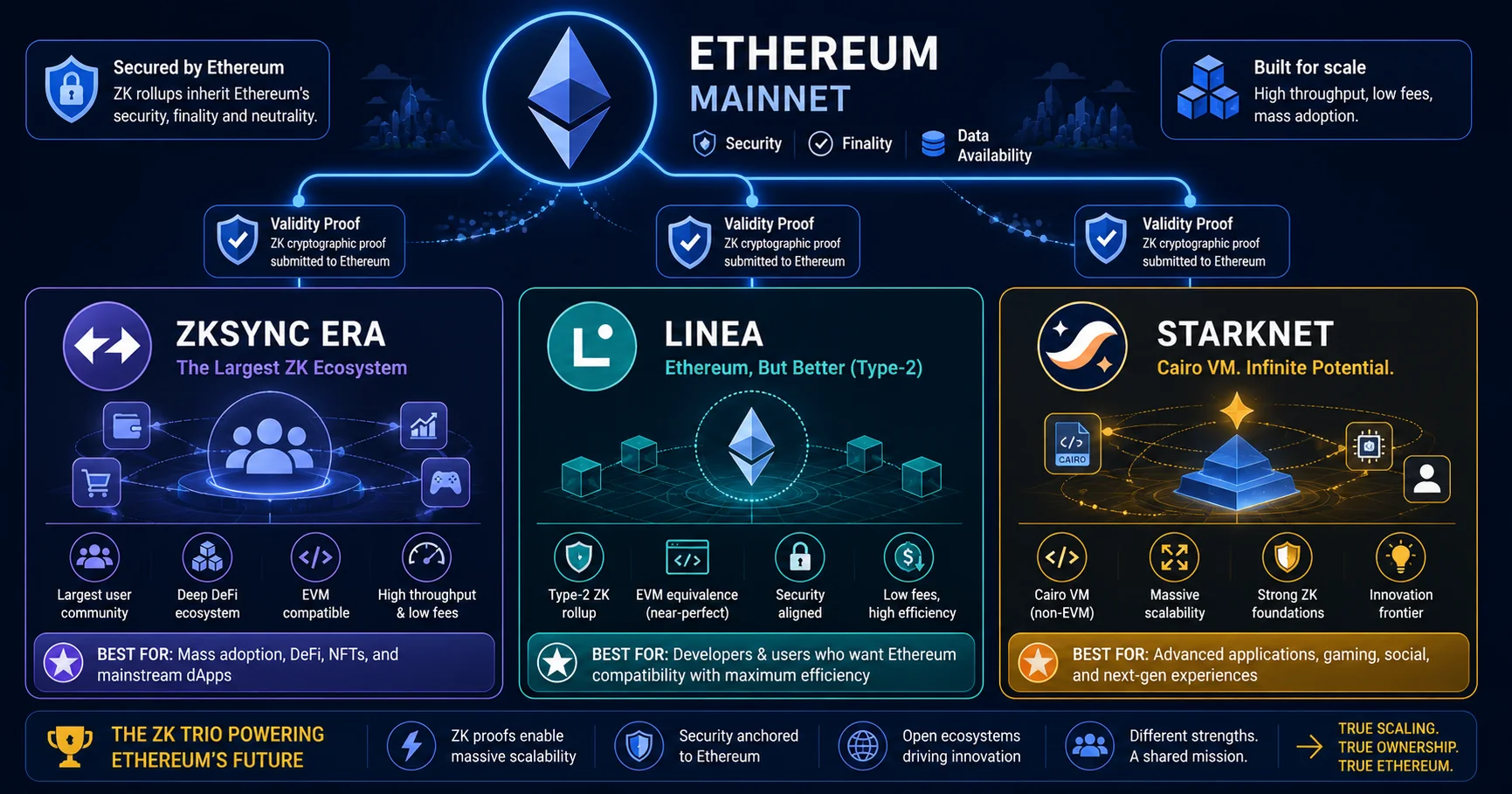
You narrowed your L2 choice to the ZK family — now you want a clean head-to-head on the three commercial ZK rollups worth knowing in 2026. This compare covers zkSync Era (Matter Labs, Type-4 zkEVM), Linea (ConsenSys, Type-2 zkEVM with full Ethereum equivalence on the roadmap), and Starknet (StarkWare, Cairo VM — non-EVM, completely different developer experience). For OP-stack rollup comparison (Arbitrum, Optimism, Base), see our Big 3 comparison. For the fraud-proof versus validity-proof technical mechanics, see optimistic vs ZK rollups.
Introduction
The three ZK rollups worth knowing for capital deployment in 2026 are zkSync Era, Linea and Starknet. They are not interchangeable. zkSync Era is the EVM-familiar option with a Type-4 zkEVM that compiles Solidity to a custom Era VM bytecode, and is the smallest of the trio by total value locked as of mid-2026. Linea is the Type-2 zkEVM with bytecode-equivalent EVM today; Type-1 and the 5,000 TPS throughput figure remain roadmap targets, not shipped. Starknet is the non-EVM Cairo chain — completely different developer experience, native account abstraction, and, despite the non-EVM design, the largest of the three by total value locked.
Pick by what you actually need. If you want an established EVM-compatible ZK ecosystem and Solidity-with-caveats deployment, pick zkSync Era. If you want bytecode-equivalent EVM and the ConsenSys/MetaMask ecosystem, pick Linea. If you want non-EVM Cairo, native account abstraction, or specific Cairo cryptographic primitives, pick Starknet. The three solve different problems and the comparison matrix in section 8 makes the trade-offs scannable in a single view.
This compare is the canonical head-to-head for the ZK trio. For the broader L2 selection framework including OP-stack chains, see our Ethereum L2 complete guide. The structure: at-a-glance summary, EVM-equivalence spectrum (the most distinctive ZK comparison dimension), fees, DeFi ecosystem, security maturity, decision framework, and the central matrix.
At a Glance
zkSync Era is the smallest of the three ZK rollups by total value locked as of mid-2026, though it retains an established EVM-compatible DeFi ecosystem anchored by SyncSwap. Built by Matter Labs, zkSync Era is a Type-4 zkEVM — Solidity contracts compile to a custom Era VM bytecode rather than running as EVM bytecode unchanged. Most Solidity contracts work after compilation but with subtle differences in gas semantics and certain opcodes; developers must test deployments.
The chain uses the Boojum proof system since December 2023 — a STARK-based proof wrapped inside a SNARK, designed to run on a single GPU (ZKsync's docs now put the minimum at 24 GB of VRAM). The native ZK token launched in June 2024. L2BEAT stage 0 as of mid-2026; Matter Labs retains upgrade authority for the rollup contracts. Pick zkSync Era if you want an established EVM-compatible ZK ecosystem and accept Type-4 Solidity-with-caveats deployment.
Linea is ConsenSys's ZK rollup, currently a Type-2 zkEVM; Type-1 remains a roadmap target, as does the 5,000 TPS throughput figure. Type-2 today means bytecode-equivalent EVM with minor gas-handling differences — most Solidity contracts deploy unchanged with the cleanest migration path amongst the ZK trio. ConsenSys ecosystem integration is the structural advantage — the MetaMask wallet is the most-used Web3 wallet, and Linea ships as the default ZK L2 for MetaMask users.
Total value secured sits around $350 million on L2BEAT as of mid-2026 — the middle of the trio, above zkSync Era but below Starknet, with DeFi-specific TVL considerably lower (verify current figures on L2BEAT and DefiLlama). Linux Foundation governance arrived in May 2026, alongside the Maru consensus client with QBFT for progressive sequencer decentralisation. L2BEAT stage 0 as of mid-2026; the LINEA token has launched (verify current circulation status). Pick Linea if you want Ethereum-equivalent developer experience and ConsenSys-ecosystem integration.
Starknet is StarkWare's ZK rollup and the only major L2 that is not EVM-compatible. Starknet uses the Cairo virtual machine — a completely different bytecode format, different mental model, different tooling. Solidity contracts do not deploy on Starknet; the migration story is rewrite in Cairo, not port.
The trade-off is real but the upside is distinctive: native account abstraction (gasless transactions paid in arbitrary tokens, social recovery by default, multi-call without ERC-4337 plumbing), and access to Cairo's specific computational primitives. Starknet has held L2BEAT Stage 1 since May 2025 — the only ZK trio member at Stage 1, with permissionless exits and validity proofs verified on L1. STRK staking growth has been strong with over 1.1 billion STRK staked by Q1 2026. Despite being the only non-EVM member, Starknet leads the trio by total value locked as of mid-2026 (around $390 million on L2BEAT, ahead of both Linea and zkSync Era; verify current figures on L2BEAT). Pick Starknet if you specifically want non-EVM Cairo or native account abstraction.
EVM Equivalence Spectrum
The most distinctive comparison dimension across the ZK trio is where each chain sits on Vitalik Buterin's zkEVM type taxonomy. Type-1 is full Ethereum equivalence — the same proof system would verify Ethereum mainnet. Type-2 is bytecode-equivalent EVM with minor differences in gas handling and certain pre-compiles. Type-3 is closer to EVM-equivalent with documented compatibility deltas. Type-4 compiles high-level Solidity to a custom virtual machine bytecode; most contracts work but the bytecode is not EVM-identical. Starknet sits in a separate category — Cairo VM, non-EVM entirely.

zkSync Era — Type-4 zkEVM
zkSync Era is a Type-4 zkEVM. Solidity contracts go through the zkSync compiler, which produces Era VM bytecode rather than EVM bytecode. Most contracts work after compilation, but there are real differences worth knowing: gas semantics differ in specific cases (account abstraction is native, which changes the cost model), certain opcodes behave differently or are unavailable, and some Solidity patterns that work on EVM produce unexpected behaviour after Era compilation. The practical recommendation: do not assume any Solidity contract works on zkSync Era without testing it on a zkSync testnet first. The migration cost is meaningfully smaller than rewriting in Cairo (Starknet) but meaningfully larger than zero (Linea Type-2 today).
Linea — Type-2 zkEVM, Type-1 on roadmap
Linea is currently a Type-2 zkEVM — bytecode-equivalent EVM with minor gas-handling differences. Type-1, aiming for full Ethereum equivalence at the proof-system level, is a roadmap target and not shipped. Type-1 would mean Linea proofs verify the same bytecode that Ethereum mainnet executes, with no compilation step required for Solidity contracts. Performance targets travel with it: 5,000 transactions per second remains a roadmap figure, which would put Linea ahead of the other ZK trio members on throughput if it shipped.
The practical implication for developers: Linea is the lowest-friction ZK L2 for deploying existing Solidity contracts today. Verify the Type-1 status when you read this — ship dates in ZK infrastructure historically do slip, so treat Type-1 as a stated intention rather than a dated deliverable.
Starknet — Cairo VM, Type-4+
Starknet is in a separate category from the zkEVM trio. The chain uses the Cairo virtual machine, which is not derived from the EVM. Solidity does not compile to Cairo bytecode; the migration story for an existing Solidity codebase is rewrite in Cairo, not port. The upside is that Cairo was designed from scratch for ZK proving, which produces a cleaner proof-system story (Cairo programs prove efficiently in zk-STARKs), and Cairo enables design patterns that the EVM cannot match natively. Account abstraction is built into the protocol — every Starknet account is a smart contract, every transaction can be paid in arbitrary tokens, social recovery and multi-call ship as defaults.
The practical implication for developers: Starknet is a deliberate technology choice with a real learning curve. Picking Starknet means committing to Cairo as your team's primary smart-contract language for the relevant codebase, which is a meaningful organisational decision rather than a routine deployment choice. The payoff is access to Cairo's specific capabilities and to Starknet's account-abstraction-native design.
Practical implications by user type
For developers: Linea is the least migration friction (existing Solidity contracts deploy unchanged or near-unchanged), zkSync Era requires testing for Era VM compatibility, Starknet requires a full Cairo rewrite. If you have existing EVM code and want minimum porting cost, Linea is the answer; if you want non-EVM design freedom and are willing to invest in Cairo, Starknet is the answer; zkSync Era sits in the middle.
For users: the differences are largely invisible day-to-day. You swap tokens on a DEX, you supply assets to a lending market, you bridge ETH in and out — the chain-specific differences do not show up in routine interactions. The differences matter when interacting with cross-chain protocols that may not yet support all three ZK L2s, when using a hardware wallet that requires chain-specific firmware support (Ledger and Tangem both support all three), or when investigating account-level behaviour that depends on EVM-specific assumptions.
Fees Compared
All three ZK rollups sit in similar fee ranges post-EIP-4844: sub-cent to a few cents per swap during normal conditions, with congestion premiums occasionally pushing higher during high-demand events. The base fee structure has an extra component compared to OP rollups — the prover cost. Generating a validity proof requires meaningful computation, and that cost flows through to user fees as a small constant added to the calldata-plus-execution-plus-congestion base.
The prover-cost component has compressed substantially over 2023-2026 as proof-system improvements landed. Boojum on zkSync Era (December 2023) brought prover hardware requirements down to a single GPU. Linea's prover-system optimisations and Starknet's Stwo prover have narrowed but not closed the prover-cost gap with OP-stack chains. The practical implication: in 2026 the prover-cost differential is rarely the dominant factor in ZK L2 fees — the structural drivers (ETH gas price, L2 congestion, blob market dynamics) matter more.
For real-time per-L2 figures, L2Fees is the live aggregator. For full fee decomposition methodology — what calldata, execution, congestion and prover cost mean component-by-component, and how EIP-4844 changed the picture — see our L2 fees and bridging satellite. A concrete sizing rule: under $5,000 per trade, the fee delta across the three ZK L2s during normal conditions is typically under $1 — not enough to drive the chain-selection decision. Above $20,000 per trade or in high-frequency workflows, fee differences can compound; in those workflows you should monitor L2Fees during your typical activity window and route accordingly.
DeFi Ecosystem
The three ZK rollups have meaningfully different DeFi compositions. Starknet actually leads the trio on DeFi TVL as of mid-2026 — its Cairo-native DeFi — now effectively Ekubo, after JediSwap wound down and deactivated its front end on 30 July 2025 — holds materially more locked value than the EVM-compatible peers, even though Solidity does not deploy there. zkSync Era has an established EVM-compatible DeFi ecosystem anchored by SyncSwap but sits at the smaller end of the trio by locked value. Linea has limited mature DeFi as of mid-2026 — ConsenSys-ecosystem deployments are ramping but have not reached OP-stack scale.
zkSync Era — established EVM-compatible DeFi
zkSync Era's DeFi anchor stack: SyncSwap (the most active DEX on Era with TVL in the single-digit-millions range directly on Era plus additional cross-chain deployment), with a tail of smaller protocols including various lending markets, derivatives venues and yield aggregators. By total value locked it now sits at the smaller end of the trio, and the whole ZK DeFi space remains an order of magnitude smaller than the OP-stack chains (Arbitrum, Optimism, Base). For routine Solidity-compatible DeFi positions on a ZK L2, zkSync Era is a natural default even though it no longer leads the trio on locked value.
Linea — limited mature DeFi
Linea's DeFi ecosystem is limited as of mid-2026. ConsenSys-ecosystem deployments are ramping but the practical protocol picture is smaller than zkSync Era's. Linea is a Type-2 zkEVM — Type-1 remains a roadmap target — and that equivalence story is gradually attracting more deployments. Pick Linea for ConsenSys-ecosystem integration and Ethereum-equivalent developer experience; for routine DeFi today, the OP-stack chains and zkSync Era both offer deeper venues.
Starknet — Cairo-native ecosystem
Starknet's DeFi protocols are Cairo-native by necessity (Solidity does not deploy here). Ekubo is the concentrated-liquidity AMM with Starknet-native design — efficient capital utilisation with the kind of fine-grained liquidity-positioning controls Uniswap V3 introduced to EVM, plus Starknet's account-abstraction primitives. JediSwap, the other Cairo-native AMM this section used to recommend, wound down and deactivated its front end on 30 July 2025 — do not route new liquidity to it. Note also that Starknet's own write-up describes JediSwap as a v3-model AMM rather than the Uniswap V2 equivalent this page called it, so treat older descriptions of it with care. As of mid-2026 Starknet actually holds the most DeFi TVL of the three ZK rollups despite its Cairo-native constraint, and those protocols are operationally distinctive in ways the EVM-compatible ZK peers cannot match — though ZK-L2 TVL moves quickly, so verify current figures on DefiLlama.
This compare covers the commercial overview of DeFi distribution across the ZK trio; for the full per-L2 protocol detail (which specific protocols, what they do, where to deploy what kind of capital), see our Best L2s for DeFi 2026 satellite.
ZK ecosystem maturity context
The ZK DeFi maturity gap relative to OP-stack chains has narrowed materially through 2024-2026 but has not closed. The single largest gap is liquidity depth — even the leading ZK DEXes trade order-of-magnitude smaller daily volume than Uniswap on Arbitrum or Aerodrome on Base. The practical consequence shows up at trade size rather than at price level: a $1,000 swap executes near-spot on every ZK DEX, but a $50,000 swap exhibits visible slippage on most ZK pairs that the same trade on an OP-stack DEX would not show. For routine retail DeFi, this gap is invisible; for trades above the $20,000-$30,000 range, the gap becomes a measurable cost difference.
The second gap is auditor and security-researcher attention. Aave, Uniswap and the major OP-stack protocols have been audited by dozens of independent security firms and have years of production track record absorbing real-world attack attempts. ZK-native protocols on the smaller ZK L2s typically have fewer independent audits and shorter production exposure. This is not an indictment — the protocols are designed to be secure — but the asymmetry in independent verification means tail risks are less well-understood. Size positions accordingly: a position you would size at $50,000 on Aave Arbitrum probably warrants a $5,000-$10,000 sizing on a comparable ZK-native protocol until the audit and incident history catches up.
The third gap is integration tooling depth. The wallet-connect, oracle, indexer, and analytics tooling ecosystem on OP-stack chains has years more integration work behind it than the ZK equivalents. Your portfolio tracker, your tax-reporting tool, your wallet UI — all of these support OP-stack chains as a baseline and ZK chains with varying degrees of polish. The gap closes meaningfully each quarter but is real today, and it affects the operational ease of running DeFi positions on ZK L2s versus the OP-stack alternatives.
Starknet specifically lags hardest on tooling because the Cairo address format and signing flow require separate integration work beyond the standard EVM patterns — most third-party tools that support EVM L2s natively need explicit Starknet-specific code paths to handle the chain properly.
For users running portfolio analytics across multiple chains, verify Starknet support explicitly before assuming coverage; many widely-used tools support all major EVM L2s but not Starknet at the same depth.
Budget extra setup time when adding Starknet to an existing multi-chain tracking workflow, because address format conversion and signing-flow differences typically require manual configuration that EVM L2s do not need.
Tooling parity probably reaches OP-stack levels around 2027, but practical workflow integration today still requires deliberate effort beyond the EVM-compatible alternatives. Plan for this when choosing Starknet as part of a multi-chain DeFi strategy rather than a standalone destination — operational complexity scales meaningfully without explicit warning.
Security Maturity
The ZK trio sit at different L2BEAT stages with different operational records. The stage classification is the formal-maturity axis; the operational record is the empirical-track-record axis. Both matter, and the two tell asymmetric stories across the trio.
Stage classifications
Starknet has held L2BEAT Stage 1 since May 2025 — permissionless exits live, validity proofs verified on L1, security council with documented delays and transparency. zkSync Era remains at Stage 0 as of mid-2026; Matter Labs retains upgrade authority for the rollup contracts. Linea also remains at Stage 0; ConsenSys retains upgrade authority for the Linea contracts, with the May 2026 Linux Foundation governance transition and the Maru consensus client with QBFT representing the progressive-decentralisation path.
The Stage 0 status on zkSync Era and Linea is not a security failure — it reflects the deliberate operational design where the operating organisation retains the ability to push upgrades, with the trust assumption being that the organisation acts in good faith. Stage 1 (Starknet) is a stronger formal guarantee with cryptographic verification of state validity backed by permissionless force-exit mechanics.
Operational records
Starknet's Grinta upgrade (2 September 2025) caused a multi-hour outage that included two chain reorganisations. Separately, a blockifier bug on 5 January 2026 triggered a roughly four-hour sequencer halt, within which an 18-minute stretch of block production was rolled back. Both incidents were documented in detail in Starknet's official postmortems, with root cause and remediation steps published transparently. zkSync Era has a clean recent operational record — the April 2025 admin-wallet incident affected an airdrop-claim contract rather than the Era rollup itself, and is outside the 24-month "recent" window most users should weight. Linea has a clean operational record as of mid-2026. For the full Starknet Grinta case study and the broader security analysis framework, see our L2 security tradeoffs satellite.
Calibration milestones to watch
The ZK trio is younger than the OP-stack trio in operational maturity, and the maturity-progression milestones matter for users who want to track when the trust assumptions shift. Watch for Linea's Type-1 shipment (a roadmap target still unshipped — verify status), Starknet's full sequencer-decentralisation rollout (2026 target — "all Starknet validators will run their own sequencers" per the published roadmap), and zkSync Era's stage progression from Stage 0 towards Stage 1 as Matter Labs unwinds upgrade authority over time. Three consecutive quarters of progress on these milestones across all three chains would meaningfully narrow the maturity gap with OP-stack chains; conversely, three quarters of slippage would be a warning signal worth weighting in any new deployment decision.
When to Pick Which
The decision framework reduces to developer experience preference and ecosystem fit. The three ZK rollups solve different problems, and the right pick depends on what you are actually trying to do rather than on a chain-first ranking.
- Pick Linea if you want Ethereum-equivalent developer experience (Solidity bytecode deploys unchanged or near-unchanged), prefer the ConsenSys ecosystem with native MetaMask integration, value the Linux Foundation neutral governance transition, or want a neutral-governance ZK L2 backed by the ConsenSys ecosystem.
- Pick zkSync Era if you want an established EVM-compatible ZK ecosystem with a familiar Solidity-based DeFi footprint, accept Type-4 zkEVM Solidity-with-caveats deployment (testing required per contract), are interested in Matter Labs's institutional pivot per their Q1 2026 deliverables, or want the Boojum consumer-hardware prover story for any prover-side infrastructure work.
- Pick Starknet if you want non-EVM Cairo development experience, are building applications that benefit from native account abstraction (gasless transactions, social recovery, multi-call as defaults), value Cairo's specific computational primitives, or want exposure to the only ZK trio member currently at L2BEAT Stage 1.
- Multi-ZK strategy is unusual — most users pick one ZK L2 unless they are deploying a cross-chain protocol or testing across multiple targets. The bridging cost between ZK L2s does not justify diversification for routine capital deployment below the institutional-scale threshold.
A concrete sizing rule for the ZK trio: at $1,000-$10,000 in DeFi capital on a ZK L2, zkSync Era is the most familiar EVM-compatible option to settle on, though Starknet holds the most DeFi liquidity of the trio if you are willing to use its Cairo-native protocols. At $10,000-$50,000, the choice should be use-case-driven — Linea if you are building on it as a developer or want MetaMask-integrated user-onboarding, Starknet if you have a specific Cairo-protocol target. Above $50,000, you should still avoid multi-ZK deployment unless you have a specific cross-protocol reason to be on more than one; the diversification benefit within a single rollup family is small, and the bridging friction is meaningful.
A common misuse worth flagging: deploying Solidity-based capital to Starknet assuming standard EVM contracts will work. They will not. Bridges work, the Cairo-native DeFi protocols accept the bridged assets, but any standard Solidity DeFi protocol you might expect to find (Aave, Compound, Uniswap V3 with concentrated liquidity) is not present on Starknet. If your strategy depends on standard Solidity protocols, Linea or zkSync Era are the ZK answers; Starknet is the wrong fit.
Comparison Matrix
The scan-friendly summary across the dimensions covered above. Use this as a quick-reference; for the reasoning behind any specific row, see the corresponding section.
| Dimension | zkSync Era | Linea | Starknet |
|---|---|---|---|
| Rollup type | ZK (Type-4 zkEVM) | ZK (Type-2 zkEVM) | ZK (Cairo VM, non-EVM) |
| Backed by | Matter Labs | ConsenSys | StarkWare |
| L2BEAT stage | Stage 0 (operator upgrade authority) | Stage 0 (operator upgrade authority) | Stage 1 (permissionless exits live) |
| Native token | ZK (June 2024 launch) | LINEA (launched, verify circulation status) | STRK (February 2024 launch) |
| TVL (qualitative) | Smallest of ZK trio (mid-2026) | Middle of trio | Largest of ZK trio (mid-2026) |
| EVM compatibility | Type-4 (Solidity compiled, caveats) | Type-2 today, Type-1 on roadmap | Non-EVM (Cairo rewrite required) |
| Canonical withdrawal | Hours (post-proof) | Hours (post-proof) | Hours (post-proof) |
| Top DeFi anchors | SyncSwap | Limited mature DeFi yet | Ekubo (Cairo-native; JediSwap wound down, frontend deactivated 30 July 2025) |
| Recent operational events | Clean record (April 2025 admin-wallet incident on airdrop contract — outside 24-month window) | Clean record | Grinta outage (Sep 2025); 5 Jan 2026 sequencer halt (see L2 security tradeoffs satellite) |
| Prover / sequencer roadmap | Validator-based sequencing planned | Maru + QBFT (Linux Foundation May 2026) | Decentralised sequencer 2026 rollout |
| Best for | Established EVM-compatible ecosystem | Ethereum-equivalent dev experience | Cairo, native account abstraction |
Conclusion
The ZK trio covers three distinct technical positions. zkSync Era is the established EVM-compatible ZK option with Type-4 Solidity-with-caveats deployment and the Boojum consumer-hardware prover story, and the smallest of the trio by total value locked as of mid-2026. Linea is the most Ethereum-equivalent path forward with Type-2 today and Type-1 still on the roadmap, plus ConsenSys-ecosystem integration and the recent Linux Foundation governance transition. Starknet is the non-EVM Cairo chain with native account abstraction, the only ZK trio member currently at L2BEAT Stage 1, and the largest of the three by total value locked as of mid-2026. Pick by developer experience preference and use-case fit; the chains are not interchangeable, and the right answer depends on what you are actually building or deploying.
The ZK landscape is younger than the OP-stack landscape in operational maturity — more variance in incident frequency, more spread on stage classifications. Stage 1 progression is the milestone that matters most; Starknet has reached it, zkSync Era and Linea have the path mapped but not shipped. Track stage progressions quarterly via L2BEAT and treat the Stage 0 chains as carrying a residual operator-trust assumption that the Stage 1 chains have reduced.
For the parallel OP-stack rollup commercial comparison, the broader L2 selection framework covering both rollup families, and the validity-proof versus fraud-proof technology depth, see the Related Resources section below.
Sources
- L2BEAT — scaling summary: primary reference for the per-chain stage classifications and security analysis referenced throughout this comparison.
- Vitalik Buterin — The different types of zk-EVMs: canonical taxonomy of Type-1 through Type-4 zkEVMs that anchors the EVM-equivalence discussion above.
- DefiLlama — L2 chains: live TVL data per L2 chain. The primary source for verifying the per-L2 protocol-and-liquidity picture referenced above.
- Starknet incident report (5 January 2026): official postmortem for the 18-minute block-production rollback referenced in the security-maturity section.
- zkSync Era documentation: official documentation for the Era VM architecture, Boojum proof system and the Type-4 zkEVM model referenced above.
Frequently Asked Questions
- Is zkSync safer than Starknet?
- They sit at different L2BEAT stages, so the comparison is asymmetric. Starknet reached Stage 1 in May 2025 (permissionless exits live, validity proofs verified on L1, security council with delay-and-transparency override). zkSync Era remains at Stage 0 as of mid-2026 — Matter Labs retains upgrade authority for the rollup contracts. Stage 1 is a stronger guarantee in the L2BEAT framework, so on the formal-maturity axis Starknet has the edge. On operational record, the picture flips: Starknet had a multi-hour outage during the Grinta upgrade in September 2025 (with chain reorganisations) and a separate roughly four-hour sequencer halt on 5 January 2026 from a blockifier bug, within which an 18-minute stretch of block production was rolled back; zkSync Era has a clean recent operational record (the April 2025 admin-wallet incident affected an airdrop-claim contract, not the Era rollup itself). Treat the two as different trade-offs: Starknet has the stronger maturity tier, zkSync Era has the cleaner recent operational record. For the full security framework, see our L2 security tradeoffs satellite.
- Can I use Solidity contracts on Starknet?
- Not directly. Starknet uses the Cairo virtual machine, not the EVM. Solidity contracts do not deploy unchanged — the bytecode formats are incompatible at the protocol level. There is no production-ready Solidity-to-Cairo transpiler — Warp, the best-known one, was sunset by Nethermind in 2023, and Kakarot is a zkEVM written in Cairo (it interprets EVM bytecode in its own environment) rather than a transpiler that converts contracts to native Cairo. The migration story for an existing Solidity codebase to Starknet is rewrite in Cairo, not port. This makes Starknet a deliberate choice rather than a default — pick it when you specifically want Cairo's properties (native account abstraction, computation-heavy workloads, specific cryptographic primitives), accept that you cannot reuse existing EVM tooling, and budget for the Cairo learning curve for your development team. If your priority is reusing EVM contracts, Linea (Type-2 zkEVM) is the cleanest ZK choice; zkSync Era (Type-4) requires deployment testing but most Solidity contracts work.
- Which ZK L2 has lowest fees?
- All three sit in similar ranges post-EIP-4844: typically sub-cent to a few cents per swap during normal conditions, with congestion premiums occasionally pushing higher during high-demand events. The absolute differences across the three are rarely meaningful for retail-size transactions. ZK rollups have a different fee structure than optimistic rollups because the prover cost is a meaningful component — though Boojum on zkSync Era (December 2023) and continuing prover-system improvements on Linea and Starknet have compressed the prover-cost gap with OP-stack chains substantially. For real-time per-L2 figures, L2Fees is the live aggregator; for full fee decomposition methodology, see our L2 fees and bridging satellite. Picking by fee alone is rarely the right frame — the meaningful differences are in protocol availability, EVM compatibility and developer experience.
- Why doesn't Polygon zkEVM appear in this comparison?
- Polygon zkEVM Mainnet Beta was sunset on 1 July 2026 and stopped producing blocks on 3 July. Polygon Labs strategically pivoted product focus to the AggLayer (cross-chain settlement infrastructure) and the long-running Polygon PoS sidechain. Polygon zkEVM never adopted the EIP-4844 blob format, which left it at a structural fee disadvantage versus competing zkEVMs. By 2026 the chain ran at an estimated $1 million annual operating loss. We exclude sunsetting L2s from comparison matrices because including them would mislead readers into evaluating them as viable deployment targets. For the broader sunset context, see our hub L2 lifecycle case study and the L2 security tradeoffs satellite. If you still have capital on Polygon zkEVM, the exit window closed on 1 July 2026: balances held in an ordinary wallet were migrated to Ethereum L1 and can be claimed there until 31 December 2027, while anything left inside a DeFi contract at the deadline cannot be recovered.
- How do ZK proofs differ across these three?
- Different proof systems with different trade-offs. zkSync Era uses Boojum since December 2023 — a STARK-based proof wrapped inside a SNARK for L1 verification efficiency, designed to run on a single GPU (ZKsync's docs now put the minimum at 24 GB of VRAM). Linea uses zk-SNARKs with a trusted setup, optimised for the Type-2 zkEVM equivalence target. Starknet uses zk-STARKs natively, which are post-quantum secure and require no trusted setup but produce larger proofs that are more expensive to verify on L1. The practical implication for users: all three settle in hours through their canonical bridge, the proof system rarely matters day-to-day. For developers, the choice has implications for prover hardware requirements, proof-system future-proofing, and integration patterns. For technology depth on validity proofs versus fraud proofs, see our optimistic vs ZK rollups satellite.
Financial Disclaimer
This content is not financial advice. All information provided is for educational purposes only. Cryptocurrency investments carry significant investment risk, and past performance does not guarantee future results. Always do your own research and consult a qualified financial advisor before making investment decisions.