DeFi Derivatives: The Complete Guide 2026
A crypto derivative is a contract whose value is set by a price it names rather than by anything the holder owns. Four classes sit under that definition and they behave differently under stress: the perpetual, the dated future, the option and the synthetic. This hub is the map. It sets out what separates the four, disentangles the one word that names two unrelated product classes, explains what a perpetual puts in place of an expiry, follows the consequence of that substitution to the point where a position can close with the market flat, and classifies the venue architectures and the access questions that each cluster page then takes into depth.
Introduction
Four different contracts are sold under one word, and the word is doing none of the work. A perpetual, a dated future, an option and a synthetic all take their value from a price they name rather than from anything their holder owns. That is the whole of what they share. Everything that decides how each one behaves — whether it ends, who is obliged to whom, what holds it near the price it references, and whether a counterparty exists at all — differs across the four.
This guide is the map for that terrain and the entry point to a cluster that takes each piece of it into depth. It has one organising claim: the class of a contract, rather than the venue it sits on or the name it is marketed under, determines the risks a holder is exposed to. A reader who can place an instrument in the right class already knows which questions to ask about it, and a reader who cannot will ask the wrong ones no matter how much venue detail is available.
The map has five parts. The first is the taxonomy itself, which is this page's own contribution and appears nowhere else in the cluster: the four classes set against each other on the properties that separate them. The second untangles the single most costly vocabulary collision in this subject, between the contracts described here and the liquid-staking tokens that published writing routinely files under the same heading. The third explains what a perpetual substitutes for an expiry, and — more usefully — what it substitutes for nothing at all.
The fourth follows that substitution to its end. Because the periodic payment on a perpetual is taken from the margin supporting the position, and because the position has no scheduled end, the payment can carry a position to closure with the reference price exactly where it started. That chain is stated in full here and on no other page, because it is a property of the instrument rather than of any venue that lists it. The fifth part classifies the venue architectures and summarises the access question, both of which hand off to cluster pages built for them.
Three things are deliberately outside this guide. There is no trading strategy in it: no entries, no exits, no view on direction. There is no position sizing and no discussion of what leverage is appropriate, because that is advice about a reader's finances rather than a description of a contract. And there is no venue recommendation in the analytical sections; where a commercial link appears it is marked as such and sits next to a data tool rather than inside an argument.
One convention runs throughout. Where a claim comes from a regulator's published text or a protocol's own documentation, this page says whose claim it is and treats it as that party's characterisation. Where a figure or a rule belongs to a cluster page that verified it at source, the sentence here carries the shape of the finding and the link carries the apparatus: the dates, the search bounds and the exact wording. A hub that restates a satellite's numbers acquires a second copy to keep current, and second copies rot.
What makes a contract a derivative
Start from the definition and then break it apart, because the definition is broad enough to be useless on its own. A derivative is a contract whose value is fixed by reference to another price, while the holder acquires no claim on the referenced thing. Buying a token gives you the token. Buying any of the contracts below gives you a position whose settlement is computed from a price the contract names — an index, a spot rate, another contract — and which you can hold without ever touching the asset behind it.
That definition covers all four classes and distinguishes none of them. What distinguishes them is a short set of structural properties, and a reader who checks these four before anything else will classify an unfamiliar instrument correctly far more often than one who reads the product page.
- Does it end? Is there a date, fixed when the contract is listed, on which it stops existing and settles? A yes and a no here produce entirely different risk shapes, and it is the single most informative question of the four.
- Is the obligation symmetrical? Do both sides carry an obligation to perform, or does one side hold a right and the other the matching obligation? Asymmetry changes what the maximum loss on each side can be.
- What holds it near the reference? Every one of these contracts needs some device that keeps its price from drifting away from the price it names. The device differs by class, and knowing which one applies tells you what recurring cost or event to expect.
- Is there a counterparty position at all? Is your exposure the mirror of another trader's, or was it created by issuing something against collateral, with no single party on the other side?
The perpetual: no end date, a recurring payment instead
A perpetual is a contract with no fixed expiration date, held near its reference by a payment exchanged periodically between the two sides of the market. That mechanism-based description is also the one a regulator reached for when it had to define the instrument: the US Commodity Futures Trading Commission's 2026 policy statement on listing perpetual contracts identifies them by the absence of a fixed expiry combined with a periodic funding mechanism, and sets them against ordinary futures on exactly that axis.
Both sides are obliged. There is no premium and no optionality: a holder is exposed to the full move in the reference in both directions, scaled by position size. The counterparty is another trader holding the mirror position, which is why the periodic payment is a transfer between the two sides rather than a fee — a point our funding page documents venue by venue.
The classifying property is the absence of the date. Everything distinctive about the instrument, including the failure mode set out later on this page, follows from a contract that has no moment at which it must be settled and no moment at which its holder is forced to look at it.
The dated future: the expiry does the work
A dated future carries a termination date fixed when the contract is listed. On that date the contract settles against its reference, and that pending settlement is what draws the two prices together as the date approaches: a contract that must be valued at the reference on a known day cannot sit far from the reference on the day before it. No recurring payment is required, because the calendar performs the same function.
The obligation is symmetrical, as with a perpetual, and the counterparty is another trader. What differs is that the position has a scheduled end. A holder wanting continuous exposure has to roll: close the expiring contract and open the next one, paying the difference between them. That roll is a cost, but it is also a forced review, and the absence of it on a perpetual matters more than its presence here.
A funding mechanism does not make a contract a perpetual. A contract can carry both a periodic funding payment and an expiry date, in which case the expiry decides the class and the funding is a secondary device. Instruments of exactly that shape are listed in 2026, and our jurisdiction page identifies one and prints its settlement dates. The name on the product page is not the classification; a European regulator said as much in a February 2026 statement on which derivatives fall inside its intervention measures, and treated the commercial name as irrelevant to how an instrument is categorised.
The option: a right on one side, an obligation on the other
An option breaks the symmetry that the first two classes share. The buyer pays a premium at the outset and receives a right to exercise the contract against a fixed strike price; the seller receives the premium and carries the obligation to perform if the buyer exercises. Both the right and the obligation expire on a known date.
On the venues covered across this site, crypto options on the major assets are European-style, which means exercise happens at expiry rather than at any moment the buyer chooses beforehand. That is a structural detail with a practical edge: it removes the early-exercise decision entirely and makes the contract's value before expiry purely a function of the reference price, the strike, the time remaining and how much variation the market expects in between.
Because the contract terminates on a known date and its payoff on that date is defined against the strike, an option needs no periodic payment to hold it near its reference. The premium paid up front is the price of the entire arrangement. The consequence for the two sides is asymmetric and worth stating plainly: the buyer's loss is bounded by the premium paid, while the seller's exposure is not bounded in the same way.
The synthetic: exposure issued rather than agreed
The fourth class stretches the definition hardest, because there is no contract between two traders in it at all. A synthetic is a token or a balance whose price is made to track a reference by an issuance-and-collateral mechanism: capital is locked, an instrument tracking the reference is issued against it, and some combination of collateral requirements, redemption rights and a quoted reference price keeps the issued instrument near the price it names.
There is no expiry, and there is no counterparty position in the sense the first three classes have one. The other side of a holder's exposure is a pool of collateral providers, or a protocol-level balance sheet, rather than a named trader with the mirror position. That changes what a holder is exposed to: the failure modes are the collateral system's failure modes, not a counterparty's.
This guide names no live issuer for the class, and the reason is a finding rather than a gap. Membership of this class turns over faster than any of the other three. A well-known debt-pool implementation of it, in which stakers collectively underwrote a supply of tracking instruments, was wound down on one major network across 2025 and 2026 — our Layer 2 DeFi guide carries the wind-down dates. A named example on a hub becomes wrong faster than the classification does.
What the four have in common
Setting the classes against each other exposes the small set of properties they genuinely share, and each of the three is a place where readers are surprised.
- A reference price that is not the traded price. Every class settles or margins against a constructed number — an index, a mark, an oracle quote — rather than against the last trade on the venue's own screen. The two can differ, and they differ most when a market is under stress.
- Collateral posted against an obligation. Except for the option buyer, who has paid the premium and owes nothing further, every side of every class commits capital that stays committed while the position is open.
- A settlement rule written by someone else. Each class defines in advance what happens at the end: settlement against the reference, exercise against the strike, redemption against the collateral. Reading that rule before entering is the one habit that transfers across all four.
Why the classification is the useful thing
The payoff for doing this taxonomy properly is that each class comes with its own recurring event, and the recurring event is what surprises holders. A dated future has a roll. A perpetual has a payment that arrives on a schedule and takes from the same collateral that keeps the position open. An option has a premium already paid and a value that erodes as its remaining time shortens. A synthetic has a collateral requirement that belongs to the issuing system rather than to a counterparty.
Confuse the classes and you inherit the wrong expectation. A reader who thinks of a perpetual as a future without the annoying expiry has imported the mental model of an instrument with a scheduled end into one that has none, and the next section but one is about what that costs.
One caution belongs here. The word derivative also has a legal register, naming a category of financial instrument defined by statute and rulebook. That category is coarser than the taxonomy above, and when a regulator or a venue's terms use the word it is usually the legal sense being invoked. The classification on this page tells a reader which risks exist; the legal category tells them which permission a firm needs.
Liquid-staking tokens are a different product class
One word carries two unrelated meanings in crypto writing, and the collision costs readers more than any other terminology problem in this subject. Alongside the contract classes above, the word derivative is routinely applied to stETH, rETH and their peers — tokens issued against staked ETH. The two senses have almost nothing in common beyond the etymology, and this section separates them because no other page in this cluster does.
What a liquid-staking token actually is
A liquid-staking token is issued by a protocol when a depositor sends it ETH to stake. The token represents that deposit plus the network rewards accrued on it, and it is redeemable for the underlying through the protocol's own withdrawal path. Holding it is holding staked ETH in a transferable wrapper; the wrapper exists so the position can move around decentralised finance while the ETH itself remains locked in the staking system.
Two implementations dominate and they differ in where the reward shows up. A rebasing token such as stETH adjusts the holder's balance as rewards accrue, so the number in the wallet grows while each unit stays close to one ETH. A value-accrual token such as rETH keeps the balance constant and lets its exchange rate against ETH rise instead. Both mechanics are set out in our liquid staking yield strategies guide.
Three tests that separate the classes
Each of these tests can be applied in a few seconds to any instrument, and any one of them settles the question on its own.
- Redemption. A liquid-staking token is a claim on a specific deposited asset held by the issuer, and it can be exchanged back for that asset through the protocol. A derivative contract has nothing to redeem: it settles in a quote currency against a reference price, and no deposited asset sits behind it waiting to be returned.
- Direction. A liquid-staking token carries one direction of exposure and cannot be entered inverted. A derivative contract can be held from either side, which is the property that makes the contract classes useful for offsetting an existing exposure and makes the token useless for it.
- Margin. A liquid-staking token has no margin account, no maintenance requirement and no closure engine standing behind it. Its risks are the protocol's own: penalties applied to the underlying validators, delay in the withdrawal queue, and a secondary-market price that can sit below the redemption value while the queue is long.
The third test is where the practical stakes sit, and our page on liquid-staking risks works through the failure modes in full. What matters for the classification is that none of them is a margin call. A holder of a liquid-staking token is exposed to the underlying asset and to the staking system; a holder of a derivative contract is additionally exposed to a collateral requirement enforced by a venue.
Why the two senses collide, and what it costs
The collision has a linguistic cause. In the staking sense the word means derived from a deposit — the token is downstream of something the holder handed over. In the contract sense it means a contract deriving its value from a reference price, with no deposit involved anywhere. Both readings are defensible English and the products they name are not related.
A third use circulates as well. Markets that trade the future yield of a position, splitting an income stream away from the capital producing it, are also described as derivatives markets. The instruments there are contracts on a rate rather than on a spot price. That use is defensible; the point is that a reader meeting the word cold has three possible referents and needs the sentence around it to choose one.
The cost is not abstract. Writing that files staking tokens under a derivative markets heading and then assigns them a hedging function has made a claim that is wrong on both axes: the token is directionally single-sided, so it offsets nothing, and the heading imports a contract-class expectation that the token does not meet. That formulation is common enough in published guides to be worth naming as an error rather than a stylistic preference.
There is a second reason to keep the classes apart, and it is the one that makes the confusion expensive rather than merely untidy. A liquid-staking token is widely accepted as collateral behind derivative positions. The token and the contract genuinely do appear in the same sentence, in the same account, at the same time — as collateral and as position. A reader who has fused the two ideas cannot tell which of them is being described when something goes wrong.
The vocabulary fix is small and worth adopting. Call stETH and rETH liquid-staking tokens, and reserve the word derivative for the contract classes in the previous section. The abbreviation LST is the term the issuing protocols and most current documentation use, and it has no second meaning to trip over.
Why a perpetual has no expiry, and what replaces it
The usual framing of this question is too narrow. It asks what replaces the expiry's convergence function and answers, correctly, that a periodic payment does. But an expiry is not one mechanism. It is four, bundled into a single date, and a perpetual replaces exactly one of them.
The four jobs an expiry performs
Listing them separately is the useful move, because three of the four are removed without anything taking their place, and the page's central argument is built on the residue.
- Convergence. The contract must be valued at its reference on a known day, so the gap between the two closes as the day nears. This is the only job a perpetual replaces.
- Termination. The contract stops existing. The position is closed by the calendar whether or not the holder acts.
- Margin release. Settlement returns the collateral supporting the position. Capital committed to the trade comes back on a known date.
- Scheduled review. The roll decision puts the position in front of its holder at a fixed interval, with a price attached to continuing.
The substitute is a payment, not a settlement
What a perpetual puts in place of the first job is a payment exchanged between the two sides of the market at intervals, sized by the gap between the contract's price and its reference. It is a transfer between traders rather than a charge levied by the venue, and its arithmetic — the formula, the interval, the caps, and the reason venues publishing the same formula produce different numbers — belongs to our page on perpetual funding rates, which works through it venue by venue.
What that page also establishes, and what a hub should not paper over, is that the payment is an incentive rather than a guarantee. A settlement date compels the two prices to meet. A periodic payment makes it costly to sit on one side of a gap, which is a different kind of force, and whether it is the mechanism actually producing convergence in practice is a live question in the research literature rather than a settled one. The funding page sets out that finding with its source.
What is replaced by nothing
The other three jobs simply disappear, and this is where the instrument's character is decided.
Termination goes first. A perpetual position persists until its holder closes it or the venue closes it. Those are the only two ways it ends, and one of them is not under the holder's control.
Margin release goes with it. Collateral committed to the position stays committed for as long as the position exists, with no date on which it comes back by itself. On a dated future the capital has a known return date written into the contract; on a perpetual the return date is whenever the holder acts, which means it is a decision rather than a fact.
The scheduled review is the loss that gets least attention and matters most. On a dated future the calendar forces an examination of the position at a known interval, with an explicit cost attached to continuing. On a perpetual there is no such moment. A position stays open by default, and the default has no end. A position with no scheduled end has no scheduled review — and the payment described above continues arriving throughout the period in which nobody is looking.
That is the pivot into the next section. The convergence substitution is well documented and widely explained. The interaction between the substitution and the three removals is not, and it produces a failure mode that belongs to the instrument itself rather than to any venue that lists it.
The consequence chain: a closure with the market flat
Here is the claim, stated before the reasoning that supports it. A perpetual position can be closed out by the accumulated funding payments alone, with no adverse movement in the reference price at any point. The entry price never moved against the position. The market ended where it started. The position still closed.
This is not a rare edge case and it is not a venue quirk. It follows from two properties already established: the payment is taken from the same collateral that keeps the position open, and the position has no scheduled end. Put those together and the arithmetic is unavoidable.
The chain, step by step
Five links, each one mechanical.
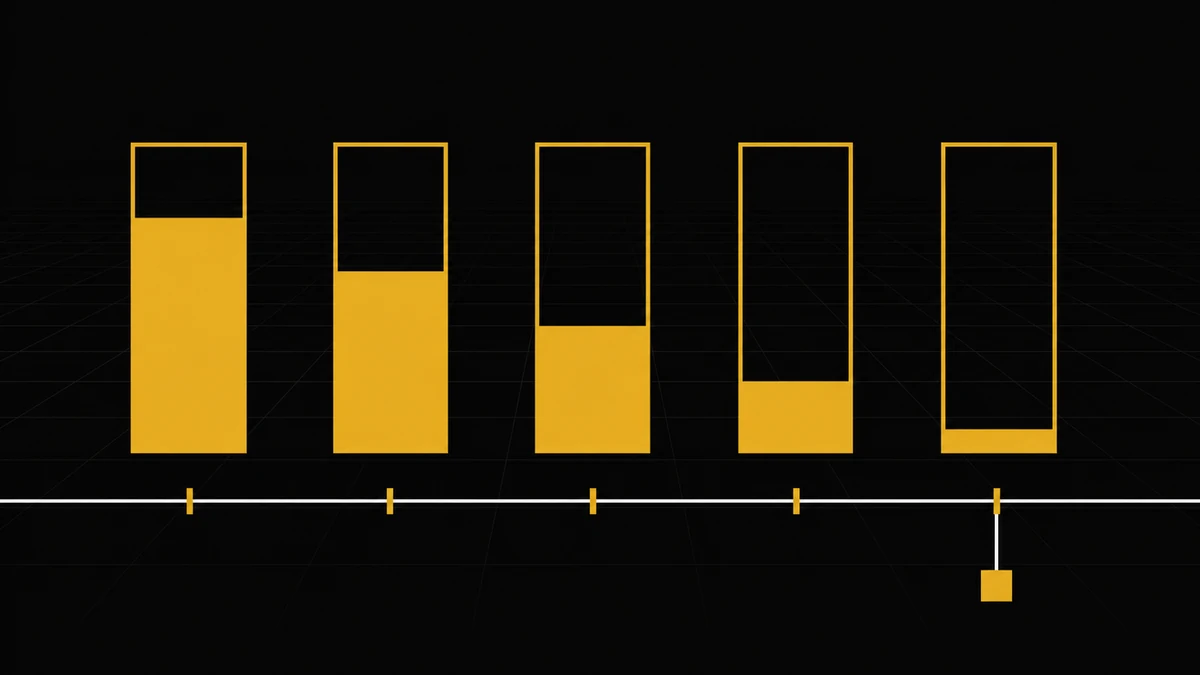
- The position is held against collateral. A margin account carries the equity supporting the position, and a maintenance requirement sets the floor below which the venue will close it. The gap between the two is the position's remaining tolerance.
- Each interval, the paying side has the payment taken from the account. Where the free balance covers it, equity falls by the amount paid. Where the free balance does not cover it, the payment comes out of the margin supporting the position itself. The venue-specific order in which those two are drawn on is documented on our funding page.
- Equity falls while the position size stays the same. Nothing about the exposure has changed. The only number that moved is the one measuring how much room the position has before the maintenance requirement is breached.
- The closure level moves towards the current price. Because the tolerance narrowed and the size did not, the price at which the venue would close the position sits nearer to where the market is trading than it did an interval ago.
- Repeat on the schedule, with no scheduled end. The payment recurs for as long as the position exists, and nothing in the contract creates a moment at which it stops. The narrowing is monotonic while the position stays on the paying side.
Run that far enough and the closure level reaches the market. The position is closed by the venue, having never been wrong about direction. The account on the receiving side of each interval sees the same arithmetic run the other way, which is the symmetry that makes the transfer a transfer.
Why it stays invisible until it happens
The two numbers a holder watches are the entry price and the current price, and in the scenario above neither of them moves. The number that moves is the third one, and interfaces typically present it as a field established at entry — a static-looking figure sitting beside two that visibly tick.
The second reason is a units problem. The chain runs on occasions rather than on exposure: what determines how much has been taken is the number of intervals the position survived, not the distance the price travelled. A position that sat still for weeks has paid at every interval in those weeks. A position that moved violently and closed the same day may have paid once. Nothing on a price chart encodes the first quantity.
It is worth separating this from the failure everybody already expects. A price-driven closure is legible: the market moved against the position and the loss is visible on the chart. The chain above produces the same outcome with none of that evidence, which is why it tends to be attributed to a venue error rather than to arithmetic that was running in plain sight.
Two responses change different things and it is worth being precise about which. Adding collateral restores the tolerance, moving the closure level away again; it does not touch the mechanism, and the narrowing resumes at the next interval. Reducing the position's size reduces the payment proportionally, because the payment scales with position value — so the rate at which the tolerance narrows scales with size too. Neither of these is a recommendation about what to do; they are the two levers the arithmetic actually has.
What this section is not
This is a property of the instrument, not an account of how a venue's closure engine works. The engines themselves — the maintenance formulas, the laddered sequences, the residual-absorption machinery and the differences between architectures — belong to the market structure comparison in this cluster, which the venue-type map below links.
It is also distinct from the general reader's treatment of the topic elsewhere on this site. Our liquidation protection strategies guide addresses lending collateral — borrowing against deposited assets — which is a different mechanism with a different trigger and no funding payment in it at all. It is a companion to this section rather than a deeper version of it, and the two should not be read as describing one thing.
The venue-type map: three architectures
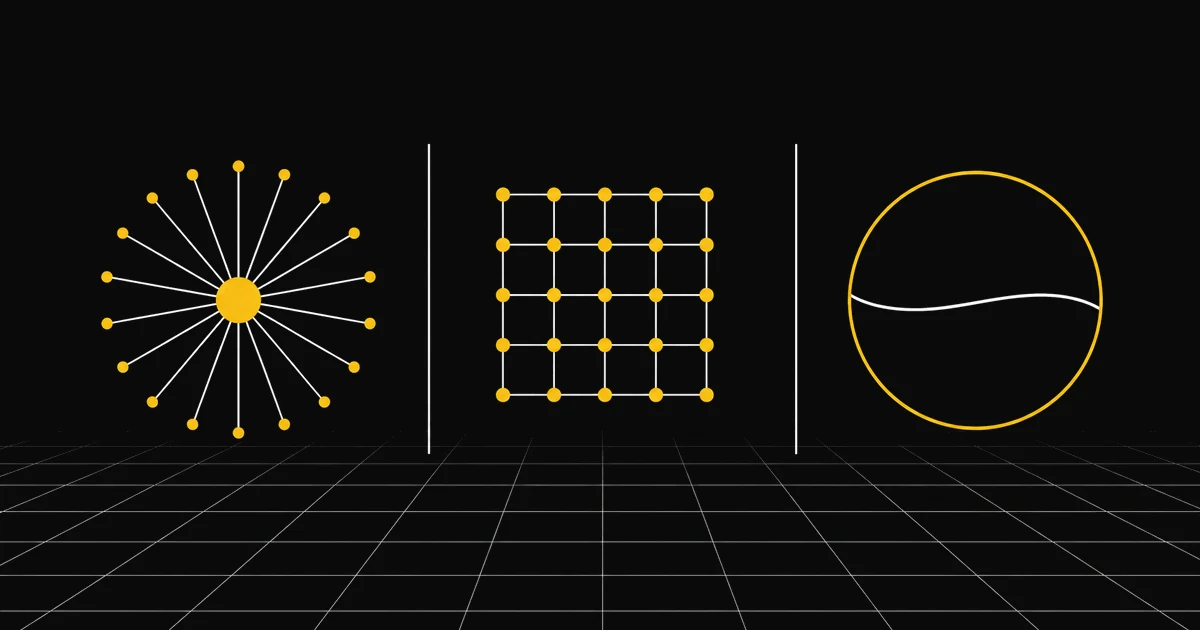
Perpetual contracts are listed on three structurally distinct kinds of venue. The taxonomy usually offered instead — centralised against decentralised — sorts venues by who runs them and tells a reader nothing about how a position behaves. The distinction that carries information is where the other side of a trade comes from, and on that axis there are three answers rather than two.
Three questions classify any venue in a minute, and all three are answerable from public documentation.
- Where does the other side come from? A resting order placed by another trader, or a pool of capital quoting a price and taking the trade itself.
- Where does matching physically happen? Inside an operator's engine, or as part of a chain's own state transitions.
- Where does the reference price come from? Compiled by the operator, or imported from outside and published on-chain. In both cases it is constructed rather than observed.
The centralised order book
The first architecture is an operator running a matching engine over customer orders. Balances are ledger entries with that same operator, a matched trade moves nothing on any chain, and the operator also compiles the reference price and runs the engine that closes positions. It is the oldest of the three and by far the largest by volume.
The structural consequence is concentration. One commercial group performs several functions that would sit with different parties in an exchange-and-clearing model, and the terms governing each function are written by that group. Our market structure comparison reads those documents function by function and reports where a venue's own texts disagree with each other.
What a book accepts from a trader is a separate topic, and the order types a venue supports determine how a position is entered and exited; our guide to exchange order types covers them.
The on-chain order book
The second architecture keeps the central limit order book but relocates it. The book, the matching and the margin state are part of a chain's own state rather than a service running beside it, so an order, a cancel and a closure are all state transitions rather than messages to a private engine.
This was treated as impractical for most of a decade for a reason worth stating precisely: a book is dominated by quote updates rather than trades, and a general-purpose settlement chain prices every message as though it carried economic intent. The venues that made it work did so by building the chain around the venue rather than deploying the venue onto a chain. General-purpose networks host a large derivatives market of other kinds, which our Layer 2 DeFi guide maps.
One property survives the relocation and surprises readers who changed venue to escape it: the reference price is still assembled from outside quotes. Matching moved on-chain; the price the position is margined against did not become native to the chain by moving there.
The oracle-priced pool
The third architecture has no book. A pool of capital quotes a price taken from an external reference and takes the other side of every position at that quote. There are no resting orders to match against and no queue to join, so a trade executes at the quoted reference rather than against another trader's limit price.
Two properties follow directly and they are the reasons the class deserves its own row. Depth is a property of the pool's capital rather than of orders sitting on a book, so what a venue can absorb is a balance-sheet question rather than a liquidity-at-price question. And the reference price is the execution price rather than a number used to margin against one, which makes the venue's exposure to a wrong reference direct rather than mediated by traders who would have to be willing to trade at the wrong level.
This guide classifies the architecture and names no venue running it. That is deliberate: the classification is stable and the roster of live implementations is not, and a hub that prints a name acquires a maintenance obligation it will fail quietly. A reader identifying a venue with these two properties has identified an instance of the class, whatever it is called.
The three architectures are not three points on one scale, and reading them as degrees of decentralisation loses the information the taxonomy carries. A pool-based venue can be more permissionless than an on-chain book while being more exposed to a single reference feed. Each architecture trades a different pair of properties against each other, which is why the classification is worth doing before the venue comparison rather than after it.
Where venue-level detail lives
Nothing above is a comparison of specific venues, and it deliberately carries no fee figures, leverage ceilings or contract counts. Side-by-side detail of that kind for two major centralised venues sits in our Bybit versus OKX comparison, which carries the figures with their reading dates.
Where these contracts are legally reachable
Access to these contracts is decided by law and by contract, and the two answers frequently differ. A prohibition binds a firm and follows from a rule. A block is a commercial decision recorded in a venue's terms. A reader who conflates them will be confidently wrong in either direction, and most published round-ups conflate them.
What follows is a five-row summary and nothing more. Each row is compressed to the point where trimming one further word would make it false, and none of them carries the qualifiers, dates and search bounds that a claim of this kind needs to be usable. Those live on our jurisdiction page, which reads each rule at source and prints the venue documents alongside the regulator's text where the two disagree. Everything summarised here was read at source on 13 August 2026.
The five rows
- United States. An onshore route exists on regulated venues and opened during June 2026, which is later than the regulatory date usually reported as the opening. The framework is subject to a live court challenge asking that it be vacated, undecided as at the date above.
- United Kingdom. The retail restriction binds firms acting in or from the UK and turns on client categorisation, so a professional client sits outside a restriction that a retail client sits inside. It is a rule about firms and client classes rather than about residence.
- European Union. A crypto-asset service authorisation is the wrong permission for these contracts, because instruments qualifying as financial instruments fall outside that regime entirely. The retail route that does exist in the European Economic Area carries an expiry date on the contract.
- Asia-Pacific. One regulator placed a decentralised venue and a centralised one on the same investor alert list nine days apart in June 2026. Jurisdictional exposure therefore attaches to how a venue is reached rather than to how it is built.
- Every jurisdiction. A product's commercial name has no bearing on its classification, and the test applied is the instrument's own terms — above all whether it carries an expiry date. One regulator has said that in terms, and it is worth knowing which. ESMA's public statement of 24 February 2026 records that the commercial name a firm uses, "perpetual futures" among them, is irrelevant to categorisation under MiFID II. The American documents of the same year do not carry an equivalent sentence: neither the CFTC's May 2026 policy statement on listing perpetual contracts nor the contract approvals beside it addresses what a product is called. So the naming point is a European statement that holds elsewhere by analogy, not a transatlantic consensus anyone has written down.
The two questions that decide a row
Both are answerable without legal training, and between them they resolve most of the confusion in this area.
The first is which class of customer the rule addresses. Several of the restrictions above are retail-facing measures that leave professional clients untouched, so the question is which class a reader falls into rather than whether a rule exists. Qualifying as a professional client removes a protection rather than granting a permission, which is the framing our jurisdiction page uses and the one that survives contact with the rule text.
The second is where the firm is acting from. Most prohibitions in this area bind the firm rather than the customer, which is why a change of address or a network route does not move a position out of scope.
Venue-level restrictions are a separate layer written into terms of service, and they can be narrower than the law, wider than it, or unrelated to it. Reading the contract rather than the help-centre article is the discipline that catches the difference, and our jurisdiction page records a case where the two surfaces gave different answers about the same venue and the same region.
Conclusion
The four contract classes on this page are held apart by four questions, and the first of them does most of the work. Does the contract end? A dated future does, and the expiry performs the convergence, the termination, the margin release and the scheduled review all at once. A perpetual does not, and it replaces exactly one of those four with a periodic payment. An option ends on a known date but splits the obligation, so the buyer's loss is bounded by the premium and the seller's is not. A synthetic has no counterparty position at all, and its risks belong to a collateral system rather than to a trader on the other side.
The disambiguation is worth restating in one line, because it is the most common error in published writing on this subject. A liquid-staking token is a redeemable claim on a deposit, single-sided, with no margin account behind it. A derivative contract is a claim on a price, holdable from either side, with a collateral requirement enforced by a venue. Sharing a word does not make them one product class, and treating the token as an instrument for offsetting an exposure is a mistake the arithmetic will not forgive.
The consequence chain is this guide's own contribution and the reason the taxonomy earns its length. Because the periodic payment is drawn from the collateral that keeps a position open, and because nothing in the contract schedules an end or a review, the payment can carry a position to closure with the reference price exactly where it started. It runs on the number of intervals survived rather than on the distance the market travelled, which is why nothing on a price chart records it and why the number it moves is the one that looks static on the screen.
Three habits carry across the whole subject. Classify the instrument before reading anything about the venue, because the class decides which risks exist. Check whether a contract has an expiry date before accepting the name on the product page, because a funding payment and an expiry together still make a dated future. And read the recurring event that comes with the class — the roll, the payment, the premium already spent, the collateral requirement — because the recurring event is what surprises holders rather than the direction of the market.
From here the cluster takes each part into depth: the funding calculation venue by venue, the market structure underneath the two order-book architectures, and the access question jurisdiction by jurisdiction with each rule read at source. Read the one that answers the question you arrived with.
Sources
- US CFTC — Policy Statement Concerning the Listing of Perpetual Contracts: the mechanism-based definition of a perpetual, and the contrast drawn with futures that rely on a fixed expiration date.
- ESMA — public statement of 24 February 2026 on derivatives in scope of the product intervention measures: the treatment of a product's commercial name as irrelevant to how the instrument is categorised.
- EUR-Lex — Regulation (EU) 2023/1114 on markets in crypto-assets: the Article 2(4)(a) exclusion of crypto-assets qualifying as financial instruments, which is why a crypto-asset service authorisation is the wrong permission here.
- FCA Handbook — COBS 22.6, the retail cryptoasset restrictions: the UK restriction as it applies to cryptoasset derivatives, and the client categories it addresses.
- Monetary Authority of Singapore — Investor Alert List: the register itself, including the two June 2026 entries nine days apart that the Asia-Pacific row rests on.
- Ethereum — staking documentation: what a staked position earns, and the withdrawal path that makes a liquid-staking token a redeemable claim rather than a contract on a price.
- Lido — protocol documentation: stETH as the token issued against deposited ETH, and the rebasing model in which the holder's balance changes as rewards accrue.
- Rocket Pool — protocol documentation: rETH as the value-accrual alternative, where the balance stays constant and the exchange rate against ETH rises instead.
Refresh audit, 21 September 2026
Every claim on this page that could be checked was put to a primary source before its freshness date, and each finding is recorded below whether or not it survived a second, adversarial check. The check was aimed at regulatory claims, where a summary sentence is the part most likely to have outrun its source. Of the findings raised, 1 were verified and corrected, 2 were refuted — meaning the page was already right and nothing changed — and 1 could not be settled either way. The refuted ones are listed too, so a later pass does not raise them a second time.
- Verified and corrected. “Every jurisdiction. A product's commercial name has no bearing on its classification....” esma.europa.eu
- Refuted, and nothing was changed. “Everything summarised here was read at source on 13 August 2026.” handbook.fca.org.uk
- Refuted, and nothing was changed. “Instruments of exactly that shape are listed in 2026, and our jurisdiction page identifies one...” cftc.gov
- Unsettled, left as written. “EUR-Lex — Regulation (EU) 2023/1114 on markets in crypto-assets: the Article 2(4)(a) exclusion...” eur-lex.europa.eu
Frequently asked questions
- What makes a contract a derivative rather than an asset?
- A derivative is a contract whose value is fixed by reference to another price, while the holder owns no claim on the referenced thing itself. Buying a token gives you the token. Buying a perpetual, a dated future or an option gives you a position whose settlement is computed from a reference price the contract names. Four properties separate the classes inside that definition: whether the contract has a termination date, whether both sides carry an obligation, what device holds the contract price to the reference, and whether a counterparty position exists at all.
- What is the difference between a perpetual and a dated future?
- The expiry, and everything the expiry was doing. A dated future terminates on a date fixed when it is listed and settles against its reference at that point, which is what draws the contract price and the reference together as the date approaches. A perpetual has no such date. It substitutes a periodic payment exchanged between the two sides for the convergence work the expiry performed, and substitutes nothing at all for the termination, the forced settlement and the scheduled roll. A contract carrying both a funding payment and an expiry date is a dated future, whatever it is called.
- Is stETH a derivative?
- Not in the sense this guide uses the word, and the collision of vocabulary is why the question keeps being asked. stETH and rETH are liquid-staking tokens: a protocol issues them against deposited ETH, and each represents that deposit plus the protocol rewards accrued on it, redeemable through the protocol's own withdrawal path. Published writing often calls them staking derivatives because the token is derived from a deposit. A perpetual, a dated future and an option are contracts deriving value from a reference price. One word, two unrelated product classes, and the clearer term for the first is liquid-staking token.
- Can a liquid-staking token be used to hedge a position?
- A liquid-staking token carries a single direction of exposure, which makes it the wrong instrument for that job. Holding stETH or rETH is holding staked ETH plus its reward stream; no side of that position gains when the reference falls, and there is no way to enter it inverted. Writing that files staking tokens under derivative markets and assigns them a hedging function has described the contract class by mistake. A liquid-staking token can sit behind a derivative position as collateral, which is a different role, and it is where the two ideas most often get fused into one sentence.
- Why does a perpetual contract have no expiry date?
- Because the design removes the termination event deliberately and pays for the consequence with a recurring payment. An expiry does four jobs at once: it draws the contract towards its reference, it ends the contract, it releases the margin, and it puts a scheduled decision in front of the holder. A perpetual replaces the first with a periodic payment sized by the gap between the contract and its reference, and replaces the other three with nothing. A position therefore persists until its holder closes it or the venue closes it, and no calendar event ever arrives to prompt a review.
- Can a position be liquidated by funding alone?
- Yes, and it is the least visible failure mode on the instrument. At each interval the account on the paying side has the payment taken from it, which lowers the account's equity while leaving the position's size unchanged. The distance between that equity and the maintenance requirement narrows by the amount paid, so the level at which the venue would close the position moves towards the current mark. Repeat that on a schedule for long enough, with the reference price flat throughout, and the two numbers meet. The entry price never moved, and neither did the market.
- What replaces the roll on a perpetual contract?
- Nothing does, and that absence is the part worth carrying away. A dated future forces a decision on a known date: settle, or open the next contract and pay the spread between them. The calendar performs the review whether or not the holder wants it. A perpetual has no such date, so a position stays open by default and is examined only when its holder chooses to look. The recurring payment continues throughout. A position with no scheduled end has no scheduled review, and the arithmetic of the payment runs for exactly as long as the inattention lasts.
- What venue architectures carry perpetual contracts?
- Three, and they differ in where the other side of a trade comes from. A centralised order book has an operator matching customer orders, holding the collateral as ledger balances and running the closure engine. An on-chain order book puts the book and the matching into a chain's own state, while still importing the reference price from outside. An oracle-priced pool has no book at all: a pool of capital quotes an external reference and takes the other side at that quote, so depth is a property of the pool's capital rather than of resting orders.
- How does a crypto option differ from a perpetual?
- An option splits the obligation, and it needs no funding device. The buyer pays a premium up front and holds a right to exercise; the seller carries the obligation to perform if it is exercised. On the venues covered across this site those contracts are European-style, meaning exercise happens at expiry rather than at any chosen moment before it. Because the contract terminates on a known date and the payoff at that date is defined against the strike, nothing has to be paid periodically to hold the price to its reference. The buyer's loss is bounded by the premium.
- Where can perpetual contracts legally be reached?
- The answer turns on which class of customer a rule addresses and where the firm is acting from, rather than on where a reader lives or how a venue is built. A United States route opened during June 2026 on regulated venues and is under a live court challenge. The United Kingdom restriction binds firms acting in or from the UK and separates retail from professional clients. In the European Union a crypto-asset service authorisation is the wrong permission for these contracts. Our jurisdiction page carries the rule text, the dates and the scope each of those sentences needs.
← Back to Crypto Investing Blog Index
Financial Disclaimer
This content is not financial advice. All information provided is for educational purposes only. Cryptocurrency investments carry significant investment risk, and past performance does not guarantee future results. Always do your own research and consult a qualified financial advisor before making investment decisions.