
Crypto Card Costs: Published vs Deferred
Neither of these cards is the transparent one. Across twenty-three cost items both issuers publish most of them — and each withholds a different kind of thing. Wirex withholds rates inside a clearly UK-scoped estate; Nexo publishes rates in an estate that never names the UK reader. On one line the gap is a cliff: what a purchase costs.
Introduction
Open Wirex's UK fee page and two lines sit a few rows apart. One tells you exactly what an ATM withdrawal costs: free up to 200 GBP a month, then 2% of the amount withdrawn. The other tells you that exchange rates vary depending on the currency pair and available liquidity, and that the associated fees can be viewed in the app.
Both are published by the same company about the same card. One is a number you can plan around; the other is a promise that a number exists somewhere else. That is the subject of this page.
Rate tables age badly, and most crypto card content is written as though the percentages were the point. What does not age is which costs an issuer commits to in public and which it defers until you are already in the app.
This page compares two cards on that basis. Every figure below is taken from the issuer's own published material, with the source listed at the end and the access date attached. Where a figure is not published, that absence is reported as a finding rather than filled in with an estimate — and an absence is only claimed after searching the issuer's whole published estate, because an earlier version of this article claimed one after reading two pages and was wrong.
What this is not: a recommendation of either card, or a conclusion that one is cheaper, because on the published evidence that cannot honestly be reached. Nor is it a rate list — the percentages here illustrate a structure and they will change. It is a method and a worked application of it, and if you take the method rather than the numbers, the page has done its job.
One more framing note before the detail. Two costs on this page fall on a UK reader that appear on no fee schedule anywhere: the tax treatment of spending crypto, and the administrative weight of recording it. They are set out towards the end, and for a reader who uses the card regularly they may be the largest items here.
Neither company is being held to a standard the other invented. The question asked of both is the same, and it is the one any reader would ask before signing up: if I spend a hundred pounds on this card tomorrow, can I find out today what that will cost me?
The frame that makes that question answerable is worth carrying away on its own. A crypto card takes money in four places — the conversion from your tokens into the merchant's currency, the ATM withdrawal, getting the card into your hand, and the plan or tier that sets the other three — and only one of them looks like a fee. Collapsed into a single impression of whether a card is cheap, they cannot be checked against anything. Kept apart, each can be held against what the issuer actually publishes, and a missing figure reads as a missing figure rather than as something you have not yet looked hard enough to find.
The Four Costs a Crypto Card Charges You
A crypto card takes money in four places, and only one looks like a fee. Separating them makes comparison possible.
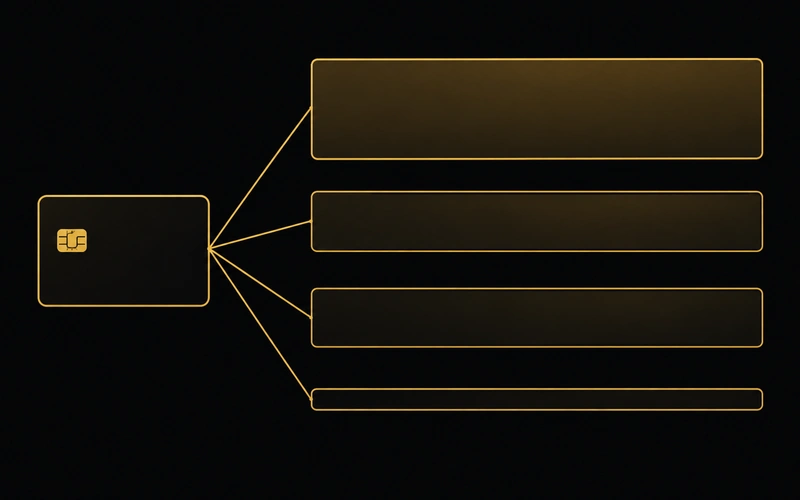
The conversion, which is usually the largest
When you tap a crypto card, something has to turn your tokens into the currency the merchant wants. That conversion carries a spread — the gap between the rate you get and the rate the market is quoting — and on a card used for ordinary shopping it is normally the biggest single cost. It is also the one least often stated as a percentage, because it moves.
Two things are folded into that single cost and it helps to keep them apart. There is the issuer's own margin on the conversion, and there is slippage: the amount the executed price differs from the quoted one because the order had to be filled against real liquidity. A published percentage typically covers the first; the second depends on the size of your transaction and the depth of the market for that pair at that moment.
The ATM withdrawal, which is the easiest to publish
Cash withdrawal is a fixed operation with a fixed cost, so it is the cost most likely to appear in a public table with a real number attached — usually a monthly free allowance followed by a percentage. It is the number card guides quote most often, partly because it is the number that exists.
Getting the card into your hand
Issuance, delivery and replacement are one-off costs, small relative to a year of spending and almost always published. A virtual card is generally free; a physical one costs whatever the courier costs.
What separating them buys you
Kept apart, these four costs can be checked one at a time against what an issuer publishes. Collapsed together into a single impression of whether a card is "cheap", they cannot, and that is how a card with an excellent ATM allowance and an undisclosed conversion spread comes to look like good value.
The monthly plan, which sets everything else
Wirex ties its reward rates and free allowances to a paid plan, so the plan fee is not a separate cost so much as the dial that moves the other three. Nexo works differently, and the difference matters: it has no subscription at all. Its Loyalty Tiers are set by the ratio of NEXO tokens to the rest of your portfolio, so the dial there is what you hold rather than what you pay.
What Wirex Publishes
Wirex's UK fee page is specific about the costs it commits to. For a reader in the United Kingdom, the figures below can be planned around before the card arrives.
- ATM withdrawals: free up to 200 GBP monthly, then 2% of the amount withdrawn
- Card issuance: free
- PIN change: free
- Virtual card: free, with no delivery step
- Plastic card: free to order, £5 delivery by Royal Mail within the United Kingdom, £15 by DHL Express internationally — though that figure carries a caveat on the source: deliveries outside Europe may cost more, and the applicable amount is shown in the app
- Metal card: £45 to order, with DHL Express delivery included at no extra charge
- Fiat deposits and withdrawals: bank transfer, SEPA and Faster Payments are all free
What that lets a UK reader work out
Enough for a whole class of decisions. Withdraw £300 in a month and you can compute the charge before you go: the first £200 free, the remaining £100 at 2%, so £2. A metal card is £45 with the courier included. Faster Payments funding is free. None of this requires opening the app, and Wirex meets the ordinary standard for these items.
What Wirex Withholds, Inside an Estate That Is Otherwise Well Drawn
At the top of the same page, above the tables quoted in the previous section, sits the exchange fee entry. It reads that Wirex taps into multiple liquidity sources to offer market-leading exchange rates, that the rates vary depending on the currency pair and available liquidity, and that associated fees can be viewed in the app.
There is no percentage, no range and no worked example. The cost that applies every time you buy something with the card is not one the fee page quantifies — and it is not the only one, which matters for how this page argues.
The full list, because a shorter one would be wrong
Reading Wirex's published material rather than one page of it, four costs are withheld from a UK reader. Naming all four is the point: an earlier draft of this article named three, and got every one of them wrong in one direction or the other.
- The conversion cost. No figure on any surface. This is the one that recurs with every purchase.
- The UK card top-up fee. The UK table gives the whole cell as “based on the top-up currency”; the global schedule says “0% or more”. Wirex published this until around 2023 — 3.24% for crypto, 1.99% for fiat — and then withdrew the figure.
- The delivery uplift outside Europe. Per-country prices are published to the currency unit, but a UK-origin order carries a possible uplift shown only in the app.
- The storage fee rate. Its existence is stated on UK pages; the rate appears only in the rest-of-world terms, where it runs to 0.20% of your crypto balance monthly and then 0.003 BTC per cryptoasset account per day after eighteen months.
Two things this article previously got wrong, corrected
Wirex does publish its list of ineligible Merchant Category Codes — forty-one numeric codes with descriptions, in a dedicated help-centre article, no login required. An earlier version of this page said the list was not public. That was false, and it was false because the claim was made after reading two pages and generalising to a fifty-page estate.
Wirex also publishes availability by country in a 250-row matrix with a dedicated card column. So the shape is not “Wirex publishes what is fixed and defers what varies by pair, country or merchant”. Country is published. Merchant is published. And the withheld card top-up fee is not a moving rate at all — it is a number Wirex used to print and stopped printing.
What the pattern actually is
Wirex has a genuinely UK-scoped estate: UK fee schedules, UK terms, UK reward caps, a UK row in the country matrix. What it withholds are rates, and it withholds them inside that well-drawn boundary. The reader knows exactly which document applies to them and finds an empty cell where the price should be.
On conversion specifically, Wirex is not silent so much as inconsistent. Its own Wirex One terms concede that “any associated mark-ups or fees will apply” on a foreign-currency transaction, while its card marketing advertises Zero FX Fees and its Australian product disclosure statement — a document a regulator requires to tabulate every fee — carries no currency-conversion row at all and says spending happens “with no exchange fees”.
What Nexo Publishes, in an Estate That Never Names You
Nexo takes the opposite approach on the cost that matters most. It publishes a foreign-exchange figure, and it does so by making the variable something a reader can look up rather than something only the app knows.
A rate that varies by the day of the week
- Weekdays, EEA / UK / Switzerland: 0.2%
- Weekends, EEA / UK / Switzerland: 0.7%, which is three and a half times the weekday rate
- Everywhere else: 2% on weekdays and 2.5% at weekends
The variable here is the calendar, and you own a calendar. A UK reader can work out the conversion cost of a Saturday purchase before making it, which is exactly the calculation Wirex defers.
Cash withdrawal, published by tier and in sterling
- Base: up to €200 / £180 free each month
- Silver: up to €400 / £360
- Gold: up to €1,000 / £900
- Platinum: up to €2,000 / £1,800
Past the allowance the charge is 2%, with a minimum of 1.99 in the withdrawal currency. Note the sterling column: a UK reader does not have to convert anything to know where they stand.
Where Nexo's estate stops short
It publishes rates and then declines to say who they apply to. Card processing is banded 1.99% for the EEA and 3.49% for non-EEA, and the United Kingdom sits in neither band — its own supported-country list names the UK separately from the EEA block. Card availability is never enumerated: “selected European countries, including the EEA and the United Kingdom, as well as Argentina, Brazil, and Mexico”, resolved only by an in-app eligibility check.
And every article in its help centre carries a footer saying the information is not intended for residents of the United Kingdom, on the same pages whose bodies name the United Kingdom as eligible. That is a legal disclaimer rather than a product exclusion, but a reader trying to establish where they stand meets it on every page.
One thing that is not a difference at all
Nexo publishes its own list of ineligible merchant category codes too — money transfer, ATM disbursements, investment platforms, brokers, real estate. Both card issuers publish this. It is worth saying plainly because this article once treated the merchant list as a point of contrast, and it is not one.
The Real Difference: Two Kinds of Incomplete
Put the two estates side by side against the same list of costs and the tidy story collapses. Across twenty-three cost items, both issuers publish most of them. Neither is the transparent one and neither is the opaque one.
What separates them is what kind of thing each withholds.
- Wirex withholds rates inside a well-drawn UK estate. You know which document applies to you; the price is missing from it.
- Nexo publishes rates in an estate that never names the UK reader. The price is there; whether it applies to you is not.
- Neither withholds what the other does. Both publish ATM terms in sterling, both publish a merchant exclusion list, both publish issuance and tier structures.
Each is complete on the axis where the other is incomplete, which is why comparing them on “transparency” produces nothing useful. A UK reader on Wirex can be certain the fee schedule is theirs and cannot price a purchase. A UK reader on Nexo can price a purchase and cannot be certain the card-processing band is theirs.
Where the asymmetry is real, it is a cliff
On one line the two genuinely diverge, and it is the line that recurs with every purchase. Nexo states 0.2% on weekdays and 0.7% at weekends. Wirex states no figure anywhere across fifty-one published surfaces — help centre, global and regional terms, the legal estate, a regulator-mandated disclosure document — while conceding in its own card terms that a mark-up exists.
That is not a lean in one direction. It is one issuer answering the question and the other not answering it, on the single cost that dominates ordinary spending.
The same split runs through the legal layer
The pattern is not confined to prices. Nexo's terms of service open by stating that they do not apply to residents of the EEA, Switzerland, the United Kingdom or the United States, and refer the reader to “the relevant terms for your jurisdiction” without saying where those are. The document is detailed and precise; it simply is not addressed to a UK reader, and the one that is could not be located.
Neither vendor is hiding anything. Each is complete on the axis where the other is not — in fees, in limits, and now in law.
Who Actually Funds the Cashback
Card rewards are not a gift from the issuer, and understanding where the money comes from explains most of what looks arbitrary about reward programmes.
Interchange, in one paragraph
Every time a card is used, the merchant's bank pays a fee to the card issuer's side of the transaction. That fee is called interchange, set by the card network as a fraction of the payment. In the United Kingdom and the EEA it is capped by regulation at 0.2% on debit and 0.3% on credit, which is worth holding onto: an 8% headline reward cannot be funded from a 0.2% inflow. Interchange is a contribution, not the source.
Three things that follow from it
Once you know where the money comes from, several features of card programmes stop looking like marketing decisions.
- Rates track tiers, not purchases. Your reward depends on the tier you hold, because the tier is what the issuer is selling.
- Some merchant categories pay little or no interchange. That is why exclusion lists exist at all, and why they are keyed to Merchant Category Codes rather than to what you bought.
- Cash withdrawals sit outside the reward programme for a different reason. They do carry their own interchange, but the issuer is already charging you an ATM fee, so paying a reward on top would be paying you out of a charge you also paid.
This is also why a headline rate can rise while the practical yield falls. Raising a percentage costs the issuer nothing if the caps, tiers and excluded categories do the work of holding the payout down.
Why crypto cards sit under extra pressure
A crypto card issuer has a cost a conventional one does not: it must convert your tokens into the currency the merchant is paid in, every time, and carry the market risk of doing so. With interchange capped at 0.2%, the funding has to come from the conversion spread or the tier — which makes the spread the natural home of a crypto card's economics, and it is exactly the figure hardest to publish as a fixed number. Commercial pressure and disclosure difficulty point at the same line in the table.
It also explains why crypto card rewards are so often paid in the issuer's own token rather than in cash. A reward paid in WXT or NEXO costs the issuer something quite different from a reward paid in sterling, and its value to you depends on a price neither of you controls. That is a genuine difference in kind from a cashback card that pays pounds.
Reward Rates With Their Conditions Attached
Both cards advertise a headline percentage. Both are real and neither is what a typical holder earns, because each sits at the top of a structure.
Wirex: 8% is the Elite Ultimate tier
Wirex publishes eight Cryptoback tiers across three plans. Standard pays 0.5% at Entry and 1% at Enhanced. Premium pays 1%, 2% and 3% across Entry, Enhanced and Ultimate. Elite pays 4%, 6% and 8% across the same three. The advertised 8% is the last of those eight.
Each tier also carries two caps, one per transaction and one per month, both denominated in WXT. Standard Entry is capped at 100 WXT per transaction and 10,000 monthly; Elite Ultimate at 9,000 and 250,000. Rewards are paid in WXT, so the value of a reward also depends on what WXT is worth when you receive it.
Nexo: 2% needs four conditions at once
Nexo's headline requires the Platinum loyalty tier, an account balance above $5,000, payout taken in NEXO tokens rather than Bitcoin, and — the condition most easily missed — that the card is used in Credit Mode. Taken in Bitcoin the ceiling is 0.5%. By tier the schedule runs Platinum 2% or 0.5%, Gold 1% or 0.3%, Silver 0.7% or 0.2%, and Base 0.5% or 0.1%.
What earns nothing on either card
Wirex states that Cryptoback rewards are available for in-store and online payments and exclude ATM withdrawals, peer-to-peer fund transfers and tax payments — three of at least eight exclusion categories it names across its help centre. The tax exclusion is worth pausing on: a card marketed on rewarding your spending does not reward the largest scheduled payment many people make in a year.
Transactions on Wirex's list of ineligible Merchant Category Codes earn nothing either, and that list is published — forty-one codes with descriptions, in its own help-centre article. Nexo publishes an equivalent list. A purchase can therefore be checked against it beforehand, which is the opposite of what an earlier version of this page claimed.
A Worked Year, With the Arithmetic Shown
Take a specific reader: someone in the United Kingdom who puts £800 a month through the card and withdraws £300 in cash. For the same arithmetic on earning, our passive income case study runs a year through real figures. That is £9,600 of spending and £3,600 of withdrawals a year. Both cards can be pushed some distance through the calculation, and one stops partway.

The withdrawals, which both cards let you compute
On Wirex, the first £200 each month is free and the remaining £100 costs 2%, so £2 a month and £24 across the year. That figure is fully determined by the published table; nothing about it depends on what the market is doing.
On Nexo the allowance depends on your loyalty tier, and it is published in sterling as well as euros. At Base the free allowance is £180, so a £300 withdrawal puts £120 past it at 2% — £2.40 a month, £28.80 a year. At Gold the allowance is £900 and the whole £300 falls inside it, so the annual cost is nothing. No conversion is needed to reach either figure.
The spending, where the two cards part company
On Nexo the conversion cost is published, so the calculation completes. A UK resident pays 0.2% on weekdays and 0.7% at weekends. If our reader's £9,600 splits roughly three-quarters weekday and one-quarter weekend, that is about £14 plus about £17, so somewhere near £31 for the year.
Quarrel with the weekday split if you like; the point survives it. Every input is something you know or can estimate, without opening the app.
On Wirex the same calculation cannot be started. There is no percentage to multiply £9,600 by, no range to bound it with, and no worked example to reason from.
What the gap is worth
Consider a plausible spread. On £9,600, 0.5% is £48; 1.5% is £144; 2.5% is £240. Those are not Wirex figures and this page does not claim they are — they show what an unpublished number does to an annual total. The spread between them is roughly £190, against £24 of ATM charges the table states precisely — the quantified cost an order of magnitude below the deferred one.
Add the reward side and the picture does not resolve, it complicates. Our reader's rewards depend on their plan tier and on the value of WXT when the reward arrives. The merchant-code list is published, so that input is knowable in advance — which leaves two unknowns on the earning side against one that dominates the paying side.
The reward side, run through the same £9,600
The tier figures are published, so this part can at least be started. On Wirex's Standard plan at Entry level the rate is 0.5%, which on £9,600 is £48 across the year. At the Elite Ultimate tier the rate is 8%, which on the same spending is £768.
The gap between those two numbers is the whole reason the tier question matters more than the headline. A reader who sees "up to 8%" and assumes something near it is out by a factor of sixteen if they are actually on the entry tier.
On Nexo the same £9,600 earns £192 at the Platinum rate of 2%, or £48 at the 0.5% Bitcoin rate. But the Platinum figure needs the loyalty tier, a balance above $5,000, payout in NEXO and the card in Credit Mode, so it describes a fairly specific reader rather than a typical one.
Both reward figures are softer than they look: caps bite before the rate does, excluded purchases earn nothing, and the payout arrives in WXT or NEXO, so its sterling value is not fixed until you convert. A reader working out whether the card pays for itself is short a number on both halves of the sum.
Credit Mode Is a Loan, and a Loan Has Its Own Price
Nexo's card runs in two modes, and the difference between them is larger than any fee on this page. It is easy to miss because both modes are the same piece of plastic and the fee schedule presents them together.
What each mode actually does
In Debit Mode you spend your own digital assets: they are sold to fund the purchase and leave your account. In Credit Mode you sell nothing — the crypto serves as collateral for a loan, and what you spend is borrowed fiat.
That distinction drives the tax treatment, as the tax section sets out.
The cost that lives in a different document
A borrowed balance accrues interest, and interest is a lending term rather than a card fee. So a reader comparing crypto cards on their fee schedules may be reading the wrong document — but that depends on the issuer. Nexo prints the borrowing cost on the card page itself: credit lines starting from 1.9% interest. Wirex does not: its dedicated article on interest says only that rates “will vary based on the currency you choose to borrow”.
The figure to look for is the rate on the credit line. Comparing a borrow-and-spend card against an ordinary credit card means comparing that rate against an APR, and comparing it against selling your own assets means weighing it against the return you expect from continuing to hold them. On this item the two issuers sit the opposite way round from the conversion cost — which is the clearest sign that neither is simply the transparent one.
This is not a criticism of how Nexo has organised its documentation — a loan genuinely is a separate product with separate terms. It is a warning about a specific reading error: concluding that Credit Mode is cheaper because the card's fee table shows no charge for it.
The collateral is the part that moves
A loan secured against crypto has a feature a loan secured against a salary does not: the security can lose value quickly. If the collateral falls far enough, the platform can sell it to protect the loan, on its schedule rather than yours.
For a UK resident, a forced sale of collateral is still a disposal, so it can produce a tax event at a moment you did not choose. That is the sharpest version of this page's general point. The costs that are easiest to publish are the ones that are fixed, and the costs that matter most are the ones that move.
None of this makes borrowing a bad choice. It simply means the relevant comparison is against other credit, on interest and collateral terms, not against another card's exchange fee.
What You Cannot Work Out in Advance
Suppose you want to know what spending £500 on a Wirex card will cost. The merchant list you can check and the reward cap you can look up; the conversion spread you cannot, and it is the largest of the three. One missing input is enough — the total can only be observed afterwards.
What to do about it, practically
- Test with a small amount first. A single deliberate purchase reveals the spread you actually receive, which is the number no table will give you.
- Compare the rate you got against the market rate at that moment. The difference is the real cost, and it is the only way to measure it on a card that publishes no figure.
- Check the reward actually landed. If it did not, the merchant category was probably ineligible, and you have learned something the published material would not have told you.
- Keep the plan fee in the arithmetic. A higher tier pays for itself only above a spending level you should calculate rather than assume.
One shortcut is worth knowing. If the conversion cost is the figure you cannot obtain, convert to fiat on the exchange first and spend that. It puts the rate in front of you before you commit, at the price of an extra step.
Whether that trade is worth making depends on how much you spend and how much you mind the friction. It is at least a decision you can make deliberately, which is more than can be said for a spread you only see afterwards.
None of this criticises either card. It describes what each lets you know before you decide, which is not the same as whether it is good value.
How to Read Any Crypto Card's Fee Page
Both cards on this page will change their terms, probably before this article is a year old. What will not change is the method, because it asks about the shape of a fee page rather than the numbers on it. Four questions get you most of the way.
First: is the conversion cost a number or a promise?
Find the line about exchange rates or foreign exchange and check whether it contains a figure. If it gives you a percentage, or a rule keyed to something you can observe such as the day of the week, you can budget. If it says rates vary and refers you to the app, you cannot, and no amount of reading further will change that.
This one question separates the two cards discussed here more sharply than any comparison of their reward rates.
Second: what is the headline rate actually attached to?
Advertised reward percentages are almost always the top of a structure. Read for the tier that carries it, what that tier requires, the payout currency and the caps. A rate that survives all four intact is unusual.
Third: which purchases are excluded, and is the list published?
Every programme has exclusions, and the ordinary ones are predictable. The question is whether the list is published in full or referred to as a category you cannot enumerate. Both issuers here publish theirs — the answer you want, and not the one this article originally assumed.
Fourth: which kind of thing is missing?
Do not count deferrals — that is the mistake this article made. Ask what sort of gap it is. A missing rate inside a document clearly addressed to you is a different problem from a published rate in a document that never says whether you are covered.
Notice that the method never required deciding which card is better. It produces something more durable: an account of which questions each card lets you answer before you commit, and which only after.
Who Can Actually Get One
Price comparisons assume both options are available to you, and with crypto cards that assumption often fails first. Eligibility is settled by residency, and checking it can make the rest of the analysis moot.
The brand on the card is not always the licence behind it
Nexo's card is issued by DiPocket UAB rather than by Nexo itself — a normal arrangement, where a crypto platform partners with a licensed electronic money institution that holds the regulatory permissions.
It matters for one practical reason: the consumer protections on the payment side come from the issuer's licence and its regulator, not from the crypto platform whose name is on the card. Two sets of rules, two halves of one product.
Geography narrows the field early
Wirex publishes a 250-row availability matrix with a dedicated card column, so the question has a published answer. Nexo does not enumerate: its card covers “selected European countries” plus Argentina, Brazil and Mexico, resolved by an in-app eligibility check. That is the axis difference again, on the most basic question of all.
What to confirm before comparing anything
- Residency: whether the card is issued in your country at all, which is a yes-or-no question and the cheapest one to answer
- The fee page for your region: figures quoted in one currency for one market may not be the ones that apply to you
- The issuing entity: who holds the licence, since that determines which regulator stands behind the payment side
- Tier availability: whether the plan carrying the headline reward rate is offered where you live
Answering these four first costs a few minutes and occasionally removes the need for the rest of the exercise entirely.
Where Your Assets Actually Sit
A crypto card only works if the issuer can reach your assets at the moment you pay. That requirement has a consequence which appears on no fee page: the funding balance has to be in the platform's custody, not in a wallet you control.

Custodial by construction
On both cards discussed here, the cryptocurrency backing your spending is held by the platform. You do not hold the private keys to it. This is not a design flaw — a card that had to wait for you to sign a blockchain transaction at the till would not function as a payment card at all.
It does mean the familiar advice about self-custody is in direct tension with using a card — not absolutely; our Simple review covers the exception: a card spending from keys you hold. Assets in a wallet whose private key you control cannot be spent at a card terminal, and assets that can be spent at a card terminal are in someone else's custody. You cannot have both properties for the same coins at the same time.
The trade-off is a balance question, not an all-or-nothing one. Fund the card with what you intend to spend, keep long-term holdings in a wallet you control, and treat the card balance the way you treat cash in a current account.
Centralised, and settled off-chain
The vocabulary overlaps with DeFi and the mechanics do not. Borrowing against collateral in DeFi means interacting with a lending protocol whose rules execute as a smart contract you can inspect; borrowing through a card platform means an agreement with a company, governed by its terms. Neither is safer in the abstract, but the risks differ in kind.
And no blockchain transaction happens at the till: the card network moves fiat between banks as it would for any card. What you can verify is what the platform reports to you, which is why the export-your-history habit in the tax section is worth acquiring early.
The Costs That Are Not Fees at All
Three further costs attach to a crypto card, and none of them will ever appear in a fee schedule, because none of them is a fee. They are consequences of how the product works.
The gap between tapping and settling
A card payment is not one event: there is an authorisation when you tap and a settlement afterwards. On a crypto card something has to be sold in between, and the price at settlement is not necessarily the price at authorisation. For a small purchase this is noise; for a large one during a volatile session it is not, and no percentage in any table describes it, because it depends on the market rather than the issuer.
A reward you cannot spend is not yet a reward
Both cards here pay rewards in their own token: Wirex in WXT, Nexo in NEXO at the higher rate. Between the moment a reward lands and the moment you convert it, its value moves with that token's price, and you carry that movement.
So a 2% reward in a token is not comparable to 2% in sterling. If the token falls you did worse than the headline; if it rises, better. The point is that the headline is not the number, in either direction.
A paid plan is an annual commitment, and only one of these cards has one
On Wirex, reward tiers are attached to paid plans, and the arithmetic on a plan only works above a certain level of spending. Below that level you are paying a subscription to earn rewards worth less than the subscription. On Nexo there is no subscription to break even against: the tier is set by how much NEXO you hold relative to the rest of your portfolio, which is a capital commitment rather than a fee, and it carries its own price in the form of exposure to that token.
Compute the break-even before upgrading, not after: the extra reward percentage times what you actually spend in a year, against twelve months of fee. If the answer is close, the tier is not paying for itself — the reward side carries caps and exclusions while the fee side carries neither.
Tax: The Cost the Fee Table Does Not Show
For a reader tax resident in the United Kingdom, there is a cost to card spending that appears in no fee schedule, and it can exceed the fees discussed above.
Spending crypto is a disposal, and here is how we know
HMRC lists "using tokens to pay for goods or services" among the disposals in CRYPTO22100, and paying a merchant with crypto at the point of sale is such a payment. So for a UK resident, that spend is a disposal and a Capital Gains Tax event arises on the movement since acquisition.
Note what this is: a deduction from a general rule, not a ruling about cards — CRYPTO22100 names the category of transaction, not the payment method. The rule is stated in general terms and the card is one way of triggering it, which is a weaker and more honest claim than saying the regulator has ruled on crypto cards.
Every purchase is its own disposal
The consequence of the rule above is easy to state and easy to underestimate. If spending crypto is a disposal, then a card used for daily purchases produces a disposal every time it is tapped. A coffee is a disposal. A weekly shop is a disposal.
Each one needs the same treatment as any other: the value in pounds at the moment of the transaction, the cost basis of the tokens spent, and the gain or loss between them. A card used two hundred times in a year generates two hundred of these.
This is not a tax charge, and for small everyday amounts the gains involved are often trivial. It is an administrative cost, and it is the one most likely to be discovered late, because nothing in the card's own interface presents it as something you owe attention to.
It also argues for exporting your transaction history regularly rather than at year end. The figures you need are your own records, and a platform that changes its export format, or your access to it, is a problem you would rather meet in March than in January.
A card that spends borrowed money is a different case
Nexo's card runs in two modes and the tax position differs between them. In Credit Mode you borrow against your crypto and spend the borrowed fiat, and drawing a loan is not a disposal, so for a UK resident no capital gains event arises at the till. In Debit Mode you spend your digital assets directly, which is a disposal on the reasoning above.
Whether transferring crypto as collateral is itself a disposal depends on the platform's terms, and HMRC's guidance on that question turns on whether the platform may deal with the collateral as it wishes. We have not been able to read Nexo's collateral clause, so no position is stated on that step here.
And the reward itself
In the United Kingdom, HMRC has published no guidance specific to crypto card cashback. That is a narrow gap rather than a vacuum: HMRC has published a general treatment of cashback, and for a private customer its two halves point the same way. BIM100210 says a customer not carrying on a trade who takes their business to one provider rather than another is “not providing that concern with a recognisable service such as to bring them within the scope of the miscellaneous income sweep-up provisions”. CG13027 says a cashback of that kind “is NOT a capital sum derived from an asset, TCGA92/S22 (1), and is not chargeable to Capital Gains Tax”.
So for a UK resident who is not trading, the deduction is that ordinary card cashback is neither miscellaneous income nor a chargeable gain when it arrives. What the general rule does not settle is this page’s own case: CG13027 reasons about a cash sum paid by a financial institution, and a crypto reward arrives as an asset, carrying an acquisition and a later disposal that a cash rebate does not. Keep the date and the GBP value of every reward — under the rule it sets your base cost for a later disposal as a UK resident, and under the open question it is what any position you take will need. Our fuller treatment sits in the crypto cashback guide, and the general UK position is in the crypto taxes guide.
Your position follows from where you are tax resident, not from where the card is licensed. If you are not a UK resident, take these questions to your own tax authority: treatments differ between countries and no single answer covers them.
What a Publication Choice Tells You, and What It Does Not
It would be easy to finish this page with an accusation, and the evidence does not support one. A live exchange rate genuinely does move, a published figure would genuinely be stale within the hour, and directing a user to the app is a reasonable engineering answer to a real problem.
The weaker claim, which is the one the evidence carries
What the evidence supports is narrower than a pattern. An issuer that publishes a figure has committed to it: you can quote it back, plan against it, and notice when it changes. An issuer that defers has made no such commitment, whatever its reasons. That holds one item at a time and does not aggregate into a character judgement about either company.
Nexo's approach shows the problem has a solution. Keying the rate to the day of the week rather than to the transaction gives up some precision and gains something a reader can use. That is a design choice available to anyone, which is why its absence elsewhere is worth noticing without being worth condemning — and Nexo forgoes it on a different item, by pricing card processing for the EEA and for non-EEA while leaving the United Kingdom in neither band.
Where this generalises
The test transfers beyond cards. Any provider chooses where to draw the line between what it states and what it reserves, and reading for that line is faster than reading for the numbers — it also stays valid when the numbers change. Numbers tell you what something costs today; the line tells you what you will be able to find out tomorrow.
A note on how this page was checked
Every figure here was read from the issuer's own material on the dates given in the sources, and figures we could not confirm were left out rather than estimated. Where this page reasons rather than reports — the range of plausible conversion costs, the interchange explanation — it says so in the sentence that does it. Claims of absence were made only after searching each issuer's whole published estate: fifty-one surfaces for Wirex, thirty-three for Nexo.
That is worth stating because the subject rewards it, and because an earlier version of this page failed the standard. It claimed Wirex's ineligible-merchant list was unpublished after reading two pages of a fifty-page estate. The list is published. A page arguing that disclosure matters should be legible about its own, including when its own has been wrong.
Conclusion
The useful comparison between these two cards is not which pays more. It is which one lets you know what you are paying before you pay it.
Both publish their ATM terms in your own currency. Both publish their merchant exclusion lists. Both publish issuance, delivery and tier structures. Wirex leaves rates blank inside an estate that is otherwise clearly scoped to a UK reader; Nexo prints rates in an estate that never quite says the UK reader is the one they apply to. Only one publishes the cost of buying something, and that single line is where the difference stops being academic.
Reward headlines deserve the same treatment. Wirex's 8% is the Elite Ultimate tier with per-transaction and monthly caps in WXT; Nexo's 2% needs Platinum, a $5,000 balance, Credit Mode and payout in NEXO, falling to 0.5% in Bitcoin. Neither is wrong to advertise its ceiling. Both are worth reading with the conditions restored.
If you take one operational habit from this page, make it the small test purchase. On a card that publishes no spread, comparing the rate you received against the market rate at that moment is the only measurement available, and it takes one transaction to obtain.
If you take one analytical habit, make it the four questions in the method section. They survive a change of tariff, they apply to products that are not cards at all, and they can be answered from a provider's own website in the time it takes to read a fee table properly.
And if you take one number, do not make it a reward percentage. On Wirex, make it the break-even on your plan: the extra reward rate multiplied by what you genuinely spend in a year, set against twelve months of subscription. On Nexo there is no subscription to break even against, so the equivalent question is what holding enough NEXO to reach your tier exposes you to. Both are calculations you can do from what you already know.
For a UK resident, the tax position is part of the cost and does not appear on any fee page. Our detailed platform notes are in the Wirex review and the Nexo review.
One caution about the shelf life of everything above. Rates move, tiers get renamed, and a card that publishes its spread today may stop — or start. What does not move is the shape: the cost that is hardest to publish is the one that varies, and the cost that is easiest to publish is the one that does not. An issuer printing the easy numbers while deferring the hard one is not necessarily hiding anything, but it is asking you to accept a figure you cannot check. So treat a re-read of the fee page as part of the annual cost of holding the card, and do it before your plan renews rather than after. The tariff you chose when you signed up is not reliably the tariff you are on today, and no issuer will announce the drift for you.
Sources
Every figure on this page comes from the issuer's own published material. Access dates are given because fee schedules change and both issuers say so on the pages themselves.
- Wirex Fees (UK) — ATM, issuance, delivery and the exchange-fee entry. Accessed 4 September 2026.
- Wirex's Cryptoback rewards explained — the eight-tier table, the caps and the exclusions. Accessed 4 September 2026.
- Nexo Crypto Card — the two modes, the foreign-exchange schedule, the ATM allowances, the cashback conditions and the issuer. Accessed 3 September 2026.
- HMRC Business Income Manual, BIM100210 — cash-backs and the miscellaneous income sweep-up. Accessed 4 September 2026.
- HMRC Capital Gains Manual, CG13027 — cashbacks and TCGA92/S22 (1). Accessed 4 September 2026.
- HMRC Employment Income Manual, EIM21618 — air miles and credit card points. Accessed 4 September 2026.
- HMRC Cryptoassets Manual, CRYPTO22100 — what constitutes a disposal. Accessed 3 September 2026.
Frequently Asked Questions
- Can I work out what a crypto card purchase will cost me before I make it?
- With Wirex, no. Its published UK fee table gives a figure for ATM withdrawals and gives none for the conversion that happens when you buy something: the rates vary by currency pair and available liquidity, and the associated fees are shown in the app. With Nexo you can, because it publishes a foreign-exchange figure that varies by day of the week rather than by transaction. That difference is the practical one between the two cards.
- What does the 8% Cryptoback headline actually require?
- The Elite Ultimate tier. Wirex publishes eight tiers across three plans: Standard pays 0.5% and 1%, Premium pays 1%, 2% and 3%, and Elite pays 4%, 6% and 8%. Each tier also carries a per-transaction and monthly cap in WXT, so the headline rate is a ceiling on a ceiling rather than a rate you earn by default.
- Which card purchases earn no cashback at all?
- Wirex excludes ATM withdrawals, peer-to-peer transfers and tax payments — three of at least eight categories it names. Transactions on its ineligible Merchant Category Code list earn nothing either, and that list is published in full: forty-one codes with descriptions. Nexo publishes an equivalent list. So exclusions can be checked before you buy, on either card.
- Is spending crypto on a card a taxable event in the UK?
- For a UK resident, yes, and it is worth being precise about how we know. HMRC lists using tokens to pay for goods or services among the disposals in CRYPTO22100, and spending crypto at the point of sale is such a payment. That is a deduction from a general rule, not a ruling about cards: CRYPTO22100 names the category of transaction, not the payment method. Your own position follows from where you are tax resident, so a reader resident elsewhere should take the question to their own tax authority.
- Which of the two cards is cheaper overall?
- That question cannot be settled from published figures, and the reason is the finding rather than a dodge. For a typical spending pattern the conversion cost dominates the total, Nexo publishes that figure and Wirex refers you to the app, so one side of the comparison has no number in it. What can be said is narrower and still useful: Nexo lets a UK reader calculate the cost of a purchase in advance, and Wirex does not.
- Would I be better off converting to fiat first and spending that?
- Often. Converting on the exchange first lets you see the rate and decide whether to accept it — the control a card takes away by converting at the moment of purchase. The trade is convenience against visibility, and where the card's conversion cost is unpublished, converting first is the only way to know what it cost you.
- Does a card that spends a borrowed balance work the same way?
- No, and the difference matters more than the fee table does. Nexo's card runs in two modes: in Credit Mode you borrow against your crypto and spend the borrowed fiat, and drawing a loan is not a disposal, so for a UK resident no capital gains event arises at the till. In Debit Mode you spend the assets directly, which is a disposal. Whether transferring crypto as collateral is itself a disposal depends on the platform's terms and is not settled here.
- Who actually issues these cards, and does that change who protects me?
- Often, yes. Nexo's card is issued by DiPocket UAB rather than by Nexo itself, which is a normal arrangement: a crypto platform partners with a licensed electronic money institution that already holds the payment permissions. The practical consequence is that your consumer protections on the payment side come from the issuer's licence and its regulator, not from the crypto platform whose name is printed on the card. Two sets of rules sit behind one product, and only one of them is the brand you recognise. Confirm which entity issues the card in your country before you rely on a protection you have assumed you have.
- Can I keep my crypto in self-custody while using it to fund a card?
- On both cards compared here, no — not for the same coins at the same time. A card only works if the issuer can reach your assets at the instant you pay, so the funding balance sits in the platform's custody and you do not hold its private keys. That is not a design flaw: a card that had to wait for you to sign a blockchain transaction at the till would not function as a payment card at all. Exceptions exist in the wider market, but for these two the honest framing is a balance question rather than an all-or-nothing one. Fund the card with what you intend to spend, and keep long-term holdings in a wallet you control.
- Why is the conversion cost so rarely given as a percentage?
- Because it moves, and because two different things are folded into it. When you tap the card, your tokens have to become the currency the merchant wants, and that conversion carries a spread: the gap between the rate you get and the rate the market is quoting. Part of that spread is the issuer's own margin, which is a policy and could be published. Part is slippage — how far the executed price lands from the quoted one, which depends on the size of your transaction and the depth of the market for that pair at that moment. A published percentage normally covers the margin only. On a card that publishes neither, a small test purchase measured against the market rate is the only figure you can actually obtain.
← Back to Crypto Investing Blog Index
Financial Disclaimer
This content is not financial advice. All information provided is for educational purposes only. Cryptocurrency investments carry significant investment risk, and past performance does not guarantee future results. Always do your own research and consult a qualified financial advisor before making investment decisions.