How to Minimise Crypto Exchange Fees in 2026

Four fee-management tactics explained through dated schedules and worked examples.
Introduction
Fees are the silent tax on every crypto transaction. A 0.10% trading fee sounds negligible — until you realise that £5,000 in monthly spot trading volume costs you £60 per year in maker/taker fees alone. An active trader doing £50,000/month pays £600 in trading fees before touching a single withdrawal. Add blockchain network fees for withdrawals (roughly £0.02–0.05 per transaction on Ethereum mainnet at the gas prices of 1 November 2026, or a Layer 2 like Arbitrum), card deposit markups, and the spread embedded in Convert features, and the total cost of using a centralised exchange comes directly out of your portfolio returns.
Most exchange marketing pages advertise headline rates like "0.10% fees" without mentioning that this applies only to spot trading on limit orders. If you use market orders, you pay the taker rate. If you deposit via debit card, you pay 1.8% on top. If you withdraw BTC, distinguish the network component from the exchange's own quoted charge; the amount depends on the route and provider. If you swap between altcoins using the Simple Convert feature instead of the order book, the exchange bakes a 0.1-0.5% spread into the exchange rate — invisible unless you compare the quoted rate against the mid-market price on a tool like CoinGecko or TradingView.
This guide explains trading, deposit, withdrawal and conversion costs and four fee-management tactics, using dated exchange schedules and network-cost examples. On 1 November 2026, Kraken Pro's entry tier listed a 0.40% maker fee and a 0.80% taker fee. On the Coinbase Exchange schedule read on 1 November 2026, the entry tier listed 0.40% maker and 0.60% taker; that is a separate product from Coinbase's standard interface. Maker treatment depends on the order adding liquidity: an immediately matched portion pays taker fees, while a portion that rests can receive maker treatment when another order fills it.
Coinbase's standard-interface disclosure read on 1 November 2026 described a Coinbase fee, spread in the quoted price and a separate 1% execution fee on simple limit orders, with a warning that its fees do not apply in every region. Network costs are another component, and they must be distinguished from an exchange's withdrawal charge. At the gas price read on 1 November 2026, a simple Ethereum transfer cost about £0.02 in network fees and the assumed ERC-20 transfer cost about £0.05; neither figure is a complete exchange withdrawal quote. Use the provider's current preview and the specific asset/network route to work out your own costs.
If you are just getting started and want the full beginner roadmap before diving into fee structures, read our first 30 days on a crypto exchange guide first. Already comfortable with exchange basics? Read on — every section includes real pound-sterling examples so you can calculate your own fee exposure and identify which fees eat the largest share of your returns. Use the worked examples to identify which charges apply to your own trading and withdrawal pattern.
Types of Exchange Fees You Pay
Trading Fees (Maker and Taker)
Every time you buy or sell crypto on a spot exchange, you pay a trading fee calculated as a percentage of your trade value. The fee you pay depends on two factors: whether you are a maker or a taker, and your volume-based VIP tier. When you place a limit order that does not execute immediately — for example, a buy order below the current price — you are a maker because your order adds liquidity to the order book. When you place a market order that fills instantly, you are a taker because your order removes liquidity from the order book.
Understanding this distinction helps you choose the right order type for every trade. Which type should you use? In most cases, you should default to maker (limit) orders.
Exchanges reward makers with lower fees because they contribute to a healthy, liquid market. Here is what you actually pay at the base tier on each major exchange: Binance charges 0.10% for both maker and taker. OKX charges you 0.08% maker and 0.10% taker — an immediate 20% saving on limit orders compared to Binance. At Kraken Pro's entry tier, rates were 0.40% maker and 0.80% taker as of 1 November 2026; only a portion that rests in the order book receives maker treatment when filled. Coinbase's standard interface charges a Coinbase fee plus a spread in the quoted price, with a separate 1% fee on simple limit orders, while Coinbase Exchange's base tier is 0.40% maker and 0.60% taker and Coinbase Advanced includes no spread because you trade directly on the order book (as of 1 November 2026; Coinbase says its standard-interface fees do not apply in all regions).
What does this mean for your wallet? If you are buying £500 of BTC and you are not in a rush, use a limit order set at the current bid price or slightly below. An immediately matched portion pays taker fees; a resting portion may receive maker treatment when filled, but there is no guarantee of a fill. At Kraken Pro's entry rates read on 1 November 2026, a £500 maker fill costs £2 and a taker fill £4; twelve such fills cost £24 or £48 respectively, before other charges. A limit price controls the price you are willing to accept; the fill and fee depend on execution, so check the complete order preview rather than assuming a price improvement or saving.
Should you care about basis points at this level? That depends on your trading frequency. If you execute one trade per month, the difference between 0.08% and 0.10% on a £500 trade is 10p — irrelevant. But if you trade daily, rebalancing between BTC, ETH, and stablecoins, those basis points compound into £50-100/year. The key insight: trading fees are proportional to both your volume and your frequency. A high-volume DCA investor who buys once per week pays far less in total fees than a low-volume day trader who executes twenty trades per day.
Deposit Fees
Before funding an account, confirm that the exchange accepts customers in your jurisdiction and supports your intended GBP payment route; check the current fee shown for that method. Where a bank transfer is available, it is the default deposit method and the one you should use for any planned purchase. Card deposits (Visa or Mastercard debit) are instant but carry a percentage fee: 1.8% on Binance, 1.5-3.5% on OKX (varies by provider), and 3.75% on Kraken. Compare the fee quoted for a card payment with the charge and settlement time shown for an available bank-transfer route. Choose a funding method after checking those conditions for your account; do not assume that a bank transfer is free or arrives within one business day.
P2P (peer-to-peer) deposits charge you zero platform fee, but the seller sets their own price which typically includes a 1-3% markup above the mid-market rate. Should you use P2P for your deposits? Only if bank transfers are restricted or unavailable in your region. If you have Faster Payments access in the UK, P2P will almost always cost you more than a direct bank deposit. Apple Pay and Google Pay deposits are available on some exchanges but carry card-equivalent fees (1.5-2%) — you gain convenience but your total cost of investing increases significantly over time.
One hidden deposit cost that catches many UK users: if you deposit GBP and the exchange converts it to USDT automatically (some exchanges do this by default), the fiat-to-stablecoin conversion includes a spread of 0.1-0.3% that you never see as a separate fee line. You should check whether your deposit arrives as a GBP fiat balance or gets auto-converted to a stablecoin. On OKX, your experience depends on account settings — you must verify this before depositing large amounts.
How should you handle deposits if you are running a monthly DCA strategy? Set up a recurring Faster Payments standing order from your bank to your exchange GBP deposit address. This way, your capital arrives with zero deposit fees, ready for your scheduled buy. If your bank blocks the transfer (some UK banks still flag crypto exchange payments), try a different sending account or use the exchange's Open Banking integration if available. Never fall back to a card deposit for a planned, recurring purchase — the 1.8% card fee on a £500 monthly DCA costs you £108 per year for no benefit over a free bank transfer.
Withdrawal Fees
Withdrawal fees depend on the cryptocurrency and the blockchain network you choose, and exchanges add their own markup above the base network gas fee. If you send BTC on the Bitcoin mainnet, the network fee for a simple transaction of about 140 vbytes was roughly 140 sats (about £0.08 at £58,106 per BTC) at the 1 sat/vByte rate mempool.space recommended on 1 November 2026, before any exchange withdrawal fee. ETH on Ethereum mainnet cost about 0.00001 ETH (about £0.02) for a simple transfer at the average gas price of 0.46 gwei on 1 November 2026. But the same USDT sent on TRC-20 (Tron network) costs you under £1, and on Arbitrum (an Ethereum Layer 2 rollup) under £0.20.
Compare the exchange's quoted withdrawal charge with the other charges that apply to your activity; a network-only cost is not a complete fee quote. If you are withdrawing USDT to your personal wallet or another exchange, compare the TRC-20, Arbitrum and ERC-20 (Ethereum mainnet) quotes. For BTC, the Lightning Network offers near-instant transfers for under £0.10 — though your receiving wallet must support Lightning channels. Always check the network options dropdown before confirming a withdrawal — you cannot reverse an on-chain transaction once confirmed.
For UK users who withdraw to a hardware wallet for self-custody — where you control your own private key rather than trusting the exchange — withdrawal fees are a recurring cost worth minimising. If you withdraw monthly, the network difference between Ethereum mainnet and Arbitrum is under £1 per year at the gas prices recorded on 1 November 2026 (about £0.05 per ERC-20 transfer on mainnet). You can learn more about securing your assets off-exchange in our hardware wallet security guide.
What about GBP fiat withdrawals back to your bank account? You need to sell your crypto for GBP on the spot market first, then withdraw the GBP balance to your UK bank via Faster Payments. Confirm that the exchange supports a GBP withdrawal route for your account, and check the current fee shown for it. Your money typically arrives within 30 minutes during business hours. If you are withdrawing a large amount (over £10,000), you should consider splitting into two transactions to reduce the risk of your bank placing a compliance hold on the entire amount.
Hidden Costs Most Guides Miss
Spread. The difference between the buy price (ask) and the sell price (bid) on any trading pair. The Binance BTCUSDT snapshot read on 1 November 2026 had bid 78,019.48 and ask 78,019.49 USDT, a gap of approximately 0.00001% at the top of the book. On less liquid pairs or smaller exchanges, your effective spread can be 0.5-2% — a hidden fee that does not appear on your trade confirmation. You should always check the order book depth before placing a large order: if the bid-ask spread is wider than 0.1%, consider splitting your trade into smaller chunks or using a limit order to avoid paying the full spread.
Convert feature markup. The Convert or Swap feature on Binance and OKX is simpler than the Spot trading page, but it embeds a 0.1-0.5% markup in the exchange rate that you never see as a line item. For a £50 purchase, the difference is 5-25p — irrelevant. For a £5,000 conversion, you lose £5-25 compared to placing the same trade on the Spot page. How can you check? Compare the Convert rate against the current mid-market price on CoinGecko — if the difference exceeds 0.1%, use the Spot trading page instead.
Inactivity fees. Some exchanges charge a monthly fee on dormant accounts. You will not pay inactivity fees on Binance, OKX, or Coinbase as of 2026. But smaller exchanges and certain legacy platforms (particularly those with traditional brokerage roots) may deduct £5-25/month from accounts with no activity for 6-12 months. You should check the terms of service before you stop using any exchange — if inactivity fees apply, withdraw your remaining balance to your own wallet rather than letting it erode to zero.
Crypto-to-crypto swap fees. Swapping BTC for ETH is a trade, not a transfer — you pay the standard trading fee (0.08-0.10% on Binance/OKX) on the swap value. It is also a taxable disposal event under HMRC rules — treated identically to selling BTC for GBP and then buying ETH. Under HMRC guidance read on 1 November 2026, every swap is a disposal for Capital Gains Tax purposes, measured at the GBP value at the time of the swap, and it creates a charge only if the year's net gains exceed your annual exempt amount. If you frequently rebalance your portfolio between assets, you should track every swap for both fee and tax purposes — the cumulative impact can be significant.
Slippage on large orders. Have you ever placed a market order and noticed the fill price was worse than expected? That is slippage — your order eats through multiple price levels in the order book because there is not enough liquidity at the quoted price. On BTC/USDT or ETH/USDT on Binance, you can execute £50,000+ with negligible slippage because the order book depth is massive. Kraken does not list an AVAX/GBP pair, and on its AVAX/EUR book on 1 November 2026 a market buy worth about £5,000 would have filled within about 0.04% of the mid price (roughly £2), so check the depth of the specific book you trade before assuming slippage is large or small. You should use limit orders for any trade above £1,000, or split large orders into smaller chunks executed over several minutes to minimise price impact.
In summary, the fees you should watch for on any exchange include:
- Trading fees — 0.00–0.80% per trade on the Kraken Pro and Coinbase Exchange spot order books, depending on volume tier and order type (as of 1 November 2026; Kraken's instant buy charges 1%)
- Deposit fees — free via bank transfer, 1.5-3.75% via card
- Withdrawal fees — distinguish the network component from the exchange's own quoted charge; the amount depends on the asset, route and provider
- Spread — the Binance BTCUSDT snapshot read on 1 November 2026 had a one-cent bid–ask gap at about 78,019 USDT, approximately 0.00001%; other pairs and times require their own quote
- Funding rates — about 0.9%/month on perpetual futures positions at the 0.01% per 8-hour rate on Binance BTCUSDT on 1 November 2026
- Inactivity fees — £5-25/month on some smaller exchanges
Funding rates on leveraged positions. If you use perpetual futures or margin trading on smart contract-based platforms or centralised exchanges (covered in our order types guide), you pay or receive a funding rate on perpetual futures contracts.
The payment moves between long and short holders rather than to the venue, so it is not a fee in the sense the rest of this page uses the word — our guide to the funding formula sets out the construction. On Binance's BTCUSDT contract the rate is capped at ±0.3% per 8-hour period; in the periods returned from 29 September to 1 November 2026 it ranged from about -0.004% to +0.01%. During bullish periods, if you hold a long position, you must pay short holders — effectively a 0.03% fee three times per day, or 0.09%/day on your position. At the assumed 0.03% per eight-hour period, three periods daily for thirty days give 2.7% of notional; monitor actual funding separately from trading fees.
GBP-to-stablecoin conversion losses. One of the least visible costs for UK users specifically: if your exchange does not list a direct GBP/BTC pair with deep liquidity, you end up converting GBP to USDT first and then USDT to BTC. Each leg has its own spread and fee, and the cumulative slippage on a £1,000 deposit can reach 0.3-0.6% even on a major exchange.
On Binance, the GBP/USDT spot pair was suspended (listed as not trading, with an empty order book) on 1 November 2026, while USDT/USD was trading, so check that a GBP route is actually open before you plan the first leg. The fix is to use exchanges that offer direct GBP/BTC and GBP/ETH spot pairs, after checking their current pair listings and depth, or to simply accept the conversion cost as a fixed friction of trading from a non-USD currency.
For monthly DCA amounts under £200 the cost is small enough to ignore in the context of your overall returns. For lump-sum deposits of £5,000 or more it is genuinely worth choosing the exchange with the deepest GBP order book on the relevant trading pair you intend to use, rather than picking the venue based purely on whichever exchange happens to advertise the cheapest headline maker fee on its official rate schedule landing page primarily aimed at new sign-ups.
Four Ways to Minimise Trading Fees
1. Use Native Exchange Tokens for Fee Discounts
Binance offers you a 25% discount on spot trading fees when you pay fees in BNB (Binance Coin). To activate this: first, buy a small amount of BNB (£5-10 is enough for months of fee payments). Then go to Settings → Fee Payment and enable "Pay trading fees with BNB." Your effective rate drops from 0.10% to 0.075%. On a £10,000 annual trading volume, this saves you £2.50 per year — modest but free. On £100,000 annual volume, your saving is £25.
OKX no longer offers an equivalent. OKB-based fee tiers were removed in OKX's Global Fee framework effective 25 November 2025, and OKX states plainly that OKB "can't be used to offset exchange trading fees, and holding OKB doesn't affect fee discount tiers." For the sourced order-book examples, Kraken Pro's entry rates were 0.40% maker and 0.80% taker, and Coinbase Exchange's were 0.40% and 0.60%, as of 1 November 2026; maker treatment depends on resting in the book. Kraken and Coinbase have never offered native token fee discounts either — you pay the full published rate regardless of what tokens you hold. So this tactic now applies to Binance alone, and holding £5-10 of BNB there pays for itself on your first trade.
Can you lose money on the native token itself? Yes — BNB is a volatile crypto asset with its own tokenomics and governance risks. But you only need a tiny balance (£5-10) to cover months of fee payments, so your price risk is minimal compared to the guaranteed savings you get on every trade.
One detail worth knowing about how the discount actually applies: BNB is consumed automatically each trade at the BNB-to-fee-currency conversion rate at the moment of execution, which means a fast-moving BNB price introduces small fluctuations into your effective rate. In practice the variance is invisible at retail volumes — you set it once and never look at it again for years on end. The mechanic only matters if you are paying tens of thousands of pounds in fees per month and trying to optimise down to the basis point of expected execution cost. For everyone else, the simple summary holds: enable the discount in your Binance account settings, hold a small BNB balance equivalent to around 30 days of expected fees, and treat it as a permanent 25% reduction on your Binance trading costs that costs effectively nothing to maintain after the initial five-minute setup process is complete.
2. Use Limit Orders (Be the Maker)
Kraken Pro's entry-tier maker and taker fees were 0.40% and 0.80%, and Coinbase Exchange's were 0.40% and 0.60%, as of 1 November 2026. On an order book, an immediately matched portion pays the taker fee, while a resting portion receives maker treatment when filled. Check the product, pair, account tier and execution instructions before calculating a charge; a limit order does not itself establish a fee saving.
For a routine purchase, choose a limit price you are willing to accept and review the current order book before submitting. Coinbase Advanced's order-types documentation says a Post only order is rejected if any part would execute immediately when it reaches the matching engine (read 1 November 2026). That execution setting is distinct from entering a price in a Limit tab. Without Post only, Coinbase Advanced documents taker fees on an immediately matched portion and maker fees on the remaining portion if it later fills from the book (read 1 November 2026). Review open orders and cancel or amend those that no longer match your plan.
There is one situation where you should use market orders instead: when price is moving fast and you need to execute immediately (for example, exiting a position during a flash crash). In those moments, paying the taker fee is worth it because the price difference from waiting may exceed the fee you save. For everything else — your routine DCA buys, planned portfolio rebalancing, taking profits at a target price — limit orders are the better choice for your wallet.
3. Increase Your VIP Tier Through Volume
Kraken Pro's schedule read on 1 November 2026 determines a customer's tier using spot volume, futures volume or assets on the platform. Its table lists Level 1 maker and taker fees of 0.40% and 0.80%, and Level 2 fees of 0.30% and 0.60%, with the spot-volume criterion beginning above $2,500 over 30 days (as of 1 November 2026). A published threshold is a qualification criterion, rather than a reason to generate additional trades. Check which of the listed eligibility routes applies to your account and use the rate shown for the specific order.
Coinbase Exchange's schedule read on 1 November 2026 uses trailing 30-day USD trading volume and excludes Stable Pairs volume from that total. Its table lists maker and taker fees of 0.40% and 0.60% below $10,000, 0.25% and 0.40% in the $10,000–$50,000 bracket, and 0.15% and 0.25% in the $50,000–$100,000 bracket (as of 1 November 2026). These are Coinbase Exchange rates; the consumer interface and Coinbase Advanced are separate products. Use the schedule for the product you intend to trade rather than assigning its figures to another interface.
Coinbase Exchange calculates fees using the tier in effect when the order is placed, and its disclosure warns that a tier update can take time (read 1 November 2026). For its non-USD books, Coinbase Exchange converts filled trading volume into USD using the latest fill on the corresponding USD book (read 1 November 2026). An annual GBP turnover total therefore does not directly specify an account's rolling USD tier. Check the current tier before each order and retain the execution details needed to understand the charge. Treat deposit costs, withdrawals and any other applicable product charges as separate inputs to the trading-fee calculation.
If you do reach a volume that genuinely matters to your overall trading costs, the rational play is to email the exchange's institutional desk directly rather than relying on the public schedule. Both Binance and OKX offer custom rates below the published schedule for serious counterparties willing to commit volume, and the quoted starting point in those private conversations is usually negotiable on top of that.
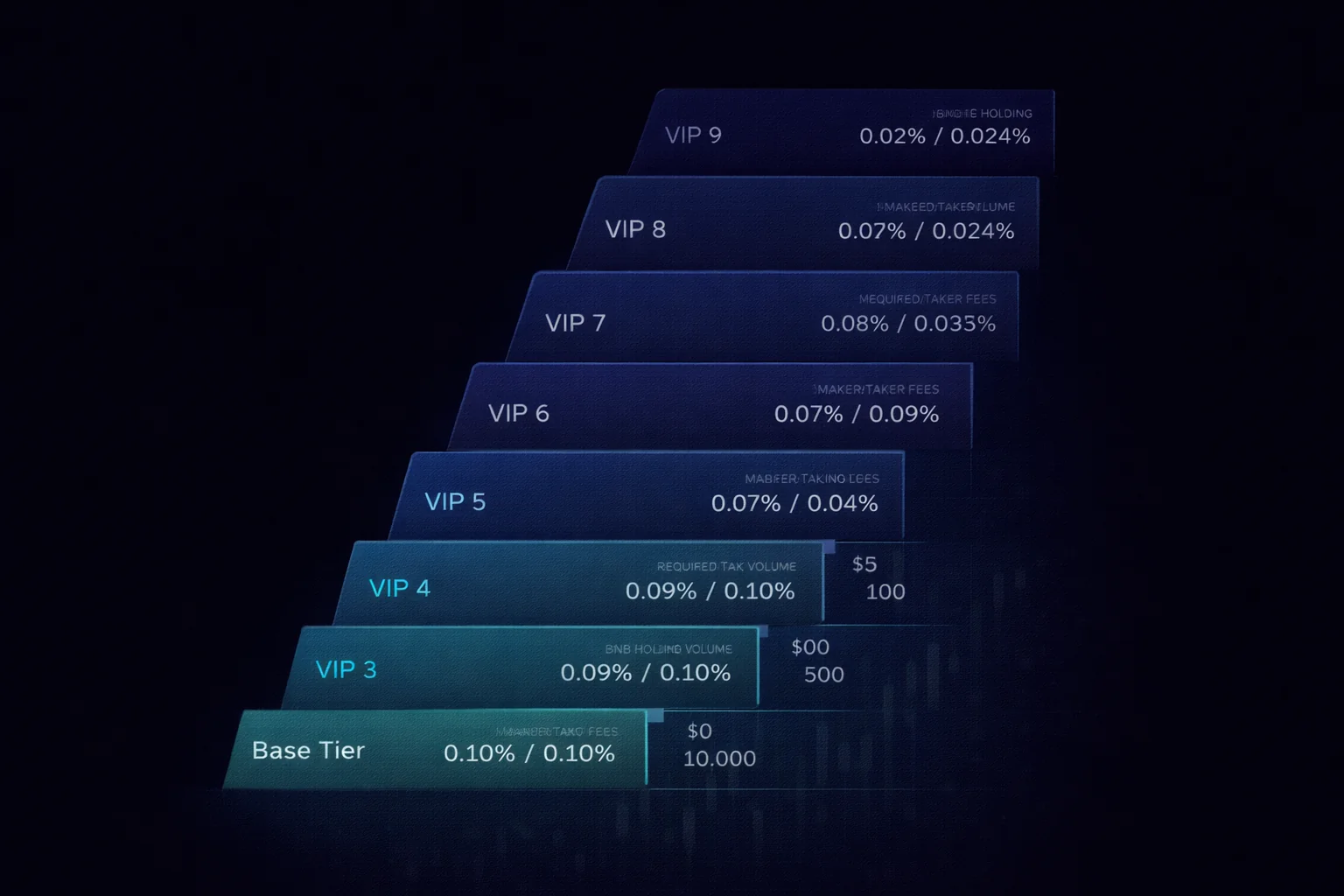
Tier criteria differ by venue, so it is worth knowing the ladder exists in case your activity grows over time.
Our links to Binance and OKX are referral links, so either exchange may pay us a commission if you sign up through them.
4. Choose the Cheapest Withdrawal Network
This tactic applies to anyone who withdraws crypto to a personal wallet or transfers between exchanges, and it costs nothing to implement. The same asset can be sent on different blockchain networks at different costs. For USDT, your options typically include ERC-20 (Ethereum mainnet), TRC-20 (Tron), BEP-20 (BNB Smart Chain) and Arbitrum (an Ethereum Layer 2); at the gas price read on 1 November 2026, the assumed ERC-20 transfer cost about £0.05 in network fees, before any exchange charge. You receive identical USDT regardless of which network you choose — the difference is purely in the transfer fee and confirmation speed.
Before every withdrawal, you must check which networks your receiving wallet supports. If you are sending to a hardware wallet via MetaMask on Arbitrum, verify that MetaMask is configured for the Arbitrum network and that the receiving address is correct for that network. Sending tokens on the wrong network to a wallet that does not support it can result in permanent, irrecoverable loss of your funds — no customer support team can reverse an on-chain blockchain transaction.
If you are unsure which network to choose, here is a quick reference for your most common withdrawal scenarios:
- USDT/USDC — use TRC-20 (under £1) or Arbitrum (under £0.20)
- BTC — at the 1 sat/vByte rate recommended on 1 November 2026, a transaction assumed to use 140 vbytes cost 140 sats, about £0.08, before any exchange withdrawal charge
- ETH — at the gas price read on 1 November 2026, a simple Ethereum transfer cost about £0.02 in network fees; the provider's withdrawal charge is a separate quote
- GBP fiat — confirm the GBP payment routes your account supports and check the current fee shown for that method
Should you batch your withdrawals to save on fees? Yes, if you are withdrawing to long-term self-custody. Instead of withdrawing every trade result immediately, let your balance accumulate on the exchange for a week or a month, then withdraw in a single transaction. One monthly withdrawal at £0.20 (Arbitrum) costs you £2.40/year. Weekly withdrawals cost £10.40/year. The trade-off is custodial risk: your funds sit on the exchange longer, exposed to platform risk. For amounts under £1,000, monthly withdrawals strike a reasonable balance between fee savings and security. For amounts over £5,000, consider withdrawing more frequently — the fee cost is trivial compared to the risk of exchange insolvency.
At the gas price read on 1 November 2026, the assumed ERC-20 transfer cost about £0.05 in network fees, before any exchange charge. Network conditions change, while the exchange sets its quoted withdrawal charge; check the current quote for the intended transfer.
Annual Fee Calculator: What You Actually Pay
How much do you actually pay in fees over a full year? The percentages look small in isolation, but they compound across every trade, deposit, and withdrawal. Here are three illustrative scenarios based on the dated Kraken Pro and Coinbase Exchange schedules, with deposit and withdrawal charges treated separately because they depend on the route and provider. Find the scenario closest to your trading profile and check whether fee optimisation is worth your time.
Illustrative £200/month purchases. Twelve purchases have an annual notional value of £2,400. Kraken Pro's entry tier was 0.40% maker and 0.80% taker on 1 November 2026. Assuming those rates applied to every purchase, the trading component would be £9.60 for maker fills or £19.20 for taker fills; a limit order must rest to receive maker treatment. These calculations exclude deposits and withdrawals. For the Bitcoin network component, the recommendation read on 1 November 2026 was 1 sat/vByte: a transaction assumed to use 140 vbytes therefore cost 140 sats, about £0.08 at the £58,106 BTC price read that day. An exchange can add its own withdrawal charge. Check the quote for the actual Bitcoin route instead of treating a network-only estimate as the platform's complete fee.
Illustrative £48,000 annual turnover. Twenty-four trades of £2,000 each produce £48,000 of annual turnover, regardless of how much new money you contribute. The Kraken Pro Level 2 schedule read on 1 November 2026 listed 0.30% maker and 0.60% taker. Applying those rates solely as fixed-rate illustrations gives £144 or £288 respectively on £48,000, before any deposit, withdrawal or other charge. Actual tier eligibility must be checked against the provider's rolling-volume and other criteria; an annual GBP total is not itself a 30-day USD tier. Check the complete fee preview rather than treating the illustration as an account quote. Network and platform withdrawal charges are separate inputs, and the network estimate does not establish the exchange's final charge.
Illustrative £500,000 annual turnover. One hundred trades averaging £5,000 produce £500,000 of annual turnover. The Coinbase Exchange schedule read on 1 November 2026 based tiers on trailing 30-day USD trading volume, excluding Stable Pairs volume, and used the tier in effect when each order was placed. Its schedule read on 1 November 2026 listed entry-tier rates of 0.40% maker and 0.60% taker, $10,000–$50,000 rates of 0.25% and 0.40%, and $50,000–$100,000 rates of 0.15% and 0.25%. Do not assign one annual trading total to a monthly tier without checking the applicable criteria for each order. Immediately matched and resting portions can also pay different rates. Calculate trading charges from those inputs and add the platform's actual withdrawal quotes separately. The network-cost snapshots in this guide do not verify an exchange's complete withdrawal charge.
What does this mean for you? If you are a casual investor, fees are a rounding error. But if you trade actively, fee optimisation is a genuine investment return. Where do you fall on this spectrum? If your monthly volume is under £1,000, you should spend five minutes enabling BNB fee payment and then forget about fees entirely. If your volume exceeds £5,000/month, you should implement all four tactics in this guide and review your fee expenditure quarterly.
Tracking Your Fees and Tax Implications
Every fee you pay on a centralised exchange is recorded in your trade history and can be exported as a CSV file. On Binance, go to Orders → Trade History → Export. On OKX, navigate to Assets → Order History → Export Records. Kraken provides a comprehensive ledger export under History → Export. You should download these records at least quarterly — exchanges occasionally change their export format or limit historical data access to 12-18 months, and you need complete records for your annual tax return.
Why does fee tracking matter for your UK tax return? Under HMRC rules, trading fees are an allowable cost that directly reduces your Capital Gains Tax liability. Here is how it works: when you buy £1,000 of BTC and pay a £1 trading fee, your cost basis becomes £1,001. When you sell for £2,000 and pay another £1 fee, your disposal proceeds are £1,999. Your taxable gain is £998, not £1,000. For an active trader paying £200-500/year in total fees, you can reduce your CGT bill by roughly £36-120 (at the 18% basic-rate or 24% higher-rate CGT charge) simply by including these costs in your Self Assessment calculations. You are legally entitled to deduct them — do not leave money on the table.
Portfolio tracking tools like Koinly, CoinTracker, and Summ can automatically import your exchange data via API key or CSV upload and calculate your capital gains with fees included as allowable costs. If you trade on multiple centralised exchanges and also use DeFi protocols (decentralised exchanges, yield farming, liquid staking), these tools handle the complexity of matching buys and sells across platforms using HMRC's share pooling rules and Section 104 holding calculations. The subscription cost (£49-99/year for most UK users) is usually justified if you make more than 20-30 trades per year, as the time you save on manual spreadsheet calculations exceeds your subscription cost.
One tax trap you should watch: if you transfer crypto between your own wallets (exchange to hardware wallet, or between exchanges), the transfer itself is not a taxable event — but the withdrawal fee is still an allowable cost you can deduct. You should record these transfers and their fees separately from your trades. If HMRC queries your records, you need to demonstrate that a transfer was a wallet-to-wallet movement, not a disposal.
What about income from exchange earn features? If you earn staking rewards (where your tokens help secure a proof-of-stake consensus network via a validator node), mining pool distributions, or lending interest through your exchange, your income is subject to Income Tax at the point you receive it — and the exchange may or may not withhold any tax.
The APY advertised on earn products does not account for the fees your exchange charges on reward distribution or the tax liability you incur. For example, if Binance offers 3.5% APY on ETH staking and charges a 25% commission on rewards, your net APY is approximately 2.6% before tax. You should track these earnings separately from your trading activity — they create a different type of tax obligation under HMRC's cryptoasset guidance.
Your Fee Minimisation Action Plan
Ready to start saving? Here is exactly what you should do, in order, based on your experience level. Four fee-management checks to assess against your current fee quotes, order execution and tax circumstances:
- Compare the exchange's quoted withdrawal charge with the other charges that apply to your activity; a network-only cost is not a complete fee quote
- Check whether the order adds or removes liquidity: the entry-tier maker/taker gap read on 1 November 2026 was 0.20 percentage points on Coinbase Exchange and 0.40 on Kraken Pro, and a limit order does not by itself ensure maker treatment
- Enable BNB fee payment on Binance — saves you 25% on trading fees (OKX removed its OKB discount in November 2025)
- Classify fees for tax reporting — HMRC allows certain acquisition/disposal costs, excludes some exchange charges, and requires the annual allowance to be considered (read 1 November 2026)
If You Are Just Getting Started
First, verify account eligibility, funding-route availability and the fee preview before sending money. Then, on Binance, buy a small amount of BNB (£5-10) and enable BNB fee payment in your account settings; OKX has no equivalent since it withdrew the OKB discount in November 2025. Finally, when you make your first purchase, use a limit order instead of a market order — set your price at the current bid and wait for it to fill. Check the fee displayed for your actual order; a setting alone does not establish your final cost.
If You Already Trade Regularly
Verify that native token fee payment is enabled (Settings → Fee Payment on Binance). Review your last 10 withdrawals: did you use the cheapest network available? Compare current asset/network quotes: a network-only snapshot does not establish the exchange's complete withdrawal fee. Export your trade history CSV and check your total fees paid in the last quarter — you may be surprised by the cumulative amount. Consider whether a portfolio tracking tool like Koinly would save you time on your Self Assessment tax return.
If You Trade £5,000+ Per Month
At your volume, you should implement all four tactics from this guide and review your fee expenditure monthly. Check your VIP tier status — if your 30-day volume (including futures) qualifies you for a higher tier, the fee reduction applies automatically. Consider whether consolidating your trading on a single exchange would push you into a better VIP tier rather than splitting volume across two or three platforms. Keep records of each fee and classify it before claiming relief: HMRC's CRYPTO22150 says not all exchange costs are allowable, and sterling deposit and withdrawal charges are not allowable CGT costs (read 1 November 2026). A tax charge or deduction also depends on the year's gains and applicable allowance.
Conclusion
You now understand the four categories of exchange fees: trading fees (0.00–0.80% on the Kraken Pro and Coinbase Exchange spot order books, depending on order type and tier, as of 1 November 2026; instant-buy services can cost more, such as Kraken's 1%), deposit fees (a bank transfer can be free, while a card payment can carry an extra fee), withdrawal fees (which depend on the blockchain network you choose and on the exchange's own charge), and hidden costs (bid-ask spread, convert markup, slippage, funding rates, and swap tax events). Knowing all four categories helps you avoid overpaying on the ones you can control — and most of them are controllable.
Here are the four techniques: first, assess withdrawal routes using the exact asset and exchange quote — at the gas price read on 1 November 2026, the assumed mainnet ERC-20 transfer cost about £0.05 in network fees, which does not establish the exchange's total charge. Second, check whether the order adds or removes liquidity: the entry-tier maker/taker gap read on 1 November 2026 was 0.20 percentage points on Coinbase Exchange and 0.40 on Kraken Pro, and a limit order does not by itself ensure maker treatment.
Third, activate BNB fee payment on Binance (saves you 25% on every trading fee for the cost of holding £5-10 in BNB; OKX withdrew its OKB equivalent in November 2025). Fourth, check the published eligibility criteria for your account's fee tier rather than assuming one monthly GBP threshold applies to every platform.
Your next step depends on where you are in your crypto journey. If you have not yet registered on an exchange, start with our first 30 days on a crypto exchange hub, which walks you through account setup, KYC verification, and your first trade. If you want to automate your purchases, read our DCA strategy setup guide. For the side-by-side fee comparison across Binance, OKX, Kraken, Bybit, and Coinbase, see our exchange fees comparison.
Sources and References
Frequently Asked Questions
- Which crypto exchange has the lowest fees?
- Kraken Pro's entry tier is 0.40% maker / 0.80% taker, and Coinbase Exchange's is 0.40% / 0.60% (as of 1 November 2026). Compare the current published schedules for your account and order type; the dated examples on this page concern specific products, rather than establishing a market-wide lowest fee.
- Are withdrawal fees the same on every exchange?
- No. Withdrawal fees vary by exchange and by network. For a Bitcoin mainnet withdrawal, the network component at the 1 sat/vByte rate recommended on 1 November 2026 was about 140 sats (about £0.08) for a transaction assumed to use 140 vbytes, and the exchange can add its own charge. For stablecoins, always compare the TRC-20 and Arbitrum network fees across exchanges. Some exchanges subsidise withdrawals on specific networks to encourage usage — check the withdrawal page for current fees before committing.
- What is the difference between maker and taker fees?
- A maker places a limit order that adds liquidity to the order book — it sits there waiting to be filled by another trader. A taker places a market order (or an aggressive limit order) that fills immediately by matching against existing orders. Exchanges charge makers less because they improve market quality. At Kraken Pro's entry tier, rates were 0.40% maker and 0.80% taker as of 1 November 2026; only a portion that rests in the order book receives maker treatment when filled.
- Is Coinbase more expensive than Binance?
- On the standard Coinbase interface, you pay a Coinbase fee plus a spread in the quoted price, and simple limit orders carry a separate 1% execution fee (as of 1 November 2026; Coinbase says these fees do not apply in all regions). Coinbase Advanced (previously Coinbase Pro) reduces this to 0.05-0.08% for high-volume traders, which is competitive with Binance VIP tiers.
- Do I pay fees on crypto-to-crypto swaps?
- Yes, both a trading fee and a tax event. The exchange charges the standard spot trading fee (0.08-0.10% on Binance/OKX) on the swap value. Additionally, under HMRC guidance read on 1 November 2026, every crypto-to-crypto swap is a disposal of the first asset, and a gain above your cost basis is charged to Capital Gains Tax only if the year's net gains exceed your annual exempt amount. If you bought BTC at £40,000 and swap it for ETH when BTC is at £60,000, you have a £20,000 taxable gain regardless of whether you ever converted to GBP. Track every swap for tax reporting.
Back to Crypto Investing Blog Index
Financial Disclaimer
This content is not financial advice. All information provided is for educational purposes only. Cryptocurrency investments carry significant investment risk, and past performance does not guarantee future results. Always do your own research and consult a qualified financial adviser before making investment decisions.