Perpetual Funding Rates Explained: The Formula, Venue by Venue
Four venues publish the same funding equation and compute four different numbers from it. The shape is shared — an average premium index, plus an interest term, clamped — but the interest term is scaled by interval on one venue and fixed on another, and a fifth venue does not use the equation at all. This page takes the formula apart term by term, from each venue's own documentation, and derives two properties no venue states: the nested bands inside which funding stops responding to the market.
Introduction
A futures contract with an expiry needs no mechanism to make it track spot. The expiry does that work: as delivery approaches the two prices are forced together, and a trader who disagrees can wait. Remove the expiry and the force goes with it — nothing in the design of a perpetual obliges its price to resemble the price of the thing it references.
Funding is the engineering answer — a periodic payment, sized by the gap between the contract and its reference, moving between the two sides in the direction that makes the gap expensive to sustain. Funding is not a concept with a rate attached; it is an equation with named terms, and the terms do not agree across venues even where the equation looks identical.
The terms are few: an average premium index, built not from a mid price but from the average fill price a set size would achieve on each side of the book; an interest rate inherited from centralised-exchange convention and switched off on pairs where neither leg is cash; and a clamp on their difference. Around that core sit four venue parameters — the interval, the depth the book is probed to, the weighting of the premium's samples, and the outer cap.
Two properties follow from that construction in one substitution each, and no venue states either: inside a ten basis-point band of premiums the clamp holds funding at exactly the interest rate, and the premium index returns a hard zero for any book whose impact prices bracket the index. The two bands nest. Deribit, the fifth venue, runs none of that machinery, and is the counterexample separating what describes perpetual contracts from what describes one popular implementation.
Four adjacent questions sit elsewhere: rate bands and what a given level implies in our CoinGlass review, funding as a recurring cost in our guide to exchange fees, funding as the carrying cost of a hedge in our impermanent-loss guide, and what a perpetual is in the cluster's complete guide to DeFi derivatives.
Every formula below is quoted from the venue publishing it, read on 12 August 2026, and treated as that venue's current specification rather than a permanent fact — one venue states in writing that it changes these settings without announcing them. Derived properties are shown as substitutions rather than asserted, so you can check the arithmetic rather than take the conclusion on trust.
The interest term, and the exception that proves it
What the term is for
The interest component is the part of the formula nobody explains, mostly because its value looks arbitrary. Hyperliquid's documentation gives the rationale in one sentence: the term "represents the difference in cost to borrow USD versus spot crypto."
Read that as a financing comparison between the two ways of holding the exposure: a trader long the underlying without leverage has funded a purchase; a trader long the perpetual has posted margin instead. Same payoff, different financing. The interest term is the constant the venues insert to acknowledge that asymmetry, and it is why funding does not rest at zero when the contract and the reference agree.
Hyperliquid also states why the number is what it is rather than deriving it: the "interest rate component is predetermined at 0.01% every 8 hours", pinned to centralised-exchange convention. It is an inherited constant, not a measurement.
Two notations for one constant, and where the eightfold gap really sits
All four venues describe the same convention and write it down two different ways, and the notations only stop looking equivalent when the funding interval stops being eight hours. Binance expresses the constant as a daily figure: "the interest rate is fixed at 0.03% daily by default (0.01% per funding interval" on an eight-hour cycle. Bybit publishes it as a formula rather than a number — "Interest Rate (I) = 0.03% / (24 / Funding Interval)" — so the term scales with whatever the interval currently is. OKX publishes it as a constant that does not scale — "Interest rate = 0.01% (fixed across all settlement intervals)" — because on OKX the scaling has already happened outside it: the (8 / N) divisor encloses the whole bracket, interest term included.
Substituting into both formulas settles it. On an eight-hour contract Bybit gives 0.03% ÷ (24 ÷ 8) = 0.01%, matching the convention exactly; on a one-hour contract it gives 0.03% ÷ (24 ÷ 1) = 0.00125%. OKX's constant stays at 0.01%, but the bracket holding it is then divided by 8 ÷ 1, so what an hourly OKX contract charges in that term is 0.01% ÷ 8 = 0.00125% as well. The two venues reach the same number by different routes, and OKX says that is the point: the divisor exists "so that the daily-equivalent funding cost remains consistent across all supported settlement cycles".
The eightfold gap between these two venues is real, but it sits in the other term and runs the other way. Bybit normalises only the interest rate; its premium index reaches the output unscaled. So once the premium has pushed the clamp to its bound, an hourly contract at a premium index of 1% charges 1% − 0.05% = 0.95% on Bybit and (1% − 0.05%) ÷ 8 = 0.11875% on OKX. Where funding is small the two agree to the basis point; where funding is large — which is exactly the condition that escalates a contract to hourly settlement in the first place — Bybit charges eight times what OKX does.
Hyperliquid, which pays hourly, reaches the same figure in the sentence that gives the constant: 0.01% every eight hours is "0.00125% every hour".
The pairs where the term is switched off
If the interest term represents a borrowing-cost differential, a contract with no such differential should carry no interest term. Both venues that document an exception do exactly that, and they choose the same class of instrument.
Binance names the case directly: certain contracts, "such as ETHBTC, for which interest rate is set to 0%". Bybit gives two further examples and reaches the same setting: on those, it says, "the interest rate (I) will default to 0%".
Note what those instruments have in common. Each quotes one crypto-asset against another, or one stablecoin against another. Neither leg is cash, so there is no leg on which a trader would have been borrowing cash to fund a spot purchase. The financing asymmetry the term exists to price does not arise, so the term is set to nothing. Stablecoin-denominated yield mechanics, including products built out of this same funding stream, are covered in our stablecoin yield guide.
The clamp is a bias, not a limiter
A clamp reads as a safety device — something that stops a number running away. In this formula it does something else across most of its operating range, and the behaviour falls out of the published equation in one substitution. What follows is derived from the formulas quoted above rather than taken from any venue's commentary, and the arithmetic is short enough to check in a minute.
The substitution
Start from the shared equation and the shared constant: F = P + clamp(I − P, −0.05%, +0.05%), with I = 0.01% per eight-hour interval.
Ask when the clamp returns its argument unchanged. By Binance's own statement of clamp semantics that happens whenever the argument sits inside the bounds, so the condition is −0.05% ≤ 0.01% − P ≤ +0.05%. Solving both halves gives −0.04% ≤ P ≤ +0.06%. Inside that range the clamp returns 0.01% − P, so:
F = P + (0.01% − P) = 0.01% = I
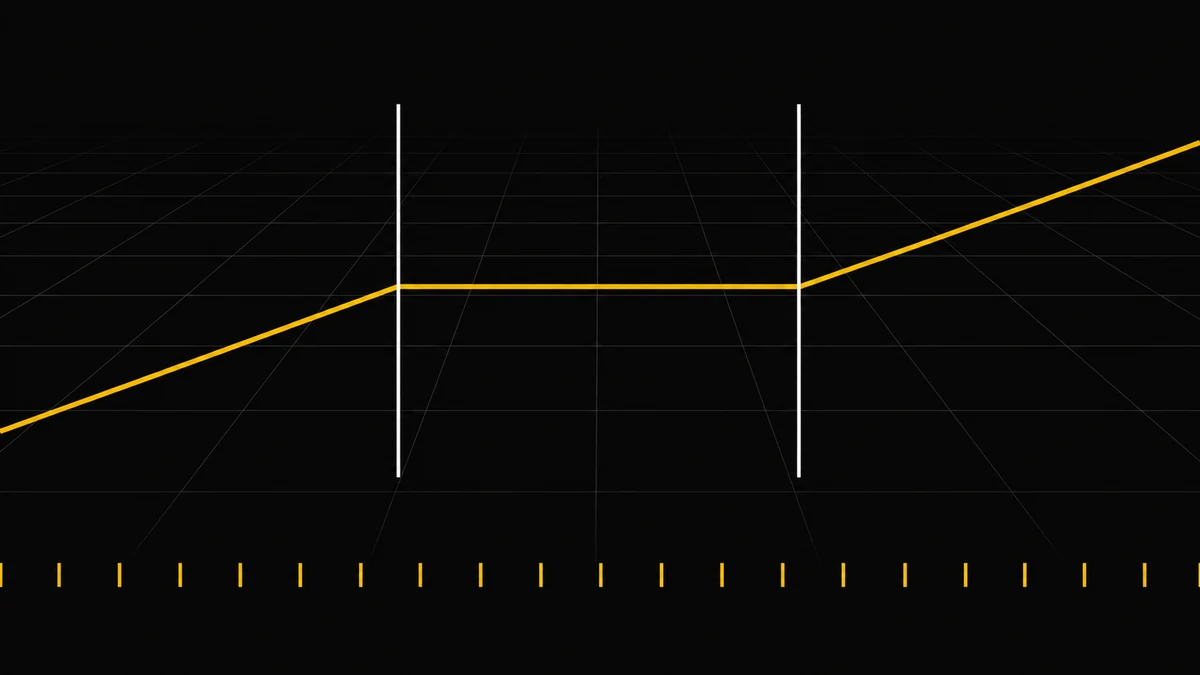
The premium cancels itself. For every average premium index between −0.04% and +0.06% — a band 0.10% wide, or ten basis points — the funding rate is exactly the interest rate, and where inside the band the premium sits makes no difference. Funding is not damped there, or smoothed, or lightly weighted toward the premium; it is completely insensitive to it.
What happens outside the band
Below −0.04% the clamp saturates at its upper bound and the equation becomes F = P + 0.05%. Above +0.06% it saturates at its lower bound and becomes F = P − 0.05%. Both branches track the premium one-for-one, offset by a constant.
The lower branch produces the property worth naming. At a premium index of −0.045%, meaning the contract is trading below its reference, the funding rate is −0.045% + 0.05% = +0.005%. It is positive. The rate reaches zero only when the premium index reaches −0.05% exactly, and turns negative only below that. So the sign of funding is not the sign of the premium, and the divergence is neither an anomaly nor a lag — it is the arithmetic. The region where it holds runs from a premium of −0.05% up to zero: five basis points wide, set by the clamp bound rather than by the interest term.
Checking the derivation against a venue's own example
One venue supplies a case at the far end of the range. Hyperliquid's numerical example takes a contract trading 1% above the reference: 0.01% − 1% = −0.99%, clamped to −0.05%, giving a funding rate of 1% − 0.05% = 0.95%. That is the upper branch above evaluated at P = 1%, and the two agree. The venues simply never publish an example inside the dead band, because the answer there is dull to look at and structurally the most interesting thing in the formula.
One caveat travels with all of this. The band's width is fixed by the clamp bound, but its position is fixed by I, and I is not the same number everywhere. On a venue whose hourly interest term works out at 0.00125%, whether by scaling the constant or by dividing the bracket, an hourly contract has its band running from −0.04875% to +0.05125% — the same ten basis points wide, centred almost exactly on zero rather than offset above it. The band is a property of the formula; where it sits is a property of the venue.
Why an impact price and not a mid
The hinges
The premium index P is not a difference between two prices. It is a pair of one-sided hinges over a third quantity, and that shape produces the second dead band. OKX publishes it in two fragments — "[Max (0, Impact bid price – Index price)" and "– Max (0, Index price – Impact ask price)] / Index price" — and Bybit publishes it identically.
The two hinges ask separate questions. Could a real seller hit bids above the index price? If so, the excess is the premium. Could a real buyer lift offers below it? If so, the shortfall is the discount. Each is answered with a Max against zero, so a negative answer contributes nothing rather than contributing negatively.
The second dead band
The consequence is a single-step derivation from that quoted formula. Suppose the index price sits between the impact bid and the impact ask — the ordinary condition for a book straddling its reference. Then impact bid minus index is negative, so the first hinge returns 0; and index minus impact ask is also negative, so the second hinge returns 0. The premium index is (0 − 0) ÷ index price, which is:
P = 0, exactly
Not approximately zero, and not a small number that rounds. The formula returns a hard zero for any book whose impact prices bracket the index, however wide or narrow that bracket is. Feed that into the previous section and the two bands nest: with P = 0 the clamp passes 0.01% through untouched and F = 0.01%, the interest term alone. A trader watching a live premium tick around while the funding rate does not move is watching the formula work as specified.
Why a fill price rather than a quote
The impact price is defined by execution rather than by display. Bybit states it flatly: the impact bid price is "The average fill price required to execute the Impact Margin Notional on the bid side." OKX gives the computation, a volume-weighted average by construction — "Impact bid/ask price = Impact value / Total base amount required to meet impact value". Hyperliquid uses the same definition.
The numbers below are ours, chosen to be checkable rather than realistic.
- Index price: 30,000 USDT.
- Bid side: 0.10 units resting at 30,000, then 0.10 units at 29,900, then a large block at 29,400.
- Best ask: 30,020.
- Impact margin notional: 12,000 USDT.
The mid is 30,010, which says the contract trades above its reference. Walking the book says the opposite: the first two levels absorb 5,990 USDT, the remaining 6,010 fills at 29,400, and the 12,000 USDT clears at an average of about 29,672.
The two readings of one book disagree in direction, not merely in magnitude. And because the index now sits between the impact bid and an impact ask at or above the best offer, both hinges return zero and the premium index is exactly zero. The mid would have fed a positive premium into the funding rate on the strength of two quotes worth a tenth of a unit each. A mid price is a claim about where trading could happen; an impact price measures where a specific size actually would, and a payment on notional should be sized by prices that survive contact with notional.
Three ways of choosing how deep to look
The size of that probe is itself a venue parameter. OKX derives it from leverage, Binance from the margin requirement — "200 USDT / Initial margin rate at the maximum leverage level" — and those two are the same quantity written twice, since the initial margin rate at maximum leverage is the reciprocal of that leverage. Hyperliquid does not derive it at all: its contract specifications set two flat tiers across the venue. A derived notional adapts the probe to the contract's own risk parameters; a flat notional probes a thin market and a deep one with the same order, measuring depth more honestly on the large assets and more harshly on the small ones.
Hyperliquid carries a second premium formula for the permissionless markets under its HIP-3 framework, and it has no hinges: "premium = (0.5 * (impact_bid_px + impact_ask_px) / oracle_px) - 1". A midpoint of the two impact prices returns zero only where that midpoint equals the reference exactly. The dead band is not narrowed there; it is removed.
The average that is not an average
Every venue in the shared-formula group feeds an average premium index into the equation, and not one of them computes a mean in the sense the word implies. The weighting is the same construction on all three; what differs is how finely each cuts the interval.
The ramp on Binance
Binance samples densely, and it does not weight those samples equally. The step that consumes them is headed "Time-to-funding weighted average of premium index of the observed funding period", and for symbols whose funding interval is greater than one hour the coefficients are printed in full — 1, 2, 3 and so on to n. Its documentation states that "Binance calculates the premium index every 5 seconds", and that the input to the funding rate is a "time-weighted average across all 5,760 premium index data points for the 8-hour funding interval". Eight hours at one sample every five seconds is exactly those 5,760 observations, but the last of them carries 5,760 times the weight of the first. The phrase "time-weighted" names the ramp; it is not a synonym for flat.
Hyperliquid uses the same cadence over its own window — "The premium is sampled every 5 seconds and averaged over the hour."
The same construction on Bybit and OKX
Bybit describes the intent before giving the formula: it performs an "N-Hour Time-Weighted-Average-Price (TWAP) over the series of minute rates", and then states the rule — the "closer to the funding fee settlement time, the greater the coefficient of the premium index."
The series is published. Bybit's denominator runs over 480 terms, the last of them "Premium Index _480 * 480)/(1 + 2 +... + 480)". OKX publishes the identical scheme, opening "(1 × Premium index at T1 + 2 × Premium index at T2", over a window of one sample per minute. Four hundred and eighty minutes is eight hours, so all three venues ramp across the same interval and differ only in how finely they cut it. Bybit's denominator is 115,440, and the last minute of the window counts 480 times as much as the first.
Why the weighting matters more than it sounds
An interval that spent seven hours at a premium and closed flat does not produce a rate dominated by those seven hours on any of the three: these venues are not measuring the interval so much as the end of it. The real exception sits inside Binance rather than between venues — for symbols whose funding interval is one hour the average premium index is equally weighted, so the same exchange computes the average two different ways depending on which contract you hold.
The second consequence concerns the number a trader watches beforehand. Bybit states that the funding rate "is not fixed and is updated every minute" until the settlement timestamp. Because the samples carrying the most weight are the ones nearest settlement, a predicted rate published early in an eight-hour window forecasts the stretch that will count least, and it firms up only as the window closes — on Binance, Bybit and OKX alike. On Binance's hourly symbols the reverse holds: every sample counts the same, so an early reading is already representative.
Three prices, three jobs
A perpetual contract carries at least three prices at once. None of them is the real one; each answers a different question. Selecting between them as a trigger for an order is covered in our guide to exchange order types.
The index price answers: what is this worth elsewhere?
The index is the external reference, and the denominator of the premium index in every version of the formula above. It is also the most heavily engineered of the three, because it is the one an attacker would want to move.
Bybit's construction is documented in unusual detail: "the sum of the prices of the top six (6) Spot trading pairs", weighted by 24-hour volume, with "The index weights are updated hourly." Three substitution rules sit underneath it, each a documented answer to a way the inputs can fail.
- When spot is too thin, the index leaves spot. Where "spot market liquidity is extremely low, futures market prices will be used as index components".
- When a constituent's last trade looks wrong, the index stops using trades. It references best bid and ask together with their sizes instead: "Ob Price = (AskPrice1 × BidVolume1 + BidPrice1× AskVolume1) ÷ (BidVolume1+ AskVolume1)". Note the pairing — each price is weighted by the size resting on the opposite side, tilting the result toward whichever side is thin.
- When a constituent diverges too far, it is dropped and its weight redistributed. A component far enough from the median of all sources is temporarily excluded, its weight "gradually reduced using a smoothing algorithm and redistributed among the remaining non-excluded components".
The mark price answers: is this position still solvent?
It is the number that closes positions. Bybit states its two jobs directly — it "uses Mark Price as a trigger for liquidation and to measure" open profit and loss — and that it is deliberately not the last traded price.
The mark price cannot be described flatly as containing the funding rate. Bybit's standard construction is a median of three inputs:
- Mark Price = Median (Price 1, Price 2, Last Traded Price)
- Price 1 = Index Price × [1 + Last Funding Rate × (Time Until Funding /8)]
- Price 2 = Index Price + Moving Average (2.5-minute Basis)
Only Price 1 carries a funding term, and a decaying one — the last funding rate scaled by the fraction of the interval still to run. A median returns the middle value, which need not be Price 1, so the funding rate is an input to one candidate and reaches the published figure only when the other two allow it.
Contracts listed after 14 November 2025, 10 AM UTC carry no funding term in their mark price at all. Bybit rolled out a different construction for those symbols and a named set of existing ones: "Mark price = Price3 × C + Index price × (1 − C)", where "C = clamp (DeltaPrice ÷ MaxDeltaPrice, 0.3, 0.7)". Every term is index, basis or a clamped weight, and the funding rate does not appear. The date is the load-bearing part of that claim: without it, the statement is simply wrong for whichever half of the contract set the reader happens to hold.
Which price converts the position into a payment
The third question decides the size of the transfer, and two venues answer it differently. Bybit converts on the mark: its funding fee is "Position value × Funding rate" where "Position value = Contract quantity × Mark price". Hyperliquid converts on the oracle instead, because "spot oracle price is used to convert the position size to notional value".
Bybit's figure is a venue-local construction, assembled partly from its own book and, on some contracts, from its own last funding rate — so the payment depends on a number the funding rate has already influenced. Sizing it on the external reference breaks that loop; Hyperliquid's oracle is computed by its validators as "the weighted median of CEX spot prices".
One venue converts the position on the mark, the other on the external reference. How the two architectures build and depend on these prices is the subject of our page on perpetual venue structure.
Who pays, out of what, and whether the venue keeps any
The transfer is between traders
Funding is not a fee in the sense that a trading commission is a fee. Bybit describes the movement in one clause: funding fees "are exchanged directly between long and short position holders at each funding time." Its worked example shows the symmetry with numbers — on ten contracts at a mark price of 8,000 USDT and a rate of 0.01%, the position value is 80,000 USDT and the payment is 8 USDT, with "a short position holder with the same contract quantity" receiving 8 USDT. Nothing is retained in the arithmetic. Which side is the payer follows from the sign, which the cluster hub page covers.
One venue asserts it; another proves it by refusing a refund
Hyperliquid states the zero-sum property outright: "Funding is purely peer-to-peer and no fees are collected on the payments." That is a clear claim, and it is a claim — a venue describing its own economics.
Bybit never asserts it anywhere in the funding documentation read for this page. What Bybit does instead is act on it, in a place where a venue with a cut would behave differently. Its help centre warns that settlement takes a few seconds to complete across the platform, so "opening or closing a position within 5 seconds before or after the funding time" does not determine whether the position is included in that cycle. A trader caught by that timing might reasonably ask for the payment back. Bybit declines reimbursement, and states the reason: "the counterparty to the trade would have also paid or received the corresponding funding fees."
Read the structure of that refusal. The money is unavailable to refund because it is already in another trader's account. A venue holding a margin, a spread or a share of the flow would have that share available to make a goodwill payment from, and the refusal would be a policy choice; here it is an accounting constraint. A venue declining a refund on the grounds that the counterparty already has the money is evidence rather than marketing copy.
Which account the payment comes out of
The deduction order is documented and it has two steps rather than one. Bybit states that "The funding fee is deducted from the trader's available balance." Where that balance is insufficient, the fee is taken from the position itself: "The funding fee will be deducted from the position's initial margin."
The venue attaches the mechanical consequence to that second step: "The liquidation price will move closer to the mark price." Margin is what sets the distance between a position and its liquidation level, so removing margin shortens the distance — arithmetic rather than policy. What the accumulation of that effect implies over many intervals belongs to the cluster hub page. The narrower point here is that the same nominal rate has two different mechanical effects depending on how the account is funded at settlement.
The snapshot is a venue convention, not a property of perpetuals
The claim commonly made about perpetual futures — that they charge a funding rate every eight hours to whoever holds a position at the settlement moment — describes how several large venues have chosen to implement funding. It does not describe what a perpetual contract is, and a live counterexample with specification-grade documentation says so.
What the snapshot design commits a venue to
On a venue that settles at timestamps, holding across the moment is the entire test. Bybit states the rule in both directions: "Traders will only pay or receive funding fees if they hold positions at the funding time", and that "no funding fee will be charged or received" on a position fully closed before it. Hyperliquid uses the same design on a shorter clock — the rate "is added or subtracted from the balance of contract holders at the funding interval", with settlement every hour.
That design makes funding a step function of holding time. A position opened after one settlement and closed before the next costs nothing in funding, however long it was held; a position held a few seconds longer pays a full interval. The charge is proportional not to exposure but to how many timestamps the position survived.
A step function has boundaries, and boundaries have to be adjudicated — which is why Bybit publishes the five-second window quoted above. The window is not a defect in the implementation. It is the unavoidable artefact of paying a discrete amount at an instant, on a system where an instant takes a few seconds to process.
Deribit runs no funding snapshot at all
Deribit accrues funding continuously and settles it continuously. The distinction is visible in the API specification rather than in marketing copy: two fields describe two different horizons over the same instrument.
One of them, current_funding, is the instantaneous rate, "Calculated as `(mark_price − index_price) / index_price` at this moment" — and the specification adds that this "is the rate that would apply if a funding settlement occurred right now." The other, funding_8h, is a running total rather than a scheduled charge: the "time-weighted accumulation of the funding rate since the last 8-hour settlement".
Deribit's own education material puts the cadence plainly: funding there, in Deribit's own words, "[i]s actually calculated in real time and transferred every few seconds". Its historical endpoint reports that accrual in hourly buckets, which is a reporting granularity rather than a settlement schedule. The familiar eight-hour figure therefore exists on Deribit as a display convention, not a moment at which a snapshot is taken and a discrete amount moves.
What the counterexample settles
Deribit is not an exception to a rule about perpetual contracts. It is evidence that the rule does not exist. Once one venue computes funding continuously, on a contract that is a perpetual future by every other criterion, the timestamp snapshot can no longer be part of the definition of the instrument. It is one implementation choice among at least two, and three of its consequences are usually presented as facts about perpetuals:
- Timing tactics exist only under the discrete design. Closing before a settlement to avoid a payment is meaningful on a snapshot venue and meaningless on a continuous one, where the charge has been accruing throughout the holding period.
- An indeterminacy window exists only under the discrete design. Continuous accrual has no boundary to be on the wrong side of, so there is nothing to adjudicate and no window to publish.
- Cost scales with holding time only under the continuous design. A step function and a linear accrual produce materially different costs for the same exposure and duration, particularly on short holds.
The general form of the correction is worth more than the example. This page found four instances in one formula: the interval, the interest term's scaling, the averaging window and the settlement cadence are all venue parameters the standard account presents as properties of the product.
The interval is not a constant
The funding interval is a parameter, and on two of the three venues covered in depth here it changes automatically in response to the funding rate itself.
OKX changed its escalation rule on 14 April 2026
OKX published a revised mechanism effective 14 April 2026, and the revision reversed the character of the response rather than adjusting a number. Under the previous rule, hitting a cap was a single jump: "the settlement frequency was directly adjusted to 1 hour". Under the rule in force since that date, "the frequency will be escalated by one level at a time".
The ladder is published with its settlement times, from eight hours down to one. Escalation moves one rung when the funding rate reaches its cap or floor at a settlement, and the first settlement after a change lands on the next scheduled time of the new frequency.
The reversion condition is quantified, which is unusual and useful: when the "funding rate at every settlement during the preceding 12 consecutive hours was within +/-0.20%", the frequency returns to the contract's default without further notice. Reversion is a single step back rather than a rung-by-rung descent — escalation is gradual and recovery is immediate.
Two exclusions travel with the mechanism. OKX "reserves the right to disable the automatic frequency adjustment feature for specific contracts", and perpetual contracts on traditional financial assets are excluded entirely. The announcement's own advice is the honest one: OKX directs traders to its contract information page or funding-rate API "for the latest settlement frequency". A published default is a starting value, not a current one.
Bybit still jumps straight to hourly, and changes the rules quietly
Bybit's documented behaviour is the rule OKX replaced: when a contract's funding rate reaches its preset limit at settlement, "the system will automatically switch the settlement frequency to once per hour". One trigger, one jump, no intermediate rungs.
The more consequential sentence is the one about disclosure: "Future funding rate limits and settlement frequencies may be adjusted dynamically without separate announcements." That is a venue telling readers, in writing, that any figure quoted from its documentation has an unknown expiry — and it is the reason every parameter here carries a reading date.
The other interval designs
Binance sets a default and reserves discretion over it: "The default funding interval is every 8 hours", and it "reserves the right to update the funding interval of a perpetual contract".
OKX's supported set is small and explicit — "N ∈ {1, 2, 4, 8}" — which is what the (8/N) divisor normalises across. Three eight-hourly settlements at rate r and twenty-four hourly settlements at r ÷ 8 both come to 3r a day: escalating the frequency changes when funding is charged, not how much accrues in a day.
Hyperliquid splits computation from payment rather than varying either: "funding is paid every hour at one eighth of the computed rate", with the formula defined on an eight-hour basis.
Bybit's pre-market contracts show how far the parameters can be overridden. During the continuous auction "the funding rate is fixed at 0.005% and is settled every 4 hours", and during the call auction "the funding rate is set to zero" — no premium index or interest term involved. The formula is not a law of the venue; it is what the venue runs when it has a market to measure.
Why the contract tracks at all
Everything above describes a mechanism for producing a payment, not evidence that the payment works — and a venue describing why its own design succeeds is not independent evidence. This section rests on one academic source and every claim in it is theirs: the working paper Fundamentals of Perpetual Futures, by Songrun He, Asaf Manela, Omri Ross and Victor von Wachter, first drafted December 2022 and revised July 2024.
The starting position: convergence is not guaranteed
The authors set out the problem in the terms this page opened with, and more sharply. "Unlike fixed-maturity futures, perpetuals are not guaranteed to converge to the spot price." No delivery date forces the two prices together, so convergence has to be produced by something, and the paper identifies the funding payment as the device intended to do it. Intended is not achieved, which is why the paper is worth citing.
Random-maturity arbitrage, and why the trade is not riskless
The authors derive no-arbitrage prices for perpetual futures, and they are explicit that the notion of arbitrage they use is weaker than the textbook one. They call it random-maturity arbitrage: "unlike traditional riskless arbitrage, we allow the strategy's time-to-maturity to be random."
A trader taking the opposite side of a mispriced perpetual against the spot market has no date on which the position resolves, because "there is no predetermined expiration date when the trade would be unwound at a profit". The position must be financed and margined for an unknown duration, and even opportunities "that appear to be riskless in theory, may be risky in practice" — a temporary worsening of the gap can force a liquidation before the convergence arrives. That is the honest description of the force making a perpetual track its reference: a trade someone has to be willing to hold, at risk, for an unknown period.
How large the gaps get, and where they are heading
The paper measures deviation from its own benchmark rather than from spot, and the average is unremarkable: the mean deviation is "modest and statistically insignificant". The dispersion around it is the finding. Mean absolute mispricing runs "about 60% to 90% per year across different cryptocurrencies", far larger than the equivalent deviations in traditional currency markets. That measures how far the contract wanders from its theoretical price; it is not a rate paid by anyone. The trend runs the other way — "Deviations decline on average about 11% a year", which the paper attributes to arbitrage capital arriving and competing.
The finding that constrains how this page can be read
One result deserves to sit last. Decomposing the returns of a spot-versus-perpetual convergence trade, the authors observe that "industry publications usually emphasize the funding rate channel" and then report the opposite: "price convergence plays a dominant role in total trading returns", with funding payments minor and diminishing over time.
The funding formula is worth understanding in detail because it determines what a position is charged, when, and out of which account. What it is not, on the evidence of the only rigorous decomposition cited here, is the main thing moving money in the trade that keeps the contract honest. Funding is necessary, precisely specified, and second.
Conclusion
The funding rate is a short equation with a lot of venue inside it. Four exchanges publish the same core — an average premium index, plus an interest rate minus that premium, clamped to five basis points — then differ on almost every term feeding it: the interest component is scaled by interval on two venues and fixed on a third, the average runs one shared weighting ramp at two sampling resolutions, the depth probed is sized three ways, and the outer cap follows four rules. Deribit runs none of it.
Two properties of the equation are stated by no venue and fall out of the arithmetic in one step each. The clamp pins funding at exactly the interest rate across a ten basis-point band of premiums, so the number is insensitive to the market inside that band and only tracks it outside — which is also why funding can stay positive on a contract trading at a discount of up to five basis points. And the premium index returns a hard zero whenever the index price sits between the impact bid and the impact ask, because both of its hinges are one-sided. The two bands nest: inside both, funding equals the interest term and nothing the book does changes it.
The most transferable finding is not a number: several things the genre states as properties of perpetual futures are properties of one popular implementation. The eight-hour snapshot is a convention Deribit's continuous accrual disproves. The interval is a parameter OKX has escalated one rung at a time since 14 April 2026, while Bybit still jumps straight to hourly. And the mark price carries a decaying funding term on Bybit's older contracts and none at all on contracts listed after 14 November 2025.
Three habits follow. Read the venue's own formula rather than a summary, because the summaries agree with each other more than the venues do. Attach a date to every parameter, because one venue states in writing that it changes these settings without announcement. And when a statement about perpetual contracts sounds like a property of the instrument, test it against a venue built on a different implementation.
Sources
- Binance — introduction to futures funding rates: the clamped formula, its interval divisor and clamp semantics, the daily interest rate and its zero-interest exception, five-second sampling with a 5,760-point time-to-funding weighted average, and the maintenance-margin cap.
- OKX — perpetual swap funding fee mechanism: the inner clamp and outer cap in one bracket, the interval divisor and supported set, the interest rate fixed across all intervals, the premium-index hinges, the leverage-sized impact value and the 480-minute ramp.
- OKX — funding fee settlement frequency mechanism, published 14 April 2026: the superseded single-jump rule, the one-rung escalation replacing it, the published ladder, the 12-hour reversion condition and the traditional-asset exclusion.
- Bybit — introduction to the funding rate: the formula with a named limit pair and no interval divisor, the interval-scaled interest rate and its zero-rate pairs, the premium-index and impact-price definitions, the 480-term ramp, the minimum-of-two cap, and the pre-market cases.
- Bybit — funding fee calculation: the direct exchange between position holders, the worked payer-and-receiver example, the holders-at-the-timestamp rule, the two-step deduction into initial margin, the five-second window and the reimbursement refusal.
- Bybit — mark price calculation, perpetual and expiry contracts: the median-of-three construction, the decaying funding term inside Price 1 only, and the separate formula for contracts listed after 14 November 2025 carrying no funding term. Read as last updated 24 March 2026.
- Bybit — index price calculation: the six-constituent volume-weighted construction with hourly weight refresh, futures substitution on low spot liquidity, the orderbook-weighted price for abnormal prints and the median-deviation exclusion. Read as last updated 19 June 2026.
- Hyperliquid — funding documentation: the clamp in decimals, the borrowing-differential rationale for the interest term, the peer-to-peer no-fee statement, hourly payment at one eighth of the computed rate, oracle-priced notional conversion, the 4% hourly cap, the impact-price definition, the validator-computed oracle, the HIP-3 midpoint premium and the numerical example this page checks its derivation against.
- Hyperliquid — contract specifications: the flat two-tier impact notional.
- Deribit — API reference and OpenAPI specification: the instantaneous funding field defined as mark minus index over index, the eight-hour field defined as an accumulation rather than a scheduled charge, and the hourly historical endpoint.
- Deribit Insights — perpetual swap funding: the output dead band reducing the rate to zero, and funding calculated in real time and transferred every few seconds. Deribit's per-asset caps could not be retrieved from a primary source and are deliberately absent here.
- He, Manela, Ross and von Wachter — Fundamentals of Perpetual Futures, first drafted December 2022, this draft July 2024: the sole source for the section on why the contract tracks — non-convergence without an expiry, the random-maturity arbitrage construction, the mean absolute deviation of 60% to 90% a year and its 11% annual decline, and the decomposition finding price convergence dominant.
Frequently asked questions
- Why does the funding rate sit at exactly 0.01% so often?
- Because the formula pins it there across a range of premiums. Funding is the average premium index plus the interest rate minus that premium, clamped to plus or minus 0.05%. Inside the clamp's bounds the premium cancels and funding equals the interest term — 0.01% per eight-hour interval — for every premium between −0.04% and +0.06%. Outside that band the clamp saturates and funding tracks the premium at a fixed 0.05% offset.
- Do all perpetual exchanges charge funding every eight hours?
- No — the eight-hour snapshot is a venue convention, not a property of the instrument. Bybit settles at 00:00, 08:00 and 16:00 UTC, Hyperliquid every hour at one eighth of the computed rate. Deribit runs no funding snapshot, accruing continuously and describing the transfer as happening every few seconds. Intervals move — OKX publishes an 8h, 4h, 2h and 1h ladder, and Bybit states that settlement frequencies may be adjusted dynamically without separate announcements.
- Does the mark price contain the funding rate?
- On some contracts and not on others. Bybit's standard perpetual mark price is the median of Price 1, Price 2 and the last traded price, and only Price 1 carries a funding term — a decaying one. A median need not return the input carrying that term. Contracts listed after 14 November 2025, 10 AM UTC use a different construction built from index, basis and a clamped weight, with no funding term.
- Why does the premium index use an impact price rather than the mid?
- Because a mid price is a quote and an impact price is a fill. Bybit defines the impact bid price as the average fill price required to execute the impact margin notional on the bid side; OKX as impact value divided by the base amount needed to meet it. One consequence is a second dead band: whenever the index price sits between the impact bid and ask, both of the premium index's one-sided terms return zero.
- Does the exchange keep any part of a funding payment?
- One venue says so outright and another demonstrates it. Hyperliquid's documentation states that funding is purely peer-to-peer and no fees are collected on the payments. Bybit makes no such claim in the funding documentation read for this page, yet acts on it, refusing reimbursement to traders caught by the settlement boundary because the counterparty would have also paid or received the corresponding fee.
- Why do two exchanges publish different funding rates for the same asset?
- Four inputs to one shared formula differ. The interest term is written two ways for one result: scaled by interval on Bybit, fixed at 0.01% on OKX but sitting inside a bracket the venue then divides, so both land at 0.00125% hourly. The eightfold gap is in the premium term instead, and it runs the other way — Bybit passes the premium through unscaled, so on a one-hour contract at a bound premium it charges about eight times what OKX does. The premium runs the same time-to-funding weighting ramp on all three, at two resolutions: 5,760 five-second samples on Binance, and 480 minute-rates on Bybit and OKX whose final minute carries 480 times the weight of the first of the first. The order-book depth sampled is sized two ways across the three venues, and the outer cap follows four rules.
- Is the funding payment what keeps a perpetual tracking spot?
- Only partly. The 2024 working paper Fundamentals of Perpetual Futures, by He, Manela, Ross and von Wachter, opens from the position that perpetuals are not guaranteed to converge to the spot price. What produces convergence instead is the trade between spot and the perpetual, which the authors call random-maturity arbitrage because no predetermined expiration date exists at which it would be unwound at a profit. Decomposing its returns, they find price convergence dominant and funding payments minor.
← Back to Crypto Investing Blog Index
Financial Disclaimer
This content is not financial advice. All information provided is for educational purposes only. Cryptocurrency investments carry significant investment risk, and past performance does not guarantee future results. Always do your own research and consult a qualified financial advisor before making investment decisions.