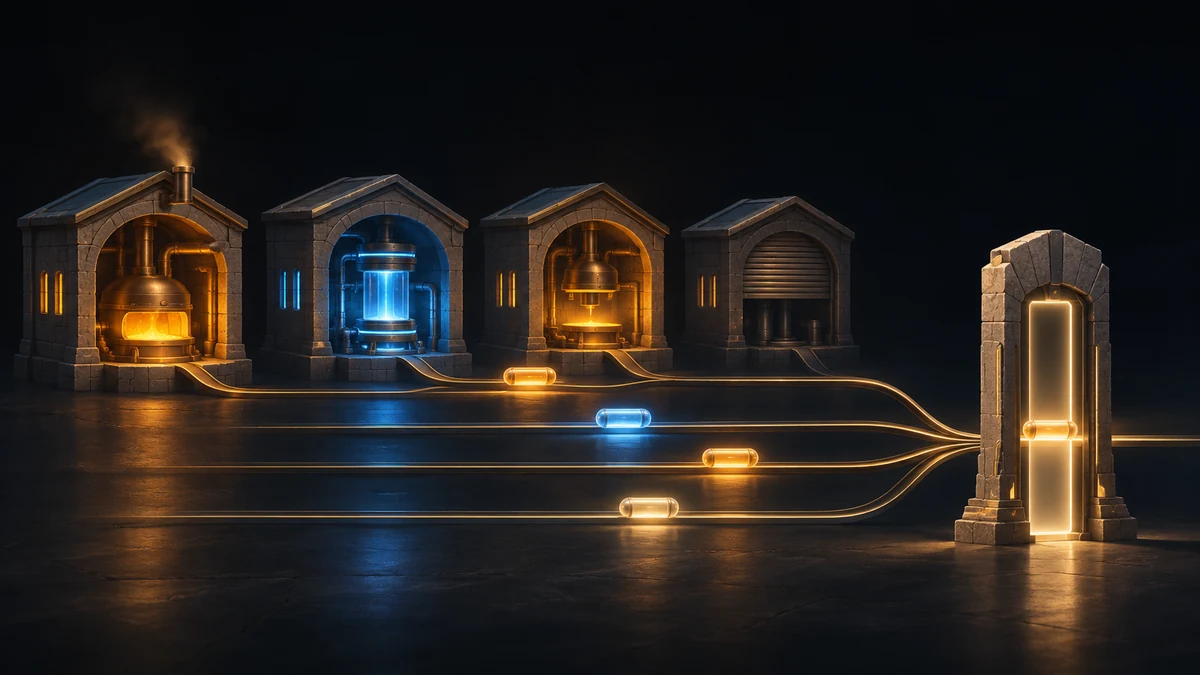
ZK Proofs and Provers: SNARKs vs STARKs
A validity proof is efficient to check, relative to the underlying computation, and expensive to make. ethereum.org says succinctness keeps proofs compact and verification efficient in that sense, allowing Ethereum to verify state transitions without re-executing every transaction, and describes generating proofs as very complex calculations best performed on specialised, expensive machines, often out of the reach of regular individuals (read 16 November 2026). This guide is about who makes the proofs: what SNARKs and STARKs promise, who is allowed to submit proofs on ZKsync Era, Starknet, Linea and Scroll, and where the provers of Ethereum's own blocks stand against the Ethereum Foundation's definition of real-time proving.
Introduction
Our guide to how ZK rollups work follows a transaction from your wallet to Ethereum, and every ZK rollup in it ends its pipeline in the same place: a contract on Ethereum checks a validity proof before it accepts the rollup's new state. This guide starts at that proof. It explains what the two families of proof systems, SNARKs and STARKs, promise and what each costs to verify, what a prover does, who is allowed to submit proofs on four networks, and how real-time proving is defined for Ethereum's own blocks.
Making the proof is expensive, and that matters for who can take part. ethereum.org lists among the drawbacks of ZK rollups that producing validity proofs requires specialised hardware, which may encourage centralised control of the chain by a few parties. Its page on zero-knowledge proofs adds that applications using the technology must factor in hardware costs, which may increase costs for end users (both read 16 November 2026). Who makes the proofs, and on what terms, is therefore a question about each network as much as about the mathematics.
ETHBEAT (formerly L2BEAT), which tracks Ethereum's layer-2 networks, defines a rollup as a blockchain that inherits consensus and data availability from another blockchain, its layer 1. It gives Ethereum as an example of a layer 1: a blockchain that is self-reliant on its validator set for its security and consensus properties (read 16 November 2026). For each network it records the kind of proof Ethereum receives, the prover and trusted setup it names, and the accounts or whitelists that decide who may submit proofs. Linea's, Scroll's and Starknet's documentation describe their provers in more detail; the ZKsync page read for this guide describes Airbender, its next-generation proof system, rather than ZKsync Era's prover. This guide reads both for the hub guide's four networks, ZKsync Era, Starknet, Linea and Scroll, and gives each in its source's words where they differ.
Each figure and each state below carries its source and the date it was read. ETHBEAT's pages for ZKsync Era and Linea were read again on 18 November 2026: the entries this guide cites from them had not changed, and Linea's page carried one new entry, described below. Where none of these sources states something, the guide says so rather than filling the gap.
The table of contents below gives the order of the sections. One question runs through all of it: when a source names a prover, does it also say who runs it?
What a Validity Proof Proves
ethereum.org describes a zero-knowledge proof as a way of proving the validity of a statement without revealing the statement itself. The prover is the party trying to prove a claim, the verifier is responsible for validating it, and the secret information the prover holds is called the witness (read 16 November 2026). In a ZK rollup, the statement is that the new state follows from the transactions in a batch. ETHBEAT's pages for all four networks describe the rule in the same words: each update to the system state must be accompanied by a ZK proof, and these proofs are then verified on Ethereum by a smart contract (read 16 November 2026).
ethereum.org lists three properties such a protocol must have (read 16 November 2026):
- Completeness. If the input is valid, the protocol always returns true: when the statement is true and the prover and verifier act honestly, the proof can be accepted.
- Soundness. A lying prover cannot trick an honest verifier into believing an invalid statement is valid, except with a tiny margin of probability.
- Zero knowledge. The verifier learns nothing about the statement beyond whether it is true or false.
For a rollup, the property that matters is validity. ethereum.org's page on ZK rollups says that succinct validity proofs establish that offchain state transitions were computed correctly. A proof system may additionally provide zero knowledge, the same page says, and these are separate properties: using validity proofs for scaling does not, by itself, make a rollup's transactions confidential (read 16 November 2026). A ZK rollup is therefore not private because of its proofs, and our hub guide sets out what a ZK rollup publishes and why that data is public.
Early protocols were interactive: the verifier asked, the prover answered, and the exchange repeated until the verifier was convinced. ethereum.org explains that non-interactive proofs need only one round of communication between prover and verifier, and that once a proof is generated, it is available for anyone else with access to the shared key and the verification algorithm to verify (read 16 November 2026). ethereum.org's page on ZK rollups adds that a separate contract on Ethereum, the verifier contract, verifies the zero-knowledge proofs submitted by block producers.
Succinctness, in ethereum.org's passage above, is what makes the arrangement work for Ethereum. The work does not disappear: it moves from the chain that checks the proof to the party that makes it, and the rest of this guide follows it there.
SNARKs and STARKs, Property by Property
The four networks in this guide use SNARKs, STARKs or both, in ETHBEAT's descriptions (read 16 November 2026), and ethereum.org explains the two families. It expands ZK-SNARK as Zero-Knowledge Succinct Non-Interactive Argument of Knowledge. In its description, the proof is smaller than the witness and can be verified quickly, and the prover and verifier interact only once. The proof satisfies the soundness requirement, so cheating is extremely unlikely, and it cannot be constructed without access to the secret information it proves knowledge of (read 16 November 2026).
ZK-STARK stands for Zero-Knowledge Scalable Transparent Argument of Knowledge. ethereum.org calls it scalable because its prover and verification times only slightly increase as the witness grows, and transparent because it relies on publicly verifiable randomness, instead of a trusted setup, to generate the public parameters for proving and verification (read 16 November 2026). ETHBEAT's definition of a STARK describes it as resolving one of the primary weaknesses of ZK-SNARKs, their reliance on a trusted setup. The S-two book, Starknet's documentation for its prover, draws the families closer together: it calls STARKs hash-based SNARKs.
The trusted setup
The trusted setup is the first difference. In a ZK-SNARK, ethereum.org explains, the public parameters, collectively known as the Common Reference String, are created in a trusted setup ceremony whose participants are assumed to be honest, and there is really no way for users to assess their honesty (read 16 November 2026). Multi-party computation reduces the risk: several parties each contribute random values to the ceremony, and as long as one honest party destroys its portion of the entropy, the protocol retains computational soundness. Trusted setups, the same page says, require users to trust the participants in parameter generation.
| Property | zk-SNARK | zk-STARK |
|---|---|---|
| Public parameters | Created in a trusted setup ceremony whose participants are assumed to be honest (ethereum.org) | Generated from publicly verifiable randomness instead of a trusted setup (ethereum.org) |
| Proof size | Smaller than the witness, and popular for small proof sizes (ethereum.org) | Larger than SNARK proofs, with generally higher verification overheads (ethereum.org) |
| Verifying on Ethereum | About 500,000 gas for a single proof, a figure ethereum.org gives without a date or a method | Even higher fees than a SNARK, with no gas figure given (ethereum.org) |
| Proving and verifying as the computation grows | Times scale linearly with the size of the computation (ethereum.org), whose ZK rollups page also credits SNARKs with constant-time verification | Times increase quasilinearly with the complexity of the computation (ethereum.org) |
| Hash-based or elliptic-curve | Elliptic-curve cryptography (ethereum.org) | Collision-resistant hash functions only (ethereum.org); no elliptic curves or pairings, relying purely on hashes and information theory (ETHBEAT) |
| Quantum computers | Its elliptic-curve cryptography is widely believed to be susceptible to quantum computing attacks (ethereum.org) | Secure against quantum computers (ethereum.org and ETHBEAT) |
None of the pages behind this table gives a proof size in bytes for either family or a gas figure for verifying a STARK, and ethereum.org gives its 500,000-gas figure for a SNARK without a date or a method (read 16 November 2026). The table compares the two families in the terms their sources use. ethereum.org's pages also disagree on one cell. Its ZK rollups page credits SNARKs with constant-time verification in one paragraph and says in another that their proving and verification times scale linearly with the computation, so the table gives both.
On quantum computers, ethereum.org gives its reasoning for both families. For ZK-SNARKs, the elliptic-curve discrete logarithm problem is assumed to be intractable for now, but the development of quantum computers could break this security model in the future. A ZK-STARK relies only on collision-resistant hash functions, which are more difficult for quantum algorithms to break than the public-private key pairs of elliptic-curve cryptography (read 16 November 2026).
Where each family wins
ethereum.org qualifies its own comparison. Its page on zero-knowledge proofs says there are cases, such as proving large datasets, where ZK-STARKs may be more cost-effective than ZK-SNARKs. Its page on ZK rollups explains why SNARKs are popular: proof verification on Ethereum is the larger cost of operating a ZK rollup, so layer 2s use ZK-SNARKs to generate proofs that can be verified quickly and cheaply on Mainnet (both read 16 November 2026). In ethereum.org's terms, proof size and the cost of verifying on Ethereum favour SNARKs, while working without a trusted setup, and speed when the witness is large, favour STARKs.
The S-two book makes a claim about speed and gives its reason. It says S-two implements STARKs and has a faster prover than elliptic-curve SNARKs such as Groth16 or PLONK. The reason it gives is that S-two runs most of the computation in a small, 32-bit prime field, while elliptic-curve SNARKs need big prime fields, such as 254-bit ones, which incur a lot of overhead (read 16 November 2026). That is a project's description of its own prover, not a measurement this guide has checked.
The two families differ for a reader in three places: whether a network depends on a ceremony whose participants' honesty, in ethereum.org's words, users have no way to assess; what verifying each proof on Ethereum costs; and which cryptographic assumption the proof's security rests on. For the wider comparison between validity proofs and the fraud proofs of optimistic rollups, see our guide to optimistic vs ZK rollups.
STARKs Wrapped in SNARKs: What Reaches Ethereum
ETHBEAT describes ZKsync Era and Scroll in the same words: STARKs and SNARKs are zero-knowledge proofs that ensure state correctness, STARK proofs are wrapped in SNARK proofs for efficiency, and SNARKs require a trusted setup (read 16 November 2026). Starknet's entry named STARK proofs from Stwo, and Linea's named “Plonk: Gnark”, a zk-SNARK proving system that, in ETHBEAT's definition, requires a universal trusted setup (read 16 November 2026).
- ZKsync Era: STARK proofs are wrapped in a SNARK proof for efficiency, and a router sends each proof to
EraVerifierPlonk_v33orEraVerifierFflonk_v33on Ethereum, depending on the proof type, in ETHBEAT's entry (read 16 November 2026). - Starknet: SHARP proves tasks with Stwo and aggregates the proofs recursively, and the last proof in the series goes to a verifier on Ethereum that checks a STARK proof, in ETHBEAT's entry and Starknet's documentation (read 16 November 2026).
- Linea: small inner proofs from Vortex and Arcane are aggregated into a single PLONK proof, in ETHBEAT's entry, and Linea's documentation describes an inner proof wrapped by gnark into an outer zk-SNARK (both read 16 November 2026).
- Scroll: STARK proofs are wrapped in a SNARK proof for efficiency, in ETHBEAT's entry, and Scroll's documentation describes chunk, batch and bundle proofs from the OpenVM prover, with the bundle proof converted to a SNARK for onchain verification (both read 16 November 2026).
The networks' documentation describes wrapping in its own terms. ZKsync's page for Airbender, the proving system its documentation describes alongside ZKsync OS, lists a final stage that wraps the final FRI proof into a final FFLONK proof, which is posted and verified onchain. Linea's says its proving system reduces the expanded trace data to an inner proof, then wraps it with the gnark library into an outer proof, the zk-SNARK that a verifier contract can check cheaply. Scroll's describes its bundle proofs as the final aggregation, converted to a SNARK for onchain verification (all read 16 November 2026).
The sources give the reason in their own terms. ETHBEAT's phrase is “for efficiency”. ethereum.org says that ZK-STARKs produce larger proofs, which are more expensive to verify on Ethereum, and that layer 2s use ZK-SNARKs for proofs that can be verified quickly and cheaply on Mainnet (read 16 November 2026). The consequence is stated as plainly: a SNARK brings its trusted setup with it. ETHBEAT names the setups: “Plonk: Bellman” and “Fflonk: Zksync” for ZKsync Era, “Plonk: Gnark” for Linea and “Plonk: Halo2” for Scroll, while Starknet's entry lists “STARK: Stwo” with no ceremony named (read 16 November 2026).
The Ethereum Foundation's proposed definition of real-time proving takes a position on this pattern for Ethereum itself. Its post of 10 July 2025 says proof size should remain under 300 KiB and must not rely on recursive wrappers that use trusted setups (read 18 November 2026). That definition is written for proving Ethereum's own blocks, which the section on real-time proving below covers, not for the way a rollup proves its batches today.
What a Prover Does
A prover turns a record of execution into a proof. ETHBEAT's entries and the networks' documentation describe that work in their own terms.
Linea: one module, three kinds of proof
Linea's documentation describes the prover of Lineth, the open-source stack behind Linea Mainnet, as a module that turns execution traces into zk-SNARKs, and says that because proof generation is computationally intensive, deployments run the prover as one or more dedicated instances rather than inside the execution client (read 16 November 2026). It produces three kinds of proof, in the same documentation's description:
- Execution proofs show that the transactions in a batch executed correctly.
- Compression proofs show that a blob's compressed data expands to the batches it stands for.
- Aggregation proofs combine the proofs for several blobs into the single proof submitted at finalisation.
ETHBEAT breaks Linea's prover into two parts. Corset, written in Go and a Lisp domain-specific language, expands EVM execution traces and generates a bespoke constraint system for the zkEVM; gnark, written in Go, takes the expanded traces and the constraint system, instantiates the circuits and produces the SNARK proof (read 16 November 2026). ETHBEAT adds that the prover code is available on GitHub and that Linea's flow uses a recursive proof stack it calls Vortex, Arcane and PLONK compression (read 16 November 2026). In that stack, in ETHBEAT's description, Vortex and Arcane supply small inner proofs that are aggregated into a single PLONK proof that the contract on Ethereum can verify (read 16 November 2026).
Scroll: a coordinator and a pool of provers
Scroll's documentation describes a pool. Its Coordinator dispatches proving tasks to a pool of provers, collects completed proofs and manages their aggregation in three layers (read 16 November 2026):
- Chunk proofs prove the execution of individual chunks, which are collections of blocks.
- Batch proofs aggregate multiple chunk proofs.
- Bundle proofs are the final aggregation, converted to a SNARK for onchain verification, and the final proofs are relayed for submission to Ethereum.
Scroll's documentation says Scroll uses the OpenVM prover, introduced in its Euclid upgrade, which proves the execution of RISC-V programs, written in Rust, that implement EVM verification logic (read 16 November 2026). Before Euclid, the same page says, Scroll used custom EVM circuits that directly proved each EVM opcode.
Starknet: SHARP, a shared prover
Starknet's documentation describes a shared service. SHARP, the SHARed Prover, is StarkWare's proof aggregator, which generates a unified STARK proof for multiple Cairo programs and verifies it on Ethereum; for Starknet, that means sending a single proof per multiple blocks (read 16 November 2026). In SHARP's recursive model, each statement is proved on arrival and verified offchain by a verifier program written in Cairo, pairs of such verifications are aggregated and proved again, and when a trigger is reached the last proof in the series goes to the verifier contract on Ethereum.
The same page names SHARP's prover as either Stone or S-two (read 16 November 2026). ETHBEAT records that Starknet switched to S-two, which it writes as Stwo, to prove its state transitions on Ethereum on 19 October 2025, and it describes the pipeline as using Stwo for proving tasks and Stone for the roots of the recursive tree (read 16 November 2026). The S-two book says its prover has CPU and GPU optimisations and can be compiled to WebAssembly for fast proving in web environments.
ZKsync: Boojum and Airbender
ZKsync Era's prover, in ETHBEAT's table, is Boojum, which ETHBEAT describes as containing essential tools such as the prover, the verifier and other backend components, with Era's circuits built from it to replicate the behaviour of the EVM (read 16 and 18 November 2026). ZKsync's documentation describes Airbender as its next-generation RISC-V proof system, which runs on consumer GPUs and standard hardware and removes the dependency on large datacentres. It was developed in parallel with ZKsync OS, a modular execution layer that lets chains run virtual machines such as the EVM, EraVM or WASM, with Airbender validating their execution encoded in RISC-V bytecode (read 16 November 2026). The Airbender page names EraVM among the virtual machines ZKsync OS can run but does not mention the ZKsync Era network, and ETHBEAT names Boojum as Era's prover in both of its reads, so this guide does not attribute Era's proofs to Airbender.
Where the documentation points: RISC-V
What the three documentation sets share is a direction. Scroll's documentation says its prover proves RISC-V programs, and ZKsync's describes Airbender as a RISC-V proof system (both read 16 November 2026). Linea's documentation, last updated on 9 November 2026, says Lineth is evolving towards a RISC-V proving architecture in which guest programs define the computation to prove, one that is in development and not yet part of any Lineth deployment (read 16 November 2026).
A caveat on zero knowledge
The S-two book adds a caveat that belongs beside the privacy point above: as of its writing, for which it gives no date, S-two does not provide the zero-knowledge feature, because its proofs reveal information to the verifier beyond the validity of the statement (read 16 November 2026).
What Proving Costs, and What the Sources Do Not State
Hardware and verification
ethereum.org names two costs. The first is the hardware that generates proofs, which applications must factor in and which may increase costs for end users; the second is verification on Ethereum, where ZK rollups pay about 500,000 gas to verify a single ZK-SNARK proof and ZK-STARKs require even higher fees (read 16 November 2026). Its page on ZK rollups gives the same figure and adds that producing validity proofs for transaction batches is resource-intensive.
Scroll's documentation addresses who pays for proving. Its page on how Ethereum and Scroll differ lists the prover's cost among the costs Scroll's L2 gas fee covers (read 16 November 2026). Its page on transaction fees says that proof generation and the gas for verifying proofs on Ethereum are currently subsidised by Scroll and various proving partners, partly covered by a floor on the L2 gas price (read 16 November 2026). Neither page gives a figure, and the fee page does not date that statement.
Costs paid to Ethereum
ETHBEAT's page for each of the four networks has an onchain costs section, which it describes as the operating costs that layer 2s pay to Ethereum, with a total and averages per day and per L2 UOP in its labels (read 16 November 2026). The text our verification client read carried the section's labels but none of its figures, so this guide quotes none. They are costs paid to Ethereum, not the cost of running a prover's hardware, and none of the pages read for this guide states that hardware cost for ZKsync Era, Starknet, Linea or Scroll.
In practice, a proof's onchain cost can be shared. Starknet's documentation explains how SHARP spreads it without giving figures: sending a single proof per multiple blocks means that Starknet pays for its onchain verification only with respect to its relative share in that proof (read 16 November 2026). The same page lists what recursion buys:
- Parallelisation: recursive proofs let work run in parallel, reducing user latency and improving SHARP's efficiency.
- Cheaper onchain costs: parallelisation lets SHARP create larger proofs, which reduce onchain costs.
- Lower cloud costs: each job is smaller, so it needs less memory to process.
- Cairo support: recursive proofs need support only in Cairo, not in the onchain verifiers.
How those costs reach the fee you pay is covered in our guide to L2 fees and bridging.
Bounds for proving Ethereum's own blocks
For Ethereum's own blocks, the Ethereum Foundation's proposed definition sets bounds rather than prices. Its post of 10 July 2025 says on-premises real-time proving should require a maximum capital expenditure of 100,000 US dollars, against the roughly 80,000 dollars of stake it said a validator needed at the time of writing. It names energy as the most significant constraint for home proving with GPUs: most residential homes have at least 10 kW entering from the street, so real-time proving must be possible on hardware running at 10 kW or less (read 18 November 2026).
The same post says proving in the cloud is already quite cheap with multi-GPU spot instances, so the focus for zkVM teams targeting real-time proving will largely be on running provers on-premises, where the specifications are much more constrained. Its reason is the network: the definition aims to enable home proving, with the idea that some of the solo stakers who run validators from home will opt in to proving, to keep the liveness and censorship resistance of Ethereum at their highest levels (read 18 November 2026).
Ethproofs makes the same argument for its own programme. Its post of 18 March 2026 says that if zkEVM-generated proofs are becoming core infrastructure for Ethereum's base layer, they cannot depend on a small number of cloud-hosted clusters, and that the 1-of-n security model only works if the proving set is broad and geographically distributed (read 18 November 2026). It frames decentralised proving as a question of whether proving can remain available, resilient and censorship-resistant without depending on a handful of cloud providers.
Ethproofs' cost per proof
Ethproofs, which describes itself as a block proof explorer for Ethereum that aggregates data from zkVM teams on key metrics such as cost, latency and proving time, shows a cost beside each prover in its tables (read 18 November 2026). Ethproofs labels this column as the average cost per proof: on 18 November 2026 it showed $0.0023 for ZisK 4x5090 and, on its on-premises page, $0.0017 for ZisK 2x5090.
Who Submits the Proofs on Each Network
ETHBEAT's project pages answer this question in terms of permissions: which addresses may submit proofs or state roots, and what happens if they stop. Its liveness section shows how frequently a project's operators submit the transactions it tracks, which include proofs for ZKsync Era, Linea and Scroll but not for Starknet (read 16 November 2026). It names few operators: StarkWare's SHARP service proves Starknet's state, and the ScrollAdminMultisig is described as a multisig of Scroll team operators (read 16 November 2026). ETHBEAT does not say who controls the two externally owned accounts that may submit ZKsync Era's batch proofs or the two allowed to prove Linea's blocks (read 16 November 2026). For what else can go wrong when a proof is valid, see our guide to L2 security trade-offs.
ZKsync Era
ETHBEAT recorded on 16 November 2026, and again on 18 November, that only the whitelisted proposers can publish ZKsync Era's state roots on Ethereum, so in the event of failure the withdrawals are frozen, and that a decentralised governance system can attempt to change the proposers with an upgrade. Batch proofs reach Ethereum through the EraMultisigValidator, a multisig with a threshold of 3 of 8 that wraps the ValidatorTimelock and requires a threshold of approvals before batch execution can proceed (ETHBEAT, read 16 and 18 November 2026). ETHBEAT lists two externally owned accounts that can interact with it to submit batch proofs, without naming who controls them (read 16 and 18 November 2026).
ETHBEAT also describes a fallback that Era cannot use. Its EraPermissionlessValidator is the only address allowed to commit, prove and execute batches of a chain while that chain's Priority Mode is active, and anyone can call it to settle such batches (ETHBEAT, read 16 and 18 November 2026). An entry dated 5 November 2026 in ETHBEAT's Ossification & updates section says Priority Mode cannot be activated on Era, because Era is not a ZKsync OS chain (read 16 and 18 November 2026). ETHBEAT's milestones for Era include a proof-system intervention on 30 July 2025, when the proof system was manually paused because of a vulnerability, causing a partial liveness failure.
Starknet
ETHBEAT recorded on 16 November 2026 that only Starknet's whitelisted proposer can update state roots on Ethereum, so in the event of failure the withdrawals are frozen, and that the Security Council minority can be alerted to enforce censorship resistance because it is a permissioned operator. ETHBEAT describes state advancement as a separate, permissioned pipeline, in which execution tasks are proved and recursively aggregated through StarkWare's SHARP service (read 16 November 2026). After the resulting proof fact is registered on Ethereum, ETHBEAT says, only the two Starknet operators, the service operator and the Security Council minority, can update the canonical state (read 16 November 2026).
The verifier is shared. ETHBEAT says Starknet shares its SHARP verifier with other StarkEx and SN Stack layer 2s, and that the shared verifier used for state validation can be changed by the 2-of-4 SHARP Multisig with an eight-day delay, affecting all rollups that share it, Starknet among them (read 16 November 2026).
Linea
ETHBEAT recorded on 16 November 2026, and again on 18 November, that only the whitelisted proposers can publish Linea's state roots on Ethereum, so in the event of failure the withdrawals are frozen. ETHBEAT adds that only after six months without finalised blocks does the operator role become public, theoretically allowing anyone to propose state with valid proofs (read 16 and 18 November 2026). ETHBEAT notes that the software users would need to propose and prove a new state themselves has not been made available (read 16 and 18 November 2026). Two externally owned accounts are allowed to prove blocks and post the corresponding transaction data, Linea's verification keys are hardcoded in the verifier contract, and its trusted setup is “Plonk: Gnark”, in ETHBEAT's entries (read 16 and 18 November 2026).
ETHBEAT's Ossification & updates section for Linea records verifier changes. Entries dated 4 September and 8 October 2026 each say an upgraded verifier is not yet reproduced from the sources, and the read of 18 November 2026 showed a newer entry, dated 16 November 2026, that records an update to Linea's type 0 verifier to version 7.8.0, not yet regenerated.
Scroll
ETHBEAT recorded on 16 November 2026 that if Scroll's proposer fails, users can use the source-available prover to submit proofs to the bridge on Ethereum, which it labels self-proposing, and that proposing new blocks requires creating ZK proofs. Scroll's provers otherwise sit behind a whitelist: one 2-of-4 Scroll multisig can add permissioned batchers and provers to it with a one-day delay, and another can remove them, and the ScrollAdminMultisig, a 3-of-4 multisig of Scroll team operators in ETHBEAT's description, can update Scroll's zk proof verifier (read 16 November 2026).
Scroll's record shows how a proof system can fail. ETHBEAT's milestones include emergency upgrades by the Security Council to fix a bug in the plonky3-based proof system on 26 May 2025 and a bug in the verifier on 9 August 2025, and an emergency replacement of the verifier on 23 February 2026 because of a bug in the guest prover program (read 16 November 2026). Scroll's own report, posted on 11 November 2026, says a fixed verifier was registered on 10 November for a bug in its bundle proof verifier, that exploiting the bug required either the permissioned prover role or enforced batch mode, and that it was not exploited on Scroll mainnet (read 18 November 2026).
Plans, with their dates
Linea published a dated plan. Its product roadmap update of 8 August 2025 set a goal of real-time proofs on Ethereum by the second quarter of 2026 (read 17 November 2026). Under the first quarter of 2026 it listed a multi-prover design: multiple proof systems, including trusted execution environments and alternative zero-knowledge proofs, first as a backup to address bugs in the main Linea prover and eventually run in parallel (read 17 November 2026). Both quarters had ended by the time of these reads, and none of the Linea pages or ETHBEAT entries read for this guide says that either goal was met.
Real-Time Proving and the zkVMs
What a zkVM is
Ethproofs defines a zkVM as a virtual machine that leverages zero-knowledge proofs for private and verifiable computation on generic programs, a broader concept than a zkEVM, which it calls a specific type of zkVM designed to execute Ethereum smart contracts (read 18 November 2026). On Ethproofs, zkVMs are measured on proving Ethereum's own blocks (read 18 November 2026).
The Foundation's plan
The Ethereum Foundation's plan, set out on 10 July 2025, starts by giving validators the option to run clients that, instead of re-executing execution payloads, verify several proofs generated by different zkVMs. For this first step, it says, all it needs from the protocol is “some form of pipelining in Glamsterdam to allow for more proving time” (read 18 November 2026).
The same post sets out the later steps as expectations, not dates. It expects few validators to run ZK clients at first. When a supermajority of stake is comfortable running them, it says, the gas limit can be raised to a level that would require validators running reasonable hardware to verify proofs instead of re-executing blocks. Once all validators verify execution proofs, the same proofs can also be used by an EXECUTE precompile for native zk-rollups (read 18 November 2026). On 7 September 2026 the Foundation's Protocol team described its zkEVM work as moving execution proofs from available and optional, to expected, to mandatory, with mandatory proofs arriving in the fork it calls K* under the current Strawmap ordering, or in L* under a reordering in review (read 18 November 2026).
The working definition
The Foundation's working definition of real-time proving, in its post of 10 July 2025, is specific (read 18 November 2026):
- Latency: at most 10 seconds for the 99th percentile of mainnet blocks, because the slot time is 12 seconds and propagating data across the network can take about 1.5 seconds.
- On-premises capital expenditure: at most 100,000 US dollars.
- On-premises power: at most 10 kW.
- Code: fully open source.
- Security: at least 128 bits, with a minimum of 100 bits accepted in the initial months of deployment.
- Proof size: at most 300 KiB, with no trusted setups.
The Foundation updated the security side in a second post, of 18 December 2025. It said zkVMs then proved 99 per cent of all Ethereum blocks in under 10 seconds on target hardware, called its performance sprint over and named 128-bit provable security, as estimated by its soundcalc tool, as the target (read 18 November 2026). It set three milestones in the same post:
- Milestone 1, end of February 2026: proof systems integrated with soundcalc.
- Milestone 2, end of May 2026, titled Glamsterdam: 100-bit provable security and final proofs of at most 600 KiB.
- Milestone 3, end of 2026, titled H-star: 128-bit provable security and final proofs of at most 300 KiB.
The race on Ethproofs
Ethproofs presents what it calls the race to mainnet-grade L1 zkEVMs. On 18 November 2026 its home page showed the second of five phases, a security sprint, as current, after a completed performance sprint and before phases named delayed proving, mandatory proving and enshrined proofs. It described the current work as M2: 100-bit provable / 600 KiB, the milestone the Foundation's December post had set for the end of May 2026 (read 18 November 2026). The same page showed four of the eleven 1:1 multi-GPU provers it evaluates as eligible (read 18 November 2026), and it presents that eligibility week by week, so the count is a reading of one day, not a standing result.
Ethproofs' zkVMs page listed seven under “zkVMs, active” on the same day, each with an instruction set given as a variant of rv32im or rv64im (read 18 November 2026):
- Matter Labs: ZKsync Airbender v3 and Zilkworm Airbender, each listed with rv32im.
- Brevis: Pico, with rv64im.
- ZisK: ZisK, with rv64ima.
- Axiom: OpenVM 2.1 Preview, with rv64im_zicclsm.
- Succinct: SP1, with rv64im.
- AntChain OpenLabs: zkDTVM, with rv32im.
The same page listed Scroll's Ceno under “zkVMs, inactive” (read 18 November 2026). Two of the names also appear in the networks' documentation: ZKsync's describes Airbender as its next-generation proof system, alongside ZKsync OS rather than ZKsync Era, and Scroll's names OpenVM as its prover (both read 16 November 2026).
Grants and the on-premises cohort
Ethproofs has put money behind on-premises proving. On 18 March 2026 it announced 65,000 dollars in hardware grants to five proving teams, 13,000 dollars each, to procure a comparable two-GPU proving rig and prove one in every ten Ethereum blocks, starting in May 2026 (read 18 November 2026). An undated update on the same post says Axiom decided not to take part (read 18 November 2026). On 18 November 2026 the initiative's page listed two on-premises provers, from ZisK and Succinct, and gave the goal for that cadence as proofs within two minutes.
The same post updated Ethproofs' three real-time proving grants of 100,000 dollars each, first announced in May 2025, to criteria it aligns with published upstream standards, linking the Foundation's posts of July and December 2025 (read 18 November 2026). It said all three prizes remained unclaimed as of 14 March 2026, and that on data reported through that day no cluster had sustained at least 99 per cent performance at the 99th percentile for a full calendar month (read 18 November 2026). The table sets out all ten criteria, original and updated.
| Criterion | Original, May 2025 | Updated, March 2026 |
|---|---|---|
| Measurement | Not specified | Sustained live proving on Ethproofs |
| Evaluation window | One month, then five more months | One calendar month continuous, then five more months |
| Latency | 99% of blocks in under 12 seconds | 99th percentile in 10 seconds or less |
| Security | At least 100 bits | At least 128 bits, provable, as estimated by soundcalc |
| On-premises capital expenditure | No cap | At most 100,000 US dollars |
| Power | No cap | At most 10 kW |
| Proof size | Not specified | At most 300 KiB, no trusted setups |
| Open source | Yes | Fully open source, unchanged |
| Allocation | First come, first served | First come, first served, unchanged |
| Payout | 50,000 dollars after one month, 50,000 after five more | Unchanged |
Ethproofs separates its on-premises cohort from the zkEVM team's zkVM evaluation process for possible Ethereum L1 integration, which it describes as having its own criteria and timeline (read 18 November 2026). The Foundation's July post expected proof systems to move to 128-bit security by the time ZK clients are in production, and its December post put a date on that target, the end of 2026 (both read 18 November 2026). None of these statements is a forecast: the sources give no date for the end of Ethproofs' race to mainnet-grade zkEVMs.
Buterin's zkEVM Types and What the Networks Say Now
Buterin's four types
The type labels come from one post. In The different types of ZK-EVMs, dated 4 August 2022 and read 16 November 2026, Vitalik Buterin sorted designs by how closely they replicate Ethereum:
- Type 1 strives to be fully Ethereum-equivalent and changes no part of the Ethereum system to make proofs easier to generate.
- Type 2 strives to be exactly EVM-equivalent but not quite Ethereum-equivalent, with differences on the outside such as the block structure and the state tree.
- Type 3 is almost EVM-equivalent and makes a few sacrifices to exact equivalence to improve prover times.
- Type 4 compiles source code written in a high-level language, such as Solidity, to a language explicitly designed to be ZK-SNARK-friendly.
Buterin placed projects as they stood in 2022 and said they could move. He wrote that ZKsync was a Type 4 system, though it might add compatibility for EVM bytecode over time. Scroll and Polygon, he wrote, were both Type 3 in their forms of 2022 and expected to improve compatibility over time. He expected Nethermind's Warp project, a compiler from Solidity to StarkWare's Cairo, to turn StarkNet into a de-facto Type 4 system. He added that the types are not unambiguously better or worse than one another, and that projects can start at higher-numbered types and move to lower-numbered ones over time, or the reverse.
What each network's documentation says
On 16 November 2026 the networks' own documentation described them as follows. ZKsync's says chains such as Era operate on EraVM, a ZK-optimised virtual machine that differs from the EVM in its instruction set and execution model (read 16 November 2026). Solidity and Vyper can be compiled to EraVM bytecode, it says, and an EVM bytecode interpreter lets unmodified EVM bytecode run without recompilation or changes to developer tooling (read 16 November 2026). Linea's applies Buterin's scale to itself and calls Linea a type 2 zkEVM that uses and proves an L2-specific state representation (read 16 November 2026). Scroll's describes its design as a modified design for a zkEVM (read 16 November 2026).
Starknet's documentation describes Sierra as a linear intermediate representation between high-level Cairo and low-level Cairo assembly, or CASM, and the Starknet OS as a Cairo Zero program that verifies the validity of blocks by applying their transactions to an initial state (read 16 November 2026). For the wider layer-2 landscape these networks sit in, see our Ethereum layer 2 guide.
A label is a date
Read side by side, the labels and the documentation make one point: a type label is a statement about compatibility at a date. Buterin wrote in 2022 that ZKsync may add compatibility for EVM bytecode, and ZKsync's documentation described an EVM bytecode interpreter on 16 November 2026. Scroll's documentation, read on the same day, says its prover proves RISC-V programs with OpenVM, where before its Euclid upgrade it used custom EVM circuits that proved each EVM opcode. Linea's roadmap update of 8 August 2025 set a goal of a Type 1 zkEVM by the first quarter of 2026 (read 17 November 2026), and on 16 November 2026 its documentation still called it a type 2 zkEVM.
Conclusion
A validity proof is a promise about correctness, made by someone. SNARKs and STARKs make different trades in the terms their sources use: a trusted setup and small, quickly verified proofs on one side; publicly verifiable randomness, larger proofs, higher verification fees and hash-based cryptography described as secure against quantum computers on the other. On ZKsync Era and Scroll the two are combined, and in ETHBEAT's description the proof Ethereum checks is a SNARK, with its setup (read 16 November 2026).
Who makes the proof is, on all four networks, a matter of permissions that ETHBEAT records: whitelisted proposers, and accounts or a whitelist that decide who may submit proofs (read 16 November 2026). ETHBEAT says withdrawals are frozen if the proposers fail on ZKsync Era, Starknet and Linea, each with a different fallback, while Scroll's users can submit proofs themselves (read 16 November 2026):
- ZKsync Era: an upgrade governance can attempt.
- Starknet: a minority of the Security Council acting as operator.
- Linea: an operator role that becomes public after six months without finalised blocks, though the software users would need has not been made available.
- Scroll: self-proposing with its source-available prover.
ETHBEAT does not say who controls the two externally owned accounts that may submit ZKsync Era's batch proofs or the two allowed to prove Linea's blocks (read 16 and 18 November 2026), and the reads behind this guide carry no figure for what proving costs on any of the four networks. When you read that a network's proving is decentralised, ask which of those entries has changed.
You can read those entries yourself, on each network's ETHBEAT page (read 16 November 2026):
- State validation names the kind of proof, the prover and any trusted setup.
- Permissions lists the accounts and multisigs that may submit proofs or manage who can.
- Ossification & updates records upgrades to verifiers and proving programs, with notes such as whether the new version was reproduced from its sources.
- Liveness shows how frequently the operators submit the transactions it tracks.
Each of them can change after the dates in this guide.
For Ethereum's own blocks, the Ethereum Foundation wrote down what real-time proving means in July 2025 and moved its focus to provable security in December 2025, and Ethproofs shows the race week by week; read its figures with their dates. For the mechanics of the rollups themselves, start with our ZK rollups explained guide; for three of the networks side by side, see our ZKsync vs Linea vs Starknet comparison, and for the terms used here, our crypto glossary.
Sources
Every source below was read with our verification client on 16 November 2026, except Linea's roadmap update, read on 17 November 2026, and the Ethereum Foundation's three posts, the five Ethproofs pages and Scroll's report, read on 18 November 2026. ETHBEAT's pages for ZKsync Era and Linea were read again on 18 November 2026. Each entry names the document and what it supports.
- Zero-knowledge proofs, on ethereum.org — the definitions, SNARKs and STARKs, trusted setups, costs and quantum computing. ethereum.org
- Zero-knowledge rollups, on ethereum.org — validity and zero knowledge, SNARK and STARK trade-offs, the verifier contract and proving costs. ethereum.org
- Vitalik Buterin, The different types of ZK-EVMs, 4 August 2022 — the four types and the placements of 2022. vitalik.eth.limo
- ETHBEAT (formerly L2BEAT), ZKsync Era — proofs, prover, setups, proposers, proof submitters, Priority Mode, costs and liveness. ethbeat.org
- ETHBEAT, Starknet — proofs, Stwo, SHARP's shared verifier, the proposer, the operators and the STARK definition. ethbeat.org
- ETHBEAT, Linea — proofs, the prover stack, setup, keys, proposers, proof submitters, the fallback and verifier changes. ethbeat.org
- ETHBEAT, Scroll — proofs, setup, self-proposing, the prover whitelist and milestones. ethbeat.org
- ZKsync Docs, ZKsync Airbender — the RISC-V proof system, ZKsync OS and the
FFLONKwrapper. docs.zksync.io - ZKsync Docs, EVM Bytecode Interpreter — EraVM, native compilation and the interpreter. docs.zksync.io
- Starknet Documentation, SHARP — the shared prover, its recursion and its provers. docs.starknet.io
- Starknet Documentation, the S-two book: Why S-two — hash-based SNARKs, prover speed, hardware and the zero-knowledge caveat. docs.starknet.io
- Starknet Documentation, Understanding Sierra — Cairo, Sierra and CASM. docs.starknet.io
- Starknet Documentation, SNOS — the Starknet OS. docs.starknet.io
- Linea Documentation, Prover — Lineth's prover, its proofs, the gnark outer proof and RISC-V; last updated 9 November 2026. docs.linea.build
- Linea Documentation, The differences between Ethereum and Linea — Linea as a type 2 zkEVM. docs.linea.build
- Linea, Product Roadmap Update, 8 August 2025 — the real-time proof, multi-prover and Type 1 goals. community.linea.build
- Scroll Documentation, Proof Generation — OpenVM, the Euclid upgrade, aggregation and the prover pool. docs.scroll.io
- Scroll Documentation, Ethereum & Scroll Differences — the zkEVM design and what the L2 gas fee covers. docs.scroll.io
- Scroll Documentation, Transaction Fees on Scroll — the proving subsidy. docs.scroll.io
- Scroll, Report: Scroll Mainnet Emergency Upgrade on 2026-11-10, Scroll governance forum, posted 11 November 2026 — the bundle proof verifier bug. forum.scroll.io
- Ethereum Foundation Blog, Shipping an L1 zkEVM #1: Realtime Proving, 10 July 2025 — the plan and the working definition. blog.ethereum.org
- Ethereum Foundation Blog, Shipping an L1 zkEVM #2: The Security Foundations, 18 December 2025 — the performance sprint's end and the security milestones. blog.ethereum.org
- Ethereum Foundation Blog, EF Protocol: Current and Emerging Priorities, 7 September 2026 — the zkEVM work. blog.ethereum.org
- Ethproofs, home page — the race phases, the current milestone, eligible provers and the average cost per proof. ethproofs.org
- Ethproofs, Learn — what Ethproofs and a zkVM are. ethproofs.org
- Ethproofs, zkVMs — the active and inactive zkVMs. ethproofs.org
- Ethproofs, On-Prem Proving Initiative — the on-premises provers, the two-minute goal and the average cost per proof. ethproofs.org
- Ethproofs, The Ethproofs On-Prem Proving Initiative and Updated Real-Time Proving Grants, 18 March 2026 — the cohort, cloud-only proving and the grant criteria. ethproofs.org
Frequently Asked Questions
- Do STARKs need a trusted setup?
- No. ethereum.org says a ZK-STARK generates its public parameters from publicly verifiable randomness instead of a trusted setup, and ETHBEAT (formerly L2BEAT) describes the STARK as resolving the SNARK's reliance on one (both read 16 November 2026). The proof that reaches Ethereum can still need one: ETHBEAT says ZKsync Era's and Scroll's STARK proofs are wrapped in SNARK proofs, and SNARKs require a trusted setup (read 16 November 2026).
- Does a zero-knowledge proof make a ZK rollup private?
- No. ethereum.org says validity and zero knowledge are separate properties, and that using validity proofs for scaling does not, by itself, make a rollup's transactions confidential (read 16 November 2026). The S-two book, the documentation of Starknet's prover, says that as of its writing S-two does not provide the zero-knowledge feature (read 16 November 2026).
- Who makes the proofs on ZKsync Era, Starknet, Linea and Scroll?
- ETHBEAT (formerly L2BEAT) records permissions and names few operators. On 16 November 2026 it listed two externally owned accounts that may submit ZKsync Era's batch proofs through a multisig, StarkWare's SHARP service proving Starknet's state, two externally owned accounts allowed to prove Linea's blocks and a whitelist of permissioned provers for Scroll, without saying who controls the accounts on ZKsync Era and Linea. If Scroll's proposer fails, users can submit proofs with its source-available prover; on Linea the operator role becomes public only after six months without finalised blocks, and ETHBEAT notes that the software users would need has not been made available (read 16 November 2026).
- What does real-time proving mean?
- In the Ethereum Foundation's working definition of 10 July 2025, it means proving the 99th percentile of mainnet blocks in 10 seconds or less on on-premises hardware costing at most 100,000 US dollars and drawing at most 10 kW, with fully open-source code, at least 128 bits of security and proofs of at most 300 KiB with no trusted setups (read 18 November 2026). The target is Ethereum's own blocks, which validators could then verify instead of re-executing. A second post, of 18 December 2025, made 128-bit provable security, as estimated by its soundcalc tool, the target, with milestones to the end of 2026 (read 18 November 2026).
- Why do ZKsync Era and Scroll wrap STARK proofs in SNARKs?
- ETHBEAT (formerly L2BEAT) says STARK proofs are wrapped in SNARK proofs for efficiency, and that SNARKs require a trusted setup (read 16 November 2026). ethereum.org says verifying proofs on Ethereum is the larger cost of operating a ZK rollup, that SNARK proofs can be verified quickly and cheaply, and that STARK proofs are larger and costlier to verify (read 16 November 2026). Scroll's documentation describes its final bundle proofs as converted to a SNARK for onchain verification (read 16 November 2026).
- What is a zkVM?
- Ethproofs, a block proof explorer for Ethereum, defines a zkVM as a virtual machine that leverages zero-knowledge proofs for private and verifiable computation on generic programs, a broader concept than a zkEVM, a specific type of zkVM designed to execute Ethereum smart contracts (read 18 November 2026). Its zkVMs page listed seven under “zkVMs, active” that day, among them ZKsync Airbender v3, SP1, Pico, ZisK and OpenVM 2.1 Preview, and Scroll's Ceno as inactive.
- What are zkEVM types?
- Labels from Vitalik Buterin's post The different types of ZK-EVMs, dated 4 August 2022 and read 16 November 2026: Type 1 strives to be fully Ethereum-equivalent, and Type 4 compiles high-level source code to a language designed to be ZK-SNARK-friendly. He placed ZKsync at Type 4 and Scroll and Polygon at Type 3 in their forms of 2022, and wrote that projects can move between types over time. Linea's documentation calls Linea a type 2 zkEVM, and ZKsync's describes an EVM bytecode interpreter beside EraVM (both read 16 November 2026).
← Back to Crypto Investing Blog Index
Financial Disclaimer
This content is not financial advice. All information provided is for educational purposes only. Cryptocurrency investments carry significant investment risk, and past performance does not guarantee future results. Always do your own research and consult a qualified financial adviser before making investment decisions.