Passive Income in Crypto: 2026 Guide
How to earn passive income with cryptocurrency through staking, lending, DeFi yields, CeFi earn and liquidity strategies — with risk, effort and return trade-offs to help you choose the right approach.
Introduction
You can earn passive income with crypto through five core strategies: staking (delegate tokens to secure a proof-of-stake network and receive rewards), lending (supply assets to CeFi or DeFi platforms and earn interest from borrowers), yield farming (provide liquidity to decentralised exchanges and collect trading fees plus token incentives), restaking (re-use already-staked ETH to secure additional protocols via EigenLayer for supplementary rewards), and CeFi earn programmes (deposit on regulated exchanges like Binance or Nexo for hands-off yields). Conservative approaches typically return 3-6% APY with minimal effort, whilst aggressive DeFi strategies can reach 10-15% but demand weekly monitoring and carry smart contract risk.
The 2022-2023 platform collapses (Celsius, BlockFi, Voyager) proved that yield source matters more than yield size. Platforms offering 15%+ on stablecoins were re-lending deposits into illiquid or leveraged positions. The survivors — Nexo (never froze withdrawals, EU-regulated), Aave ($10B+ TVL, audited by Trail of Bits), and exchange staking on Kraken and Coinbase — earn lower yields through sustainable mechanisms: institutional borrowing demand, proof-of-stake network rewards, and trading fee revenue.
For UK investors, crypto yield is taxed as miscellaneous income at receipt (not covered by the Personal Savings Allowance). At a 40% higher-rate tax bracket, a gross 6% APY becomes approximately 3.6% net — still competitive with UK savings accounts offering 4-5% gross with FSCS protection. The risk-reward calculation is individual: CeFi platforms like Nexo offer simplicity and customer support but carry counterparty risk, whilst DeFi protocols like Aave offer transparency and self-custody but require wallet management and gas fee awareness. For a broader view on how crypto exposure compares against traditional equity returns, our crypto vs stocks 2025 comparison maps the risk-return trade-offs in detail.
This guide will help you evaluate the most effective passive income strategies available today, covering staking, lending, yield farming, liquidity provision, and CeFi earn programmes. For a side-by-side comparison of every strategy covered here, see our passive income strategies comparison. If you are specifically weighing staking against DeFi yield farming, our staking vs yield farming comparison breaks down the risk-return trade-offs in detail. You will learn how to assess returns, manage risks, and build a diversified income portfolio that matches your risk tolerance and technical expertise level.
Whether you are a beginner looking to earn your first crypto yields or an experienced investor seeking to optimise your strategy, you should find actionable insights here that can improve your passive income approach. First, you need to understand how each strategy works, then you can decide which combination suits your financial goals and the amount of time you want to invest in managing your positions.
Tax implications represent another crucial consideration that you must factor into your calculations. Most jurisdictions treat staking rewards, lending interest, and yield farming returns as taxable income, so you should keep careful records and account for tax obligations when estimating your net returns from any passive income strategy.
Protocol-level innovations have reshaped the yield landscape considerably since 2023. Liquid staking derivatives now allow you to earn staking rewards whilst simultaneously deploying your capital in DeFi lending markets, effectively compounding your returns across multiple layers. Restaking protocols like EigenLayer have introduced an entirely new yield primitive, enabling you to secure additional networks with your already-staked ETH and earn supplementary rewards on top of your base staking yield.
You should also consider the correlation between your yield sources when constructing a passive income portfolio. Concentrating all your capital in a single protocol or strategy exposes you to idiosyncratic risks — a smart contract exploit, a governance attack, or a sudden liquidity crisis could wipe out your entire position. Spreading your allocations across at least three to five independent yield sources, ideally spanning both CeFi and DeFi, provides meaningful diversification that protects your capital whilst maintaining attractive aggregate returns.

Passive Income Overview
Earning yields in cryptocurrency has evolved dramatically, and you now have multiple pathways to generate returns without active trading [2]. From traditional staking and lending to sophisticated DeFi yield strategies, you can find opportunities that match your risk profile and investment size.
Your success in digital asset returns generation depends on understanding the risk-return spectrum and diversifying across multiple strategies. Whilst some methods, such as CeFi earn programmes, offer you simplicity and predictable returns, others, like yield farming, can provide higher yields but require more active management and carry additional risks.
Increased institutional adoption, better regulatory clarity, and more mature protocols have made passive crypto income more accessible than ever before. However, you must remember the fundamental principle: higher returns typically come with higher risks, and proper due diligence on your part is absolutely essential.
Market Context
You should understand the key trends shaping your yield opportunities:
- Regulatory Clarity: Clearer guidelines in major jurisdictions have increased institutional participation
- Protocol Maturity: Battle-tested DeFi protocols with proven track records
- Yield Compression: More competition has led to more sustainable, realistic yield expectations
- Risk Management: Better tools and practices for managing smart contract and counterparty risks
- Accessibility: Improved user interfaces making DeFi accessible to mainstream users
Comprehensive Strategy Breakdown
1. Proof-of-Stake (PoS) Staking
Staking remains one of the most straightforwards yield generation methods in crypto. By locking up tokens in a PoS network, you help secure the blockchain and earn rewards in return.
Native Staking
Direct staking involves running your own validator node or delegating to existing validators [3]. Popular networks include:
- Ethereum (ETH): typically 3-4% APY, 32 ETH minimum for solo staking; check current rates on ethereum.org [1]
- Cardano (ADA): 4-5% APY range, no minimum, no lock-up period
- Solana (SOL): 6-8% APY range, flexible delegation options
- Polkadot (DOT): 10-14% APY range, 28-day unbonding period
Liquid Staking Solutions
Liquid staking protocols like Lido and Rocket Pool allow you to stake ETH while maintaining liquidity through derivative tokens (stETH, rETH). This innovation has revolutionised staking by eliminating the opportunity cost of locked funds.
Benefits: You can maintain liquidity, compound your rewards, and participate in DeFi simultaneously.
Risks: You should be aware of smart contract risk, slashing risk, and derivative token depeg risk. Our liquid staking yield strategies guide covers LST looping, restaking, and advanced DeFi integration in depth.
Restaking (EigenLayer)
Restaking represents the newest evolution in staking, and it can allow you to secure additional protocols while earning extra rewards on top of your base ETH yield. EigenLayer leads this space, with EtherFi providing a liquid restaking wrapper that simplifies the process. Check current reward rates on each protocol's dashboard, as they fluctuate with AVS demand — but you should carefully assess the added smart contract and slashing risk before committing your staked assets.
2. Crypto Lending (CeFi & DeFi)
Lending your crypto assets to borrowers generates interest income. The approach differs significantly between centralised (CeFi) and decentralised (DeFi) platforms.
CeFi Lending Platforms
Centralised platforms can offer you simplicity and often insurance coverage, but you must trust the platform's solvency before depositing funds:
- Nexo: variable APY on stablecoins (check current rates on Nexo), EU regulated, insurance coverage
- YouHodler: variable APY, Swiss regulated, crypto-backed loans
- Compound: Algorithmic rates, fully on-chain, check current supply APY on the protocol dashboard
DeFi Lending Protocols
Decentralised lending can remove intermediaries from your yield strategy, but you should have some technical knowledge before getting started:
- Aave: variable APY depending on asset utilisation, flash loans, safety module
- Compound: Algorithmic interest rates, check current supply rates on the Compound dashboard
- MakerDAO: DAI savings rate, check current DSR on the MakerDAO governance portal
Key Considerations: You should evaluate these factors before lending your crypto assets:
- Collateralization ratios and liquidation risks
- Platform security and audit history
- Interest rate volatility
- Regulatory compliance and insurance coverage
3. Yield Farming and Liquidity Mining
Yield farming involves providing liquidity to DeFi protocols in exchange for trading fees plus token incentives. Whilst potentially lucrative, it requires active management and carries significant risks.
Popular Yield Farming Strategies
- Uniswap V3: Concentrated liquidity positions, variable fees depending on pool and range
- Curve Finance: Stablecoin pools, trading fees plus CRV token rewards
- Pendle: Yield tokenisation, split yield into principal tokens (PT) and yield tokens (YT) for fixed or leveraged yield exposure
- Balancer: Multi-asset pools, BAL token incentives
Understanding Impermanent Loss
Impermanent loss occurs when the price ratio of pooled assets changes. For a 50/50 ETH/USDC pool, if ETH doubles in price, you'll have less ETH than if you held it. This loss is "impermanent" because it disappears if prices return to the original ratio.
Mitigation Strategies: You should follow these steps to protect your liquidity positions:
- Choose correlated asset pairs (ETH/stETH)
- Use stablecoin pairs to minimise IL
- Ensure trading fees + rewards exceed potential IL
- Monitor positions regularly and rebalance when needed
For advanced yield optimisation techniques including Pendle yield tokenisation, ve-tokenomics, and auto-compounding vaults, see our yield optimisation strategies guide.
→ Complete yield farming guide
4. CeFi Earn Programs
Centralised exchange earn programmes can give you the simplest entry point for digital asset income generation. Major exchanges provide competitive rates with user-friendly interfaces that should suit your needs if you prefer a hands-off approach.
Top CeFi Earn Platforms
- Binance Earn: Flexible and locked savings products, check current rates on Binance Earn
- Coinbase: Staking on various assets, FDIC insurance on USD balances
- Kraken: On-chain staking, variable APY depending on asset
- OKX: Earn products, DeFi integration, check current rates on OKX
Advantages: You get simple UX, customer support, and often insured deposits.
Disadvantages: You must accept counterparty risk, withdrawal limits, and KYC requirements.
5. Advanced Liquidity Strategies
Sophisticated investors can employ advanced strategies combining multiple DeFi protocols to enhance your yields beyond what single-protocol approaches offer.
Leveraged Staking
You can borrow stablecoins against your staked ETH to buy more ETH and stake it, amplifying your returns significantly. Platforms like Lido combined with Aave make this leveraged loop possible:
- Stake ETH on Lido, receive stETH
- Deposit stETH as collateral on Aave
- Borrow USDC against stETH
- Buy more ETH with USDC and repeat
Risk Warning: Leveraged positions can be liquidated if the stETH/ETH ratio drops or if the ETH price falls significantly.
Delta-Neutral Strategies
You can earn yield while hedging your price exposure by taking equal long and short positions. This delta-neutral approach is popular on Pendle and GMX, and you should consider it if you want yield without directional market risk.
Cross-Chain Yield optimisation
You can bridge your assets to different chains for higher yields, but you should carefully consider gas costs and bridge risks before moving funds. Popular chains for yield farming include Arbitrum, Polygon, and Avalanche, each offering you lower transaction fees than Ethereum mainnet.
6. Crypto Cashback and Rewards Cards
Crypto cards can help you generate yield through everyday spending, providing cashback in cryptocurrency that compounds your overall returns over time.
Top Crypto Cards
- Wirex: Up to 8% cashback, multiple cryptocurrencies
- Coinbase Card: Up to 4% cashback in select cryptos, no annual fee
- Bybit Card: Cashback rewards on spending, integrated with exchange earn products
Considerations: You should check geographic availability, staking requirements, and spending categories before choosing your card.
→ Compare crypto cards
Real-World Case Studies
These case studies demonstrate practical passive income strategies across different risk levels and portfolio sizes. For an in-depth analysis of a real investor's journey and detailed results, see our comprehensive passive income case study.
Case Study 1: Conservative Approach ($10,000 Portfolio)
Profile: If you are a conservative investor, you should prioritise stable yields over high returns.
Strategy: Here is how you can allocate your capital for steady income:
- 40% USDC on Nexo (8% APY) = $4,000 → $320/year
- 30% ETH liquid staking via Lido (3.8% APY) = $3,000 → $114/year
- 20% BTC on Binance Earn (2% APY) = $2,000 → $40/year
- 10% emergency cash = $1,000 → $0/year
Total Annual Return: $474 (4.74% APY) — your risk level stays low to medium.
Time Commitment: You should expect to spend 1-2 hours per month monitoring your positions.
Case Study 2: Balanced Approach ($25,000 Portfolio)
Profile: If you have moderate risk tolerance and some DeFi experience, this approach should suit your goals.
Strategy: You can diversify across CeFi and DeFi for better risk-adjusted returns:
- 25% stETH/ETH Curve pool (5% APY) = $6,250 → $312/year
- 25% USDC lending on Aave (4% APY) = $6,250 → $250/year
- 20% SOL staking (7% APY) = $5,000 → $350/year
- 15% Pendle PT-stETH (12% APY) = $3,750 → $450/year
- 15% stable reserves = $3,750 → $0/year
Total Annual Return: $1,362 (5.45% APY) — your risk level is medium.
Time Commitment: You should dedicate 3-5 hours per month to managing these positions.
Case Study 3: Aggressive Approach ($50,000 Portfolio)
Profile: If you have high risk tolerance and actively participate in DeFi, you can pursue aggressive yield strategies.
Strategy: This approach can maximise your returns but requires constant attention:
- 30% Leveraged stETH strategy (15% APY) = $15,000 → $2,250/year
- 25% High-yield farming rotations (20% APY) = $12,500 → $2,500/year
- 20% Restaking on EigenLayer (18% APY) = $10,000 → $1,800/year
- 15% Arbitrage opportunities (25% APY) = $7,500 → $1,875/year
- 10% Stable reserves = $5,000 → $0/year
Total Annual Return: $8,425 (16.85% APY) — your risk level is high.
Time Commitment: You must dedicate 10-15 hours per month to active management and monitoring.
Key Lessons from Case Studies
- Diversification is crucial: No single strategy should dominate your portfolio
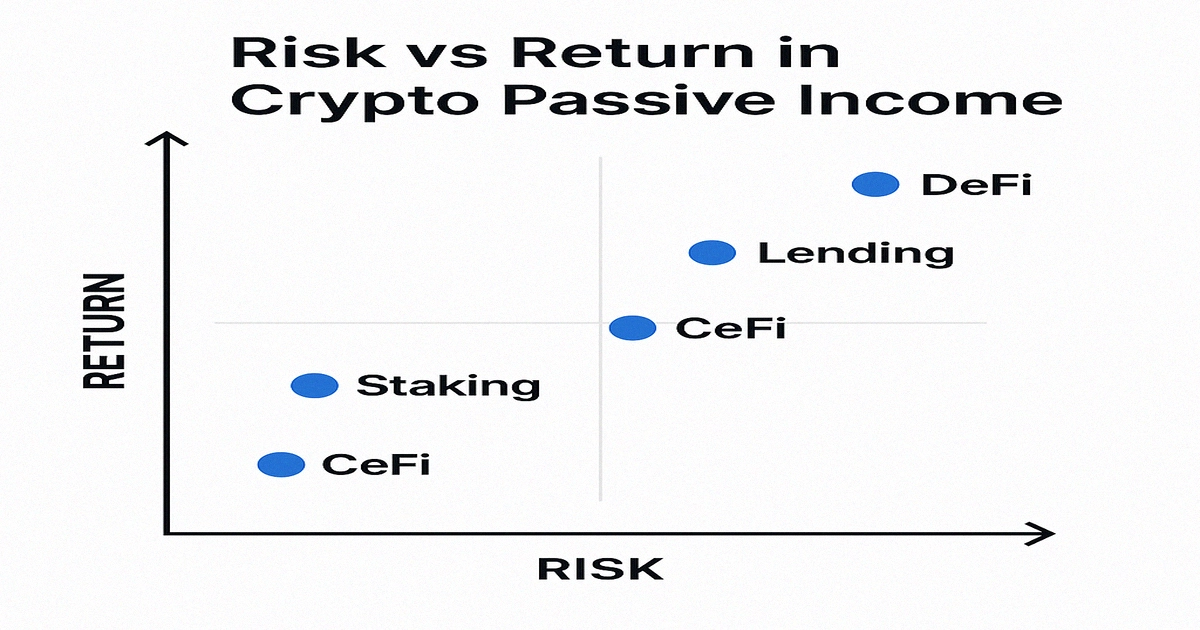
- Risk scales with returns: Higher yields require more active management and carry more risk
- Time commitment matters: Passive strategies require less monitoring but offer lower returns
- Reserve funds are essential: Always maintain liquidity for opportunities and emergencies
Comprehensive Risk Analysis
Smart Contract and Protocol Risks
DeFi protocols are governed by smart contracts that can contain bugs or vulnerabilities, and you should understand these risks before depositing your funds:
- Code vulnerabilities: Bugs that can be exploited by attackers
- Governance attacks: Malicious proposals that change protocol parameters
- Oracle manipulation: Price feed attacks affecting lending protocols
- Upgrade risks: Protocol changes that affect user funds
Mitigation: You should use battle-tested protocols, check audit reports, diversify across platforms, and start with small amounts to limit your exposure.
Counterparty and Custodial Risks
CeFi platforms introduce counterparty risk, and you must evaluate the possibility that your chosen platform becomes insolvent or acts maliciously:
- Platform insolvency: FTX, Celsius, and BlockFi collapse in 2022-2023
- Regulatory action: Government intervention affecting operations
- Operational failures: Technical issues, hacks, or mismanagement
- Withdrawal restrictions: Limits during market stress
Mitigation: You should choose regulated platforms, check insurance coverage, avoid keeping all your funds on one platform, and verify platform solvency regularly.
Market and Liquidity Risks
Crypto markets are volatile, and this volatility can directly affect your yield generation strategies:
- Price volatility: Asset values can fluctuate dramatically
- Impermanent loss: Affects liquidity providers in AMMs
- Liquidation risk: Leveraged positions can be forcibly closed
- Correlation risk: Crypto assets often move together during market stress
Mitigation: You should diversify across asset classes, use stablecoins for yield, avoid excessive leverage, and maintain emergency reserves for your portfolio.
Operational and Security Risks
User errors and security breaches can cause fund loss, and you must take precautions to protect your assets:
- Private key loss: Losing access to wallets
- Phishing attacks: Fake websites stealing credentials
- Transaction errors: Sending to wrong addresses
- Device compromise: Malware or hardware failures
Mitigation: You should use hardware wallets, verify URLs carefully, double-check your transactions, maintain backups, and use multi-signature wallets for large amounts.
Regulatory and Tax Risks
The regulatory landscape for crypto is evolving rapidly, and you should stay informed about changes that could affect your yield strategies:
- Changing regulations: New rules affecting platform operations
- Tax implications: Yield earnings are typically taxable
- Geographic restrictions: Some platforms may become unavailable
- Reporting requirements: KYC/AML compliance obligations
Mitigation: You should stay informed about regulations, maintain detailed records, consult tax professionals, and use compliant platforms for your yield activities.
Risk vs Return Chart
Tools & Providers
- CeFi: Binance Earn, Nexo, Coinbase
- DeFi: Lido, Rocket Pool, Aave, Pendle (see established staking platforms compare)
- Analytics: CoinGlass, TradingView for tracking yields
Comparison Table
| Method | Effort | Risk | Return potential | Where to start |
|---|---|---|---|---|
| Staking | Low | Medium | Medium | Lido Review |
| Lending | Low | Medium | Medium | Nexo |
| Yield Farming | Medium | High | High | Yield Farming guide |
| CeFi Earn | Low | Medium | Low–Medium | Binance Earn |
| Liquidity | High | High | High | DeFi vs CeFi analysis |
Practical Implementation Tips
Getting Started Checklist
- Education first: Understand each strategy before investing
- Start small: Begin with 5-10% of your crypto portfolio
- Choose your risk level: Conservative, moderate, or aggressive approach
- Set up proper security: Hardware wallet, 2FA, secure passwords
- Track everything: Use spreadsheets or portfolio trackers
- Plan for taxes: Understand your jurisdiction's requirements
Platform Selection Criteria
When choosing platforms for yield generation, you should evaluate these criteria carefully:
- Security track record: No major hacks or fund losses
- Regulatory compliance: Licensed and compliant operations
- Insurance coverage: Protection for user funds
- Transparency: Clear terms, regular audits, proof of reserves
- User experience: Intuitive interface, good customer support
- Yield sustainability: Realistic, not too-good-to-be-true rates
Portfolio Allocation Guidelines
Your recommended allocation depends on your risk tolerance:
Conservative Portfolio (Low Risk)
- 50% Stablecoins on regulated CeFi platforms
- 30% Large-cap staking (ETH, ADA, SOL)
- 15% Liquid staking derivatives
- 5% Cash reserves
Moderate Portfolio (Medium Risk)
- 30% CeFi earn programs
- 25% DeFi lending (Aave, Compound)
- 20% Liquid staking
- 15% Conservative yield farming
- 10% Cash reserves
Aggressive Portfolio (High Risk)
- 20% Leveraged staking strategies
- 25% High-yield farming
- 20% Restaking protocols
- 15% Arbitrage opportunities
- 10% Experimental protocols
- 10% Cash reserves
Monitoring and Rebalancing
Successful yield generation requires you to review your positions periodically:
- Weekly: Check for any protocol issues or news
- Monthly: Review yields and compare alternatives
- Quarterly: Rebalance portfolio based on performance
- Annually: Comprehensive strategy review and tax planning
Red Flags to Avoid
You should watch for these warning signs of potentially risky opportunities:
- Unsustainable yields: >50% APY without clear value creation
- Anonymous teams: No known developers or advisors
- No audits: Unaudited smart contracts
- Ponzi mechanics: Returns paid from new investor funds
- Pressure tactics: Limited-time offers, FOMO marketing
- Lack of transparency: Unclear how yields are generated
Future of Crypto Yield Generation: and Beyond
Emerging Technologies
The digital asset returns landscape continues evolving, and you should keep an eye on these emerging technologies that can expand your yield opportunities:
Restaking Protocols
Restaking allows validators to secure multiple networks simultaneously, and this can potentially increase your rewards. EigenLayer and similar protocols enable you to earn additional yields by validating other services on top of your base ETH staking. This innovation should significantly boost your yield opportunities while maintaining security.
Real World Asset (RWA) Tokenization
Traditional assets like real estate, bonds, and commodities are being tokenised on blockchain, and you can access new yield streams through these innovations:
- Tokenized real estate dividends
- Government bond yields on-chain
- Commodity-backed staking rewards
- Traditional finance integration
Cross-Chain Yield optimisation
Advanced protocols can automatically move your funds between chains to capture the highest yields. These yield aggregators use sophisticated algorithms to maximise your returns while managing gas costs and bridge risks on your behalf.
Regulatory Developments
Regulatory clarity is creating more institutional participation, and you should benefit from these developments:
Institutional Adoption
- Corporate treasuries: More companies allocating to crypto staking
- Pension funds: Exploring regulated staking products
- Insurance coverage: Better protection for institutional stakers
- Tax clarity: Clearer guidelines for staking rewards taxation
Compliance-First Platforms
New compliance-first platforms can offer you additional protections and features:
- Automated tax reporting
- KYC/AML compliance
- Institutional-grade custody
- Regulatory insurance coverage
Market Maturation Trends
Yield Normalization
As markets mature, you should expect yields to normalise around sustainable levels:
- Staking yields: 4-8% for major cryptocurrencies
- DeFi lending: 6-12% for established protocols
- Liquidity provision: 8-15% depending on risk
- High-risk strategies: 15-30% with appropriate warnings
Infrastructure Improvements
Better infrastructure should reduce your barriers to entry over time:
- Lower gas fees: Layer 2 solutions making DeFi accessible
- Better UX: Simplified interfaces for complex strategies
- Mobile optimisation: Managing yields from smartphones
- Automated strategies: Set-and-forget yield optimisation
Advanced Yield Generation Strategies
Delta-Neutral Strategies
If you are an advanced user, you can earn yields while minimising your price exposure through these strategies:
Perpetual Funding Arbitrage
You can capture funding rates on perpetual contracts while hedging your spot positions. This strategy can generate 10-30% APY during volatile markets with minimal directional risk to your portfolio.
Basis Trading
You can exploit price differences between spot and futures markets by buying spot assets while shorting futures, capturing the basis as profit when your contracts expire.
Cross-Chain Arbitrage
You can profit from price differences across different blockchains using these approaches:
- Bridge arbitrage: Exploit temporary price differences
- Yield arbitrage: Move funds to highest-yielding chains
- Governance arbitrage: Participate in multiple governance tokens
Leveraged Staking Strategies
You can use borrowed funds to amplify your staking returns, but you must understand the high risk involved:
Recursive Staking
You can stake your assets, borrow against the staked tokens, then stake the borrowed funds again. This recursive approach amplifies both your returns and your risks significantly.
Liquid Staking Leverage
You can use liquid staking tokens as collateral for additional borrowing, creating leveraged exposure to staking rewards that can multiply your yield.
MEV (Maximal Extractable Value) Strategies
If you are an advanced user, you can participate in MEV extraction through these methods:
- MEV staking pools: Share MEV rewards with validators
- Flashloan arbitrage: Capture arbitrage opportunities
- Sandwich protection: Earn from protecting other users
Quantitative Analysis and Performance Metrics
You should track your yield performance using risk-adjusted metrics rather than raw APY alone. Calculate your Sharpe ratio by dividing excess returns by portfolio volatility — a ratio above 1.0 suggests your strategy compensates you adequately for the risk involved. You can use tools like DeBank or Zapper to monitor your positions across multiple protocols in real time.
Your performance dashboard should include annualised percentage yields, maximum drawdown figures, and compound annual growth rates for each strategy. Rebalance your portfolio monthly based on these metrics, and consider reducing exposure to any position where the Sharpe ratio drops below 0.5 for two consecutive weeks.
Institutional Yield Management Approaches
If you manage larger portfolios, you should implement institutional-grade practices even as a retail investor. Multi-signature wallets can protect your funds from single points of failure, and maintaining a detailed audit trail of every transaction will help you during tax season. You must separate your operational wallet from your cold storage to limit exposure.
Your liquidity reserves should cover at least 3 months of expected withdrawals, and you can use professional analytics platforms like Nansen or Dune Analytics to monitor protocol health before committing capital. Regulatory compliance matters more than ever — you should verify that each platform you use holds appropriate licences in your jurisdiction.
Advanced Risk-Return Optimisation Models
You can apply modern portfolio theory to your crypto yield strategies by mapping the correlation between different income sources. Staking rewards, lending yields, and liquidity provision fees often move independently, so combining them should reduce your overall portfolio volatility. Run stress tests against historical drawdown scenarios — if your portfolio cannot survive a 40% market crash without liquidation, you must reduce leverage or increase your stablecoin allocation.
Technical Implementation and Advanced Strategies
To maximise your cryptocurrency passive income, you must understand how yield sources differ across protocols and chains. Your strategy should account for gas costs, bridge fees, and the opportunity cost of locked capital — factors that can erode your net returns if you ignore them.
Protocol-Level Considerations
You should evaluate each blockchain network based on its native yield mechanisms before committing capital. Ethereum gives you the deepest DeFi ecosystem but charges higher transaction fees, so your positions must be large enough to justify gas costs. Understanding the differences between Bitcoin and Ethereum is essential here, as each network offers fundamentally different yield mechanisms. Newer networks like Solana and Avalanche can offer you competitive staking yields with lower barriers to entry, but you should verify their validator set decentralisation and uptime history first.
Smart Contract Integration
Before you deposit funds into any smart contract, you should verify the protocol's audit history on platforms like DeFiSafety or CertiK. Your due diligence checklist must include checking the contract's time-lock settings, admin key controls, and whether the protocol uses upgradeable proxies that could change behaviour after your deposit.
Yield Optimisation Techniques
You can boost your net yields by auto-compounding rewards through protocols like Yearn or Beefy Finance, which reinvest your earnings automatically. Your compounding frequency matters — daily compounding on a 10% APR position can increase your effective APY to approximately 10.5%, and you should factor in the gas cost of each compound transaction to determine the optimal frequency for your position size.
Advanced Considerations and Professional Implementation
Your long-term success with passive income depends on disciplined diversification and regular rebalancing. You should spread your capital across at least three different strategy types — staking, lending, and liquidity provision — so that underperformance in one area does not wipe out your overall returns. Compound interest can work powerfully in your favour, but only if you reinvest consistently and maintain sufficient liquidity reserves to avoid forced selling during market downturns.
Advanced Passive Income Strategies and Professional Implementation
Multi-Protocol Yield Farming and Optimisation
You can significantly boost your returns by deploying capital across multiple DeFi protocols simultaneously. Your first step should be identifying 3-5 protocols with uncorrelated yield sources — for example, combining Curve stablecoin pools with Pendle yield tokenisation and Aave lending. You must monitor each position's gas costs relative to your deposit size, because a $500 position on Ethereum mainnet can lose 2-3% of its annual yield to transaction fees alone.
Your yield aggregator selection matters more than most investors realise. Yearn Finance and Beefy Finance can auto-compound your rewards across multiple chains, but you should compare their performance fees (typically 10-20% of profits) against manual compounding costs. For positions above $10,000, you can often achieve better net returns by managing compounding yourself on a weekly schedule.
Institutional Staking and Validator Operations
If you hold 32 ETH or more, running your own validator node can increase your staking returns by 10-15% compared to liquid staking services. You must maintain 99.9% uptime to avoid inactivity penalties, so your infrastructure should include redundant internet connections and a backup execution client. You can use tools like Grafana and Prometheus to monitor your validator performance in real time.
For smaller holdings, you should delegate to validators with strong track records rather than chasing the highest commission rates. Your validator selection criteria must include historical uptime, slashing history, and the operator's technical reputation. Diversifying your stake across 2-3 validators can protect you against single-operator failures.
Cryptocurrency Lending and Credit Strategies
You can optimise your lending returns by splitting deposits across both CeFi and DeFi platforms based on current rate differentials. When Aave's USDC supply rate exceeds 5%, your capital should flow towards DeFi; when CeFi platforms like Nexo offer promotional rates above 8%, you can temporarily shift allocation. Your lending portfolio must never concentrate more than 30% on any single platform to limit counterparty exposure.
Advanced credit strategies allow you to borrow against your existing positions to deploy capital elsewhere. You should maintain a health factor above 1.5 on Aave to give yourself a comfortable buffer against liquidation. If your collateral drops in value, you must be prepared to add more collateral or repay part of the loan within hours — setting up price alerts on CoinGlass can help you react quickly.
Liquidity Provision and Market Making
Your liquidity provision strategy should start with correlated pairs like stETH/ETH on Curve, where impermanent loss stays minimal. Once you understand the mechanics, you can move to concentrated liquidity positions on Uniswap V3, which can earn you 2-5x higher fees but require active range management. You must rebalance your position whenever the price moves outside your selected range, or your capital sits idle earning nothing.
Cross-Chain Yield Optimisation
You can access higher yields on Layer 2 networks like Arbitrum and Optimism, where gas costs are 10-50x lower than Ethereum mainnet. Your bridge selection should prioritise security over speed — canonical bridges operated by the L2 teams themselves are safer than third-party alternatives. You must account for bridge fees and withdrawal delays when calculating your net cross-chain yield, as a 7-day withdrawal period on Optimism can reduce your effective APY if you need to rebalance frequently.
Automated Portfolio Management and Rebalancing
You should set up automated rebalancing triggers based on allocation drift rather than fixed time intervals. When any single position exceeds 40% of your total portfolio, you must trim it back to your target weight. Tools like Zapper and DeBank can help you track your positions across chains, and you can use DeFi Saver's automation features to protect leveraged positions from liquidation without manual intervention.
Risk Management and Insurance Strategies
Your risk management framework should include DeFi insurance coverage for your largest positions. Nexus Mutual and InsurAce can protect you against smart contract exploits, typically costing 2-4% of the covered amount annually. You must weigh this insurance cost against your expected yield — covering a 5% APY position with 3% insurance leaves you with only 2% net return, so insurance makes the most sense for higher-yield strategies where the potential loss justifies the premium.
Conclusion: Building Sustainable Crypto Passive Income
The cryptocurrency passive income landscape offers you unprecedented opportunities if you are willing to navigate the complexities of digital asset yield generation. From conservative staking strategies offering 4-8% annual returns to aggressive DeFi farming yielding 15-30%, you can find options that match your risk tolerance and investment goals. Your success in this space depends on careful platform selection, thorough risk assessment, and strategic diversification across multiple income streams.
Before diving into yield strategies, make sure you understand the fundamentals — our Bitcoin review covers the base asset that underpins most crypto portfolios.
You should take advantage of the maturation happening across both centralised and decentralised platforms, which has created more reliable passive income opportunities than ever before. Regulatory clarity in major jurisdictions now offers you better consumer protections, while institutional adoption has brought professional-grade tools and deeper liquidity within your reach. However, you must remember that higher yields typically correlate with higher risks, making education and due diligence essential for your long-term success.
Your sustainable passive income portfolio should balance conservative strategies like Bitcoin and Ethereum staking with more aggressive approaches such as liquidity provision and yield farming. Our Ethereum 2025 review covers the staking asset behind most of these yields. You can mitigate risks by diversifying across multiple platforms, protocols, and asset types while capturing opportunities across the entire cryptocurrency ecosystem. Regular monitoring, rebalancing, and staying informed about protocol changes will help you maintain optimal returns over time.
The future of cryptocurrency passive income looks increasingly promising, and you should position yourself to benefit as blockchain technology continues evolving. New opportunities will emerge through technological innovation, regulatory development, and market maturation. By starting with established strategies, gradually building your expertise, and maintaining disciplined risk management, you can build substantial passive income streams that complement your traditional investments.
Regulatory Environment Evolution
You should monitor regulatory developments closely, as new frameworks in the EU, US, and Asia can directly affect which yield strategies remain available to you. Compliance-first platforms will help you navigate these changes, and you must ensure your chosen platforms hold appropriate licences in your jurisdiction before committing significant capital.
Institutional Adoption Impact
Institutional participation in crypto yield strategies should benefit you as a retail investor through deeper liquidity pools and more stable yield opportunities. As corporate treasuries allocate to staking and lending, you can expect improved infrastructure, better insurance options, and more transparent reporting across the platforms you use.
Technology Innovation Cycles
Your passive income toolkit will continue expanding as platforms focus on user experience improvements, automated rebalancing, and comprehensive risk assessment tools. These technological advances should make sophisticated yield strategies accessible to you without requiring extensive technical knowledge or constant monitoring of your positions.
Sources & References
- CoinGecko. (2026). "Cryptocurrency Prices, Charts, and Market Data". Real-time staking yields and APY data for major cryptocurrencies.
- Messari. (2026). "Crypto Research and Data". In-depth analysis of DeFi protocols and passive income strategies.
- Ethereum.org. (2026). "Ethereum Staking". Official documentation on Ethereum staking mechanisms and rewards.
- DeFiLlama. (2026). "DeFi Yield Rankings". Real-time yield data across DeFi protocols and chains.
- EigenLayer. (2026). "EigenLayer Documentation". Restaking protocol architecture, AVS mechanics, and operator delegation.
Frequently Asked Questions
- What is the safest yield generation method in crypto?
- There is no zero-risk method in crypto. However, for many users, staking large-cap assets like ETH or ADA via reputable providers offers a good balance of risk and return. CeFi platforms, such as Nexo or Binance, provide additional simplicity but introduce counterparty risk. The key is diversification and never investing more than you can afford to lose.
- Is DeFi yield better than CeFi earnings?
- It depends on your risk tolerance and technical expertise. DeFi typically offers higher yields (8–25% APY) but requires more active management and carries risks associated with smart contracts. CeFi is simpler (2–8% APY) but introduces counterparty risk and often caps earnings. Many investors use both approaches for diversification.
- How much can I realistically earn with $1,000?
With $1,000, you can expect:
- Conservative approach: $30–50/year (3–5% APY) via CeFi staking
- Moderate approach: $50–80/year (5–8% APY) mixing CeFi and simple DeFi
- Aggressive approach: $80–200/year (8–20% APY) with active DeFi strategies
Remember that higher returns come with higher risks and time commitments.
- Do I need a lot of money to start?
No, you can start with as little as $50 to $100. Many platforms have low minimums:
- Binance Earn: $1 minimum
- Lido staking: No minimum
- Aave lending: ~$10 minimum (due to gas costs)
- Most CeFi platforms: $10–50 minimum
- How often should I check my positions?
It depends on your strategy:
- CeFi earn/Simple staking: Monthly check is sufficient
- DeFi lending: Weekly monitoring recommended
- Yield farming: Daily to weekly, depending on volatility
- Leveraged strategies: Daily monitoring essential
- What about taxes on passive crypto income?
Cryptocurrency earnings are generally taxable as ordinary income in most jurisdictions. Key considerations:
- Track all rewards and their USD value when received
- Staking rewards are taxed when received, not when sold
- DeFi yields may have complex tax implications
- Consider using crypto tax software like Koinly or CoinTracker
- Consult a tax professional for large amounts
- Should I use a hardware wallet for yield generation?
- For significant amounts (>$1,000), yes. Hardware wallets like Ledger or Tangem provide better security than software wallets. However, some strategies require keeping funds on platforms or in hot wallets for functionality.
- What's the biggest mistake beginners make?
The most common mistakes include:
- Chasing high yields without understanding risks
- Not diversifying across strategies and platforms
- Ignoring gas costs on Ethereum-based strategies
- Poor security practices leading to fund loss
- Not tracking for tax purposes
← Back to Crypto Investing Blog Index
Financial Disclaimer
This content is not financial advice. All information provided is for educational purposes only. Cryptocurrency investments carry significant investment risk, and past performance does not guarantee future results. Always do your own research and consult a qualified financial advisor before making investment decisions.