Yield Strategies for Beginners
New to crypto passive income? This comprehensive guide teaches you how to start earning returns safely in 2025 through staking, DeFi lending, and reward programs. Learn step-by-step with practical examples and safety tips.
Introduction
Crypto yield strategies have evolved from complex technical processes accessible only to experienced traders into user-friendly opportunities that beginners can safely navigate in 2025. The maturation of the cryptocurrency ecosystem has created multiple pathways for generating passive income, ranging from simple staking rewards to sophisticated DeFi protocols that offer competitive returns while maintaining reasonable risk profiles.
For newcomers to cryptocurrency investing, understanding yield generation represents a crucial step towards building long-term wealth through digital assets. Unlike traditional savings accounts that offer minimal returns, crypto earning strategies can provide annual percentage yields ranging from 3% to 15% or more, depending on the approach and risk tolerance. These opportunities have become increasingly accessible through user-friendly platforms and improved security measures.
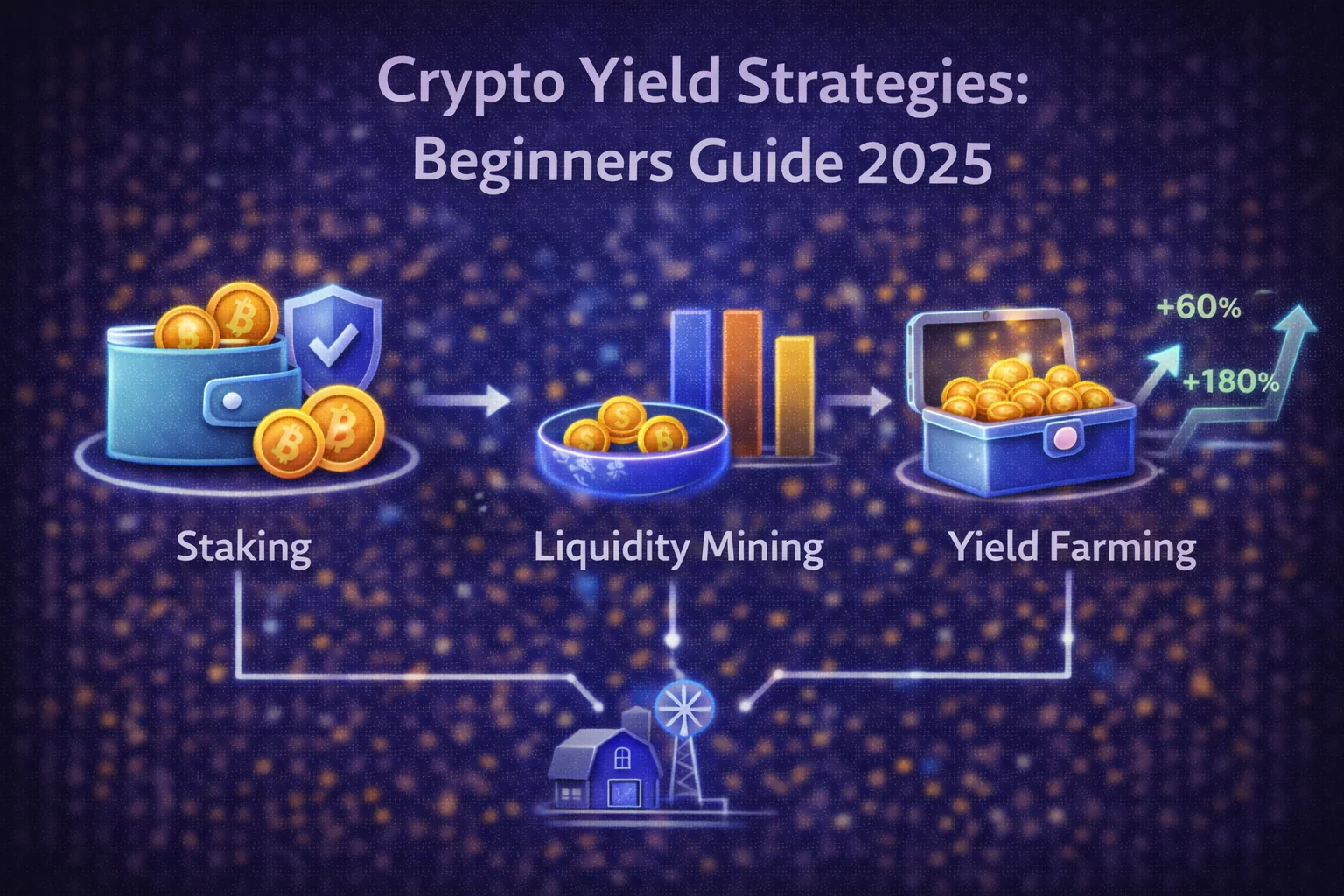
The landscape of crypto yield generation encompasses several distinct approaches, each with unique characteristics, risk profiles, and return expectations. Staking allows users to earn rewards by participating in blockchain network security, while lending protocols enable earning interest by providing liquidity to borrowers. Liquidity provision in decentralised exchanges offers trading fee rewards, and yield farming strategies combine multiple protocols to optimise returns.
Safety and education remain paramount when exploring digital asset yield strategies, particularly for beginners who may be unfamiliar with the technical aspects and risk factors involved. The cryptocurrency space has experienced significant evolution in security practices, regulatory clarity, and platform reliability, making 2025 an opportune time for newcomers to begin their yield generation journey with proper guidance and risk management.
This comprehensive guide provides step-by-step instructions for implementing beginner-friendly yield strategies, covering everything from platform selection and security setup to advanced optimisation techniques. We'll explore the most accessible and reliable methods for generating crypto yields, helping you understand the trade-offs between different approaches and make informed decisions based on your risk tolerance and investment goals.
Market conditions in 2025 have created unique opportunities for yield generation, with institutional adoption driving platform improvements and regulatory developments providing clearer frameworks for cryptocurrency activities. Understanding these market dynamics and their impact on yield opportunities is essential for making strategic decisions about where and how to deploy your cryptocurrency holdings for maximum returns while maintaining appropriate risk management.
Whether you're looking to earn modest returns on your existing cryptocurrency holdings or build a comprehensive passive income strategy, this guide provides the foundation for successful yield generation in the evolving cryptocurrency landscape of 2025 and beyond.
The regulatory environment has also improved significantly, with major jurisdictions providing clearer guidelines for cryptocurrency activities and tax treatment. This regulatory clarity has encouraged institutional participation and provided retail investors with greater confidence in the legitimacy and long-term viability of digital asset earning strategies.
Technology improvements in blockchain infrastructure, including faster transaction processing and lower fees, have made yield strategies more accessible and cost-effective for users of all sizes.
These developments, combined with improved security practices and comprehensive user education resources, create an optimal environment for beginners to start their crypto yield generation journey safely and effectively in the dynamic digital asset landscape of 2025.
Platform diversity has expanded significantly, offering beginners multiple entry points into yield generation with varying levels of complexity and risk. Centralised platforms provide user-friendly interfaces and customer support, while decentralised protocols offer higher potential returns for those comfortable with increased technical requirements and self-custody responsibilities.
Crypto yield generation has transformed from an experimental concept into a mature financial ecosystem offering diverse opportunities for passive income generation. For beginners entering this space in 2025, the landscape can appear overwhelming with its complex terminology, numerous platforms, and varying risk profiles. However, understanding the fundamental principles and starting with conservative strategies can provide a solid foundation for building a successful yield-generating cryptocurrency portfolio.
The evolution of yield strategies has democratised access to sophisticated financial instruments previously available only to institutional investors. Modern platforms offer user-friendly interfaces that abstract away much of the technical complexity while maintaining the underlying benefits of decentralised finance. This accessibility has created unprecedented opportunities for retail investors to earn competitive returns on their cryptocurrency holdings without requiring extensive technical knowledge or large capital commitments.
The current market environment in 2025 presents unique opportunities for yield generation that didn't exist in previous years. Regulatory clarity has improved significantly, with many jurisdictions providing clear frameworks for cryptocurrency activities. This regulatory progress has encouraged institutional participation, leading to more stable and mature yield opportunities. Additionally, the infrastructure supporting yield generation has become more robust, with improved security measures, optional third-party cover, and user protection mechanisms.
Traditional financial markets continue to offer historically low interest rates, making digital asset earning strategies increasingly attractive to investors seeking higher returns — our crypto vs stocks comparison breaks down the numbers. Whilst savings accounts and government bonds provide minimal yields, cryptocurrency platforms offer opportunities to earn 4-15% annually through various strategies. This yield premium reflects both the innovative nature of the technology and the additional risks involved, making proper education and risk management essential for success.
Successful yield generation requires a systematic approach that balances potential returns with risk management, diversification, and security considerations. Beginners must understand the different categories of yield strategies, from conservative staking options offering 4-8% annual returns to more aggressive DeFi protocols that can generate 15-25% yields but carry higher risks. The key is to start with simple, well-established strategies and gradually expand to more sophisticated approaches as knowledge and confidence grow.
Security and platform selection represent critical factors that can determine the success or failure of yield generation efforts. The cryptocurrency space has witnessed numerous platform failures, smart contract exploits, and market volatility events that have resulted in significant losses for unprepared investors. Understanding how to evaluate platforms, implement proper security practices, and maintain appropriate diversification can help beginners avoid common pitfalls while maximising their earning potential.
This comprehensive guide provides a structured approach to cryptocurrency yield generation specifically designed for beginners. We'll explore fundamental concepts, analyse different strategy categories, examine platform options, and provide practical implementation guidance. By the end of this guide, you'll have the knowledge and confidence needed to begin generating passive income from your cryptocurrency holdings while maintaining appropriate risk management practices.
Yield Overview
The cryptocurrency landscape in 2025 has evolved into a sophisticated financial ecosystem, offering numerous opportunities to generate passive income from digital assets. Unlike traditional banking systems, which provide minimal interest on savings accounts, cryptocurrency yield strategies can deliver annual returns ranging from 3% to over 20%, depending on the approach and risk tolerance you're willing to accept.
For beginners entering this space, the abundance of options can feel overwhelming. From simple staking mechanisms to complex DeFi protocols, the variety of yield-generating strategies requires careful navigation to avoid common pitfalls while maximising earning potential. This comprehensive guide provides a structured approach to building your first cryptocurrency income portfolio, starting with the safest, most beginner-friendly options and gradually introducing more advanced strategies as your knowledge and confidence grow.
The maturation of the cryptocurrency ecosystem has brought increased regulatory clarity, institutional adoption, and improved security measures across major platforms. This evolution has made yield generation more accessible and safer for retail investors, with many traditional financial institutions now offering cryptocurrency services alongside established crypto-native platforms.
Understanding the fundamentals of cryptocurrency yield generation is essential before diving into specific strategies. Unlike traditional investments, which generate returns primarily from price appreciation, cryptocurrency yield strategies generate income through various mechanisms, including network validation rewards, lending interest, liquidity provision fees, and protocol incentives. These diverse income streams can provide steady returns even during periods of market volatility, making them attractive for building long-term wealth.
The key to successful cryptocurrency yield generation lies in understanding the risk-reward profiles of different strategies and implementing proper diversification across multiple approaches and platforms. This guide will teach you how to evaluate opportunities, manage risks, and build a sustainable income portfolio that aligns with your financial goals and risk tolerance while avoiding the common mistakes that can lead to significant losses in the cryptocurrency space.
Advanced Beginner Progression and Professional Development Pathways
Successful cryptocurrency yield generation requires systematic skill development that progresses from basic staking concepts to sophisticated portfolio management techniques. Advanced beginners benefit from structured learning pathways that introduce complex concepts gradually, including smart contract interactions, cross-chain yield optimisation, and advanced risk management frameworks. Professional development in cryptocurrency yield strategies involves mastering quantitative analysis, understanding protocol tokenomics, and implementing systematic approaches to opportunity evaluation and risk assessment.
Educational progression includes understanding blockchain fundamentals, DeFi protocol mechanics, and advanced financial concepts including impermanent loss calculations, yield farming mathematics, and sophisticated hedging strategies. Professional practitioners develop expertise in technical analysis, fundamental protocol research, and comprehensive due diligence frameworks that enable systematic identification of high-quality yield opportunities while avoiding common pitfalls that affect inexperienced participants in cryptocurrency markets.
Institutional-Grade Security and Risk Management for Individual Investors
Individual cryptocurrency investors can implement institutional-grade security practices including multi-signature wallet configurations, hardware security modules, and comprehensive backup strategies that protect against both technical failures and human error. Advanced security frameworks incorporate cold storage solutions, secure key management protocols, and sophisticated monitoring systems that provide enterprise-level protection for personal cryptocurrency holdings while maintaining accessibility for active yield generation strategies.
Professional risk management techniques include portfolio diversification across multiple protocols and networks, systematic position sizing based on risk-adjusted return calculations, and optional third-party cover bought separately from a smart-contract insurer such as Nexus Mutual, which pays out only on the specific events each policy names — typically exploits and oracle failures — rather than offering blanket protection against every platform risk. These approaches enable individual investors to achieve institutional-level risk management while maintaining the flexibility and control advantages of self-custody cryptocurrency management and direct protocol interaction for optimal yield generation opportunities.
Modern cryptocurrency yield strategies have evolved significantly from the early days of simple mining rewards. Today's ecosystem includes sophisticated mechanisms such as proof-of-stake validation, automated market making, liquidity mining, and algorithmic trading strategies. Each approach offers different risk profiles, technical requirements, and potential returns, making it crucial for beginners to understand these distinctions before committing capital.
The regulatory environment surrounding cryptocurrency yield generation has also matured considerably in 2025. Major jurisdictions have established more straightforward guidelines for taxation, compliance, and consumer protection, providing greater confidence for both individual and institutional participants. This regulatory clarity has led to increased adoption of cryptocurrency yield strategies by traditional financial advisors and wealth management firms.
Security considerations remain paramount when engaging with cryptocurrency yield strategies. The decentralised nature of many protocols means that users must take personal responsibility for protecting their assets through proper wallet management, platform selection, and risk assessment. Understanding these security fundamentals is essential before pursuing any yield-generating activities in the cryptocurrency space.
This comprehensive guide will walk you through each major category of cryptocurrency yield strategies, starting with the most conservative approaches suitable for complete beginners and progressing to more advanced techniques for experienced users. By the end of this guide, you'll have the knowledge and confidence to begin generating passive income from your cryptocurrency holdings while maintaining appropriate risk management practices.
The cryptocurrency yield landscape continues to evolve rapidly, with new protocols, platforms, and opportunities emerging regularly. Staying informed about these developments while maintaining a disciplined approach to risk management will be key to long-term success in cryptocurrency yield generation. This guide provides the foundational knowledge needed to navigate this dynamic environment effectively and profitably.
What is Cryptocurrency Income Generation?
Cryptocurrency income generation refers to various methods of earning returns on your digital asset holdings without actively trading. These strategies put your idle cryptocurrencies to work, generating income through different mechanisms within the blockchain ecosystem. The four primary categories include:
- Staking: Earning rewards by participating in network consensus mechanisms on proof-of-stake blockchains
- Lending: Providing liquidity to borrowers through centralised or decentralised platforms in exchange for interest payments
- Liquidity Provision: Earning trading fees by providing liquidity to decentralised exchanges and automated market makers
- Yield Farming: Earning token rewards from DeFi protocols by participating in various liquidity mining programs
Why Cryptocurrency Yields Exceed Traditional Finance
Several factors contribute to the higher yields available in cryptocurrency markets compared to traditional financial products. The nascent nature of DeFi protocols creates opportunities for early adopters, while the global, 24/7 nature of cryptocurrency markets enables more efficient capital allocation. Additionally, the programmable nature of smart contracts allows for innovative yield generation mechanisms that don't exist in traditional finance. The competitive landscape amongst protocols drives innovation and higher rewards for users, while the absence of traditional banking intermediaries allows for more direct value transfer to yield farmers and stakers.
Risk Management for New Investors
Understanding and managing risk is crucial for successful income generation in cryptocurrency markets. Smart contract risks, impermanent loss, platform risks, and market volatility all play significant roles in determining actual returns. New users should start with lower-risk strategies such as staking established cryptocurrencies on reputable platforms before progressing to more complex DeFi strategies. Diversification across different protocols, asset types, and risk levels helps create a balanced approach to income generation while protecting against potential losses from any single strategy or platform failure.
However, these higher returns come with corresponding risks that must be carefully understood and managed. Smart contract vulnerabilities, regulatory uncertainty, market volatility, and platform risks all contribute to the risk profile of cryptocurrency yield strategies. Successful yield generation requires balancing potential returns against these risks through proper due diligence, diversification, and risk management practices.
The Beginner's Advantage
Starting your yield generation journey in 2025 offers several advantages over earlier periods in cryptocurrency history. Improved user interfaces, better educational resources, enhanced security measures, and clearer regulatory frameworks have made the space more accessible to newcomers. Major exchanges now offer simple staking services, while DeFi protocols have implemented better risk management and user protection measures.
This guide will take you through a progressive learning approach, starting with the simplest, lowest-risk strategies and gradually introducing more sophisticated techniques as you build experience and confidence. By following this structured path, you can begin generating meaningful returns from your cryptocurrency holdings while minimising the risks associated with more complex strategies.
Entry-Level Approaches
As a new investor, focus on simple, transparent methods with established track records. Here are the three main categories ranked by complexity and risk:
1. Digital Asset Staking (Lowest Risk)
Staking is the most straightforward income generation method, involving locking virtual currencies to support network operations and generate rewards.
Best Staking Options for New Investors:
- Ethereum (ETH): 3.5-4.5% APY through liquid staking providers
- Solana (SOL): 6-8% APY with various validators
- Cardano (ADA): 4-6% APY through staking pools
- Cosmos (ATOM): about 15.7% gross (September 2026), set by inflation against the bonded share
2. CeFi Lending (Medium Risk)
Centralised Finance (CeFi) platforms offer user-friendly interfaces for lending virtual currencies and earning interest.
Recommended CeFi Platforms:
- Nexo: 4-12% APY; MiCA CASP application pending (not yet authorised); underwriter-backed custodial-hack cover via custody partners (covers custodian theft, not insolvency)
- Binance Earn: 1-8% APY, integrated with exchange
- Coinbase Earn: Various rates, US regulated
3. Conservative DeFi (Higher Risk)
Decentralised Finance (DeFi) offers higher returns but requires more technical knowledge and carries additional risks.
Entry-Level DeFi Options:
- Aave: Established lending protocol with good track record
- Compound: Simple lending interface with governance tokens
- Curve: Stablecoin pools with lower impermanent loss risk
Digital Asset Staking for Newcomers
Staking is the ideal starting point for beginners because it is conceptually simple and has lower technical barriers than the other ways of earning yield.
How Staking Works
When you delegate virtual currencies, you're essentially participating in the network's security and consensus mechanism. Your delegated tokens help validate transactions and secure the network, earning you a portion of block rewards and processing charges.
Types of Staking
Native Staking
Delegating directly on the blockchain network, typically requiring technical setup and minimum amounts (32 ETH for Ethereum).
Liquid Staking
Delegating through providers like Lido or Rocket Pool, which give you liquid tokens representing your delegated assets. This allows you to maintain liquidity while earning staking rewards.
Exchange Staking
Delegating through centralised exchanges like Coinbase or Binance, offering the simplest client experience but requiring trust in the platform.
Token Staking Implementation Guide
Step 1: Choose Your Asset
Start with established Proof-of-Stake virtual currencies:
- Ethereum: Most secure and established
- Solana: Higher returns but more volatile
- Cardano: Stable network with good returns
Step 2: Select a Token Staking Provider
For beginners, liquid staking providers offer the best balance of simplicity and flexibility:
- Lido: Largest liquid staking provider for Ethereum
- Rocket Pool: decentralised alternative to Lido
- Coinbase: Regulated exchange staking
Step 3: Start Small
Begin with a small amount ($100-500) to understand the process before committing larger sums.
Token Staking Risks and Considerations
- Slashing Risk: Potential loss if validators misbehave
- Lock-up Periods: Some staking requires locking funds for specific periods
- Validator Risk: Choosing unreliable validators can affect rewards
- Smart Contract Risk: Liquid staking involves smart contract risks
CeFi Lending Platforms
Centralised Finance (CeFi) lending services provide a familiar, user-friendly way to earn interest on cryptocurrency holdings. These platforms operate similarly to traditional banks but offer higher interest rates.
How CeFi Lending Works
You deposit cryptocurrency into a platform, which then lends it to institutional borrowers, traders, or other participants. The platform pays you interest from the fees charged to borrowers, minus their operational costs and profit margin.
Top CeFi Platforms for Beginners
Nexo
- Regulation: Not yet MiCA-authorised (CASP application pending); EEA services run via partner licences (Tangany custody, DLT Finance trading); not FCA-registered
- Yields: 4-12% APY depending on asset and tier
- Insurance: The cover sits with the custodians, not with Nexo. Ledger publishes up to $150 million for its Ledger Vault platform and calls it pooled — one limit shared by every client on that platform, so it is not a per-account figure (Ledger Enterprise insurance material, read 22 August 2026). It answers custodian theft; it is not deposit insurance and it does not cover insolvency
- Minimum: No minimum deposit
Binance Earn
- Integration: Built into the Binance exchange, so funds already held there can be allocated to Earn products without a transfer to a separate platform
- Yields: 1-8% APY across various products
- Flexibility: Flexible and fixed-term options
- Variety: Wide range of supported cryptocurrencies
YouHodler
- Regulation: Not FINMA-licensed; its Swiss cover is AML-only PolyReg/SRO (self-regulatory) membership, not a banking or e-money licence
- Yields: 3-8% APY on major cryptocurrencies
- Features: Multi HODL and turbo loans available
- Availability: As of July 2026, new EU/EEA account onboarding is suspended (existing users retained); not available in the UK or US
- Support: 24/7 client assistance
CeFi Implementation Strategy
Step 1: Platform Research
Evaluate platforms based on:
- Regulatory compliance and licensing
- Insurance coverage and security measures
- Track record and user reviews
- Return rates and fee structures
Step 2: Account Setup
- Complete KYC verification process
- Enable two-factor authentication
- Set up withdrawal whitelisting
- Review terms and conditions carefully
Step 3: Start Conservative
- Begin with stablecoins for predictable returns
- Use flexible terms initially for liquidity
- Diversify across multiple platforms
- Monitor platform health regularly
CeFi Risks and Mitigation
- Counterparty Risk: Platform could fail or freeze withdrawals
- Regulatory Risk: Changes in regulations could affect operations
- Custody Risk: You don't control your private keys
- Mitigation: Diversify across platforms, monitor news, maintain emergency funds
DeFi Basics for Beginners
Decentralised Finance (DeFi) offers higher returns and more control over your funds, but requires greater technical knowledge and risk management skills.
Understanding DeFi Fundamentals
DeFi protocols operate through smart contracts on blockchain networks, eliminating traditional intermediaries. Users interact directly with protocols using cryptocurrency wallets.
Essential DeFi Concepts
Smart Contracts
Self-executing contracts with terms directly written into code. They automatically execute transactions when predetermined conditions are met.
Liquidity Pools
Collections of funds locked in smart contracts that provide liquidity for decentralised exchanges and lending protocols.
Governance Tokens
Tokens that give holders voting rights in protocol decisions often provide additional returns through rewards programs.
Impermanent Loss
The impermanent loss of funds experienced by liquidity providers due to volatility in trading pairs, compared to simply holding the assets.
Beginner-Friendly DeFi Protocols
Aave
- Type: Lending and borrowing protocol
- Yields: 2-15% APY depending on asset
- Features: Flash loans, rate switching, governance
- Safety: Multiple audits, established track record
Compound
- Type: Algorithmic lending protocol
- Yields: Variable rates based on supply and demand
- Features: Automatic rate adjustments, COMP rewards
- Interface: Simple, user-friendly design
Curve Finance
- Type: Stablecoin-focused DEX and liquidity pools
- Yields: 5-15% APY on stablecoin pools
- Benefits: Lower impermanent loss risk
- Rewards: CRV token incentives
Curve is the natural starting point for stablecoin-pool yields, but the protocol mechanics — gauges, vote-escrow CRV, bribe markets — take time to map. Our review of Curve protocol mechanics for stablecoin yield covers what each of those moving parts actually does to a passive depositor's APY.
DeFi Getting Started Guide
Step 1: Set Up a Wallet
Choose a reputable wallet that supports DeFi interactions:
- MetaMask: Most popular browser extension wallet
- Trust Wallet: Mobile-first with DApp browser
- Coinbase Wallet: User-friendly with built-in DeFi access
Step 2: Fund Your Wallet
- Transfer cryptocurrency from exchange to wallet
- Ensure you have ETH for gas fees
- Start with small amounts for testing
- Double-check addresses before sending
Step 3: Connect to Protocols
- Visit official protocol websites
- Connect your wallet securely
- Review transaction details carefully
- Start with simple lending before complex approaches
DeFi Risk Management
- Smart Contract Risk: Bugs or exploits in protocol code
- Governance Risk: Malicious proposals or centralised control
- Liquidity Risk: Inability to exit positions during market stress
- Gas Fee Risk: High transaction costs during network congestion
Step-by-Step Implementation
Follow this systematic approach to implement your first yield approach safely and effectively.
Phase 1: Preparation (Week 1)
Day 1-2: Education and Research
- Read about chosen approach thoroughly
- Understand risks and potential returns
- Research platform security and track record
- Join community forums and Discord channels
Day 3-4: Setup and Security
- Set up necessary wallets and accounts
- Enable all security features (2FA, whitelisting)
- Backup seed phrases securely
- Test with very small amounts first
Day 5-7: Initial Testing
- Make first small deposit ($50-100)
- Verify rewards are accruing correctly
- Test fund extraction
- Document all transactions
Phase 2: Scaling (Week 2-4)
Week 2: Gradual Increase
- Increase position size gradually
- Monitor performance daily
- Track returns and costs carefully
- Adjust approach based on results
Week 3-4: Diversification
- Add second platform or approach
- Maintain detailed records
- Set up monitoring alerts
- Review and optimise regularly
Phase 3: Optimisation (Month 2+)
Performance Analysis
- Calculate net returns after fees
- Compare actual vs expected yields
- Identify optimisation opportunities
- Adjust allocation based on performance
Strategy Expansion
- Explore additional yield opportunities
- Increase position sizes gradually
- Maintain risk management discipline
- Continue learning and adapting
Essential Tools and Resources
Success in return approaches requires the right tools for monitoring, analysis, plus security.
Portfolio Tracking Tools
DeBank
- Comprehensive DeFi portfolio tracking
- Real-time return calculations
- Protocol health monitoring
- Transaction history and analytics
Zapper
- Multi-protocol portfolio management
- Yield farming opportunity discovery
- One-click position management
- Historical performance tracking
CoinTracker
- Tax-focused portfolio tracking
- Automatic transaction categorisation
- Tax report generation
- Integration with major platforms
Yield Analysis Tools
DefiLlama
- Total Value Locked (TVL) tracking
- Protocol rankings and metrics
- Return comparison across protocols
- Market trend analysis
Revert Finance
- Liquidity pool performance tracking
- Impermanent loss calculations
- Historical yield data
- Strategy backtesting
Security Tools
Hardware Wallets
- Ledger Nano S/X: Most popular hardware wallet
- Trezor: Open-source alternative
- GridPlus Lattice1: Advanced features for DeFi
Security Monitoring
- Forta: Real-time security monitoring
- OpenZeppelin Defender: Smart contract monitoring
- Tenderly: Transaction simulation and monitoring
Information Resources
News and Analysis
- DefiLlama: DeFi TVL and analytics
- The Defiant: DeFi-focused journalism
- Bankless: Comprehensive DeFi coverage
Educational Content
- Finematics: DeFi educational videos
- Coin Bureau: Crypto education and analysis
- DeFi Dad: Beginner-friendly DeFi tutorials
Safety and Security Checklist
Security matters more than yield when you are starting out. Follow this comprehensive checklist to protect your investments.
Platform Security Evaluation
Before Using Any Platform:
- Verify official website URL and SSL certificate
- Check for security audits and bug bounty programs
- Research team background and track record
- Review insurance coverage and user protections
- Analyse Total Value Locked (TVL) plus user base
- Read recent user reviews and community feedback
Account Security Setup
For CeFi Platforms:
- Enable two-factor authentication (2FA)
- Use strong, unique passwords
- Set up withdrawal whitelisting
- Enable email/SMS notifications
- Regularly review account activity
For DeFi Protocols:
- Use hardware wallet for large amounts
- Verify smart contract addresses
- Keep seed phrases secure and backed up
- Use separate wallets for different purposes
- Keep software updated
Risk Management Practices
Diversification Rules:
- Never put more than 20% in any single platform
- Diversify across different approach types
- Maintain emergency funds in liquid assets
- Start small and scale gradually
- Regular portfolio rebalancing
Ongoing Monitoring
Daily Checks:
- Monitor yield rates and platform health
- Check for unusual account activity
- Review news and community updates
Weekly Reviews:
- Calculate net returns and performance
- Update portfolio tracking spreadsheets
- Review and adjust approach if needed
Monthly Audits:
- Comprehensive security review
- Platform health assessment
- Strategy performance analysis
- Tax record organisation
Common Beginner Mistakes

Learn from others' mistakes to avoid costly errors in your yield approach journey.
Strategy Selection Mistakes
Chasing High APY Without Understanding Risks
Mistake: Investing in protocols offering 100%+ APY without researching sustainability or risks.
Solution: Prioritise risk-adjusted performance and learn the underlying yield generation mechanisms.
Ignoring Platform Track Record
Mistake: Deploying substantial capital to newly launched, untested platforms without proven history.
Solution: Prioritise established platforms with long track records and multiple audits.
Putting All Funds in One Strategy
Mistake: Concentrating all yield investments in a single platform or approach.
Solution: Diversify across multiple platforms, approaches, and risk levels.
Technical Implementation Mistakes
Not Testing with Small Amounts
Mistake: Making large deposits without testing the platform first.
Solution: Begin with minimal test deposits to familiarise yourself with the platform mechanics.
Ignoring Gas Fees and Transaction Costs
Mistake: Not accounting for processing charges when calculating returns.
Solution: Factor in all costs and use Layer 2 solutions when appropriate.
Poor Record Keeping
Mistake: Not tracking transactions, yields, and tax implications.
Solution: Maintain detailed records from day one using tracking tools.
Risk Management Mistakes
Investing More Than You Can Afford to Lose
Mistake: Using emergency funds or borrowed money to chase yield.
Solution: Only invest disposable income and maintain emergency funds separately.
Not Understanding Impermanent Loss
Mistake: Providing liquidity without understanding impermanent loss risks.
Solution: Learn about impermanent loss before participating in liquidity pools.
Panic Selling During Market Volatility
Mistake: Exiting positions during temporary market downturns.
Solution: Develop a long-term approach and stick to it during volatility.
Security Mistakes
Using Weak Security Practices
Mistake: Reusing passwords, not enabling 2FA, or storing seed phrases insecurely.
Solution: Implement comprehensive security measures from the start.
Falling for Phishing Attacks
Mistake: Clicking malicious links or connecting wallets to fake websites.
Solution: Always verify URLs and use bookmarks for important sites.
Portfolio Allocation Guidelines
Proper allocation is crucial for balancing returns with risk management. Here are recommended allocation approaches for different experience levels.
Conservative Beginner Allocation
Total Yield Allocation: 5-10% of digital asset portfolio
- 60% Staking: ETH, SOL, ADA through reputable providers
- 30% CeFi Lending: Stablecoins in regulated platforms
- 10% Learning: Small DeFi experiments
Expected Return: 4-8% APY with low-medium risk
Moderate Beginner Allocation
Total Yield Allocation: 10-20% of digital asset portfolio
- 40% Staking: Diversified across multiple assets
- 35% CeFi Lending: Mix of stablecoins and crypto
- 25% Conservative DeFi: Established protocols like Aave
Expected Return: 6-12% APY with medium risk
Aggressive Beginner Allocation
Total Yield Allocation: 15-25% of digital asset portfolio
- 30% Staking: Higher-yield, newer protocols
- 30% CeFi Lending: Diversified across platforms
- 40% DeFi Strategies: Lending, liquidity pools, income farming
Expected Return: 8-15% APY with medium-high risk
Allocation Principles
Risk Ladder Approach
- Start with lowest-risk approaches
- Gradually add higher-risk, higher-reward options
- Maintain core allocation in conservative approaches
- Use profits from conservative approaches to fund riskier experiments
Diversification Rules
- No more than 20% in any single platform
- No more than 30% in any single approach type
- Maintain at least three different platforms/protocols
- Balance between CeFi and DeFi exposure
Rebalancing Schedule
- Weekly: Monitor performance and adjust small positions
- Monthly: Comprehensive portfolio review and rebalancing
- Quarterly: Strategy evaluation and major allocation changes
- Annually: Complete approach overhaul if needed
Tax and Record Keeping
Proper tax planning and record keeping are essential for yield approach success. For a UK resident, HMRC's CRYPTO21200 states that where staking does not amount to a trade, the sterling value at the time of receipt of any tokens awarded is taxable as miscellaneous income; lending and liquidity returns are a separate question that this rule does not settle.
Tax Implications
Income Recognition
- Where staking does not amount to a trade, the sterling value at the time of receipt of any tokens awarded is taxable as miscellaneous income for a UK resident
- Lending interest is taxable as ordinary income
- DeFi rewards are taxable at fair market value
- Governance tokens may be taxable upon receipt
Capital Gains Considerations
- Selling reward tokens triggers funds gains/losses
- Impermanent loss may create tax-loss harvesting opportunities
- Compounding approaches may create frequent taxable events
Record Keeping Requirements
Essential Records to Maintain
- Date and time of all transactions
- Transaction hashes and blockchain confirmations
- USD value at time of receipt
- Platform or protocol used
- Type of reward or yield earned
Recommended Tracking Methods
- Spreadsheet: Simple tracking for basic approaches
- Crypto Tax Software: Automated tracking and reporting
- Portfolio Trackers: Real-time monitoring with tax features
- Professional Help: CPA specialising in crypto taxes
Tax Optimisation Strategies
Legal Tax Minimisation
- Hold rewards for long-term fund gains treatment
- Use tax-loss harvesting to offset gains
- Consider jurisdiction-specific approaches
- Time transactions for optimal tax treatment
Compliance Best Practices
- Consult with crypto-experienced tax professionals
- Keep detailed records from day one
- Understand local tax laws and requirements
- File accurate and complete tax returns
Scaling Your Strategy
Once you have mastered the basics of earning yield, you can gradually scale up your operations and explore more advanced opportunities.
Scaling Timeline
Months 1-3: Foundation Building
- Master 1-2 basic approaches
- Establish security and tracking systems
- Build confidence through small successes
- Develop risk management discipline
Months 4-6: Diversification
- Add 2-3 additional approaches
- Increase position sizes gradually
- Explore different platforms and protocols
- Optimise for tax efficiency
Months 7-12: Advanced Strategies
- Explore income farming and liquidity mining
- Consider leveraged approaches (with caution)
- Participate in governance and protocol decisions
- Develop automated monitoring systems
Advanced Strategy Considerations
Yield Farming
- Higher returns but increased complexity
- Requires active management and monitoring
- Impermanent loss and token price risks
- Gas fee optimisation becomes crucial
Cross-Chain Strategies
- Explore opportunities on different blockchains
- Understand bridge risks and costs
- Manage multiple wallets and assets
- Consider Layer 2 solutions for lower fees
Institutional Strategies
- Larger position sizes enable new opportunities
- Access to institutional-grade platforms
- More sophisticated risk management tools
- Professional tax and legal considerations
Scaling Best Practices
Gradual Growth Approach
- Increase allocations by 25-50% monthly maximum
- Test new approaches with small amounts first
- Maintain core conservative allocation
- Don't chase performance or FOMO into new approaches
System Improvements
- Upgrade to more sophisticated tracking tools
- Implement automated monitoring and alerts
- Develop standard operating procedures
- Consider professional management tools
Real Beginner Success Stories
Story 1: College Student - Starting with $500
Background: 22-year-old student, no prior crypto experience
Month 1-2: Learning Phase
- Started with $500 in ETH
- Staked via Coinbase (4% APY)
- Spent 2 weeks reading guides and watching tutorials
- Earned $3.33 in first month
Month 3-6: Expanding Strategy
- Added $200/month from part-time job
- Diversified: 60% ETH staking, 40% USDC lending on Aave
- Total portfolio: $1,300
- Monthly earnings: ~$5-7
Month 7-12: Confidence Building
- Continued $200/month contributions
- Tried Curve stablecoin farming with $300
- Final portfolio: $3,200
- Total yield earned: $145 (4.5% average APY)
Key Lessons: Started small, learnt gradually, avoided risky approaches, consistent contributions mattered more than high APY.
Story 2: Working Professional - $5,000 Start
Background: 35-year-old software developer, some investment experience
Initial Strategy (Month 1):
- $5,000 split: $3,000 ETH staking (Lido), $2,000 USDC lending (Aave)
- Conservative approach: established platforms only
- Expected APY: 4.5% blended
6-Month Results:
- ETH staking rewards: $67.50 (4.5% APY)
- USDC lending interest: $45 (4.5% APY)
- ETH price appreciation: +15% = $450
- Total return: $562.50 (11.25%)
12-Month Results:
- Added $500/month from salary
- Final portfolio: $11,200
- Total yield earned: $380
- Capital appreciation: $1,200
- Combined return: $1,580 (31.6% on initial funds)
Key Lessons: Consistent contributions amplified returns, conservative approach avoided losses, ETH appreciation was bonus on top of yield.
Story 3: Retiree - Income Focus
Background: 62-year-old retiree, seeking stable income
Strategy:
- $20,000 in stablecoin lending (USDC on Aave)
- Goal: Monthly income without price volatility
- Target APY: 4-5%
12-Month Results:
- Monthly income: $75-85 (consistent)
- Annual yield: $960 (4.8% APY)
- Zero price volatility (stablecoin)
- Withdrew interest monthly for living expenses
Key Lessons: Stablecoins provided predictable income, avoided crypto volatility stress, lower returns but perfect for risk-averse goals.
Story 4: Cautionary Tale - Moving Too Fast
Background: 28-year-old trader, overconfident novice
Mistakes Made:
- Started with $3,000 in high-APY farming (150% advertised)
- Skipped research on protocol security
- Ignored impermanent loss warnings
- Chased yield without understanding risks
Results:
- Week 1-2: Position grew to $3,400 (+13%)
- Week 3: Reward token crashed 60%
- Week 4: Impermanent loss realised: -25%
- Final outcome: $2,250 remaining (-25% loss)
Recovery Strategy:
- Moved remaining funds to ETH staking (4% APY)
- Spent 3 months learning DeFi fundamentals
- Rebuilt portfolio slowly with conservative approaches
- After 12 months: Recovered losses and earned 8% overall
Key Lessons: High APY = high risk, start conservative, learn before experimenting, losses are expensive education.
Common Success Patterns
- Start small: Everyone who succeeded started with amounts they could afford to lose
- Learn first: Spent 1-2 months understanding basics before scaling up
- Conservative platforms: Used established protocols (Coinbase, Lido, Aave)
- Consistent contributions: Regular additions mattered more than timing
- Patience paid off: 12-month horizons showed better results than quick flips
- Avoid FOMO: Ignored 100%+ APY offers, stuck to sustainable 4-8% yields
Conclusion
Starting your cryptocurrency yield generation journey in 2025 represents an exciting opportunity to participate in the evolution of decentralised finance while building passive income streams from your digital assets. The strategies outlined in this guide provide a structured pathway from simple, low-risk approaches to more sophisticated techniques as your knowledge and confidence develop.
The key to success lies in starting conservatively and scaling gradually. Begin with established staking opportunities on major cryptocurrencies like Ethereum, Solana, or Cardano through reputable exchanges or native wallets. These approaches offer predictable returns with minimal complexity, allowing you to learn the fundamentals while earning steady rewards on your holdings.
As you gain experience, surviving centralised lending platforms like Nexo and exchange-based earn programmes (Coinbase Earn, Binance Earn, OKX Earn) provide the next logical step. These platforms offer higher yields than traditional staking while maintaining user-friendly interfaces and customer support. However, always remember that higher yields typically come with increased risks, including platform risk and regulatory uncertainty — the 2022 bankruptcies of BlockFi, Celsius and Voyager are the clearest reminder that CeFi lending is custodial and counterparty health matters more than the headline rate.
DeFi protocols represent the frontier of yield generation but require significant technical knowledge and risk management skills. Protocols like Aave, Compound, and Uniswap offer compelling opportunities for experienced users willing to navigate the risks of smart contracts, impermanent loss, and complex tokenomics. Never rush into DeFi without thoroughly understanding the underlying mechanisms and potential risks.
Risk management remains paramount throughout your journey. Never invest more than you can afford to lose, diversify across multiple platforms and strategies, and maintain emergency funds in traditional assets. The cryptocurrency market's volatility means that even the most conservative yield strategies carry risks not found in traditional finance.
The regulatory landscape continues to evolve, with increasing clarity expected throughout 2025. Stay informed about tax implications in your jurisdiction, maintain detailed records of all transactions, and consider consulting with tax professionals familiar with cryptocurrency regulations. Proper compliance protects your investments and ensures the long-term sustainability of your yield generation activities.
Success in cryptocurrency yield generation requires patience, continuous learning, and disciplined execution. The strategies that work today may not work tomorrow, so maintain flexibility and adapt to changing market conditions. Focus on sustainable yields rather than chasing the highest APYs, and remember that consistent, moderate returns often outperform volatile high-yield strategies over the long term.
By following the principles and strategies outlined in this guide, you're well-positioned to build a diversified cryptocurrency yield portfolio that generates meaningful passive income while managing risks appropriately. If you are just getting started, our passive income starter guide walks you through your first deposit step by step. Start small, learn continuously, and scale your activities as your expertise grows. The future of decentralised finance offers tremendous opportunities for those who approach it with knowledge, caution, and strategic thinking.
Sources & References
Frequently Asked Questions
- What's the simplest way to start earning crypto returns?
- Begin by staking Ethereum with reputable providers like Lido or Coinbase. Start with small amounts ($100-500) to learn the process before scaling up. This provides steady returns with relatively low complexity.
- How much should a beginner allocate to crypto yield strategies?
- Start with 5-10% of your digital asset portfolio allocated to return-generation techniques. Never invest more than you can afford to lose, and begin with conservative options before exploring higher-risk approaches. Scale up gradually as you gain experience.
- Do I need multiple wallets or chains to earn yield?
- Start with one trusted wallet on the Ethereum mainnet. As you gain experience, you can explore Layer 2 solutions and other chains to access lower fees and additional opportunities. Focus on mastering one ecosystem before expanding.
- How do I track my income farming performance?
- Use portfolio trackers like DeBank or Zapper for DeFi positions, and maintain a simple spreadsheet with dates, amounts, and transaction hashes for tax purposes. Set up alerts for significant changes in yields or platform health.
- What are the main risks for beginners earning yield in crypto?
- Key risks include smart contract bugs, impermanent loss in liquidity pools, platform failures, and market volatility. Start with established protocols, understand each risk before investing, and never invest more than you can afford to lose.
← Back to Crypto Investing Blog Index
Financial Disclaimer
This content is not financial advice. All information provided is for educational purposes only. Cryptocurrency investments carry significant investment risk, and past performance does not guarantee future results. Always do your own research and consult a qualified financial advisor before making investment decisions.