Rocket Pool Review: ETH Liquid Staking
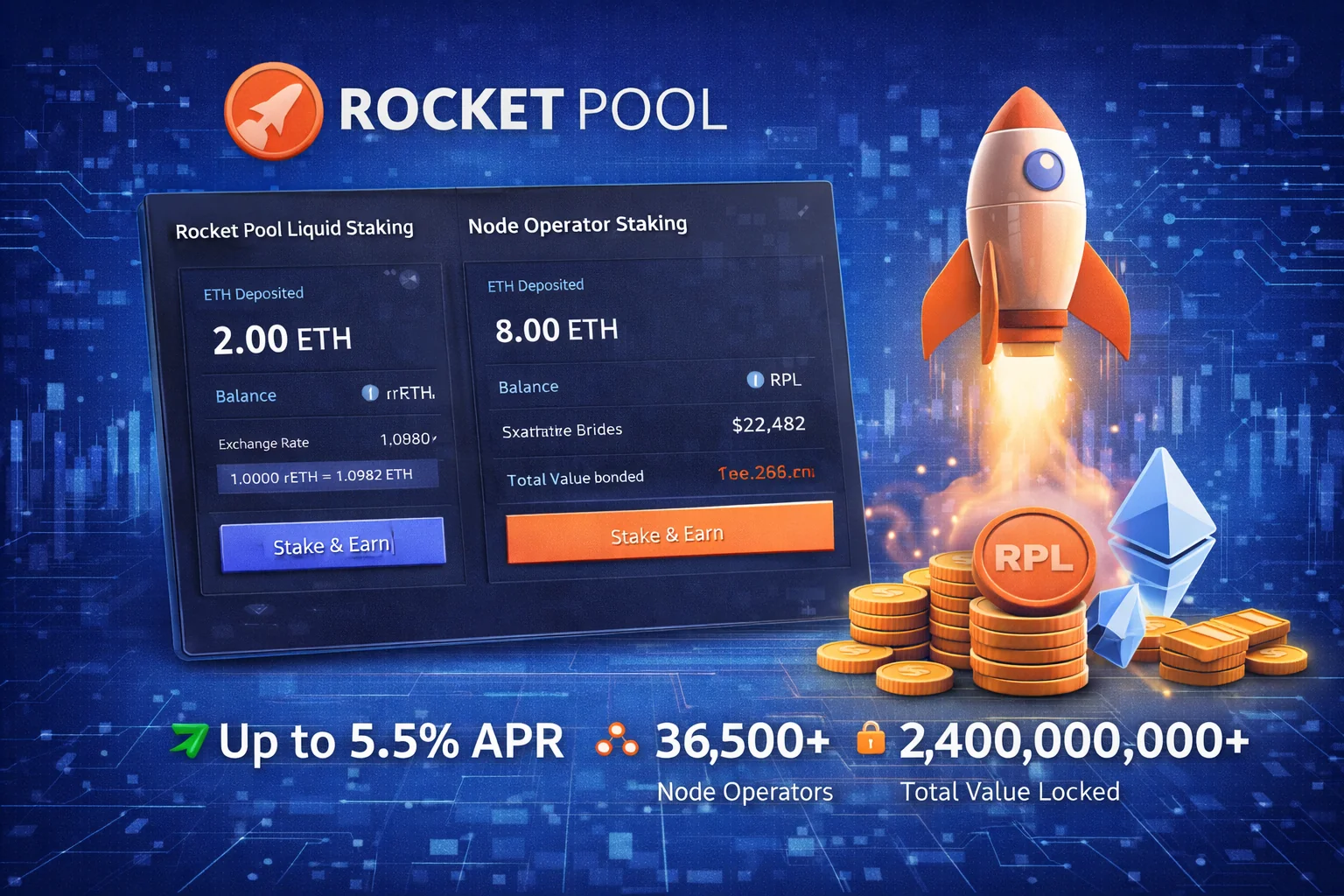
Rocket Pool is the leading permissionless Ethereum liquid staking protocol. Since the Saturn 1 upgrade of February 2026, node operators run validators with a 4 ETH bond (vs 32 for solo staking) and no compulsory RPL. Liquid stakers deposit any ETH amount and receive rETH — a value-accrual token that appreciates against ETH as staking rewards accumulate.
Introduction
Rocket Pool launched in November 2021 after several years of development and security auditing. DeFiLlama put the protocol at roughly $1.3B in TVL on 16 October 2026 — check it for a current figure before sizing a position — against Lido's roughly $23.7B. That is fourth place in Ethereum liquid staking, behind Lido, Binance's wBETH and ether.fi, and the gap is widening: the ETH staked through Rocket Pool shrank about 18% over the past year while Lido's grew.
Unlike Lido's curated operator set, Rocket Pool allows anyone to run a validator without approval from the DAO. The two-sided model works as follows: liquid stakers deposit ETH (any amount) and receive rETH, a value-accrual token whose rETH/ETH exchange rate increases over time as rewards accumulate. Node operators originally deposited 16 ETH plus a minimum RPL stake, then 8 ETH under the LEB8 design.
Saturn 1 replaced both: each new validator now takes a 4 ETH bond matched with 28 ETH from the deposit pool, and legacy minipool deposits are disabled. Existing 8 and 16 ETH minipools still run and can migrate, but are closed to new operators.
Operators earn the base staking reward on their bonded ETH plus commission on the matched ETH. That commission is no longer dynamic: Saturn 1's Universal Adjustable Revenue Split fixes the node share at 5% of rewards, with a further 9% paid in ETH to megapool RPL stakers and the residual 86% accruing to rETH. RPL inflation remains 5% a year, but RPIP-81 cut the operators' slice of it from 70% to 50%, redirecting the rest to protocol funding. Every one of those shares is adjustable by governance vote.
rETH differs from Lido's stETH in an important way: it does not rebase. The balance in the wallet stays constant while the token's exchange rate against ETH increases. This makes rETH more tax-efficient in jurisdictions that treat rebasing events as taxable income, and simpler to integrate as collateral in lending protocols.
The trade-off is that rETH has far less liquidity than stETH, and the in-protocol burn route depends on how much ETH sits in the rETH contract — on 16 October 2026 that buffer was empty, against a target of 1% of rETH in issue, which matters when exiting a large position.
The original contracts were audited by Sigma Prime and ConsenSys Diligence, and the Saturn 1 set by Cantina, Bailsec and Sigma Prime before deployment. The protocol uses upgradeable proxy contracts with governance time-locks and an emergency guardian multisig that can pause contracts for a limited time. The modular architecture (Rocket Storage, Rocket Vault, Rocket Megapool Manager, Rocket Node Manager, etc.) separates concerns and limits blast radius if any single component has a vulnerability.
The biggest change for operators is that RPL is no longer compulsory. Since Saturn 0 in October 2024 there has been no collateral minimum and no rewards cliff, so RPL is optional upside — a share of the 9% voter revenue, RPL inflation and governance weight — rather than a condition of running a validator. Exiting it is slower than it was: an unstaking request takes 28 days, earns nothing in the meantime, and cannot be cancelled.
For rETH holders the main risks are smart contract vulnerability, penalties that exceed an operator's bond and become a debt on their megapool, and an rETH/ETH discount when the burn buffer runs thin.
Executive Summary
Overall Rating: 8.5/10
- Decentralisation: 10/10 - Truly decentralised protocol
- Security: 9/10 - Audited smart contracts, battle-tested
- User Experience: 8/10 - Good for rETH, complex for node operators
- Rewards: 8/10 - Competitive staking yields
- Innovation: 9/10 - Pioneer in decentralised staking
Bottom Line: This protocol is the leading decentralised Ethereum staking protocol, offering both liquid staking through rETH and permissionless validator operation through megapools.
It's ideal for users who prioritise decentralisation and self-custody over convenience.
What is RocketPool?
RocketPool provides a decentralised solution for Ethereum staking without the technical complexity, the 32 ETH requirement, or the need to run a solo validator. Since launching in 2021, it has been built around permissionless node operation, which sets it apart from custodial options like Coinbase and from Lido's mostly curated operator set, though its Oracle DAO is invite-only.
Core Components
- rETH (Rocket Pool ETH): Liquid staking token representing staked ETH plus accumulated rewards; value-accrual model (exchange rate increases, balance stays constant)
- Megapools: One contract per operator holding many permissionless validators, each bonded with 4 ETH
- RPL Token: Protocol governance token; optional stake earning a pro-rata share of the 9% of protocol revenue paid to megapool RPL stakers
- Node Operators: Permissionless network of independent validator runners
- Smart Contracts: Fully on-chain protocol with no centralised operator custody
Key Features
- Permissionless: No DAO approval, allowlist or KYC required to run a validator
- Liquid Staking: rETH is tradeable and usable in DeFi while earning staking rewards
- Lower Capital Barrier: 4 ETH bonded per validator vs 32 ETH for solo staking
- Low Minimum for Stakers: 0.01 ETH or more can be deposited for rETH
- Self-Custody: No centralised entity holds user funds
How RocketPool Works
rETH Liquid Staking Process
- Deposit ETH: Users deposit ETH into the protocol's smart contracts
- Receive rETH: Get rETH tokens representing staked ETH plus accrued rewards
- Automatic Staking: Protocol matches deposits with node operators
- Reward Accrual: rETH appreciates in value relative to ETH over time
- Flexible Exit: Trade rETH on DEXs or burn for ETH (when available)
Megapool Operation
A megapool validator pairs 4 ETH from the operator with 28 ETH from the liquid staking deposit pool to form a full 32 ETH validator. One megapool contract serves every validator an operator runs, which is where the gas saving over the old design comes from.
Operators earn commission on the matched 28 ETH in addition to full staking rewards on their own bond. Because the bond fell to 4 ETH while the rate held, the same 8 ETH that once funded one LEB8 validator now funds two, and commission per ETH bonded rose from roughly 15% to 35% of the bond's own reward rate.
Megapool Validator Requirements
- 4 ETH: Bond per validator (vs 32 ETH for solo staking)
- RPL Stake: Optional; only RPL up to 150% of bonded ETH counts for voting power
- Technical Setup: Run Ethereum execution and consensus clients
- Monitoring: Maintain uptime and avoid slashing conditions
Megapool Rewards
- Validator Rewards: Standard Ethereum staking rewards on bonded ETH
- Commission: A flat 5% of rewards earned on the matched liquid staker ETH
- Voter Share: A pro-rata slice of the 9% of protocol revenue paid in ETH to megapool RPL stakers
- RPL Rewards: Inflation rewards paid in RPL tokens
- MEV: Maximum Extractable Value from block proposals
Rewards Structure & Analysis
rETH Reward Mechanism
rETH earns rewards through token appreciation, not rebasing. Your wallet balance stays constant while the rETH/ETH exchange rate increases as validator rewards accumulate.
This differs from Lido's stETH, where your balance changes daily. The rETH model is simpler for DeFi integrations and potentially more tax-efficient. There are no separate reward payments — the exchange rate captures everything automatically.
Reward Metrics, August 2026
- Net APR: Around 2.2% for rETH holders, on DeFiLlama's 30-day average to 16 October 2026
- Total Commission: 14% of rewards on matched ETH — 5% to the node operator, 9% to RPL stakers
- rETH Share: The residual 86%, which is what the 2.2% figure is net of
- Compounding: Rewards automatically compound in rETH value appreciation
- Rate Updates: The Oracle DAO resets the exchange rate roughly every 24 hours
Ethereum's own reward rate has compressed since 2023, and that — not a change in Rocket Pool's fee — moved rETH from four-point-something per cent to two. The 86/14 split is a governance parameter, not a promise.
Reward Comparison with Alternatives
| Protocol | Net APR to Holder, Aug 2026 | Fee Structure | Reward Token |
|---|---|---|---|
| Rocket Pool | ~2.2% | 14% total commission, built into exchange rate | rETH (value-accrual) |
| Lido | ~2.2% | 10% protocol fee | stETH (rebasing) |
Exchange staking tokens such as Coinbase's cbETH and Binance's BETH are left out on purpose. Both draw on the same Ethereum reward rate, but the commission comes out at a rate the platform sets rather than one governance votes on, and neither publishes a dated net figure comparable with the two above. Read the provider's own current rate before comparing.
Megapool Operator Rewards
Node operators earn from four revenue streams: base staking rewards on their bond, 5% commission on the matched ETH, RPL inflation and the 9% voter share, and MEV fees.
The commission is the part that lifts an operator above a solo staker. Five per cent of the rewards on 28 ETH is worth about 35% of what a 4 ETH bond earns on its own, so the ETH-denominated return runs roughly a third above the plain validator rate before any RPL. The double-digit operator APRs quoted in older write-ups belong to a period when Ethereum itself paid four to five per cent; they do not describe 2026.
Detailed Reward Components
1. Bonded ETH Staking Rewards
- Full Rewards: 100% of staking rewards on the operator's 4 ETH bond
- Base Rate: Whatever Ethereum consensus and execution rewards pay at the time
- MEV Inclusion: Block proposal rewards and MEV through the smoothing pool
- Attestation Rewards: Regular rewards for correct attestations
2. Commission on Matched ETH
- Commission Rate: A flat 5% of rewards from matched liquid staker ETH
- Not an Auction: The old demand-driven rate is gone; minimum, target and maximum are all 5%
- Revenue Share: 5% of the rewards earned on 28 ETH per validator
- Governance Risk: The rate is a pDAO parameter and can be voted up or down
3. RPL Token Rewards
- Inflation Rewards: 5% annual RPL inflation, of which operators now receive 50%
- Voter Share: Staked RPL earns a pro-rata slice of the 9% revenue share, paid in ETH
- No Requirement: RPL is optional; running validators without any RPL is permitted
- 28-Day Unstaking: Withdrawal requests wait 28 days, earn nothing, and cannot be cancelled
- Price Exposure: Rewards value depends on RPL token price
4. MEV and Priority Fees
- Smoothing Pool: Optional participation in MEV distribution
- Block Proposals: Enhanced rewards when selected as block proposer
- Priority Fee Tips: Transaction priority fees during high network usage
- Fair Distribution: MEV smoothed across all participating validators
Megapool Profitability Analysis
The scenario below works from the underlying rate implied by rETH's 2.2% net figure — roughly 2.5% gross — for one 4 ETH megapool validator. Substitute the live rate before committing capital; it is the input that moves most.
Example Scenario (One 4 ETH Validator)
- Bonded ETH (4 ETH): 2.5% = 0.100 ETH annually
- Commission (28 ETH at 5%): 5% of 2.5% on 28 ETH = 0.035 ETH annually
- RPL Rewards: Optional, and variable with RPL price and the amount staked
- Total on Bond: About 3.4% in ETH terms, before RPL and before running costs
Fee Structure and Economics
| Service | Fee | Who Pays | Notes |
|---|---|---|---|
| Minting rETH | 0.05% deposit fee | Depositor | Minimum deposit 0.01 ETH |
| Validator Creation | Gas costs only | Node operator | Megapools cut per-validator gas versus legacy minipools |
| Reward Commission | 14% of rewards on matched ETH | rETH holders, indirectly | 5% node operator, 9% RPL stakers; taken before rETH accrues |
| Burning rETH | No fee | Time cost only | Reverts outright if the rETH contract lacks ETH |
| RPL Unstaking | Gas costs only | Node operator | 28-day wait, no rewards during it, cannot be cancelled |
Reward Optimisation Strategies
For rETH Holders
rETH's value-accrual model offers a tax advantage in many jurisdictions: because your balance does not change (the token appreciates instead), you may not owe income tax until you sell or swap. Compare this with Lido's stETH, where daily rebase events can create taxable income. You should confirm this treatment with a tax adviser in your jurisdiction before relying on it.
Using rETH as Aave collateral lets you borrow ETH or stablecoins without exiting your staking position. If you borrow ETH and deposit it back into Rocket Pool, you create a leveraged staking loop — your effective APR increases but so does your liquidation risk. Keep your Aave health factor above 1.5 to maintain a buffer against combined rETH depeg and ETH price volatility.
For Node Operators
The smoothing pool is almost always worth joining: it distributes MEV and priority fees evenly across all participating operators, reducing the variance of block proposal income. Without it, a single validator might go months between block proposals, creating unpredictable cash flow. The case for opting out only really appears once you run enough validators for the variance to average out on its own.
Scaling is cheaper than it was: each additional validator takes another 4 ETH bond and no RPL, so three need 12 ETH rather than the 48 ETH the old minipools demanded. RPL is a separate decision — stake it only for the 9% voter share and governance weight, and price in the 28-day exit first.
Security Assessment
Smart Contract Security
Rocket Pool's original smart contracts were audited by Sigma Prime and ConsenSys Diligence, and the Saturn 1 contract set by Cantina, Bailsec and Sigma Prime before deployment in February 2026. The modular architecture separates concerns across 12+ contracts, limiting blast radius if one component has a vulnerability.
A guardian multisig can pause contracts in emergencies for a limited time. All non-emergency upgrades go through governance with mandatory time-locks. If you want to verify the current contract state before depositing, you can inspect the verified source code on Etherscan — this open-source transparency is an advantage over CeFi staking services.
Security Measures
- Multiple Audits: Sigma Prime and ConsenSys Diligence originally; Cantina, Bailsec and Sigma Prime for Saturn 1
- Bug Bounty: Immunefi programme running since 2021, critical findings paying up to $150,000
- Gradual Rollout: Phased launch with increasing deposit limits
- Decentralised Governance: Protocol upgrades require community consensus
- Emergency Procedures: Guardian role for emergency pausing (time-limited)
Operational Risks
For rETH Holders
If you hold rETH, your primary risk is smart contract vulnerability across Rocket Pool's 12+ deployed contracts. Slashing is not socialised across rETH holders in the first instance: a penalised validator's shortfall is charged against that operator's own ETH bond, and only what exceeds the bond becomes a debt on their megapool.
rETH holders carry that debt until it is repaid, and repayment is enforced — the operator cannot create new validators or reduce their bond, and later rewards are swept to clear it. Legacy minipools created before Saturn 1 still follow the older path, where the operator's RPL stake absorbs a borrowed-ETH shortfall after their ETH bond is exhausted.
Exit liquidity is the more practical concern, and it works differently from Lido's queue. Burning rETH in-protocol pays the exact exchange rate with no fee, but only while the rETH contract holds enough ETH; there is no queue and no IOU, so an oversized burn simply reverts.
On 16 October 2026 the burnable buffer was empty — no ETH against 314,914 rETH outstanding and a 1% target — so every exit had to go through a DEX. Check that buffer before assuming an in-protocol exit is available.
For Node Operators
RPL price exposure is now a choice rather than a requirement. There is no collateral minimum for new validators and no rewards cliff, so an operator who does not want RPL exposure can simply run megapool validators on ETH alone.
If you do stake RPL for the voter share, the risk is not a forced top-up but illiquidity: unstaking takes 28 days, earns nothing in the interim, and a fresh request restarts the clock on the whole balance.
Technical risk is ongoing: hardware failures, client bugs, or connectivity issues can cause missed attestations (minor penalties) or double-signing (slashing). Losses hit your bond first and any remainder becomes a debt on your megapool that blocks new validators until repaid.
The Oracle DAO can also apply penalties by vote, capped by protocol settings, with a fine for failing to signal a validator exit on time. Run redundant hardware with failover, and never run the same validator keys on two machines simultaneously.
Risk Mitigation Strategies
If you are committing more than 30% of your ETH to liquid staking, split between Rocket Pool and Lido to diversify protocol risk. For node operators, use a hardware wallet for key management and set up Grafana/Prometheus monitoring with Telegram alerts for missed attestations. Start with one validator before scaling to several — the operational learning curve is steeper than the documentation suggests.
DeFi Ecosystem Integration
rETH in DeFi Protocols
rETH is non-custodial and fully composable across DeFi. You can use it as collateral on Aave, supply it to an rETH/ETH liquidity pool, or deploy it in Yearn strategies — all whilst continuing to earn staking rewards through the token's value appreciation.
The key advantage of rETH over centralised staking tokens like cbETH is that no single entity controls your staked ETH. If you value self-custody and protocol transparency, rETH gives you verifiable on-chain guarantees that exchange-based staking cannot match.
Before deploying rETH into any DeFi strategy, you should check the specific protocol's rETH support — not all lending platforms accept rETH as collateral, and oracle pricing may lag behind the actual exchange rate during periods of rapid appreciation.
Lending and Borrowing
Aave V3 accepts rETH as collateral with competitive LTV parameters. If you deposit 10 rETH (about 11.7 ETH at the 16 October 2026 exchange rate of roughly 1.174), you can borrow a proportion of that value in stablecoins whilst your rETH continues appreciating from staking rewards. This is the most capital-efficient way to access liquidity without exiting your Rocket Pool position. You should monitor your health factor and set liquidation alerts through DefiSaver or Instadapp.
Liquidity Provision
Rocket Pool maintains an official Balancer composable stable pool for rETH/ETH, built to honour the oracle exchange rate so swaps clear with low slippage; the staking interface itself falls back to CoW Swap when an in-protocol burn is not possible. Providing liquidity there earns trading fees, and the rETH/ETH pair carries lower impermanent loss risk than most LP positions because rETH only appreciates against ETH under normal conditions.
On Uniswap V3, you can set a concentrated liquidity range around the current rETH/ETH exchange rate to earn higher fees per unit of capital. This requires more active management — you should adjust your range every 2–4 weeks as the exchange rate drifts upwards from accumulated rewards.
Yield Farming Opportunities
Convex and Yearn both offer automated strategies for rETH that compound Curve LP rewards without manual intervention. If you prefer a hands-off approach, depositing rETH into a Yearn vault handles claiming, swapping, and redepositing rewards automatically. The trade-off is an additional layer of smart contract risk — each vault adds exposure to both the vault contract and the underlying DEX pool contracts.
Layer 2 Access
rETH is available on Arbitrum and Optimism via canonical bridges. If you want to use rETH in DeFi but find Ethereum mainnet gas costs prohibitive, you can bridge your rETH to Arbitrum where swap and LP transaction costs are typically under $0.50. Your rETH continues accruing staking rewards regardless of which chain it sits on — the exchange rate updates are propagated through oracle infrastructure.
You should bridge through the official Rocket Pool or chain-canonical bridges rather than third-party bridges to minimise smart contract risk. Verify the rETH token contract address on the destination chain before interacting with any DeFi protocol to avoid counterfeit token scams.
User Experience & Interface Analysis
rETH Staking Experience
Staking for rETH is straightforward: connect a Web3 wallet to stake.rocketpool.net, enter an ETH amount, and confirm the transaction. rETH tokens appear in your wallet immediately.
Two things are worth checking before a first deposit: Ethereum gas costs, and the 0.05% fee the protocol charges on minting. The deposit cap that used to turn stakers away is no longer a practical constraint — governance raised it to 6,000,000 ETH in January 2026. Buying rETH on Balancer or Uniswap is the alternative, and on 16 October 2026 the main Uniswap pool paid about 0.4% below the protocol exchange rate.
Detailed Step-by-Step Process
- Connect Wallet: Connect MetaMask or other Web3 wallet to stake.rocketpool.net
- Verify Interface: Ensure you're on the official protocol application
- Check Deposit Pool: Review available deposit pool capacity
- Choose Amount: Enter ETH amount to stake (minimum 0.01 ETH)
- Review Exchange Rate: Understand current rETH/ETH exchange rate
- Estimate Gas: Review gas costs for the transaction
- Confirm Transaction: Approve and execute the staking transaction
- Receive rETH: Get rETH tokens in your wallet immediately upon confirmation
- Track Performance: Monitor rETH value appreciation over time
Common User Challenges
The deposit queue that frustrated new stakers for years is largely a historical problem. Rocket Pool once took new ETH only as fast as operators created minipools to absorb it, and the cap was routinely full; the cap now stands at 6,000,000 ETH and the pool sits near empty because demand is weak, not because it is capped.
The constraint has moved to the exit side: it is burning rETH back into ETH, not minting it, that depends on available protocol liquidity.
Gas for a deposit is typically well under 0.001 ETH: the one deposit found on 15–16 October 2026 used about 161,000 gas and paid 0.0004 ETH, most of it a priority tip. Only near the 0.01 ETH minimum is that a noticeable share of the deposit, about 4% at that deposit's cost, so time very small stakes for a quiet period.
Node Setup Experience
Running a megapool validator requires significant technical expertise. You need comfort with Linux command-line interfaces, server administration, and blockchain infrastructure.
If you have never managed a server before, practise on whichever testnet Rocket Pool currently supports — check the node operator documentation, as Ethereum's testnets are periodically retired. Running a testnet validator for 2–4 weeks will give you realistic experience with client updates, monitoring, and troubleshooting before you commit real capital.
Comprehensive Technical Requirements
Hardware Specifications
- CPU: any modern processor with at least 4 threads; thread count matters more than core count
- RAM: 16GB minimum, 32GB recommended for optimal performance
- Storage: 2TB+ NVMe SSD for blockchain data and growth
- Network: Stable internet with 100+ Mbps up/down speeds
- Uptime: 99%+ uptime requirement to avoid penalties
Software Stack
- Operating System: Linux (Ubuntu 20.04+ recommended)
- Execution Client: Geth, Nethermind, Besu, Reth or Erigon
- Consensus Client: Lighthouse, Prysm, Teku, Nimbus, or Lodestar
- Protocol Node: The protocol's node management software
- Monitoring Tools: Grafana, Prometheus for performance monitoring
Operational Complexity
- Initial Setup: 4-8 hours for experienced users
- Ongoing Maintenance: 2-5 hours per month
- Update Management: Regular client updates and monitoring
- Troubleshooting: Ability to diagnose and fix technical issues
Interface Quality Assessment
Web Application
- Design: Clean, functional interface focused on essential operations
- Navigation: Intuitive menu structure and clear information hierarchy
- Real-time Data: Live updates on exchange rates, pool capacity, and network stats
- Transaction Flow: Clear confirmation steps and transaction status
- Error Handling: Helpful error messages and troubleshooting guidance
Documentation and Support
- Comprehensive Guides: Detailed documentation for all user types
- Video Tutorials: Step-by-step video guides for complex processes
- Troubleshooting: Extensive FAQ and problem-solving resources
- API Documentation: Technical documentation for developers
Community Support Ecosystem
- Discord Community: Active 24/7 community support and discussion
- Reddit: r/rocketpool for community discussions and updates
- GitHub: Open-source development and issue tracking
- Official Forums: Structured discussions and governance participation
- Developer Support: Technical support for node operators and developers
Mobile Experience
- Responsive Design: Works well on mobile browsers
- Wallet Integration: Compatible with mobile Web3 wallets
- Touch optimisation: Mobile-friendly interface elements
- Performance: Fast loading on mobile networks
- Limitations: Node operation requires desktop/server environment
User Onboarding Process
For rETH Stakers
- Educational Content: Built-in explanations of liquid staking concepts
- Risk Disclosures: Clear information about smart contract and market risks
- Guided Tours: Interactive tutorials for first-time users
- Test Transactions: Ability to test with small amounts
For Node Operators
- Prerequisites Check: Technical requirements assessment
- Testnet Practice: Encouraged testnet operation before mainnet
- Setup Wizard: Step-by-step node setup guidance
- Mentorship Program: Community mentorship for new operators
RocketPool vs Alternatives
Technical Architecture Deep Dive
Smart Contract Architecture
The protocol employs a modular design enabling secure, upgradeable operations while maintaining decentralisation. Multiple interconnected contracts handle separate protocol functions — storage, vault, megapool management, node management, deposit pool, rETH token, fee calculations, and rewards distribution.
Core Contract Components
- Rocket Storage: Central storage contract using eternal storage pattern
- Rocket Vault: Manages all ETH deposits and withdrawals securely
- Rocket Megapool Factory and Manager: Deploys and tracks the per-operator megapool contracts introduced by Saturn 1
- Rocket Node Manager: Manages node operator registrations and requirements
- Rocket Deposit Pool: Queues and matches ETH deposits with node operators
- Rocket Token rETH: Implements the liquid staking token with exchange rate logic
- Rocket Network Revenues: Holds the governable revenue split — currently 5% node operator, 9% RPL voter share, 86% rETH
- Rocket Rewards Pool: Distributes RPL inflation rewards to node operators
Upgrade Mechanism
- Proxy Pattern: Uses upgradeable proxy contracts for future improvements
- Governance Control: Upgrades require DAO approval through RPL token voting
- Time Delays: Critical upgrades have mandatory waiting periods
- Emergency Procedures: Guardian multisig can pause contracts in emergencies
- Backwards Compatibility: Upgrades maintain compatibility with existing deposits
Validator Infrastructure
Legacy Minipool Lifecycle
- Initialised State: Minipool created, awaiting ETH matching
- Prelaunch State: 32 ETH matched, preparing for validator activation
- Staking State: Validator active on Beacon Chain earning rewards
- Withdrawable State: Validator exited, funds ready for withdrawal
- Dissolved State: Minipool closed, all funds distributed
Consensus Layer Integration
- Validator Keys: Node operators generate and manage validator keys
- Withdrawal Credentials: Set to protocol contracts for automated management
- Exit Signalling: Operators initiate validator exits themselves, and a node that fails to signal one in time is fined
- Reward Distribution: Automatic distribution of consensus rewards
Vs Lido (stETH)
Protocol Advantages
- Decentralisation: Permissionless node operators vs Lido's curated set
- Self-Custody: No central party holds stakers' ETH, though governance and the Oracle DAO still carry risk
- Lower Concentration: A wider operator set, though stake is uneven — the ten largest nodes held around 27% of bonded ETH in August 2026
- Node Operation: Option to run validators with reduced capital
Lido Advantages
- Liquidity: Much deeper stETH liquidity across DeFi
- Integration: Wider protocol integration and acceptance
- Simplicity: Simpler user experience and interface
- Scale: Larger TVL and market presence
Vs Centralised Exchanges
Advantages Over Centralised Staking
- Self-Custody: Users maintain control of their assets through rETH tokens
- Transparency: Open-source protocol with auditable smart contracts
- No Exchange Counterparty: No exchange bankruptcy can freeze your rETH
- Decentralisation: Supports Ethereum network decentralisation
- Composability: rETH can be used across DeFi protocols
Centralised Exchange Advantages
- Simplicity: Familiar interface for traditional users
- Customer Support: Direct customer service and assistance
- Fiat Integration: Easy conversion between fiat and crypto
- Insurance: Some exchanges offer insurance on deposits
- Regulatory Clarity: Clear regulatory framework in some jurisdictions
Vs Solo Staking
RocketPool Advantages
- Lower Capital: Stake any amount vs 32 ETH minimum
- Liquidity: rETH tradeable vs locked ETH
- Reduced Risk: Diversified across many validators
- Easier Management: No direct validator maintenance for rETH
Solo Staking Advantages
- Full Control: Complete control over validator setup
- Maximum Rewards: No protocol fees or commissions
- Independence: No reliance on third-party protocols
- MEV Capture: Full MEV rewards for block proposals
Getting Started with RocketPool
Prerequisites
- Web3 Wallet: MetaMask or another WalletConnect-compatible wallet is required
- ETH Holdings: ETH for staking plus gas fees (well under 0.001 ETH extra in October 2026)
- Basic DeFi Knowledge: Familiarity with smart contract interactions and transaction signing
- Risk Awareness: Smart contract risk and rETH liquidity risk should be understood before depositing
How to Stake rETH
- Visit Official App: Go to stake.rocketpool.net — verify the URL to avoid phishing sites
- Connect Wallet: Connect MetaMask or another Web3 wallet
- Check Exchange Rate: Review the current rETH/ETH exchange rate before depositing
- Enter Amount: The minimum for liquid staking is 0.01 ETH
- Review Transaction: Check gas fees and final rETH amount before confirming
- Receive rETH: rETH tokens appear in the wallet immediately upon confirmation
- Monitor Position: Track rETH/ETH exchange rate appreciation over time
Node Setup Overview
Running a validator requires significant technical expertise — command-line administration, server management, and ongoing monitoring. The protocol's node operator documentation and testnet are essential starting points before mainnet operation.
Key Requirements for Node Operators
- Technical Skills: Command-line interfaces and Linux server administration
- Time Commitment: 4–8 hours for initial setup, 2–5 hours monthly for maintenance
- Capital: A 4 ETH bond per validator, RPL optional, plus hardware and electricity costs
- Risk Understanding: Slashing conditions, validator uptime penalties, and how a penalty that exceeds your bond becomes a megapool debt blocking further validators until repaid
Best Practices
- Start Small: Test with a small deposit before committing larger amounts
- Hardware Wallet: Use a hardware wallet for key management
- Stay Informed: Monitor protocol governance proposals and client upgrade announcements
- Diversify: Avoid concentrating all ETH in a single liquid staking protocol
Pros & Cons Analysis
Advantages
- Decentralised operators: Permissionless node operation, though the Oracle DAO is invite-only
- Self-Custody: Users maintain control of their private keys and funds
- Liquid Staking: rETH provides liquidity while earning staking rewards
- Permissionless: Anyone can become a node operator with reduced capital
- Competitive Rewards: Market-competitive staking yields
- DeFi Integration: rETH composable across DeFi protocols
- Transparent: Open-source code and on-chain operations
- Battle-Tested: Live since 2021 with no known protocol-level exploit
Disadvantages
- Smart Contract Risk: Potential bugs or exploits in protocol contracts
- Complexity: More complex than centralised alternatives
- Lower Liquidity: rETH has less liquidity than stETH
- Technical Barriers: Running validators requires significant expertise
- Gas Costs: Ethereum gas fees for all interactions
- Thin Burn Buffer: In-protocol redemption reverts unless the rETH contract holds enough ETH
- RPL Exposure: Node operators exposed to RPL token price volatility
- Learning Curve: Requires understanding of DeFi and staking concepts
Final Verdict
Who Should Use the Protocol?
- Decentralisation Advocates: Users who prioritise decentralisation over convenience
- DeFi Users: Those comfortable with smart contract interactions
- Long-term Holders: ETH holders seeking yield while maintaining exposure
- Technical Users: Those interested in running validators with reduced capital
- Self-Custody Believers: Users who want to maintain control of their keys
Who Should Consider Alternatives?
- Beginners: New users may prefer centralised exchange staking
- Large Liquidity Needs: Those requiring deep liquidity may prefer Lido
- Risk-Averse Users: Those uncomfortable with smart contract risks
- Simple Preference: Users wanting the simplest possible experience
Final Rating: 8.5/10
This protocol is an excellent choice for users who value decentralisation and self-custody. The protocol successfully delivers on its promise of decentralised Ethereum staking with competitive rewards and innovative features. Whilst it requires more technical knowledge than centralised alternatives, the benefits of true decentralisation make it worthwhile for many users.
Recommendation: Ideal for DeFi-savvy users seeking decentralised staking. Beginners should start with small amounts and consider centralised alternatives initially.
Conclusion
Rocket Pool was built around a permissionless validator model from launch, where Lido added one alongside its curated set. rETH holders were earning around 2.2% net in mid-October 2026 through exchange rate appreciation — no rebase, no daily income events, which simplifies DeFi collateral use and has cleaner tax treatment in most jurisdictions than stETH's daily rebasing model. The roughly $1.3B TVL is a fraction of Lido's $23.7B, and the gap is widening rather than closing, but that reflects distribution and liquidity rather than any security weakness.
Node operators commit 4 ETH per validator, with RPL optional, and earn the validator rate on their bond plus a flat 5% of the rewards on the 28 ETH matched to it — roughly a third more per bonded ETH than solo staking, before RPL and running costs. The old RPL collateral cliff is gone; what replaced it is a 28-day unstaking wait that makes RPL a considered position rather than a working requirement.
The choice between Rocket Pool and Lido comes down to one trade-off: decentralisation versus liquidity. Rocket Pool's permissionless entry means a wider operator set with lower centralisation risk, though its own stake is concentrated in a few dozen large nodes. Lido's share of all staked ETH has fallen from a peak near 32% to roughly 23–24% by mid-2026 on third-party estimates, so the 33.3% finality threshold is less immediate than it was.
But stETH has far deeper DeFi liquidity, which matters for large exits or leveraged strategies. For ETH holders prioritising network health, rETH is the more principled choice — provided the exit route is planned in advance.
Frequently Asked Questions
- What is RocketPool and how does it work?
- Rocket Pool is a decentralised Ethereum staking protocol that lets you stake any amount of ETH and earn rewards, through the liquid staking token rETH or by running a validator yourself. It pools smaller deposits and distributes rewards proportionally. Since the Saturn 1 upgrade of February 2026, a new validator needs a 4 ETH bond rather than the standard 32 ETH, and RPL staking alongside it is optional.
- What is rETH and how is it different from ETH?
- rETH is the protocol's liquid staking token that represents your staked ETH plus accumulated rewards. Unlike regular staking, rETH can be traded, used in DeFi, or held while still earning staking rewards.
- Is RocketPool safe to use?
- Its Saturn 1 contracts were audited by Cantina, Bailsec and Sigma Prime, and it runs an Immunefi bug bounty paying up to $150,000 for critical findings. Audits reduce risk rather than remove it, and every DeFi protocol carries smart contract risk.
- How much can I earn staking with RocketPool?
- rETH was returning about 2.2% in mid-October 2026, measured from the rise in its exchange rate over the trailing 30 days and net of the 14% commission taken on matched ETH. The rate tracks Ethereum's own reward rate, which has compressed steadily since 2023, so it is not a fixed figure — check the live exchange rate or the Rocket Pool dashboard before depositing.
- Can I unstake my ETH from RocketPool anytime?
- You can trade rETH for ETH on a decentralised exchange at any time. On 16 October 2026 the main Uniswap pool paid about 0.4% below the protocol exchange rate, and the discount widens when sellers outrun on-chain liquidity. Burning rETH in-protocol pays the exact rate with no fee, but there is no queue: it works only while the rETH contract holds enough ETH and otherwise reverts, so a DEX sale is the fallback for anything larger than the current buffer.
Sources & References
- Rocket Pool Official Website - decentralised Ethereum staking protocol platform
- Rocket Pool Documentation - Technical documentation and user guides
- Rocket Pool Staking Interface - Official staking platform and rETH interface
- rETH Token Contract on Etherscan - Live exchange rate, total supply and burnable collateral
- RPIP-81: Rebalance RPL Inflation for Protocol Funding - The 70% to 50% cut in the node operator share of RPL inflation
- Rocket Pool Bug Bounty on Immunefi - Reward tiers and scope, including the critical-severity ceiling
Affiliate Disclosure
This page contains affiliate links. When you sign up through our referral links, we may earn a commission at no additional cost to you. This helps support our platform and allows us to continue providing valuable content and recommendations.