RocketPool vs Lido Comparison
Both protocols have proven their security. They have proven their reliability through years of operation. However, they serve different segments of the Ethereum staking market. Understanding their fundamental differences is crucial. You need this to make an informed decision about where to stake your ETH in 2026.
This comprehensive comparison examines every aspect of both protocols. We cover technical architecture. We cover user experience. This helps you determine which ETH staking solution best aligns with your investment goals. It aligns with your values in the evolving Ethereum ecosystem.
Introduction
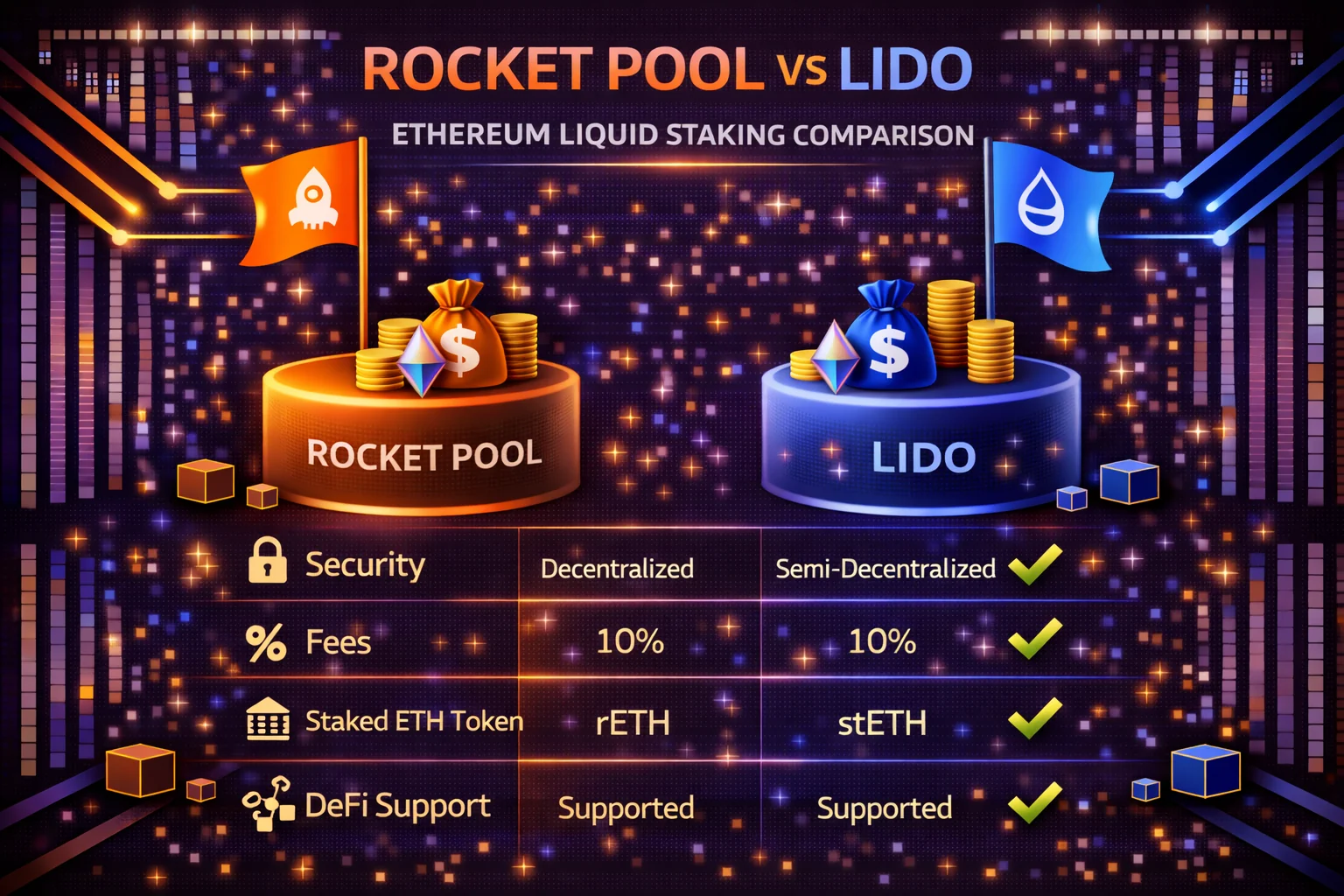
Lido and Rocket Pool are the two best-known Ethereum liquid staking protocols, but they serve fundamentally different users. Lido holds around 9.4 million ETH — roughly $17 billion as of August 2026, close to a quarter of all staked ETH and about two-thirds of the Ethereum liquid-staking market — with a one-click interface and stETH that works across most major DeFi venues. Rocket Pool holds around 528,000 ETH (roughly $1 billion, near 1.3% of staked ETH) but offers genuinely permissionless validation: since the Saturn 1 upgrade went live in February 2026, anyone can run a node with a 4 ETH bond and no RPL at all.
The numbers that matter for most stakers: Lido displayed a 2.2% staking APR on 4 August 2026, net of its 10% protocol fee, and rETH's on-chain exchange rate rose at roughly 2.2% annualised over the preceding thirty days, net of Rocket Pool's 14% total commission. On yield alone there is now nothing to choose between them. RPL rewards never reached rETH holders in the first place — they accrue to node operators who choose to stake RPL, and RPIP-81 cut the operators' share of RPL inflation from 70% to 50% in 2026.
For most passive stakers who want simplicity and maximum DeFi composability, Lido is the straightforward choice. For those who prioritise Ethereum's decentralisation health and can accept far thinner exit liquidity, Rocket Pool offers meaningful advantages. This comparison breaks down every factor honestly so you can decide based on your priorities, not marketing.
Protocol Overview
Lido Finance
Lido is the largest liquid staking protocol. Deposit ETH at stake.lido.fi and receive stETH immediately — a token that represents your staked position and earns rewards through daily rebasing. Your stETH balance grows at the daily oracle rebase as staking rewards accrue. The token trades near 1:1 with ETH, though lending markets such as Aave and Sky's SparkLend list its non-rebasing wrapper wstETH rather than stETH itself, because receipt tokens cannot track a balance that changes without a transfer. If you need to exit, sell on Curve or request a native withdrawal through the Lido interface, which Lido guides at 1-5 days under normal conditions.
- Market share: Around a quarter of all staked ETH — still the largest single protocol
- Two operator sets: DAO-curated professional firms plus a permissionless Community Staking Module
- Simple UX: One-click staking with immediate liquidity
- Wide Integration: stETH accepted across DeFi protocols
- Established Track Record: Operating since 2020
Rocket Pool
Rocket Pool takes the decentralised approach. Visit stake.rocketpool.net, deposit any amount of ETH, and receive rETH — a value-accruing token where the price increases relative to ETH as staking rewards accumulate. Unlike stETH, your rETH balance stays the same; the token itself becomes worth more ETH over time. That rate is not a market price — it is set from Oracle DAO balance submissions and updates roughly daily. The mechanical difference matters for record-keeping: stETH produces a visible balance increase most days, whereas an rETH balance never moves and the whole gain crystallises only on disposal.
Running a node no longer requires 16 ETH or any RPL. Since Saturn 1 went live on mainnet in February 2026, every new validator is a megapool validator with a flat 4 ETH bond, and the RPL requirement was removed back in Saturn 0 in October 2024. Operators earn a 5% base commission on the ETH the protocol matches to them; staking RPL is optional and buys a share of the separate 9% voter share plus governance weight. A node still needs a dedicated machine (£400-600 mini PC or £40-80/month VPS) and 24/7 uptime, but there is no application or approval process.
Quick Comparison Table
| Feature | Lido (stETH) | RocketPool (rETH) |
|---|---|---|
| Total Value Locked (Aug 2026) | ~$17 billion (~9.4M ETH) | ~$1 billion (~528k ETH) |
| Market Share | ~24% of staked ETH | ~1.3% of staked ETH |
| Minimum Stake | Any amount | 0.01 ETH |
| Protocol Fee | 10% of rewards | 14% total (5% operators, 9% voter share) |
| Node Operators | ~37 curated firms plus ~335 permissionless (CSM) | ~1,565 addresses with bonded ETH |
| decentralisation | Moderate | High |
| DeFi Integration | Excellent (stETH) | Good (rETH) |
| Governance Token | LDO | RPL |
| Launch Date | December 2020 | November 2021 |
Decentralisation Analysis
Lido's Centralisation Problem
Third-party trackers put Lido at roughly a quarter of all staked ETH, down from a peak near 32% in late 2023. Its Curated Module — 37 actively used professional operators — still secured about 90% of Lido Core's stake as at July 2026. The Ethereum community has flagged that concentration as a systemic risk: if those operators colluded or were compelled by a government to censor transactions, they could affect a large slice of the validator set.
The picture is no longer purely permissioned, though. Lido's Community Staking Module allows permissionless entry against a bond and secured over 770,000 ETH across roughly 335 operators by July 2026, capped at 9% of Lido's stake. LDO governance remains concentrated amongst early investors and the founding team.
Rocket Pool's Decentralisation Model
Rocket Pool takes the opposite approach: anyone can register a node and launch a validator with a 4 ETH bond and no RPL. No application, no approval committee, no whitelist — the registration path contains no allowlist at the contract level. Around 1,565 node addresses currently hold bonded ETH, out of roughly 4,150 ever registered. If one operator goes offline, the network barely notices, and the permissionless model directly strengthens Ethereum's censorship resistance.
Entry is genuinely open, but the stake behind it is not evenly spread: the largest twenty addresses hold about 39% of bonded ETH and the largest fifty about 56%, and one entity can run several addresses, so real concentration can only be higher. The trade-off against Lido's professional firms is operational variability, which shows up marginally in attestation rates and yield.
Why This Decision Matters Beyond Yield
If both protocols offered identical APY, the decentralisation argument alone would favour Rocket Pool. Choosing where to stake is not purely a financial decision — it affects which validators secure Ethereum, and therefore the network's long-term resilience. Ethereum developers have explicitly called for staking diversity as a priority. If Lido's share exceeds 33%, a single entity could theoretically prevent consensus finalisation. Staking with Rocket Pool or spreading across multiple protocols actively reduces this concentration risk.
- Consensus Risk: Large staking pools could influence consensus
- Censorship Resistance: Distributed operators resist censorship better
- Network Resilience: More operators mean a more resilient network
- Regulatory Risk: Centralised pools face higher regulatory scrutiny
Fees and Rewards
Lido Fee Structure
Lido charges a 10% protocol fee, deducted before rewards reach stakers. How the 10% is divided depends on the staking module:
- Protocol Fee: 10% of rewards, changeable by DAO vote
- Fee Distribution: per module, not site-wide — the dominant Curated Module splits it 5% operators / 5% DAO treasury
- Net APR: around 2.2% as of 4 August 2026, a rolling seven-day average
- No Additional Rewards: only ETH staking income
- No Insurance Slice: the old 0.5% insurance-fund component no longer appears in Lido's fee documentation
Rocket Pool Fee Structure
- Total Commission: 14% — a 5% node operator share plus a 9% voter share to RPL stakers
- rETH Holders: receive the residual 86%, a governance-adjustable setting rather than a guarantee
- RPL Rewards: paid to node operators who opt in, never to rETH holders
- Net APR: around 2.2% to rETH as of August 2026, measured from the exchange rate
- Deposit Fee: 0.05% on minting rETH from the protocol; burning back to ETH is free
Reward Comparison
| Reward Type | Lido | Rocket Pool |
|---|---|---|
| Net APR to the token holder (Aug 2026) | ~2.2% | ~2.2% |
| Additional Token Rewards | None | None for rETH holders (RPL goes to opted-in operators) |
| Commission Taken | 10% | 14% |
| How the Rate Moves | Daily rebase on oracle consensus | Oracle-set exchange rate, updated roughly daily |
Fee Considerations
- Headline take: Lido deducts 10% of rewards, Rocket Pool 14%
- Neither is fixed: Lido's rate moves by DAO vote, Rocket Pool's split by pDAO vote
- Entry fee: minting rETH costs 0.05%; Lido charges no equivalent
- Exit fee: neither charges one — burning rETH and redeeming stETH are both free

APY in Practice: What the Numbers Actually Mean
The headline APR figures are only part of the picture. Ethereum's base staking yield falls as more ETH is staked and rises with network activity, and it has compressed hard: Lido's displayed APR was reported at 13.06% in February 2025, around 2.62% in early 2026, and 2.2% on 4 August 2026. Both protocols pass through that underlying variation, which is why the two now sit within a tenth of a percentage point of each other despite Rocket Pool taking 14% in total commission against Lido's 10%. Lido's figure is a rolling seven-day average and Rocket Pool's is implied by the oracle-set exchange rate, so neither is a forecast.
RPL used to be the wild card, and that link has weakened considerably. RPL is no longer required collateral — Saturn 0 removed the requirement in October 2024 — and in the Saturn contract set RPL cannot be slashed to cover a megapool validator's losses at all. Those losses are absorbed by the operator's ETH bond first and, beyond it, by a debt the megapool must repay before the operator is paid again.
RPL is now a yield-and-governance token for operators who opt in, not a bond that protects anyone.
On a 5 ETH position at August 2026 rates, both protocols land close to 0.11 ETH a year. The yield differential is no longer a reason to pick one over the other. What should drive the choice is how easily you can get out: Lido redeems stETH for ETH one-for-one through its withdrawal queue, whereas Rocket Pool's in-protocol rETH burn is limited to whatever spare ETH the rETH contract and deposit pool happen to hold, which in August 2026 was a fraction of a percent of the rETH in circulation. Anything larger has to be sold on a DEX.
Gas Costs: What Staking Actually Costs to Execute
Both protocols require an on-chain transaction to stake, and at Ethereum's current gas prices (5-15 gwei during off-peak hours, 30-80 gwei during busy periods), the cost is material for smaller deposits. Lido's stake function uses approximately 80,000-120,000 gas units. At 10 gwei base fee, that is roughly 0.001 ETH — a little over £1 at August 2026 ETH prices. At 50 gwei during a busy period, the same transaction costs about 0.005 ETH, or £7. Rocket Pool's rETH mint uses 100,000-130,000 gas units — slightly more complex due to the deposit pool routing logic — so gas runs marginally higher, nearer £1.60 at 10 gwei.
The practical implication: at today's compressed yields, gas dominates small deposits. On 0.5 ETH earning about 2.2% APR — roughly 0.011 ETH a year, or £15 or so at August 2026 ETH prices — an off-peak round trip in and out costs around £3, a fifth of that first year. At 50 gwei both ways the bill is closer to £14, the whole year. Timing therefore matters more than protocol choice at this size: accumulate your allocation, then transact once, off-peak.
One cost note for rETH: minting from the protocol carries a 0.05% deposit fee, so buying on a DEX can work out cheaper when rETH trades near its exchange-rate value, as it did on 4 August 2026 at roughly 0.08% below fair value. The catch is depth rather than price: the ETH-paired rETH pools are shallow enough that anything beyond a modest order moves the price against you.
Security and Risks
Smart Contract Risks
- Lido: its security page lists 120 audit reports, with V3 reviewed by Certora, MixBytes and Consensys in December 2025
- Rocket Pool: Saturn 1 was audited by Cantina, Bailsec and Sigma Prime before deployment
- Bug Bounties: Lido's Immunefi maximum is $2,000,000; Rocket Pool's critical tier tops out at $150,000
- Upgrade Risks: both have upgrade mechanisms, and Saturn 1 added forced delegate upgrades for megapools
Slashing Risks
- Lido: penalties are socialised across every stETH holder through a negative rebase; the daily rebase has never yet been negative
- Rocket Pool: the operator's ETH bond absorbs the loss first, and only a shortfall beyond it becomes megapool debt that rETH holders carry until it is repaid
- Cover, not insurance: Lido once bought third-party cover from Unslashed Finance; that policy lapsed and the DAO moved to a self-cover contract that does not pay out automatically; RPL stopped backstopping newly created validators after Saturn 1
- Historical incidents: Lido operators were slashed twice in 2023 (RockLogic, 11 validators; Launchnodes, 20) and the DAO compensated stakers, so no loss reached stETH balances
Liquidity Risks
- stETH market discount: stETH fell to roughly 0.94 ETH in June 2022, before withdrawals existed; since Shapella the redemption right anchors the price, and the 2025 episode was only 0.3-0.6% below par
- rETH liquidity: far thinner than stETH — the in-protocol burn buffer holds a fraction of a percent of rETH outstanding, and ETH-paired DEX depth is shallow
- Market Conditions: both are affected by overall market sentiment and by the Ethereum validator exit queue, which topped six weeks in September 2025
- Withdrawals: native at Lido since 2023 through a FIFO queue; rETH has no native withdrawal, only a burn against whatever collateral is available
Regulatory Risks
- Lido: Higher regulatory scrutiny due to size and centralisation
- Regulatory Position: More decentralised structure may offer regulatory advantages
- Geographic Risk: Distributed operators reduce single-jurisdiction risk
- Compliance: Both working on regulatory compliance frameworks
User Experience
Staking Process and Costs
Lido's staking interface is a single page: connect your wallet, enter the ETH amount, approve, and receive stETH immediately. No minimum deposit. Gas cost for a Lido stake transaction is typically 80,000-120,000 gas units, which at August 2026 ETH prices translates to roughly £1-8 across the ordinary 5-80 gwei range. During rarer congestion spikes it runs several times that for a single staking transaction — worth checking current gas prices on Etherscan before committing.
Rocket Pool's rETH staking is similarly simple: visit the deposit page, connect your wallet, enter the amount, and receive rETH. The minimum deposit is 0.01 ETH. Gas costs are comparable to Lido at 100,000-130,000 gas units per transaction. Minting carries a 0.05% deposit fee, and the deposit pool cap was raised to 6,000,000 ETH in January 2026, so minting rETH is no longer throttled by the protocol. The constraint runs the other way: getting out in-protocol requires the rETH contract to be holding spare ETH, and at the moment it mostly is not.
Interface and Accessibility
Lido's stake.lido.fi interface is minimal and focused: a single staking widget, a rewards tracker showing your daily stETH accrual, and links to DeFi protocols that accept stETH. The design prioritises simplicity over information density. Rocket Pool's stake.rocketpool.net is slightly more detailed, showing the current deposit pool capacity, rETH exchange rate, and commission percentage — useful context for informed stakers but one extra step of complexity.
Both interfaces work on mobile through any wallet browser (MetaMask, Rabby, Coinbase Wallet). For hardware wallet users, connecting a Ledger or Trezor via MetaMask works with both protocols. WalletConnect is supported by both, enabling staking from mobile hardware wallets like Tangem.
Monitoring and Management
Lido stakers can track daily stETH balance changes directly in their wallet — since stETH rebases daily, the token balance visibly increases each day. This makes monitoring effortless but creates a long tax record of micro-increases. Rocket Pool's rETH does not rebase: your token count stays fixed, but each rETH becomes worth more ETH over time. Track the rETH/ETH ratio on the protocol's own dashboard or through portfolio trackers like DeBank and Zapper, which both display the underlying ETH value of rETH holdings.
For active monitoring, Rated.network provides validator performance data for both protocols, including individual node operator effectiveness, attestation rates, and slashing history. This is more relevant for advanced users evaluating protocol health than for passive stakers, but the data is free and accessible.
Liquidity and DeFi Integration
Where can you use your staked tokens? DeFi integration matters. It affects your earning potential:
stETH DeFi Integration
stETH's rebasing mechanism is awkward in DeFi rather than an advantage. Because stETH does not emit a transfer event when balances change, Lido's own integration guide tells builders to work with internal shares rather than stETH balances, and most lending markets list wstETH — the non-rebasing wrapper, whose balance never moves while its price in stETH rises — instead of stETH itself. What gives Lido its DeFi edge is scale and a long listing history, not the rebase.
- Aave V3: wstETH is listed on the Ethereum core market with a 78.5% maximum loan-to-value and an 81% liquidation threshold as at August 2026. stETH itself is not listed
- Curve ETH/stETH Pool: around $76m in the main pool in early August 2026, far below its 2022-23 peak but still the deepest ETH-paired liquid-staking market on Curve
- SparkLend (Sky): wstETH is accepted as collateral for borrowing stablecoins against a staked ETH position without exiting the yield
- EigenLayer restaking: stETH remains an accepted restaking asset, but the thesis has cooled sharply — EigenLayer's TVL fell from about $22bn in August 2025 to roughly $5bn a year later, with restaked stETH around $0.5bn of that. Treat AVS rewards as speculative, not a reliable top-up
rETH DeFi Integration
rETH's value-accruing design suits protocols that track asset prices rather than balances, so it needs no wrapper: lending markets can price it against an oracle directly. The trade-off is commercial rather than mechanical. Far fewer venues list rETH, the pools that do are small, and rETH supply has been shrinking — from about 500,700 rETH in August 2024 to 321,000 in August 2026 — which thins those markets further.
- Aave V3: rETH is listed on the Ethereum core market with a 75% maximum loan-to-value and a 79% liquidation threshold as at August 2026, slightly below wstETH's 78.5%/81%
- Balancer rETH/ETH Pool: the largest ETH-paired rETH pool held only a few million dollars in early August 2026 — enough for retail-sized swaps, not for exiting a large position without slippage
- EigenLayer: rETH is also an accepted restaking asset, though restaked rETH was under $10m in August 2026. The option exists but is barely used
- In-protocol redemption: the surest exit is not a DeFi venue at all but burning rETH at the oracle rate, which works only while the rETH contract holds spare ETH. In August 2026 that buffer sat far below its 1%-of-TVL target
Liquidity Comparison
How liquid are these tokens? Here's a direct comparison:
| Metric | stETH | rETH |
|---|---|---|
| Deepest ETH-paired DEX pool (Aug 2026) | ~$76m (Curve ETH/stETH) | a few million dollars (Balancer) |
| DEX Liquidity | Deep relative to peers | Thin |
| Price vs ETH (4 Aug 2026) | At par | ~0.08% below exchange-rate value |
| In-protocol redemption | 1:1 via withdrawal queue; 1-5 days normally, weeks under stress | No native withdrawal; burn only, capped by rETH contract collateral |
Governance Models
Who controls these protocols? Governance structures differ significantly:
Lido Governance (LDO)
LDO token holders govern Lido, but since July 2025 stETH holders have had a limited counterweight. Dual Governance lets holders of stETH, wstETH and withdrawal NFTs escrow their tokens to signal dissent: past 1% of stETH supply, a dynamic timelock of 5 to 45 days blocks a governance motion, and past 10% a "rage quit" halts execution entirely until objectors have had the chance to withdraw. It is a delay-and-exit right rather than a vote — stETH holders still cannot propose or vote on anything.
- Token Distribution: Concentrated amongst early investors and team
- Voting Power: LDO holders vote on protocol changes
- Proposal Process: Formal governance process with multiple stages
- Key Decisions: Validator selection, fee changes, protocol upgrades
- Participation: Moderate governance participation rates
Rocket Pool Governance (RPL)
RPL token holders govern Rocket Pool through the protocol DAO, and distribution is more community-focused. One important caveat sits outside that structure: the rETH exchange rate is set from Oracle DAO submissions, and the Oracle DAO is a permissioned, elected body that also votes on validator penalties. Permissionless node entry does not make the whole protocol trustless.
- Token Distribution: More distributed amongst community
- Node Operator Focus: staking RPL is optional and buys voting power, capped at 150% of bonded ETH
- Community Driven: Strong community involvement in decisions
- Decentralised Process: More grassroots governance approach
- Active Participation: High community engagement
Governance Comparison
How do governance models differ? Here's what matters:
- Centralisation: Lido more centralised, Rocket Pool more distributed
- Stakeholder Alignment: Both align token holders with protocol success
- Decision Speed: Lido makes faster decisions, the RPL DAO is more deliberative
- Community Voice: RPL governance gives more weight to community input
Recommendations
The right protocol depends on three factors: how much liquidity you need, whether you plan to use the staked token in DeFi, and how much you care about Ethereum's decentralisation.
Choose Lido If:
Lido is the practical choice if you plan to use your staked ETH as DeFi collateral. Its wrapper wstETH is listed on Aave at a 78.5% maximum loan-to-value, on Sky's SparkLend, on Curve and across dozens of other venues, and the main Curve ETH/stETH pool held around $76m in August 2026 — thinner than it once was, but an order of magnitude deeper than anything rETH has.
Just as important, stETH can be redeemed one-for-one through Lido's own withdrawal queue rather than only sold. The 10% fee sits at the low end for pooled staking and well below what large custodial exchanges deduct from ETH staking rewards. Start at stake.lido.fi, connect your wallet, enter the amount, and receive stETH within the same transaction.
Choose Rocket Pool If You:
The decentralised alternative appeals to validators and Ethereum purists. Node operators bond 4 ETH per megapool validator with no RPL required, and earn the 5% base commission on the ETH the protocol matches to them:
- Value Decentralisation: Prioritise true decentralisation over convenience
- Accept Thinner Liquidity: Comfortable exiting through a small DEX market or waiting for the burn buffer to refill
- Support Ethereum's Vision: Believe in permissionless, decentralised systems
- Are Long-term Holder: Plan to hold staked ETH for extended periods
- Want to Support Innovation: Prefer supporting newer, more innovative protocols
Portfolio Approach: Using Both
If you hold 10+ ETH and want to stake all of it, splitting between both protocols reduces protocol-specific risk. A practical split: 70% in stETH (for DeFi composability and deeper liquidity) and 30% in rETH (for decentralisation support and simpler record-keeping). If Lido suffered a governance attack or validator mass-slashing, only 70% of your staked position would be affected. If rETH's exit liquidity stayed as thin as it is now, only 30% would be hard to move quickly.
For smaller positions under 5 ETH, splitting adds complexity without meaningful diversification benefit. Pick the protocol that matches your primary use case: Lido if you want DeFi integration and a redemption queue that clears at par, Rocket Pool if you value permissionless validation and a token that does not rebase.
Both protocols have earned their place through years of secure operation. The decision rests on what matters most to you: maximum liquidity and DeFi composability, or permissionless validation and a simpler transaction history.
Both protocols continue evolving. They serve the growing demand for ETH staking. The Ethereum ecosystem benefits from both approaches.
Getting Started
- Lido: Visit Lido Finance for simple staking
- ETH staking pool: Check RPL protocol for decentralised staking
- Research: Read both protocols' documentation thoroughly
- Start Small: Begin with smaller amounts to test the experience
Professional Staking Strategies and Institutional Implementation
Split Strategy: Using Both Protocols
Many sophisticated stakers allocate across both protocols rather than choosing one. A common institutional split is 70% Lido / 30% Rocket Pool, which provides maximum liquidity for DeFi strategies through stETH whilst supporting network decentralisation through rETH. You can adjust this ratio based on your priorities.
Practical implementation: deposit 70% of your staking allocation through Lido, wrap the stETH into wstETH — which is what Aave actually lists — and use that as collateral, earning roughly 2.2% staking yield as at August 2026 plus variable lending income. Deposit 30% through Rocket Pool's rETH, which appreciates against ETH as rewards accrue rather than rebasing, leaving a single disposal to record instead of a daily balance change.
Tax Considerations: stETH vs rETH for UK Investors
The structural difference between rebasing and value-accruing tokens has real record-keeping consequences, and possibly tax ones. HMRC's guidance on staking income sits at CRYPTO21200 in the Cryptoassets Manual, which states that where staking does not amount to a trade, the sterling value at the time of receipt of any tokens awarded is taxable as miscellaneous income. For stETH, that raises the question of whether each daily rebase is a separate receipt — on a 10 ETH position, roughly 365 tiny increases a year, each at the prevailing ETH/GBP rate.
rETH does not rebase. Your token count stays fixed — 1.000 rETH today, 1.000 rETH in twelve months — but each token's ETH value increases as the exchange rate appreciates. No token is ever awarded to you, so there is no obvious receipt to value. HMRC has published no guidance specific to liquid staking tokens, and CRYPTO21200 addresses tokens awarded for staking rather than a rising exchange rate. Many UK advisers therefore treat rETH's appreciation as a capital matter recognised on disposal, but that is an interpretation of guidance written for a different mechanism, not a published HMRC position.
The capital-disposal reading also assumes a passive hold. If you actively use rETH as DeFi collateral and borrow against it, HMRC may characterise some of the benefit as income depending on how the transaction is structured — the sort of leveraged collateral strategy described later in this guide.
What is not in doubt is the administrative difference: one disposal to record against hundreds of balance changes. Treat that as the confirmed benefit and the tax outcome as unsettled, and take advice from a crypto-specialist accountant before deciding how to report either position on your Self Assessment return.
Risks Neither Protocol Advertises
Both protocols carry smart contract risk despite extensive auditing. Lido's Curated Module still secures roughly 90% of its stake through 37 firms, so a coordinated failure there would reach a meaningful share of all staked ETH, and losses are socialised across every stETH holder through a negative rebase rather than falling on the operator at fault.
Rocket Pool's problem is different and less advertised: rETH supply has fallen in every measured period since mid-2024, from about 500,700 rETH in August 2024 to 321,000 in August 2026, and RPIP-81 redirected RPL inflation towards the treasury in 2026 precisely because the protocol faced a funding shortfall. Neither has suffered a protocol-level exploit, but past performance does not guarantee future security.
Additional Considerations
Withdrawal Mechanics
Native withdrawals have been live at Lido since the Shapella upgrade of April 2023. Lido locks your stETH and mints a withdrawal NFT representing a place in a FIFO queue, guided at 1-5 days under normal conditions, and rewards stop accruing the moment the request is made. That guidance is not a protocol property: the Ethereum exit queue ran past six weeks in September 2025, and bunker mode can add roughly ten days on Lido's side.
Rocket Pool has no equivalent. rETH holders cannot trigger a validator exit, so redemption means burning rETH against whatever spare ETH the rETH contract happens to hold — about 76 ETH on 4 August 2026. It pays at the oracle rate when that collateral is there and reverts when it is not. Protocol-level rETH withdrawal liquidity is still only a Saturn 2 proposal, RPIP-71, which remains a draft. Larger exits mean selling on a DEX, where rETH depth is roughly an order of magnitude below the $76m in Curve's main stETH pool.
Future Development
Lido's Simple DVT Module, which spread validator key management across clusters of operators, is going the other way: a Snapshot vote in June 2026 approved winding down its 72 regular clusters from 1 July on grounds of unsustainable economics, leaving only the ten Super Clusters. Distributed validation now enters Lido through the Community Staking Module instead, whose v3 upgrade added an Identified DVT Cluster operator type alongside Staking Router v3 in July 2026.
Rocket Pool's Saturn upgrade is not upcoming: Saturn 0 shipped in October 2024 and Saturn 1 went live on mainnet on 18 February 2026, cutting the bond to 4 ETH per validator and replacing per-validator contracts with megapools. Saturn 2 is the one still ahead, and it is where protocol-level rETH withdrawal liquidity would come from — but its core proposals remain drafts with no ship date, and the earlier plan to cut bonds to 1.5 ETH has been shelved.
Advanced Liquid Staking Analysis
Yield Maximisation with stETH
The most popular advanced strategy uses wstETH as collateral — Aave lists the wrapper, not stETH itself. You deposit wstETH, borrow ETH against it, stake the borrowed ETH for more wstETH, and repeat. The maths only works while the ETH borrow rate sits below the staking yield, and with base yields compressed to around 2.2% that spread is thin and frequently negative: Aave ETH borrow rates spiked from about 3% to over 18% in July 2025, forcing exactly these loops to unwind. Leverage also multiplies liquidation risk. stETH traded at roughly a 6% discount to ETH during the June 2022 stress, when no redemption mechanism existed at all.
Running a Rocket Pool Node
Running a node no longer needs 16 ETH or any RPL. Since Saturn 1 the bond is a flat 4 ETH per megapool validator, so 8 ETH buys two validators matched with 56 ETH from the deposit pool rather than one matched with 24 ETH.
The operator earns the 5% base commission on matched ETH on top of the underlying staking yield; staking RPL is optional and adds a share of the 9% voter share plus governance weight, though unstaking RPL now means a 28-day wait that cannot be cancelled. The trade-offs are technical complexity, 24/7 uptime, and the fact that your ETH bond absorbs penalties before rETH holders see any of them. One timing point applies whichever protocol you validate through: a new validator joins the Ethereum entry queue, which held about 2.5 million ETH — roughly six weeks — on 4 August 2026, while the exit queue that day was close to empty.
Conclusion
The practical difference between Lido and Rocket Pool comes down to three factors: exit liquidity, record-keeping, and decentralisation conviction. Yield is no longer one of them — both paid roughly 2.2% net as at August 2026. Lido's stETH has around $76m in its main Curve pool and, more importantly, a withdrawal queue that redeems at par. Rocket Pool's rETH has neither: shallow ETH-paired DEX depth, and an in-protocol burn buffer holding a fraction of a percent of rETH outstanding, so exiting a large position means accepting slippage or waiting.
For UK investors, the mechanical difference is worth understanding early even though the tax consequence is not settled. stETH rebases daily, producing hundreds of balance changes a year; rETH's balance never moves and the whole gain crystallises on disposal. HMRC has published no guidance specific to liquid staking tokens, so treat the reduced record-keeping burden as the certain benefit and take advice on the tax treatment rather than assuming it.
For Ethereum network health, Rocket Pool is still the better answer, though by a smaller margin than it once was. Lido sits at roughly a quarter of all staked ETH, with 37 curated firms securing around 90% of Lido Core, but it now also runs a permissionless Community Staking Module of some 335 operators. Rocket Pool's entry is permissionless throughout, across roughly 1,565 bonded node addresses, though the largest fifty hold over half the bonded ETH.
Quick Decision Framework
To make your choice concrete: if you want to use your staked tokens in DeFi, or expect to need a clean exit at par, choose Lido — the liquidity and integration advantages are decisive for that use case. If you have at least 4 ETH, the technical skills to run validator software, and conviction in Ethereum's decentralisation mission, run a Rocket Pool megapool validator for the commission on top of base yield and a direct contribution to network health. If you want exposure to both, a 70/30 Lido/Rocket Pool split balances liquidity against decentralisation support.
Sources & References
Frequently Asked Questions
- Which is better: RPL protocol or Lido?
- Both are established liquid staking protocols, and on yield there is now nothing between them — each paid roughly 2.2% net as at August 2026. Lido offers simplicity, far deeper markets and redemption at par through its withdrawal queue. Rocket Pool offers permissionless node entry and a non-rebasing token, at the cost of much thinner exit liquidity.
- What are the fees for the ETH staking pool vs Lido?
- Lido charges a 10% protocol fee on rewards, split per staking module — 5% to operators and 5% to the DAO treasury in the dominant Curated Module. Rocket Pool takes 14% in total: a 5% node operator commission plus a 9% voter share paid to RPL stakers, leaving rETH holders the remaining 86%. RPL rewards never go to rETH holders.
- Is RPL protocol more decentralised than Lido?
- On operator entry, yes: anyone can run a Rocket Pool node with a 4 ETH bond and no RPL, with no allowlist. The gap has narrowed, though. Lido now runs a permissionless Community Staking Module alongside its curated firms, and the bonded ETH behind rETH is concentrated — the largest fifty node addresses hold over half of it. The Oracle DAO that sets the rETH exchange rate is itself a permissioned elected body.
- Can I unstake immediately from both protocols?
- Only at Lido, where native withdrawals have been live since Shapella in April 2023. Lido issues a withdrawal NFT for a FIFO queue, guided at 1-5 days in normal conditions but longer under stress, and rewards stop accruing while you wait. Rocket Pool has no native withdrawal for rETH holders: redemption means burning rETH against whatever spare ETH the rETH contract holds — about 76 ETH on 4 August 2026 — and it reverts when that collateral is short. Anything larger must be sold on a DEX. Protocol-level rETH withdrawals remain a Saturn 2 draft proposal.
- Which token has better DeFi integration?
- stETH by a wide margin, though what lending markets actually list is wstETH, its non-rebasing wrapper — Aave carries wstETH at a 78.5% maximum loan-to-value and rETH at 75%. rETH is listed in fewer places, and its supply has been shrinking rather than growing, from about 500,700 rETH in August 2024 to 321,000 in August 2026.
- Are there any risks with staking tokens?
- Yes: smart contract risk, slashing risk and liquidity risk. Neither has an insurance policy. Lido socialises slashing losses across all stETH holders through a negative rebase, backed by a DAO-funded self-cover contract that does not pay out automatically. At Rocket Pool the operator's ETH bond absorbs losses first, and RPL stopped backstopping newly created validators after Saturn 1.
- Can I switch between protocols?
- Yes, you can trade stETH for rETH (or vice versa) on DEXs like Curve or Balancer, though you will pay trading fees and slippage. Size matters here: rETH's ETH-paired pools held only a few million dollars in August 2026, so a large swap into or out of rETH will move the price noticeably.
- Which protocol is better for large amounts?
- Lido, on exit mechanics rather than yield. Above about 100 ETH the binding constraint is how you get out, and Lido redeems stETH one-for-one through its withdrawal queue in requests of up to 1,000 stETH each, so larger positions are simply split across several requests. Rocket Pool's in-protocol burn is capped by the rETH contract's own ETH balance, which held under a tenth of a percent of rETH outstanding in August 2026, so a large rETH position would have to be worked out through thin DEX markets.