Simple Wallet vs MetaMask
Compare Simple Wallet and MetaMask to find the best crypto wallet for your specific needs and requirements. Detailed comprehensive analysis of features, security measures, ease of use, and supported networks for informed decision-making.
Introduction
Choosing the right cryptocurrency wallet is crucial for managing your digital assets securely. Simple and MetaMask are both self-custody wallets, but they differ at the key-management layer, not merely in polish: Simple splits your key into MPC shares, MetaMask issues a 12-word recovery phrase.
Simple Wallet positions itself as a user-friendly solution for you. Designed for newcomers to cryptocurrency who prioritise simplicity. The wallet provides an intuitive interface that makes transactions easy to access. Technical background doesn't matter when you use it.
Simple removes complexity partly by removing the seed phrase. Its terms describe a 2-of-2 MPC signature scheme in which one key share sits on your device and the other is managed by Simple, so no traditional 12 or 24-word phrase is ever issued.
One point of history matters before you commit funds. Simple also ran a separate custodial wallet, Euro card and IBAN through a Bulgarian entity, Stored Assets Ltd. That custodial arm permanently ceased commercial activity on 30 June 2026 when the MiCA transitional periods expired, and now runs in withdrawal-only mode to return client assets. Simple states the self-custodial wallet is unaffected, which is the product this comparison covers.
MetaMask has established itself as the leading Ethereum wallet for you. The gateway to decentralised applications (DApps) works effectively. Originally launched as a browser extension, it evolved into a comprehensive platform. Multiple networks are supported with extensive functionality.
MetaMask helps you interact with the DeFi ecosystem effectively. The robust feature set makes it the preferred choice. Experienced users, developers, and DeFi enthusiasts benefit from advanced capabilities.
The fundamental difference lies in the target audience for you. Simple Wallet prioritises user experience and accessibility. Ideal for beginners starting their cryptocurrency journey without technical overwhelm. MetaMask offers comprehensive functionality with extensive customisation options.
Advanced features for DeFi interactions are available in MetaMask. NFT management and multi-network operations work well for you. All requirements are met effectively.
This comprehensive comparison examines both wallets across multiple dimensions. Security architecture, user interface design, and supported networks are analysed. DeFi integration capabilities, mobile experience, and performance metrics help you decide. We evaluate transaction costs, customer support quality, community resources, and long-term development roadmaps to provide complete insights for your wallet selection decision. Additional factors include backup procedures, recovery options, and cross-platform compatibility.
Real-world usage scenarios determine which wallet suits your needs. Specific cryptocurrency requirements and investment goals in 2026 are considered for you.
You should also weigh the long-term implications of your wallet choice on your overall cryptocurrency strategy. Simple Wallet's curated approach means you benefit from a narrow, mobile-only application that keeps the common actions - hold, send, swap, stake - close to the surface. MetaMask's open architecture, conversely, gives you the flexibility to connect with virtually any decentralised application or blockchain network, but this breadth of functionality demands greater vigilance against phishing attacks and malicious smart contract approvals that target its large user base. Your security posture, technical comfort level, and intended use cases should ultimately guide your decision between these two fundamentally different approaches to cryptocurrency management.
Quick Platform Comparison Overview
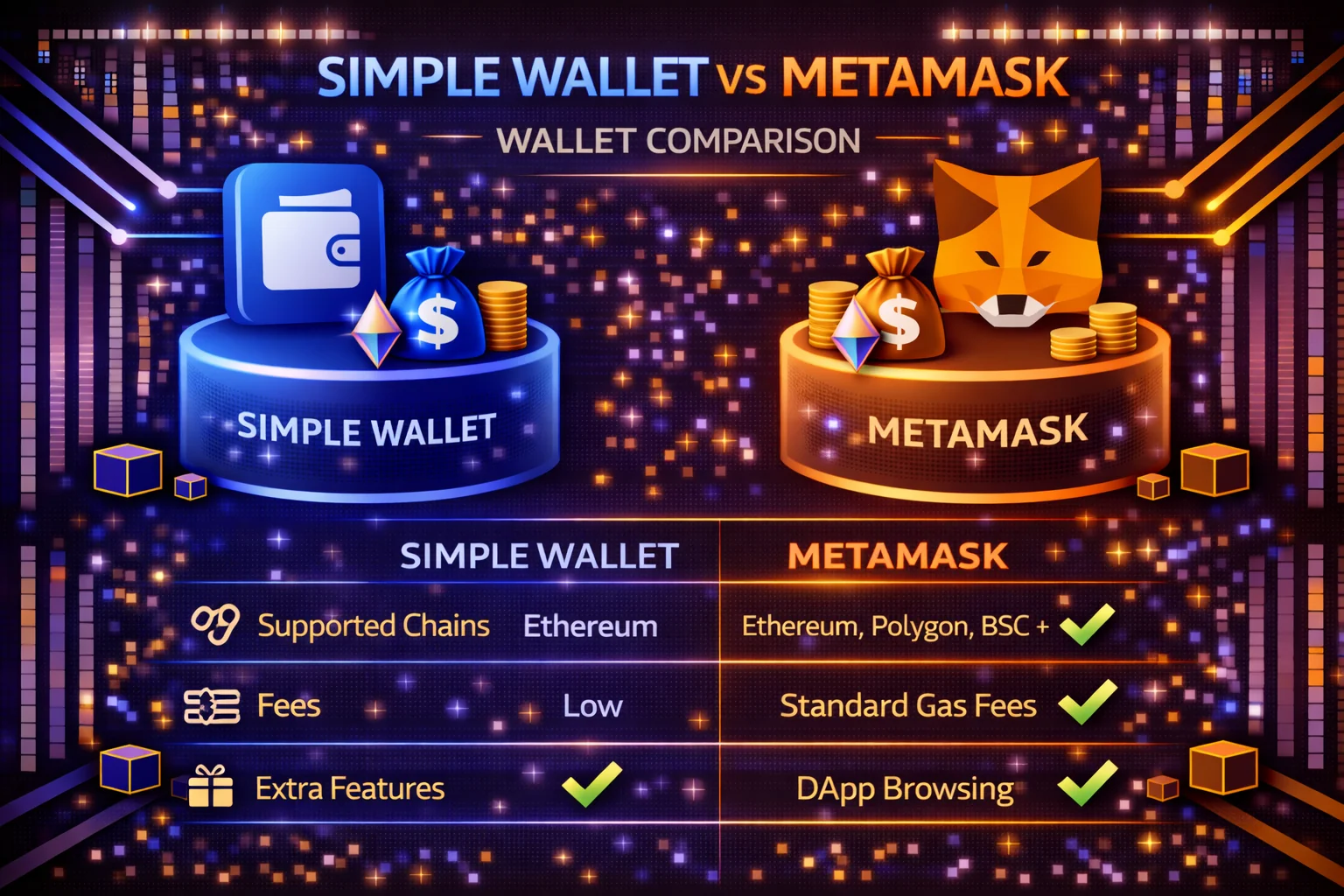
| Characteristic | Simple Wallet | MetaMask |
|---|---|---|
| Primary Audience | Digital asset newcomers seeking simplicity | Experienced participants requiring comprehensive tools |
| Interface Design | Streamlined with guided workflows | Feature-dense with extensive customisation |
| Blockchain Networks | Essential networks with optimised performance | Built-in networks, plus any custom EVM RPC you add |
| DeFi Ecosystem | In-app staking and swaps only | Unlimited access to decentralised applications |
| Mobile Application | Mobile-first design with biometric protection | Comprehensive mobile capabilities with dApp browser |
| Browser Integration | None - iOS and Android apps only | Industry-standard Web3 gateway |
| Learning Curve | Minimal - ready in minutes | Moderate - requires understanding of DeFi concepts |
| Best Use Case | Everyday transfers, in-app swaps and staking | Advanced DeFi strategies and multi-chain operations |
Simple Wallet Overview
You should consider Simple Wallet if you want a user-friendly digital asset management platform that makes cryptocurrency accessible without a seed phrase to guard. Your experience stays simple and intuitive, which makes it an excellent choice if you are new to the digital asset space.
Core Capabilities
- Intuitive Design: Clean, easy-to-understand interface
- Multi-Chain Compatibility: Ethereum, BNB Chain, Polygon, Solana, Tron and XRP Ledger among others
- Built-in Swap: An in-app exchange routed to a third-party provider, named in the terms as Changelly or another designated provider
- Native Staking: In-app staking on selected assets, which Simple calls DeFi Earn; no rates are published outside the app
- Spending Card: A non-custodial card issued and managed by Wirex — FCA-authorised for e-money, not for crypto — settled from wallet balances, with an FX markup Simple does not quantify
- Recovery Model: Device biometrics and PIN, an encrypted Recovery Kit backup to your own cloud, plus support-assisted and Face Check recovery - there is no seed phrase to write down
Target Demographic
This platform is specifically designed for digital asset beginners who want to enter the virtual currency space without overwhelming complexity. The solution caters to participants who prioritise ease of use over advanced capabilities, making it perfect for those who want to buy, hold, and occasionally trade digital currencies without diving deep into DeFi protocols or complex blockchain interactions.
The platform also appeals to mobile-first participants who prefer conducting their digital asset activities on smartphones rather than desktop computers. Its streamlined interface makes it ideal for participants who want quick access to their funds without having to navigate through complex menus and settings. The simplified approach reduces the learning curve significantly, allowing new users to become comfortable with cryptocurrency management within hours rather than days or weeks.
Development and Company Background
Simple's terms name two operating entities: Simple Europe UAB in Lithuania, company number 305959834, which provides the self-custodial wallet, and Stored Assets Ltd in Bulgaria, company number 208080420, which provided the custodial wallet, Euro card and IBAN. No venture-capital backing is disclosed on simple.app, and no investor or newsroom page is published, so treat any funding figure you see quoted elsewhere as unsourced.
Nor is there evidence for the audit and open-source claims that circulate about Simple. Its security page asserts regular assessments but names no auditor, publishes no report, and still carries a May 2022 update date describing cold storage and multisig - a description that no longer matches the MPC wallet shipping today. No repository is published anywhere on the vendor's site, so the app is closed source and its 2-of-2 MPC implementation is unaudited in public.
Advantages
- Extremely participant-friendly for newcomers
- Fast and responsive mobile app
- Simplified transaction process
- Direct in-app support channel
- Support-assisted recovery via your registered email and device
- Prepaid gas through the in-app Gas Station
- Optimised for mobile devices
- Quick onboarding process
Limitations
- Limited network compatibility compared to alternatives
- Fewer advanced capabilities for power participants
- No dApp browser or WalletConnect support is documented
- Mobile only - no browser extension or desktop application
- Closed source, with no published security audit
- One MPC key share is held on Simple's servers
- Its terms warn that funds may be permanently lost if you lose the device, the Recovery Kit backup and support recovery, and it disclaims all warranties on Face Check reliability
MetaMask Overview
You should consider MetaMask if you need the most popular and widely-used Ethereum wallet and gateway to decentralised applications. MetaMask reports more than 100 million downloads across the App Store, Google Play and the Chrome Web Store, driven by DeFi protocols, smart contracts, yield farming, and Web3 applications across multiple blockchain networks.
Key Capabilities
- Extensive Network Support: Built-in EVM networks, any custom EVM RPC you add, plus native Bitcoin, Solana and Tron accounts
- DeFi Integration: Connects to thousands of dApps, liquidity pools, and yield farming protocols through the extension's injected Web3 provider, which most dApps support by default
- Browser Extension: Available for all major browsers with Web3 connectivity
- Mobile App: Full-featured mobile storage solution with blockchain synchronisation
- Hardware Device Support: Ledger, Trezor and others on the extension, though hardware accounts stay EVM-only
- Advanced Capabilities: Custom RPC, gas optimisation, portfolio tracking
History and Development
You should know that MetaMask was created by ConsenSys in 2016 and has since become the most widely adopted Ethereum wallet. Your browser extension enables Web3 interactions, and the platform has evolved into a comprehensive ecosystem supporting multiple platforms and networks.
You can trust that the platform undergoes continuous development with regular updates adding new capabilities and security enhancements. Its code is published on GitHub, but "open source" overstates it: the extension carries a bespoke Consensys licence limited to non-commercial use, and the mobile licence grants only the right to inspect and study the code. Published code still allows outside scrutiny, which is more than Simple offers.
Market Position and Adoption
You should be aware that MetaMask holds a dominant position in the wallet market, particularly for Ethereum and EVM-compatible networks, and since 2025 it has extended beyond them: native Solana shipped in mid-2025, Bitcoin in December 2025 and Tron in January 2026, so a single account now bundles EVM, Bitcoin and Solana addresses. Your DeFi interactions will benefit from its widespread adoption, as most decentralised applications support MetaMask integration by default.
You must also know that MetaMask's popularity has made it a target for phishing attacks and scams. Your security awareness should be heightened, and you should take advantage of the robust protection capabilities and education initiatives the platform provides.
Technical Architecture
You should understand that MetaMask operates as a bridge between your web browser and blockchain networks. Your browser extension injects Web3 functionality into websites, allowing you to interact with smart contracts and decentralised applications directly.
You can trust that the platform uses hierarchical deterministic (HD) key generation following industry standards. Your private keys are encrypted and stored locally on your device, which means MetaMask never has access to your funds or sensitive information.
Pros
- Industry standard with massive adoption
- Supports virtually all EVM-compatible networks
- Extensive DeFi and dApp ecosystem
- Regular updates and improvements
- Strong protection track record
- Source-available code published on GitHub
- Hardware device integration
- Advanced gas management
- Custom network configuration
- Developer-friendly capabilities
Cons
- Can be overwhelming for newcomers
- Complex interface with many options
- Higher learning curve
- Occasional network congestion issues
- Gas estimation can be inaccurate
- Frequent phishing attempts targeting participants
- Resource-intensive browser extension
Mobile App Experience
Simple Wallet Mobile App
The mobile app is designed with a mobile-first approach, resulting in a smooth and intuitive participant experience. It opens directly to your balances and provides immediate access to all essential storage functions without any unnecessary complexity. Because there is no desktop client and no documented dApp browser, the app has a narrow feature set to load, which suits older smartphone models - although Simple publishes no performance or resource figures of its own, so treat any benchmark you see quoted for it as guesswork.
You should appreciate that the mobile interface incorporates large, touch-friendly buttons and a clear visual hierarchy that makes your navigation effortless. Your learning curve stays minimal thanks to helpful tooltips and guided tutorials that explain each capability without overwhelming you with technical jargon.
Mobile-Specific Capabilities
- Biometric authentication (Face ID, fingerprint)
- Push notifications for transactions
- QR code scanning for addresses
- One-handed operation optimisation
- Dark mode compatibility
- Accessibility capabilities for visually impaired participants
MetaMask Mobile App
You should know that MetaMask's mobile app brings the full power of the browser extension to your smartphone, offering comprehensive functionality for advanced DeFi operations. Your mobile experience includes custom network configuration, advanced gas settings, and extensive dApp integration that maintains feature parity with the desktop extension.
You can use the built-in dApp browser to interact with decentralised applications directly from your mobile device. Your DeFi positions, trades, and market monitoring can all be managed from anywhere with internet connectivity.
Advanced Mobile Capabilities
- Built-in dApp browser
- WalletConnect integration
- Hardware device compatibility via Bluetooth
- Custom network management
- Advanced transaction controls
- Portfolio tracking and analytics
- Multi-account management
Platform Coverage Assessment
| Characteristic | Simple Wallet | MetaMask |
|---|---|---|
| Platforms | iOS and Android apps only | Browser extension plus iOS and Android apps |
| dApp access | None documented | Built-in dApp browser on mobile, injected provider on desktop |
| Hardware wallets | None documented | Ledger, Trezor and others on the extension; Ledger, Keystone and NGRAVE ZERO on mobile |
| Third-party extensions | Not applicable | Snaps, installable on the browser extension only |
Performance and Reliability
Speed and Responsiveness
Neither vendor publishes benchmarks, so any launch time or signing time quoted for these apps is invention rather than measurement. What can be said follows from the architecture. Simple's 2-of-2 MPC scheme means every signature is produced jointly with the key share Simple holds on its own servers, so signing depends on a network round trip and on Simple's infrastructure being reachable. MetaMask signs locally, because the key material sits on your device.
Network switching is a question of breadth rather than milliseconds: MetaMask carries built-in networks and accepts custom EVM RPC endpoints, whereas Simple exposes only the fixed set its app supports. Connecting to a decentralised application is not a like-for-like comparison at all, since MetaMask ships a dApp browser on mobile and injects a provider on desktop while Simple documents neither a dApp browser nor WalletConnect.
Service Dependencies
- Simple: signing needs its server-held key share, so an outage on Simple's side stops you transacting even though the funds remain yours
- MetaMask: signing is local, but balances, swap quotes and bridging depend on Infura and third-party quote providers
- Both: neither vendor publishes an uptime figure or any service-level commitment for its wallet
Resource Consumption and Device Impact
Device impact is worth a thought if you run older hardware, but neither vendor publishes memory or storage figures, and any RAM number quoted for these apps is unsourced. The structural difference is surface area. Simple is a single native mobile app with a fixed feature set and no desktop client at all. MetaMask ships both a browser extension and a mobile app with a dApp browser, and both hold live connections open to whatever sites you have connected.
That difference lands hardest on the desktop extension. A background service worker plus persistent connections to several dApps inevitably costs more memory than an app that only refreshes balances, and if you keep many tabs open alongside it you may notice the effect on browsing. Simple sidesteps this by not offering the functionality: there is no extension and no desktop client, so the only footprint is the phone app.
Your choice between the two wallets should factor in your typical device usage patterns rather than any published benchmark, because there are none. If you work mainly from a phone and want one app that stays out of the way, Simple's narrower scope is the lighter option. If you run modern hardware and want dApp access, MetaMask's heavier footprint buys functionality Simple does not offer at all.
Cost and Fees
Wallet Costs
- Simple: Free to download and use
- MetaMask: Free to download and use
- Both: No subscription or premium fees required
Transaction Fees
- Simple: Network gas only, which you can prepay in USDC or USDT through its Gas Station
- MetaMask: Network fees only, manual gas control available
- Difference: MetaMask exposes EIP-1559 max-fee and priority-fee controls; Simple does not document equivalent manual controls
Additional Services
- Simple: In-app swap routed to a third-party provider, priced by that provider
- MetaMask: MetaMask Swaps with aggregated pricing
- Both: In-app staking on selected assets — but only MetaMask publishes its cut, 15% of the rewards on ETH pooled staking, against no rate or fee published outside Simple's app
Hidden Costs and Fee Optimisation Strategies
You should be aware that both wallets charge more than network gas when you use their built-in exchange features. MetaMask Swaps charges a 0.875% service fee that is factored into the quoted price; MetaMask has since folded bridging into that same Swaps guide, which quotes the same 0.875%, and it no longer publishes a separate bridge-fee page. Simple publishes no swap fee schedule at all for its self-custodial wallet: pricing is set by the third-party provider and shown only at the point of confirmation, so you cannot compare it before you install the app. For larger transactions exceeding $1,000, you may find better rates by connecting directly to decentralised exchanges like Uniswap or Curve through MetaMask rather than using either built-in swap.
Your gas fee management strategy differs significantly between the two wallets. MetaMask gives you granular control over gas price and gas limit parameters, allowing you to set custom fees during periods of low network congestion and potentially save 20-40% compared to automatic estimates. Simple handles gas automatically through its Gas Station, and where you hold no native token it will lend a small amount to process the top-up and recover that cost from the same top-up. You should monitor Ethereum gas trackers and time your non-urgent transactions for off-peak hours regardless of which wallet you choose.
Best Use Cases
Choose Simple Wallet If:
- You're entering cryptocurrency for the first time and prioritise simplicity
- You value intuitive design over comprehensive feature sets
- Your activities focus on major blockchain networks like Ethereum and BSC
- You prioritise mobile-optimised cryptocurrency management
- You want a recovery route that does not depend on storing a seed phrase
- You seek integrated staking and passive income opportunities
- You prefer guided experiences over manual configuration
- You want automatic security updates without manual intervention
Choose MetaMask If:
- You possess extensive cryptocurrency knowledge or develop blockchain applications
- You require connectivity across numerous blockchain networks
- You regularly interact with DeFi protocols and decentralised applications
- You demand granular control over transaction parameters
- You utilise hardware wallets for enhanced security
- You develop or test smart contracts and blockchain applications
- You participate in complex DeFi strategies like yield farming
- You need custom network configurations for specialised use cases
Final Verdict
Winner. By Category
- Ease of Use: Simple Wallet excels with intuitive design
- Features: MetaMask dominates with comprehensive functionality
- Beginners: The wallet provides guided cryptocurrency introduction
- Advanced Users: MetaMask offers professional-grade tools
- DeFi Integration: MetaMask enables universal protocol access
- Mobile Experience: Simple Wallet delivers optimised smartphone usage
- Network Support: MetaMask adds custom EVM networks plus native Bitcoin, Solana and Tron
- Security: MetaMask, on published code and a longer public record; Simple's MPC design is unaudited in public
Overall Recommendation
For Cryptocurrency Newcomers: Simple is a gentle place to begin, with an intuitive interface and educational guidance that removes overwhelming complexity while keeping sensible security defaults. Moving to MetaMask later becomes straightforward once you have built up some proficiency.
For Blockchain Veterans: You should stick with MetaMask if you need professional DeFi interaction and sophisticated cryptocurrency operations. Your comprehensive feature set and universal compatibility make it indispensable for advanced blockchain activities.
For Hybrid Approach: You should consider maintaining both wallets simultaneously, as many experienced users do. Your Simple Wallet can handle everyday transactions while MetaMask manages your complex DeFi strategies, giving you the best of both worlds.
Migration Path and Long-Term Strategy
If you start with Simple as a beginner, transitioning to MetaMask is straightforward once you develop confidence with basic cryptocurrency operations — but note the two wallets use different key models. MetaMask is a traditional seed-phrase (BIP-39) wallet; Simple's wallet uses MPC key shares and has no 12-word phrase to export, so you cannot simply import a Simple recovery phrase into MetaMask. To switch, you create the MetaMask wallet and transfer your assets to its address. That is a small extra step, but it lets you experiment with MetaMask's advanced features whilst keeping Simple as a familiar fallback.
Your long-term wallet strategy should evolve alongside your cryptocurrency knowledge and portfolio complexity. As you begin interacting with DeFi protocols, participating in governance votes, or managing positions across multiple blockchain networks, MetaMask's extensibility becomes increasingly valuable. However, you should never abandon the security fundamentals — regardless of which wallet you use, keeping your recovery material safe (an offline seed-phrase backup for a seed-phrase wallet like MetaMask, or the app's key-share and cloud-recovery setup for an MPC wallet like Simple), enabling all available authentication methods, and regularly reviewing connected dApp permissions remain essential practices that protect your assets throughout your cryptocurrency journey.
You should also evaluate emerging wallet technologies that may complement or eventually replace your current setup. Account abstraction wallets, social-recovery mechanisms, and multi-party computation (MPC) are maturing quickly — Simple's wallet already uses MPC, which removes the single-seed-phrase point of failure — and could offer better security and usability than traditional seed-phrase wallets, so this is less an emerging option than one already in production. Staying informed about these developments ensures you can adopt improved solutions as they become production-ready.
Advanced Wallet Management and Professional Cryptocurrency Operations
Multi-Wallet Strategy Implementation
You should consider using both Simple Wallet and MetaMask together as part of a multi-wallet strategy. Your everyday transactions can go through Simple Wallet for convenience, while MetaMask handles your DeFi interactions and dApp connectivity. You must keep your significant long-term holdings in a hardware wallet for maximum security.
You should organise your multi-wallet setup with clear allocation strategies and comprehensive backup procedures. Your record-keeping must track holdings across all wallets, and you should maintain detailed documentation of each wallet's purpose and recovery procedures.
Security Architecture and Risk Management
You should implement multi-layered security that goes beyond basic wallet protection. Your hardware wallet must store significant holdings separately, and you should use dedicated devices for cryptocurrency operations. Your backup strategy needs to cover device loss, hardware failure, and user error scenarios.
You must set position limits to restrict your exposure through any single wallet. Your diversification across multiple wallet solutions reduces overall risk, and you should maintain detailed security documentation that covers your entire cryptocurrency setup.
DeFi Integration and Protocol Interaction
You can leverage MetaMask's extensive dApp integration to access diverse DeFi protocols, participate in governance, and implement automated strategies through smart contracts. Simple documents no dApp browser and no WalletConnect support, so protocol interaction there is confined to the staking and swap features built into the app.
You must assess protocol risks carefully before committing your funds. Your transaction verification should be thorough, and you should implement systematic monitoring of all your DeFi positions to manage exposure effectively.

Cross-Chain Operations and Network Management
You should use MetaMask when you need cross-chain capabilities: it ships a list of built-in networks, accepts any custom EVM RPC endpoint you add, and now holds native Bitcoin, Solana and Tron addresses alongside your EVM ones. MetaMask publishes no supported-network count, and custom RPC makes one meaningless. Your Simple Wallet works best for popular networks where you want an optimised, streamlined experience.
You must understand that different blockchain architectures have varying transaction fee structures and security considerations. Your wallet configurations should be separate for each chain, and you should test bridge protocols carefully before moving significant amounts.
Transaction Optimisation and Gas Management
You can use MetaMask's granular gas controls to minimise your transaction costs while maintaining appropriate execution speed. Your Simple Wallet handles fee estimation automatically, which should suit your everyday transaction needs without manual intervention.
You should time your transactions during low-congestion periods to reduce costs. Your batching strategies for multiple operations can save significant fees, and you should consider layer-two solutions for cost-effective transactions on your regular activities.
Privacy Considerations and Operational Security
You must consider privacy implications when choosing your wallet, including address reuse patterns and transaction linkability that could compromise your operational security. Your address rotation strategy should be systematic, and you should manage your transaction patterns carefully to maintain appropriate privacy levels.
You should understand blockchain transparency and how transaction analysis techniques could expose your activity. Your wallet selection impacts your privacy characteristics, so you must choose solutions that offer the metadata protection level you need for your specific situation.
Backup and Recovery Procedures
You must implement comprehensive backup strategies that protect against device loss, hardware failure, and user error. A seed phrase should be stored on durable media like metal plates in multiple secure locations; for an MPC wallet such as Simple, the equivalent is keeping the encrypted Recovery Kit backup and your registered email account under your control. Test your recovery procedures regularly to confirm they work.
You should maintain detailed records of your wallet addresses and transaction histories to facilitate recovery during adverse events. Your documentation must be kept secure from unauthorised access while remaining accessible when you need it.
Regulatory Compliance and Tax Reporting
You must consider regulatory compliance and tax reporting obligations when selecting your wallet. Your choice impacts your compliance capabilities, as different solutions offer varying levels of transaction tracking and tax software integration. You should implement systematic record-keeping from the start to avoid complications later.
You should consult with tax professionals regarding your complex cryptocurrency transactions. Your automated tracking systems must maintain detailed records of cost basis and transaction purposes, and you should ensure appropriate documentation is ready for any regulatory examinations.
Future Developments and Technology Evolution
You should monitor wallet technology developments, as both Simple Wallet and MetaMask continue expanding their capabilities. Your Simple Wallet experience will benefit from ongoing accessibility improvements, while MetaMask expands protocol support and advanced functionality that can enhance your DeFi operations.
You should evaluate new features systematically and implement updates carefully after appropriate testing. Your wallet strategy must remain flexible enough to adapt as the technology landscape evolves, but you should exercise caution with unproven features that could compromise your security.
Conclusion
The choice between Simple Wallet and MetaMask ultimately depends on your cryptocurrency experience level, intended use cases, and feature requirements. Both wallets serve distinct purposes in the cryptocurrency ecosystem and excel in their respective target markets.
Simple Wallet is the gentler entry point for cryptocurrency newcomers. It buys that gentleness with a specific trade: the MPC key model removes the seed phrase you would otherwise have to guard, and in exchange one of the two key shares lives on Simple's servers. Its intuitive design makes cryptocurrency accessible to users who might otherwise find the technology intimidating, and for basic transactions, portfolio tracking and learning the fundamentals it is a workable foundation.
You should know that MetaMask continues to dominate the advanced cryptocurrency wallet space with its comprehensive feature set and extensive DeFi integration capabilities. Your decentralised application interactions, multi-network management, and complex DeFi strategies all benefit from MetaMask's industry-standard tools and flexibility.
The two take different security bets rather than meeting a common standard, and you should pick the one whose risks you can live with. MetaMask's client code is published for inspection and it has a long public record, but you carry the whole burden of guarding a 12-word phrase. Simple's 2-of-2 MPC design removes that phrase, yet it is closed source, publishes no audit of that implementation, and needs a key share held on Simple's servers to sign anything. MetaMask additionally supports hardware wallets and custom network configuration; Simple's protections are whatever its app applies by default.
You should choose the wallet that matches your current needs while considering your future requirements in the cryptocurrency space. Your journey will likely lead you to adopt a multi-wallet strategy, using Simple Wallet for everyday transactions and MetaMask for complex DeFi interactions as your operational requirements expand over time.
Sources & References
Frequently Asked Questions
- Which wallet provides better cryptocurrency onboarding for newcomers?
- Simple is the gentler start: its self-custodial wallet needs only an email address and a four-digit PIN, with no identity documents and no seed phrase to write down. MetaMask requires you to record a 12-word recovery phrase and assumes more blockchain knowledge. Buying crypto in either app, and using Simple's card, does involve identity verification with a third party.
- How do network compatibility differences affect daily usage?
- MetaMask now covers EVM networks plus native Bitcoin, Solana and Tron accounts, and connects to any decentralised application. Simple covers a smaller set of major networks and documents no dApp browser, so it suits holding, swapping and staking rather than direct protocol interaction.
- What security advantages does each wallet implementation provide?
- MetaMask has the longer public record and its client code is published for inspection, though under a source-available licence rather than an open-source one. Simple uses a 2-of-2 MPC scheme in which one key share sits on its own servers, and it publishes no audit report for that implementation.
- Is simultaneous usage of both cryptocurrency wallets practical?
- Many experienced users operate both wallets for different purposes - Simple handles everyday transactions and card spending, MetaMask manages complex DeFi strategies and advanced blockchain interactions. The two hold separate keys, so assets must be transferred on-chain between them.
- How do customer support approaches differ between platforms?
- Simple offers direct in-app support and a support-assisted recovery route for its MPC wallet, verified through your registered email and device. MetaMask relies primarily on documentation and community-driven support channels, and cannot recover a lost seed phrase for you.
- What transaction costs should users expect with each wallet?
- Both wallets are free to download, and neither charges for sending or receiving - you pay only network gas. Built-in trading is different: MetaMask adds a 0.875% service fee to swaps, and its bridging now runs through the same guide at the same figure, while Simple's in-app swap is priced by a third-party provider and Simple publishes no swap fee schedule for its self-custodial wallet.