Multisig vs MPC vs Single-Sig: Self-Custody Approach Comparison 2026
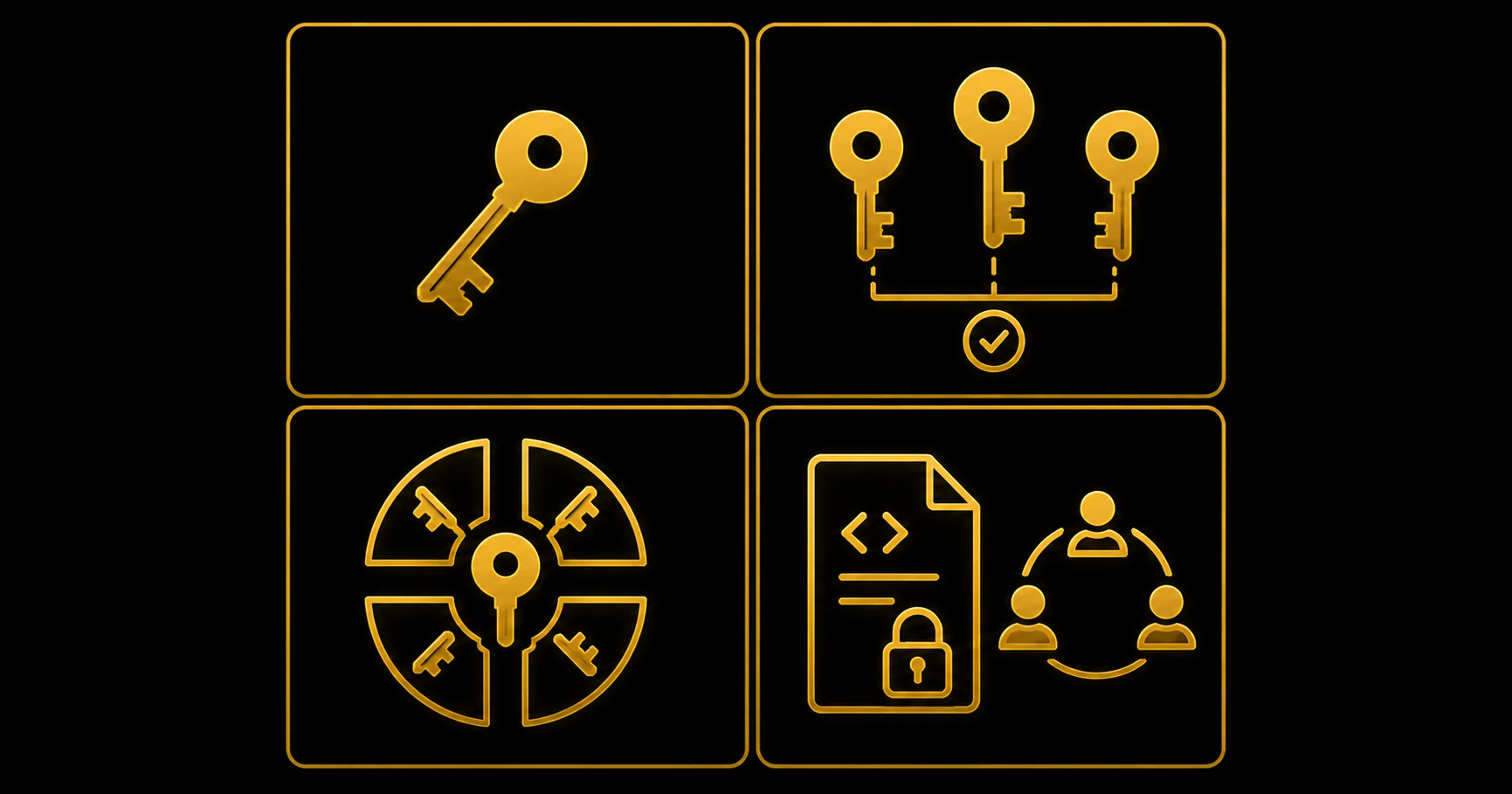
Single-sig = one key (simplest, single point of failure); multisig = M-of-N on-chain (no single point of failure, more complex, on-chain footprint); MPC = key split off-chain via threshold cryptography (no on-chain multisig footprint, but trust in the MPC provider). Smart-contract / social recovery sits alongside as a fourth approach. This page is the decision step before the operational guides: it narrows which custody approach fits your holdings, your technical comfort, and your recovery preferences. For M-of-N mechanics see the multisig wallets complete guide; for operational setup see the Bitcoin and Safe satellites (all three linked in the conclusion and related-resources below).
Introduction
The four custody approaches on the table when you decide how to hold crypto are not interchangeable, and the choice between them matters more than most onboarding flows pretend. Single-sig is the default: one private key controls the address, with all the simplicity and all the single-point-of-failure risk that implies. Multisig requires M signatures out of N keys, removing the single point of failure at the cost of coordination overhead and an on-chain footprint that varies by chain. MPC splits a single key into shares via threshold cryptography off-chain, producing a single signature on-chain with no multisig artefact, in exchange for trust in the MPC provider's protocol. Smart-contract / social recovery wraps the wallet in a smart contract, with guardian-initiated recovery as the headline feature, currently EVM-only and tied to account-abstraction tooling (ERC-4337).
This page is the decision page for the cluster. It does not re-explain M-of-N mechanics — that is the multisig wallets complete guide's job (linked in conclusion and related-resources). It does not walk through Bitcoin multisig setup or Safe deployment; those operational pages own the mechanics end-to-end. What this page does is narrow the field. By the end of it, you should know which of the four approaches fits your holdings size, your technical comfort, your multi-chain needs, and your recovery preferences. You should also know why "always pick multisig" is the wrong answer.
The calibration that runs through the page: multisig is not automatically safer than a well-managed hardware wallet. A hardened single-sig setup with a reputable hardware signer, a metal seed backup, geographic separation, and clear-signing on every transaction beats a sloppy multisig deployment where signers cannot verify what they sign. For an honest worked example of how a defensively configured multisig can still lose funds when the operational discipline does not hold, the multisig security risks satellite carries the case study (linked in conclusion and related-resources). This page references that case study once and only once — its territory is the four-way comparison framework, not the failure-mode taxonomy.
The structure that follows is straightforward. The next section defines each of the four approaches in one paragraph each, with the dimensions you actually need to compare. The trade-off matrix that follows renders the same information as a scannable table you can return to. The single-sig hardening branch and the decision tree narrow the field for your specific situation. The cost-and-complexity-reality section flags the common misuses that produce the worst outcomes — including deploying a 3-of-5 setup for a portfolio that does not justify it. The conclusion distils the framework into a one-paragraph recap, and the sources and FAQ ground the framework in cited material. For collaborative custody — third-party services that hold one of the keys for you — the Safe vs Casa vs Unchained compare picks up where this page ends (linked in conclusion and related-resources).
The Four Custody Approaches
Each approach below is described in a single paragraph along the same six dimensions: definition, single-point-of-failure status, on-chain footprint, hardware-signer compatibility, multi-chain support, and recovery model. The matrix in the next section condenses the same information into a scannable grid. Read both together if you are comparing for the first time, or skip to the matrix if you already know the categories and want the trade-off summary.
Single-sig
Single-sig is the default custody model for every hardware-wallet user. One private key controls one address — when you set up a Ledger, a Keystone, or a Trezor and write down a seed phrase, you have a single-sig wallet. Single point of failure: lose the seed phrase or compromise the device, and the funds are gone with no on-chain recovery path. Recovery is purely seed-phrase backup, which is why the discipline around seed storage (metal backup, geographic distribution, optional passphrase) carries the entire weight of single-sig security. Hardware-signer compatibility is universal. Every reputable hardware wallet (Ledger Nano X, Ledger Stax, Ledger Flex, Keystone 3 Pro, Trezor Safe 7, Coldcard Mk5 and Q) is fundamentally a single-sig device with optional multisig coordinator integration. On-chain, single-sig transactions are indistinguishable from any other standard address, with the smallest possible footprint and the lowest fees. Multi-chain: anywhere the signer supports — single-sig is the universal currency of self-custody.
Multisig (M-of-N)
Multisig requires M signatures out of N total keys (commonly 2-of-3, sometimes 3-of-5 for higher-value organisational vaults). No single point of failure — losing one key still leaves the wallet accessible, and compromising one key does nothing actionable because the threshold blocks a 1-of-N transaction. On-chain footprint differs by chain. Bitcoin multisig is implemented at the script level (P2SH, P2WSH, or P2TR redeem scripts). EVM multisig is implemented as a smart contract — typically Safe, formerly Gnosis Safe (rebranded 2022) — deployed at a contract address. Multisig is not automatically safer — the Bybit February 2025 case study covers what can go wrong; see our multisig security risks satellite for the full failure-mode breakdown. Hardware compatibility is broad. Every major signer (Ledger, Keystone, Trezor, Coldcard) supports multisig coordination. Coordinator software (Sparrow, Nunchuk, Electrum for BTC; Safe{Wallet} for EVM) assembles the partial signatures into a final transaction. Recovery: distribute N keys, tolerate up to N-M losses. Multi-chain: EVM Safes deploy per chain; Bitcoin multisig is Bitcoin-only.
MPC (Multi-Party Computation)
MPC splits a single private key into shares via threshold cryptography, distributes the shares across multiple parties or devices, and reconstitutes the signature off-chain without ever reassembling the full key. The output is a single signature on-chain — indistinguishable from a standard externally-owned account (EOA) transaction. No multisig artefact appears, fees are lower, and multi-chain support is immediate because there is no chain-specific multisig contract to deploy. The trade-off lives in trust. You trust the MPC provider's protocol implementation, the key-share-generation ceremony, and the recovery procedure when a share is lost or a participant becomes unavailable. Hardware-signer compatibility is provider-dependent. Institutional MPC products (Fireblocks, Coinbase Custody) can integrate hardware-anchored shares for enterprise threat models. Consumer MPC typically uses software shares across the user's devices. Recovery is provider-defined, usually involving a threshold reconstitution flow with operational support. Consumer MPC products exist (Zengo being one widely-cited example) but adoption is niche compared with hardware-anchored single-sig or self-managed multisig.
Smart-contract / social recovery
Smart-contract / social recovery wraps the wallet in a smart contract — the account-abstraction (ERC-4337) model on EVM chains. The wallet nominates "guardians" who can collectively initiate recovery to a new key when the primary signer is lost. No single point of failure at the key level, because guardian quorum can replace the active signing key. Recovery depends on guardian availability and on the guardian set's independence from the primary signer (if you are also the guardian, the recovery property is illusory). On-chain footprint: smart-contract wallet visible on chain with a contract event log, slightly heavier than single-sig per transaction. Hardware compatibility: usually paired with passkey or device-bound key authentication as the primary auth, with hardware available as one of the guardian roles rather than as the everyday signer. Largely EVM-only today — Bitcoin does not have account abstraction in the same shape — although future Bitcoin-script proposals (covenants, Taproot extensions) could enable comparable patterns over time.
Comparison Matrix: Single-Sig vs Multisig vs MPC vs Smart-Contract Recovery
The matrix below summarises the four custody approaches across ten dimensions. Rows are ordered by decision weight. Single-point-of-failure comes first because it is the dimension most readers care about. Complexity and cost are grouped because they are the trade-offs you pay for removing single-key risk. Read across each row to see how the four approaches compare on the same dimension; read down each column to see one approach's overall profile.
| Dimension | Single-sig | Multisig (on-chain M-of-N) | MPC (off-chain threshold) | Smart-contract recovery |
|---|---|---|---|---|
| Single point of failure | One key — full compromise on loss or theft | None — threshold blocks single-key compromise | None — key never reconstituted in one place | Depends on recovery quorum design |
| Complexity for the user | Lowest — one device, one seed | Moderate — multiple signers, coordinator software | Low for end user — provider abstracts the threshold | Low to moderate — passkey or social-recovery flow |
| On-chain footprint | None beyond standard transactions | Visible on chain (script for BTC, contract for EVM) | None — signs as a standard EOA | Smart-contract wallet visible on chain (ERC-4337) |
| Recovery options if a key is lost | Seed phrase recovery only — no third-party path | Threshold provides redundancy (M of N, with M lost < N) | Provider-managed recovery via threshold reconstitution | Social recovery, passkey, guardian set |
| Cost | One hardware device + free software | Multiple hardware devices + free software | Provider service fee (subscription or per-transaction) | Gas overhead per transaction + occasional recovery flows |
| Hardware signer required | Recommended — one device | Required — at least two devices, ideally multi-vendor | Not directly — depends on provider | Optional — usually paired with passkey or device-bound key |
| Multi-chain support | Standard — any chain the device supports | Per-chain deployment (separate Safe per EVM chain; BTC native) | Provider-dependent — most cover major chains | Per-chain deployment, mostly EVM today |
| Audit trail | Single signature per transaction | Multiple signatures visible on chain | Single signature — internal threshold not visible | Signature plus contract-event log |
| Threshold flexibility | N/A — single key | Configurable M-of-N at setup, changeable via wallet flow | Provider-defined thresholds, often fixed per tier | Configurable guardian set, changeable via recovery flow |
| Suitable holder profile | Small-to-moderate holdings, single user, hardware-only | Larger holdings, multiple stakeholders, organisations | Users wanting custody-like UX with self-sovereignty | Users wanting recovery flexibility, often onboarding from web2 |
The matrix is not a ranking — each approach fits a different holder profile. Use the next section to map your situation onto the right approach rather than reading the matrix as a ranking of best-to-worst. The "suitable holder profile" row is the row that does the most work; if your situation does not match any of those rows cleanly, the cost-and-complexity-reality section later on covers the common misuses that arise when readers force-fit themselves into the wrong approach.

If You Stay Single-Sig, Harden It
The single most important calibration on this page is that a hardened single-sig hardware wallet beats a sloppy multisig. The cluster around this page exists to make multisig accessible to readers for whom it is the right answer — but the right answer for many readers is to keep using single-sig and to harden the single-sig stack rather than to add multisig complexity that exceeds the value of the assets being protected. This subsection exists so the cluster does not read as pure multisig advocacy: it is the diversification anchor that keeps the framework honest.
What "hardened" means in practice is a short list of disciplines that compound. First, use a reputable hardware signer with first-class clear-signing support — every transaction your device approves should render destination, value, token, and (for contract calls) function name and decoded arguments, not an opaque hash. Blind signing is the operational failure mode that turns any custody setup, single-sig or multisig, into a rubber stamp on whatever transaction the UI presents. Second, back the seed phrase up on metal rather than paper. Paper degrades — fire, flood, sun, ink fade — while a stainless-steel or titanium backup survives the failure modes that ruin paper. Third, separate the seed backup from the device geographically. The same physical location losing both at once (theft, fire, flood, jurisdictional seizure) defeats the redundancy you thought you had. Fourth, consider an optional passphrase (the "25th word" on most modern signers) — it converts seed-phrase compromise from a full-funds-drain event into a "the attacker also needs the passphrase" event, which is materially harder to defeat.
The sizing heuristic that goes alongside this discipline: below a certain portfolio threshold — which varies by chain, by your time cost, and by your operational comfort — the complexity overhead of multisig (descriptor backup discipline for Bitcoin, per-chain Safe deployment for EVM, gas overhead, coordination time across signers, the human cost of keeping co-signers reachable and updated) often outweighs the single-point-of-failure risk that multisig removes. A hardened single-sig setup at a $20,000 portfolio is dramatically safer than a careless 2-of-3 multisig at the same size, because the multisig amplifies the operational surface area and the holder usually cannot sustain the discipline that the larger surface area demands. The honest framing: do not add layers until you have hardened the layer underneath them.
One forward-looking note on hardware selection. Through 2025 the newest signers began adding post-quantum signature support — Trezor's Safe 7, released October 2025, was the first consumer hardware wallet to ship it, alongside a secure element, a built-in battery, and Bluetooth. This is not something today's Bitcoin or Ethereum holders need to act on: the base chains still sign with ECDSA and Schnorr, so a quantum-resistant device buys nothing until the protocols themselves migrate, which is a multi-year proposition and not a 2026 problem. For a holder choosing a signer to sit largely untouched for a decade, though, it is a reasonable tiebreaker between two otherwise comparable devices — not a reason to replace a working one, and never a substitute for the four disciplines above, which defeat the threats that actually drain wallets today.
Inside the multisig cluster itself, the operational follow-ons are the Bitcoin multisig setup and Safe multisig setup satellites, both of which assume you already have a single-sig hardware signer working before you scale up. The natural cross-cluster bridge into the hardware-wallet hub sits in the related-resources list at the foot of this page.
Which Approach Fits Which Holder
The framework below maps the four approaches onto holder profiles. Branches are not mutually exclusive — many holders sit between two of them, and the hybrid strategies at the end of the list reflect that. Read each branch and ask whether the rationale matches your situation; if more than one branch matches, the priority order is "what removes the most actual risk for the lowest sustained operational cost", not "what looks most sophisticated".
- Stay single-sig if: your portfolio sits under the operational-overhead break-even (varies by chain — see the cost-and-complexity section below); you are a single decision-maker with no multi-party access requirement; you have not yet hardened the single-sig setup (do that first — the related-resources list below points to the C4 hardware-wallet hub); and you do not need inheritance or heir access through a threshold scheme (a separate problem the multisig inheritance planning satellite covers). A hardened single-sig setup is the right answer for a sizeable share of crypto holders — probably more than the multisig-evangelism content on the wider internet implies.
- Pick multisig (M-of-N) if: you have mid-to-large holdings where single-point-of-failure risk meaningfully dominates operational risk; you can credibly distribute keys across independent physical locations, independent devices (different manufacturers for vendor diversity), and (for higher-N setups) independent jurisdictions or trusted humans; you are comfortable with the BTC descriptor backup discipline (Bitcoin) or per-chain Safe deployment overhead (EVM). For the Bitcoin operational walkthrough see the BTC multisig setup with Sparrow and Nunchuk; for the EVM operational walkthrough see the Ethereum Safe multisig setup guide. Multisig is the right answer when single-key risk is the dominant risk in your threat model; do not pick it for portfolio sizes where coordination cost is the dominant risk instead.
- Pick MPC if: you are operating in an institutional context where Fireblocks, Coinbase Custody, or a comparable provider offers enterprise-grade MPC with hardware-anchored shares and the operational support to back up the protocol with procedural discipline; you want a multisig-like risk profile without an on-chain multisig footprint, which can matter for privacy or for fee-sensitive multi-chain operations; you are comfortable trusting the MPC provider's protocol implementation plus their recovery procedure plus their continuity (if the provider goes down, your wallet's operational availability goes with them). Consumer MPC products exist but adoption remains niche; weigh provider continuity carefully before committing meaningful assets to a consumer-tier MPC product.
- Pick smart-contract / social recovery if: you are mobile-first and want recovery without managing seed phrases directly; you are comfortable with account-abstraction tooling and accept the EVM-only constraint for the foreseeable future; you have a guardian set that is at least partly independent of you (other addresses you control are not real guardians — if you lose access to your primary key, you have likely lost access to the secondary too). The right context for this approach is users who value recovery flexibility and onboarding simplicity over multi-chain breadth, and who have a credible guardian set rather than a notional one.
- Hybrid strategies: a common pattern is a single-sig hot wallet for small daily-use balances paired with multisig cold storage for the larger long-term holdings — layered custody with the operational simplicity at the front end and the threshold protection at the back end. The multisig hub covers the layered-custody concept written out, and the collaborative-custody service comparison (Safe vs Casa vs Unchained) covers the trade-offs around third-party services that hold one of the multisig keys for you — both linked in the conclusion and related-resources below.
The branch you fit is rarely a single bullet point — most holders sit closer to one branch than the others, with elements of a second branch they want to keep open. That is fine; the matrix in the previous section is the artefact that lets you cross-check your tentative choice against the dimensions you might have under-weighted. If your branch and the matrix disagree, prefer the matrix — branches simplify by design, and the dimension you forgot about is the one most likely to bite you operationally later.
Cost and Complexity Reality
Multisig is not free, and treating it as if it were free is the source of most of the operational misuses that surface in the long tail of "I lost access to my multisig" stories. The honest cost ledger has four entries: setup time (selecting signers, generating keys, distributing devices, verifying the configuration); coordination overhead (every transaction requires reaching enough signers, which is fine when the signers are reachable and slow-or-painful when they are not); ongoing on-chain cost (EVM Safe transactions consume more gas than single-sig because the contract must verify multiple signatures; Bitcoin multisig produces larger scripts that cost more in fees, with Taproot multisig narrowing the gap); and descriptor-backup discipline (Bitcoin specifically — losing the descriptor while keeping the seeds intact leaves your funds unspendable, and the backup work is real). The list below itemises the common misuses that follow when those costs are under-acknowledged.
Common misuses to avoid
Common misuse: deploying a 3-of-5 multisig for a $5,000 portfolio — complexity overhead outweighs single-key risk at that size. Five hardware signers cost more than the portfolio when amortised across their useful life, the coordination time across five signers exceeds the time you can sustainably commit, and the descriptor backup discipline at that scale almost certainly slips before the portfolio grows into the setup. The right answer at that size is a hardened single-sig setup on one good hardware signer — see the previous section.
Common misuse: 2-of-3 with all three keys in the same physical location. The threshold guarantee assumes geographically and operationally distributed keys; if all three live in the same drawer, the same house, or the same office, the threshold is theatrical. Fire, flood, theft, jurisdictional seizure, or simple proximity-based key loss defeats all three at once. Distribution is the point — without it, you have paid the operational cost of multisig and gained none of the security property it claims to deliver. If you cannot credibly distribute three keys across three locations, single-sig with a robust seed-backup discipline is the more honest choice.
Common misuse: treating MPC as "multisig without trade-offs". Provider trust is real. If Fireblocks experiences an operational incident, your MPC wallet's availability goes with it; if a consumer MPC provider winds down, your wallet's continuity depends on the recovery procedure surviving the wind-down. The MPC trade-off is not "free multisig" — it is "easier UX and multi-chain flexibility in exchange for procedural trust in the provider". Multi-provider MPC, where shares live across independent providers, exists for institutional contexts and partially mitigates this risk; for consumer use, weigh provider continuity as part of the decision rather than assuming it as a given.
Common misuse: social-recovery guardians you also control. If your guardian set consists of other wallets you also hold the keys to, the recovery property is illusory — the same loss event that takes out your primary signer takes out your guardians. Guardian sets should be at least partly independent: trusted humans whose keys you do not hold, hardware devices stored separately from the primary signing environment, or services acting as one guardian amongst several. Self-guardianship is a common mistake amongst holders who set up social recovery alone, and it is a mistake the framework cannot catch — only your honest accounting of guardian independence does.
Common misuse: skipping the test transaction on new high-value destinations. Independent of which custody approach you pick, the discipline of sending a small test transaction (a few dollars of stablecoin) to a new destination before sending the full amount catches the address-substitution and clipboard-hijacking attacks that no threshold scheme protects against. Multisig signers approving the wrong destination still drain the wallet; MPC signing the wrong destination still drains the wallet; smart-contract recovery does nothing about destination errors. The test transaction is a custody-approach-agnostic discipline that pays off disproportionately on the rare occasion you would otherwise have made an expensive mistake.
The reader takeaway across these misuses: the cost of complexity compounds, and the misuses above are the standard ways that compounding goes wrong. The framework on this page narrows the field; the misuse list above is the calibration that keeps you from picking the right approach in name and the wrong approach in practice. When in doubt, harden the layer below before adding the layer above — single-sig discipline before multisig, multisig discipline before MPC, MPC discipline before social recovery — and stop adding layers when the layer you are on is the one your operational discipline can sustain over years rather than weeks.
Conclusion
The four-way framework recap, condensed to a single sentence each. Single-sig = one key, lowest complexity, single point of failure, universal hardware compatibility, the foundation everything else is built on. Multisig = M-of-N keys, no single point of failure, on-chain footprint (script for Bitcoin, smart contract for EVM), highest coordination overhead, the right answer when single-key risk is the dominant risk in your threat model. MPC = key split off-chain via threshold cryptography, no on-chain multisig artefact, multi-chain by default, provider trust as the cost of admission. Smart-contract / social recovery = wallet as smart contract, guardian quorum for recovery, EVM-only today, the right answer when recovery flexibility outranks multi-chain breadth in your priorities.
The calibrated stance — the one this page defends throughout — is that the right approach depends on holdings size, technical comfort, multi-chain needs, and recovery preferences, not on which approach sounds most advanced. A hardened single-sig setup is the right answer for a sizeable share of holders; multisig is the right answer for another sizeable share; MPC and smart-contract recovery serve narrower but real niches. Picking the approach that fits your situation honestly is more valuable than picking the approach that signals sophistication, and the cluster around this page exists to help you make the honest choice rather than the signalling one.
Three forward links close the loop. For the conceptual basis of M-of-N mechanics if you arrived here without it, return to the multisig wallets complete guide. For operational setup, the Bitcoin multisig setup guide and the Ethereum Safe multisig setup guide are your next stops. For the collaborative-custody decision branch — third-party services that hold one of the keys for you — see Safe vs Casa vs Unchained, which picks up where this page ends.
Sources
- Safe — official protocol overview: primary citation for Safe as the EVM smart-contract multisig protocol; AUM and chain-coverage figures referenced in the multisig approach paragraph come from the Safe ecosystem.
- Fireblocks — institutional MPC overview: primary reference for institutional MPC threat-model framing; supports the "MPC is provider-trust-dependent" calibration in the MPC paragraph and the matrix.
- ERC-4337 — Ethereum account-abstraction specification: canonical reference for the smart-contract recovery approach, including the bundler / paymaster / entry-point architecture that makes social recovery a first-class wallet primitive on EVM chains.
- Nunchuk — Bitcoin multisig coordinator: reference for Bitcoin multisig coordination context discussed in the multisig approach paragraph and the decision tree's Bitcoin branch.
- Sparrow Wallet — Bitcoin desktop coordinator: companion Bitcoin coordinator reference for the descriptor-backup-discipline framing used in the cost-and-complexity section.
Frequently Asked Questions
- Is multisig safer than a hardware wallet?
- Not automatically. A hardened single-sig hardware wallet beats a sloppy multisig in practice. Multisig removes the single point of failure but adds coordination overhead, descriptor or contract complexity, and new failure modes such as blind-signing attacks. The February 2025 Bybit incident is the cautionary case — a 2-of-3 cold multisig was drained because every signer approved a substituted transaction they could not verify on hardware. Before adding multisig, harden your single-sig stack: reputable hardware signer with clear-signing, metal seed backup, geographic separation, and optional passphrase. Then ask whether multisig pays for itself at your portfolio size.
- What is the difference between multisig and MPC?
- Multisig is on-chain: the wallet requires M signatures out of N keys, and each signature is recorded on-chain in the script (Bitcoin) or smart contract (EVM). MPC — multi-party computation — is off-chain: a single private key is split into shares via threshold cryptography, multiple parties hold the shares, and they jointly compute a single signature off-chain. On-chain, the MPC output looks identical to single-sig, with no multisig footprint and lower fees. The trade-off: MPC requires trust in the provider's protocol, key-share-generation ceremony, and recovery procedure; multisig enforces the threshold rule at the protocol layer with no provider in the loop.
- Is MPC just multisig with extra steps?
- No — the threat model differs. Multisig threshold guarantees are on-chain protocol enforcement: the script or smart contract refuses to settle without M signatures, end of story. MPC threshold guarantees are cryptographic plus provider-procedural: the maths makes single-share compromise insufficient, and the provider's ceremony and recovery flow make the operational story work. Pick MPC when you want off-chain footprint, multi-chain ease, and provider-managed recovery. Pick multisig when you want on-chain enforcement and provider-independent trust. Neither is universally better — each fits a different threat model.
- How big does my portfolio need to be for multisig to make sense?
- There is no universal dollar threshold — break-even depends on chain choice (BTC versus EVM gas profiles differ), your time cost for coordination, and how hardened your existing single-sig setup is. As a heuristic: below the cost-of-complexity threshold for your situation, harden single-sig (metal backup, geographic separation, clear-signing device) before considering multisig. Above the threshold — where the operational overhead of a 2-of-3 setup is small relative to the assets it protects — multisig pays for itself by removing single-point-of-failure risk. Do not optimise for theatre or apparent sophistication; the most common multisig misuse is deploying complexity that exceeds the value it protects.
- What is ERC-4337 / account abstraction and how does it differ from multisig?
- ERC-4337 is the Ethereum account-abstraction standard that lets the wallet itself be a smart contract, with arbitrary signature and authorisation logic written into the contract. That unlocks features like social recovery, passkey login, session keys, and gas sponsorship — features that traditional externally-owned accounts (EOAs) cannot express. Multisig is one custody pattern you can build inside an account-abstraction wallet, but ERC-4337 is the broader framework: any wallet logic, not just M-of-N. Social-recovery account-abstraction wallets sit alongside multisig in the four-way decision framework on this page; they are not a strict superset or subset.
- Can I use a hardware wallet for MPC?
- It depends on the provider. Institutional MPC services (Fireblocks, Coinbase Custody) can integrate hardware-anchored key shares, where one or more shares live on a hardware module rather than a software environment. Consumer MPC products typically distribute software shares across the user's devices (phone, laptop, cloud) and treat each device as the trust anchor. If hardware anchoring matters for your threat model, verify with the chosen provider whether their flow supports it, because MPC is not a single product category — implementations vary widely on this exact dimension.
- Is single-sig old technology?
- No — single-sig is the foundation. Every multisig signer key is a single-sig key with a threshold rule wrapped around it; every MPC share is generated and stored using single-sig cryptographic primitives; every social-recovery guardian holds a single-sig key. The question is not single-sig versus the new stuff — the question is whether you have hardened your single-sig before layering additional complexity on top. A well-hardened single-sig hardware wallet (clear-signing device, metal seed backup, geographic separation, optional passphrase) is the right answer for many holders, and the wrong answer to skip past in pursuit of perceived sophistication.
← Back to Crypto Investing Compare Index
Financial Disclaimer
This content is not financial advice. All information provided is for educational purposes only. Cryptocurrency investments carry significant investment risk, and past performance does not guarantee future results. Always do your own research and consult a qualified financial advisor before making investment decisions.