How to Set Up a Safe Multisig on Ethereum: 2-of-3 Walkthrough 2026
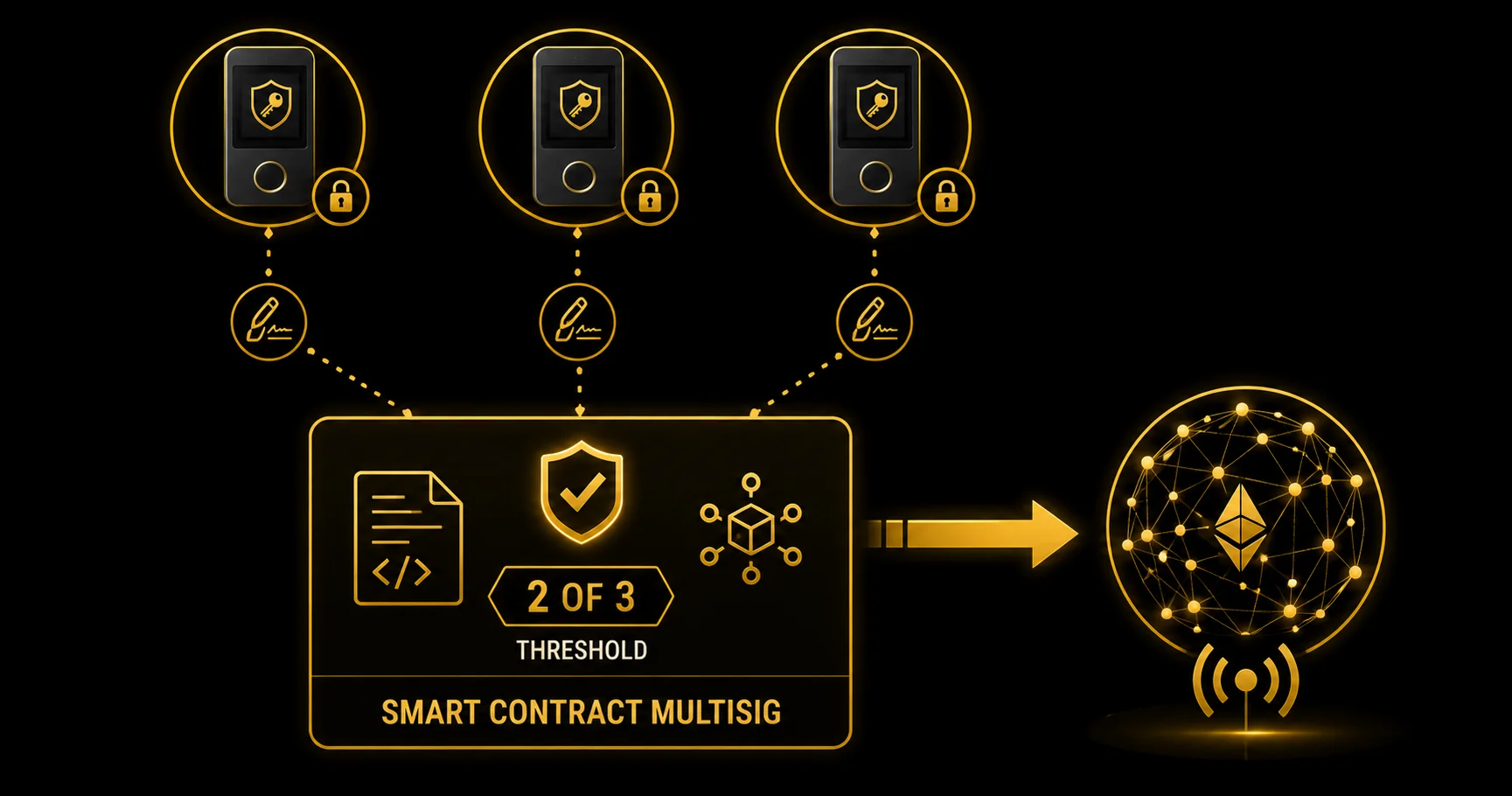
Safe, formerly Gnosis Safe, is a smart-contract multisig for Ethereum and EVM L2s: deploy a Safe, add owner addresses (ideally hardware wallets), set the threshold (e.g. 2-of-3), and confirm each transaction from every owner. This guide walks the full 2-of-3 deployment end-to-end — choosing signers, deploying the Safe contract, adding owners, setting the threshold, confirming a first transaction, and running the same Safe pattern across Ethereum mainnet and your preferred L2. It also covers the operational discipline that matters most: verify every raw transaction on every signer, and never blind-sign.
Introduction
Safe, formerly Gnosis Safe, is a smart-contract multisig for Ethereum and EVM L2s. You deploy a Safe contract, add owner addresses (ideally hardware wallets), set the threshold (e.g. 2-of-3 — two signatures out of three owners are required), and confirm each transaction from every owner up to the threshold. The protocol has been live since 2018. Safe reports over $60 billion secured across more than 40 EVM mainnets (September 2026), under SafeDAO governance. Safe's own figures disagree: $60B+ on its homepage, $80B+ on its security page, neither dated. The only dated figure is $35B+, from its Q1 2026 report. This guide is the operational walkthrough — what you actually click, sign, and verify to put a Safe into service.
Why a Safe multisig matters in practice: it removes the single-key compromise risk that breaks single-sig hardware wallets, it lets two people approve transactions for a shared treasury without either holding unilateral spending power, and it supports a "cold-plus-warm-plus-recovery" personal pattern where one device handles routine signing, another sits in a vault as a cold key, and a third is offsite for disaster recovery. None of those properties hold automatically — they hold only when the owner-set is well chosen, the threshold matches your risk tolerance, and every signer verifies what they are signing on hardware. The protocol gives you the architecture; you supply the discipline.
The calibrated framing matters before you click anything. Safe is not "automatic safety". The protocol contracts have a clean record — no contract-level exploit since the first Safe contract shipped in July 2018 — but the operational layer (the signing UI, the signer's discipline at the moment of approval) is where things go wrong. The one-sentence operational lesson the rest of the guide carries: verify the raw transaction on every signer, never blind-sign. The full case study that motivates that lesson (vector, attribution, what every multisig signer should change about their workflow) lives in our multisig security risks page.
Two reader assumptions before you continue. You already understand M-of-N conceptually — what 2-of-3 means, why threshold matters, and where multisig sits relative to single-sig and MPC. The cluster's multisig wallets complete guide owns that conceptual basis. Second, your single-key setup already sits on hardware. If you are still keeping serious funds in a browser-extension key, multisig is the second step, not the first; harden the single-key baseline first and come back here once your day-to-day key lives on a hardware device.
The structure that follows is straightforward. First a brief framing of why Safe (smart-contract multisig) sits in a different shape from Bitcoin's native-script multisig, so you know which set of operational concerns apply. Then the deployment walkthrough — pre-flight, opening Safe{Wallet}, creating the contract, naming, gas review. Then owner selection with hardware-wallet emphasis, the threshold mechanics that determine your day-to-day operations, the L2 pattern for users who run treasuries across mainnet and rollups, and the operational discipline section that the rest of the guide quietly defends — verify, do not blind-sign. The single-sentence stance the page carries throughout: a Safe is only as secure as the verification discipline its signers actually perform, every time, on hardware.
Smart-Contract vs Native Multisig: a Brief Operational Contrast
Bitcoin and EVM chains implement multisig in fundamentally different shapes. Bitcoin enforces the M-of-N rule at the script level — a P2SH address commits to a redeem script, P2WSH to a witness script, and P2TR to a tapscript leaf that the network validates when the multisig branch is spent (a Taproot key-path spend validates no script at all). EVM chains, by contrast, do not have native multisig opcodes; Safe implements the M-of-N rule inside a smart contract whose owner set and threshold are recorded on-chain. The on-chain artefact, in other words, is a contract address on EVM, not a script-bearing UTXO on Bitcoin. This page is about the smart-contract side — for the native BTC script side, see BTC multisig setup with Sparrow or Nunchuk. For the full conceptual contrast between the two, the cluster hub owns the explainer.
The operational implications of that shape difference are what matter for you here. On the Safe side, your wallet configuration — owner addresses, threshold, modules — lives on the Safe contract itself, so the Bitcoin "descriptor backup" footgun does not apply. You do not have to back up xpubs, derivation paths, or a script type in a separate text artefact. What you do have to remember is which Safe address belongs to which chain and which deployment, because that contract address is your wallet identifier. Lose the Safe contract address along with all signer transaction history and recovery is harder than it should be — the failure-mode breakdown covers the full discipline. In normal operation, however, your owner wallets can reach the Safe just by knowing the address.
The other side of the smart-contract shape is that everything costs gas. Owner-set changes are themselves transactions that must clear the current threshold and pay execution gas; module installations and guard configurations are transactions; even reading the Safe state in some advanced flows involves a small RPC cost. Bitcoin multisig pays the script-size premium per spend; EVM multisig pays a smaller premium per transaction but more frequently, and on Ethereum mainnet that can add up during fee spikes. The L2 deployment pattern that section 6 covers exists largely to manage that gas cost — a Safe on Arbitrum, Optimism, or Base costs a small fraction of what a mainnet deployment costs at the same gas-price moment, and ongoing operations carry the same discount.
The other operational shape that matters: a Safe must be deployed on each chain separately — the contract you create on Ethereum mainnet does not automatically exist on Arbitrum. Whether that per-chain deployment lands at the same address or a different one is set by the deployment parameters, not the chain ID: Safe deploys through CREATE2, so an identical factory, singleton, initializer (owner set plus threshold) and saltNonce reproduce the same address on every chain; any divergence in those inputs produces a different one.
Treat each deployment as its own wallet you must provision deliberately, and never assume an address that exists on one chain is claimed on another. Section 6 walks through what this means for treasury teams operating across mainnet and one or more L2s, and the cross-chain replay footgun that catches people who assume the address simply differs by chain.
Deploy a Safe: Step-by-Step
This is the worked example that anchors the page. The walkthrough below covers a personal 2-of-3 Safe on Ethereum mainnet, using two Ledger devices and one Keystone 3 Pro as owners — chosen because both manufacturers support clear-signing for Safe transactions, the two devices share no firmware lineage (so a single firmware exploit cannot compromise the full signer set), and the Keystone's air-gapped QR flow gives the cold signer an extra layer of isolation against malware that lives on USB-connected machines. The pattern generalises straightforwardly to a one-Ledger, one-Trezor, one-Keystone mix if you want vendor diversity widened further; the steps are the same.
Pre-flight: three hardware signers, three roles
Before you open Safe{Wallet}, initialise the three hardware devices and decide which role each one plays. Owner A is the daily signer: the Ledger Nano X, Stax, or Flex you keep at hand for routine transactions. Owner B is the cold signer: the Keystone 3 Pro that lives in your home safe, plugged in only for approvals that have already passed the daily signer's review. Owner C is the recovery signer: a second Ledger (or a Trezor Safe 7) held in a separate geographic location, ideally at a trusted relative or a safe-deposit box, so that a single fire or burglary cannot take more than one signer at once. Each device has its own seed phrase generated on-device, never typed into a computer, and backed up on steel or paper in line with your existing single-key discipline.
Write down which address belongs to which device before you go further. The Safe will be deployed against three Ethereum addresses, one from each device; if you do not record which is which, future device replacement or signer recovery becomes guesswork. Use the receive screen on each device to confirm the address on-screen rather than copying from a software interface — this is your first practice of the "device display is the source of truth" discipline the rest of the guide reinforces. Skip this step and you will not know which signer holds which seed when one device eventually fails — three years from now, at the worst possible moment.
Open Safe{Wallet} and connect the first owner
Open the official Safe{Wallet} interface at app.safe.global (verify the URL in the browser address bar before connecting any device — phishing sites mimic the Safe domain). Connect the first hardware wallet through Safe{Wallet}'s own connect flow: choose the Ledger option (device plugged in, unlocked, with the Ethereum app open), the Trezor option (which drives Trezor Connect in the browser), or, for the air-gapped Keystone, the QR / WalletConnect pairing its companion app presents. Safe{Wallet} talks to each device directly — you do not route the connection through Ledger Wallet or Trezor Suite. Choose Ethereum mainnet from the network selector at the top of the interface, and confirm in the connected wallet that you are on mainnet (chain ID 1).
The connecting wallet does not have to be one of the Safe owners — it just has to be a wallet that holds a small amount of ETH to pay the deployment gas — but it is cleanest if the deploying wallet is also Owner A, because that gives you one less address to manage.
Create the Safe Account
Click "Create new Safe Account" in the Safe{Wallet} interface. The wizard walks through three substantive choices: the local name for the Safe, the owner set, and the threshold. Supply a local name — something specific enough that future-you can read it in a list of three or four Safes and know which one you are looking at. "Personal 2-of-3, Ethereum mainnet, deployed 2026-05-28" is verbose but unambiguous; "main vault" is short and confusing once you have a second Safe on Arbitrum.
The name lives only in your browser's local storage — Safe{Wallet} keeps it on your device and does not sync it to any server, so it is not on-chain, costs nothing, and can be changed later from settings. The flip side of local-only storage is that the label does not follow you to another browser or device; switch machines and you re-enter it (or import it from an address-book CSV export). Skip the local-naming step and you will forget which Safe is which the moment you have two or three across mainnet and L2s — a tiny time-cost up-front saves real confusion later.
Add three owner addresses
Enter the three Ethereum addresses you wrote down in pre-flight. The owner set is recorded on-chain in the deployed Safe contract, so getting it right at deployment is materially cheaper than fixing it later: changing the owner set after deployment is itself a transaction that has to clear the current threshold and pay execution gas. Verify each address character-by-character against the receive screen on the device that controls it, particularly the first six and last six characters — vanity-address phishing relies on partial-string matches, and the device's display is again your source of truth. The wizard accepts plain addresses, ENS names, and pasted strings; whichever format you use, the verified comparison is against the bytes the device shows, not the human-friendly label.
Set the threshold to 2
Choose 2 as the threshold. The Safe{Wallet} wizard surfaces the M choice as a numeric field with the owner count in context — for three owners, valid values are 1, 2, or 3. Two is the personal-Safe default: you can lose one signer without losing access (1 device dies, 1 human unavailable, still 2 active owners), and an attacker has to compromise two signers to drain the Safe (raises the operational bar for theft). Section 5 walks through threshold trade-offs in more depth; for the deployment, set 2 and continue.
Review the deployment summary and pay gas
The wizard now shows a deployment summary: the proposed Safe contract address (deterministic under CREATE2 over the factory contract, the proxy/singleton creation code, the initializer data — owner set, threshold, and setup parameters — and the saltNonce; the deploying wallet and its account nonce are not inputs), the gas estimate for the deployment transaction, and the chain context. Read all three before confirming.
The gas estimate on Ethereum mainnet for a Safe deployment is typically in the low-six-figure gas range; the actual ETH cost depends on the gas price at the moment of confirmation, which can swing from a few dollars during quiet periods to tens of dollars during fee spikes. On a major L2 the same deployment costs cents to a couple of dollars. Skip the gas review and you may pay tens of dollars in a fee spike when you could have waited or deployed on an L2 first if your immediate operational needs allow it.
Confirm the deployment transaction from Owner A's device. The hardware screen will show the contract creation transaction — destination address (the Safe factory contract), value (zero, for a deployment), and the method (createProxyWithNonce or its equivalent in the version of the Safe factory you are using). If your device clear-signs the deployment, the factory contract address and method name should be readable on-device; if your device shows only an opaque hash, the device is in blind-signing mode and the same class of signing-UI substitution risk that section 7 covers applies in miniature here. Pause, enable clear-signing in your device's app settings, and re-attempt. Once the device renders the deployment cleanly, approve.
Wait for confirmation and record the Safe address
Wait one block confirmation on mainnet (typically about twelve seconds in 2026), or your L2's equivalent finality window. Safe{Wallet} surfaces the new Safe contract address in the top-left of the interface once the deployment lands. Copy it into your local records alongside the deployment date, the chain, the owner set, and the threshold — "Personal 2-of-3, Ethereum mainnet, deployed 2026-05-28, owners: 0xAAA... 0xBBB... 0xCCC..., threshold: 2". This is the configuration backup the section 2 framing flagged: on EVM the on-chain Safe contract holds the canonical configuration, but your local records mean you can find the Safe even if your wallet history is wiped or you migrate to a new device. Store the local record in the same vault discipline you use for seed phrases — a password manager entry, a printed sheet in the safe, or both.
The Safe is deployed. It holds zero funds at this point. The next two sections set up the operational mechanics — the owner-selection rationale you can apply if you are choosing devices fresh, and the threshold-plus-confirmation flow you will use every time you spend from this Safe.
Add Owners — Use Hardware
An owner is not a person. An owner, on a Safe, is an Ethereum address — and behind that address sits a private key, and behind that key sits the device or software that controls it. The unit of custody is the address; the unit of trust is the device. Confusing the two is the cleanest way to build a Safe whose security posture is much weaker than the M-of-N marketing implies. The discipline this section lays out exists to keep that confusion out of your setup from day one.
Recommended owner-device mix for a personal 2-of-3
For a personal Safe, three roles map onto three devices. Owner A is the daily signer — a Ledger Nano X, Stax, or Flex, capable of clear-signing across EVM transactions, mobile-capable for travel, kept at hand for routine approvals. Owner B is the air-gapped cold signer — a Keystone 3 Pro that lives in your safe, signs via QR codes (no USB, no Bluetooth), and renders the full transaction on its four-inch screen so you can clear-sign on a device that has never been connected to a malware-prone machine. Owner C is the recovery signer — a second Ledger, or a Trezor Safe 7, held offsite with a trusted relative or in a safe-deposit box, so a single physical-security incident at home cannot take more than one device.
The vendor mix matters. If all three devices come from the same manufacturer, a firmware-level vulnerability that affects that vendor's signing stack compromises all three signers at once — and the M-of-N threshold buys you nothing, because the same exploit drains all three keys. Mixing Ledger and Keystone, or Ledger and Trezor, or all three vendors, gives you defence in depth against vendor-specific firmware bugs. Skip the vendor mix and use three of the same device → a vendor-specific firmware exploit becomes a correlated failure across all your signers; the Safe protocol behaves correctly while your assets leave the contract.
Why hardware-only, not browser-extension
A software-wallet owner — a MetaMask hot key, a Rainbow seed sitting in your phone, a Coinbase Wallet on a laptop you also use for email — reintroduces exactly the single-key compromise risk that drove you to multisig in the first place. The browser-extension key lives on a machine that opens email, runs browser extensions of varying maintenance quality, and joins web sessions where any number of clipboard or session-hijack attacks can land.
A multisig whose threshold M includes a single browser-extension key is, at the moment that key is compromised, an M-minus-one multisig — and a 2-of-3 with one browser-extension owner reduces effectively to a 1-of-2 hardware Safe. The threshold did not protect you; it only changed how many other signers had to fail at the same time. Skip the hardware requirement and use three MetaMask hot wallets → you have built a slower single-sig wallet, not a multisig; any machine compromise that catches two browser keys at once breaks the Safe.
There is no such thing as a "non-threshold" owner. Every address on the Safe's owner list is equal — any M of the N owners' signatures execute a transaction, and the contract cannot mark one owner as able to sign but never able to count toward the threshold. So adding a MetaMask hot wallet as an owner does not keep hardware approval mandatory: in a 2-of-3, that hot key plus any one hardware key is a full quorum.
If all you want is for a tooling script or hot wallet to propose transactions your hardware owners then approve, register it as a delegate in the Safe Transaction Service instead — a delegate can create and queue proposals but is not an owner and never contributes a signature toward M. Reading the Safe needs no special status at all, because its owner set and balances are public on-chain. For a personal 2-of-3, keep it simple: three hardware-only owners.
Clear-signing on Ledger and Keystone
Both Ledger and Keystone render Safe transaction details on-device in human-readable form. On Ledger, the Ethereum app's clear-signing for Safe transactions surfaces the destination address (or ENS name where resolvable), the token (with decimals decoded), the value, and the function name being called on the Safe contract. On Keystone 3 Pro, the four-inch touch screen renders the same information at a size that makes character-by-character verification practical rather than squinted. The Trezor Safe 7 renders the same fields on its own 2.5-inch colour touchscreen — smaller than the Keystone's four-inch display, but still large enough to read a destination and amount before you approve. Whichever combination you choose, the criterion is the same: the device must be able to render the transaction's destination, value, token, and chain in a form you can read and verify, before you tap approve.
What an owner-set change looks like
Changing the owner set after deployment is itself a transaction. If you want to add a fourth owner, remove an old owner whose device you have lost, or swap one owner address for another, you propose the owner-management transaction in Safe{Wallet} and the current threshold of owners must approve it before it executes. Plan owner sets thoughtfully at deployment because each change costs gas and signer coordination time. For personal Safes, the most common owner-set changes happen at inheritance or major-life events (marriage, divorce, business reorganisation) — and the operational pattern for those changes is its own subject, with the inheritance angle covered in our cluster's dedicated inheritance satellite. For lighter-touch alternatives where one of the owner slots is held by a paid service, the Safe vs Casa vs Unchained comparison covers when the trade-off is worth it.
For deeper device-selection rationale — which hardware wallet fits which threat model, current model lineups, and the secure-element generation each manufacturer ships — the C4 hardware-wallet hub covers the framing end-to-end (linked from the conclusion of this guide). The device-selection rationale there applies directly to picking Safe owners; the only addition the Safe context adds is the vendor-mix rule above.
Threshold and Confirmations
The threshold M is the integer that determines exactly how many owner signatures the Safe contract requires for any transaction to execute. With M=2 on a three-owner Safe, two valid owner signatures send the transaction; a third signature is acceptable but unnecessary, and one signature alone does not execute. The contract enforces this at the EVM level — there is no "I am a privileged owner" exception, no admin override, no recovery path that bypasses the threshold without an owner-managed transaction. The threshold is the rule, and the rule is unforgiving.
Why 2-of-3 sits at the sensible default
Two thresholds bracket the sensible range for personal custody. Going lower — 1-of-2, 1-of-3 — gives you key redundancy but no compromise tolerance, because any single key compromise drains the Safe. Going higher — 3-of-3, 3-of-4 — gives you stronger compromise tolerance but no redundancy, because losing any single signer locks the Safe until you can reconstitute the owner set or recover the missing seed. 2-of-3 sits at the practical midpoint: it tolerates losing one signer (the seventh dead Ledger of the decade, the cousin who held your offsite recovery key relocating without notifying you), and it tolerates one signer compromise (the phishing campaign that catches your daily-signer machine without catching the cold signer). The compromise-tolerance and redundancy properties cost each other directly in higher thresholds, and 2-of-3 is the configuration where the trade is most balanced for a single user or a small team.
Treasuries and organisational custody typically push higher. A 3-of-5 Safe — three signatures required from five owners — survives losing two owners and requires three compromises to drain. The operational weight goes up correspondingly: every transaction needs three humans in three timezones to coordinate, and the owner-management overhead scales with the owner count. 4-of-7 is the high-stakes vault configuration that some funds and DAOs deploy for the largest treasuries. For personal custody, the operational weight of a 3-of-5 (every spend requires you to chase three signers down) often outweighs the security benefit, which is why the personal default lives at 2-of-3.
The confirmation flow in practice
Safe transactions exist as off-chain proposals first and become on-chain executions only at the moment the threshold is met. The flow is: Owner A creates a transaction in Safe{Wallet} (selecting destination, value, token, and any contract call parameters) and signs it from their hardware device. The signing produces a signature that lives in the Safe{Wallet} backend queue alongside the unsigned transaction body — no gas has been paid yet, and the transaction has not touched the chain. Owner B opens Safe{Wallet}, sees the pending proposal in the queue, reviews the destination and parameters, signs from their hardware device, and (because the threshold is now met) clicks Execute. The Execute step is the actual on-chain transaction, which Owner B's wallet pays gas for; the prior signatures are batched in as transaction data.
Two operational consequences follow from that flow. First, only the executing signer pays gas — the proposer and the intermediate signers contribute signatures but not ETH. For organisational custody, this means you can designate a treasury operator to execute every approved transaction, keeping the gas-payment workflow centralised even when approvals are distributed. Second, the proposal lives in Safe{Wallet}'s queue for as long as the signers take to coordinate. A proposal Owner A created on Monday and Owner B did not get round to until Friday is still valid Friday afternoon — provided the Safe's nonce has not been used by some other transaction in the meantime.
Nonce mechanics and queue collisions
Each Safe transaction carries a contract-level nonce that the Safe contract increments by one for every executed transaction. Two transactions cannot share a nonce; if Owner A proposes a transfer at nonce 7 and Owner B proposes a different transfer at the same nonce, only one will execute, and the second will fail at the contract level when its nonce no longer matches the Safe's current state. In practice this is rare, because Safe{Wallet} surfaces the queue and shows you the active nonce as you propose; the failure mode shows up most often in tooling-driven setups where multiple operators script proposals against the Safe in parallel. The mitigation is workflow rather than contract — coordinate proposals via the Safe{Wallet} queue or a shared chat, and resist scripting proposals against a single Safe from multiple machines without explicit nonce management.
Replacing a pending proposal is a routine operation. If Owner A proposes a transaction and you decide before execution that it should be different — wrong destination, wrong amount, fee market moved — Safe{Wallet} lets you queue a replacement at the same nonce. The replacement transaction must be signed by the threshold and executes in place of the original. The original remains in the queue as "replaced" rather than "executed", and the Safe's nonce advances by one when the replacement executes. This is the recommended path for fixing mistakes in pending proposals; do not try to mutate the original proposal in-place, because every change invalidates the existing signatures.
Modules and guards, briefly
Safe supports two extension primitives that experienced users layer on top of the threshold model. Modules are contracts that can execute transactions on the Safe under conditions other than the standard threshold — the canonical example is a spending-limits module, where the Safe permits a daily allowance to a specific address without going through the full multisig flow. Guards are contracts that run additional checks at the transaction level — a guard can require that every transaction pass through an external policy contract, an authorised relayer, or a time-locked review window.
For a personal 2-of-3 deployment you can leave both at default — no modules installed, no guards configured. The threshold model is enough for personal custody. Modules and guards become relevant when you need to delegate specific permissions (e.g. a treasury bot that can move stablecoins below a limit without involving the human signers), when you want policy enforcement beyond signature counting, or when you operate the Safe within a larger account-abstraction stack. Treat these as power-user features and learn them from Safe's official docs when you actually need them, not at deployment.
Safe on L2s
The Safe contract code is the same across every chain it ships on, but each chain has its own deployed instance — and your Safe is the deployment instance, not the code. Deploying on mainnet does not conjure the same Safe on Arbitrum, Optimism, or Base; you have to run the deployment on each chain you want to use. Whether the resulting address matches across chains depends on the deployment parameters rather than the chain: because Safe deploys through CREATE2, an identical factory, singleton, initializer (owner set plus threshold) and saltNonce reproduce the same address everywhere, while any change to those inputs yields a different one.
Two mental models follow. First, each Safe deployment is its own wallet you must provision deliberately. Second, if you want symmetric custody across the chains you actively use, deploy a Safe on each of them and confirm the address the deployment actually produces rather than assuming it.
The pragmatic multi-chain pattern
For a personal user who operates across Ethereum mainnet and a couple of L2s, the operational pattern is straightforward. Deploy a Safe on Ethereum mainnet first as your canonical primary — this is the Safe that holds your long-term ETH, your stablecoin reserves, and any assets that are mainnet-native. Then deploy a Safe on each L2 you actively use: Arbitrum for DeFi positions, Base for stablecoin operations, Optimism for governance and grants if you participate in those ecosystems. Use the same owner set across every deployment so your security posture is consistent; the keys behind each owner address remain the same, the threshold remains the same, only the contract address differs. Each deployment is a one-time transaction with its own gas cost, and on L2 that cost is a small fraction of a mainnet deployment at the same gas-price moment.
Record every Safe address against its chain and deployment date in your local records. "Personal 2-of-3, Ethereum mainnet, 0xMain..., deployed 2026-05-28. Personal 2-of-3, Arbitrum One, 0xArb..., deployed 2026-05-29. Personal 2-of-3, Base, 0xBase..., deployed 2026-05-30." The records are not on-chain in any aggregated way — Safe{Wallet} surfaces each Safe per chain in its own view, but you are the index that ties them together. Treat the index with the same care as your seed-phrase backups, because the value it carries is the same: continuity of access in the event your wallet history is wiped or you migrate to a new machine.
Common misuse: divergent owners across chains
The misuse to flag explicitly: deploying separate Safes per chain with different owner sets, because the owners available at deployment time differed (one was travelling, one had a dead device, one was being onboarded mid-week). The result is two custody postures sitting under one mental model. Your Arbitrum Safe might have owners A, B, and D; your Base Safe might have owners A, C, and D; and you treat them in your head as "my multi-chain Safes" without registering that an attacker who compromises owner D plus one other has unilateral control over two of your three Safes, while compromising owner B only gives them mainnet, and compromising owner C only gives them Base. Keep owner sets identical across chains, or accept explicitly that you are operating genuinely distinct custody setups whose security postures must be reasoned about separately. The simpler discipline is the first one.
The same applies to threshold. If you deploy a 2-of-3 Safe on mainnet and a 1-of-3 Safe on Arbitrum because "Arbitrum is just for trading" and you wanted faster confirmations, you have introduced a single-key compromise risk on Arbitrum that your mainnet deployment does not carry. The owner set may be identical, but the threshold change means a compromise of any one signer drains the Arbitrum Safe entirely. Either keep the threshold consistent across chains, or accept that the lower-threshold chain holds funds you are explicitly willing to lose to a single-key compromise. Both stances can be coherent; the incoherent stance is "I have a 2-of-3 Safe" while the Arbitrum deployment is 1-of-3.
L2 security posture inheritance
Running a Safe on an L2 inherits the L2's own security posture in addition to the Safe contract's. The Safe enforces its threshold on the L2; the L2 enforces its own rules about sequencer trust, force-exit availability to mainnet, data availability for state reconstruction, and finality guarantees. A 2-of-3 Safe on a rollup is only as secure as the rollup's worst case — if the sequencer goes down and the force-exit path is constrained, your Safe is technically intact but operationally stuck until the rollup recovers. This is the cross-cluster topic you should read before parking serious value on any L2 Safe: for the full landscape of L2 security trade-offs, see our running a Safe on an L2 guide in the L2 cluster.
The practical takeaway for a Safe operator: provision on L2 for the operational economy of cheap deployments and cheap transactions, but understand that L2 Safes inherit the L2's trust assumptions. Mainnet Safes carry mainnet trust assumptions, which are the strongest set the EVM offers in 2026. For assets you do not need to touch frequently and that you want the strongest finality on, the mainnet Safe remains the right home; for assets you actively use in DeFi or stablecoin operations, the L2 Safe is the pragmatic home and the L2 trust assumptions are part of the deal.
Verify, Don't Blind-Sign
The single highest-leverage discipline on a Safe is verification at the moment of approval. The threshold protects you against an attacker who compromises only some of your signers; it does not protect you against all of your signers being tricked into approving the same malicious transaction. The mechanism that closes the verification gap is clear-signing on the hardware device — the protocol-agnostic name for the property where your signer renders the transaction's destination, value, token, and function name in human-readable form on its own screen, before you tap approve.
Clear-signing vs blind-signing — what the device shows
Clear-signing: your hardware screen shows "Send 1,000 USDC to 0xABCD...1234 on Ethereum mainnet via Safe contract 0xSafe...". The destination, the token (with the decimals decoded so the figure is human-readable), the chain, and the calling contract are all visible characters you can read. You can compare the destination against your address-book entry, the value against your intention, the chain against where you meant to be operating, and the calling contract against the Safe address you actually own. The signature you produce binds to a payload you have read and validated.
Blind-signing: your hardware screen shows "0x3a7c8d92f1e4b6...". Thirty-some hexadecimal characters and an approve button. You have no on-device way to verify the destination, the value, the token, or the function. The signature you produce binds to whatever bytes the upstream UI sent — and if those bytes were substituted before they reached your device, you have just authorised the substitution as completely as if you had typed it yourself.
The Bybit February 2025 incident showed why this discipline matters — the full case study lives in our multisig security risks satellite, cross-linked from this guide's introduction and conclusion. The operational rule on Safe: every signer verifies the raw transaction details on their hardware device before approving. If the device renders only a hash, decline and investigate. That single rule, applied without exception, is what separates a Safe used responsibly from one whose threshold operates in name only.
The Safe verification checklist — every transaction
Before tapping approve on any Safe transaction, the device should show four things and you should confirm each one against your intent.
The destination address — match the device's display character-by-character against your address book entry, particularly the first six and last six characters. Visual scans defeat nothing; vanity-address phishing deliberately generates matching prefixes and suffixes. For high-value destinations, send a small test transaction first (1 to 10 USDC), confirm receipt out-of-band by phone call or signed message, and only then send the full amount.
The function and token — for a plain ETH transfer the device shows "transfer" or its equivalent; for a stablecoin transfer the device shows the token contract address (and ideally the decoded token symbol with decimals applied) so you can confirm you are sending USDC and not some lookalike token with a similar ticker. For contract calls (a swap, a deposit, a permit), the device should show the function name; if you do not recognise the function name, do not approve until you understand what it does on the destination contract.
The value — render in the token's native units with decimals decoded. "1,000 USDC" is readable; "0x3b9aca00" is not. If the device cannot decode the value into human-readable units, that is the device telling you it is in blind-signing mode for this transaction; resolve the blind-signing problem before approving.
The chain — particularly important after you have deployed Safes across mainnet and one or more L2s. The device should show the chain ID or the chain name (Ethereum, Arbitrum, Base, Optimism) and you should confirm it matches the chain you meant to be operating on. Approving a transaction on the wrong chain is the most common L2-operator mistake, and the chain field on the device display is your last guardrail.
If the device cannot clear-sign — decline
The hardest discipline is the one that costs you operational throughput. If the device cannot render the transaction's details in human-readable form — because the contract call is too novel for the device's parser, because clear-signing for that contract is not yet supported in the device firmware, or because the device is genuinely in blind-signing mode for this specific call — the answer is to decline. Wait, update the device firmware to a version that supports the call, use a different signer that does, or break the transaction into simpler operations the device can render. The answer is never to blind-sign through it because the UI says it is safe. Skip on-device verification of the raw transaction → you have built a multisig whose operational layer is effectively single-sig at the worst possible moment, and the threshold buys you nothing against the UI-substitution failure mode the next section describes.
The second discipline that compounds clear-signing is mismatch checking. If the Safe{Wallet} UI shows you a transaction with destination 0xAAA and your hardware device renders destination 0xBBB, you trust the device and decline the transaction. The UI lives upstream of the device in your trust chain; the device is the bottom layer of that chain and the only one where the bytes you sign are guaranteed to be the bytes that go on-chain. UI compromises happen, and the only practical defence is to treat the device's display as the source of truth and the UI's display as a convenience that may or may not match.
Practical hardening for the signer side
Beyond clear-signing on the device, three additional disciplines compound the verification baseline. Update device firmware regularly — clear-signing support for new contracts ships in firmware updates, and a device running a year-old firmware will blind-sign transactions that a current firmware would clear-sign. Verify the Safe{Wallet} interface URL in the browser address bar before connecting any device — phishing sites mimic the Safe domain, and the entire verification discipline below assumes you connected to the real UI and not to a phishing facsimile. Use a dedicated browser profile or a dedicated machine for multisig operations, separate from the browser session where you read email and click links; the cleanest way to prevent a session-hijack attack is to never have the session running in the first place on the same machine that opens email.
Conclusion
A 2-of-3 Safe with three hardware-wallet owners, deployed on Ethereum mainnet and replicated on the L2s you actively use, is the practical default for personal smart-contract multisig in 2026. The deployment is a one-time procedure; the operational mechanics — proposal, confirmation, execution — settle into a routine within a handful of transactions; the threshold tolerates losing one signer and requires two compromises to drain. None of that is exotic. The work is in the discipline around the routine, not the configuration of the routine itself. What separates a Safe used responsibly from one that gets drained spectacularly is the verification discipline at the moment of approval — clear-sign every transaction on every device, treat the device's display as the source of truth, and decline anything the device cannot render in human-readable form even when the transaction looks routine in the coordinator UI.
Three operational disciplines compound the threshold. Mix vendors across your signer set so a single firmware exploit cannot compromise all your devices at once. Deploy a Safe per chain when you operate across mainnet and L2s, keep owner sets identical for symmetric custody, and document each Safe address against its chain in records you treat with seed-phrase care. Clear-sign every transaction, and refuse to approve anything your device shows you only as an opaque hash. The Bybit February 2025 incident is the operational reminder of what happens when the third discipline lapses; the multisig security risks satellite (linked above) carries the full case study and the broader failure-mode taxonomy.
For the M-of-N conceptual basis if you skipped it on the way in, return to the multisig wallets complete guide. For the single-key hardware-wallet baseline that sits beneath every multisig configuration, the C4 hub covers single-key baseline before multisig custody end-to-end. For the L2 landscape underneath your L2 Safes, the C7 Ethereum L2 complete guide is where to go next (linked in the related-resources list below).
Sources
- Safe — official protocol overview: primary citation for Safe ecosystem scale ($60B+ secured — Safe's own undated headline figure) and SafeDAO governance; the network count is taken from Safe's configuration service, not from this page, and the protocol's clean contract-level record since 2018.
- Safe Docs — deployment, modules, and guards reference: official Safe documentation covering the deployment flow, owner-set management, threshold mechanics, and the modules / guards extension primitives referenced in section 5.
- Ledger — official Safe support and clear-signing: official manufacturer site for Ledger Nano X, Stax, and Flex, including the Ethereum app's clear-signing capability for Safe transactions referenced in the owner-selection and verification sections.
- Keystone — air-gapped hardware wallet with clear-signing: official manufacturer site for Keystone 3 Pro, including the four-inch touch screen and QR-based air-gapped signing flow integrated with Safe{Wallet}.
- Chainalysis — Lazarus Group tracking on Bybit: independent attribution and on-chain forensics for the Bybit February 2025 incident referenced as the one-paragraph operational lesson in section 7. Full case study lives on our risks page.
- FBI PSA — North Korea and Lazarus Group attribution: federal-law-enforcement attribution of the Bybit incident to North Korean state-sponsored actors, cross-referenced for the operational-lesson framing in section 7.
Frequently Asked Questions
- What is the difference between Safe and Safe{Wallet}?
- Safe is the smart-contract protocol — the on-chain code that enforces the M-of-N threshold and holds your funds in a contract address. Safe{Wallet} is the official web and mobile interface that helps you propose, review, and confirm Safe transactions. The protocol is the wallet; the UI is a client. Other clients exist (SDK-driven integrations, alternative UIs), and the protocol is identical underneath. When the Safe{Wallet} UI is compromised — as in the Bybit February 2025 incident — the protocol itself is unaffected, but signers who rely on the UI alone for verification are exposed. Clear-signing on the hardware device is what closes that gap.
- Is 2-of-3 the right threshold for everyone?
- It is the sensible default for personal custody. With 2-of-3 you survive losing one signer (a dead device, a missing human) and an attacker needs to compromise two signers to drain the Safe. Treasuries often choose 3-of-5 or 4-of-7 to widen the compromise tolerance further at the cost of operational weight. A 1-of-2 setup has redundancy but no compromise tolerance — any single key compromise drains the funds. A 3-of-3 setup has compromise tolerance but no redundancy — lose one signer and you are locked out. 2-of-3 sits at the most useful point on that curve for a single user or small team.
- Can I use MetaMask as a Safe owner?
- MetaMask can connect to Safe{Wallet} as an owner signer, but if you add it to the owner set you make it a full owner — every owner is equal, and any M of the N signatures execute, so a compromised MetaMask key plus a single hardware key is a full 2-of-3 quorum. A browser-extension key sits on a machine that opens email, runs browser extensions, and joins web sessions — exactly the environment that single-sig hardware was meant to escape. If you only want a script or hot wallet to propose transactions your hardware owners then approve, register it as a delegate in the Safe Transaction Service rather than adding it as an owner: a delegate can queue proposals but never counts toward the threshold. The signatures that actually authorise execution should come from hardware devices.
- Do I have to deploy a separate Safe on every L2?
- Yes. You must run the deployment on each chain — the Safe contract you create on Ethereum mainnet does not automatically exist on Arbitrum, Optimism, or Base. Whether the per-chain address matches or differs is set by the deployment parameters, not the chain: Safe deploys through CREATE2, so an identical factory, singleton, owner set, threshold and saltNonce reproduce the same address on every chain, while any change to those inputs yields a different one. The good news is that L2 deployments cost a fraction of a mainnet deployment, so provisioning a Safe on each L2 you actively use is cheap. Keep owner sets identical across chains if you want symmetric custody, and confirm the address each deployment actually produces so you do not confuse them later.
- What does clear-signing mean and why does it matter?
- Clear-signing is when your hardware device parses the transaction and renders the destination address, the value, the token, and (for contract calls) the function name on its own screen. You read what you are about to sign, line by line, before approving. Blind-signing is the opposite — your device shows an opaque hash, and you have no on-device way to verify what you are approving. Clear-signing is the operational antidote to the Bybit pattern, where a compromised signing UI substituted the transaction payload and every signer approved a hash they could not read. Refuse to sign anything your device renders only as a hash.
- What happens if one of my hardware wallets dies?
- With 2-of-3 you can keep operating. The remaining two signers still meet the threshold, so any transaction you need to send continues to work. Replace the dead device, restore its seed phrase onto the new device, and you are back to full redundancy. If two die simultaneously you are locked out — which is exactly the failure mode 2-of-3 is supposed to tolerate against, not protect against, and the reason higher-stakes setups sometimes use 3-of-5. Keep seed phrases in geographically separate, physically secure locations so that a single fire or flood cannot take more than one signer at once.
- Has Safe ever been hacked at the protocol level?
- No. The Safe smart-contract protocol has had no contract-level exploit since the first Safe contract shipped in July 2018. Safe reports over $60 billion secured across more than 40 EVM mainnets (September 2026). The high-profile losses linked to Safe — most prominently the Bybit February 2025 incident — were operational compromises at the signing-UI or developer-machine layer, not exploits of the Safe contracts themselves. The contract layer has a clean record. The signer layer is where discipline matters: clear-sign every transaction, verify the raw payload on hardware, and treat the coordinator UI as a convenience rather than the source of truth.
← Back to Crypto Investing Blog Index
Financial Disclaimer
This content is not financial advice. All information provided is for educational purposes only. Cryptocurrency investments carry significant investment risk, and past performance does not guarantee future results. Always do your own research and consult a qualified financial advisor before making investment decisions.