Crypto Security Stack: Which Setup for Which Holding Size
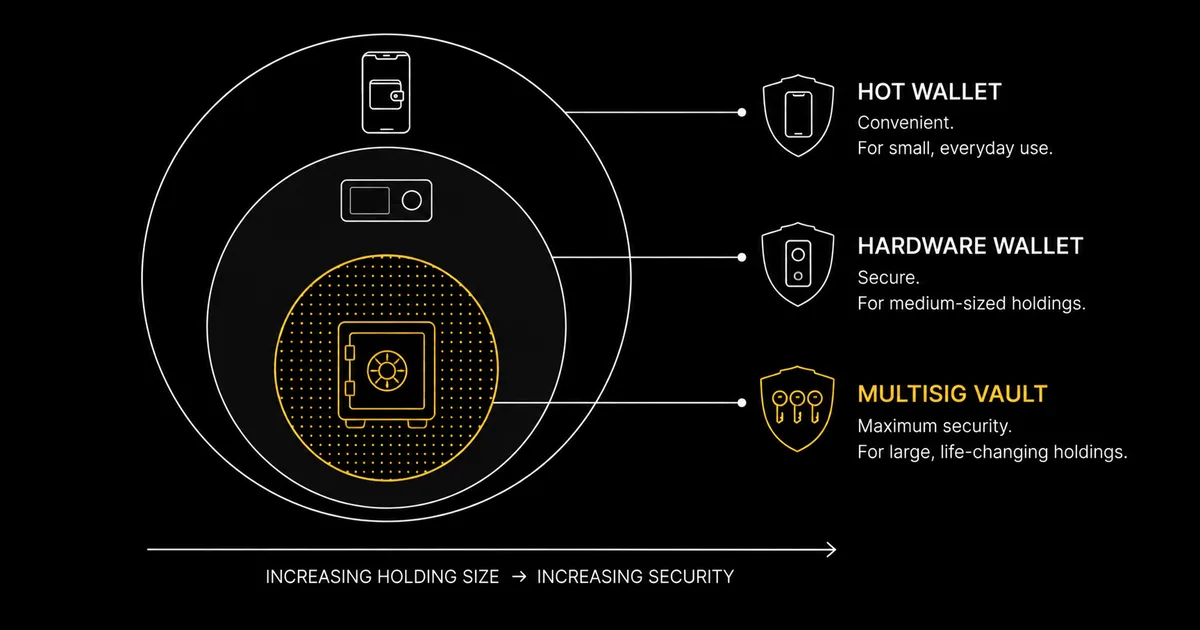
The right security stack scales with what you hold and who is realistically likely to come for it. Under about $1,000 tolerates a reputable hot wallet treated as a spending account. From roughly $1,000 to $50,000, a single hardware wallet (Ledger, Trezor or Tangem) is the baseline that takes the key off a networked machine. Above about $50,000, multisig becomes the architecture that earns its friction. No single device, backup or co-signer is then a single point of failure, and a key held elsewhere makes coercion structurally insufficient. This page is a decision matrix, not an essay. A table maps holding bands against threat tiers. The sections that follow cover the layered stack, the graduation ladder for moving up, and the collaborative-versus-self-managed split, with named coordinator pricing routed to our dedicated comparison.
Introduction
Most security advice fails the same way: it prescribes a single answer for everyone. Buy a hardware wallet. Use multisig. Never touch a hot wallet. Each of those is correct for someone and wrong for someone else, because the right amount of security is not a fixed recipe: it is a function of two variables. How much do you hold, in a sum measured against your own life rather than a leaderboard? And who is realistically likely to try to take it? A trader with $400 in a mobile wallet and a family with $400,000 in cold storage face genuinely different problems. A stack that fits one is either dangerously thin or absurdly over-engineered for the other.
This page resolves that mismatch with a matrix rather than a verdict. The two axes are holding size and threat tier, and each cell gives the recommended setup, its 2026 cost, its friction, and the dominant failure mode. The same person reads different cells over time. A holder at $800 today reads the bottom row; the same holder at $80,000 in two years reads a row four bands up. There is no single best stack here, only a best stack for where you are now and a clear ladder to the next one.
Two things sit deliberately outside this page. The first is the mechanism: why a hardware wallet keeps the key offline, why multisig removes the single point of failure, how the behaviour layer of signing and backup works. That walkthrough belongs to the cluster hub, so rather than re-derive it here we link forward to the operational security complete guide, which assembles the full four-layer stack. The second is the named head-to-head between collaborative-custody coordinators — Safe, Casa and Unchained — which has its own dedicated comparison. This page treats collaborative custody as a category and routes the per-service pricing there.
How to Read This Matrix
The matrix crosses two things, and getting both right separates a proportionate stack from a fearful or careless one. The vertical axis is holding size in dollars, banded into eight ranges, because the cost of a total loss is what justifies the friction of defending against it. The horizontal idea behind each cell is the threat tier: who is realistically able to come for the funds. The same balance warrants a different stack depending on whether the only plausible attacker is a faceless automated drainer or someone who knows you personally hold crypto.
The three threat tiers
Three tiers cover almost every real holder, and most people sit firmly in the first.
- Tier 1 — casual, remote. The attacker is automated and impersonal: a drainer kit, a phishing campaign, a clipboard trojan, a fake app. It does not know who you are and does not care; it casts a wide net and waits for a signing or paste mistake. Every holder faces this tier, regardless of size, and it is defeated by behaviour and by keeping the key off a networked machine.
- Tier 2 — targeted, remote. The attacker has identified you specifically as a holder, through a data breach, an on-chain footprint, or a social-media brag. The approach is then tailored: a SIM-swap on your phone number, spear-phishing that uses your real name, a fake support agent who knows which exchange you use. This tier scales with visibility and with size, and it adds account-level hardening to the device-level defences.
- Tier 3 — coercion, insider. The attacker can reach you in person, or is someone you already trust. This is the wrench-attack scenario and the insider scenario. It is the only tier a single hardware wallet cannot defend, because a device you can unlock under pressure is a device an attacker can make you unlock. It is a minority concern, concentrated amongst the visibly wealthy and the publicly doxxed, but where it applies it is the design driver.
What the four columns mean
Each cell is described along four columns, chosen because they decide whether a stack is right for you rather than merely strong on paper.
- Recommended setup. The architecture that fits the band: hot wallet, single hardware key, or multisig, sometimes with a coercion-specific addition such as a separated key or a passphrase-derived hidden wallet.
- 2026 cost. The money it takes to put the setup in place this year, date-stamped because hardware prices move. Hot wallets cost nothing; hardware is a one-off purchase; multisig is two or three devices plus, optionally, a recurring service fee.
- Friction. What the setup costs you in time and inconvenience on an ongoing basis, because a defence too painful to keep is worse than a modest one you actually sustain.
- Dominant failure mode. The way holders at this combination most often lose funds, so you can see what the stack is and is not protecting against.
One principle governs the whole table: a $400 problem and a $400,000 problem do not scale linearly. The cheap defences (verifying every signature, never reusing an address from history, keeping SMS off accounts that gate funds) apply at every tier and cost nothing. What changes as the holding grows is the architecture, and the jump from a single key to multisig is a jump in kind.
The Decision Matrix: Stack by Holding Size and Threat Tier
The table below is the centrepiece of this page. Read across each row to see how the setup, cost, friction and failure mode change for a given holding band. Setup and threat tier share the second column, because for most holders the realistic threat tier rises with the holding size. The costs are current as of June 2026, with the Ledger figures rechecked in September 2026, and every device price taken from the manufacturer's own store rather than the inflated bundle prices some resellers list. The figures are inflection points, not hard lines: your own crossover may sit higher or lower depending on income, public footprint and jurisdiction.
| Holding band and threat tier | Recommended setup | 2026 cost | Friction | Dominant failure mode |
|---|---|---|---|---|
| $0–1,000 (Tier 1: casual, remote) | Reputable software or mobile hot wallet, treated as a spending account | $0 — software only, network fees aside | Minimal — install and go | Phishing signature or clipboard paste; fake-app install |
| $1,000–5,000 (Tier 1: casual, remote) | First single hardware wallet for the bulk; small hot float for spending — the graduation point | $59–79 one-off (Trezor Safe 3 / Tangem / Ledger Nano) | Low — connect the device to confirm spends | Blind-signing a malicious approval; seed never backed up after purchase |
| $5,000–10,000 (Tier 1–2: casual, early targeting) | Hardware core settled; seed backed up off the phone; SMS starting to come off linked accounts | Device already owned + ~$0–30 first backup upgrade | Low — the device routine becomes a habit | Single seed kept in one fragile location; reused address leaking the balance |
| $10,000–50,000 (Tier 2: targeted, remote) | Single hardware wallet plus metal seed backup, geographically separated; SMS removed from linked accounts | $59–179 device + ~$30–90 metal backup | Moderate — backup discipline and two-factor hardening | SIM-swap on linked accounts; single seed lost in one location |
| $50,000–100,000 (Tier 2–3: targeted, coercion if visible) | Multisig (2-of-3 self-managed) crosses its warrant here, or a single hardware key with a separated backup if the holding stays private | $120–540 for 2–3 signers (self-managed); service fee if collaborative | High — multiple signatures per spend, more devices to maintain | Quorum misconfiguration locking you out; one signing surface compromised |
| $100,000–250,000 (Tier 2–3: layered split worthwhile) | Multisig deep vault for the long-term core, with a separate hardware single-key tier for working savings and a hot float for spending | $120–540 for signers; metal backups per key; service fee if collaborative | High — three layers to maintain, each with its own backup regime | Cross-contaminating the layers; a vault key handled like a working-tier key |
| $250,000–1,000,000 (Tier 3: coercion, insider as a real input) | Multisig with a geographically separated key; passphrase-derived hidden wallet with a credible decoy; written inheritance plan | $180–540+ for signers; optional collaborative-custody fee (see C8 comparison) | Highest — full operational regime, succession planning, separated keys | Coercion meeting a local quorum; insider compromise; no recovery plan on death |
| $1,000,000+ (Tier 3: coercion and insider as design drivers) | Multisig with keys split across people and jurisdictions; collaborative custody often paid for its recovery and inheritance support; rehearsed succession | $180–540+ for signers plus a collaborative-custody subscription where the fee is a small fraction of the value (see C8 comparison) | Highest — geographically and legally distributed keys, periodic recovery drills | A co-signer or jurisdiction becoming unreachable; an untested inheritance scheme failing on the day it is needed |
The matrix is a chooser, not a ranking — no row is "better" than another, each is the proportionate answer to a different problem. The per-tier reasoning below explains why each cell lands where it does.
Reading the bottom bands: $0–10,000
At the bottom band, the case for spending zero on hardware is genuine rather than a compromise. A reputable software wallet — MetaMask for Ethereum and its layer-2s, or Trust Wallet for broader multi-chain coverage — is an adequate home for a spending-sized balance. Install it only from the official source, and treat it as a current account rather than a vault. The dominant attacker is automated and remote, and a drainer does not care whether your key sits in a hot wallet or a hardware wallet. It wins by getting you to sign, and a hardware wallet signs a malicious approval just as faithfully as a hot wallet does.
What defeats the Tier 1 attacker at this size is behaviour, and the behaviour is free. Download wallets only from official sites, never enter a recovery phrase anywhere, and verify the full destination address rather than its ends. Keep any linked exchange on app-based two-factor rather than SMS. The only money worth spending is on the day the balance crosses into territory where losing it overnight would actually hurt.
That day usually arrives in the $1,000–10,000 band, and the cost of responding to it is small. A Tangem three-card set runs about $70 and a Trezor Safe 3 is $59, both as of June 2026, and a Ledger Nano X is $79 as of September 2026. Each is a one-off purchase with no subscription. What the device buys is a mechanism rather than a brand. The private key is generated inside a secure element and never leaves it, so the networked machine only ever sees the signed transaction the device hands back. That is why malware that fully owns your laptop still cannot lift the key the way it can drain a hot wallet.
The seed phrase shown once at setup — a BIP-39 mnemonic — is the only thing that can recreate that key. Backing it up before any coin moves matters more than which model you bought. The dominant failure mode shifts here from the hot-wallet paste mistake to two new shapes. The first is blind-signing an approval the device cannot render readably. The second is losing the seed because it was never backed up, or was kept in a single fragile location. Both are behaviour problems the device surfaces but does not solve.
Reading the middle band: $10,000–50,000
In the $10,000–50,000 band the architecture does not change (a single hardware wallet is still the right core), but the threat tier widens and the regime around the device tightens. A holding this size is large enough to attract a targeted, Tier 2 attacker, who may have your name from a breach and may attempt a SIM-swap to take over the accounts around your wallet.
The additions are therefore not a new device but a hardened backup and a hardened perimeter. The backup is metal, rated to survive a house fire and stored in a second building, so one fire or burglary cannot take both device and seed. That backup is a single seed by default. A holder who does not want any one sheet to be a complete key can use seed phrase splitting — SLIP-39, also called Shamir backup. It breaks the mnemonic into shares, so that a fixed number, say two of three, must be brought together to reconstruct it.
The perimeter is two-factor authentication (2FA), taken off SMS on every account that gates funds. It is replaced with an authenticator app or a hardware security key, plus a carrier port-out lock. The metal backup adds roughly $30 to $90 to the device cost. The dominant failure modes are the SIM-swap on linked accounts and the single seed lost in one location, neither of which the hardware wallet itself addresses.
Reading the top bands: $50,000 and above
Above about $50,000 the calculation changes in kind. A single key now represents a single point of failure whose loss would be catastrophic rather than painful, and for a holder whose wealth is visible the coercion tier becomes a real design input. This is where multisig earns its friction.
A self-managed two-of-three multisig — multi-signature — means any two of three independent keys must sign before a transaction is valid. Three hardware signers cost roughly $120 to $540, as a one-off. It means no single device, backup or person can move funds alone. Holding one of the three keys in a geographically separate location is what makes coercion structurally insufficient. An attacker physically present, even with full compliance, cannot meet the threshold, because the third key is not in the building. For the visibly wealthy, a passphrase-derived hidden wallet — with a decoy holding a credible smaller balance — is a complementary pattern, and an inheritance plan stops becoming optional.
The friction is real: every spend needs multiple signatures, the devices and backups multiply, and a misconfigured quorum can lock you out of your own funds. That last failure mode is why multisig below its warrant adds fragility rather than safety. The depth on coercion-resistant design and the passphrase mechanics lives in the cluster satellites.
One note belongs with any list of devices, because the attack that targets their owners is operational rather than technical: no hardware vendor will ever ask for your recovery phrase, by any channel, for any reason. In January 2026 a breach at a third-party logistics provider exposed names and postal addresses of Ledger customers, and a phishing wave followed playing on a fabricated "Ledger–Trezor merger" that urged holders to "migrate" their wallets. The keys and funds were never at risk from the breach itself; the danger was the phishing that followed. Treat any unsolicited request to enter, validate or migrate a seed as hostile, no matter how authentic the branding looks.
The Layered Stack: Not Either/Or
The matrix reads as if you pick one row and stop, but the holders who get this right almost never do. A mature setup is layered. A hot wallet handles spending, a hardware single-key core holds the working savings, and, above a threshold, a multisig deep vault holds the long-term holdings you rarely touch. The tiers are not rivals competing for your money — they are concentric layers, each holding the portion of the portfolio whose risk profile matches the layer's friction. The mistake is treating the question as "hot or hardware or multisig" when the right answer for a larger holder is "all three, in proportion".
The three layers as concentric rings
The outermost ring is the hot wallet: small, internet-connected, accepted as the most exposed layer because it carries the least value. It exists to be convenient, and is sized so that its total loss is an annoyance rather than an event. The middle ring is the hardware single-key core: the working savings, off the network and confirmed on a device screen. It is large enough to matter but liquid enough that the friction of a single device is acceptable. The innermost ring is the multisig deep vault: the long-term holdings whose loss would be catastrophic. It is protected by the architecture that removes any single point of failure, and touched least often.
A worked split: the $120,000 holder
Consider a holder with $120,000 across the three layers, which makes the proportions concrete. Around $500 sits in a hot mobile wallet for day-to-day spending and application use. It is small enough that a drainer who tricks them into signing takes a bad afternoon, not the portfolio. Around $15,000 sits on a single hardware wallet as the working savings, the balance they rebalance and occasionally spend from. Here the friction of connecting a device per transaction is worth it, but the friction of multisig is not. The remaining $104,500 sits in a self-managed two-of-three multisig as the deep vault, the long-term core they touch a handful of times a year. Its resistance to single-point failure and to coercion justifies the multiple-signature friction. Each layer holds the portion of the portfolio whose loss tolerance matches its protection, and a compromise of the most exposed layer reaches only $500.
What each layer touches
Keeping the layers genuinely separate is what makes the structure work, and a short checklist keeps the boundaries clean.
- The hot layer touches the open internet and applications. It connects to decentralised applications, signs everyday transactions, and absorbs the application-interaction risk that the savings layers must never carry. Nothing of consequence lives here.
- The hardware core touches only deliberate spends. It is connected to confirm a transaction and then disconnected; it never auto-approves, never signs blind, and never interacts casually with applications the way the hot layer does.
- The multisig vault touches almost nothing. It receives deposits and is opened only for the rare large move. Each spend is deliberately assembled and signed across separate keys, so the layer with the most value also has the smallest attack surface.
The layering only protects you if behaviour holds across all three, and behaviour sits above the device choice rather than below it. A perfect hardware core does not help if you blind-sign a drainer's approval. A perfect multisig does not help if its UI is compromised and you confirm without reading the device screen. The signing and recognition disciplines that protect every layer are the behaviour layer of the stack, covered through the cluster hub and its satellites.
The Graduation Ladder: When to Move Up
Because the same holder reads different rows over time, the most useful thing after the matrix itself is the ladder between rows. That means the specific triggers that should make you move up a layer, and the anti-pattern of moving too soon. The triggers are not all about size. Some are about visibility, jurisdiction or life events that change who can reach you even when the balance has not moved.
When to graduate from hot to hardware
The trigger to move the bulk off a hot wallet and onto hardware is the moment losing the balance overnight would genuinely hurt. For most people that lands somewhere in the $1,000 to $5,000 range, but the honest test is consequence, not a figure. If waking up to a drained wallet would change your month rather than merely annoy you, you are past the line. The move costs a one-off device purchase ($59 to $79 across the mainstream options in 2026), and the regime change is small. Generate the seed offline, back it up on metal, and from then on treat the hot wallet as a spending float topped up from the cold core. The graduation is cheap, and the failure mode it closes — remote malware lifting a key off a networked machine — is one a hot wallet cannot.
When to graduate from hardware to multisig
The trigger to move from a single hardware key to multisig is harder to pin to a number, but the shape is clear. Graduate when a single tail-risk event would be catastrophic, or when the coercion tier becomes real for you. The size inflection is usually above about $50,000, but the real triggers are often qualitative. A holding becomes publicly known: a wallet linked to your identity, a social-media brag, a press mention. A life event concentrates value in a way a single lost seed could erase. A jurisdiction or living situation raises the physical-coercion risk.
Any of these can warrant multisig before the balance alone would. The $50,000 line is a worked example rather than a rule. A holder crossing it with a publicly linked wallet should move sooner than one whose holdings are entirely private. The targeted and coercion tiers arrive with visibility, not just with size.
The anti-pattern: multisig before its warrant
The ladder runs both ways, and the more common error is climbing it too fast. Adding multisig friction below the warrant does not make a small holding safer. It makes it more fragile. A two-of-three multisig with a poorly understood quorum is a setup where a lost key, a fat-fingered configuration, or a misremembered backup can lock you out of your own funds. That self-inflicted loss is far more likely at small sizes than the single-point-of-failure event multisig exists to prevent.
The friction that protects a $250,000 vault is dead weight on a $5,000 holding. The added complexity introduces failure modes that did not exist with a single well-backed device. The backup regime these tiers depend on, and the inheritance planning the upper tiers require, are reached through the cluster hub rather than re-derived here. The chooser stays a chooser.
Collaborative Custody vs Self-Managed
At the multisig tier a second question opens up that the matrix does not resolve on its own. Do you run the multisig yourself, or pay a service to share one key and carry part of the operational burden? Both use the same underlying mechanism: several keys must agree before funds move. But they distribute responsibility differently, and the right answer depends on how much operational discipline you want to hold versus delegate. This page states the distinction; the named per-service pricing and head-to-head is routed to the dedicated comparison so it is not duplicated.
The distinction in plain terms
Self-managed multisig means you hold and run every key yourself. There is no ongoing fee, no third party knows your wallet exists, and you own the recovery path entirely. But there is also no concierge to walk you through a key rotation under stress, and no support line when something goes wrong at an inconvenient hour. Collaborative custody means a service holds one key in a recovery quorum, structured so that you always retain enough keys that the service alone cannot move your funds. In exchange for an annual fee you get guided onboarding, recovery assistance, and in some cases a built-in inheritance product. The trade you are weighing is operational responsibility against an annual fee, plus a third party's knowledge that your wallet exists. It is not custody, because in a correctly structured collaborative model the service is always below the threshold by itself.
Where the named services sit
The three services most readers evaluate occupy distinct positions, worth knowing before the detailed comparison. Casa offers collaborative custody with a built-in inheritance product, where the base inactivity-based inheritance window is now global and only the instant, death-certificate Enhanced Verification path is United States-only. Unchained offers collaborative custody through a membership-and-concierge layer, with a United States-focused, know-your-customer (KYC) footprint. Safe is a do-it-yourself, non-custodial multisig (open-source and free at the protocol level) with no built-in inheritance, which means a holder using Safe assembles their own recovery and succession scheme. All three are live and healthy as of mid-2026. The named pricing, the recovery-quorum structures, and the who-should-pick-what decision tree are set out in full in our Safe vs Casa vs Unchained comparison. That is the right next page if collaborative custody is on your shortlist.
One recurring confusion to clear up
A point that trips up holders evaluating the multisig tier deserves a flat statement: a Tangem multi-card set is not multisig. Tangem's two-card and three-card packs clone the same private key across the cards for loss-resistance: if you lose one card, the others still hold the same key and can recover the wallet. That is key redundancy, a backup mechanism, not a threshold scheme where several independent keys must agree before funds move. A Tangem set belongs in the single-key tier of this matrix as a convenient backup-resilient hardware wallet, not in the multisig tier as a signer set. If you want true M-of-N protection, you need either a self-managed multisig with independent signers or a collaborative-custody service. The redundancy a multi-card set gives you protects against losing a card, not against a single key being compromised or coerced.
Conclusion
The argument reduces to one sentence. The right security stack scales with what you hold and who can realistically reach you. The jump in protection comes from moving up an architecture tier, never from spending more on a device in the same tier. Under about $1,000, a reputable hot wallet treated as a spending account is defensible, and the money is better spent on free behaviour than on hardware. From $1,000 to $50,000, a single hardware wallet is the baseline, hardened above $10,000 with a metal backup and SMS off linked accounts. Above about $50,000, multisig earns its friction by removing the single point of failure and, with a separated key, making coercion structurally insufficient. A single device, however expensive, cannot provide that defence.
Two cautions carry across every row. A pricier hardware wallet is not a more secure architecture. A $399 device and a $70 set protect the key the same way, and paying more buys screen size and connectivity, not a higher ceiling. And a single key, at any price, cannot defend against someone physically present who can compel you to unlock it. The structural answer to the coercion tier is multisig with a key held elsewhere, not a better device. The cheapest defences, the behaviour habits, apply at every tier and cost nothing. What changes with size is the architecture, and the matrix shows exactly where each change is warranted.
The next step depends on where you landed. A holder in the hardware tier should buy the device, back up the seed, and move the savings. A holder at the multisig tier should read the mechanism and decide between self-managed and collaborative custody. Either way, the chooser here is the start of the decision, not the end of it.
Security is a standing routine, not a one-time purchase, and the stack grows with the portfolio. Revisit the matrix whenever your holdings, your public footprint, or your jurisdiction change. The mechanism behind every tier lives in the cluster hub linked throughout this page. That covers why the key stays offline, why the threshold matters, and how the behaviour layer protects all of it.
Sources
- Ledger — official store and security advisories: backs the 2026 Ledger Nano X ($79, checked September 2026) and Stax ($399) pricing used in the matrix, the on-device clear-signing capability, and the January 2026 third-party logistics breach and fake-merger phishing wave (keys and funds unaffected).
- Trezor (SatoshiLabs) — official store: backs the 2026 Trezor Safe 3 price band ($59) and the open-source firmware lineage referenced in the single-key tier.
- Tangem — official pricing: backs the 2026 Tangem two-card (~$55) and three-card (~$70) set prices, and the multi-card key-redundancy model that is backup resilience rather than M-of-N multisig.
- Scam Sniffer — 2025 annual phishing report: backs the Tier 1 failure-mode context, that automated drainers and phishing signatures dominate self-custody losses regardless of holding size and are defeated by behaviour rather than by device price.
- Safe — official protocol overview: backs the description of Safe as a do-it-yourself, open-source, non-custodial multisig with no built-in inheritance, referenced in the collaborative-versus-self-managed section.
- Casa — collaborative custody and inheritance: backs the framing of Casa's built-in inheritance product, with the base inactivity window global and the instant Enhanced Verification path United States-only, referenced lightly here and detailed in the C8 comparison.
Frequently Asked Questions
- What security stack should I use for under $1,000 in crypto?
- For under about $1,000, a reputable software or mobile wallet is a defensible stack, provided you treat it as a spending account rather than a vault. The realistic threats at this size are automated phishing, fake apps and clipboard malware, none of which need a hardware wallet to defend against. Spend nothing on hardware and instead spend your effort on behaviour: download wallets only from the official site, never enter your recovery phrase into anything, verify the full destination address rather than the abbreviated ends, and keep two-factor on any linked exchange account on an authenticator app rather than SMS. The dominant failure mode at this tier is a signing or paste mistake, so the highest-value habit is slowing down before you approve. Keep no more here than you could lose overnight without it changing your life, and move anything beyond that to hardware.
- When should I move from a hot wallet to a hardware wallet?
- The trigger is the moment losing the balance overnight would genuinely hurt, which for most people lands somewhere between $1,000 and $5,000 rather than at a fixed figure. The cost of crossing the line is small: a Tangem three-card set is around $70 and a Trezor Safe 3 is $59, both as of June 2026, while a Ledger Nano X is $79 as of September 2026, all one-off purchases. A hardware wallet keeps the private key off your internet-connected phone or laptop, which defeats the remote malware and key-extraction attacks that a hot wallet cannot. The graduation is not about the device being magic; it is about removing the key from a networked machine and adding a screen you verify on. Buy the device, generate the seed offline, back it up on metal before you move a single coin, and treat the hot wallet from then on as a small spending float.
- When is multisig worth the extra friction?
- Multisig earns its friction once a single tail-risk event, one lost seed, one stolen device, or one successful coercion, would be catastrophic rather than merely painful. As a rough inflection point that is usually above about $50,000, though the real trigger is consequence rather than a fixed figure. Multisig requires several independent keys to approve every transaction, so no single device, backup or person is a single point of failure, and a key held in a separate location makes coercion structurally insufficient because the attacker in your home cannot meet the threshold alone. The cost is real ongoing friction: every spend needs multiple signatures, you maintain more devices and backups, and a misconfigured quorum can lock you out of your own funds. Below the warrant, that friction adds fragility rather than safety, which is why a single hardware wallet remains the right answer for mid-sized holdings.
- Does a more expensive hardware wallet make my crypto more secure?
- No. A $399 Ledger Stax and a $70 Tangem set protect the key with the same fundamental architecture: the private key is generated and held offline, and transactions are signed on the device rather than on the networked machine. The price difference buys screen size, build quality, connectivity such as Bluetooth or NFC, and features, not a higher security ceiling. What actually changes your security is the architecture, single-key versus multisig, and your behaviour, whether you verify every signature and back up the seed properly. Spending more on a single device while leaving the seed photographed in a cloud note or blind-signing approvals is paying for the wrong upgrade. The jump in protection comes from moving up an architecture tier or fixing a behaviour gap, not from a pricier model in the same tier.
- Can a single hardware wallet protect me from a physical attack?
- No, and this is the single most important limit of a single-key setup. A hardware wallet defeats remote attackers, who cannot extract a key that never touches the internet, but it cannot defend against someone physically present who can compel you to unlock the device and approve a transfer, the scenario often called a wrench attack. If your PIN and device are reachable under coercion, the funds are reachable. The structural defence is multisig with at least one key held in a geographically separate location, so that even full compliance under pressure cannot move funds because the local keys alone do not meet the threshold. A BIP-39 passphrase that derives a hidden wallet, with a decoy holding a credible smaller balance, is a complementary pattern. Physical risk is a minority concern that mostly applies to visibly wealthy or publicly identified holders, but where it applies, a single key is not enough.
- Is collaborative custody the same as self-managed multisig?
- They share the same underlying mechanism, several keys must agree before funds move, but they differ in who holds the keys and who carries the operational burden. Self-managed multisig means you hold and run every key yourself, with no ongoing fee and no third party knowing your wallet exists, but also no concierge to help when something goes wrong. Collaborative custody means a service holds one key in a recovery quorum where you always retain enough keys that the service alone cannot move funds, in exchange for an annual fee, guided onboarding and recovery support. A do-it-yourself non-custodial multisig such as Safe has no built-in inheritance, whereas a collaborative service such as Casa builds inheritance in. The named pricing and structural head-to-head between Safe, Casa and Unchained is covered in detail on our dedicated collaborative-custody comparison.
- What does each crypto security stack cost to run per year in 2026?
- A hot-wallet stack costs nothing beyond network fees, so the annual run cost is effectively zero. A single hardware-wallet stack is a one-off device purchase, around $70 for a Tangem set or $59 for a Trezor Safe 3 as of June 2026, and $79 for a Ledger Nano X as of September 2026, with no subscription, so it amortises to near zero per year once bought. A self-managed multisig stack costs the hardware for two or three signers, roughly $120 to $540 depending on the devices, again as a one-off with no ongoing fee. A collaborative-custody service adds an annual subscription on top of the signer hardware, which only makes sense once the stash is large enough that the fee is a small fraction of the value protected. The named per-service annual figures are set out on our collaborative-custody comparison rather than restated here.
← Back to Crypto Investing Compare Index
Financial Disclaimer
This content is not financial advice. All information provided is for educational purposes only. Cryptocurrency investments carry significant investment risk, and past performance does not guarantee future results. Always do your own research and consult a qualified financial advisor before making investment decisions.