Bitcoin vs Ethereum Comparison
Side-by-side comparison of Bitcoin and Ethereum across technology, monetary policy, ETF access, staking yield, fees and use cases — with practical guidance for portfolio construction.
Introduction
Bitcoin and Ethereum together account for the majority of total cryptocurrency market capitalisation. Each represents a fundamentally different approach to blockchain technology, and the differences matter for portfolio construction.
Bitcoin, launched in 2009, established peer-to-peer digital cash and has evolved into the dominant store-of-value cryptocurrency. Its value proposition rests on hard-capped supply, a 17-year track record, and growing institutional adoption through spot ETFs, corporate treasury holdings and sovereign exposure.
Ethereum, introduced in 2015, extended blockchain beyond simple value transfer to programmable smart contracts and decentralised applications. The platform now hosts the dominant share of DeFi protocols, NFT markets and Web3 infrastructure. Ethereum transitioned to Proof of Stake in September 2022, reducing energy consumption by approximately 99.9%.
The choice between BTC and ETH often reflects broader investment philosophies. Bitcoin appeals to investors seeking a digital alternative to gold and other traditional store-of-value assets. Ethereum attracts investors interested in participating in the growth of decentralised applications and yield-generating staking infrastructure.
Most serious investors hold both as complementary components of a diversified cryptocurrency portfolio rather than choosing between them.
This comparison covers technology architecture, monetary policy, market performance, use cases, regulatory considerations and practical allocation guidance. The detailed Bitcoin allocation framework sits in our Bitcoin portfolio allocation guide; this comparison focuses on the BTC-versus-ETH dimension specifically.
Bitcoin vs Ethereum: Quick Overview
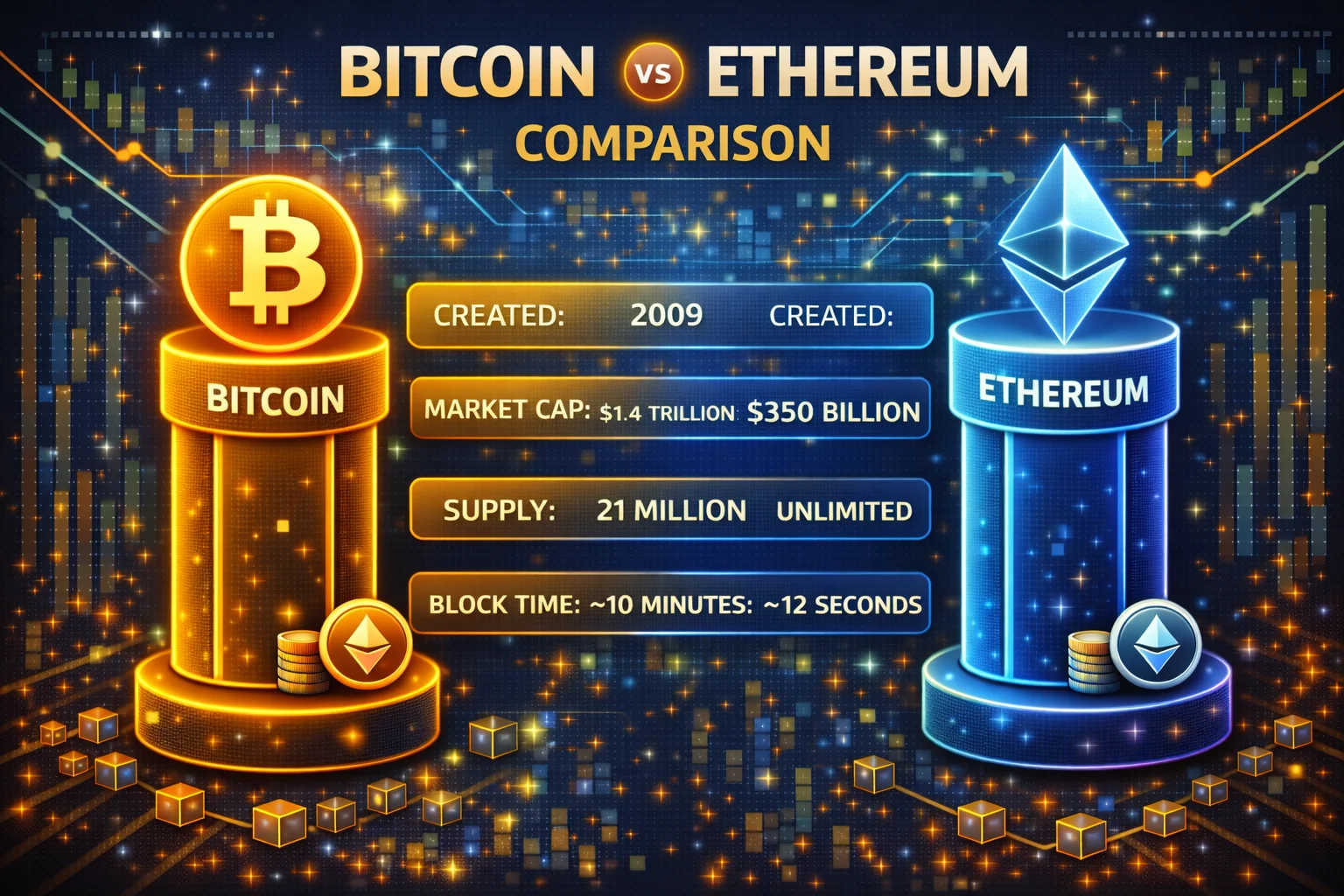
| Feature | Bitcoin (BTC) | Ethereum (ETH) |
|---|---|---|
| Launch Year | 2009 | 2015 |
| Market Cap Rank | #1 | #2 |
| Primary Purpose | Digital money & store of value | Smart contracts & DApp platform |
| Consensus Mechanism | Proof of Work | Proof of Stake (since 2022) |
| Maximum Supply | 21 million BTC | No fixed cap; net issuance runs near +0.85% a year at August 2026 fee levels |
| Base-Layer Throughput | ~7 TPS | ~29 TPS (mainnet, at the 60M gas limit); thousands on Layer 2 |
| Energy Efficiency | High energy consumption (PoW) | ~99.9% lower than pre-Merge (PoS) |
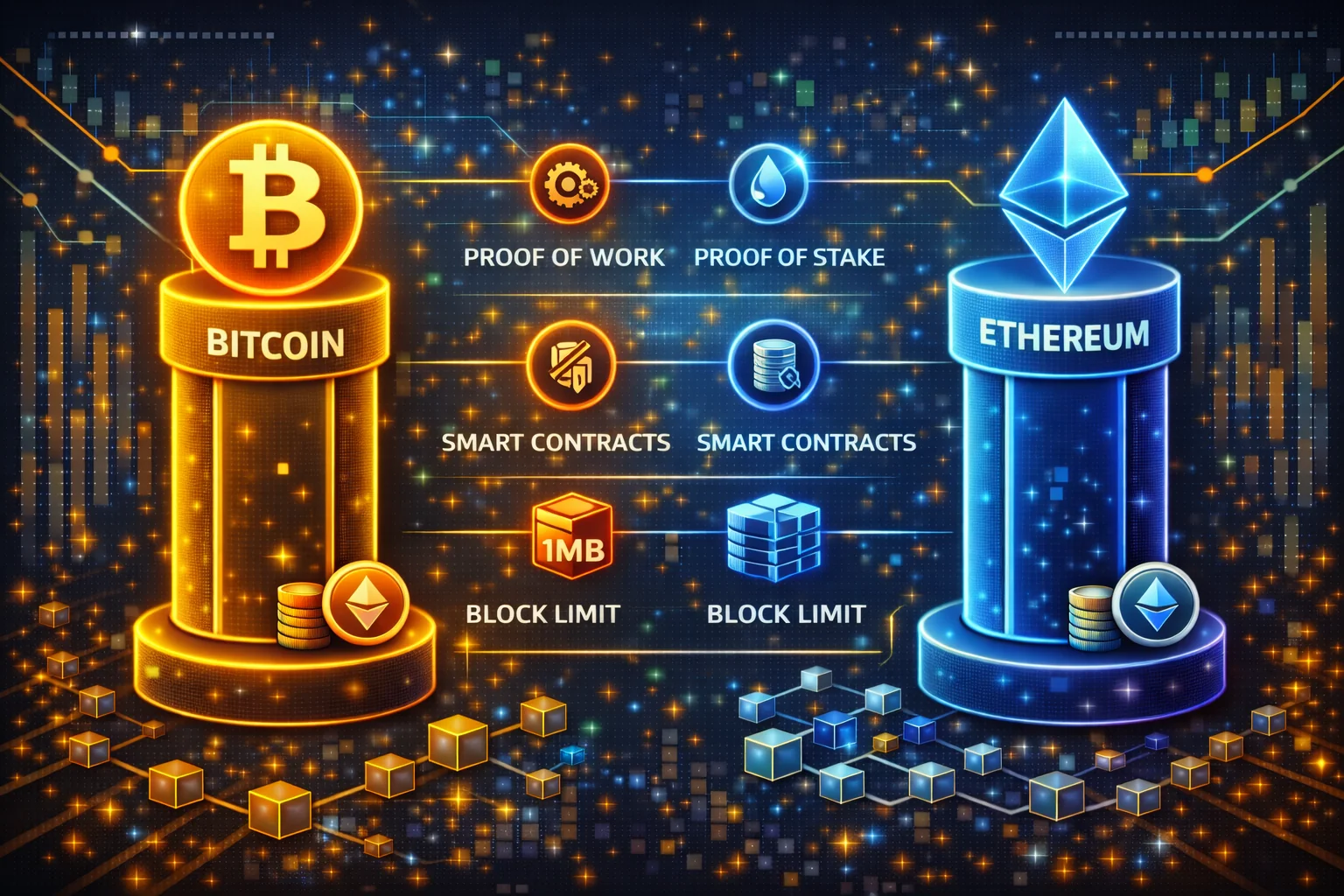
| Smart Contracts | Limited scripting (expanded with Taproot) | Full Turing-complete smart contract support |
| Spot ETF Access | US spot ETFs since January 2024; EU ETPs for longer; UK retail access to crypto ETNs only from October 2025 | US spot ETH ETFs approved July 2024; EU ETPs for longer; same UK retail ETN route from October 2025 |
| Native Yield | None at protocol level | Staking yield ~2.6% APR on staked ETH (August 2026) |
The technical differences create distinct portfolio roles. Bitcoin functions as a digital store-of-value asset with the simplest possible design and the longest track record. Ethereum functions as programmable infrastructure with native yield, broader utility and a more complex risk surface.
One row in that table deserves unpacking, because it is where the popular framing has drifted furthest from the data. Bitcoin's 21 million cap is absolute and Ethereum has no cap at all, which reads as a decisive difference.
In issuance terms it currently is not. Bitcoin mints 450 BTC a day under the 3.125 BTC block subsidy, roughly +0.82% a year against the 20.1 million coins already in circulation; Ethereum's supply grew about +0.85% a year over the month to 12 August 2026. The two rates are, for now, the same number.
What differs is trajectory rather than level. Bitcoin's rate halves on a fixed schedule and converges on zero, while Ethereum's is an output of how much ETH is staked and how much base fee gets burned, so it can move in either direction as usage changes.
Technology & Architecture
Bitcoin and Ethereum took fundamentally different design directions from the same blockchain primitives. Bitcoin prioritised security, simplicity and immutability. Ethereum prioritised programmability and composability. Both have proven robust over multi-year operation, but the trade-offs matter for portfolio decisions.
Bitcoin: the digital gold standard
Bitcoin was designed as peer-to-peer electronic cash with an unwavering focus on security, decentralisation and immutability. Every design decision prioritises these core principles over speed or functionality.
Bitcoin's technical foundation
- SHA-256 Proof of Work — the most battle-tested consensus mechanism, securing the network for over 17 years without a successful 51% attack
- UTXO model — each transaction creates new "coins" rather than updating balances, providing parallel processing capabilities and a simpler verification model
- Limited scripting — intentionally constrained to prevent complex bugs while enabling basic smart contract functionality
- 10-minute block time — optimised for global consensus and network stability rather than speed
- 1MB base block size (with SegWit increasing effective size) — ensures anyone can run a full node, maintaining decentralisation
- Difficulty adjustment — self-regulating system maintains consistent block times regardless of mining power changes
Bitcoin Layer 2 solutions
Bitcoin's base-layer constraints have driven scaling solutions:
- Lightning Network — instant, low-cost payments via payment channels
- Liquid Network — federated sidechain for faster settlements between exchanges
- Taproot — 2021 upgrade enabling more complex smart contracts and improved privacy
- Ordinals & BRC-20 — NFT-like inscriptions and tokens built on Bitcoin's base layer
- Rollups and BTC Layer 2s — emerging projects (Stacks, BOB, others) extending programmability while inheriting Bitcoin security
Ethereum: the world computer
Ethereum represents a shift from simple value transfer to programmable money and decentralised computation. The protocol functions as a global, decentralised computer capable of running any program expressible in its execution environment.
Ethereum's technical architecture
- Proof of Stake (since the September 2022 Merge) — roughly 99.9% energy reduction compared to pre-Merge while maintaining security via economic incentives
- Account-based model — simpler balance tracking allows complex smart contract interactions
- Ethereum Virtual Machine (EVM) — Turing-complete runtime environment that has become the de facto standard for smart contract development across many other chains
- Gas system — prevents infinite loops while pricing computational resources fairly
- ~12-second block time — faster finality for better user experience
- Validator-based security — about 897,000 active validators secure the network with staked ETH, though since the Pectra upgrade raised the maximum validator balance from 32 to 2,048 ETH the headline count understates the stake behind it: large operators now consolidate many old validators into one
Ethereum's scaling roadmap
Ethereum ships scalability work as a sequence of named mainnet upgrades, each with a hard activation date. Three have landed since the blob-storage change that most comparison articles still present as the current state of the art:
- Layer 2 rollups — Arbitrum, Optimism, Base and zkSync process transactions off-chain and inherit settlement security from mainnet. The field is consolidating rather than widening: Polygon retired its zkEVM mainnet beta (sequencer withdrawn in July 2026), so a rollup's liquidity depth and its operator's commitment now matter as much as its proving technology.
- EIP-4844 (Proto-Danksharding) — deployed March 2024, cut Layer 2 transaction costs by 10-100x by giving rollups a cheap, temporary blob lane for data instead of permanent calldata
- Pectra — activated 7 May 2025. EIP-7251 raised the maximum validator balance from 32 to 2,048 ETH, letting operators fold hundreds of separate validators into one, and EIP-7702 allowed ordinary accounts to execute contract code for the duration of a transaction, which is the practical route to batched approvals and sponsored gas.
- Fusaka — activated 3 December 2025. It shipped PeerDAS (EIP-7594), the first production stage of full Danksharding, under which each validator samples a slice of the blob data rather than downloading all of it, and raised the default block gas limit to 60 million (EIP-7935) — the change behind mainnet's higher measured throughput.
- Glamsterdam — the next upgrade, in development and targeted for Q4 2026
- Statelessness research — reducing node storage requirements to maintain decentralisation as state grows
Security model comparison
| Security Aspect | Bitcoin | Ethereum |
|---|---|---|
| Consensus Mechanism | Proof of Work (SHA-256) | Proof of Stake (Casper FFG + LMD GHOST) |
| Security Budget and Attack Cost | ~$10.5B a year in block subsidy buys the hash power (450 BTC a day); no published methodology reliably prices a 51% attack | ~$79B of ETH staked; the 33% that would stall finality is worth ~$26B at current prices, though buying it would cost far more |
| Finality | Probabilistic (6+ confirmations recommended) | Economic finality after ~2 epochs (~13 minutes) |
| Validator Count | Mining concentrated in major pools | ~897,000 active validators, a count deflated by post-Pectra consolidation |
| Slashing Risk | None (miners lose only electricity costs) | Yes — validators lose staked ETH for malicious behaviour |
| Centralisation Risk | Mining pool concentration | Staking service concentration (Lido and major exchanges) |
Use Cases & Applications
Bitcoin and Ethereum serve different purposes in the digital asset ecosystem.
Bitcoin use cases
Bitcoin's uses cluster around holding and settling rather than doing. Almost every item below is a variation on custody and transfer, which is a consequence of the design rather than a shortfall in it.
- Store of value — digital alternative to gold for wealth preservation
- Inflation hedge — protection against currency debasement and monetary expansion
- Cross-border payments — censorship-resistant value transfer
- Institutional treasury — corporate balance sheet diversification, led by Strategy (formerly MicroStrategy, renamed in 2025) and a lengthening list of listed companies
- Sovereign reserves — the US Strategic Bitcoin Reserve, created by executive order in March 2025, holds forfeited BTC that may not be sold; El Salvador still holds Bitcoin but removed its legal-tender status in January 2025 under an IMF programme
- Self-custody — financial sovereignty without bank intermediaries
- Lightning payments — micro-transactions and instant settlement on Layer 2
Ethereum use cases
Ethereum's list is longer because the base layer is programmable, so third parties can add whole categories without asking permission. That openness is also where most of its risk sits.
- DeFi platforms — decentralised lending, borrowing, trading and yield generation
- Smart contracts — automated agreements, escrow and conditional payments
- NFTs and digital ownership — provable ownership of digital assets
- DAOs — decentralised autonomous organisations and on-chain governance
- Web3 applications — decentralised social media, gaming, identity
- Staking yield — earn returns by securing the network with staked ETH
- Real-world asset tokenisation — emerging category of tokenised treasuries, real estate, commodities
Investment Analysis
Bitcoin: digital store of value
The Bitcoin case rests on a small number of claims that are easy to state and hard to break. Its risks are correspondingly narrow, and mostly sit outside the protocol rather than inside it.
Bitcoin's investment strengths
- Brand recognition — Bitcoin is synonymous with cryptocurrency, commanding the dominant share of total crypto market capitalisation
- Fixed supply scarcity — 21 million BTC cap creates structural scarcity as adoption grows
- Institutional adoption — spot ETFs, Strategy's treasury holdings, sovereign exposure and corporate adoption
- Proven resilience — survived multiple bear markets, regulatory pressure and technical challenges over 17 years
- Simple value proposition — "digital gold" framing is accessible to institutional and retail investors alike
- Network security — largest and most secure proof-of-work blockchain by hash rate
- Regulatory clarity — increasingly recognised as a commodity rather than a security in major jurisdictions
Bitcoin's investment risks
- Limited utility — primarily store of value, with constrained programmability compared to Ethereum
- Environmental scrutiny — Proof of Work energy consumption faces ongoing regulatory and ESG attention
- Base-layer scalability — 7 TPS limit requires Layer 2 solutions for mass payment adoption
- Mining concentration — large mining pools could theoretically coordinate attacks if incentives changed
- Quantum computing horizon — long-term cryptographic risk shared with most blockchain protocols
- Regulatory tail risks — government bans or restrictive frameworks remain possible in some jurisdictions
Ethereum: programmable money platform
The Ethereum case is broader and more conditional. It depends on sustained application demand rather than on a single monetary property, which lifts the upside and multiplies the ways it can disappoint.
Ethereum's investment strengths
- Developer ecosystem — the largest active developer base across any single blockchain
- DeFi dominance — Ethereum hosts the dominant share of DeFi total value locked across L1s
- Multiple revenue mechanisms — transaction fees, staking rewards and MEV create diverse income for validators and stakers
- Continuous innovation — regular upgrades improve scalability, security and efficiency on a publicly-known roadmap
- Network effects — most DApps, tokens, stablecoins and protocols are built on Ethereum or EVM-compatible chains
- Institutional interest — major banks and corporations exploring Ethereum for tokenisation and infrastructure
- EIP-1559 burn mechanism — every transaction destroys its base fee, so heavy usage feeds directly back into supply. The mechanism is real but currently small: at August 2026 fee levels the burn cancels under 1% of issuance, against 2022 and 2023 when it briefly exceeded issuance outright.
- Native staking yield — approximately 2.6% APR as of August 2026 provides an income stream Bitcoin lacks at protocol level
Ethereum's investment risks
- Technical complexity — smart contract bugs and protocol risks increase failure surface
- Layer 1 competition — Solana, Avalanche and others offer faster, cheaper transactions for some use cases
- DeFi regulatory uncertainty — DeFi applications face potential regulatory crackdowns in some jurisdictions
- No supply cap — ETH issuance is uncapped and currently runs near +0.85% a year, close to Bitcoin's +0.82%, but it is an output of validator count and burn rate rather than an immutable schedule, so it can rise as well as fall
- Execution risk — complex roadmap upgrades can face delays or technical issues
- Gas fee volatility — mainnet fees during congestion periods can be high, even after Layer 2 deployments
- Staking centralisation — concentration of staked ETH in Lido and major exchanges raises some governance concerns
Market dynamics and correlations
The two assets trade together far more often than their differences suggest, but they answer to different marginal buyers: one to portfolio allocation decisions, the other to on-chain activity.
Bitcoin market behaviour
- Macro correlation — increasingly correlated with risk assets during liquidity expansion and contraction cycles
- Halving cycles — historical 4-year supply reduction events have coincided with major bull markets, though the 2024 halving's effect has been more muted as ETF flows changed market structure
- Institutional flows — large ETF flows and corporate treasury purchases create significant price action
- Crisis behaviour — track record as crisis hedge is less consistent than gold; Bitcoin fell with risk assets in 2022 rather than hedging
Ethereum market behaviour
- Usage-driven value — price correlates with network activity, fee burn and DeFi adoption
- Higher beta to BTC — typically more volatile than Bitcoin, amplifying both gains and losses
- Upgrade catalysts — major protocol upgrades (Merge, Shapella, EIP-4844) often drive price action
- DeFi cycles — performance tied to DeFi activity surges and yield-farming cycles
Valuation approaches
No valuation model for either asset is settled, and each one below hides an assumption doing most of the work. They are useful for framing a range of outcomes, not for producing a price target.
Bitcoin valuation frameworks
- Network value to transactions (NVT) — compares market cap to settled transaction volume as a relative-valuation metric
- Digital gold thesis — Bitcoin captures a fraction of gold's above-ground value as adoption deepens. The World Gold Council puts that stock at 219,891 tonnes, worth roughly $31 trillion at the August 2026 price near $4,380 an ounce; Bitcoin's $1.28 trillion market capitalisation is about 4% of it. The implied price scales with whatever capture rate you are willing to assume, which is the whole weakness of the model.
- Institutional adoption maths — even small percentage allocations from institutional portfolios produce meaningful demand at current market caps
- Stock-to-flow — supply-side scarcity model that has been popular but increasingly questioned as predictive accuracy has weakened post-2022
Ethereum valuation frameworks
- Discounted cash flow analogues — values ETH based on future fee generation, staking yield and burn rate
- Network effects (Metcalfe's Law analogues) — value grows with the square of active users for network-effect-dominated protocols
- Total addressable market — DeFi, tokenisation and Web3 markets project to multi-trillion dollar opportunity over multi-decade horizons
- Burn rate analysis — treats the EIP-1559 fee burn as a supply offset. It made ETH net-deflationary through much of 2022 and 2023, but the same model is close to inert at present fee levels, where the burn cancels well under 1% of issuance. Using it now requires an explicit assumption about mainnet fees recovering.
Market Performance & Metrics
Historical performance
Both BTC and ETH have delivered exceptional returns for early investors with different risk-return profiles.
Bitcoin performance characteristics
- Lower volatility relative to most altcoins, though still substantially higher than traditional asset classes
- Strong correlation with institutional adoption cycles and ETF flow data
- 4-year halving cycle dynamics historically coincided with bull markets; the 2024 halving cycle has been less pronounced as ETF flows changed market structure
- Often leads broader crypto market cycles as the digital-gold narrative captures attention first
Ethereum performance characteristics
- Higher volatility but historically higher returns over multi-year horizons
- Performance tied to DeFi activity, fee burn rate and major protocol upgrades
- EIP-1559 burn mechanism creates structural support during high-usage periods, but contributes almost nothing at the fee levels that have prevailed through 2026
- More sensitive to technological developments and competing Layer 1 ecosystems
Network fundamentals
| Metric | Bitcoin | Ethereum |
|---|---|---|
| Daily Transactions | ~610,000 | ~2.5 million (mainnet); more again across Layer 2 |
| Median Transaction Fee | ~$0.04 | ~$0.004 for a simple transfer |
| Net Issuance Rate | +0.82% a year (450 BTC a day at the 3.125 subsidy) | +0.85% a year (fee burn offsets under 1% of it) |
| DeFi Total Value Locked | ~$3.5B | ~$41.4B |
| Developer Activity | Moderate | Very high (largest active dev community) |
| Institutional Holdings | US spot ETF net assets ~$77.6B, down from a 2025 peak above $100B | Growing (US spot ETH ETFs since July 2024) |
Read the transaction counts carefully, because the two networks are not doing the same work. Ethereum mainnet clears roughly four times Bitcoin's daily transaction count, but a Bitcoin transaction is usually a payment, whereas a large share of Ethereum's are contract calls: a swap, a token approval, a deposit into a lending market.
Counting them as equivalent units flatters Ethereum on throughput and understates what a Bitcoin block settles in value terms.
The fee and issuance figures are point-in-time. Both medians were taken on 12 August 2026, in a market with little congestion on either chain, and both would move by an order of magnitude in a busy one. Treat them as evidence about the current regime, not as constants.
Market Trends and Catalysts
Bitcoin catalysts
Most of the catalysts that drove 2024 and 2025 have already resolved. What is left is less about opening new access and more about whether the access already built gets used.
- ETF flows rather than ETF approvals — the access problem is solved, and the US complex is now consolidating rather than expanding: net assets fell to $77.6B by August 2026 after three consecutive months of outflows, and the first fund in the category was scheduled to liquidate that month. The catalyst that matters from here is whether flows turn, not whether more products list.
- Corporate treasury adoption — companies replicating the reserve-asset playbook Strategy pioneered, which concentrates a meaningful share of listed-company BTC in a handful of balance sheets
- Lightning Network growth — improved payment infrastructure drives transactional adoption
- Regulatory clarity — clearer frameworks reduce uncertainty for institutional capital. The SEC's approval of generic listing standards for commodity-based trust shares in September 2025 removed the case-by-case bottleneck that had gated every new crypto ETP.
- Sovereign policy — whether the US Strategic Bitcoin Reserve is expanded beyond forfeited coin, and whether other states follow that model rather than El Salvador's abandoned legal-tender route
- BTC Layer 2 development — emerging programmability layer expands Bitcoin use cases beyond pure store of value
Ethereum catalysts
Ethereum's catalysts are execution rather than approval: shipping named upgrades on their announced dates, and turning cheap Layer 2 capacity into applications people come back to.
- Layer 2 retention — Arbitrum, Optimism and Base already run at sub-cent fees, so the open question is whether they keep users and deepen applications, not whether they can get cheap enough
- Institutional DeFi — traditional finance integrating with Ethereum protocols for tokenisation and yield
- Real-world assets (RWA) — tokenisation of treasuries, real estate and commodities on Ethereum
- Spot ETF flows — US spot ETH ETFs (since July 2024) provide regulated access for institutional capital
- Staking derivatives — liquid staking tokens (stETH, others) unlock capital efficiency for staked ETH
- Enterprise adoption — major corporations building on Ethereum infrastructure for permissioned and public deployments
Competitive landscape
Bitcoin's competitive position
Bitcoin faces limited direct competition as a store of value. The closest competitors:
- Gold — the established store of value with 5,000-year track record (covered in our Bitcoin vs Gold comparison)
- Central Bank Digital Currencies (CBDCs) — government-issued digital currencies could compete for payment use cases but not store-of-value
- Tokenised gold products — combine gold's track record with blockchain transferability
Ethereum's competitive challenges
Ethereum faces intense competition from newer Layer 1 protocols:
- Solana — higher throughput and lower base-layer costs attract DeFi and consumer applications
- Avalanche — subnet architecture allows custom blockchain deployments
- Polygon, Base, Arbitrum, Optimism — Ethereum-compatible scaling solutions that benefit Ethereum but also attract usage that might otherwise go elsewhere
- Cardano, Polkadot, Cosmos — alternative architectural approaches to smart contract platforms
Investment Decision Framework
The choice between BTC and ETH (or the allocation between them) depends on portfolio philosophy, time horizon, technical comfort and yield preferences.
Choose Bitcoin if:
- You prioritise simplicity — straightforward "digital gold" exposure without smart contract complexity
- You seek lower volatility — Bitcoin's lower volatility relative to ETH and most altcoins
- You value the longer track record — 17 years of operation through multiple market cycles
- You want institutional exposure — broader and earlier institutional adoption pathway
- You prefer store-of-value framing — inflation hedge and wealth preservation rather than yield
- You are starting cautiously — Bitcoin is the more conservative entry point for new crypto investors
- Your time horizon is multi-decade — Bitcoin's monetary thesis benefits from long compounding periods
Choose Ethereum if:
- You want native yield — staking pays around 2.6% APR at August 2026, with no protocol-level equivalent on Bitcoin — though it is a thinner premium than the 4-5% that made this case in 2023
- You believe in DeFi — exposure to decentralised finance, tokenisation and Web3 infrastructure
- You accept higher volatility — willing to absorb Ethereum's higher beta for potentially greater returns
- You value utility beyond store of value — programmable money, smart contracts and DApp infrastructure
- You are technically comfortable — willing to engage with smart contracts and DeFi protocols
- You see Web3 potential — believe in tokenised digital ownership, decentralised applications
Allocation between BTC and ETH
The detailed allocation framework (volatility budget, three sizing tiers, rebalancing mechanics) sits in our Bitcoin portfolio allocation guide. For the BTC-versus-ETH ratio specifically, common patterns are:
- Conservative — 70-80% Bitcoin, 20-30% Ethereum. Established assets, lower technical risk.
- Balanced — 60% Bitcoin, 40% Ethereum. Captures both store-of-value and utility narratives.
- Growth-oriented — 40-50% Bitcoin, 50-60% Ethereum. Emphasises Ethereum's higher volatility and DeFi exposure for upside.
None of these allocations is right or wrong universally — the choice depends on conviction, time horizon and risk tolerance. Investors with low conviction in either thesis often default to the balanced 60/40 split because it captures both narratives without picking a side.
Dollar-cost averaging
Regardless of allocation, dollar-cost averaging (DCA) reduces timing risk for both assets. The detailed DCA execution framework — recurring buy automation, exchange selection, hardware wallet routing — sits in our Bitcoin DCA Strategy Playbook. The same principles apply to ETH purchases.
How to Buy BTC and ETH
Both BTC and ETH are available on every major regulated exchange. The platform choice depends on your jurisdiction and whether you prioritise simplicity, fees or advanced features.
Recommended exchanges
- OKX — primary recommendation outside the US. Low fees, deep liquidity, recurring-buy automation, proof-of-reserves audits, integrated Web3 wallet for ETH DeFi access.
- Coinbase — most polished UX for US investors. Standard brokerage account integration and simple recurring buys. Coinbase One is a paid subscription aimed at frequent buyers; its published terms and volume limits have been revised more than once, so price it against Coinbase's current fee disclosure rather than any third-party summary.
- Kraken — strong security record, lower fees than Coinbase for advanced users, good for both US and international investors.
- Binance — lowest fees and highest liquidity globally for advanced users (not available to US investors).
- Bybit — strong derivatives platform, growing spot offering for advanced traders.
Hardware wallets for long-term storage
Never store significant balances on exchanges. Hardware wallets are the standard for long-term holdings of both BTC and ETH:
- Ledger — industry standard, supports both BTC and ETH plus most other major chains, well-developed mobile and desktop apps.
- Tangem — card-style hardware wallet, simpler setup than traditional hardware wallets, good for first-time hardware wallet users.
- Trezor — open-source firmware appeals to security-conscious users who value transparency over polish; supports both BTC and ETH with strong long-term track record.
The detailed hardware wallet setup walkthrough — initialisation, seed phrase backup, transfer testing, recovery testing — should follow the manufacturer's official documentation alongside cross-checking against established security guidance.
Software wallets for active use
Hardware wallets are the standard for long-term storage. Software wallets are appropriate for smaller balances actively used in DeFi or for transactional use:
- MetaMask — essential for Ethereum DeFi and NFT interactions; supports hardware wallet integration for added security.
- Trust Wallet — mobile-first multi-chain wallet supporting both Bitcoin and Ethereum.
- Trezor — open-source firmware hardware wallet supporting both BTC and ETH; appeals to security-conscious users who value transparent firmware and the longest track record in the hardware wallet category.
Step-by-step buying guide
- Choose an exchange — based on your jurisdiction and experience level
- Complete KYC verification — government-issued ID, proof of address depending on tier
- Fund your account — bank transfer for lowest fees, debit card for instant deployment
- Place your order — market buy for immediate execution, limit order for specific entry prices
- Secure your holdings — transfer significant balances to hardware wallet for long-term storage
- Set up recurring buys — DCA into target allocation rather than timing entries
Institutional Adoption
BTC and ETH have followed different institutional adoption pathways, reflecting their different value propositions.
Bitcoin's institutional adoption accelerated dramatically with the January 2024 US spot ETF approval, and the complex passed $100 billion in net assets during 2025.
It has since contracted. Net assets stood at $77.6 billion in August 2026 after three consecutive months of outflows, and the first fund in the category was scheduled to liquidate that month.
That reversal is worth stating plainly, because it is often left out. ETF access is now permanent infrastructure — it does not un-approve — but the flows running through it are cyclical.
A stretch of outflows is not evidence that the infrastructure failed. It is the ordinary behaviour of a wrapper that lets institutions sell as easily as they buy.
Corporate treasury holdings have grown alongside ETF demand, led by Strategy and a lengthening list of public companies allocating reserve capital to BTC.
The concentration cuts both ways: it demonstrates conviction, and it means a single forced seller would matter more than the headline totals suggest.
Ethereum's institutional adoption follows a different curve. US spot ETH ETFs received approval in July 2024, providing regulated access for institutional capital. Adoption is broader in tokenisation infrastructure and DeFi integration than in pure treasury holdings.
Major banks and asset managers are actively building on Ethereum or EVM-compatible chains for tokenised treasuries, real estate and other real-world assets.
The institutional adoption asymmetry — Bitcoin as treasury asset, Ethereum as infrastructure — reflects the underlying differences in design philosophy. Bitcoin functions as a balance-sheet asset; Ethereum functions as programmable infrastructure that institutions use rather than just hold.
Both pathways have produced material institutional flows, but the use cases differ.
Conclusion
BTC and ETH represent compelling but fundamentally different investment opportunities.
Bitcoin has established itself as the dominant digital store-of-value asset, offering brand recognition, institutional adoption pathways and proven resilience through multiple market cycles.
The simplicity of the value proposition — hard-capped supply, no protocol-level yield, no smart contract complexity — makes Bitcoin the more accessible choice for conservative cryptocurrency investors and the standard treasury asset for institutional adoption.
Ethereum continues to anchor the decentralised applications layer of the cryptocurrency ecosystem. The platform's transition to Proof of Stake, ongoing scalability improvements via Layer 2 deployment, and expanding DeFi and tokenisation use cases provide higher growth potential alongside higher technical and execution risk.
Native staking yield distinguishes ETH from BTC for income-oriented investors, though by less than it once did. The roughly 2.6% APR available at August 2026 turns Ethereum into a quasi-yielding asset that Bitcoin cannot replicate without lending or wrapped-asset structures that introduce counterparty risk.
The rate has compressed as the staked pool grew past 41 million ETH, and at that level it no longer carries the argument on its own.
Whether that yield justifies the additional protocol complexity depends on your specific income needs and your tolerance for smart contract risk.
Most serious cryptocurrency investors hold both as complementary components rather than substitutes. The 60% Bitcoin / 40% Ethereum balanced ratio is the most common starting allocation, with conviction-based deviations to either side based on time horizon, yield preferences and DeFi conviction.
For deeper analysis of Bitcoin specifically, see our Bitcoin review and the Bitcoin investment fundamentals hub. For Ethereum holders interested in staking yield, see our liquid staking yield strategies hub.
The broader Bitcoin-vs-traditional-assets framing is covered in the Bitcoin vs Gold comparison referenced earlier. The detailed sizing framework, including volatility-adjusted tier sizes, lives in the Bitcoin portfolio allocation guide referenced earlier.
Sources & References
- Bitcoin.org — official Bitcoin documentation and resources
- Ethereum.org — official Ethereum Foundation documentation
- Ethereum roadmap — network upgrade schedule, activation dates and status for Pectra, Fusaka and Glamsterdam
- U.S. Securities and Exchange Commission — spot Bitcoin and Ethereum ETF approvals, and the 2025 generic listing standards for commodity-based trust shares
- DefiLlama — DeFi total value locked data across Ethereum and other chains
- Bitcoin Investment Fundamentals Hub
- Bitcoin Review: Investment Analysis
- Liquid Staking Yield Strategies Hub
Frequently Asked Questions
- Which is a better investment: Bitcoin or Ethereum?
- There is no universal answer because both serve different purposes. Bitcoin suits investors seeking digital gold exposure with lower volatility relative to other crypto assets. Ethereum suits investors wanting exposure to DeFi, staking yield and Web3 innovation. Most serious investors hold both for diversified crypto exposure rather than choosing between them.
- Can BTC and ETH coexist long-term?
- Yes. They serve different market needs. Bitcoin focuses on being the digital store of value and monetary asset, while Ethereum is the foundation for decentralised applications and programmable money. The roles are complementary rather than competitive.
- Which has better long-term growth potential?
- Ethereum potentially has higher growth upside due to expanding use cases in DeFi, NFTs and Web3, but with higher technical risk. Bitcoin's scarcity and institutional adoption provide more predictable long-term appreciation with lower execution risk. Risk tolerance and time horizon should guide the choice.
- Is Ethereum more risky than Bitcoin?
- Yes. Ethereum carries higher technical and execution risks because of its complexity. Smart contract bugs, protocol upgrades and competition from other chains create additional risk surfaces that Bitcoin's simpler design does not have. The complexity also enables higher potential returns through DeFi and staking.
- Should I stake my Ethereum?
- Staking ETH pays approximately 2.6% a year as of August 2026, down from the 4-5% common in 2023 because the same reward budget is now shared across roughly 41.8 million staked ETH, about a third of total supply. Solo staking requires 32 ETH and a validator you run yourself; liquid staking derivatives such as Lido's stETH keep the position tradable while it earns, at the cost of smart contract and provider risk. Consider your liquidity needs, risk tolerance and the tax treatment of staking income in your jurisdiction before committing.
- How do transaction fees compare?
- Both base layers are cheap in the low-congestion regime of August 2026. Bitcoin's median fee is around $0.04 with the mempool clearing at 1 satoshi per virtual byte, and a simple Ethereum mainnet transfer costs around $0.004 since the block gas limit rose to 60 million. Treat those as a floor rather than a norm, because both reprice within minutes: Bitcoin fees have cleared $50 and Ethereum mainnet fees $100 in past congestion cycles. Layer 2 networks such as Arbitrum, Optimism and Base settle for a fraction of a cent even when mainnet is busy, which is what changes the practical fee comparison.
- Which is more environmentally friendly?
- Ethereum became roughly 99.9% more energy efficient after transitioning to Proof of Stake in September 2022. Bitcoin still uses energy-intensive Proof of Work, though an increasing share of Bitcoin mining runs on renewable or stranded energy sources. The comparison is asymmetric — Ethereum's energy footprint is now negligible, while Bitcoin's remains substantial but with a different mix of sources.
- Can I use Bitcoin for DeFi?
- Bitcoin has limited native DeFi capabilities, but wrapped Bitcoin (WBTC) and similar bridge products allow BTC to be used in Ethereum DeFi protocols. Lightning Network enables Bitcoin-native payments and basic financial primitives on Bitcoin's Layer 2. Native Bitcoin DeFi is much smaller than Ethereum DeFi but is growing through Taproot-based protocols and Bitcoin Layer 2 development.