Aave vs Compound: Complete Comparison
Comprehensive comparison of the two leading DeFi lending protocols to help you choose the best platform for your needs
Aave vs Compound: Overview
Aave and Compound are the two leading decentralised lending protocols in DeFi, collectively managing billions of dollars in total value locked (TVL). Both protocols enable users to lend and borrow cryptocurrencies without intermediaries, but they differ significantly in their features, architecture, and user experience.
Aave, launched in 2020 (originally as ETHLend in 2017), leads with roughly $18.2 billion in TVL across all versions as of October 2026. If you need flash loans or E-Mode (up to 93% LTV on ETH-correlated collateral), Aave is your only option — Compound offers neither. V3 holds around 96% of that TVL and is the version to use. V4 went live on Ethereum in March 2026 but still holds only about 4% of the family's TVL, and every major Ethereum V2 reserve is frozen: there you can only repay and withdraw, not supply or borrow. Other V2 deployments are being wound down on the same path.
Compound, founded in 2018, pioneered the algorithmic money market model. With roughly $1.5 billion in TVL as of October 2026, it remains a major player. If you value simplicity, you should consider Compound V3 (Comet) — its single-borrowable-asset-per-market model makes it the more accessible choice for users who want straightforward lending without navigating advanced features. Compound V2 is equally shut: governance paused new deposits and borrows across every V2 market in December 2025.
This comparison examines both protocols across features, interest rates, security, and user experience. If you are new to on-chain lending, Compound's smaller parameter surface is the safer starting point; if you want E-Mode or flash loan access, Aave is the better fit.
Quick Verdict: If you need flash loans or E-Mode — choose Aave. If you value a single borrowable asset per market and fewer moving parts — choose Compound. If you are unsure, start with Compound (the learning curve is gentler) and migrate to Aave once you understand LTV ratios, health factors, and liquidation mechanics. Both are well-audited, and neither protocol's core contracts have been broken.
If you are coming from CeFi lending (Nexo, YouHodler), the key difference is self-custody: on Aave and Compound, you control your funds through your own wallet at all times. No lender holding your funds on its balance sheet, though either protocol can pause a market, and no customer support if you make a mistake. You should be comfortable managing your own private keys and understanding smart contract interactions before depositing.
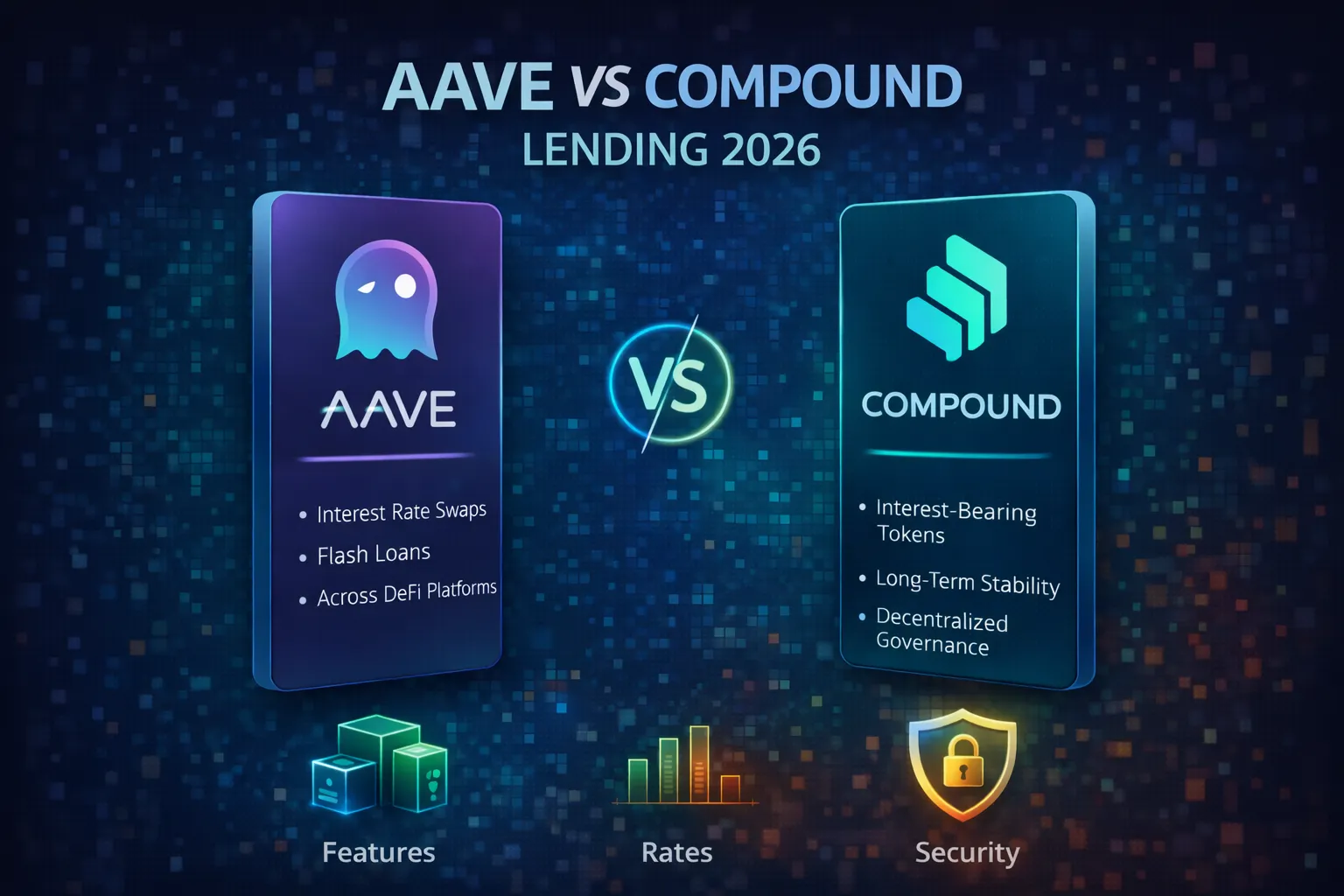
Aave vs Compound: Feature-by-Feature Comparison
Comprehensive Comparison Table
| Feature | Aave | Compound |
|---|---|---|
| Launch Year | 2020 (V1), 2022 (V3) | 2018 (V1), 2022 (V3) |
| Total Value Locked (Aug 2026) | ~$14.5 billion (all versions) | ~$1.2 billion (all versions) |
| Supported Assets | 30+ assets | 15+ assets |
| Cross-Chain Support | Yes (20+ networks: Ethereum, Base, Arbitrum, Avalanche, Polygon, others) | Yes, but shrinking (Ethereum is ~92% of TVL; Scroll, Linea, Mantle, Polygon, Ronin and Unichain deprecated in 2026) |
| Flash Loans | Yes (0.05% fee) | No |
| E-Mode (High Efficiency) | Yes (up to 93% LTV, ETH-correlated) | No (but its WETH market gives LSTs 90% LTV) |
| Isolation Mode | Removed in v3.7 | No |
| Governance Token | AAVE | COMP |
| Token Market Cap (Oct 2026) | ~$2.5B | ~$225M |
| Gas Efficiency (each vendor's claim vs its own V2) | 20-25% savings | 50% savings |
| Beginner-Friendly Rating | 7/10 (moderate complexity) | 8/10 (simpler interface) |
| Security Audits | OpenZeppelin, Trail of Bits, ABDK, Certora | OpenZeppelin, ChainSecurity, Trail of Bits |
| Security Track Record | No protocol exploit; $177M-$236M bad debt from the April 2026 KelpDAO bridge hack | No protocol exploit; ~$88M of oracle-driven liquidations in Nov 2020 and up to 490,000 COMP exposed in Sept 2021 |
| Bug Bounty Programme | Up to $1,000,000 (Immunefi) | Up to $1,000,000 (Immunefi) |
| Variable Interest Rates | Yes (default) | Yes |
| Stable Interest Rates | No (deprecated by governance in 2024) | No |
| Interest Rate Model | Two-slope kinked curve, per-asset parameters | Two-slope kinked curve, per-market parameters |
| Liquidation Penalty | 4.5-6% on majors, 1-4% in E-Mode (normally applied to at most 50% of debt) | 2.5-10% on majors, up to 25% on volatile alts, set per asset per market (applied to the whole position) |
| Max LTV on Major Collateral | 73-80.5% standard (WBTC 73%, USDC 75%, WETH 80.5%); up to 93% in E-Mode | WETH 82.5% in the USDC market and 83% in the USDT market, wstETH 82%, WBTC 80%; up to 90% for LSTs in the WETH market |
| Mobile App | Yes (iOS, Android) | No (web app only; use a mobile wallet browser) |
| Documentation Quality | Excellent (comprehensive) | Excellent (clear and concise) |
| Community Size | Larger (more active) | Smaller (but engaged) |
| Development Activity | Very active (V4 live since March 2026) | Active (V2 deprecated Dec 2025, V4 funded May 2026) |
| Overall Rating | 4.2/5.0 | 4.0/5.0 |
If the table's Aave column feels overwhelming, that is itself a signal: you should probably start with Compound. If LTV ratios, liquidation thresholds and flash loans are already familiar territory, Aave gives you more tools to work with.
How Liquidation Differs, and Why the Penalty Column Misleads
On Aave V3 a position becomes liquidatable once its health factor falls below 1.0, and a liquidator can normally repay at most 50% of the debt in one transaction. That 50% cap applies only whilst the health factor is still above 0.95 and both the collateral and the debt in the pair being liquidated exceed $2,000. Below either line, the entire position can be cleared at once. A partial liquidation must also leave at least $1,000 of collateral and $1,000 of debt behind; if it cannot, the position is closed in full instead.
Compound V3 has no partial step at all, and no close-factor parameter exists on the contract — partial liquidation has been discussed in governance but never shipped. A liquidator calls the absorb function, which takes the whole of the account's collateral in every asset it holds, clears the entire borrow, and credits the borrower the remaining value in the base asset after the liquidation factor has been deducted. The 7% penalty on WETH in the USDC market therefore applies to the whole position rather than to half of it. An identical price shock costs a Compound borrower materially more than a straight comparison of penalty percentages suggests, which is the single most important mechanical difference between the two protocols.
Key Differences Explained
Aave's Advantages:
Aave V3 introduced several features that set it apart from Compound. One that is often misread, Portal, was a bridging mechanism that was never used and was dropped in Aave v3.4. It never let you post collateral on Ethereum and draw a loan on Polygon — to borrow on a given network, your collateral has to sit in that network's market.
E-Mode (High Efficiency Mode) is another Aave exclusive, raising loan-to-value (LTV) ratios when the collateral and the borrowed asset are price-correlated. Governance sets the ceiling per category: on Ethereum V3 the ETH-correlated category runs at 93% LTV with a 95% liquidation threshold and a 1% liquidation penalty, against 80.5% LTV for plain WETH. Only assets inside the same category can be borrowed whilst E-Mode is switched on.
Flash loans remain Aave's signature feature, enabling users to borrow any available amount without collateral, provided the loan is repaid within the same transaction. This functionality powers arbitrage opportunities, collateral swaps, and self-liquidation strategies. Compound does not offer flash loans, limiting advanced use cases.
Isolation Mode was how Aave V3 limited exposure to newly listed or riskier assets, with a debt ceiling per asset and a short list of stablecoins you could borrow against one. Aave v3.7, which the Ethereum pool now runs, removed it along with Siloed Borrowing. v3.7 also lets governance flag an E-Mode category as "isolated", so that only assets inside it count towards borrowing power; two of the 48 Ethereum categories carried the flag when read on 16 October 2026.
Compound's Advantages:
Compound V3 (Comet) was built for gas efficiency, and Compound put the saving against its own V2 at roughly 50%; Aave claimed 20-25% for V3 against Aave V2. Neither figure tells you which protocol is cheaper today, because each is measured against a different baseline, and at the Ethereum base fees seen in August 2026 the residual difference is a fraction of a cent either way.
The simplified architecture of Compound V3 makes it more accessible to beginners. Each market has a single borrowable asset (e.g., the USDC market or the ETH market), reducing complexity and making it easier to understand how the protocol works. Aave's multi-asset borrowing, whilst more flexible, can be overwhelming for newcomers.
COMP governance has the longer history: Compound's 2020 liquidity mining distribution predates Aave's Governance v3. What is actually measurable is the cost of taking part — a Compound proposal needs 25,000 COMP against a 400,000 COMP quorum, whilst Aave asks 80,000 AAVE against a 320,000 AAVE quorum, rising to 1,040,000 AAVE for changes to the token or to governance itself. At August 2026 prices Compound's is the cheaper door. Neither protocol publishes a holder-concentration measure, so treat "more decentralised" as unproven rather than established.
Similarities Between Protocols
Despite their differences, the two share the fundamentals that make either a workable venue:
Overcollateralised Lending Model: Both protocols require you to deposit collateral worth more than your loan amount — typically 120-200% of the borrowed value. If you deposit $10,000 in ETH, the ceiling is around $8,000 in stablecoins (Aave allows 80.5% LTV against WETH, Compound 82.5%), but borrowing anywhere near that leaves no buffer at all. Aave starts liquidating WETH collateral at an 83% loan-to-value ratio, so the gap between the maximum you can draw and the point of liquidation is under three percentage points.
Algorithmic Interest Rates: Both use utilisation-based rate models: when borrowing demand is high, rates increase to attract more lenders; when demand is low, rates decrease to encourage borrowing. You should monitor the utilisation ratio of your supplied asset — if it approaches the kink point (80-94% on Aave's major reserves), rates spike sharply, which benefits you as a lender but increases costs dramatically if you are a borrower.
Security Focus: Both protocols have been audited by OpenZeppelin, Trail of Bits, and other leading firms, and both run Immunefi bug bounties paying up to $1,000,000 for critical findings — enough to attract serious security researchers. Neither protocol's core lending contracts have been broken by an attacker, but both have lost money to what sits around them: Aave absorbed $177M-$236M of bad debt in April 2026 when unbacked rsETH minted through a compromised KelpDAO bridge was used as collateral, and Compound's single DAI price feed triggered roughly $88 million of liquidations in November 2020. If you are depositing a significant portion of your portfolio, splitting between both protocols reduces your exposure to a single smart contract vulnerability.
Cross-Chain Deployment: Both protocols are available on Layer 2 networks, though the gas argument has weakened sharply. With Ethereum base fees measured at around 0.06 gwei on 16 October 2026 against a 60 million block gas limit, a plain Aave supply or borrow on mainnet cost about $0.08 and $0.17 at the median, and Layer 2 transactions cost a fraction of that. Aave V3 is deployed on more than twenty networks, whilst Compound V3 is retreating to Ethereum, which now holds around 92% of its TVL: governance deprecated the Scroll, Linea, Mantle, Polygon, Ronin and Unichain markets during 2026, leaving Arbitrum, Base and Optimism as the live Layer 2 options.
Non-Custodial Architecture: Both are fully decentralised — you maintain control of your private keys at all times. This means no account suspensions and no lender's balance sheet to fail, though governance or a guardian can pause a market, as Compound did for about four and a half hours on its Linea USDC market on 18 September 2026. However, you should understand that non-custodial also means no recovery if you lose your private keys or sign a malicious transaction. Always use a hardware wallet for positions exceeding $5,000.
Active Development: Aave shipped V4 on Ethereum in March 2026 and extended it to Avalanche in July, whilst Compound deprecated V2 in December 2025 and funded a $52 million V4 development programme in May 2026. If you plan to use either protocol for years, follow their governance forums: upgrades can move rate models, collateral parameters and liquidation thresholds under you.
Transparent Operations: Every transaction, rate change and protocol parameter is visible on-chain. Before you deposit, you can read the current utilisation, the rate model parameters and the total supplied and borrowed amounts on Etherscan or each protocol's dashboard. Check those rather than the headline APY on the frontend — what you earn depends on utilisation at the moment you deposit.
Neither protocol can fail as a counterparty the way Celsius and BlockFi did, though either can pause a market. That is not the same as no insolvency risk: April 2026 showed that a protocol can take on bad debt which suppliers ultimately bear, and Aave's WETH deficit was still open in mid-October. The decision comes down to what you need: if you want the simplest possible lending experience with predictable gas costs, use Compound. If you want maximum capital efficiency and are willing to learn E-Mode and flash loan mechanics, use Aave. For risk diversification, you can split your lending capital across both.
Aave vs Compound: Interest Rates Analysis
Current Interest Rates (October 2026)
Interest rates in DeFi lending fluctuate constantly based on supply and demand dynamics. The figures below were read directly from each protocol's contracts on Ethereum mainnet on 16 October 2026. They are base protocol rates only, excluding COMP and Merit incentives, and they move continuously — check the live app before you commit anything.
USDC (USD Coin) Rates:
- Aave V3: 3.81% supply APY, 4.56% variable borrow APY, at 93.2% utilisation
- Compound V3: 5.88% supply APY, 7.03% borrow APY, at 90.8% utilisation
- Analysis: Compound paid lenders about two points more and charged borrowers about 2.5 points more, because its USDC market had just crossed its 90% kink while Aave's sat just below its own at 94%. Past Aave's kink, each further point of borrowing demand adds about 1.7 percentage points to the borrow rate.
ETH (Ethereum) Rates:
- Aave V3: 1.31% supply APY, 1.96% variable borrow APY, at 79.1% utilisation
- Compound V3: 1.48% supply APY, 1.93% borrow APY, at 73.3% utilisation
- Analysis: Close to level for borrowers, while Compound paid lenders slightly more despite lower utilisation, because Comet sets its supply curve separately from its borrow curve rather than passing on a share of borrow interest.
USDT (Tether) Rates:
- Aave V3: 3.34% supply APY, 4.27% variable borrow APY, at 87.3% utilisation
- Compound V3: 7.85% supply APY, 9.26% borrow APY, at 91.4% utilisation
- Analysis: Compound paid more on USDT for both lenders and borrowers on this reading. The idea that Aave is reliably the higher-rate venue does not survive contact with the contracts.
WBTC and DAI — mind the market, not just the rate: Compound V3 does run a WBTC market on Ethereum, but it is tiny: around 13 WBTC supplied on 16 October 2026, paying nothing because none of it was borrowed. WBTC's real role in Comet is as collateral in the USDC, USDT and WETH markets, and collateral in Comet earns no interest at all. There is no DAI market on Compound; it lists a USDS market instead. Aave paid 0.00% on WBTC (borrowing demand was almost nil, at 2.1% utilisation) and 3.45% on DAI on the same reading.
What this means for your deposit: On a $10,000 USDC supply the difference between the two protocols was roughly $10 a year on 4 August 2026 and about $207 a year the other way round on 16 October. Gas is no longer the counterweight it once was — a mainnet Aave supply cost about $0.08 and a borrow about $0.17 at the median on 16 October 2026. What still argues against chasing the gap is that both curves move daily, and the advantage you switch for can be gone within weeks or reverse outright, as USDC and ETH did between those two readings.
Rate Comparison Analysis
Why the Rates Differ:
Neither protocol is reliably the dearer or the cheaper one. The gap on any given asset comes from where that asset sits on its own utilisation curve. What Aave's scale does buy is depth: with roughly $18.2 billion in TVL against Compound's $1.5 billion, a single large borrow moves Aave's rates less, so its pricing tends to be steadier at size even when it is not better.
E-Mode pushes utilisation upwards on correlated assets. When a category permits 93% LTV instead of the 80.5% Aave allows against plain WETH, more capital is actively deployed, which lifts utilisation and therefore the rate lenders earn on those reserves.
Flash loan revenue does not reach lenders. The 0.05% premium on Aave V3 is routed entirely to the DAO treasury rather than shared with suppliers, so it funds governance and reserves instead of lifting your supply APY.
Why Both Curves Spike:
Both protocols price borrowing off a two-slope utilisation curve with a kink, so the claim that one is inherently smoother than the other does not hold. Aave's Ethereum USDC reserve kinks at 94% utilisation with a 10% second slope, which means every point of utilisation above the kink adds about 1.7 percentage points to the borrow rate. USDC on both protocols was sitting close to its kink in mid-October 2026 — precisely the zone where rates move in whole percentage points within a day.
Compound's simpler architecture, with one borrowable asset per market, does make rate behaviour easier to reason about: you track a single utilisation figure per market rather than a dozen reserves. That is a genuine advantage for planning, though it does not make the curve itself any flatter.
Rate Shopping Strategy:
Some users practise rate shopping, moving capital between protocols to capture the best rate. It has real limitations:
- Gas costs mattered far more historically than they do now. On Ethereum mainnet on 16 October 2026 a supply or borrow ran well under a dollar, and on Layer 2 networks it is a fraction of a cent.
- Time value matters. Rates change constantly, so today's advantage might disappear tomorrow. Frequent rebalancing is time-intensive and risky.
- Protocol risk increases with multi-protocol strategies. Using both Aave and Compound doubles your exposure to smart contracts.
For most users the gap is noise: about 0.1 percentage point on USDC in early August 2026, and running the other way on USDT. Choose one protocol on its features and stick with it. Rate-shopping only pays if you are managing six figures and can watch both curves continuously, because the ranking flips as utilisation moves and the operational overhead of monitoring two protocols is constant.
Recommendation: Check both before you deposit rather than assuming one leads. On 4 August 2026 Aave paid more on USDC and ETH whilst Compound paid more on USDT; on the 16 October readings above Compound paid more on all three — the ranking changes by asset and by week.
Aave vs Compound: Security Analysis
Security Audits
Both protocols have been audited repeatedly by the industry's leading firms.
Aave Security Audits:
- OpenZeppelin: Multiple audits across V1, V2 and V3
- Trail of Bits: Vulnerability and attack-vector assessment
- ABDK: Verification of the interest rate and liquidation maths
- Certora: Formal verification of contract correctness
- Ongoing: Fresh reviews with each protocol upgrade
Aave's Immunefi bug bounty offers up to $1,000,000 for critical vulnerabilities, calculated as 10% of the funds directly affected and floored at $50,000, with a proof of concept mandatory on every submission. The listing covers 83 assets across Aave V2 and V3, GHO infrastructure, governance contracts and the safety modules.
Compound Security Audits:
- OpenZeppelin: Audits of V1, V2 and V3 (Comet), reports published
- ChainSecurity: Independent review of economic attack vectors
- Trail of Bits: Multiple smart contract security audits
- Formal Verification: Proofs of critical contract properties
Compound's Immunefi bug bounty also offers up to $1,000,000 for critical vulnerabilities, on the same 10%-of-funds-affected basis with a $50,000 floor, across 255 assets covering both V2 and Compound III. The two programmes are equivalent at the top end, so the old assumption that Aave outbids Compound for researcher attention no longer holds.
Both publish their audit reports openly, so you can verify the claims rather than take them on trust.
Security Track Record
Aave Security History:
Aave's core contracts have never been broken, but the record is no longer spotless. In April 2026 a compromise of the RPC nodes behind KelpDAO's single LayerZero verifier allowed roughly 116,500 rsETH to be minted unbacked and posted as collateral to borrow real WETH. The fault lay in the bridge's verification setup rather than in Aave's code, but Aave carried the loss: published estimates put the bad debt at $177M-$236M, and around $10 billion was withdrawn during the run that followed. Part of it is still outstanding — on 16 October 2026 the V3 Ethereum pool still reported a WETH deficit of about 52,964 WETH, roughly $130 million at that day's ETH price, whilst other reserves were effectively clean.
Aave's backstop has also changed, and the familiar description of it is out of date. The legacy Safety Module now returns a maximum slashable percentage of zero on-chain for stkAAVE, stkGHO and stkABPT, so staked AAVE can no longer be slashed to cover a shortfall. The current backstop is Umbrella, where depositors stake aTokens or GHO into vaults that are burned automatically when a pool's deficit exceeds a per-asset offset. Cover is scoped per asset and per network, no governance vote is required to trigger a slashing, and there is no cap below the full staked amount.
Aave's governance can pause individual markets through emergency procedures, which limits the damage whilst a fix is prepared.
Compound Security History:
Compound has a strong but not perfect record. Its lending contracts have never been drained by an attacker, but the protocol has had serious incidents around them. On 26 November 2020 the price of DAI on Coinbase Pro — then the feed Compound read for that market — spiked above $1.30, and the protocol liquidated roughly $88 million of collateral across 124 accounts, with a single borrower accounting for about half of it. The fault was oracle design rather than lending logic, and for the borrowers hit the losses were emphatically not minimal. Compound III prices collateral through Chainlink feeds rather than one exchange.
In September 2021 a one-character comparison bug in a Comptroller upgrade paid COMP out against a corrupted reward index. Founder Robert Leshner first bounded the exposure at 280,000 COMP, about $80 million, then raised it to 490,000 COMP. It cost protocol-owned tokens rather than user deposits, and some recipients returned them voluntarily.
Two further episodes belong on the same list. An August 2022 V2 oracle upgrade returned an empty price for cETH and froze the largest V2 market for about a week, because the fix had to clear a governance timelock. In July 2024 a delegate bloc pushed a proposal moving roughly 499,000 COMP of DAO funds into its own vault; it passed and was queued before being cancelled, and a proposal guardian was added afterwards. That same month compound.finance was DNS-hijacked to a phishing site, leaving contracts untouched but users at risk if they signed.
No Compound exploit has ever drained user deposits, and that is the defensible version of the safety claim. OpenZeppelin, its security partner since 2021, reported six critical vulnerabilities found in the July 2024 to June 2025 term alone — a more honest anchor than "no hacks".
Overall Security Assessment:
Both protocols are well built and suitable for holding significant capital, and they are closer than the headline audit lists suggest. Aave's greater scale and longer battle-testing count for something, but the April 2026 bad-debt event shows that a protocol can be sound and still lose money to a dependency it did not write. Compound's history says the same thing from the other direction: its worst days came from an oracle, an upgrade and its own governance, not from an attacker breaking the lending code. For most users the difference between the two is small next to the smart contract risk common to both, and next to the risk of the oracles and bridges they rely on.
Aave vs Compound: Which Should You Choose?
Choose Aave If You Need
Advanced Features: Aave is the clear choice if you require flash loans or E-Mode. These features enable sophisticated strategies unavailable on Compound, such as:
- Flash loan arbitrage and collateral swaps
- High-leverage positions on correlated assets (up to 93% LTV with E-Mode)
- Access to newly listed tokens
Maximum Asset Selection: With 30+ supported assets compared to Compound's 15+, Aave offers more diversification options. If you want to lend or borrow less common tokens, Aave likely supports them.
Network Coverage: Aave V3 is deployed on more than twenty networks against Compound V3's ten, six of them deprecated, so if you need a specific chain, Aave is likelier to be there. Note that this is separate market instances rather than one pooled position: you cannot post collateral on one network and borrow on another, and each deployment has its own liquidity and its own parameters.
Competitive but not guaranteed rates: Aave paid more than Compound on USDC and ETH when both were read on 4 August 2026, and less on USDT, with a USDC gap of about 0.1 percentage point; on 16 October Compound paid about 2.1 points more on USDC, roughly $1,035 a year on a $50,000 supply. Check both before depositing rather than assuming Aave leads.
Larger Liquidity Pools: With roughly $18.2 billion in TVL, Aave can accommodate larger positions without significantly impacting rates. If you're managing substantial capital (over $100,000), Aave's deeper liquidity is advantageous.
Active Development: Aave V4 is already live on Ethereum and Avalanche, and V3 continued to receive upgrades through 2026. If you value being at the forefront of DeFi development, Aave is more likely to introduce cutting-edge features — though V4 held only about 4% of the family's TVL as of October 2026, so V3 remains where the liquidity is.
Choose Compound If You Prefer
Simplicity and Ease of Use: Compound's single-borrowable-asset-per-market design means you choose "the USDC market" or "the ETH market" rather than navigating Aave's multi-asset interface. If this is your first DeFi lending experience, you should start with Compound — the reduced complexity lowers your chance of accidentally choosing wrong parameters that could lead to unexpected liquidation.
Gas, in Perspective: Compound put V3's saving against its own V2 at roughly 50%, and Aave claimed 20-25% for V3 against Aave V2 — different baselines, so neither number tells you which protocol is cheaper today. With Ethereum base fees around 0.06 gwei on 16 October 2026, both cost cents per transaction on mainnet and less on Layer 2. Gas is a tiebreaker at most now; the difference in how each one liquidates matters far more to a borrower.
Fewer Parameters to Track: With one borrowable asset per market, you monitor a single utilisation figure rather than a dozen reserves, which makes it easier to plan a long-term position. The underlying rate curve is just as steep above its kink as Aave's, so this is clarity rather than genuine rate stability.
A Lower Bar to Participate: Compound's governance has run since 2020, and its thresholds are the more accessible ones — 25,000 COMP to put a proposal on-chain and a 400,000 COMP quorum to pass it, against Aave's 80,000 AAVE and 320,000 AAVE. If you want to vote on the rate parameters that set your yield, that is a materially cheaper stake to build. It is not evidence that COMP holdings are less concentrated; neither protocol publishes that.
Conservative Approach: Compound ships fewer features than Aave, which means fewer parameters to get wrong and a smaller attack surface. If you prioritise a simple mental model over cutting-edge functionality, that restraint is the real product.
Conclusion: Aave vs Compound Winner
If you have read this entire comparison and still cannot decide, here is a simple rule: use Compound if you want one borrowable asset per market and a smaller set of parameters to track, and use Aave if you need flash loans, E-Mode, or the depth that comes with roughly twelve times the TVL. Position size no longer settles it the way it once did, because gas costs cents on both. What should settle it is which liquidation model you are comfortable with — Aave's partial close factor or Compound's all-at-once absorb.

Aave wins for:
- Advanced users seeking maximum features and flexibility
- Large allocations where pool depth matters more than a rate tick
- Users requiring flash loans or E-Mode functionality
- Those who value innovation and cutting-edge DeFi features
- Borrowers above roughly $2,000 per collateral and debt pair, where Aave normally closes at most half the position
Compound wins for:
- Beginners prioritising simplicity and ease of use
- Lending a single asset in one market rather than juggling a multi-asset position
- Users who want fewer parameters to monitor per position
- Those preferring conservative, proven approaches
- Governance participants, who face a lower proposal and quorum threshold
The split-protocol strategy is worth considering once a position is large enough to be worth the attention it costs. Splitting across both gives you smart contract risk diversification — if one protocol suffers an exploit, only half your capital is affected. The real price of splitting is no longer gas but attention: two positions to watch — Aave shows a health factor, whilst Compound simply flags whether the account has become liquidatable — on two liquidation models that behave differently under the same price shock. Do not split unless you will actually monitor both.
Both protocols have survived multiple market cycles, bear markets, and security challenges without their core contracts being broken, though Aave's April 2026 bad debt and Compound's 2020 oracle liquidations show that surviving the code is not the same as surviving the dependencies around it. If you are choosing your first DeFi lending platform, pick the one whose interface feels more intuitive to you — try both on testnets first. Your first priority should be understanding liquidation mechanics and health factor monitoring, not chasing the highest rate.
Next Steps:
- Read the full Aave review for detailed protocol analysis
- Read the full Compound review for a feature breakdown
- Try both on testnets before committing real funds
- Start small to familiarise yourself with each interface
- Consider Layer 2 (Arbitrum, Base) for lower costs on both
Sources & References
- Aave Documentation - Official technical documentation covering V3 features, interest rate models, and security
- Aave V3 Ethereum Pool contract - Source of the Aave rates, LTVs, bonuses and WETH deficit
- Compound USDC Comet contract - Source of the Compound collateral factors and utilisation
- Aave Umbrella documentation - How the current backstop stakes and slashes aTokens
- Immunefi: Aave bug bounty - Payout tiers and assets in scope
- Immunefi: Compound bug bounty - Payout tiers and assets in scope
- CoinDesk: Aave losses after the KelpDAO bridge exploit - Reporting behind the April 2026 bad-debt range
- The Block: DAI price spike liquidated $88 million on Compound - The November 2020 price-feed incident
- Compound Documentation - Comprehensive guide to Compound V3 (Comet) architecture and functionality
- DeFi Llama - Real-time TVL data and protocol analytics for both Aave and Compound
- DeFi Rate - Historical and current interest rate comparisons across DeFi lending protocols
- Aave V3 Origin repository - In-depth technical specifications and smart contract code
- Compound V3 (Comet) Whitepaper - Technical architecture and design decisions
- DeFi Lending Complete Guide 2026 - Comprehensive overview of DeFi lending fundamentals
- Aave Protocol Review 2026 - Detailed analysis of Aave V3 features, security, and performance
- Compound Protocol Review 2026 - In-depth review of Compound V3 (Comet) and governance
- Overcollateralised vs Undercollateralised Lending - Understanding collateral requirements in DeFi
- DeFi Interest Rate Models Explained - How algorithmic rates work on Aave and Compound
- DeFi Lending Risks Management 2026 - Comprehensive risk analysis and mitigation strategies
Disclaimer: This comparison is for educational purposes only and does not constitute financial advice. Cryptocurrency lending involves significant risk. Always conduct your own research and consult with qualified financial advisors before making investment decisions.
Frequently Asked Questions About Aave vs Compound
- Which is better: Aave or Compound?
- Neither protocol is objectively "better"—the optimal choice depends on your specific needs. Aave offers more features and roughly twelve times the TVL, making it suited to experienced users and larger positions. Compound provides simplicity and one borrowable asset per market, making it better for beginners. Neither protocol reliably leads on rates: on 4 August 2026 Aave paid lenders more on USDC and ETH whilst Compound paid more on USDT, and on 16 October 2026 Compound paid more on all three. The bigger difference is liquidation, where Aave normally takes at most half the debt and Compound takes the whole position at once.
- Which protocol has higher interest rates?
- Neither does consistently. Read from the contracts on 4 August 2026, Aave V3 paid 3.36% supply APY on USDC against Compound V3's 3.26%, but Compound paid 3.18% on USDT against Aave's 2.75%; on 16 October 2026, with Compound's stablecoin markets just past their kink, Compound paid 5.88% on USDC against 3.81%, 7.85% on USDT against 3.34% and 1.48% on ETH against 1.31%. Rates on both protocols are driven by utilisation against a kinked curve and can move by whole percentage points in a day when a market sits near its kink. Check current rates on both platforms before making decisions.
- Which protocol is safer?
- Both are well audited and neither protocol's core contracts have been broken. Aave's record is not spotless, though: in April 2026 a compromised KelpDAO bridge allowed unbacked rsETH to be posted as collateral, leaving Aave with an estimated $177M-$236M of bad debt, and a WETH deficit of roughly 52,964 WETH was still outstanding on 16 October 2026. Compound has not been exploited either, but its November 2020 DAI price-feed failure liquidated roughly $88 million of collateral across 124 borrower accounts, and a September 2021 reward bug misallocated COMP worth tens of millions. Both run Immunefi bug bounties paying up to $1,000,000 for critical findings. The gap between them is small next to the smart contract, oracle and bridge risk common to both, and diversifying across both reduces single-protocol exposure.
- Which protocol is easier for beginners?
- Compound is generally considered more beginner-friendly due to its simpler interface and streamlined architecture. The single-borrowable-asset-per-market model reduces complexity, making it easier to understand how the protocol works. Compound documentation is also more concise and easier for newcomers to understand. Aave's additional features (flash loans, E-Mode) add complexity that can overwhelm beginners. However, Aave's mobile app — Compound has no first-party app and is used through a browser — and its improved V3 interface have narrowed this gap. If you're completely new to DeFi lending, start with Compound to learn the basics, then explore Aave's advanced features as you gain experience.
- Can I use both Aave and Compound simultaneously?
- Yes, and many experienced DeFi users do exactly this. Running both diversifies smart contract risk, gives you each platform's features, and lets you take the better rate asset by asset. The cost is no longer gas — a mainnet supply or borrow ran well under a dollar on 16 October 2026 — it is attention. You are watching two positions under two different liquidation models: Aave publishes a health factor and normally closes at most half your debt, whilst Compound simply flags the account as liquidatable and then seizes all of the collateral at once. Split only if you will genuinely monitor both.
← Back to Crypto Platform Comparisons
Financial Disclaimer
This content is not financial advice. All information provided is for educational purposes only. Cryptocurrency investments carry significant investment risk, and past performance does not guarantee future results. Always do your own research and consult a qualified financial advisor before making investment decisions.