DeFi Lending Security Best Practices
Why Security is Critical in DeFi Lending
Over $3 billion was lost to DeFi exploits in 2023. Euler Finance lost $197M in a flash loan attack (March 2023). Mango Markets was drained of $114M through oracle manipulation (October 2022). These were not obscure protocols — they had audits, TVL in the hundreds of millions, and active communities. The common thread: exploitable smart contract logic that passed initial review.
Unlike traditional banks with deposit insurance and customer support hotlines, DeFi lending operates in a trustless environment where you bear full responsibility for protecting your capital. A single malicious token approval, a phishing link in a Discord DM, or an overlooked health factor can result in permanent, irreversible loss.
The security landscape has improved meaningfully since those events. Aave V3 and Compound V3 have each undergone six or more independent audits, maintain active bug bounties ($250K and $150K for critical issues respectively), and have processed hundreds of billions in cumulative volume without major exploits. Monitoring tools like DeFi Saver and Pocket Universe make it practical to automate position protection and simulate transactions before signing.
This guide covers the specific security practices that separate users who participate safely in DeFi lending from those who suffer avoidable losses. Rather than generic advice like "audit your contracts," each section provides concrete verification steps — where to check audit reports, what health factor numbers to target, which monitoring tools to configure, and how real phishing attacks have actually worked in practice.
Whether you are lending stablecoins on Aave V3 to earn 3-5% APY, borrowing against ETH on Compound to access liquidity without selling, or evaluating a newer protocol with attractive rates, the security framework below applies. The specific numbers and thresholds (health factor targets, approval amounts, monitoring intervals) reflect current protocol parameters and market conditions as of early 2026.
What this guide covers:
- Smart contract risk assessment — where to verify audits on DefiLlama, how to check deployed contract versions on Etherscan, and what a quality audit report looks like versus an audit-mill product
- Wallet security beyond the basics — hardware wallet integration with DeFi, seed phrase storage methods, token approval hygiene, and multi-signature setups for larger positions
- Protocol selection criteria with concrete red flags, a tier list of battle-tested protocols, and practical steps to evaluate any new protocol before depositing
- Liquidation mechanics — worked examples with health factor calculations, monitoring tool configuration for DeFi Saver and Zerion, and automated protection strategies
- Real phishing attack patterns with documented examples (Curve DNS hijack, BadgerDAO frontend exploit) and step-by-step defence measures
- A complete security checklist you can work through systematically before depositing into any lending protocol
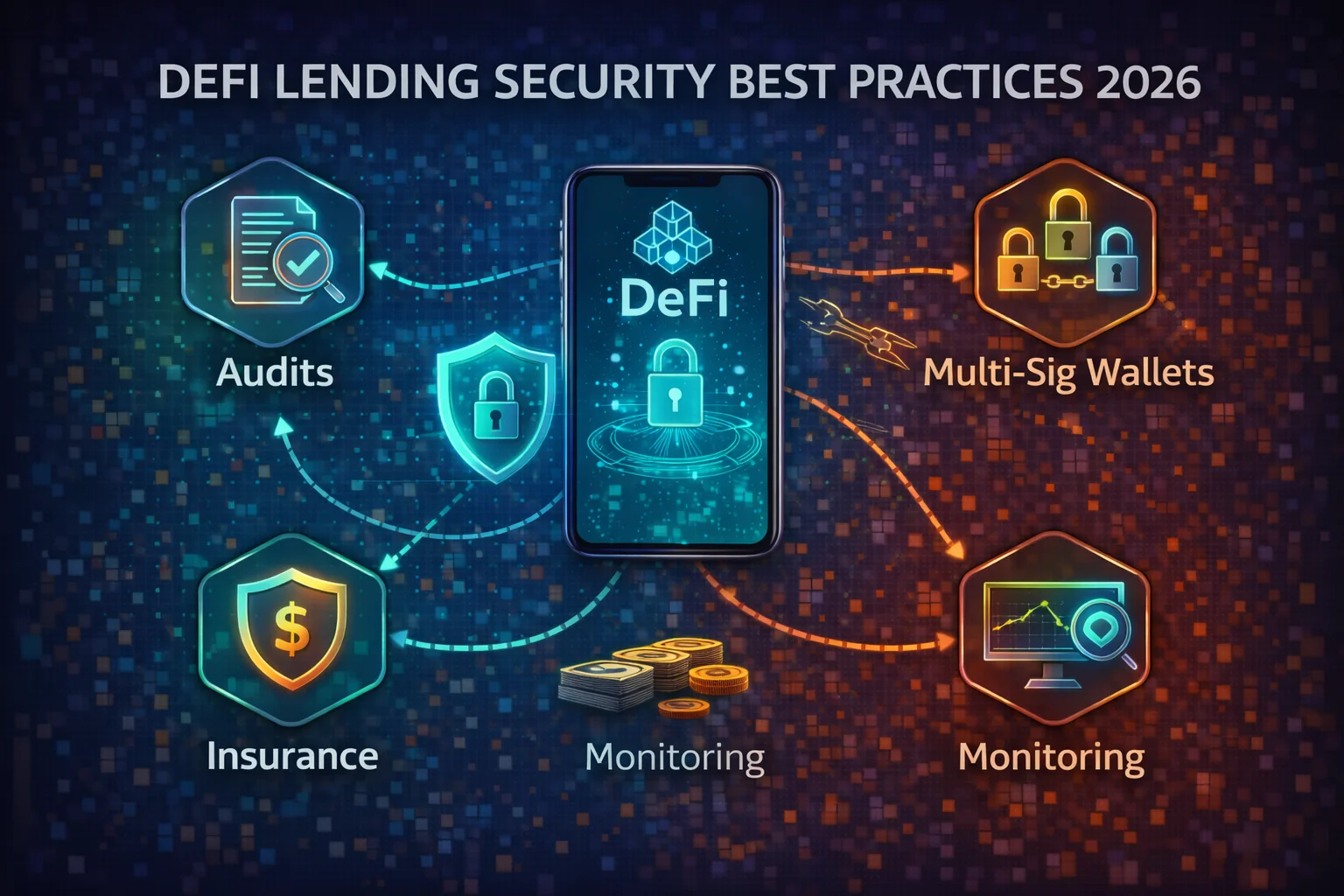
Understanding Smart Contract Risks
Every DeFi lending interaction runs through smart contracts — code that holds your funds, calculates your interest, and enforces liquidation rules. If that code has a vulnerability, your deposit is at risk regardless of how carefully you manage your wallet. Before depositing into any protocol, you need to understand the types of vulnerabilities that have caused real losses and how to check whether a protocol has addressed them.
Common Smart Contract Vulnerabilities
DeFi lending protocols face several categories of smart contract vulnerabilities. These are not theoretical — each has caused significant real-world losses:
- Reentrancy attacks: A malicious contract repeatedly calls a lending function before the protocol updates its internal state, draining funds in a loop. The Curve/Vyper exploit (July 2023, ~$70M lost) used a compiler-level reentrancy bug that bypassed standard guards. Modern protocols implement reentrancy locks, but compiler or integration-level bugs can still bypass them.
- Oracle manipulation: Attackers manipulate price feeds to inflate collateral values or trigger incorrect liquidations. Mango Markets lost $114M in October 2022 when an attacker used thin liquidity to pump MNGO's oracle price, then borrowed against the inflated collateral. Protocols using Chainlink or TWAP oracles with multiple sources are more resistant.
- Flash loan attacks: Euler Finance lost $197M in March 2023 through a flash loan exploit that manipulated the protocol's donate-and-liquidate logic. The attacker borrowed without adequate collateral and extracted funds within a single transaction block. Euler had been audited six times — the vulnerability was in interaction logic between functions, not individual functions.
- Access control issues: Vulnerabilities where unauthorised callers can invoke admin functions. Proper role-based access control, multi-sig requirements, and timelock delays (24-48 hours) on parameter changes are essential defences.
- Integer overflow/underflow: Mathematical errors in collateral ratio or interest calculations. Solidity 0.8.0+ includes built-in overflow protection, but protocols using older compiler versions or custom math libraries remain exposed.
2026 threat landscape (as of mid-2026): April 2026 became the worst month in DeFi history — DefiLlama tracked more than 30 separate attacks netting attackers ~$635M in a single month, dominated by the KelpDAO restaking exploit (~$293M) and the Drift Protocol incident (~$285M). Cumulative DeFi hack losses crossed $840M across 50+ incidents by end of May 2026, and the trend continued into June (Verus-Ethereum bridge on 18 May; Superfortune/$GUA token misdirection on 27 May). Lazarus-affiliated North Korean actors are credibly tied to roughly three-quarters of these losses, including KelpDAO and Drift. The takeaway for lenders: audited, mature, multi-chain-tested protocols (Aave, Compound, Morpho) are not immune, but the heaviest 2026 losses concentrate in newer restaking/derivatives venues with less battle-tested codebases — favour protocols with multi-year on-chain track records, ongoing bug bounties, and timelock-gated upgrades.
The Importance of Security Audits
Professional security audits are the primary defence against smart contract vulnerabilities, but "we have been audited" alone means little. Here is how to verify audit quality yourself:
How to check a protocol's audit status:
- Go to defillama.com, search for the protocol, and check the "Audits" tab — it lists audit firms, dates, and links to full reports
- Read the audit report summary (not just the headline). Look for how many critical/high-severity findings were reported and whether all were resolved before deployment
- Check whether the audited contract version matches what is currently deployed — verify on Etherscan by comparing the deployed bytecode hash against the audited commit
- Look for multiple auditors (2-3 minimum). A single audit from even a reputable firm misses vulnerabilities that cross-auditor review catches
Reputable audit firms (2026): Trail of Bits, OpenZeppelin, Consensys Diligence, ChainSecurity, Sigma Prime, ABDK, and Certora (formal verification). Be cautious with audit-mill firms that produce reports in days rather than weeks — thorough audits of lending protocols typically take 4-8 weeks.
Aave V3 has been audited by Trail of Bits, OpenZeppelin, ABDK, Certora, and Sigma Prime, with all critical and high-severity findings resolved before deployment. The Aave V4 release (30 March 2026) went one step further — four audit firms, four independent security experts, and a 900+ participant public contest across a 345-day review window. Compound V3 underwent auditing from OpenZeppelin and ChainSecurity. Despite all of this, remember that Euler Finance had six audits before its $197M exploit, and KelpDAO/Drift in April 2026 collectively lost ~$578M despite extensive code reviews — audits reduce risk but do not eliminate it.
Bug Bounty Programmes
Leading protocols maintain substantial bug bounty programmes to incentivise white-hat hackers to discover and responsibly disclose vulnerabilities:
- Aave: Up to $250,000 for critical vulnerabilities through Immunefi
- Compound: Up to $150,000 for critical bugs
- Sky (formerly MakerDAO): Up to $10 million for critical vulnerabilities
Before you deposit, check whether your chosen protocol runs an active bug bounty. Go to immunefi.com and search for the protocol name. If the bounty is listed and has paid out rewards, that signals genuine commitment. If there is no bounty or it has been inactive for months, treat that as a yellow flag — the protocol may not be investing in ongoing security.
Open Source Code and Verification
You should always verify that the protocol's code is open source and that the deployed contracts match the audited version. Here is how to check:
- Check the GitHub repository: Search for the protocol on GitHub. You should find complete source code with recent commit activity. If the repo is archived or has not been updated in months, that is a warning sign.
- Verify on Etherscan: Find the protocol's main contract address (listed in their documentation), search it on Etherscan, and confirm the "Contract" tab shows a green checkmark for "Verified." If it does not, do not deposit.
- Read the technical documentation: Look for clear explanations of how interest rates are calculated, how liquidations work, and what admin keys can do. Vague or missing documentation suggests rushed development.
- Review test coverage: Well-maintained protocols publish test suites that cover edge cases. You can check test coverage reports in the GitHub repository's CI pipeline.
If a protocol's contracts are not verified on Etherscan, do not deposit your funds. Unverified code means you cannot confirm what the contract actually does with your tokens. This is a hard rule — no exceptions regardless of how attractive the yield looks.
Wallet Security Fundamentals
Every DeFi position you hold — Aave deposits, Compound borrows, Curve LP tokens — is controlled by a single private key. If someone obtains that key, they drain everything in one transaction. There is no "forgot password" link, no fraud team to call, no chargeback. In March 2024, a single compromised MetaMask browser extension drained $4.2M from a DeFi power user who had approved unlimited token allowances across 15 protocols. The attacker needed just one key to access all of them. Your wallet security directly determines whether your DeFi lending experience ends in steady yield or total loss.
Hardware Wallets: The Gold Standard
If you plan to deposit more than $1,000 into any lending protocol, a hardware wallet is not optional — it is essential. Hardware wallets store your private keys on a dedicated chip that never exposes them to your computer or browser. Every transaction requires physical button confirmation on the device itself.
Recommended Hardware Wallets (2026):
- Ledger Nano X: Supports 15,000+ cryptocurrencies, Bluetooth connectivity, Ledger Wallet integration for DeFi. Secure Element chip (CC EAL5+) protects private keys.
- Trezor Model T: Open-source firmware, touchscreen interface, Shamir Backup for seed phrase splitting. No Secure Element, but fully auditable code.
- Tangem Wallet: Card-format hardware wallet with NFC, multiple backup cards, simple user experience. EAL6+ certified chip.
To use your hardware wallet with DeFi lending, connect it to MetaMask via the "Hardware Wallet" option in account settings, or use WalletConnect to link directly. You will see transaction details on your device screen before confirming. If the details do not match what your browser shows, reject the transaction — your computer may be compromised.
Seed Phrase Protection
Your seed phrase is the master key to every asset in your wallet. If someone photographs it, reads it off your screen, or finds it in a cloud backup, they can recreate your wallet on their own device and transfer everything out. Treat your seed phrase with the same security you would apply to the deed to your house.
Critical Seed Phrase Rules:
- Never store digitally: Do not photograph your seed phrase, save it in cloud storage, paste it into a password manager, or store it in an encrypted file. Any digital copy can be exfiltrated by malware or data breaches.
- Use physical backups: Write your seed phrase on paper and store it in a fireproof safe. For added durability, use a metal backup solution (Cryptosteel, Billfodl) that withstands fire and water damage.
- Store in multiple locations: Keep copies in two separate secure locations (e.g., home safe and a bank safety deposit box). This protects you if one location is destroyed by fire or burglary.
- Consider Shamir backup: If you use a Trezor, you can split your seed into multiple shares using Shamir's Secret Sharing. You might require 3 of 5 shares to recover — meaning no single stolen share compromises your wallet.
- Never share with anyone: No legitimate DeFi protocol, exchange, or support team will ever ask for your seed phrase. If anyone requests it, they are attempting to steal your funds.
Hot Wallet Security
You may want to keep a hot wallet (MetaMask, Trust Wallet) for day-to-day DeFi interactions while storing the bulk of your funds on a hardware wallet. If you do use a hot wallet for lending, follow these rules to limit your exposure:
- Separate wallets by purpose: Keep your main DeFi lending capital on a hardware wallet. Use a hot wallet only for small, active positions — if the hot wallet gets compromised, your strategic capital stays safe.
- Dedicated DeFi browser: Run your DeFi interactions in a separate browser profile with only MetaMask installed. This reduces your attack surface from malicious extensions or compromised browsing history.
- Sweep earnings regularly: Transfer accumulated yield from your hot wallet to your hardware wallet weekly. Do not let interest pile up in a less-secure wallet.
- Revoke stale approvals: Visit revoke.cash monthly. Revoke token approvals for any protocol you no longer actively use. Each outstanding approval is a potential drain vector if that protocol's contract is later exploited.
Multi-Signature Wallets
If you manage more than $50,000 in DeFi lending positions, consider a multi-signature wallet. Multi-sig requires multiple parties (or multiple devices you control) to approve each transaction, adding a layer that protects against single-point compromises:
- Gnosis Safe: Industry-standard multi-sig wallet supporting Ethereum and multiple chains. Requires M-of-N signatures (e.g., 2-of-3, 3-of-5).
- Use Cases: Treasury management, shared funds, additional security layer for large positions.
- Setup: Distribute signing keys across multiple hardware wallets and trusted parties.
How to Select Safe DeFi Lending Protocols
Not all DeFi lending protocols are created equal. Selecting protocols with strong security track records, proper audits, and proven resilience significantly reduces your risk exposure. The difference between a well-vetted protocol and a hastily launched fork can be the difference between earning steady yield and losing your entire deposit to an exploit that a proper audit would have caught.
Protocol Evaluation Criteria
Before you deposit funds into any protocol, run through these evaluation criteria. Each factor has a direct bearing on whether your funds are safe:
1. Track Record and Age:
- Time in Operation: Protocols operating for 2+ years have survived multiple market cycles and potential exploits. Aave (launched 2020) and Compound (launched 2018) have extensive track records.
- Total Value Locked (TVL): Higher TVL indicates market confidence and provides economic security. Protocols with $1B+ TVL attract more security attention and have more to lose from exploits.
- Exploit History: Research whether protocols have suffered exploits and how they responded. Transparent incident response and user compensation demonstrate commitment to security.
2. Security Audits:
- Multiple Audits: Protocols should have audits from at least 2-3 reputable firms
- Recent Audits: Audits should be recent (within 12 months) and cover current contract versions
- Audit Reports: Full audit reports should be publicly available with all issues addressed
- Ongoing Audits: Best protocols undergo audits after every significant upgrade
3. Bug Bounty Programmes:
- Active Programme: Substantial bug bounties ($100K+ for critical issues) through platforms like Immunefi or HackerOne
- Disclosure History: Review disclosed vulnerabilities and how quickly they were patched
- Payout History: Verify that bounties are actually paid to researchers
4. Governance and Decentralisation:
- Decentralised Governance: Token-based governance reduces single points of failure
- Timelock Contracts: Protocol upgrades should have timelocks (24-48 hours), allowing users to exit before changes take effect
- Multi-Sig Controls: Admin functions should require multi-signature approval
- Transparent Governance: All governance proposals and votes should be publicly visible
Security Red Flags to Avoid
If you spot any of these characteristics during your evaluation, either avoid the protocol entirely or limit your exposure to an amount you can afford to lose completely:
- Anonymous teams: If you cannot find the team's identities through LinkedIn, conference talks, or doxxed profiles, your funds have less accountability protection. Prefer protocols where you can verify who built them.
- No audits or unknown auditors: If a protocol has no audit reports or only reports from firms you have never heard of, do not risk your capital. Check defillama.com for the protocol's audit status before depositing.
- Closed source code: If the contract code is not verified on Etherscan, you cannot confirm what happens to your tokens after you deposit. Walk away.
- Unrealistic Yields: If a lending protocol offers 20%+ APY on stablecoins when Aave pays 3-5%, ask where the extra yield originates. Usually it comes from unsustainable token emissions or hidden smart contract risk.
- Frequent unannounced changes: If a protocol upgrades contracts or changes parameters without governance votes or public announcements, your position terms can change without your knowledge.
- Sparse documentation: If you cannot find clear explanations of how the protocol calculates interest, manages collateral, and handles liquidations, the development team likely cut corners elsewhere too.
- Low TVL and thin liquidity: Protocols with under $50M TVL can face bank-run dynamics where early withdrawers get out while later users find the pool drained. Check DefiLlama for current TVL before you deposit.
Recommended Protocols
If you want to minimise your risk while still earning yield, start with these protocols. Each has survived multiple market crashes, processed billions in volume, and maintained security through years of operation:
Tier 1 (Highest Security):
- Aave V3: $8B+ TVL, 6+ security audits, 5+ years operational, extensive bug bounty programme. Multiple chain deployment with unified liquidity.
- Compound V3: $3B+ TVL, multiple audits from OpenZeppelin and ChainSecurity, 6+ years operational, proven governance model.
- Sky: $5B+ TVL, longest-running DeFi protocol (2017), extensive audits, $10M bug bounty, battle-tested through multiple market crashes.
For detailed analysis of these protocols' security features, see our comprehensive reviews of Aave and Compound.
Liquidation Protection and Monitoring
Liquidation is one of the most common — and most preventable — ways to lose money in DeFi lending. When your collateral value drops below the protocol's threshold, a liquidator repays part of your debt and seizes your collateral at a discount. You lose 10-20% of the liquidated amount. With proper monitoring and conservative ratios, you can avoid this entirely.
Understanding Liquidation Mechanics
When you borrow against collateral in DeFi lending, your position has a health factor that must remain above 1.0. Here is how it works with a concrete example:
Health Factor Calculation:
Health Factor = (Collateral Value x Liquidation Threshold) / Total Borrowed Value
Example: You deposit $10,000 of ETH on Aave V3 (liquidation threshold: 82.5%) and borrow $4,000 USDC. Your health factor = ($10,000 x 0.825) / $4,000 = 2.06. If ETH drops 40% to $6,000, your health factor becomes ($6,000 x 0.825) / $4,000 = 1.24 — still safe but approaching the warning zone.
- Safe zone (HF > 2.0): Your collateral can absorb a 40-50% price drop before liquidation. Target this for volatile collateral like ETH or BTC
- Warning zone (HF 1.2-2.0): Monitor daily. Set DeFi Saver alerts at 1.5 and consider adding collateral or repaying debt
- Danger zone (HF 1.0-1.2): Liquidation is imminent. Act within hours, not days
- Liquidated (HF < 1.0): Liquidators repay part of your debt and seize collateral at a discount
Liquidation Penalties (the cost of getting liquidated):
- Aave V3: 5% penalty for stablecoins, 10% for ETH/BTC, up to 15% for smaller-cap assets. A $10,000 ETH liquidation at 10% penalty means you lose $1,000 plus gas fees
- Compound V3: 8% liquidation incentive with a 50% close factor (liquidators can repay up to half your debt per transaction)
- Total impact: Between the penalty, gas costs, and price slippage during volatile markets, a liquidation event typically costs 10-20% of the liquidated collateral
Monitoring Tools and Alerts
Do not rely on manually checking your positions. Set up automated alerts so you receive a notification the moment your health factor drops into the warning zone. Here are the tools to configure:
Recommended Monitoring Tools:
- DeFi Saver: Automated liquidation protection with smart wallet integration. Set target collateral ratios and automatic collateral top-ups or debt repayments.
- Instadapp: Position management dashboard with safety margin monitoring and one-click adjustments.
- Zerion: Portfolio tracker with liquidation alerts and position health monitoring across multiple protocols.
- Zapper: DeFi dashboard showing all positions with collateral ratios and liquidation prices.
- DeBank: Comprehensive DeFi portfolio tracker with mobile app notifications.
Configure your alerts like this:
- Set your first alert at health factor 1.5 — this gives you time to add collateral or repay debt before the situation becomes urgent
- Set a critical alert at health factor 1.2 — if you receive this, act within hours, not days
- Enable notifications on at least two channels (email plus Telegram or mobile push) so you do not miss an alert if one channel fails
- Test your alerts monthly by checking that notifications actually arrive on your devices
Liquidation Protection Strategies
Monitoring alerts tell you when danger approaches. These strategies help you avoid reaching that point in the first place:
1. Conservative Collateral Ratios:
- Maintain collateral ratio > 2.0 for volatile collateral (ETH, BTC)
- Borrow maximum 50% of available credit (not 80-90%)
- Leave buffer for 30-50% collateral price drops
2. Stablecoin Collateral:
- Use stablecoins (USDC, DAI) as collateral when possible
- Stablecoin collateral eliminates price volatility risk
- Lower yields but significantly safer
3. Automated Protection:
- DeFi Saver Automation: Automatically add collateral or repay debt when position health drops
- Instadapp Automation: Set up automated position management rules
- Cost: Small gas fees for automation but prevents liquidation losses
4. Emergency Funds:
- Keep emergency funds (10-20% of position) in stablecoins
- Ready to add collateral or repay debt quickly
- Store in hot wallet for immediate access
5. Diversified Collateral:
- Use multiple assets as collateral to reduce correlation risk
- Combine volatile (ETH) and stable (USDC) collateral
- Spread positions across multiple protocols
For detailed strategies on managing liquidation risk, see our guide on DeFi Lending Risk Management.
Phishing Attacks and Common Scams
More DeFi users lose funds to phishing than to smart contract exploits. Protocol hacks make headlines, but the day-to-day threat is a fake website, a malicious token approval, or a Discord scam that tricks you into signing a transaction you did not intend. The good news: phishing is almost entirely preventable if you follow consistent verification habits.
Common Phishing Techniques
Attackers use increasingly sophisticated techniques to steal credentials, seed phrases, and private keys:
1. Fake Websites and Domains:
- Typosquatting: Domains with slight misspellings (aavve.com instead of aave.com, compound.finance with Cyrillic 'o' instead of Latin 'o')
- Homograph Attacks: Using Unicode characters that look identical to Latin letters (e.g., Cyrillic 'a' in place of Latin 'a' in aave.com)
- Subdomain Tricks: Legitimate-looking subdomains (aave.com.phishing-site.com)
- HTTPS Deception: Phishing sites often have valid SSL certificates, making them appear legitimate
Protection: Always bookmark official protocol websites and access them only through bookmarks. Verify URLs character-by-character before connecting wallets. Use browser extensions like MetaMask's phishing detector.
2. Malicious Smart Contract Approvals:
- Unlimited Approvals: Malicious dApps request unlimited token approvals, allowing them to drain your wallet later
- Hidden Functions: Smart contracts with hidden functions that transfer tokens without user knowledge
- Fake Airdrops: Scam tokens appearing in your wallet, with websites claiming you need to "claim" them by approving contracts
Protection: Review all token approvals carefully. Use tools like revoke.cash to audit and revoke unnecessary approvals. Never approve contracts from unknown sources. Set limited approvals when possible (approve only the amount you're depositing, not unlimited).
3. Social Media Scams:
- Impersonation Accounts: Fake accounts on X (formerly Twitter) impersonating protocol teams, offering "support" or "exclusive opportunities"
- Discord/Telegram Scams: Fake admin accounts in official channels, direct messaging users with "urgent security updates"
- Giveaway Scams: Fake giveaways requiring you to "verify" your wallet by entering seed phrases or sending funds
- Fake Support: Scammers posing as customer support, asking for seed phrases or private keys
Protection: Never respond to unsolicited direct messages. Verify accounts through official protocol websites. Remember: legitimate teams never ask for seed phrases, private keys, or funds. Enable 2FA on all social media accounts.
4. Malicious Browser Extensions:
- Fake Wallet Extensions: Malicious browser extensions mimicking MetaMask or other wallets
- Clipboard Hijacking: Extensions that replace copied wallet addresses with attacker addresses
- Transaction Manipulation: Extensions that modify transaction details before signing
Protection: Only install extensions from official sources (Chrome Web Store, Firefox Add-ons). Verify extension publishers and review counts. Regularly audit installed extensions and remove unnecessary ones. Use dedicated browsers for DeFi interactions.
Transaction Verification Best Practices
Before you confirm any transaction, verify these details on your hardware wallet screen (not just your browser). Malware can alter what your browser displays while the actual transaction does something different:
- Recipient Address: Verify the full address character-by-character, not just first/last characters
- Transaction Amount: Confirm exact amounts match your intentions
- Contract Interactions: Understand what functions you're calling (deposit, withdraw, approve, etc.)
- Gas Fees: Unusually high gas fees may indicate malicious contracts
- Token Approvals: Review approval amounts and spender addresses carefully
Your hardware wallet screen shows the actual transaction data being signed. If the address or amount on the device screen does not match what your browser displays, reject the transaction immediately — your browser may be compromised.
Emergency Response Procedures
If you notice unauthorised transactions, unexpected token approvals, or any sign that your wallet may be compromised, act within minutes. Every second of delay gives an attacker more time to drain your remaining assets:
Immediate Actions (within minutes):
- Transfer Funds: Immediately transfer all assets to a new, secure wallet
- Revoke Approvals: Use revoke.cash to revoke all token approvals from the compromised wallet
- Document Everything: Take screenshots of transactions, addresses, and any suspicious activity
- Disconnect Wallet: Disconnect the compromised wallet from all dApps
Follow-up Actions (within hours):
- Create New Wallet: Generate a completely new wallet with a new seed phrase (never reuse compromised seed phrases)
- Secure New Wallet: Use hardware wallet for the new wallet if possible
- Report Incident: Report to protocol teams, blockchain explorers (Etherscan), and relevant authorities
- Analyse Attack: Determine how the compromise occurred to prevent future incidents
- Update Security: Change passwords, enable 2FA, scan for malware, review browser extensions
Prevention saves you from this scenario entirely. Most successful phishing attacks exploit a single moment of inattention — clicking a link without verifying the URL, approving a transaction without reading the details, or trusting a Discord DM without checking the sender. Build verification into every DeFi interaction as a non-negotiable habit.
Real-World Phishing Examples
These are not hypothetical — each pattern has resulted in documented fund losses:
- Curve DNS hijack (August 2022): Attackers compromised Curve's domain registrar and redirected curve.fi to a phishing contract. Users who approved token transfers on the fake site lost funds. Lesson: bookmark protocol URLs and verify the SSL certificate before every wallet connection
- Uniswap airdrop phishing (July 2022): A fake "Uniswap V3 LP airdrop" token appeared in 73,000+ wallets. The claim site requested unlimited token approval, then drained approved assets. Lesson: never interact with unexpected tokens in your wallet — do not attempt to "sell" or "claim" them
- BadgerDAO frontend exploit (December 2021, $120M): Attackers injected malicious scripts into Badger's frontend via a compromised Cloudflare API key. The scripts prompted users to grant unlimited token approvals. Lesson: use transaction simulation tools (Pocket Universe, Fire) to preview what a transaction actually does before signing
Website Verification Checklist
Run through this checklist every time you connect your wallet to a DeFi site — even sites you have used before, because DNS hijacks and frontend compromises can affect established protocols:
- URL Verification: Check exact spelling, HTTPS certificate, domain age
- Official Links: Access sites only through official documentation, CoinGecko, or CoinMarketCap
- Contract Addresses: Verify contract addresses on Etherscan match official documentation
- Social Proof: Check the official X, Discord and documentation for correct URLs
- Browser Extensions: Use MetaMask's phishing detector, Pocket Universe, or Fire for transaction simulation
Transaction Security Best Practices
Every transaction you sign is a binding instruction to the blockchain. Once confirmed, it cannot be reversed. Build these verification steps into your signing process:
Before Signing Transactions:
- Verify Contract: Check contract address on Etherscan, verify it matches official documentation
- Understand Function: Know what the transaction does (deposit, withdraw, approve, etc.)
- Check Amounts: Verify token amounts and approval limits
- Simulate Transaction: Use Tenderly or Pocket Universe to simulate transaction effects before signing
- Gas Fees: Unusually high gas fees may indicate complex or malicious transactions
Token Approval Management:
- Limited Approvals: Approve only specific amounts needed, not unlimited
- Regular Audits: Monthly review of all token approvals using revoke.cash or Etherscan
- Revoke Unused: Revoke approvals for protocols you no longer use
- Cost vs Risk: Small gas fees for revocations prevent potential large losses
Social Engineering Defence
Social engineering targets your decision-making rather than your technology. These rules protect you from the most common manipulation tactics:
- Never Share Seed Phrases: No legitimate service ever requests seed phrases or private keys
- Verify Support Channels: Official support never initiates DMs, always verify through official channels
- Urgency Tactics: Scammers create false urgency ("act now or lose funds"). Take time to verify
- Too Good to Be True: Guaranteed returns, risk-free investments, or exclusive opportunities are always scams
- Impersonation: Verify identities through multiple channels before trusting financial advice
Complete DeFi Lending Security Checklist
Print this checklist or save it as a note on your phone. Before depositing into any lending protocol, work through every item. If you cannot tick an item, fix it before you deposit — not after. Users who skip even one step have lost funds to the exact attack vector that step prevents. The checklist takes 30-45 minutes to complete for your first protocol; subsequent protocols take 10-15 minutes because your wallet security is already configured.
Wallet Setup and Protection
- Hardware Wallet: Use Ledger, Trezor, or Tangem for significant funds
- Seed Phrase Backup: Physical backup in secure location (safe, safety deposit box)
- Multiple Backups: Store seed phrase backups in 2-3 separate secure locations
- Metal Backup: Consider Cryptosteel or Billfodl for fire/water resistance
- Test Recovery: Verify you can recover the wallet from the seed phrase before depositing large amounts
- Separate Wallets: Different wallets for large holdings (hardware) and active use (hot wallet)
- Multi-Sig: Consider Gnosis Safe for amounts > $50,000
Protocol Selection
- Track Record: Protocol operational for 2+ years
- TVL: Total Value Locked > $500M (preferably $1B+)
- Audits: Multiple audits from reputable firms (Trail of Bits, OpenZeppelin, Consensys)
- Bug Bounty: Active bug bounty programme with $100K+ for critical issues
- Open Source: Verified contract code on Etherscan/blockchain explorers
- Governance: Decentralised governance with timelock contracts
- Documentation: Comprehensive technical documentation
- Community: Active community and responsive development team
Operational Security
- Bookmark Sites: Bookmark legitimate DeFi sites, never click links in emails/messages
- Verify URLs: Check exact spelling and HTTPS certificate before connecting wallet
- Contract Verification: Verify contract addresses on Etherscan match official documentation
- Transaction Simulation: Use Tenderly or Pocket Universe to simulate transactions
- Limited Approvals: Approve specific amounts, not unlimited
- Regular Audits: Monthly review and revoke unused token approvals
- Dedicated Browser: Use separate browser for DeFi interactions
- Updated Software: Keep wallet software, browsers, and OS updated
Position Management
- Conservative Ratios: Maintain safety margin > 2.0 for volatile collateral
- Monitoring Tools: Set up DeFi Saver, Instadapp, or Zerion monitoring
- Alerts Configured: Health factor alerts at 1.5 (warning) and 1.2 (critical)
- Emergency Funds: Keep 10-20% of position value in stablecoins for quick response
- Automated Protection: Consider DeFi Saver automation for large positions
- Regular Monitoring: Check positions daily during volatile markets
- Diversification: Spread positions across multiple protocols
- Position Sizing: Never risk more than you can afford to lose
Ongoing Security Practices
- Stay Informed: Follow protocol announcements, security updates, and exploit news
- Regular Reviews: Monthly security audit of all positions and approvals
- Incident Response: Know how to quickly exit positions if protocol issues arise
- Insurance: Consider Nexus Mutual for large positions
- Tax Records: Maintain detailed records of all transactions for tax purposes
- Education: Continuously learn about new security threats and best practices
- Community: Participate in protocol communities to stay informed
For comprehensive coverage of DeFi lending fundamentals, see our Complete DeFi Lending Guide 2026.
Conclusion: Security as Foundation
The majority of DeFi lending losses stem from preventable causes: unsigned audits trusted blindly, phishing links clicked without URL verification, health factors left unmonitored during volatile markets, and unlimited token approvals never revoked. Protocol-level exploits like the Euler and Mango incidents are real, but user-side failures account for a larger share of total funds lost.
The core security framework is straightforward: use a hardware wallet for any position above $1,000, verify audit reports on DefiLlama before depositing, maintain health factors above 2.0 for volatile collateral, simulate every transaction with Pocket Universe or Fire before signing, and revoke unused token approvals monthly via revoke.cash. These practices take 30-60 minutes to set up and 10-15 minutes per week to maintain.
DeFi lending security in 2026 is not about eliminating risk — it is about making risk visible and manageable. Aave and Compound have demonstrated that well-audited, battle-tested protocols can operate safely at scale. Your role is to match that protocol-level discipline with personal operational security: verify before connecting, monitor after depositing, and always maintain enough reserve to act when conditions change.
Operational Discipline Checklist
Beyond the detailed sections above, these operational habits reduce risk across all DeFi lending activity:
- Separate wallets by function — use one hardware wallet for long-term holdings and a different hot wallet for active lending. A compromised hot wallet cannot touch your strategic reserves
- If you combine staking (e.g., stETH) with borrowing, account for validator exit queue delays. During high network congestion, emergency collateral top-ups may take 10-30 minutes to confirm — factor this into your health factor buffer
- Review governance proposals weekly on protocols where you have active positions. Parameter changes (liquidation thresholds, interest rate curves) can shift your risk profile without any market price movement
- Set a maximum slippage tolerance on every collateral swap or rebalance — even during volatility. MEV bots exploit unbounded slippage settings aggressively
Sources & References
- Aave Protocol Documentation - Security Architecture
- Compound Finance Documentation - Smart Contract Security
- Ethereum.org - Smart Contract Security Best Practices
- Trail of Bits - Building Secure Smart Contracts
- ConsenSys - Smart Contract Security Best Practices
- Immunefi - DeFi Bug Bounty Platform
- Rekt News - DeFi Security Incidents Database
Frequently Asked Questions
- Is DeFi lending safe in 2026?
- DeFi lending can be safe when using established protocols like Aave and Compound that have extensive security audits, multi-year track records, and billions in TVL. However, it requires proper security practices, including the use of hardware wallets, careful selection of protocols, position monitoring, and awareness of phishing attacks. Unlike traditional banks, DeFi lacks deposit insurance, so users must take full responsibility for their security. Following the best practices in this guide significantly reduces risks whilst allowing you to benefit from DeFi's opportunities.
- What is the safest DeFi lending protocol?
- Aave V3 and Compound V3 are considered the safest DeFi lending protocols in 2026 based on their extensive security audits (6+ audits each), multi-year operational history (5-6 years), substantial bug bounty programmes ($150K-$250K for critical issues), and proven resilience through multiple market cycles. MakerDAO also ranks highly with the longest track record (since 2017) and a $10M bug bounty. These protocols have processed hundreds of billions in transactions without major exploits, though no protocol is completely risk-free.
- How do I protect my DeFi lending position from liquidation?
- Protect against liquidation by maintaining conservative collateral ratios (a health factor above 2.0), setting up monitoring alerts through DeFi Saver or Zerion at health factor 1.5 and 1.2, keeping emergency funds (10-20% of position) in stablecoins for quick response, and considering automated protection through DeFi Saver automation. Never borrow more than 50% of your available credit, and check positions daily during volatile markets. Using stablecoin collateral eliminates price volatility risk entirely.
- Should I use a hardware wallet for DeFi lending?
- Yes, hardware wallets (Ledger Nano X, Trezor Model T, Tangem) are essential for any significant DeFi lending activity. They keep your private keys offline and require physical confirmation for all transactions, protecting against remote attacks, malware, and phishing. For DeFi interactions, hardware wallets connect to MetaMask through the Hardware Wallet option in account settings, or link directly via WalletConnect, and the private keys stay on the device's dedicated chip throughout. For smaller amounts or active trading, you can use hot wallets, but regularly transfer earned interest to hardware wallets for long-term storage.
- How do I identify phishing attacks in DeFi?
- Identify phishing attacks by carefully verifying URLs before connecting your wallet (check exact spelling, HTTPS certificate), bookmarking legitimate sites and only accessing through bookmarks, verifying contract addresses on Etherscan match official documentation, being suspicious of unsolicited messages claiming airdrops or urgent security updates, and never sharing your seed phrase with anyone. Use browser extensions like MetaMask's phishing detector or Pocket Universe to simulate transactions before signing. Remember that legitimate support never initiates DMs or requests seed phrases.
- What should I do if I suspect my wallet is compromised?
- If you suspect wallet compromise, immediately transfer all funds to a new wallet with a fresh seed phrase generated on a clean device. Revoke all token approvals from the compromised wallet using revoke.cash or Etherscan. Do not reuse the compromised wallet or seed phrase. If funds were stolen, report the incident to the protocol's Discord/support and file a report with relevant authorities. Review how the compromise occurred (phishing, malware, seed phrase exposure) to prevent future incidents. Consider using a hardware wallet for the new wallet to prevent similar compromises.
- Are DeFi lending protocols insured?
- Most DeFi lending protocols are not insured by default, unlike traditional banks with FDIC insurance. However, you can purchase coverage through decentralised insurance protocols like Nexus Mutual that cover smart contract exploits, oracle failures, and other technical risks. Coverage typically costs 2-5% annually and covers specific protocols and risk types. Some CeFi platforms, like Nexo, carry custodial insurance that covers theft or hacks of the custodian's cold storage rather than user balances against insolvency, and this doesn't apply to pure DeFi protocols. Insurance is worth considering for large positions ($ 50,000+), but it doesn't cover user errors such as phishing or lost seed phrases.
- How often should I check my DeFi lending positions?
- Check positions at least weekly during normal market conditions and daily during volatile periods. Set up automated monitoring with DeFi Saver, Zerion, or DeBank, with alerts at health factor 1.5 (warning) and 1.2 (critical), so you're notified immediately if positions approach liquidation. Monthly, conduct comprehensive security audits, including reviewing all token approvals, checking for protocol updates or security incidents, and verifying your monitoring tools are working correctly. The more volatile your collateral, the more frequently you should monitor positions.
← Back to Crypto Investing Blog Index
Financial Disclaimer
This content is not financial advice. All information provided is for educational purposes only. Cryptocurrency investments carry significant investment risk, and past performance does not guarantee future results. Always do your own research and consult a qualified financial advisor before making investment decisions.