RWA Private Credit Lending Guide 2026
On-chain private credit in 2026 — Maple Finance, Centrifuge, and Goldfinch — covered as the credit-risk-bearing tier of the RWA market. How a credit pool works, how underwriting frameworks evolved after the 2022-2023 default cycle, what the historical losses actually teach, and where the category fits relative to tokenised treasuries and crypto-native lending. Lessons-led rather than recommendation-led.

What On-Chain Private Credit Is in 2026
On-chain private credit is the second-largest live category in the broader RWA market by total value locked, and the one whose risk profile differs most sharply from tokenised treasuries. As of mid-2026, the category has grown to a meaningful multi-billion-dollar capital pool, with the bulk concentrated in Maple Finance (around $2.1B TVL across Ethereum and Solana, per DeFiLlama May 2026) and Centrifuge (around $500M+ TVL across institutional partner pools). Goldfinch, which played an outsized role in the category's early-2020s build-out, currently operates at roughly $200M TVL with 8-12% yields (DEXTools, May 2026).
The structural fact that defines the category is that on-chain private credit lends to off-chain borrowers — institutional credit funds, trade-finance counterparties, specialist emerging-market lenders — rather than to overcollateralised crypto positions. The yield is paid by underlying borrower interest, less the protocol's and credit manager's fees. The principal-at-risk profile is fundamentally different from a tokenised T-bill: credit risk is real, it has resulted in losses in this category before, and the appropriate mental model is "high-yield credit allocation" rather than "yield-bearing stablecoin substitute".
This guide is structured around that distinction. The next section walks through how an on-chain credit pool actually works — lender flow, tranche structure, default write-down mechanics — at the level a portfolio-allocation conversation requires. The three protocol profiles that follow cover Maple Finance and Centrifuge as the institutional venues, and Goldfinch as the depth case study on what historical defaults actually teach. After that, a section on underwriting and default mechanics, the lessons section that puts Goldfinch's three defaults on record with their primary sources, a brief contrast with crypto-native lending baselines, and a worked example showing where the category fits a credit-aware portfolio.
Two framing notes before we begin. First, this page is educational, not action-oriented — readers who decide on-chain private credit fits their portfolio are routed to the cluster's how-to-invest companion guide for the operational path, and the pre-deposit due-diligence section below distils that path into a five-check sequence before any specific protocol is named.
Second, the historical defaults section names specific events with primary-source citations because the honest case for the category is built on accurate accounting of what has gone wrong before, not on the yield numbers alone. The Goldfinch material in particular reads as a balanced contrast: real defaults with documented losses, paired with protocol continuity and a restructured framework that has so far prevented the category from converting individual losses into protocol-level failures. That balance is the right frame for evaluating any future entrant in the category — credit risk is real, but credit risk is also exactly what the yield premium compensates for in a working market.
What On-Chain Private Credit Is
Two structural questions separate the category from adjacent on-chain yield routes: what type of borrower is on the other side of the loan, and what mechanism enforces repayment.
Secured versus unsecured exposure
On-chain private credit ranges from fully secured (real-world receivables, trade-finance invoices, or specific asset claims pledged off-chain) through partially secured (corporate borrowers with covenants but limited collateral) to functionally unsecured (institutional credit funds borrowing on reputation and underwriting). Centrifuge concentrates at the secured end — trade receivables and supply-chain finance are the dominant exposure types. Maple Finance sits towards the institutional-borrower end, where credit-manager underwriting is the primary risk control rather than specific collateral. Goldfinch's emerging-market lending pools span both modes, with collateral mechanics that vary by counterparty geography.
How a credit pool works end-to-end
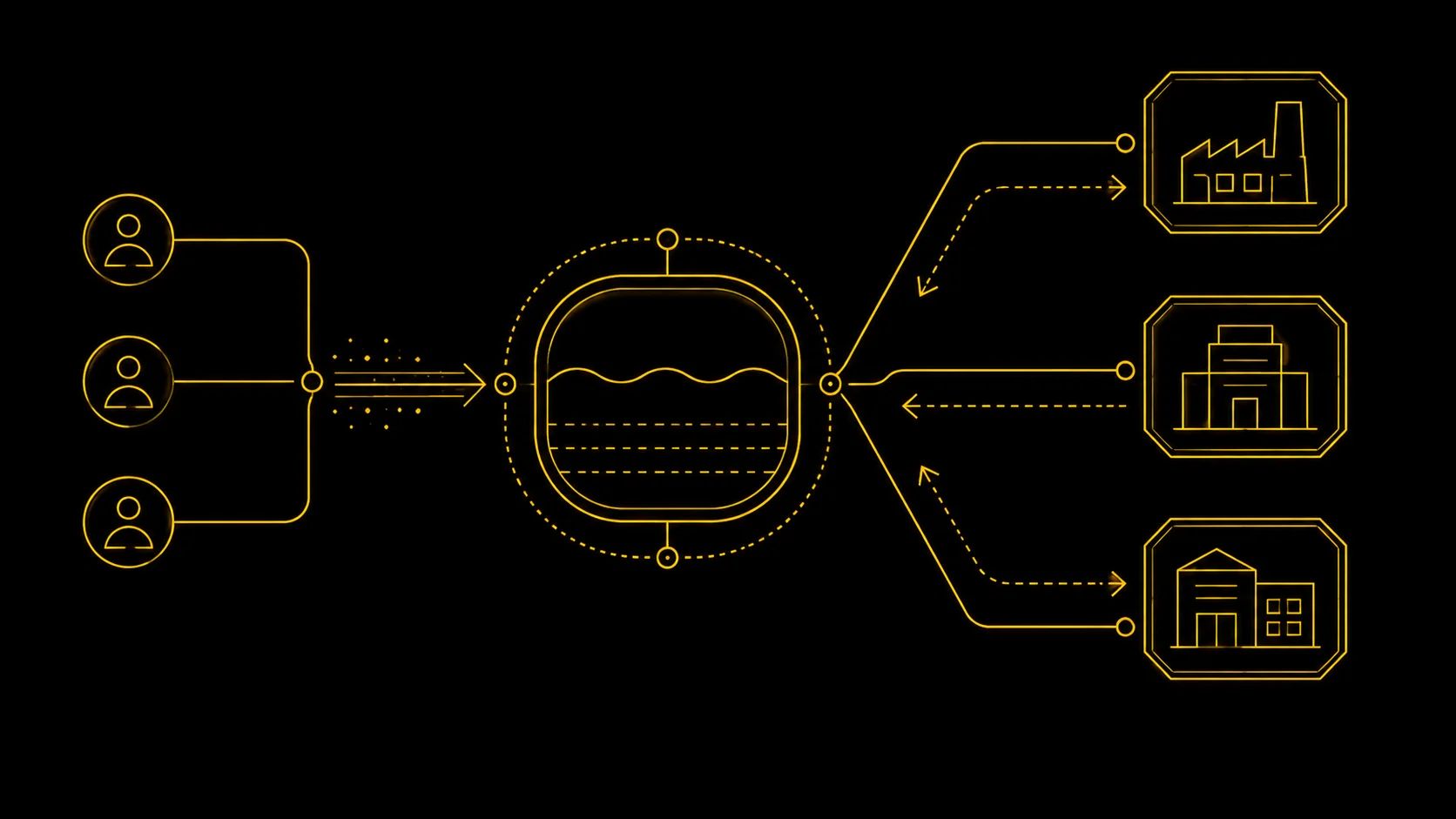
The end-to-end lifecycle of an on-chain credit pool has four stages. First, a lender deposits stablecoin capital (typically USDC) into a pool smart contract managed by the protocol or by a delegated credit manager. Second, the pool extends loans to vetted off-chain borrowers under terms negotiated at loan origination — interest rate, maturity, covenants, and any collateral arrangements. Third, borrower interest payments flow back to the pool over the life of the loan, less the protocol's fee and the credit manager's fee, and accrue pro rata to lenders. Fourth, at maturity (or earlier, if a default triggers write-down), capital returns to lenders — at par if the loan performed, at the post-write-down amount if it did not.
Senior and junior tranches
Most institutional-style on-chain credit pools use a tranche structure to allocate first-loss capital. The junior tranche absorbs the first portion of any default before senior lenders take a write-down; in exchange, the junior tranche typically earns a higher yield. This mechanic exists in TradFi private credit and translates directly to the on-chain version, with the additional property that tranche positions are themselves transferable on-chain tokens — a transparency feature that traditional private-credit funds do not offer. Investors who want a more conservative position take the senior tranche and accept a lower yield; investors who explicitly want first-loss exposure take the junior tranche for a yield premium and an explicit acknowledgement of higher loss probability.
Institutional versus retail access
The bulk of on-chain private credit by AUM is institutional — accredited investors, qualified purchasers, or KYC'd institutional capital — because the historical underwriting demands have suited that audience. Retail access exists in narrower wrappers. Maple Finance's syrupUSDC product is a permissionless wrapper that exposes retail lenders to a curated slice of Maple's pools without requiring KYC, with value accrual mirroring the underlying borrower interest. Centrifuge's senior tranches are accessible through certain wrappers depending on jurisdiction. Goldfinch's senior pool token, FIDU, has historically been broadly accessible, though the protocol's experience after its emerging-market default cycle changed the framing of "broadly accessible" considerably.
Major Protocols 2026
Three protocols account for the bulk of live on-chain private credit AUM, and each occupies a structurally different niche.
Maple Finance
Maple Finance is the largest institutional on-chain credit venue, with approximately $2.1B TVL across Ethereum and Solana as of May 2026 (DeFiLlama). The protocol operates a credit-manager model in which delegated managers underwrite and originate loans to institutional borrowers, with lenders supplying stablecoin capital to pools managed by those credit managers. The retail-facing edge of Maple is syrupUSDC — a permissionless wrapper that issues a 1:1 token against USDC and accrues value as the underlying borrower interest flows in, without requiring KYC at the wrapper level.
Maple's fee posture varies by pool tier. The Cash Management Pool sits at a flat 50 basis points annualised (Maple docs). Institutional lending pools land at approximately 70-90 basis points all-in across protocol and credit-manager fees, with each delegate negotiating its own performance share — Maple Direct, for instance, retains 12% of pool interest (Genfinity, June 2026).
The 2022 Orthogonal default reshaped the protocol's underwriting framework. In late 2022, Orthogonal Trading — a Maple borrower — defaulted on its outstanding obligations after market stress related to the broader 2022 credit cycle, triggering a write-down of the affected pool and prompting Maple to overhaul its credit-manager model. The post-Orthogonal framework tightened due-diligence requirements, restructured pool isolation between credit managers, and moved away from the more permissive borrower acceptance criteria that had prevailed earlier. The yield premium over crypto-native lending exists because Maple lenders are taking real default risk; the 2022 Orthogonal default required protocol restructuring, and the underwriting framework has tightened since but credit risk has not been eliminated.
For investors evaluating Maple, the operational track record since the post-Orthogonal restructuring is the most informative data point — the protocol has continued to operate through multiple subsequent market events with no further default of comparable scale reported. An absence of reports is not an absence of losses: Maple publishes no default or loss series that would settle the question, so read that as the limit of what is public rather than as a clean record. syrupBTC was cleared to launch in mid-2026 after the 22 May 2026 settlement of the Core Foundation lstBTC exclusivity dispute (Cayman Grand Court injunction lifted; crypto.news May 2026), extending the credit-pool mechanic to BTC-denominated exposure.
Centrifuge
Centrifuge concentrates at the institutional-receivables end of the on-chain private-credit spectrum. As of June 2026, the protocol holds approximately $1.636B TVL across its institutional partner pools (DeFiLlama; deepest depth on Ethereum at ~$1.25B, with growing footprints on Avalanche, Base, and Plume Mainnet), with V3 — launched on 24 July 2025 across six EVM chains via Wormhole — providing the current technical baseline.
The CFG token migrated to ERC-20 to Ethereum in March 2025 as a precursor to V3, and the platform's institutional rails support pool-level customisation that aligns with how TradFi credit funds structure their books. Platform fees are tiered by pool size, with pools under $10M currently at the 0% tier per the protocol's revenue-flow governance proposal (Centrifuge CP162); higher-tier rates are not publicly specified as of mid-2026, so lenders evaluating a specific pool should check the pool detail page for the live fee.
The partner list is the most informative single signal about Centrifuge's positioning. Active institutional partners include Janus Henderson, BlockTower Credit, Anemoy, and Sky (formerly MakerDAO, rebranded August 2024), each of which uses Centrifuge as the on-chain infrastructure layer for a specific credit strategy. Janus Henderson's involvement is the headline TradFi anchor and signals that Centrifuge is operationally credible to a traditional credit-fund counterparty; Sky's use of Centrifuge for RWA collateral is part of the broader Sky strategy that now generates more than 60% of Sky's protocol revenue from RWA exposures.
Centrifuge's eight-year operational history through prior crypto market cycles — including the 2018-2020 build-out, the 2022 credit cycle, and the 2023-2024 RWA-category emergence — is the second informative signal. The protocol has not been default-free, but the default profile has been concentrated in trade-receivables exposures rather than headline institutional defaults of the Maple-Orthogonal type, and the operational continuity through multiple winters is part of the honest case for Centrifuge as the supply-chain-finance pillar of on-chain private credit.
Goldfinch
Goldfinch operates at the emerging-market and US specialist-lending end of the category, with approximately $200M TVL and 8-12% yields as of May 2026 (DEXTools). The protocol's historical positioning was in emerging-market credit — East African asset financiers (Tugende's Kenya subsidiary), Southeast Asian specialty lenders (Lend East), US specialist credit funds (Stratos) — and the lending pools historically concentrated risk in a small number of off-chain counterparties whose credit performance proved harder to underwrite at scale than the protocol's early framework anticipated; three named borrowers drove ~$18M in cumulative pool-level write-downs on a ~$170M loan book. Goldfinch charges no direct protocol fee on lender yield, but retains 10% of all interest payments as treasury reserves and applies a 0.5% redemption fee on FIDU-to-USDC exits (Goldfinch docs).
Goldfinch's default history is treated in depth in the lessons section below — three named defaults, primary-source citations, and the FIDU senior-pool case study that became the worked example in the category's distressed-debt literature. The defaults shaped the protocol's underwriting approach for emerging-market credit and reinforced the broader category lesson that individual loan defaults are not the same as protocol failure. Goldfinch continued operations after the loss events, and the protocol's current TVL and yield profile reflect a smaller, more cautious operational footprint than the pre-default period. Update (June 2026): Goldfinch governance approved GIP-87, an orderly wind-down into maintenance mode — Warbler Labs has stopped new protocol development, and the protocol is now focused on collecting legacy borrower repayments rather than onboarding new lenders.
Underwriting and Default Mechanics
How a protocol underwrites borrowers, and how it handles defaults when they occur, is what separates well-built on-chain credit from fragile attempts at the same.
How a protocol evaluates a borrower
Borrower evaluation in on-chain private credit looks much like TradFi underwriting at the senior level — financial statements, repayment history, sector analysis, covenant structure — with the additional layer that the protocol or delegated credit manager publishes pool composition on-chain. The transparency property is what distinguishes the on-chain version from a TradFi private-credit fund: a lender can verify, at any moment, what borrowers a pool is exposed to and at what tenor, even if the underlying loan documents are off-chain.
Three signals tend to distinguish a serious underwriting framework from a marketing one. First, a named credit manager with a track record outside the protocol — credit-manager experience that pre-dates the on-chain expansion is materially more useful than experience that begins with it. Second, explicit pool-isolation between credit managers — if one manager underwrites badly, the loss is contained to that manager's pool rather than affecting other lenders. Third, a published default-handling policy that names the write-down mechanic, the timeline, and the order of loss allocation across tranches.
First-loss capital
First-loss capital is the structural cushion that protects senior lenders. In the tranche-based pools used by Maple and Centrifuge, the junior tranche absorbs default losses before senior lenders take a write-down. The size of the junior tranche relative to the senior tranche is the most informative single piece of risk data for a senior lender: a 10% junior tranche means the first 10% of any default is absorbed before senior capital is touched; a 2% junior tranche means senior lenders are exposed to almost the full loss after a small buffer.
In protocols without explicit tranches — or where the tranche structure is unclear — senior lenders are effectively first-loss on the pool's whole credit exposure. This was part of the operational lesson from Goldfinch's emerging-market pools: the FIDU senior-pool token absorbed write-downs from the default cycle that a clearer tranche structure might have isolated to a junior layer.
As reference points, Centrifuge institutional pools historically use a junior-tranche minimum around 20% (per Centrifuge V3 documentation and the live pool detail pages on the protocol's app); Goldfinch's senior FIDU pool sits behind a backer-tranche capital layer whose size varies per borrower pool (Goldfinch docs cited in the protocol profile above); Maple pools position delegate-provided first-loss capital beneath lenders, with the specific buffer set per pool agreement. Compare the candidate pool's actual first-loss layer against these references rather than assuming a uniform structure across protocols.
Loan default and write-down process
When a loan defaults, the protocol or credit manager triggers a write-down process. The mechanics differ by protocol. Goldfinch historically applied a linear write-down over 120 days, with the FIDU senior-pool token's value falling proportionally as the default amortised against pool capital. Maple's variant uses a credit-manager-led write-down with a faster recognition timeline once a borrower is flagged. Centrifuge's institutional pools follow the credit-fund convention of write-downs at the pool level once the credit manager confirms the default.
The practical implication for a lender is that the value of a tranche position can fall meaningfully without the loan reaching final loss. Recovery is possible — borrowers who default sometimes restructure and partially repay, and the recovery flows back to the affected tranche. But the headline yield numbers in the on-chain private-credit category are gross-of-defaults, and any honest evaluation has to net the expected default rate against the published APY rather than treating the headline number as a realised return.
Recovery versus total loss
The realistic recovery distribution in on-chain private credit looks much like TradFi private credit. Some defaulted loans recover most of their principal through restructuring; others recover a partial amount over a multi-year workout; a meaningful minority result in near-total loss. The protocols above have published recovery data for at least some of their default events, and rwa.xyz maintains case-study material on the highest-profile losses. A lender's sizing should incorporate a recovery assumption — historically in the 30-70% range for restructurable corporate credit, lower for unsecured emerging-market exposures — rather than treating default as either "fine" or "100% loss" in expected-value terms.
Historical Defaults and Lessons
This section names three specific Goldfinch defaults, with primary-source citations and the operational lessons each one carries. The intent is not to single out Goldfinch — the protocol continues to operate and has restructured its approach — but to put the category's largest publicly documented loss events on record so that readers can size positions with accurate inputs.
$5M Tugende default — Kenya asset financing
Tugende is a Uganda-headquartered asset-financier (HQ Kampala; founded 2012) that historically lent to motorcycle-taxi operators and other commercial-vehicle users in East Africa, with operations across Uganda and Kenya. The Goldfinch facility sat on Tugende's Kenya subsidiary, and the pool took an approximately $5M write-down after the borrower's repayment performance deteriorated; Warbler Labs subsequently backstopped lender losses with a Goldfinch DAO treasury contribution of $1M USDC (DL News). The operational lesson is that emerging-market credit underwriting requires materially more local-market expertise than the early on-chain credit frameworks captured — the macro and sectoral risks in East African asset finance differ in kind from the risks in developed-market institutional credit, and a uniform underwriting framework applied across both is fragile in the way Tugende exposed.
$7M Stratos default — US specialist credit
Stratos is a US specialist credit fund whose Goldfinch borrowings of approximately $7M were written down after the fund's underlying portfolio underperformed. Warbler Labs assumed "full risk and responsibility of recovery" on the Stratos position (DL News), backstopping lender losses on the pool. The Stratos event sits as the developed-market counterpoint to Tugende: the loss happened in a US context with familiar legal and recovery rails, yet the on-chain pool still took a meaningful write-down because the underlying credit thesis did not perform. The lesson is that on-chain pools lending to US credit funds inherit the credit funds' own underwriting quality — a layer of indirection that does not reduce the total credit risk, only the visibility into it.
Lend East default — Southeast Asian credit
Lend East — a Singapore-headquartered emerging-market credit firm — was the third headline default in the Goldfinch series. Per DL News (April 2024), the loan structure was approximately $10.2M with a roughly $5.9M shortfall after Lend East's CEO indicated only ~$4.25M could be repaid; the lender-loss outcome remained unresolved at the time of reporting (in contrast to Tugende and Stratos, where Warbler Labs backstopped lender losses). Combined with Tugende and Stratos, the total cumulative pool-level write-downs across the three named events reached approximately $18M against a ~$170M cumulative Goldfinch loan book — historically a concentrated exposure across just three off-chain counterparties, which is the structural pattern worth naming explicitly: the protocol auto-allocates across pools by design, but the realised book has historically concentrated risk in a small number of borrowers.
FIDU as a worked distressed-debt case study
FIDU is Goldfinch's senior-pool token, and the value trajectory through the default cycle became a worked example of how an on-chain senior-pool token behaves under default stress. The rwa.xyz coverage tracks the FIDU price over the write-down period and analyses how the senior position absorbed losses that, in a clearer tranche structure, might have been isolated to a junior layer. For readers who want a primary-source case study on the mechanics of a real on-chain credit write-down, the FIDU material is the most thoroughly documented event in the category to date.
Protocol default versus loan default
The single most important operational lesson from the Goldfinch series is the distinction between an individual loan default and a protocol failure. The defaults named above resulted in meaningful capital losses for affected lenders, but the protocol itself continued to operate — Goldfinch retained roughly $200M TVL and continued to publish 8-12% yields through May 2026. Against a peak TVL of approximately $200M, the cumulative documented defaults of roughly $18M represent about 9% of the protocol's peak deposits — material but structurally absorbed, because the senior-pool 120-day linear write-down spread loss recognition over time rather than forcing instant insolvency (Goldfinch docs).
Maple's experience after the 2022 Orthogonal default followed the same pattern: the protocol restructured its framework and continued operations rather than failing outright.
This distinction matters for category framing. A reader who treats on-chain private credit as "default-free" because individual protocols have not gone insolvent is misreading the data; a reader who treats every default as an existential protocol risk is misreading it differently. The honest reading is that individual loan defaults are part of the asset class, that protocols have so far absorbed those losses without failing, and that lenders should size accordingly.
Versus Crypto-Native Lending
The most useful comparison for a reader evaluating on-chain private credit is against crypto-native lending — Aave, Compound, and the broader pool of overcollateralised stablecoin-borrowing protocols. The two routes look superficially similar at the wrapper level (deposit stablecoins, earn yield) but differ fundamentally at the credit-risk level.
Overcollateralisation versus underwriting
Crypto-native lending requires the borrower to post crypto collateral worth materially more than the loan amount — typically 130-200% — with on-chain liquidation triggered automatically if the collateral value drops below the liquidation threshold. The lender's principal-protection mechanism is the collateral itself: if the borrower stops repaying, the collateral is sold on-chain to recover the principal. Credit risk in the traditional sense barely exists in this model; the dominant risks are smart-contract failure, oracle failure under stress, and bad-debt accumulation from liquidations that fail to clear at fair value.
On-chain private credit operates without that automatic collateral mechanic. The lender's principal-protection comes from underwriting — the credit manager's assessment of the borrower's repayment capacity, the covenants in the loan documents, and the tranche structure that allocates first-loss capital. Credit risk is the dominant risk, and the yield premium over crypto-native lending compensates for it.
Transparent on-chain liquidation versus off-chain collections
The second structural difference is what happens when a borrower stops paying. In crypto-native lending, liquidation is automatic, transparent, and on-chain — the same block that triggers the liquidation event records the sale of collateral and the protocol's recovery. In on-chain private credit, default handling is off-chain — the credit manager works with the borrower on restructuring, the legal-recovery rails are TradFi rails, and the timeline for any recovery measures in months or years rather than seconds.
This is not a flaw in the on-chain private-credit model — it is the model. Off-chain borrowers cannot be liquidated on-chain because the collateral (where it exists) lives off-chain. But it means lenders need a different mental model of "what happens when things go wrong" than the one that crypto-native lending trains. The crypto-native lending baseline guide covers the overcollateralised side of the comparison in depth, and the comparison of crypto-native lending platforms page covers the CeFi-and-DeFi product landscape side by side.
Yield context
The headline mid-2026 yield numbers reflect the credit-risk differential. Crypto-native lending pays roughly 3-6% APY on USDC stablecoin supply (varying with utilisation), with the rate spiking under volatility-driven borrowing demand. On-chain private credit pays 8-12% in the Goldfinch range and similar levels on Maple's institutional pools, with the spread above crypto-native lending covering default risk. The maths only works for a lender who can absorb the expected losses without that breaking the position's purpose.
Operational Due Diligence Before Depositing
A reader who has decided that on-chain private credit fits their portfolio still has to choose a specific pool, and the choice rewards a small amount of pre-deposit work more than most on-chain decisions because the credit risk is real and the pool-level differences are material. Five concrete checks distinguish a deliberate deposit from a marketing-driven one.
Check 1 — Read the live loan book before the headline yield
Every major protocol publishes a loan-by-loan view of the active pool, typically including the borrower name, the loan size, the current performance status, and the maturity date. Open that view first, before reading the headline APY. The composition of the active book tells you whose credit you are funding — three loans to specialist US credit funds is a different exposure profile from twelve loans to emerging-market asset-financiers, even if both pools quote the same APY. The headline yield is the price of the average credit risk in the book; the book itself is the risk.
Where individual borrower identities are confidential, the concentration figure is still public and remains the most informative single piece of structure to read. Maple's syrupUSDC family, for instance, currently shows the top three borrowers accounting for approximately 48.8% of the family loan book against a total syrupUSDC TVL approaching $2.1B (TID Research, mid-2026) — concentration at that level is what distinguishes a deliberate deposit from a marketing-driven one even before any individual borrower is named.
Check 2 — Verify the first-loss capital structure
The first-loss layer is what absorbs the initial impact of any default. Every protocol describes its first-loss structure publicly, but the practical question for a lender is what size the first-loss layer is in dollar terms relative to the senior layer, and who provides it. A pool with a $5M first-loss layer against a $50M senior layer absorbs the first 10% of losses before the senior holder takes any impairment; the same senior holder in a pool with a $1M first-loss layer against the same $50M senior absorbs losses much sooner. The credit-manager's own skin in the game (where they are the first-loss provider) is the most reassuring structure; third-party first-loss capital with credible track records is the next-best.
Check 3 — Trace the redemption window end-to-end
On-chain private credit is not a same-block-exit product. Every pool has a redemption window — sometimes a fixed quarterly or monthly cadence, sometimes a more bespoke window that depends on borrower repayment timing. Trace the realistic end-to-end timeline before depositing: from the moment a redemption request is submitted, how long until the funds are actually in the wallet? For some pools the answer is days; for others it is months. A lender who needs liquidity inside a specific window should know the window before the deposit, not after.
Check 4 — Pull the historical default-and-recovery record
Most protocols have at least one default event on record. Pull the case-study material for each one — the protocol's own write-up if available, the third-party coverage (rwa.xyz, DL News) as a cross-check, and the recovery numbers as they have evolved since the default. A protocol that handled a default well — transparent communication, prompt write-down recognition, recovery progress documented — is structurally different from one that handled it badly, regardless of the headline yield. The Goldfinch material on Tugende, Stratos, and Lend East named earlier in this guide is the most thoroughly documented set, and reading the rwa.xyz coverage in full before sizing a position on any protocol with similar exposure types is worth the time.
Check 5 — Verify the tax treatment in your jurisdiction
On-chain private credit yield is income in most jurisdictions, but the specific framing varies. UK holders generally treat the yield as miscellaneous income at the GBP equivalent on the day of receipt, with the income figure becoming the cost basis of any tokens received as yield; the underlying CGT framework applies to disposal gains separately. US, EU, and other jurisdictions have their own framings.
The practical advice is to settle the tax framing before depositing — not because it changes the deposit decision in most cases, but because the record-keeping discipline is far easier to start at the deposit step than to reconstruct after the first realised yield event. A simple per-position record with the deposit date, the deposit amount, the yield-distribution dates, and the exchange rate on each receipt date covers the vast majority of jurisdictions adequately.
The five checks above are deliberately mechanical because the credit-risk evaluation itself rewards structured pre-deposit review more than gut-feel pattern-matching. A reader who runs through the five-check sequence before each new deposit will catch most of the pool-level differences that the headline APY does not surface, and will build a personal sense of what each protocol looks like under their own scrutiny rather than under the marketing-narrative scrutiny that drives most first-time deposits in the category. The discipline compounds across positions, and the second-time review for any given protocol takes a fraction of the time that the first one required, especially when the original notes are still on hand.
For a quick-reference checklist a reader can keep open in a side window during pre-deposit review, the five checks distil to:
- Loan book composition — borrower names, sizes, statuses, maturities; read before the APY.
- First-loss capital structure — size, provider, and skin-in-the-game posture.
- Redemption-window timeline — the realistic end-to-end exit timing, not the marketing number.
- Default-and-recovery record — protocol write-ups, third-party coverage, recovery progress.
- Tax framing — jurisdiction-specific income treatment plus record-keeping setup at deposit time.
Who This Is For
A worked example makes the portfolio framing concrete. Consider two lenders with identical $50,000 stablecoin allocations and different objectives.
Lender A — first-time on-chain yield seeker
Lender A is new to on-chain yield and wants stable dollar-denominated income with low principal risk. The portfolio role of the $50,000 is the cash sleeve — the dry powder that funds opportunistic moves elsewhere. The correct route for Lender A is tokenised treasuries (USDY or BENJI retail, depending on jurisdiction) at roughly 4.5% APY, paying about $2,250 a year. Adding on-chain private credit to this portfolio is the wrong move because the headline-yield differential is being paid for a risk profile that does not fit the position's purpose. A default would not just hurt the yield; it would partly defeat the function of the cash sleeve.
Lender B — credit-aware allocator
Lender B already runs a diversified portfolio with explicit allocations to equities, fixed income, and an alternatives sleeve that includes private credit. The $50,000 here is the on-chain side of the alternatives bucket, not the cash sleeve. The correct route is to allocate a meaningful slice to a senior-tranche position on Maple or Centrifuge — say $30,000 at perhaps 9% APY, paying around $2,700 a year before expected default losses — and to keep the rest in tokenised treasuries as a stable counterweight. The expected return after a sensible default assumption (perhaps 1-2% annualised loss expectation on the credit sleeve) lands in the 7-8% range, which is what the position is supposed to deliver for credit-allocator capital.
Portfolio fit summary
The portfolio-fit rule generalises straightforwardly:
- Credit sleeve capital with explicit default-loss expectations is the natural home for on-chain private credit; size positions at the level you would size a similar TradFi private-credit allocation.
- Cash sleeve capital belongs in tokenised treasuries; the headline-yield differential does not compensate for the wrong-bucket risk.
- First-time on-chain yield seekers are better served by tokenised treasuries until they have direct experience with at least one full credit cycle on-chain; the credit-risk-bearing-yield mental model is harder to size correctly without prior reps.
- Allocators new to private credit generally should size their on-chain exposure at the smaller end of any private-credit allocation until they have observed at least one drawdown event in the category.
For the operational step-by-step on how to actually access these protocols — including KYC paths for institutional tiers and the wrapper-by-wrapper guidance for retail-accessible products like syrupUSDC — see the cluster's access path guide.
Conclusion
On-chain private credit in 2026 is a real, multi-billion-dollar category with verified-2026 protocol activity, restructured underwriting frameworks after the 2022-2023 default cycle, and a documented loss history that lets honest investors size positions with accurate inputs. Maple Finance (around $2.1B TVL) and Centrifuge ($500M+ TVL) are the institutional venues; Goldfinch ($200M TVL, 8-12% yields) operates at a smaller scale after its emerging-market default cycle but remains the most thoroughly documented case study on what on-chain credit risk actually looks like in practice.
The category sits in the credit-risk-bearing tier of the RWA market, distinct from tokenised treasuries (cash-sleeve, regulated TradFi yield) and crypto-native lending (overcollateralised, smart-contract-dominated risk). The honest case rests on three observations: first, the yield premium over crypto-native lending is paid by real default risk, not by structural inefficiency; second, protocol-level operational continuity through individual defaults is now a documented pattern rather than a hopeful assumption; third, the wrapper transparency that on-chain pools offer — visible composition, tranche structure, on-chain accounting — is a genuine advantage over equivalent TradFi private-credit funds for investors who value that transparency.
For readers who decide the category fits their portfolio, the next concrete step is the cluster's how-to-invest companion guide — the operational handbook covers KYC paths for institutional tiers and the retail-wrapper guidance for products like Maple's syrupUSDC. For readers who want to read across to the tokenised-treasury and crypto-native-lending sides of the broader yield landscape before committing, the cluster hub maps the full RWA category and the comparative table on the tokenised-treasuries satellite covers the cross-yield comparison this page deliberately does not duplicate. Treat the headline yields as gross of expected default losses, treat the protocols' published loss history as the most honest data the category has, and treat this category as a credit allocation rather than a yield-bearing stablecoin substitute.
Sources and References
The figures and events cited in this guide draw on protocol announcements, primary financial press, and on-chain analytics. Live TVL and yield figures change quickly; verify each number against the primary source before sizing a position.
- Maple Finance TVL (DeFiLlama) — live TVL for Maple's institutional and retail pools
- Centrifuge V3 documentation — 24 July 2025 multichain launch (six EVM chains via Wormhole) and institutional partner architecture
- Goldfinch Lend East default (DL News) — documentation of the third headline emerging-market default in the Goldfinch series
- Goldfinch Tugende default (DL News) — $5M write-down on the Kenya-subsidiary exposure of Uganda-headquartered Tugende
- FIDU distressed-debt case study (rwa.xyz) — worked example of the senior-pool token value trajectory through the default cycle
- Goldfinch TVL and yield context (DEXTools) — May 2026 reference for the protocol's continuing operational footprint
- Goldfinch wind-down (The Defiant, June 2026) — GIP-87 approved an orderly wind-down into maintenance mode; Warbler Labs halts new protocol development
- Maple institutional fee compression (Genfinity, June 2026) — Cash Management Pool 50bps tier, 70-90bps institutional all-in range, Maple Direct's 12% credit-manager performance share
- Centrifuge CP162 governance proposal — pool-size-tiered platform fee structure, with under-$10M pools at the 0% tier
- Goldfinch liquidity-provider docs — no direct protocol fee; 10% interest reserve; 0.5% FIDU redemption fee; 120-day linear write-down on the Senior Pool
- syrupUSDC concentration report (TID Research, mid-2026) — top-3 borrower concentration at ~48.8% of the family loan book
Disclaimer: On-chain private credit carries real default risk and the potential for total loss of principal. This guide is for educational purposes only and does not constitute financial, legal, or tax advice. TVL, yield, and default figures are point-in-time references; verify against the primary source before sizing allocations. Always consult a qualified professional for advice specific to your jurisdiction.
Frequently Asked Questions
- What is on-chain private credit in 2026?
- On-chain private credit is a category of tokenised real-world assets in which lenders supply stablecoin capital to pools that lend, in turn, to vetted off-chain borrowers — institutional credit funds, trade-finance counterparties, or specialist lenders in emerging markets. As of mid-2026, the category sits at multi-billion-dollar scale, concentrated in Maple Finance (~$2.1B TVL, DeFiLlama May 2026) and Centrifuge ($500M+ across institutional partner pools). The yield is paid by the underlying borrower interest rather than by network rewards, and the principal-at-risk profile is meaningfully different from a tokenised treasury — credit risk is real and has resulted in losses in this category before.
- How does an on-chain credit pool actually work?
- A lender deposits stablecoins (typically USDC) into a pool smart contract managed by the protocol or by a delegated credit manager. The pool extends loans to off-chain borrowers under terms set at the loan-origination stage, often with a senior / junior tranche structure that puts first-loss capital ahead of senior lenders. Borrower interest payments flow back to the pool, less the protocol's and manager's fees, and accrue to lenders. If a loan defaults, the loss is written down against the pool's principal — usually starting with the junior tranche before touching senior capital.
- Is Maple Finance safe after the 2022 Orthogonal default?
- Maple Finance restructured its underwriting framework after Orthogonal Trading defaulted on its Maple borrowings in late 2022, moving to a stricter credit-manager model with more conservative collateral requirements and tighter due diligence. As of May 2026 Maple's TVL stands at approximately $2.1B (DeFiLlama), and no default on the Orthogonal scale has been REPORTED since — an absence of reports, which is not the same as an absence of losses, and Maple does not publish a default series that would settle it. The yield premium over crypto-native lending exists because Maple lenders are taking real default risk; the underwriting framework has tightened since 2022 but credit risk has not been eliminated.
- What is Centrifuge V3 and how does it differ from Maple?
- Centrifuge V3 — launched on 24 July 2025 across six EVM chains via Wormhole, following the March 2025 CFG token migration to Ethereum (a precursor, not V3 itself) — focuses on bringing institutional real-world receivables on-chain through SPV structures, with senior and junior tranches that let investors size their credit exposure explicitly. Partners include Janus Henderson, BlockTower Credit, Anemoy, and Sky (formerly MakerDAO, rebranded August 2024). Centrifuge typically targets supply-chain finance, trade receivables, and short-duration credit exposures rather than direct corporate lending — a different shape of credit risk from Maple's institutional-borrower model. Centrifuge has operated through multiple crypto market cycles, with eight years of continuous operations as of 2026.
- What happened with Goldfinch's defaults and what did the protocol learn?
- Goldfinch experienced three notable defaults across its emerging-market and US lending pools: a $5M Tugende default (the facility sat on Tugende's Kenya subsidiary; the parent entity is Uganda-based, HQ Kampala, per DL News), a $7M Stratos position (US specialist credit fund), and a Lend East default of approximately $5.9M shortfall on a $10.2M loan (DL News April 2024). Cumulative pool-level write-downs reached approximately $18M against a ~$170M cumulative loan book — historically concentrated in those three off-chain counterparties. Warbler Labs backstopped lender losses on Tugende (via a $1M USDC Goldfinch DAO treasury contribution) and Stratos ("full risk and responsibility of recovery"); the Lend East lender-loss outcome remained unresolved at the time of DL News' reporting. FIDU — Goldfinch's senior pool token — became a worked case study in distressed-debt write-downs on rwa.xyz. The defaults shaped the protocol's underwriting approach for emerging-market credit and reinforced two lessons: individual loan defaults are not the same as protocol failure (Goldfinch continued to operate at roughly $200M TVL and 8-12% yields through May 2026 per DEXTools), but the Senior Pool's auto-allocation design did not, in practice, prevent borrower-level concentration in a small number of off-chain counterparties.
- How is on-chain private credit different from Aave or Compound lending?
- Crypto-native lending protocols like Aave V3 and Compound require overcollateralisation — a borrower posts crypto worth more than they borrow, and liquidation happens automatically on-chain if the collateral value drops. On-chain private credit, by contrast, lends to off-chain borrowers under terms negotiated by credit managers, with collateral (where it exists) typically held off-chain and recovery handled through traditional collections. The yield profile differs accordingly: crypto-native lending yields track stablecoin utilisation (~3-6% on USDC in mid-2026), while private-credit yields compensate for credit risk and concentrate in the high single digits or low double digits, with the explicit possibility of write-downs.
- Who should consider on-chain private credit?
- Investors who have a credit-sleeve allocation in their portfolio already, who understand that yield above the risk-free rate compensates for default risk, and who treat the position as a high-yield-credit allocation rather than a stablecoin substitute. A first-time on-chain investor looking for stable dollar yield is better served by a tokenised treasury — the credit-bearing-yield mental model is harder to size correctly without prior experience. For investors who already understand TradFi private credit, the on-chain wrappers offer transparent pool composition, on-chain accounting, and (where applicable) tranche-level allocation that traditional private-credit funds do not — at the cost of an additional smart-contract surface to evaluate.
← Back to Crypto Investing Blog Index
Financial Disclaimer
This content is not financial advice. All information provided is for educational purposes only. Cryptocurrency investments carry significant investment risk, and past performance does not guarantee future results. Always do your own research and consult a qualified financial advisor before making investment decisions.