How to Invest in RWA 2026
The operational handbook for the RWA tokenisation cluster: jurisdiction and KYC matrix per product, the canonical four-step path from fiat to a held RWA position, the realistic custody options, and the mistakes most first-time RWA investors actually make. Practical, jurisdiction-aware, action-oriented — and explicit about what is and is not available to readers in each major jurisdiction.
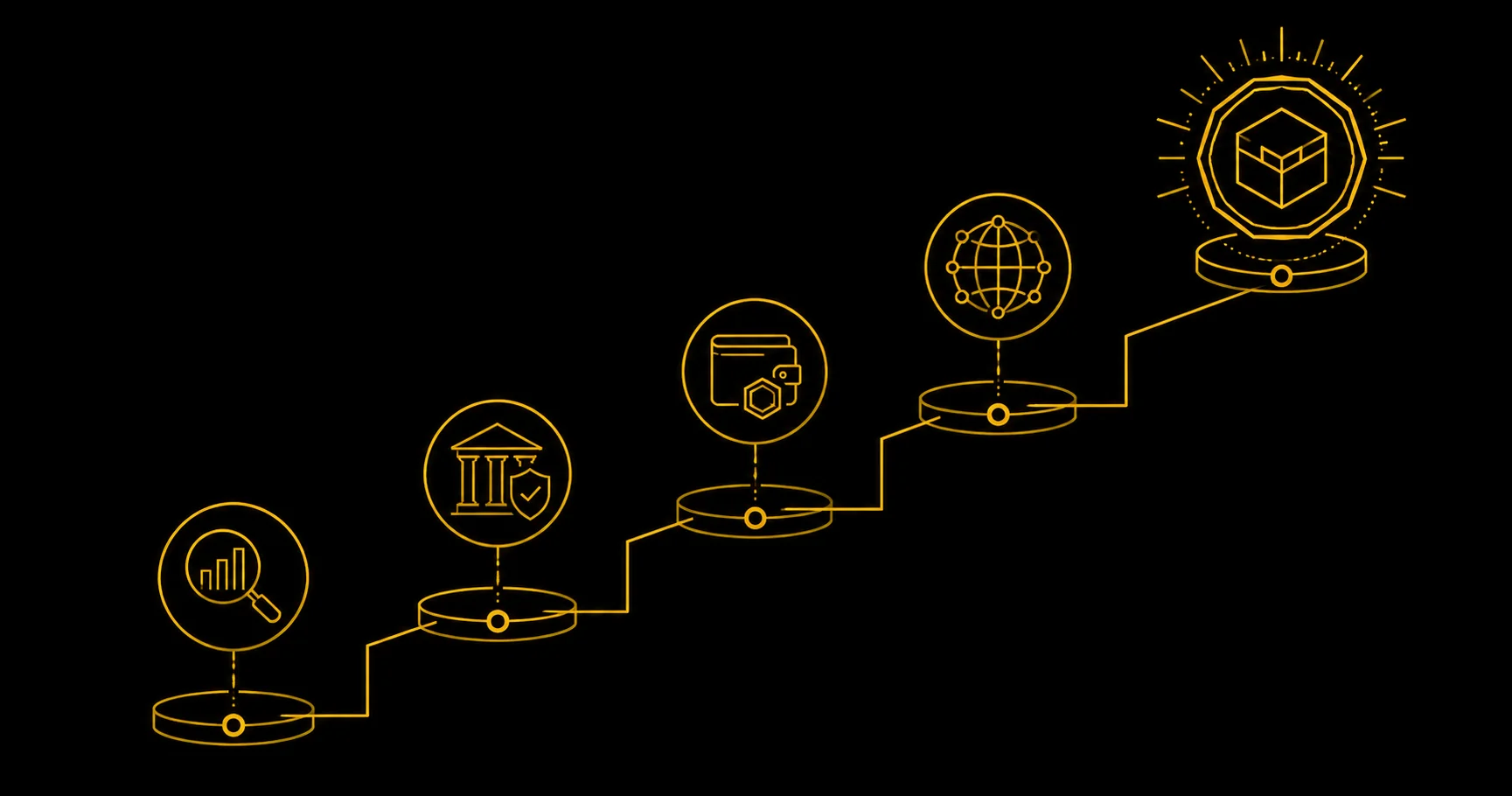
How to Invest in Tokenised RWA in 2026
The shortest practical answer is that investing in tokenised real-world assets in 2026 reduces to a four-step path: choose an exchange where you can convert fiat to a stablecoin or chain asset; buy the stablecoin (USDC is the most widely supported); move it to a self-custody wallet appropriate for the size of the position; and route into the chosen RWA product through the issuer's primary mint rail or a supported retail wrapper. Every step is gated by jurisdiction and accreditation rules, which is why the matrix in the jurisdiction matrix is the single most important table in this guide.
This page is the action-oriented satellite of the RWA tokenisation cluster. The cluster hub maps the four RWA categories and the risk taxonomy. The tokenised-treasuries satellite carries the product-by-product depth and the cluster's only yield-route comparative table. The private-credit satellite covers Maple, Centrifuge, and Goldfinch with default-history detail. This page takes the reader who has decided RWA exposure makes sense for their portfolio and walks them through the operational mechanics — which exchange to use, which stablecoin to buy, where to put the wallet, and which product to actually deposit into.
Two practical framings before we start. First, the page is jurisdiction-aware throughout. The realistic answer to "how do I invest in RWA" differs depending on whether you sit in the US, the UK, the EU, or one of the supported non-US retail jurisdictions, and any guide that gives a single answer is glossing over the matrix that actually determines which products you can buy.
Second, the page is action-oriented but not recommendation-oriented. The decision framework section flags the cases where RWA is and is not a fit for a particular portfolio, and the rest of the guide assumes that decision has already been made through the hub or one of the other satellites. The combined effect is a guide that translates "I'm ready to deposit" into a concrete operational sequence the reader can verify against their own jurisdiction and circumstances before signing the first transaction.
One reading recommendation. The jurisdiction matrix below is dense, and the temptation is to skim it. Resist that — the matrix is built from issuer disclosures verified at draft time, and the difference between "retail-accessible in your jurisdiction" and "not currently available to you" is the entire game for any reader who is not already an accredited institutional investor. Read your row carefully, then check the issuer's current page before depositing any meaningful capital. Availability changes; this guide is anchored to mid-2026 conditions.
Decision Framework: Does RWA Belong in Your Portfolio?
The honest case for tokenised RWA exposure rests on a small number of features, each of which matters more or less depending on what the underlying portfolio looks like. The frame below is not a recommendation; it is a checklist that helps a reader decide whether the operational steps that follow are worth taking at all.
Yield framing
At the US short end of 4-5% in mid-2026, a tokenised T-bill product like Ondo USDY (around 3.60% published APY as of 31 August 2026) is directly comparable to a TradFi money-market fund. The on-chain wrapper adds three things on top: 24/7 settlement and programmability, jurisdiction-independent access for savers whose local rails are weak, and composability with the rest of an on-chain portfolio. It also adds a smart-contract risk premium and an issuer credit risk that lives at the regulated TradFi level. For a stablecoin-denominated saver who already operates on-chain, the trade is usually favourable; for an investor whose flows live in a TradFi brokerage, the brokerage path is often the cleaner answer.
Portfolio bucket
Tokenised RWA is not a single allocation. Tokenised treasuries belong in the cash sleeve; private credit belongs in the credit sleeve; tokenised gold belongs in the precious-metals sleeve; tokenised real estate, where you hold it at all, belongs in the illiquid private-market sleeve. Treating any of these as interchangeable is the most common initial-allocation mistake. The right sizing for each category mirrors the equivalent TradFi allocation rather than the headline yield, and the right exit assumption mirrors the underlying liquidity rather than the on-chain price screen.
Risk budget
Every step beyond a fiat brokerage adds a layer of risk. The smart-contract surface of the issuer's token contract; the bridge layer if you route the token across chains; any DeFi protocol you layer on top; the wallet you self-custody in. The risk budget for an RWA position is the sum of every layer, not just the issuer's published risk disclosures. A reader whose risk tolerance is calibrated to a fully-insured brokerage account is going to find on-chain holdings uncomfortable regardless of how clean the issuer is; a reader who already runs a DeFi-native portfolio will find the same holdings unremarkable.
Three questions before proceeding
If the three questions below answer cleanly for your situation, the operational guide that follows is useful. If they do not, the broader cluster hub may be the better starting point.
- Which portfolio bucket is this filling? Cash, credit, precious metals, or illiquid private-market. The answer determines which product category fits.
- Which jurisdiction are you in? The matrix in the next section makes the available product set explicit by jurisdiction; pre-filter mentally before reading the operational steps.
- What is the position's exit mechanic? Primary-rail redemption (typically T+0 or T+1 for institutional products, longer for retail wrappers), secondary-market sale (thin for most RWA tokens), or hold-to-maturity. Sizing should reflect the realistic exit horizon, not the marketing-page liquidity claims.
Jurisdiction and KYC Matrix
The table below is the single source of truth for product accessibility across the major retail jurisdictions, as of mid-2026. Each cell reflects what the issuer's current disclosures say; any cell flagged for verification with the issuer indicates that the situation was either ambiguous or actively in transition at draft time. Verify your row against the issuer's product page before depositing capital — availability changes.
| Product | Retail or accredited | US-accessible | EU (MiCA / fund framework) | UK (FCA) | Rest-of-world |
|---|---|---|---|---|---|
| USDY (Ondo) | Retail (Reg S) | No — Reg S excludes US persons since launch | Selectively — verify on Ondo's product page | Selectively — Ondo's disclosures apply | Available in supported non-US jurisdictions |
| OUSG (Ondo) | Accredited / qualified purchaser (Reg D) | Yes for accredited investors | Selectively for qualified institutional buyers | Selectively for qualified institutional buyers | Selectively — see Ondo's institutional onboarding |
| BUIDL (BlackRock, via Securitize) | Accredited only (Reg D) | Yes for accredited investors | Yes for qualified institutional buyers | Yes for qualified institutional buyers | Yes for qualified institutional buyers in supported jurisdictions |
| BENJI suite (Franklin Templeton) | Mixed — retail wrappers on Stellar and select chains; institutional tier elsewhere | Yes for retail via supported wrappers — verify on Franklin Templeton's product page | Selectively — see Franklin Templeton disclosures | Selectively — Franklin Templeton's wrapper-availability matrix applies | Selectively in supported jurisdictions |
| Invesco Short Duration US Government Securities Fund (formerly Superstate USTB) | Qualified purchaser tier in transition under the Q2 2026 Invesco portfolio-management transition (Invesco Advisers becomes portfolio manager; Superstate retains corporate ownership and on-chain infrastructure) | Yes for qualified purchasers | Verify on Invesco / Superstate's product page | Invesco / Superstate's disclosures apply | See Invesco / Superstate's onboarding page |
| bIB01 (Backed Finance) | Retail with $5,000 minimum direct issuance + KYC (Swiss DLT-Act) | Check current terms on Backed | Yes via supported intermediaries | Check current terms on Backed | Yes in supported jurisdictions |
| Maple syrupUSDC (permissionless wrapper) | Retail (no wrapper-level KYC; underlying Maple pools are institutional) | Check current terms on Maple Finance | Check current terms on Maple Finance | Check current terms on Maple Finance | Generally available in supported jurisdictions |
| Centrifuge institutional pools | Accredited / qualified purchaser via institutional partner pools | Yes for qualified purchasers via partner pools | Selectively via partner pools — check current terms | Selectively via partner pools — check current terms | Selectively — check current terms on Centrifuge |
| PAXG (Paxos Gold) | Retail | Yes (subject to state listings) | Yes via supported intermediaries | Yes via supported intermediaries | Yes in supported jurisdictions |
| XAUT (Tether Gold) | Retail | Limited — verify on Tether | Yes via supported intermediaries | Yes via supported intermediaries | Yes in supported jurisdictions |
Two reading notes for the matrix. First, "selectively" reflects the realistic state where an issuer's product is technically available to a jurisdiction but routed through a specific intermediary or wrapper that may or may not be active on draft day. The honest position is that the issuer's current disclosures are the authoritative source, and any "selectively" cell should be confirmed before depositing. Second, the US column is the most operationally constrained — most retail-friendly tokenised-treasury products do not currently take US customers, the accredited-tier products do, and the matrix's "US-accessible" cells reflect that split rather than blanket availability.
Step-by-Step Access Path
The canonical four-step path below applies to most retail-accessible RWA products. Accredited-tier products substitute step four for the issuer's institutional onboarding flow, but the first three steps generalise.
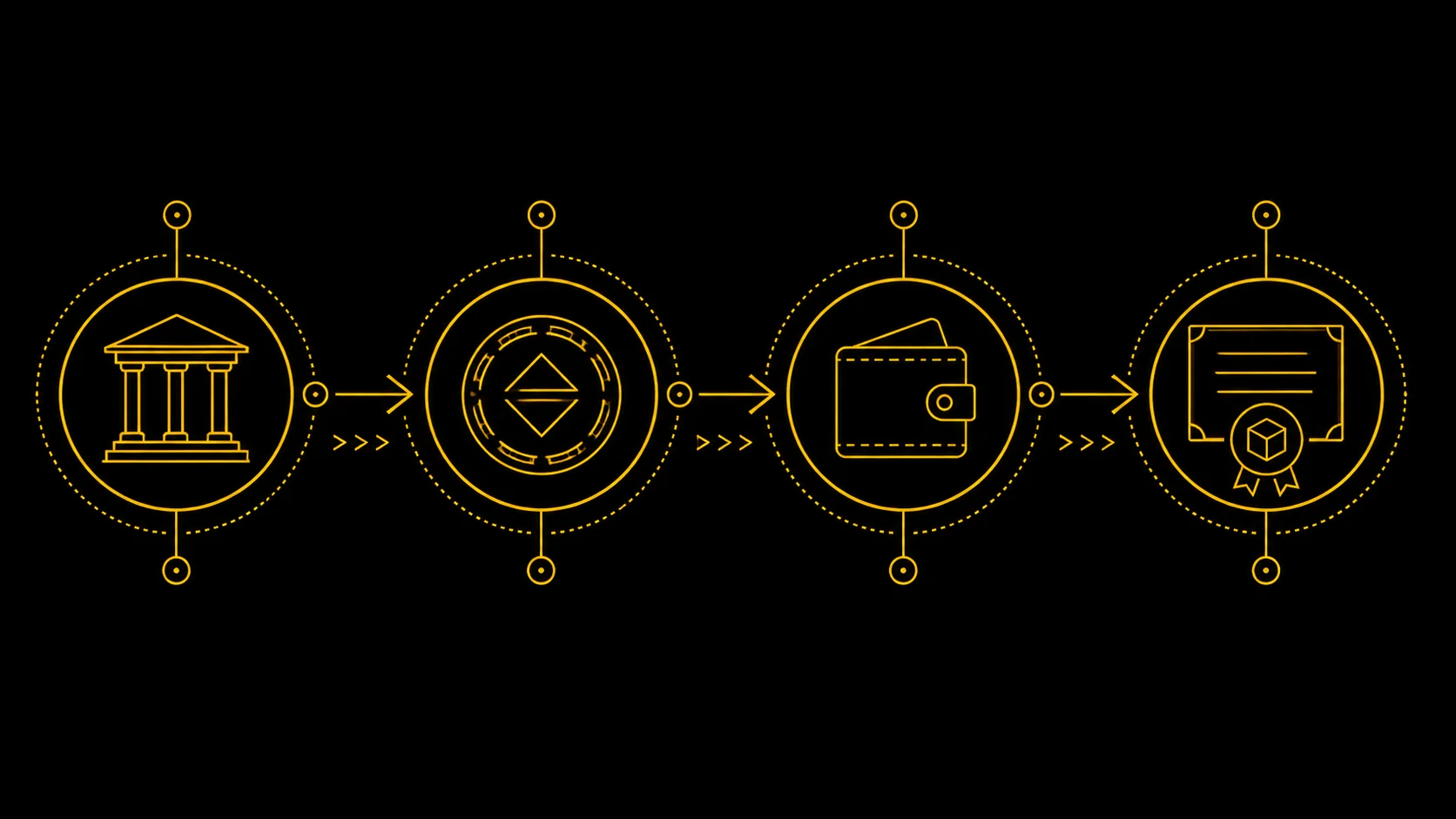
Step 1 — Choose an entry exchange
The entry exchange is where you put cash on-chain. For non-US retail readers looking for broad asset support, deep stablecoin rails, and a regulated-enough operational profile, OKX is one of the most widely used corridors into the on-chain RWA universe. OKX lists USDC and USDT alongside chain-native tokens, supports withdrawal to self-custody wallets on Ethereum and several L2s, and operates a Web3-wallet product that integrates with the chains where major RWA issuers maintain their primary rails.
The compliance backdrop on OKX is worth naming explicitly before any sign-up step. The exchange's parent entity, Aux Cayes FinTech, pleaded guilty in February 2025 to operating an unlicensed money-transmitting business and paid $504.4 million in penalties to the US Department of Justice (CNBC, 24 February 2025). Per the DOJ SDNY filing, OKX retains an external Consultant through February 2027 — a retained external compliance consultant rather than a government-appointed independent monitor. The settlement did not bar OKX from non-US operation, and the platform remains widely used by non-US retail and institutional traders. The practical step before completing onboarding is to confirm eligibility under the jurisdiction-specific KYC criteria on OKX's own onboarding page.
For US-eligible readers, OKX is restricted; the realistic options route through US-domiciled venues with their own listing constraints. For first-time exchange onboarding mechanics generally — KYC documentation, account funding, fiat-to-stablecoin conversion — our exchange onboarding / KYC basics guide covers the universal steps that apply regardless of which venue you choose.
Step 2 — Acquire a stablecoin
The stablecoin you buy on the entry exchange becomes the asset you actually withdraw to your wallet. For most RWA products, USDC is the lowest-friction default — it is the primary mint asset for BUIDL, BENJI, USDY, OUSG, and Maple's syrupUSDC, and it is widely listed across all the major chains the issuers support. USDS — Sky's upgraded stablecoin, the successor to DAI — connects to Maple's yield engine at the protocol layer via institutional Sky/Spark allocations into Maple pools (not via direct retail USDS deposits into syrupUSDC, which accepts USDC only; syrupUSDT exists separately for USDT). USDS itself is broadly available through Sky's Spark and other on-ramps; it is the natural choice if your downstream usage lives in the Sky ecosystem.
USDT works on most CEX rails but is less commonly the primary mint asset for major tokenised-treasury products. If you buy USDT on the entry exchange, plan to swap it for USDC or USDS at the product's preferred chain before depositing.
Network choice matters for cost. Ethereum mainnet carries higher gas costs but is the deepest-liquidity chain for nearly every major RWA product. Arbitrum and Base carry materially lower gas costs and support most of the BENJI suite and several Maple pools. Polygon is lower-cost again, but product coverage there moves — issuers have both added and dropped chains, so check the issuer’s current chain list rather than any fixed statement of which chain carries which fund. The general rule is to pick the lowest-cost chain that supports your target product, and to use the issuer's documentation rather than a third-party guide for the chain-by-chain accessibility picture.
Step 3 — Choose custody
Self-custody is the standard recommendation for meaningful position sizes. The wallet you use depends on the size and the operational pattern. For small positions you are actively managing, a reputable software wallet on a primary device is acceptable; for any position that materially affects your savings, a hardware wallet is the standard recommendation because it isolates the signing key from network-connected devices and materially reduces the surface area for phishing and malware-driven theft.
One operational note worth flagging for Ledger users. In January 2026, Ledger disclosed a third-party data leak via its e-commerce partner Global-e, which exposed order data (names and contact details) for Ledger customers who purchased through Ledger's online store. The hardware self-custody design is unaffected — no private keys or wallet funds were accessed — and the underlying hardware-wallet model remains the right tool for significant on-chain holdings. The relevant user action is to treat all unsolicited "Ledger support" or "Global-e" communications as suspicious and to verify through Ledger's official channels (CoinDesk and Ledger incident notice).
An alternative worth knowing about, especially for accredited-tier products, is leaving custody with the issuer or with Securitize directly. BUIDL's institutional flow typically routes through Securitize as the transfer agent, and many accredited holders keep custody at that layer rather than moving the token to a personal wallet. The trade-off is counterparty risk at the transfer agent versus operational complexity at the self-custody layer; both are defensible, and the right choice depends on the size of the position and the holder's operational tolerance.
Step 4 — Buy the product
The final step routes the stablecoin in your self-custody wallet into the chosen RWA product. The mechanic differs by product family:
- USDY (Ondo): direct mint on Ondo's primary rail in supported jurisdictions, with secondary availability on Sui, Aptos, Mantle, and other chains where wrappers exist.
- BENJI suite (Franklin Templeton): direct mint via Stellar (the original FOBXX chain) or via the supported retail wrappers on Polygon, Ethereum, Solana, Aptos, Avalanche, Base, and Arbitrum.
- Maple syrupUSDC: permissionless wrap — deposit USDC into the syrupUSDC contract on Ethereum or supported chains; the wrapper accrues value as the underlying borrower interest flows in.
- PAXG / XAUT: direct mint with the issuer (Paxos for PAXG, TG Commodities for XAUT) or secondary market on most major CEXs and several DEXs; the secondary route is typically faster for small retail positions, and listing depth is broad enough that the choice of secondary venue rarely affects execution at retail size.
- BUIDL / OUSG (accredited): subscription routed through Securitize (for BUIDL) or Ondo's institutional onboarding (for OUSG) after accreditation verification.
For the side-by-side product details — issuer structure, redemption rails, supported chains, accreditation, AUM, and yield — see our tokenised treasuries guide, which holds the yield-route comparative table and the per-product depth that anchors product selection.
Common deposit pitfalls and how to avoid them
A handful of operational pitfalls account for the majority of first-deposit problems, and each is avoidable with a small amount of pre-deposit attention. Wrong-chain deposits are the most expensive — sending USDC on Ethereum mainnet to a contract that only accepts Arbitrum USDC will land the funds in the wrong contract, which may or may not be recoverable depending on the bridge mechanic. The fix is to verify the chain ID at the issuer's deposit address before sending, not after.
Allowlist surprises are the second category. Several tokenised-treasury products allowlist holding addresses at the contract level — the token will refuse to transfer to an address that is not pre-cleared, which generates a confusing failure mode for a holder who attempts to move the position without first whitelisting the destination wallet. Read the issuer's allowlist documentation before assuming the token behaves as a freely transferable ERC-20.
Gas-budget under-estimation on the destination chain is the third. A holder who has just paid mainnet gas to bridge a stablecoin to L2 may not have set aside enough chain-native gas (ETH on Arbitrum, POL on Polygon, formerly MATIC, BNB on BNB Chain) to pay for the subsequent deposit transaction. The fix is trivial — keep a small reserve of chain-native gas on each chain you transact on — but the symptom of getting it wrong is a wallet stuck mid-flow with no way to send the next transaction.
Slippage on small-cap secondary venues matters for products with thin DEX liquidity. The same product that trades at a fraction-of-a-percent spread on a deep CEX may show 2-3% slippage on a niche DEX with shallow pools. For products like PAXG/XAUT the choice of venue makes a measurable cost difference at retail size, especially in the $5,000-$50,000 range; the secondary-venue spread is the largest single variable cost on the buy-side.
Size a test position before committing meaningful capital
One step that is not formally part of the four-step path but that reliably distinguishes a careful first-time RWA buyer from a hurried one: size a test position before committing meaningful capital. A $500 to $1,000 deposit through the full path — entry exchange, stablecoin purchase, withdrawal to self-custody, deposit into the chosen product — exposes every operational friction point at low cost. Wallet-signature mechanics, chain-network selection, contract-allowlist behaviour, redemption-flow timing — each of these is easier to understand when the worst-case outcome of getting it wrong is a small loss rather than a portfolio-level loss.
The test position also gives you a primary-source baseline on the issuer's actual operational cadence. How quickly did the redemption settle? Was it the T+0 the marketing page advertises, or T+1, or longer? What does the NAV oracle update cadence look like in practice? These are answerable from outside the product only in marketing copy; from inside a small held position they are answerable from your own wallet activity. Carry the answers forward when you scale the position, and treat any deviation from the original test-position experience as a reason to re-verify before adding more capital.
Documentation discipline at deposit time
The third operational habit that pays out over time is documentation discipline at the deposit step. Save the transaction hash, the on-chain contract address, the issuer's then-current product page URL, and the redemption-gate language as it stood at deposit. This is a five-minute exercise that materially reduces the cost of any subsequent dispute, tax filing, or jurisdictional change. Treat the deposit step as if it were a notarised filing, not a casual swap. The records support both your own future decision-making and any conversation with a tax authority, auditor, or estate executor that needs to reconstruct what happened.
Custody Choices
This section is deliberately short — custody depth lives on the cluster hub, not here. The hub's custody-and-security section covers the two-layer model (off-chain custody of the underlying asset, on-chain custody of the token), the Ledger Global-e disclosure, and the practical guidance on hardware-wallet selection. For the full read, see the custody section of our RWA tokenisation complete guide.
The one-line summary for this page: hardware wallet for meaningful holdings, software wallet for small test positions, issuer-level custody (Securitize, Franklin Templeton, etc.) as the realistic alternative for accredited-tier institutional flow. The hub goes deeper on each.
Common Mistakes
The mistakes below are the ones we see most often in first-time RWA investors, and each carries an operational lesson that the matrix and the step-by-step path do not address directly.
- Ignoring jurisdiction restrictions. The single most common error is assuming that because an RWA product is "live" it is also available to you. USDY excludes US persons under Reg S; BUIDL is accredited-only; BENJI's retail wrappers vary by chain and jurisdiction. Pre-filter on the matrix before reading any issuer's marketing page.
- Confusing tokenised T-bills with stablecoins. A tokenised treasury redeems through the issuer's primary rail, not through the open swap market. Treating a tokenised treasury as if it were a stablecoin — using it as the quote asset in a high-frequency strategy, expecting instant any-size redemption, sizing the position as if it were USDC — is the most common operational mistake first-time holders make.
- Neglecting redemption-gate terms. Every regulated RWA issuer reserves the right to gate redemptions under stress; the terms vary materially between products. Read the gate language in the offering documents before sizing meaningful capital, not after the gate is invoked.
- Treating RWA as risk-free. The underlying assets behind tokenised treasuries are low-risk by any traditional credit standard, but the on-chain wrapper, the issuer credit risk, and any DeFi layering you add on top are not risk-free. The cash-sleeve framing is the correct mental model; "stablecoin equivalent with yield" is not.
- Over-routing through bridges and wrappers. Every additional bridge or wrapper between you and the issuer's primary rail compounds smart-contract risk. The Kelp DAO April 2026 ~$292M bridge exploit (rsETH backing restored above 100% in May 2026 from Kelp DAO treasury plus a $71M tranche frozen by the Arbitrum Security Council and routed via Aave multisig; the stolen ETH itself was laundered through Wasabi and Tornado Cash and largely unrecovered) is the recent case study; for RWA products, use the issuer's first-party chain rails wherever possible rather than chasing a marginal yield uplift on an exotic wrapper.
- Skipping the tax framing. UK CGT on disposals made on or after 30 October 2024 is 18% (basic-rate band) and 24% (higher- and additional-rate bands); yield received in stablecoins is generally treated as miscellaneous income at GBP value on the day of receipt. US, EU, and other jurisdictions have their own framings. Record-keep from the first deposit, not after the first realised gain.
After the Deposit — Operational Aftercare
The four-step access path ends at "deposit complete," but the operational job does not. RWA positions reward a small amount of ongoing attention more than most on-chain holdings because the underlying asset, the issuer, and the regulatory perimeter all move during the holding period, and the cheapest way to catch a material change is a light recurring check rather than a one-off setup.
Setting a monitoring rhythm
The minimum-useful rhythm for a held RWA position is monthly and quarterly. The monthly check covers three things: the issuer's published NAV or APY against the historical baseline, any redemption-gate language updates on the issuer's page, and any material news in the issuer's regulatory perimeter. Five minutes per position is typically enough. The quarterly check is heavier: pull the attestation (for products that publish them on a quarterly cadence), reconcile the position size against personal records, and re-read the offering documents for any term changes that the issuer would not necessarily flag in a marketing update. Twenty to thirty minutes per quarter covers most positions adequately.
The reason both cadences matter is that material changes do not always announce themselves loudly. A redemption gate that tightens from T+3 to T+5 will not generate a marketing email; an issuer who changes the published-attestation cadence from monthly to quarterly will note it in the offering documents but probably not on the front-page product card. A reader who treats the deposit step as the end of the operational job is the reader most likely to be surprised by a change they could have caught at a monthly check.
Yield reinvestment mechanics by product family
Different RWA products distribute yield through different mechanics, and the holding experience varies accordingly. USDY accrues value through the token price rising over time — there is no separate yield-claim transaction, and the position simply grows in dollar terms as the underlying treasury yield accrues. BUIDL distributes yield through a daily on-chain airdrop of additional tokens, which means a holder ends each day with marginally more BUIDL than they started; the operational implication is that any wallet-balance reconciliation has to account for the airdrop pattern rather than treating the position as static.
BENJI's retail wrappers behave more like share-based wrappers with NAV-based pricing; the underlying mechanic varies by chain. Maple's syrupUSDC compounds in-wrapper — the token's price against USDC rises as borrower interest flows in, and the holder realises yield on withdrawal rather than continuously. PAXG and XAUT carry no yield mechanic; the position simply tracks the spot price of gold without distribution.
The practical implication is that record-keeping at the cost-basis level differs by product. A position in USDY or PAXG/XAUT is a single cost-basis entry with the deposit transaction as the basis event; a position in BUIDL with daily airdrops generates daily cost-basis entries that the holder needs to track for tax filing. A reader who plans to hold a yield-bearing RWA position for multiple tax years is well-served by setting up the record-keeping pattern at deposit time rather than at first realised gain, because reconstructing daily airdrop cost-basis after twelve months of accrual is a meaningfully harder problem than logging the events as they occur.
Tax record-keeping with worked examples
The UK tax treatment of RWA positions in 2026 follows the broader cryptoasset framework. Disposals on or after 30 October 2024 attract Capital Gains Tax at 18% (basic-rate band) and 24% (higher- and additional-rate bands), with a £3,000 annual allowance from 2024/25 onwards. Yield received in stablecoins or in additional tokens (the BUIDL airdrop case) is generally treated as miscellaneous income at the GBP equivalent on the day of receipt, with the income figure also becoming the cost basis of any tokens received as yield. HMRC's Cryptoassets Manual is the authoritative source.
A worked example. A UK-resident holder deposits £10,000 in USDY on 1 January 2026 at a hypothetical token price of $1.10 (the position size is 9,090 USDY at the deposit-day GBP/USD rate). By 30 June 2026, the token price has risen to $1.13 — a roughly 2.7% accrual reflecting the underlying treasury yield — and the holder sells the full position for £10,275 at the prevailing exchange rate. The realised gain is £275, which against a £3,000 annual allowance generates no CGT liability.
Scaling the same example: for the same holder with a £100,000 position the realised gain at the same rate is £2,750, still within the annual allowance; at £200,000 the gain is £5,500, of which £2,500 is the CGT-eligible amount taxed at the holder's marginal rate.
The mechanical lesson from the worked example: keep the deposit-day exchange rate, the deposit-day USD token price, and the sale-day equivalents in a single per-position record; that record is what an HMRC self-assessment filing actually requires.
When to rebalance or exit
A held RWA position usually deserves to sit untouched between checks. But three signals reliably justify a re-evaluation. The first is a material yield change in the underlying asset class — a Fed cut that moves the T-bill curve materially affects tokenised-treasury yields, and an investor whose original thesis was a specific yield level deserves to re-evaluate when that level moves.
The second is a regulatory perimeter change at the issuer (a new restriction, a wrapper retirement, or a jurisdiction exit can change the position's accessibility or wind-down rights).
The third is a portfolio-fit change on the holder's side (a change in employment status, tax residency, or accreditation status that moves the holder into or out of a product's eligibility set).
Outside these three signals, churn between RWA products is rarely productive — the underlying yields are similar enough that the friction of switching usually exceeds the differential.
Exits run cleanest when planned rather than urgent. For accredited-tier products with primary-rail redemption, the published settlement window plus a one-week buffer is the realistic exit timeline; for retail products with secondary-market liquidity (USDY, BENJI retail wrappers, PAXG, XAUT), the exit is typically faster but the bid-ask spread at the secondary venue is the cost. A holder who suspects they may need to exit a position within a fixed window — for a major spend, a tax bill, or a portfolio reallocation — is well-served by pre-checking the realistic settlement timeline on their specific product before the deadline arrives rather than discovering the gate language at the moment of need.
Red flags worth a closer look between checks
Most of the time the monthly and quarterly cadence is the right level of attention, but a small set of signals justifies pulling forward a closer review even outside the scheduled rhythm. A sudden silence on the issuer's published-attestation cadence — a quarterly attestation that does not appear within the published window, or a missed monthly disclosure on a product that historically publishes on time — is the highest-priority signal because it is the same pattern that has preceded several past stress events in adjacent categories.
A material spread in the secondary-market price against the issuer's published NAV deserves a closer look: a tokenised treasury trading several percent below NAV on a secondary venue may simply reflect thin liquidity, but it may also reflect early signs of redemption-gate concern that the issuer has not yet acknowledged publicly. A change in the issuer's auditor or attesting firm matters more than the marketing copy usually implies, because the relationship between issuer and attestation provider is one of the load-bearing trust assumptions a holder makes at the deposit step.
None of these signals is automatically a reason to exit a position; each is a reason to spend twenty additional minutes on the specific issue rather than waiting for the next scheduled check. The pattern that distinguishes investors who avoid the worst outcomes in any held position is not that they catch every signal at the earliest possible moment, but that they take the small signals seriously enough to investigate before the signal escalates into a forced response. The deposit decision earned the position; the aftercare decisions are what hold the position together over a multi-year window.
Per-position records worth keeping for the holding period
The records that pay out most reliably over a multi-year hold are short and specific. The deposit transaction hash is the single most important piece of information to preserve — it anchors every subsequent reconciliation and is the primary-source evidence of when and how the position originated. The issuer's product-page URL as it appeared at deposit, ideally captured as a saved snapshot, is the second most important: marketing pages change, and the version that informed the deposit decision is what the holder actually agreed to at the moment of action.
The redemption-gate language at deposit — the specific clauses in the offering documents that govern how the issuer can pause or modify redemptions — is the third; it does not need to be re-read often, but it needs to be reproducible from records if a later dispute requires it.
Beyond those three core records, a per-position log of every wallet interaction (yield claim, partial redemption, rebalancing transfer) keeps the cost-basis story coherent for tax filing and removes the need to reconstruct activity from on-chain explorer queries when filing season arrives. The setup cost is a few minutes per position at deposit time; the saved cost over the holding period is meaningful.
Conclusion
Investing in tokenised RWA in 2026 is operationally tractable for a reader who pre-filters the product set against their jurisdiction, picks the right portfolio bucket for the category, and treats the four-step path as a single coherent flow rather than four independent decisions. The matrix in the jurisdiction matrix is the single most important table in the cluster for action-oriented readers; the canonical path of exchange → stablecoin → wallet → product applies to most retail-accessible products with minor product-specific variations at step four.
For non-US retail readers, the cleanest starting positions are USDY (where supported), BENJI retail wrappers (where supported), tokenised gold (PAXG, XAUT, broadly available), and Maple's syrupUSDC for credit-aware allocators willing to take the default-risk premium. For accredited US investors, BUIDL and OUSG are the institutional anchors. For US retail readers, the realistic immediately-available set is narrower than the global retail set; tokenised gold and selective BENJI access are the most likely entry points.
Three operational reminders to close. First, the matrix is anchored to mid-2026 conditions — verify your row against the issuer's current disclosures before depositing meaningful capital, because availability shifts faster than any guide can keep up. Second, the step-by-step path is exchange to stablecoin to wallet to product, and the right answer at each step depends on the previous step's outputs (chain choice flows from product choice, wallet choice flows from position size, stablecoin choice flows from product preference).
Third, the common-mistakes list above is the difference between an investor who lands the position well and one who learns the same lessons the expensive way; treat it as a checklist worth re-reading before every new deposit, not a one-time read. The aftercare section adds the post-deposit framework — monitoring rhythm, yield mechanics, red flags, and the tax record-keeping that pays out over the holding period. Together the mistakes checklist and the aftercare framework cover the operational error budget that distinguishes a deliberate first-time RWA investor from a hurried one.
Sources and References
The matrix and operational guidance draw on issuer disclosures, primary financial press, and the FCA / HMRC / SEC regulatory portals. Verify each per-product status against the issuer's live page before depositing.
- OKX parent Aux Cayes FinTech DOJ settlement (CNBC, 24 February 2025) — $504.4M penalty and retained external compliance consultant through February 2027 (per DOJ SDNY filing — a retained Consultant, not a government-appointed independent monitor)
- Ledger Global-e third-party data leak (CoinDesk, 5 January 2026) — order-data exposure, hardware self-custody unaffected
- HMRC Cryptoassets Manual — UK CGT 18% / 24% post-30-October-2024 budget rates and miscellaneous-income framing
- ESMA MiCA CASP register and transitional period — authoritative source for EU MiCA-CASP status of any service provider
- Ondo Finance product page — current USDY APY, OUSG qualified-purchaser terms, and US accessibility status
- Franklin Templeton OnChain (BENJI suite) — live per-chain availability and retail-wrapper status
- Securitize issuer portal — BUIDL and other accredited-only product subscription pathways
- Maple Finance product portal — syrupUSDC permissionless wrapper and institutional pool access
- Paxos Gold (PAXG) product page — current redemption terms and exchange listings
- Tether Gold (XAUT) product page — current attestation cycle and redemption mechanics
Disclaimer: Tokenised real-world assets carry significant risk, including total loss of capital. This guide is for educational purposes only and does not constitute financial, legal, or tax advice. Jurisdictional accessibility, accreditation thresholds, and tax framings are point-in-time references; verify against the primary source before making allocation decisions. Always consult a qualified professional for advice specific to your jurisdiction.
Frequently Asked Questions
- How do I invest in tokenised RWA in 2026?
- The canonical path has four steps: pick an entry exchange where you can convert fiat to stablecoins (OKX is one widely-used non-US-retail option); buy USDC or USDS on a chain you can use; withdraw to a self-custody wallet (software wallet for small positions, hardware wallet for meaningful size); and route into the chosen RWA product — Ondo's USDY for non-US retail, Franklin Templeton's BENJI retail wrappers, Maple's syrupUSDC permissionless wrapper, or tokenised gold (PAXG, XAUT) on a CEX or DEX. The jurisdiction matrix in this guide flags retail vs accredited and US / EU / UK accessibility per product.
- Which RWA products are available to retail in the UK?
- As of mid-2026, the cleanest retail-accessible paths for UK readers are Ondo USDY (Reg S, non-US retail in supported jurisdictions, ~3.60% APY per Ondo's published rate, 31 August 2026), Franklin Templeton's BENJI retail wrappers via Stellar and other chains, tokenised gold (PAXG, XAUT, listed on most major CEXs), and Maple Finance's syrupUSDC permissionless wrapper for the on-chain private-credit side. Verify the issuer's current jurisdictional matrix before depositing — availability changes.
- Can US residents buy tokenised treasuries?
- Selectively. Accredited US investors and qualified purchasers can access BUIDL (BlackRock, Reg D) and OUSG (Ondo, Reg D, qualified-purchaser tier) through the issuers' onboarding. Retail-accessible products like USDY are structured under Reg S and have excluded US persons since launch — this is not a November 2025 change. Franklin Templeton's BENJI suite has some retail eligibility for US persons via specific wrappers — verify on Franklin Templeton's product page. Tokenised gold (PAXG, XAUT) is broadly available in the US.
- Is OKX safe to use as an entry exchange?
- OKX is one of the widely-used non-US retail on-ramps for converting fiat to stablecoins and chain-native tokens. In February 2025, OKX's parent entity Aux Cayes FinTech pleaded guilty to operating an unlicensed money-transmitting business and paid $504.4 million in penalties to the US Department of Justice (CNBC, 24 February 2025); the exchange operates under a retained external compliance consultant through February 2027 (per DOJ SDNY filing — a Consultant retained by OKX, not a government-appointed independent monitor). The settlement does not bar OKX from operating in non-US jurisdictions. Verify your jurisdiction's eligibility on OKX directly before signing up.
- Which stablecoin should I use to buy tokenised treasuries?
- USDC is the most widely-supported across the major issuers' on-chain rails and is the lowest-friction default for first-time RWA buyers. USDS — Sky's upgraded stablecoin, the successor to DAI — connects to Maple's yield engine via institutional Sky/Spark allocations into Maple pools (Maple's syrupUSDC retail wrapper accepts USDC only; syrupUSDT accepts USDT). USDS itself is broadly available through Sky's Spark and other on-ramps. USDT works on most CEX rails but is less commonly the primary mint asset for major tokenised-treasury products. Pick whichever your target product's issuer documentation calls out as the primary mint asset.
- Do I need a hardware wallet to hold tokenised treasuries?
- For meaningful position sizes, yes — a hardware wallet isolates the signing key from network-connected devices and materially reduces the surface area for phishing and malware-driven theft. For small initial test positions while you learn the mechanics, a reputable software wallet is acceptable. Ledger's hardware self-custody is unaffected by the January 2026 Global-e third-party data leak (the breach exposed order data via Ledger's e-commerce partner, not private keys or wallet funds), but treat all unsolicited Ledger or Global-e communications as suspicious.
- What is the UK tax treatment of tokenised RWA disposals?
- HMRC treats tokenised RWA disposals like any other crypto disposal: a sale, swap, or spend triggers a Capital Gains Tax event. Following the 30 October 2024 budget, CGT rates on disposals made on or after that date are 18% (basic-rate band) and 24% (higher- and additional-rate bands), against a £3,000 annual allowance for 2024/25 onwards. Yield received in the form of a stablecoin or additional tokens is generally treated as miscellaneous income at the GBP value on the day of receipt. Check HMRC's Cryptoassets Manual for the latest position.
← Back to Crypto Investing Blog Index
Financial Disclaimer
This content is not financial advice. All information provided is for educational purposes only. Cryptocurrency investments carry significant investment risk, and past performance does not guarantee future results. Always do your own research and consult a qualified financial advisor before making investment decisions.