How to Borrow Crypto Securely
Discover how to borrow cryptocurrency safely plus strategically in 2025. This comprehensive guide covers everything from understanding collateral requirements to choosing secure platforms, managing risks, plus protecting yourself from liquidation. Whether you're new to DeFi borrowing or looking to optimise your strategy, learn the proven methods which keep your assets safe while accessing liquidity.
Introduction
The cryptocurrency borrowing landscape has evolved dramatically, and you can now access liquidity without selling your digital assets. Unlike traditional lending, you should understand that digital asset loans operate through decentralised protocols plus centralised platforms which accept cryptocurrency as collateral.
This comprehensive guide examines the leading cryptocurrency lending platforms plus strategies available in 2025, analysing their security measures, collateral requirements, plus risk management protocols. Whether you're looking to leverage your Bitcoin holdings, access stablecoin liquidity, or implement advanced trading strategies, understanding secure borrowing practices is essential targeting protecting your digital wealth.
The DeFi borrowing ecosystem encompasses both centralised finance (CeFi) platforms offering institutional-grade security plus customer support, plus decentralised finance (DeFi) protocols providing transparency plus non-custodial solutions. Each approach presents unique advantages plus security considerations which must be carefully evaluated based on your risk tolerance plus borrowing objectives.
What Crypto Borrowing Looks Like in Practice
Here is a concrete example. You hold 5 ETH worth $15,000 and need $5,000 in cash without selling. You deposit the 5 ETH into Aave as collateral, set your LTV to 33% (well below the 80% maximum for ETH on Aave), and borrow $5,000 in USDC. Your health factor starts at approximately 2.4, meaning ETH would need to drop roughly 58% before liquidation. You pay a variable borrow rate of around 4-6% APY on the $5,000, which costs roughly $250-300 per year in interest. When you are ready, you repay the $5,000 plus accrued interest and withdraw your 5 ETH.
The 2022-2023 lending platform collapses (Celsius, BlockFi, Voyager) were not caused by the borrowing model itself but by platforms lending out user deposits without sufficient reserves. The surviving platforms — Aave, Compound on the DeFi side, Nexo on CeFi — either operate transparently on-chain or maintain verifiable reserves. You should check whether your chosen platform publishes real-time reserve data before depositing collateral.
In 2025, the borrowing toolset has expanded beyond basic collateralised loans. You can now use liquid staking derivatives (stETH, rETH) as collateral while still earning staking yield, borrow across multiple chains using cross-chain protocols like LayerZero, and set up automated collateral top-ups that add funds to your position when your health factor drops below a threshold you define.
Understanding Collateral-Based Lending
Cryptocurrency lending fundamentally differs from traditional lending through its reliance on over-collateralization and smart contract automation. Borrowers must deposit cryptocurrency worth significantly more than the loan amount, typically 150-300% of the borrowed value, to account for market volatility and provide lender protection.
This over-collateralization model eliminates the need for credit checks or income verification, making DeFi borrowing accessible to anyone with sufficient digital assets. However, it also introduces unique risks, including liquidation risk, where collateral can be automatically sold if its value falls below required thresholds.
Understanding collateral ratios, liquidation thresholds, and margin calls is crucial for successful collateralised loans. Different platforms and protocols have varying requirements, and borrowers must carefully monitor their positions to avoid unexpected liquidations that can result in significant losses. You should pay particular attention to the health factor metric used by protocols like Aave, which provides a real-time indicator of your position's safety relative to the liquidation threshold. Maintaining a health factor above 1.5 gives you a reasonable buffer against sudden market downturns and cascading liquidation events.
Platform Categories and Security Models
The digital asset loans ecosystem can be broadly categorised into centralised exchanges with lending features, dedicated CeFi borrowing platforms, established DeFi platforms, and emerging cross-chain solutions. Each category employs different security models and risk management approaches.
You should weigh the trade-offs carefully: centralised platforms typically offer insurance coverage and customer support but require you to trust the platform with your assets. DeFi protocols give you transparency and non-custodial control but demand greater technical knowledge and active monitoring from your side.
Your most secure borrowing strategy should involve careful diversification across multiple platforms and protocols, thoughtfully balancing the convenience of centralised services with the transparency of decentralised alternatives.
Risk Management and Security Principles
You must implement comprehensive risk management strategies that address market volatility, platform risks, and operational security. Your approach should include maintaining conservative loan-to-value ratios, diversifying collateral across multiple assets, and establishing clear margin safety protocols.
Your security best practices should encompass both technical measures like hardware wallet integration and multi-signature setups, as well as operational procedures including regular position monitoring, automated alerts, and emergency response plans for volatility events.
You should commit to continuous education and adaptation of your borrowing strategies as cryptocurrency markets evolve. Staying informed about platform developments, regulatory changes, and market conditions will help you maintain secure and profitable positions throughout 2025.
How Interest Rates Connect to Macro Conditions
Crypto borrow rates do not exist in a vacuum — they respond to the same supply-and-demand dynamics as traditional rates, plus crypto-specific factors. When central banks raise interest rates, stablecoin yields on CeFi platforms tend to follow (because the platforms invest reserves in treasuries), which means borrow rates also increase. Conversely, during crypto bull markets, high demand for leverage pushes DeFi borrow rates up as utilisation spikes — Aave's USDC rate jumped from 4% to 12% during the March 2024 ETH rally because borrowing demand exceeded available supply.
You can use this knowledge tactically: borrow during low-volatility periods when utilisation is moderate and rates are favourable, and build a cash buffer to avoid needing emergency collateral additions when rates and volatility spike simultaneously. If you plan to hold a position for more than 30 days, compare fixed-rate options (available on some CeFi platforms) against variable DeFi rates to lock in your borrowing cost.
Introduction
Cryptocurrency borrowing allows you to access liquidity without selling your digital assets. By using your crypto holdings as collateral, you can borrow stablecoins, fiat currency, or other cryptocurrencies while maintaining exposure to the potential price appreciation of your original assets.
This financial strategy has become increasingly popular amongst crypto investors who want to access cash for various purposes—whether to cover expenses, make investments, or take advantage of market opportunities—without triggering taxable events associated with selling cryptocurrency.
Why Borrow Against Crypto Instead of Selling?
- Tax Efficiency: Borrowing doesn't create taxable events like selling does
- Maintain Exposure: Keep your crypto positions while accessing liquidity
- Potential Appreciation: Benefit from price increases while using borrowed funds
- Flexibility: Access funds quickly without lengthy selling processes
- Portfolio Strategy: Leverage positions for additional investments
However, collateralised loans come with unique risks that traditional lending doesn't have, including extreme volatility, liquidation risks, and the technical complexities of blockchain-based lending protocols. Understanding these risks and how to mitigate them is crucial for safe digital asset loans.
How cryptocurrency lending Works
DeFi borrowing operates on the principle of overcollateralization, where borrowers must deposit cryptocurrency worth more than the amount they wish to borrow. This system protects lenders from the high volatility inherent in cryptocurrency markets.
The Basic Process
- Deposit Collateral: Lock cryptocurrency in a smart contract or platform
- Borrow Funds: Receive loan amount (typically 30-70% of collateral value)
- Pay Interest: Regular interest payments on borrowed amount
- Maintain Ratio: Keep collateral value above liquidation threshold
- Repay Loan: Return borrowed amount plus interest to unlock collateral
Loan-to-Value (LTV) Ratios
The LTV ratio determines how much you can borrow against your collateral. Different platforms and cryptocurrencies have varying LTV limits:
- Bitcoin (BTC): Typically 50-70% LTV
- Ethereum (ETH): Usually 60-75% LTV
- Stablecoins: Often 80-90% LTV
- Altcoins: Generally 30-50% LTV due to higher volatility
Start Borrowing Safely
These platforms offer reliable services with competitive rates:
Explore Nexo BorrowingCeFi vs DeFi Borrowing: Understanding Your Options
digital asset loans is available through two main approaches: Centralised Finance (CeFi) platforms and Decentralised Finance (DeFi) protocols. Each has distinct advantages and risks that borrowers must be aware of.
centralised Finance (CeFi) Borrowing
CeFi platforms operate similarly to traditional financial institutions but focus on cryptocurrency. They hold your collateral in custody and manage the lending process through their internal systems.
CeFi Advantages:
- User-Friendly: Simple interfaces similar to traditional banking
- Customer Support: Human support for issues and questions
- Insurance: Many platforms offer insurance on deposited funds
- Regulatory Compliance: Licensed and regulated in multiple jurisdictions
- Fiat Integration: Easy conversion to traditional currencies
CeFi Risks:
- Counterparty Risk: Platform could fail or freeze funds
- Custody Risk: You don't control your private keys
- Regulatory Risk: Platforms may face regulatory restrictions
- centralisation: Single point of failure
decentralised Finance (DeFi) Borrowing
decentralised protocols use smart contracts on blockchains to automate lending without intermediaries. Your collateral is locked in transparent, auditable smart contracts.
DeFi Advantages:
- Transparency: All transactions visible on blockchain
- No Custody: You maintain control of your assets
- Permissionless: No KYC or geographic restrictions
- Composability: Integrate with other decentralised protocols
- Innovation: Access to cutting-edge financial products
DeFi Risks:
- Smart Contract Risk: Bugs or exploits in code
- Technical Complexity: Requires blockchain knowledge
- No Support: Limited recourse if something goes wrong
- Gas Fees: Transaction costs can be high
- Liquidation Speed: Automated liquidations can be swift
Quick Comparison: CeFi vs DeFi
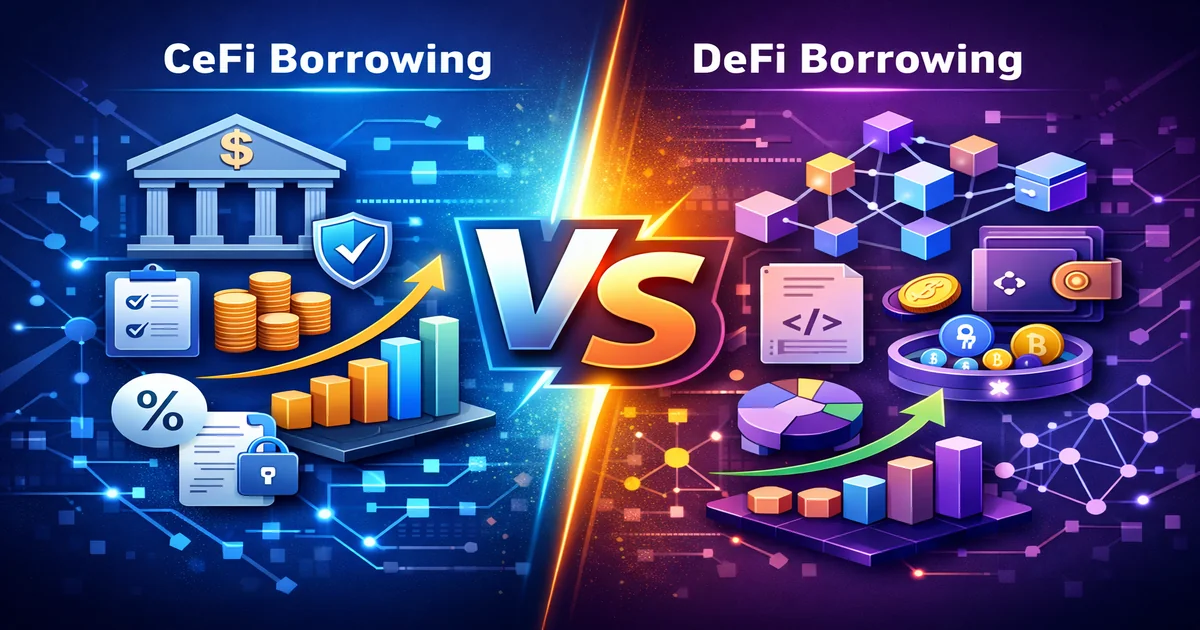
| Feature | CeFi | DeFi |
|---|---|---|
| Ease of Use | High | Medium |
| Custody | Platform | Self |
| KYC Required | Yes | No |
| Interest Rates | Fixed/Variable | Variable |
| Liquidation | Manual Review | Automatic |
Understanding Collateral in digital asset loans
Your collateral is the cryptocurrency you deposit to secure your loan. You must understand how collateral works, the types accepted, and how to manage collateral risk before you borrow.
Types of Accepted Collateral
Different platforms accept various cryptocurrencies as collateral, typically categorised by their stability and market acceptance:
Tier 1 Collateral (Highest LTV)
- Bitcoin (BTC): Most widely accepted, highest LTV ratios
- Ethereum (ETH): Second most popular, good LTV ratios
- Stablecoins (USDC, USDT): Highest LTV but limited upside potential
Tier 2 Collateral (Medium LTV)
- Major Altcoins: BNB, ADA, SOL, AVAX
- DeFi Tokens: UNI, AAVE, COMP
- Layer 1 Tokens: DOT, ATOM, NEAR
Tier 3 Collateral (Lower LTV)
- Smaller Altcoins: Higher volatility, lower acceptance
- New Projects: Limited track record
- Meme Coins: Extremely volatile, rarely accepted
Most crypto loans are overcollateralized, meaning you must deposit more value than you borrow. Learn about overcollateralized vs undercollateralized loans to understand the differences and risks.
Collateral Management Strategies
Diversification
Don't put all your collateral into a single cryptocurrency. Diversifying across multiple assets can reduce risk:
- Mix stable assets (BTC, ETH) with growth potential altcoins
- Consider correlation between collateral assets
- Balance between high-LTV and high-growth potential assets
Buffer Management
You should always maintain a buffer above the minimum collateral requirements to protect your position:
- Conservative: 150-200% of minimum requirement
- Moderate: 120-150% of minimum requirement
- Aggressive: 110-120% of minimum requirement (higher risk)
Learn more about crypto collateral management and optimising your LTV ratios for safer borrowing.
Choosing Safe Borrowing Platforms
Selecting the right platform is crucial for safe DeFi borrowing. Consider factors such as security, reputation, terms, and regulatory compliance when making your decision.
Key Evaluation Criteria
Security and Track Record
- Operating History: Platforms with 3+ years of operation
- Security Incidents: Research past hacks or issues
- Insurance Coverage: Protection for deposited funds
- Regulatory Compliance: Licensed in reputable jurisdictions
- Audit Reports: Regular security audits by reputable firms
Financial Terms
- Interest Rates: Competitive and transparent pricing
- LTV Ratios: Reasonable loan-to-value limits
- Liquidation Thresholds: Clear and fair liquidation terms
- Fees: Origination, maintenance, and early repayment fees
- Minimum Amounts: Accessible minimum loan sizes
Top Recommended Platforms
Nexo (CeFi)
If you want a regulated CeFi option with customer support and insurance, Nexo is the most operationally proven choice — it survived the 2022 crisis that bankrupted its competitors. Loan approval takes under 60 seconds, and you receive funds instantly into your Nexo account or as a bank transfer. Our Nexo borrowing guide walks you through the full application process.
- Regulation: MiCA (EU), FCA (UK), FinCEN (US) — legal recourse in multiple jurisdictions
- Insurance: $775M through Lloyd's of London covering theft, hacking, and operational failures
- LTV: Up to 90% for BTC at Platinum tier; typical safe borrowing at 50% LTV gives you a $5,000 loan on $10,000 BTC collateral
- Rates: 0% APR for Platinum-tier NEXO holders; Base tier starts around 6.9-13.9% APR depending on collateral type
- Liquidation: Margin call at 83.3% LTV with grace period to add collateral; forced liquidation at ~90% LTV
Aave (DeFi)
If you prefer non-custodial borrowing where your collateral stays in auditable smart contracts rather than a company's custody, Aave is the most battle-tested option. It has processed over $100 billion in cumulative lending volume since 2020 with no protocol-level loss of user funds. You connect your wallet, deposit collateral, and borrow — no KYC, no waiting, no geographical restrictions.
- TVL: Over $10 billion in total value locked across Ethereum, Arbitrum, Polygon, and Optimism
- Borrow rates (current): USDC ~5% variable APY, DAI ~5.5%, ETH ~3% — rates change with utilisation
- ETH collateral example: Deposit $10,000 ETH at 75% max LTV, borrow up to $7,500 USDC; liquidation triggers at ~$8,000 ETH value (liquidation threshold 82.5% on Aave V3)
- Liquidation penalty: 5% for ETH, 10% for most altcoins — this is the bonus liquidators receive for closing your position, and it comes out of your collateral
- Security: 15+ audits from Trail of Bits, OpenZeppelin, SigmaPrime; $15M bug bounty programme
For detailed comparisons, check our Nexo borrowing review and Aave protocol analysis .
Risk Management Strategies
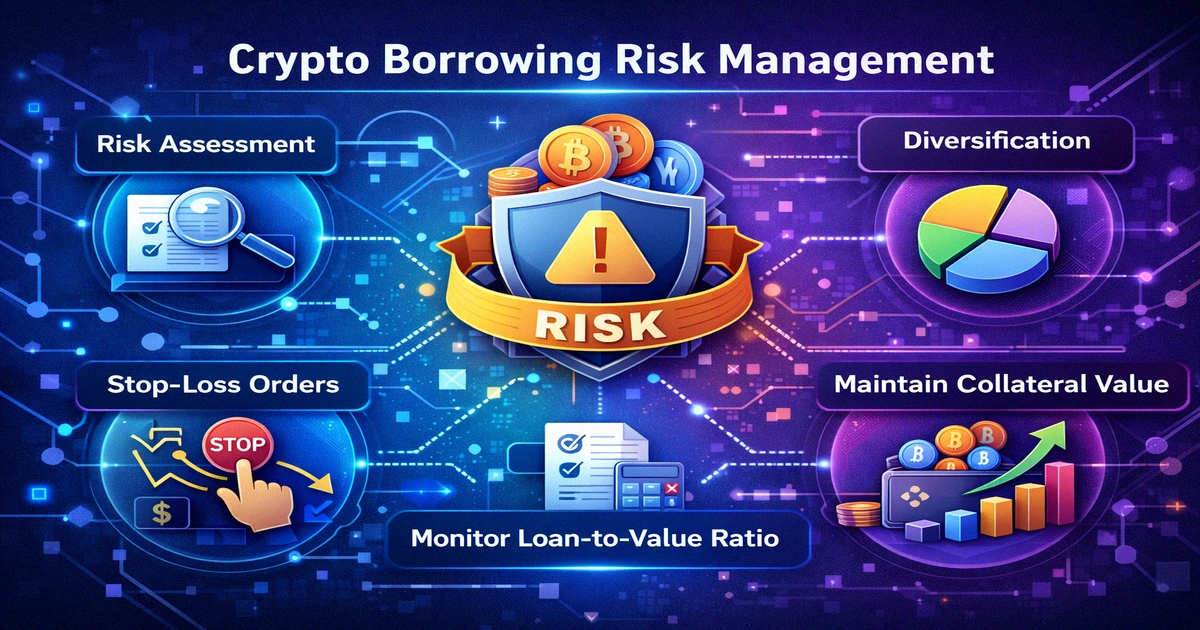
Effective risk management is essential for safe cryptocurrency lending. Understanding and mitigating various risks can protect your assets and ensure a positive borrowing experience.
Primary Risk Categories
Liquidation Risk
The most immediate risk in DeFi borrowing is liquidation, in which your collateral is automatically sold if its value falls below the required threshold.
position protection Strategies:
- Conservative LTV: Borrow only 30-50% of collateral value
- Price Alerts: Set up notifications for collateral price movements
- Additional Collateral: Keep extra crypto ready to add if needed
- Partial Repayment: Reduce loan amount during market downturns
- Diversified Collateral: Use multiple cryptocurrencies to spread risk
Platform Risk
Centralised platforms can face operational issues, while DeFi platforms may be vulnerable to smart contract bugs.
Platform Risk Mitigation:
- Due Diligence: Research platform history and security measures
- Diversification: Don't put all funds on one platform
- Insurance: Choose platforms with comprehensive coverage
- Regular Monitoring: Stay updated on platform developments
- Exit Strategy: Have a plan for quickly repaying loans if needed
Interest Rate Risk
Variable interest rates can increase your borrowing costs, especially in volatile market conditions.
Interest Rate Management:
- Fixed Rates: Choose fixed-rate loans when available
- Rate Monitoring: Track interest rate trends and forecasts
- Early Repayment: Pay off loans before rates increase significantly
- Rate Caps: Look for platforms offering maximum rate limits
Advanced Risk Management
Hedging Strategies
Advanced borrowers can use derivatives to hedge against collateral price movements:
- Put Options: Protect against collateral price drops
- Futures Contracts: Lock in collateral prices
- Perpetual Swaps: Short positions to offset collateral exposure
For example, if you deposit 10 ETH as collateral and borrow $15,000 USDC, you could buy a put option on 10 ETH at a strike price 15% above your liquidation threshold. If ETH drops sharply, the option payout offsets your collateral loss, giving you time to repay or add collateral without being liquidated. On Deribit, a 30-day ETH put option with a strike 15% below spot typically costs 1-2% of the notional value — roughly $100-200 to protect a $30,000 collateral position. This hedge is most valuable during high-volatility periods when liquidation risk spikes, and you can let the option expire unused during calm markets.
Dive deeper into comprehensive risk analysis and advanced protection techniques .
Liquidation Protection Strategies
Protecting yourself from liquidation is the most critical aspect of safe collateralised loans. Understanding liquidation mechanics and implementing protective measures can save you from significant losses.
Understanding Liquidation Mechanics
Liquidation occurs when your collateral value falls below the platform's required threshold. The process varies between CeFi and DeFi platforms:
CeFi Liquidation Process
- Margin Call: Platform notifies you when approaching liquidation
- Grace Period: Time to add collateral or repay loan
- Manual Review: Human oversight may prevent unnecessary liquidations
- Partial Liquidation: Only enough collateral sold to restore health
DeFi Liquidation Process
- Automatic Trigger: Smart contracts execute liquidation immediately
- No Grace Period: Liquidation happens as soon as threshold is reached
- Liquidation Penalty: Additional fees (typically 5-15%)
- MEV Extraction: Bots may front-run liquidations for profit
Proactive Protection Measures
Collateral Ratio Monitoring
Most platforms provide a "health factor" or similar metric indicating your liquidation risk:
- Safety Ratio above 2.0 Very safe, low liquidation risk
- Risk Ratio 1.5-2.0 Moderate risk, monitor closely
- Risk Ratio 1.1-1.5 High risk, consider action
- Risk Ratio below 1.1 Immediate liquidation risk
Automated Protection Tools
- Price Alerts: Notifications when collateral prices drop
- Auto-Repayment: Automatic loan repayment at set thresholds
- Collateral Top-Up: Automatic addition of collateral
- Stop-Loss Orders: Automatic position closure at predetermined levels
Emergency Response Procedures
When liquidation risk increases, you have several options to protect your position:
Immediate Actions
- Add Collateral: Deposit more cryptocurrency to improve collateral ratio
- Partial Repayment: Reduce loan amount to lower risk
- Collateral Swap: Replace volatile assets with stable ones
- Full Repayment: Close position entirely if necessary
Strategic Considerations
- Gas Fees: Factor in transaction costs for DeFi actions
- Market Timing: Consider if price drop is temporary
- Opportunity Cost: Weigh benefits of maintaining position
- Tax Implications: Understand consequences of different actions
Step-by-Step Borrowing Process
Follow this comprehensive guide to safely execute your first crypto-backed loan, whether using CeFi platforms or blockchain protocols.
Pre-Borrowing Preparation
Step 1: Define Your Borrowing Goals
- Purpose: Why do you need the loan? (investment, expenses, leverage)
- Amount: How much do you need to borrow?
- Timeline: How long do you plan to keep the loan?
- Risk Tolerance: How much volatility can you handle?
Step 2: Choose Your Platform Type
- CeFi for Beginners: Easier interface, customer support
- DeFi for Advanced: Better rates, more control
- Hybrid Approach: Use both for diversification
Step 3: Prepare Your Collateral
- Asset Selection: Choose stable, widely-accepted cryptocurrencies
- Amount Calculation: Ensure 150-200% of desired loan amount
- Wallet Setup: Have collateral in compatible wallet
CeFi Borrowing Process
Step 1: Account Setup
- Register on chosen platform (e.g., Nexo)
- Complete KYC verification
- Enable two-factor authentication
- Review terms and conditions
Step 2: Deposit Collateral
- Navigate to deposit section
- Select cryptocurrency to deposit
- Send funds to provided address
- Wait for confirmations
Step 3: Request Loan
- Go to borrowing section
- Select loan currency (USD, EUR, stablecoins)
- Choose loan amount (within LTV limits)
- Review interest rate and terms
- Submit loan application
Step 4: Receive Funds
- Loan approval (usually instant for qualified users)
- Funds deposited to platform account
- Withdraw to external wallet or bank account
DeFi Borrowing Process
Step 1: Wallet Preparation
- Set up compatible wallet (MetaMask, WalletConnect)
- Ensure sufficient ETH for gas fees
- Have collateral tokens in wallet
Step 2: Connect to Protocol
- Visit protocol website (e.g., Aave)
- Connect your wallet
- Review available markets
Step 3: Supply Collateral
- Select asset to supply
- Enter amount to deposit
- Approve token spending (first transaction)
- Confirm supply transaction
Step 4: Borrow Assets
- Navigate to borrow section
- Select asset to borrow
- Choose interest rate type (stable/variable)
- Enter borrow amount
- Confirm borrow transaction
Post-Borrowing Management
- Monitor Risk Metrics: Check daily or set up alerts
- Track Interest: Monitor accruing interest costs
- Plan Repayment: Set aside funds for loan repayment
- Stay Informed: Follow platform updates and market news
Security Best Practices
Implementing robust security practices protects your assets throughout the borrowing process and reduces the risk of loss from technical issues or malicious attacks.
Platform Security
Account Protection
- Strong Passwords: Use unique, complex passwords for each platform
- Two-Factor Authentication: Enable 2FA with authenticator apps
- Withdrawal Whitelisting: Restrict withdrawals to approved addresses
- Regular Monitoring: Check accounts frequently for unauthorised activity
- Secure Communication: Only use official platform channels
Wallet Security
- Hardware Wallets: Use for storing large amounts of collateral
- Hot Wallet Limits: Keep only necessary amounts in connected wallets
- Backup Procedures: Secure seed phrase storage
- Regular Updates: Keep wallet software current
Operational Security
Transaction Verification
- Address Verification: Always double-check recipient addresses
- Amount Confirmation: Verify transaction amounts before signing
- Gas Fee Review: Ensure reasonable gas prices for DeFi transactions
- Contract Interaction: Only interact with verified smart contracts
Information Security
- Private Key Protection: Never share private keys or seed phrases
- Phishing Awareness: Verify website URLs and email senders
- Social Engineering: Be sceptical of unsolicited contact
- Public Wi-Fi: Avoid accessing accounts on public networks
Risk Monitoring
Regular Health Checks
- Daily Monitoring: Check collateral ratios and risk metrics
- Price Alerts: Set notifications for significant price movements
- Platform Updates: Stay informed about platform changes
- Market Analysis: Monitor broader crypto market trends
Emergency Preparedness
- Emergency Funds: Keep additional crypto for collateral top-ups
- Quick Access: Ensure ability to act quickly during market stress
- Multiple Options: Have backup plans for different scenarios
- Contact Information: Know how to reach platform support quickly
Advanced Security Measures
Multi-Signature Security
For large borrowing positions, consider implementing multi-signature security measures that require multiple approvals for significant transactions. This approach provides additional protection against single points of failure and unauthorised access attempts.
- Multi-Sig Wallets: Use wallets requiring multiple signatures for transactions
- Distributed Keys: Store signing keys in separate secure locations
- Threshold Security: Implement M-of-N signature schemes for flexibility
- Recovery Procedures: Establish clear protocols for key recovery
Insurance and Protection
Understanding and utilising available insurance options can provide additional security for your borrowing activities. Many platforms offer various forms of protection, but coverage terms and limitations vary significantly.
- Platform Insurance: Understand what platform insurance covers and excludes
- Third-Party Coverage: Consider additional insurance from specialised providers
- Self-Insurance: Maintain emergency funds as personal insurance
- Coverage Limits: Know the maximum coverage amounts and claim procedures
Regulatory Compliance
Staying compliant with local regulations protects you from legal risks and ensures access to legitimate platforms and services. Regulatory requirements vary by jurisdiction and continue to evolve.
- Tax Obligations: Understand tax implications of borrowing and interest payments
- Reporting Requirements: Know what transactions must be reported to authorities
- Platform Compliance: Use platforms that comply with local regulations
- Legal Consultation: Seek professional advice for significant borrowing activities
Technology Security
Device Security
The devices you use to access borrowing platforms represent critical security points that require careful protection and regular maintenance.
- Dedicated Devices: Consider using dedicated devices for crypto activities
- Operating System Security: Keep OS and security software updated
- Browser Security: Use secure browsers with appropriate extensions
- Mobile Security: Implement strong mobile device security measures
Network Security
Your network security is crucial when accessing borrowing platforms, especially when you interact with DeFi protocols that require direct blockchain transactions.
- VPN Usage: Use reputable VPN services for additional privacy
- Secure Networks: Only access platforms from trusted networks
- DNS Security: Use secure DNS providers to prevent DNS hijacking
- Connection Monitoring: Monitor for unusual network activity
Common Mistakes to Avoid
Learning from common borrowing mistakes can help you avoid significant losses and enhance your overall success with crypto-backed loans.
Collateral Management Mistakes
Overleveraging
You should never borrow the maximum amount your platform allows. If you max out your LTV, you leave no buffer for price volatility, and your position can get liquidated quickly. You must borrow only 30-50% of maximum LTV to maintain a safety margin.
Inadequate Diversification
You should avoid using only one type of cryptocurrency as collateral, because your concentrated risk increases dramatically if that specific asset crashes. You can protect yourself by diversifying your collateral across multiple cryptocurrencies with different risk profiles.
Ignoring Correlation
You must not assume that holding multiple tokens equals diversification — if your collateral assets are highly correlated, they will all drop simultaneously during market downturns. You should choose assets with genuinely different risk profiles and use cases to spread your exposure.
Platform Selection Mistakes
Chasing High LTV Ratios
You should not choose platforms solely based on the highest loan-to-value ratios, as unusually high LTV can indicate inadequate risk management or an unsustainable business model. You must prioritise platform security, reputation, and sustainability over maximum LTV when selecting your borrowing provider.
Ignoring Fine Print
You must read all terms and conditions thoroughly before committing your collateral, because hidden fees, unfavourable liquidation terms, or restrictive conditions can significantly impact your returns. You should pay special attention to liquidation procedures and fee structures in every agreement.
Risk Management Mistakes
No Monitoring System
You should never set up loans and forget about them, because market volatility can quickly push your positions towards liquidation. You must implement daily monitoring and automated alerts to stay on top of your collateral health at all times.
Panic Decisions
You must avoid making hasty decisions during market stress, as emotional reactions often lead to unnecessary losses. You should prepare action plans in advance for different market scenarios so you can respond calmly when volatility strikes.
Technical Mistakes
Insufficient Gas Fees
You must set appropriate gas fees for urgent DeFi transactions, because setting them too low can cause your transactions to fail or be delayed during critical moments. You should always use higher gas fees for emergency operations like adding collateral during a market crash.
Wrong Network Usage
You must always verify network compatibility before sending any transaction, because sending tokens to the wrong blockchain network can result in permanent loss of your funds. You should double-check the destination chain and contract address every time you transfer collateral.
Advanced Borrowing Strategies
Once you've mastered basic digital asset loans, these advanced strategies can help optimise your positions and potentially increase returns while managing risks.
Leveraged Investing
Use borrowed funds to increase your cryptocurrency exposure, amplifying both potential gains and losses.
Strategy Implementation
- Deposit cryptocurrency as collateral
- Borrow stablecoins against collateral
- Use borrowed funds to buy more cryptocurrency
- Repeat process for additional leverage (carefully)
Risk Considerations
- Amplified Losses: Leverage magnifies both gains and losses
- Liquidation Risk: Higher leverage increases liquidation probability
- Interest Costs: Borrowed funds accrue interest regardless of performance
- Market Timing: Strategy works best in bull markets
Yield Farming with Borrowed Assets
You can borrow assets to participate in high-yield smart contract platforms, potentially earning more than your borrowing costs if you manage the risks carefully.
Implementation Steps
- Identify high-yield farming opportunities
- Calculate potential returns vs borrowing costs
- Borrow required assets for farming
- Monitor yields and adjust positions as needed
Key Risks
- Impermanent Loss: Liquidity provision risks
- Smart Contract Risk: Protocol vulnerabilities
- Yield Volatility: Farming returns can change rapidly
- Gas Costs: Transaction fees can erode profits
Cross-Platform Arbitrage
You can exploit interest rate differences between platforms by borrowing on low-rate platforms and lending on high-rate ones to capture the spread.
Arbitrage Process
- Identify rate spreads between platforms
- Borrow at lower rates
- Lend at higher rates
- Profit from the spread
Execution Challenges
- Rate Changes: Spreads can disappear quickly
- Platform Risk: Exposure to multiple platforms
- Liquidity Risk: May not be able to withdraw when needed
- Complexity: Requires active management
Tax optimisation Strategies
You should structure your borrowing to minimise tax implications while achieving your financial goals through these approaches.
Tax-Efficient Approaches
- Avoid Selling: Borrow instead of selling to avoid capital gains
- Interest Deductions: Potentially deduct borrowing costs
- Timing Strategies: Coordinate with tax year planning
- Jurisdiction Shopping: Consider regulatory differences
Important: Always consult with tax professionals for advice specific to your situation and jurisdiction.
Market Dynamics and Economic Factors
Regulatory Environment in 2025
The EU's MiCA framework now requires CeFi lending platforms operating in Europe to maintain minimum capital reserves, segregate user funds, and publish audited reserve reports. For borrowers, this means CeFi platforms licensed under MiCA (like Nexo) must return your collateral even if the company faces financial difficulties — a protection that did not exist when Celsius collapsed in 2022. In the US, the SEC has provided clearer guidance distinguishing DeFi lending from securities, which reduces the regulatory uncertainty that previously made some protocols hesitant to serve US users.
How Institutional Adoption Affects Your Borrowing Costs
When large institutions (pension funds, family offices, corporate treasuries) deposit billions into Aave or Compound, the increased supply of lendable assets pushes borrow rates down. Aave's USDC borrow rate dropped from approximately 8% in early 2024 to 4-6% in 2025 partly because of institutional supply growth. If you borrow during periods of high institutional liquidity, you pay less interest — check protocol utilisation rates before opening a position, as rates spike when utilisation exceeds 80%.
Technology Changes That Improve Safety
Three innovations in 2025 directly reduce your liquidation risk. First, automated collateral top-up services (offered by DeFi Saver, Instadapp) can automatically add collateral from a reserve wallet when your health factor drops below a threshold you set. Second, cross-chain collateral protocols let you use ETH on Ethereum as collateral for a loan on Arbitrum, which can reduce gas costs by 90% during emergency collateral additions. Third, real-time oracle improvements (Chainlink's low-latency feeds) have reduced the window during which a price lag could trigger unfair liquidations from minutes to under 10 seconds.
Technical Implementation and Advanced Strategies
Before attempting advanced strategies like recursive borrowing or cross-protocol arbitrage, you should have at least 3 months of experience managing a basic collateralised position. The complexity of multi-step strategies multiplies your risk — a single failed transaction during a market crash can cascade into full liquidation if you cannot add collateral quickly enough.
Choosing Your Chain: Cost vs Speed vs Liquidity
Aave V3 on Ethereum mainnet has the deepest liquidity (over $5 billion TVL) but gas fees for collateral operations can reach $20-50 during congestion. Aave on Arbitrum offers the same interface with gas fees under $0.50, but liquidity is roughly 10x smaller — which means large loans ($100K+) may face slippage during liquidation. For positions under $50,000, Arbitrum or Optimism provides the best cost-to-safety ratio. For larger positions, Ethereum mainnet's deeper liquidity pools give you better protection during cascading liquidation events.
Smart Contract Risks You Must Understand
Even audited protocols carry residual smart contract risk. Aave V3 has been audited by 6+ firms, but no audit guarantees zero bugs. You can mitigate this by checking whether the protocol has active insurance coverage through Nexus Mutual or InsurAce — Aave cover typically costs 2-3% annually on your deposited collateral. For positions above $50,000, the cost of smart contract insurance is a reasonable expense relative to the total amount at risk.
Institutional Crypto Borrowing and Professional Treasury Management
Corporate Treasury Use Case
If your company holds BTC or ETH on its balance sheet, crypto borrowing can fund operational expenses without triggering a taxable disposal. For example, a company holding 100 BTC ($6.5M at current prices) could borrow $1.5M USDC at 30% LTV through Nexo's institutional desk, paying approximately 5-8% APR while maintaining full BTC upside exposure. The interest cost is typically deductible as a business expense — consult your tax adviser for jurisdiction-specific treatment.
Institutional Custody Requirements
Institutional borrowers should use platforms with segregated custody (Nexo uses Ledger Vault and Bakkt) and require proof-of-reserves attestations. For DeFi borrowing at institutional scale, multi-signature wallets (Gnosis Safe with 3-of-5 signer setup) protect against single-key compromise. Fireblocks and Copper provide institutional-grade DeFi access with policy engines that enforce LTV limits, whitelisted protocols, and spending controls before any transaction reaches the blockchain.
Multi-Jurisdiction Compliance
If you borrow across multiple jurisdictions, tax and regulatory treatment varies significantly. In the EU under MiCA, crypto-backed loans from licensed platforms have defined consumer protections. In the US, the IRS does not treat borrowing as a taxable event, but interest payments may create reporting obligations. In the UK, HMRC guidance suggests crypto loans are not disposals for CGT purposes but interest may be deductible against income. You should work with a cross-border tax specialist before implementing multi-jurisdiction borrowing strategies.
Conclusion
Crypto borrowing lets you access liquidity without selling — but only if you manage the risks that have bankrupted both platforms and individual borrowers. The three rules that matter most: never borrow above 50% LTV on volatile collateral (ETH, BTC), monitor your health factor daily or set automated alerts, and split your borrowing across at least two platforms so that a single platform failure does not wipe out your entire position.
If you are borrowing for the first time, start with a small test position. Deposit $500 in ETH on Aave, borrow $150 in USDC (30% LTV), and watch how your health factor moves over a week as ETH price fluctuates. This costs you roughly $0.17 in daily interest but teaches you more about liquidation mechanics than any guide can. Once you understand how collateral ratios behave in a live market, scale up gradually — first to $1,000, then $5,000, only increasing once each level feels comfortable.
For CeFi borrowers, Nexo offers the strongest combination of insurance ($775M via Lloyd's), regulatory coverage (EU, UK, US), and operational track record (zero downtime through the 2022 crisis). For DeFi borrowers, Aave V3 on Ethereum or Arbitrum provides the deepest liquidity, the most audited codebase, and the most transparent risk parameters. Compound V3 is a strong alternative with simpler mechanics but fewer supported assets. For borrowers who want the lowest rates and are comfortable with DeFi, Spark Protocol (formerly MakerDAO) charges just 1% on DAI loans against ETH collateral — the cheapest major-platform rate available.
The biggest risk in 2025 is not liquidation — it is complacency. Borrowers who set up positions and forget about them during quiet markets get liquidated when volatility returns. Set your price alerts at 20% above your liquidation threshold, keep emergency collateral ready in a separate wallet, and review your positions weekly. If you follow these practices, crypto borrowing becomes a practical tool for tax-efficient liquidity access rather than a leveraged gamble.
Consider the tax angle carefully: in the UK, borrowing against crypto is not a taxable event, whilst selling triggers Capital Gains Tax at 10% or 24% (on gains above the £3,000 annual allowance as of 2024/25). For someone holding appreciated BTC or ETH, borrowing stablecoins at 5% APR can be significantly cheaper than selling, paying 24% CGT, and rebuying later. This calculation depends on your cost basis, holding period, and the interest rate — run the numbers for your specific situation before committing.
A practical borrowing checklist before every position: (1) calculate your liquidation price and set an alert 20% above it, (2) verify the platform's audit status on DefiLlama or the platform's security page, (3) check the current borrow rate and whether it is variable or fixed, (4) confirm your collateral type is supported and understand its specific liquidation penalty (Aave charges 5% on ETH, 6.5% on altcoins; MakerDAO charges 13%), (5) ensure you have emergency collateral worth at least 20% of your borrowed amount accessible in a separate wallet. If any of these steps reveals a concern, reduce your borrowing amount until the risk is comfortable.
The crypto lending market in 2026 is fundamentally safer than it was in 2022. The platforms that survived the collapse — Aave, Compound, Nexo, MakerDAO — proved their risk management through the worst downturn in crypto history. New regulations under MiCA in Europe and evolving SEC guidance in the US are adding institutional-grade requirements that further protect borrowers. But no amount of regulation eliminates the core risk of overcollateralised lending: if your collateral drops faster than you can respond, you will be liquidated. Treat every borrowing position as a risk that requires active management, and you will find crypto lending a powerful addition to your financial toolkit.
Sources & References
Frequently Asked Questions
- How does cryptocurrency lending work?
- DeFi borrowing works by depositing cryptocurrency as collateral to secure a loan. Most crypto loans are overcollateralized, meaning you must deposit more value than you borrow. The collateral is locked in smart contracts or held by the platform until you repay the loan, plus interest.
- What are the risks of borrowing crypto?
- Main risks include liquidation if collateral value drops, smart contract vulnerabilities in decentralised protocols, platform risks with centralised lenders, interest rate volatility, and regulatory changes. Always understand liquidation thresholds and maintain healthy collateral ratios.
- Which platforms are safest for collateralised loans?
- Established platforms like Nexo, Aave, and Compound are considered safer options. Nexo offers regulated CeFi lending, while Aave and Compound provide battle-tested decentralised protocols. Always research platform security, insurance coverage, and track record before borrowing.
- What is a safe loan-to-value ratio for digital asset loans?
- A safe LTV ratio is typically 30-50% for volatile cryptocurrencies. This provides a buffer against price drops and reduces the risk of liquidation. Conservative borrowers often use 25-30% LTV, while more aggressive strategies might use up to 60-70% with active monitoring.
- Can I lose more than my collateral in cryptocurrency lending?
- In most cases, you cannot lose more than your collateral. Crypto loans are typically non-recourse, meaning the lender can only claim your collateral. However, some platforms may have additional terms, so always read the fine print carefully.
- How quickly can liquidation happen?
- Liquidation speed varies by platform type. DeFi platforms can liquidate positions within minutes or even seconds when thresholds are reached. CeFi platforms often provide margin calls and grace periods, giving you time to add collateral or repay the loan.
- What happens if a lending platform fails?
- Platform failure risks differ between CeFi and DeFi. With CeFi platforms, you may lose access to funds if the company fails, though some offer insurance. Blockchain protocols are generally more resilient as they operate on blockchain technology, but smart contract bugs can still cause significant losses.
- Are crypto loans taxable?
- Tax treatment varies by jurisdiction. In many countries, borrowing cryptocurrency is not a taxable event; however, using borrowed funds for investments or business purposes may be subject to tax. Interest payments might be deductible in some cases. Always consult with tax professionals for advice specific to your situation.
- What's the difference between secured and unsecured crypto loans?
- Secured crypto loans require collateral (most common), while unsecured loans rely on creditworthiness. Secured loans offer better rates and are more widely available, but require locking up crypto assets. Unsecured loans are rare and typically available only to institutional borrowers or those with an excellent credit history.
- Can I use borrowed crypto for staking or yield farming?
- Yes, but this significantly increases risk. Using borrowed funds for staking or DeFi activities can amplify both gains and losses. Consider the combined risks of liquidation, smart contract failures, and market volatility. Only experienced users should attempt such strategies, and never with funds you can't afford to lose entirely.
← Back to Crypto Investing Blog Index
Financial Disclaimer
This content is not financial advice. All information provided is for educational purposes only. Cryptocurrency investments carry significant investment risk, and past performance does not guarantee future results. Always do your own research and consult a qualified financial advisor before making investment decisions.