Stablecoin Borrowing Strategies
Discover profitable borrowing strategies. Learn why and how to borrow USDC, USDT, and DAI for yield farming, arbitrage, and leverage trading in 2025.
Introduction
Stablecoin borrowing lets you access dollars without selling your crypto. You deposit ETH or BTC as collateral, borrow USDC or DAI at a variable rate (currently 3-8% APR across major protocols), and your debt stays fixed in dollar terms. If you hold 10 ETH worth $20,000 and need $10,000, borrowing USDC means you keep full ETH exposure, avoid triggering capital gains tax, and owe a predictable amount regardless of how ETH's price moves.
The concrete numbers: Aave V3 charges 4.5-6% variable APR on USDC borrows as of early 2026, with a minimum health factor of 1.0 (liquidation begins below this threshold). Maker/Spark Protocol offers DAI at 3.5-5% with a 150% minimum collateralisation ratio. Compound V3 charges 4-7% on USDC. Each platform has different liquidation penalties -- Aave takes 5% of your collateral, Maker takes 13%, and Compound takes 5-8%. These penalties are your real cost of getting the position wrong.
The most popular advanced strategy is the yield loop: deposit ETH as collateral, borrow USDC at 5% APR, then lend that USDC on another platform at 8% APR. Your net spread is 3% on the borrowed amount, plus you keep your ETH exposure. Here is a worked example: deposit 10 ETH ($20,000), borrow 10,000 USDC at 5% ($500/year cost), lend USDC on Aave at 8% ($800/year income). Net profit: $300/year, plus any ETH appreciation. The risk: if ETH drops 40%, your health factor plummets and you face liquidation on the original borrow.
This guide covers platform-by-platform rate comparisons, step-by-step loop strategy implementation, liquidation risk calculations, and the tax implications of borrowing versus selling. We examine both conservative approaches (low LTV, single-platform) and aggressive strategies (recursive leveraging, cross-protocol arbitrage) with honest risk assessments for each.
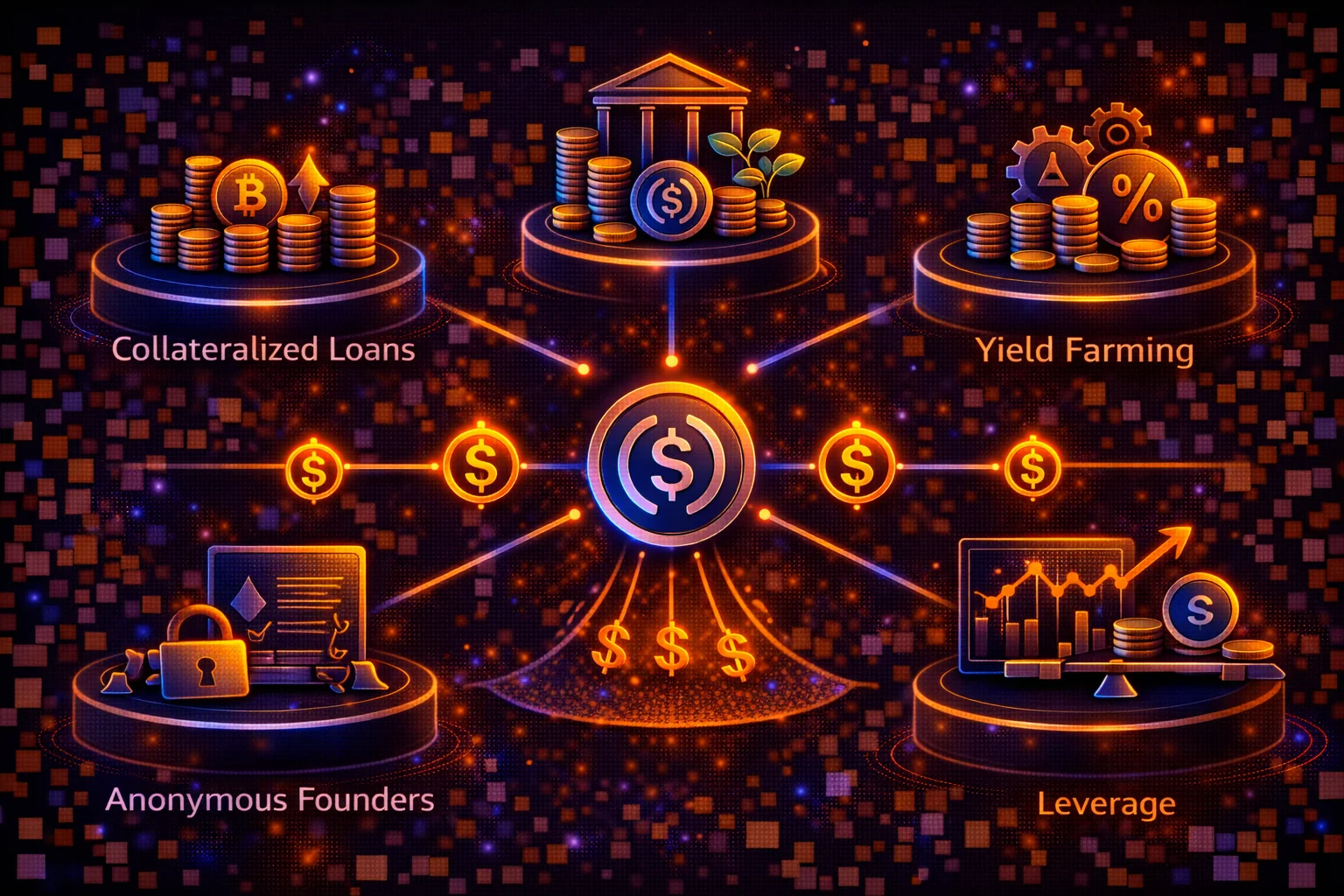
Key Advantages of Stablecoin Lending
1. Predictable Debt Amount
Your debt remains stable in dollar terms:
- Borrow 10,000 USDC = always owe 10,000 USDC
- No debt increase from price volatility
- Easy to plan repayment
- Reduced liquidation risk
2. Lower Liquidation Risk
Stable debt + volatile collateral = safer position:
- Only collateral price matters for liquidation
- Debt doesn't grow with market movements
- More predictable health factor
- Easier to manage risk
3. Real-World Utility
Stablecoins can be used for everyday expenses:
- Convert to fiat easily (1:1 ratio)
- Pay bills and expenses
- Business operations
- Emergency liquidity
4. Yield Farming Opportunities
Deploy borrowed funds for yield:
- Lend on other platforms
- Provide liquidity to DEXs
- Stake in yield protocols
- Arbitrage opportunities
Common Use Cases
Leverage Without Volatility Risk
Maintain crypto exposure while accessing liquidity:
        Scenario: You hold 10 ETH ($20,000) and need $10,000 cash

        Option 1 - Sell 5 ETH:
        - Lose 50% of ETH exposure
        - Pay capital gains tax
        - Miss future ETH gains

        Option 2 - Borrow 10,000 USDC:
        - Keep all 10 ETH
        - No capital gains tax
        - Maintain full ETH exposure
        - Debt stays at $10,000
Yield Farming Leverage
Amplify returns through borrowed funds:
        1. Deposit 10 ETH as collateral
        2. Borrow 10,000 USDC at 5% APR
        3. Lend USDC on Aave at 8% APR
        4. Net profit: 8% - 5% = 3% on borrowed amount
        5. Plus: Keep ETH exposure and potential gains
Tax optimisation
Access liquidity without triggering capital gains:
- Borrow instead of selling appreciated crypto
- Defer taxes indefinitely
- Maintain long-term holding period
- No taxable event until liquidation
Stablecoin Loans vs Volatile Crypto
| Factor | Stablecoin Loans | Volatile Crypto Borrowing |
|---|---|---|
| Debt Stability | Fixed in USD terms | Fluctuates with price |
| Liquidation Risk | Lower (only collateral moves) | Higher (both sides move) |
| Use Cases | Expenses, yield farming | Speculation, leverage |
| Complexity | Simpler to manage | More complex |
| Interest Rates | 3-8% typically | Varies widely |
Who Should Borrow Stablecoins?
Ideal For:
- Long-term holders: Want liquidity without selling
- Yield farmers: Need capital for farming strategies
- Risk-averse users: Prefer predictable debt
- Tax optimisers: Defer capital gains
- Business owners: Need working capital
Not Ideal For:
- Speculators seeking leverage on volatile assets
- Users with low-value collateral (fees eat profits)
- Those unable to monitor positions
- Users in bear markets (collateral depreciation risk)
Stablecoin lending is a powerful tool for accessing liquidity while maintaining crypto exposure. The key is understanding when and how to use it effectively.
Advanced Stablecoin Lending Strategies
Delta-Neutral Farming
Delta-neutral farming involves borrowing stablecoins against crypto collateral while simultaneously shorting the same crypto asset. This strategy aims to capture yield farming rewards while minimising price exposure.
How Delta-Neutral Works
- Deposit ETH as collateral on Aave
- Borrow USDC against ETH
- Short ETH on a derivatives platform
- Farm yield with borrowed USDC
- Profit from farming regardless of ETH price movement
Benefits of Delta-Neutral Strategy
- Reduced exposure to crypto volatility
- Consistent yield generation
- Capital efficiency through leverage
- Protection against market downturns
Risks and Considerations
- Funding costs on short positions
- Complexity of managing multiple positions
- Smart contract risks across platforms
- Potential liquidation if positions move against you
Cross-Chain Arbitrage
Cross-chain arbitrage involves borrowing stablecoins on one blockchain and lending or farming on another to capture rate differentials.
Popular Cross-Chain Opportunities
- Ethereum to Polygon rate arbitrage
- Avalanche to BSC yield differences
- Arbitrum to Optimism farming rates
- Solana to Ethereum DeFi yields
Cross-Chain Execution Steps
- Identify rate differential between chains
- Borrow stablecoins on lower-rate chain
- Bridge tokens to higher-yield chain
- Deploy capital in higher-yielding protocol
- Monitor and rebalance as needed
Leveraged Staking Strategies
Leveraged staking involves borrowing stablecoins to purchase more staking assets, amplifying potential rewards while increasing risk.
Liquid Staking Leverage
- Deposit ETH, receive stETH from Lido
- Use stETH as collateral to borrow USDC
- Buy more ETH with borrowed USDC
- Stake additional ETH for more stETH
- Repeat process for desired leverage
Risk Management for Leveraged Staking
- Monitor stETH/ETH peg closely
- Maintain conservative loan-to-value ratios
- Set up automated liquidation protection
- Have exit strategy for market downturns
Tax Implications of Stablecoin Loans
Borrowing Events
In most jurisdictions, borrowing stablecoins is not considered a taxable event. However, tax implications arise from how you use the borrowed funds and when you repay the loan.
Non-Taxable Borrowing Activities
- Taking out a stablecoin loan against crypto collateral
- Receiving borrowed stablecoins in your wallet
- Holding the borrowed funds without trading
- Repaying the loan with the same stablecoin type
Potentially Taxable Activities
- Converting borrowed funds to other cryptocurrencies
- Using borrowed funds for yield farming (income generation)
- Arbitrage trading with borrowed funds
- Repaying loans with different assets than borrowed
Yield Farming Tax Considerations
When you use borrowed stablecoins for yield farming, the rewards you earn are typically considered taxable income at the time of receipt.
Income Recognition
- Farming rewards taxed as ordinary income
- Value determined at time of receipt
- Must track all reward tokens received
- Consider quarterly estimated tax payments
Deductible Expenses
- Interest paid on borrowed stablecoins
- Gas fees for DeFi transactions
- Platform fees and commissions
- Professional tax preparation costs
Record Keeping Requirements
Proper documentation is crucial for accurate tax reporting and potential audits.
Essential Records to Maintain
- Loan origination dates and amounts
- Interest rates and payment schedules
- Collateral deposit and withdrawal records
- All yield farming transactions and rewards
- Gas fees and transaction costs
- Liquidation events and losses
Recommended Tools
- Koinly for automated DeFi tracking
- CoinTracker for comprehensive reporting
- Blockpit for European tax compliance
- Manual spreadsheets for detailed control
Market Analysis and Trends
Stablecoin Market Evolution
The stablecoin market has experienced significant growth and regulatory clarity in 2025, creating new opportunities for borrowing strategies.
Market Size and Growth
- Total stablecoin market cap exceeds $200 billion
- USDC maintains the largest market share at 35%
- USDT remains dominant for trading at 40%
- DAI and other decentralised stablecoins grow to 15%
- New regulatory-compliant stablecoins emerge
Regulatory Developments
- EU MiCA regulation provides clarity for stablecoins
- US stablecoin legislation creates framework
- Reserve requirements standardised globally
- Increased transparency in backing assets
Interest Rate Environment
The 2025 interest rate environment significantly impacts stablecoin lending strategies and their profitability.
Current Rate Landscape
- DeFi borrowing rates: 3-8% APR for stablecoins
- CeFi lending rates: 5-12% APR depending on platform
- Traditional finance rates: 4-6% for comparable products
- Yield farming opportunities: 8-25% APR in established protocols
Rate Volatility Factors
- Federal Reserve policy changes
- DeFi protocol utilisation rates
- Market demand for leverage
- Regulatory uncertainty periods
- Major market events and volatility
Platform Competition and Innovation
Increased competition amongst lending platforms has led to better rates and features for borrowers in 2025.
New Platform Features
- Automated liquidation protection systems
- Dynamic interest rate optimisation
- Cross-chain borrowing capabilities
- Integrated yield farming strategies
- Advanced risk management tools
Emerging Competitors
- Traditional banks entering DeFi space
- New Layer 2 native lending protocols
- Cross-chain specialised platforms
- AI-powered risk assessment tools
Real-World Case Studies
Case Study 1: Conservative Yield Strategy
Sarah, a risk-averse investor, used stablecoin loans to generate steady income while maintaining her ETH position during a bull market.
Strategy Execution
- Deposited 10 ETH ($25,000) as collateral on Aave
- Borrowed 15,000 USDC at 50% LTV ratio
- Lent USDC on Compound at 8% APR
- Paid 5% APR on borrowed USDC
- Net yield: 3% APR on borrowed amount
Results After 12 Months
- Earned $450 in net interest (3% of $15,000)
- ETH appreciated 40% during the period
- Total portfolio gain: $10,450 ($10,000 ETH + $450 yield)
- Maintained full ETH exposure while earning additional yield
Case Study 2: Aggressive Leverage Strategy
Mike, an experienced DeFi user, employed leveraged yield farming to maximise returns during favourable market conditions.
Strategy Execution
- Started with 5 ETH ($12,500) as initial capital
- Used recursive borrowing to achieve 3x leverage
- Final position: 15 ETH equivalent exposure
- Farmed high-yield pools with borrowed stablecoins
- Average farming yield: 20% APR
Risk Management Measures
- Set stop-loss at 15% ETH price decline
- Maintained health factor above 2.0
- Diversified across three different protocols
- Monitored positions daily for changes
Results After 6 Months
- Earned $3,750 from yield farming (20% APR on leveraged capital)
- Paid $1,125 in borrowing costs (6% APR average)
- Net profit: $2,625 before gas fees
- Successfully managed through two market corrections
Case Study 3: Arbitrage Opportunity
Lisa identified and exploited a temporary rate differential between Ethereum and Polygon networks.
Opportunity Identification
- Ethereum USDC borrowing rate: 4% APR
- Polygon USDC lending rate: 12% APR
- Rate differential: 8% APR potential profit
- Bridge costs: 0.1% per transaction
Execution Process
- Borrowed 50,000 USDC on Ethereum at 4% APR
- Bridged to Polygon using official bridge
- Lent USDC on Polygon at 12% APR
- Monitored rates for convergence signal
- Unwound position after 3 months
Final Results
- Gross profit: $1,000 (8% APR for 3 months)
- Bridge costs: $100 (0.2% round trip)
- Gas fees: $150 (multiple transactions)
- Net profit: $750 over 3 months
- Annualised return: 6% on deployed capital
Stablecoin Borrowing Strategies
1. Yield Farming Leverage: Mainnet vs L2 Economics
The profitability of borrowing stablecoins to farm yield depends entirely on where you execute. On Ethereum mainnet, gas costs for a full cycle (deposit collateral → borrow USDC → deposit into Curve pool → claim rewards → repay) total approximately £40-120 depending on network congestion. On Arbitrum, the same sequence costs under £1. This means mainnet yield farming is only viable for positions above £10,000, whilst Arbitrum positions as small as £1,000 can generate meaningful net returns.
A concrete Arbitrum example: deposit 3 ETH (£9,000) on Aave V3 Arbitrum, borrow 4,500 USDC (50% LTV, safe buffer). Deploy the USDC into a Curve stablecoin pool on Arbitrum earning 4-7% APY in trading fees. Gas cost for the entire setup: approximately £0.80. Annual yield on borrowed USDC: £180-315. Annual borrow cost at 3-4% variable: £135-180. Net profit: £45-135 per year, plus you retain full ETH exposure. Modest returns, but the risk-reward is favourable because stablecoin LP positions have near-zero impermanent loss.
2. Stablecoin LP: Concentrated vs Full-Range
Uniswap V3 and Curve V2 support concentrated liquidity, where you provide liquidity within a specific price range rather than across the full spectrum. For stablecoin pairs (USDC/USDT, USDC/DAI), concentrating your liquidity within a 0.999-1.001 range captures the vast majority of trading fees whilst using capital 10-50x more efficiently than a full-range position. The trade-off: if either stablecoin depegs beyond your range, your LP position becomes 100% the depegging token and earns zero fees until it returns to range.
In practice, USDC/USDT has traded within 0.998-1.002 for 99% of days since 2023. The March 2023 USDC depeg (briefly to $0.87 after the Silicon Valley Bank collapse) was the major exception — concentrated LP positions in USDC/USDT were pushed entirely into USDC during the depeg, resulting in a temporary 13% unrealised loss before full recovery within 3 days. For stablecoin LP, concentrated liquidity is higher reward with a rare but painful tail risk.
3. Funding Rate Arbitrage with Borrowed Stablecoins
When Bitcoin perpetual futures funding rates are strongly positive (above 0.03% per 8 hours, roughly 33% annualised), you can borrow USDC, buy spot BTC, and short BTC perpetual futures for the same notional amount. The funding payments from the short position cover your borrowing cost and generate profit, whilst the long spot and short futures positions cancel out directionally. This is a market-neutral strategy — price movement does not matter because your spot and futures positions offset each other.
Realistic returns: funding rates average 10-30% annualised during bull markets, dropping to 0-5% in bear markets. After deducting 3-5% borrow cost and 0.05% per trade in exchange fees, the net yield is typically 5-20% annualised during favourable conditions. The risk: funding rates can turn negative (shorts pay longs), making the position unprofitable. Monitor funding on CoinGlass and close the position when rates compress below your borrow cost.
4. Accessing Fiat Without Selling: The UK Tax Advantage
For UK higher-rate taxpayers, borrowing stablecoins and converting to GBP avoids a CGT disposal event that selling crypto would trigger. If you hold 5 ETH bought at £1,000 each (cost basis £5,000) now worth £15,000, selling £5,000 worth of ETH triggers a £3,333 capital gain (selling 1.67 ETH at £3,000 minus £1,000 cost per token). At 24% CGT rate after the £3,000 allowance: approximately £80 in tax. Borrowing £5,000 against the same ETH on Nexo at 5.9% APR costs £295/year in interest — more expensive if the loan runs a full year, but no tax event is created and the ETH is preserved for future appreciation.
The break-even calculation: borrowing is tax-efficient when the expected appreciation on the retained crypto exceeds the net interest cost. If ETH appreciates 10% during the year, the £1,000 gain on the retained 1.67 ETH exceeds the £295 interest cost, making borrowing the better financial decision even before accounting for the CGT saved.
Yield Farming with Borrowed Stablecoins
Strategy Example
Step 1: Deposit Collateral
- Deposit 10 ETH ($20,000) on Aave
- LTV: 75% = can borrow $15,000

Step 2: Borrow Stablecoins
- Borrow 10,000 USDC at 5% APR
- Keep safe LTV (50%)

Step 3: Deploy to Yield Farm
- Lend USDC on Curve at 12% APY
- Or provide liquidity to the USDC/USDT pool

Step 4: Calculate Returns
- Earn: 12% on $10,000 = $1,200/year
- Pay: 5% on $10,000 = $500/year
- Net profit: $700/year (7% on borrowed capital)
- Plus: Keep ETH exposure
Best Platforms for Stablecoin Yield
- Curve Finance: 5-15% APY on stablecoin pools
- Aave: 3-8% APY on USDC/USDT
- Compound: 4-10% APY
- Yearn Finance: Automated yield optimisation
Risks
- Smart contract risk on yield platform
- Yield rates can drop
- Collateral price decline = liquidation
- Gas fees eat small profits
Stablecoin Arbitrage Opportunities
Depeg Arbitrage: Real Historical Examples
Stablecoin depegs are rare but profitable for prepared investors. The March 2023 USDC depeg is the most instructive example: when Silicon Valley Bank (which held $3.3 billion of Circle's USDC reserves) was seized by the FDIC on 10 March 2023, USDC traded as low as $0.87 on decentralised exchanges. Investors who bought USDC at $0.88-0.93 on Saturday (when Circle had confirmed the reserves were safe but markets had not yet recovered) saw USDC return to $1.00 by Monday morning — a 7-13% gain in 48 hours on a stablecoin.
The risk: depegs can be permanent. UST (TerraUSD) depegged in May 2022 and never recovered, going to effectively zero. The difference: USDC is backed by real reserves (cash + US Treasuries, audited monthly by Deloitte), whilst UST was algorithmic (backed by nothing but code). Before buying any depegged stablecoin, verify that the backing reserves are intact and the depeg is driven by panic rather than a structural failure.
Cross-Exchange Arbitrage
Stablecoin prices vary by 0.1-0.5% across exchanges during normal conditions and 1-3% during volatility spikes. The opportunity: buy USDC at $0.998 on one exchange and sell at $1.002 on another. The reality: after withdrawal fees ($1-25 depending on network), exchange trading fees (0.1-0.3%), and blockchain confirmation times (1-60 minutes), most retail-accessible arbitrage opportunities are too small to profit from. Automated bots capture these spreads within seconds. For manual arbitrage to work, you need either very large positions (£50,000+) or significant depeg events where spreads exceed 1%.
Yield Arbitrage
Move capital to highest yields:
- Borrow USDC at 5% on Platform A
- Lend USDC at 10% on Platform B
- Net: 5% profit
Best Platforms for Stablecoin Borrowing
Aave - Best Overall
- Rates: 3-8% APR for USDC/USDT
- LTV: Up to 90% for stablecoin collateral
- Chains: Ethereum, Polygon, Arbitrum, Optimism
- Liquidity: Billions in stablecoin pools
Compound - Simple & Reliable
- Rates: 4-10% APR
- LTV: Up to 85%
- Pros: Simple interface, established protocol
- Cons: Lower liquidity than Aave
Nexo - CeFi Option
- Rates: 5-12% APR
- LTV: Up to 90%
- Pros: No gas fees, customer support
- Cons: Custodial, KYC required
Risks and Considerations
Stablecoin borrowing carries a deceptively calm risk profile that lulls many investors into complacency. Because the borrowed asset (USDC, USDT, or DAI) maintains a roughly stable dollar value, borrowers focus exclusively on the yield arithmetic and forget that their collateral — typically ETH or BTC — can drop 30-50% in a matter of days. The March 2025 correction saw ETH fall from £3,200 to £2,480 in 72 hours, pushing thousands of stablecoin borrowing positions past their liquidation thresholds. Borrowers who had calculated their LTV ratios during calm markets found themselves scrambling to add collateral or watching their positions dissolve into forced sales with 5-13% liquidation penalties on top of the price decline.
The hidden cost of stablecoin borrowing that most guides understate is the psychological burden of maintaining a leveraged position through volatile markets. Even with a conservative 40% LTV, a 30% crash in your collateral pushes your effective LTV to 57%, which is uncomfortably close to liquidation thresholds on many platforms. During that 72-hour March 2025 correction, borrowers on Aave needed to either top up collateral (requiring available funds at the worst possible moment) or partially repay their loans (requiring stablecoin liquidity that might be locked in a yield farming position). The compounding stress of simultaneous collateral decline and potential liquidation across multiple protocols is something no spreadsheet can capture, and it drives many borrowers to close positions at the worst possible time.
UK borrowers face an additional structural consideration: the timing mismatch between borrowing costs and tax obligations. If you borrow £10,000 in USDC against ETH collateral and deploy it into a Curve pool earning 5% over twelve months, you have earned £500 in gross yield. From this, you deduct the 3-4% borrowing cost (£300-400), gas fees (£5-50 depending on network), and the 20-40% income tax on the gross yield (£100-200 for a basic or higher rate taxpayer). The net after-tax profit on a £10,000 stablecoin borrowing strategy, executed conservatively, is often £50-150 per year. That is a 0.5-1.5% net return on borrowed capital, achieved while bearing liquidation risk on your collateral. The arithmetic only becomes compelling at scale (above £50,000 deployed) or with higher-risk yield strategies that introduce additional smart contract and market risks.
For borrowers using stablecoin loans to access fiat liquidity rather than farm yield, the UK tax efficiency argument is more straightforward but still requires careful calculation. Borrowing £10,000 against appreciated ETH avoids triggering a capital gains event that selling the ETH would create. But the interest cost of 5-8% per year on the borrowed amount must be compared against the CGT that selling would have incurred. If your ETH has a £4,000 unrealised gain and you are a higher-rate taxpayer, selling triggers approximately £960 in CGT (24% of the gain above the £3,000 allowance). Borrowing £10,000 at 6% costs £600 per year. In the first year, borrowing is cheaper than selling, but by year two the cumulative interest (£1,200) exceeds the one-time CGT cost. Borrowing is only tax-efficient for short-term liquidity needs, typically under eighteen months, unless you expect significant further appreciation that would increase the eventual CGT liability.
The most commonly overlooked risk in stablecoin borrowing is the stablecoin itself. Borrowers tend to treat USDC, USDT, and DAI as interchangeable dollar equivalents, but their risk profiles differ substantially. USDC is backed by cash and short-dated US Treasuries, audited monthly by Deloitte, and issued by Circle under US money transmitter licences. USDT is backed by a mix of US Treasuries, commercial paper, and other assets, with attestations (not full audits) from BDO Italia. DAI is overcollateralised by on-chain crypto assets through MakerDAO smart contracts, making it immune to issuer insolvency but vulnerable to smart contract exploits and collateral cascade failures. If your stablecoin borrowing strategy involves deploying borrowed USDC into a USDT-denominated pool, you have introduced stablecoin basis risk: a USDT depeg would cause your deployed capital to decline while your USDC debt remains at par.
Depeg Risk
Stablecoins can lose $1 peg:
- USDC depeg (March 2023): Dropped to $0.88
- UST collapse (May 2022): Algorithmic stablecoin failed
- Mitigation: Use established stablecoins (USDC, USDT, DAI)
Collateral Volatility
Your collateral can drop in value:
- ETH drops 30% = liquidation risk
- Use conservative LTV (30-50%)
- Monitor health factor daily
- Keep emergency funds ready
Smart Contract Risk
- DeFi protocols can be hacked
- Use audited platforms only
- Diversify across platforms
- Don't borrow more than you can afford to lose
Yield Volatility
- Farming yields can drop suddenly
- May become unprofitable
- Monitor yields regularly
- Have exit strategy
Best Practices
Successful stablecoin borrowing over the long term requires treating each position as a structured trade with defined entry conditions, monitoring parameters, and exit triggers — not as a passive set-and-forget income stream. The borrowers who lost the most during the 2022 market downturn were those who opened stablecoin borrowing positions during peak optimism, calculated their expected yields based on bull-market rates, and then stopped monitoring when rates compressed and collateral values declined simultaneously. Establishing clear management rules before opening any position protects you from the emotional decision-making that volatile markets invariably provoke.
The single most important best practice is maintaining a written record of every active borrowing position, including the platform, collateral type and amount, loan amount, current LTV, liquidation price, borrowing rate, and the yield you are earning on deployed funds. Reviewing this record weekly takes less than fifteen minutes and provides an immediate picture of your net exposure. For UK investors, this record also serves as the foundation for HMRC tax reporting — stablecoin borrowing strategies that span multiple platforms and protocols can generate dozens of taxable events per month, and reconstructing these from blockchain records at year end is both time-consuming and error-prone.
Position sizing is the second critical practice that separates sustainable stablecoin borrowing from gambling. As a general rule, no single stablecoin borrowing position should represent more than 20% of your total crypto portfolio. This limit ensures that a complete loss on any one position (due to liquidation, smart contract exploit, or platform failure) reduces your portfolio by no more than one-fifth. At the portfolio level, total borrowed stablecoin exposure should not exceed 40% of your collateral value under any circumstances, regardless of how attractive the yield differential appears. Platforms may allow you to borrow at 80% LTV, but doing so is an invitation to liquidation during the next market correction.
Gas cost awareness separates profitable stablecoin borrowing from break-even or loss-making activity. On Ethereum mainnet, a complete stablecoin borrowing cycle — depositing collateral, borrowing, deploying to a yield source, claiming rewards, repaying, and withdrawing collateral — involves six or more transactions at £5-30 each, totalling £30-180 in gas costs. On a £5,000 position earning 5% net yield (£250 per year), mainnet gas costs consume 12-72% of your annual return. The same strategy on Arbitrum costs under £2 total for all six transactions. Unless your position exceeds £20,000, always execute stablecoin borrowing strategies on Layer 2 networks where gas costs are negligible relative to your expected returns.
When Stablecoin Borrowing Makes Sense
- Bull market: Collateral appreciating
- High yields available: > 8% on stablecoins
- Need liquidity: Without selling crypto
- Tax optimisation: Defer capital gains
When to Avoid
- Bear market: Collateral depreciating
- Low yields: less than 5% (not worth risk)
- High volatility: Liquidation risk too high
- Small amounts: Fees eat profits
Risk Management
- Use 30-50% LTV maximum
- Maintain health factor > 2.0
- Set price alerts
- Keep emergency collateral ready
- Diversify yield sources
Regulatory Considerations and Future Outlook
UK Tax Treatment of Stablecoin Borrowing
HMRC's position on crypto borrowing is relatively clear, though several edge cases catch borrowers off guard. The core rule: borrowing stablecoins against crypto collateral is NOT a taxable event. Depositing ETH as collateral is NOT a disposal — no CGT triggered. Receiving USDC loan proceeds is NOT income — it is borrowed money. Repaying the loan is NOT taxable. So far, straightforward.
The taxable events hide in the details. If you borrow USDC and swap it to ETH for a yield loop, the USDC-to-ETH conversion is a disposal of USDC — technically a CGT event, though the gain is typically negligible since USDC is pegged to $1. More significantly, any yield farming rewards earned from deployed borrowed funds are taxable as miscellaneous income at the GBP value when received. If your loop strategy generates $700/year in Curve CRV rewards, that is approximately £550 of taxable income at your marginal rate. And if your collateral gets liquidated, HMRC treats the forced sale as a disposal — you owe CGT on any gain between your cost basis and the price at liquidation, even though you did not choose to sell.
The interest you pay on borrowed stablecoins is generally NOT tax-deductible for individual UK taxpayers unless the borrowed funds are used for a qualifying business purpose. This means your 5% APR borrowing cost on £10,000 (£500/year) is a pure expense with no tax relief — unlike mortgage interest, which can be offset against rental income. For incorporated businesses, the treatment differs and interest may be deductible against profits.
Practical Record-Keeping for UK Borrowers
Every stablecoin borrowing strategy creates a trail of events that HMRC can enquire about for up to 6 years after the tax year in question. Keep records of:
- Loan origination: Date, amount borrowed, collateral deposited, platform used. Screenshot the transaction hash
- Interest accrual: Most platforms show cumulative interest owed. Export monthly statements
- Yield farming rewards: Each reward claim with date, token type, amount, and GBP value at receipt. Koinly or CryptoTaxCalculator can pull this from on-chain data automatically
- Collateral top-ups and withdrawals: Every collateral movement with dates and amounts
- Liquidation events: If liquidated, record the exact price, penalty amount, and remaining collateral. This is a disposal for CGT purposes
- Loan repayment: Date and amount. If repaying with a different stablecoin than borrowed (e.g., borrow USDC, repay with DAI), the DAI acquisition may be a separate taxable event
MiCA Impact on Stablecoin Borrowing in the EU
The EU's Markets in Crypto-Assets (MiCA) regulation, fully effective since June 2024, directly affects stablecoin borrowing for EU residents. Stablecoin issuers must now hold reserves backing 100% of outstanding supply and undergo regular audits. This is positive for borrowers — it reduces the risk of the stablecoin you borrow losing its peg. However, MiCA also requires platforms offering lending services to EU residents to be licenced, which has caused some smaller platforms to exit the EU market. USDT's compliance with MiCA requirements has been uncertain, with some EU exchanges delisting Tether — borrowers should consider USDC or DAI as more MiCA-compliant alternatives for EU-facing strategies.
Rate Environment: What Drives Stablecoin Borrowing Costs
Stablecoin borrowing rates on DeFi protocols are algorithmically determined by utilisation — the percentage of deposited stablecoins that are currently borrowed. On Aave, when USDC utilisation is below 80%, borrowing rates sit at 3-5%. Above 80%, rates spike sharply via the "kink" in the interest rate curve, reaching 15-25% at 95%+ utilisation. This means borrowing rates can change dramatically within hours during market events. In March 2023 (USDC depeg), USDC utilisation on Aave hit 95%+ as borrowers rushed to short USDC, pushing rates above 50% briefly.
The practical takeaway: check utilisation rates before opening a borrow position. If USDC utilisation on Aave is already at 75%, you are close to the kink point where rates could double overnight. Borrow during low-utilisation periods (typically during market calm, weekday European/US business hours) and monitor utilisation weekly. CoinGlass and DefiLlama both show real-time utilisation data for major lending protocols.
Stablecoin Selection: Which Should You Borrow?
Not all stablecoins carry equal risk, and your choice affects borrowing costs, liquidity, and regulatory exposure:
- USDC (Circle): Backed by cash and US Treasuries, audited monthly by Deloitte. Highest regulatory compliance. Available on all major protocols. The March 2023 depeg (to $0.87) was caused by SVB exposure but recovered within 3 days. Best choice for risk-averse borrowers
- USDT (Tether): Largest stablecoin by market cap ($90B+). Tether's reserve transparency has improved but remains less rigorous than USDC. Some EU exchanges are delisting USDT due to MiCA uncertainty. Typically offers slightly lower borrowing rates than USDC due to higher supply
- DAI (MakerDAO): Decentralised, over-collateralised stablecoin backed by crypto and RWAs. Cannot be frozen or blacklisted (unlike USDC and USDT, where the issuers can freeze specific addresses). Slightly higher borrowing rates due to smaller supply. Best choice for censorship resistance
- GHO (Aave): Aave's native stablecoin, launched 2023. Discounted borrowing rates for stkAAVE holders (30% rate reduction). Smaller liquidity but growing. Worth considering if you already hold staked AAVE tokens
Worked Loop Strategy: Step-by-Step with Real Numbers
The USDC Loop on Aave (Ethereum Mainnet)
This is the most common advanced stablecoin borrowing strategy. Here is exactly how it works, with real numbers so you can calculate whether it makes sense for your position size.
Setup
- Starting capital: 10 ETH (worth $30,000 at $3,000/ETH)
- Platform: Aave V3 on Ethereum mainnet
- ETH supply APY: 2.1%
- USDC borrow APR: 4.8%
- USDC supply APY: 7.2% (on Compound, different protocol)
Execution Steps
- Deposit 10 ETH on Aave. Health factor: infinite (no debt yet). You earn 2.1% on $30,000 = $630/year.
- Borrow $15,000 USDC (50% LTV). Health factor: ~1.7. Borrow cost: 4.8% on $15,000 = $720/year.
- Deposit borrowed USDC on Compound for 7.2% APY = $1,080/year.
- Net annual income: $630 (ETH supply) + $1,080 (USDC lending) - $720 (borrow cost) = $990/year = 3.3% on your $30,000 capital.
Liquidation Risk Calculation
Your $30,000 ETH collateral secures a $15,000 USDC debt. Aave liquidates when health factor drops below 1.0. With ETH's 82.5% liquidation threshold, this happens when your collateral value drops to $15,000 / 0.825 = $18,182. That means ETH needs to fall from $3,000 to $1,818 -- a 39% crash. During the May 2022 crash, ETH fell 40% in one week. So this strategy can be liquidated in a severe crash. To survive a 60% crash, you would need to borrow only $9,000 (30% LTV) instead.
Gas Costs Reality Check
On Ethereum mainnet, each transaction costs roughly $15-40 in gas. The loop requires at minimum 4 transactions: deposit ETH, borrow USDC, bridge/transfer USDC, deposit USDC on Compound. Total setup cost: $60-160. Monthly management (checking, potential rebalancing): $30-80/month = $360-960/year. For a $30,000 position earning $990/year, gas fees can consume 35-97% of your profit. This strategy only makes sense above $50,000 on mainnet. On Arbitrum or Base, gas costs drop to $1-3 per transaction, making it viable for $10,000+ positions.
When This Strategy Fails
- Bear market: ETH drops, you get liquidated, and you lose both your ETH collateral and the 5% liquidation penalty. Net loss can exceed 50% of initial capital.
- Rate inversion: If USDC supply rates drop below borrow rates (happened in Q3 2023), you are paying to maintain the position. You need to unwind, which costs gas and potentially triggers capital gains.
- Smart contract exploit: If either Aave or Compound gets hacked, you lose funds on the affected protocol. Diversifying across two protocols doubles your smart contract exposure, not halves it.
Conclusion
Stablecoin borrowing is the most practical entry point into DeFi lending because your debt stays fixed in dollar terms regardless of market movements. Borrow 10,000 USDC against your ETH, and you owe 10,000 USDC whether ETH doubles or halves. Your only risk is on the collateral side -- which you can manage with conservative LTV ratios.
The honest assessment for 2025: simple stablecoin borrowing for liquidity (borrow at 4-8%, use for real expenses) works reliably for positions above $5,000 on established protocols. Loop strategies and yield farming with borrowed stablecoins only make mathematical sense above $50,000 on Ethereum mainnet or $10,000 on Layer 2 networks, once you account for gas fees, rate variability, and the genuine risk of liquidation. If the spread between your borrow rate and yield rate is less than 3%, the risk-adjusted return after gas fees is likely negative. Keep it simple: borrow at 30-40% LTV, use established stablecoins (USDC, USDT), and never loop more than once unless you have automated monitoring in place.
Before opening any position, run the numbers on a worst-case scenario. Calculate the exact collateral price at which liquidation triggers, factor in the liquidation penalty (typically 5-13% depending on the protocol), and ensure you have a plan to add collateral or repay the loan before that threshold is reached. Set automated alerts at 150% and 130% collateral ratio so you have time to react rather than discovering a liquidation after the fact.
Stablecoin borrowing is not risk-free — smart contract exploits, oracle failures, and stablecoin depegs are all real possibilities. Diversify across at least two protocols and two stablecoin types where possible, and never deploy more than 30% of your total portfolio into any single borrowing strategy. The investors who thrive in DeFi lending are the ones who treat borrowed capital with the same discipline as their own, not the ones chasing the highest advertised yields.
Sources & References
- MakerDAO. (2025). "MakerDAO DAI Stablecoin". Decentralised stablecoin protocol documentation.
- Compound Finance. (2025). "Compound Protocol Documentation". DeFi lending and borrowing platform guide.
- CoinGecko. (2025). "Stablecoin Market Data". Stablecoin statistics and analysis.
- Aave. (2025). "Aave Stablecoin Borrowing". Stablecoin lending and borrowing mechanics.
Frequently Asked Questions
- Why borrow stablecoins instead of volatile crypto?
- Borrowing stablecoins reduces liquidation risk since your debt amount remains stable. This is ideal for yield farming, arbitrage, or covering real-world expenses while keeping your crypto holdings. Your debt stays at $10,000 USDC regardless of market movements.
- What's the best LTV for borrowing?
- Use 30-50% LTV for safety. Whilst platforms allow up to 90%, conservative LTV protects against collateral price drops. Lower LTV = lower liquidation risk and better sleep at night.
- Can I make money borrowing stablecoins?
- Yes, if you deploy them profitably. Borrow at 5% APR, farm at 10% APY = 5% net profit. However, yields fluctuate, and risks exist. Only profitable if the yield exceeds borrowing cost plus risks.
- What happens if a stablecoin depegs?
- If your borrowed stablecoin depegs below $1, you still owe the same amount of tokens. If it repegs, you benefit. If it permanently fails (like UST, which collapsed May 2022 and never recovered), you still owe the tokens, but they're worth less. Stick to established stablecoins (USDC, USDT, DAI).
- Is borrowing safe?
- Safer than borrowing volatile crypto, but not risk-free. Main risks: collateral liquidation, smart contract hacks, stablecoin depeg. Use established platforms, conservative LTV, and only borrow what you can afford to lose.
← Back to Crypto Investing Blog Index
Financial Disclaimer
This content is not financial advice. All information provided is for educational purposes only. Cryptocurrency investments carry significant investment risk, and past performance does not guarantee future results. Always do your own research and consult a qualified financial advisor before making investment decisions.