Protocol Lending Guide: Complete Guide
Introduction
Decentralised Finance (DeFi) lending has emerged as one of the most transformative innovations in the cryptocurrency ecosystem. It offers unprecedented opportunities for both lenders and borrowers. They can participate in a truly global, permissionless financial system. In 2025, DeFi lending protocols have matured significantly. They provide institutional-grade security, competitive yields, and innovative features. Traditional banking systems cannot match these capabilities.
The DeFi lending landscape has evolved from experimental protocols to sophisticated financial infrastructure. It processes billions of dollars in lending activity across multiple blockchain networks. This evolution has created opportunities for users to earn attractive yields on their cryptocurrency holdings. They provide essential liquidity to the broader DeFi ecosystem. This enables everything from leveraged trading to complex yield farming strategies.
Professional DeFi lending strategies have become increasingly sophisticated. They incorporate risk management techniques, protocol diversification, and advanced yield optimisation methods. Institutional investors use these to maximise returns. They manage exposure to smart contract risks, market volatility, and protocol governance changes. The most successful DeFi lenders understand the importance of due diligence. They focus on risk assessment and strategic allocation across multiple protocols and blockchain networks.
This comprehensive guide examines every aspect of DeFi lending in 2025. It covers basic concepts and platform selection. It includes advanced strategies and risk management techniques. Whether you're new to DeFi or seeking to optimise your existing lending activities, this guide provides the knowledge and tools necessary. You can participate safely and profitably in the decentralised lending ecosystem.
The DeFi lending landscape has evolved from experimental protocols to battle-tested platforms managing billions of dollars in total value locked (TVL). Major protocols like Aave, Compound, and MakerDAO have demonstrated remarkable resilience through multiple market cycles, establishing themselves as the backbone of decentralised finance. These platforms offer lending and borrowing services that operate 24/7 without intermediaries, providing users with complete control over their financial activities.
For lenders, DeFi protocols offer attractive yields that often exceed traditional savings accounts by significant margins. Interest rates are determined by market dynamics of supply and demand, creating efficient pricing mechanisms that reward lenders with competitive returns. The transparency of blockchain technology ensures that all lending activities are verifiable and auditable, providing unprecedented visibility into protocol operations and risk factors.
Borrowers benefit from instant access to liquidity without lengthy approval processes or credit checks. By providing cryptocurrency collateral, users can access loans in minutes rather than weeks, enabling capital-efficiency strategies previously impossible in traditional finance. The programmable nature of smart contracts ensures that loan terms are executed automatically, eliminating counterparty risk and reducing operational costs.
The technological infrastructure supporting DeFi lending has reached new levels of sophistication in 2025. Advanced features like flash loans, credit delegation, and cross-chain compatibility have expanded the possibilities for complex financial strategies. Insurance protocols and safety modules provide additional protection for user funds, while governance tokens enable community-driven protocol development and risk management.
Understanding DeFi lending requires familiarity with key concepts such as overcollateralization, liquidation mechanisms, and yield farming strategies. This comprehensive guide will equip you with the knowledge needed to navigate the DeFi lending ecosystem safely and profitably, whether you're seeking to earn passive income on your cryptocurrency holdings or access liquidity for investment opportunities.
Blockchain lending has revolutionised the traditional financial system by enabling peer-to-peer lending without intermediaries. In 2025, decentralised lending protocols have matured significantly, offering competitive yields and innovative features that traditional banks cannot match.
This comprehensive guide covers everything you need to know about decentralised finance lending, from basic concepts to advanced strategies, helping you navigate the digital asset lending landscape safely and profitably.
Overview
Decentralised Finance (DeFi) lending has emerged as one of the most transformative innovations in the cryptocurrency ecosystem. It fundamentally changes how individuals and institutions access credit. It changes how they generate yield from digital assets. Unlike traditional banking systems that rely on centralised intermediaries, DeFi lending operates through smart contracts on blockchain networks. This enables permissionless, transparent, and globally accessible financial services.
The DeFi lending landscape in 2025 has matured significantly from its experimental beginnings. Protocols now manage billions of dollars in total value locked (TVL). They offer sophisticated financial products that rival traditional banking services. This evolution has been driven by technological improvements, regulatory clarity, and growing institutional adoption. This has brought professional-grade security and compliance standards to decentralised protocols.
Modern DeFi lending protocols offer compelling advantages over traditional financial services. These include higher yields for lenders, instant loan approvals for borrowers, and complete transparency in operations. The elimination of intermediaries reduces costs. It enables 24/7 global access to financial services. This makes DeFi lending particularly attractive for underserved populations and regions with limited banking infrastructure. It provides competitive alternatives for users in developed markets seeking better returns on their capital.
The technological foundation of DeFi lending relies on smart contracts. These automatically execute lending agreements. They calculate interest rates based on supply and demand dynamics. They manage collateral requirements without human intervention. This automation reduces counterparty risk. It eliminates the need for credit checks. It enables instant settlement of transactions across global markets. This ensures consistent and predictable execution of lending terms regardless of market conditions.
Risk management in DeFi lending has evolved considerably, with protocols implementing sophisticated mechanisms including over-collateralization requirements, automated liquidation systems, insurance funds, and governance tokens that align stakeholder incentives. Understanding these risk mitigation strategies is crucial for participants seeking to maximise returns while protecting their capital in this rapidly evolving ecosystem where new protocols and features are constantly being developed.
The regulatory landscape surrounding DeFi lending continues to develop, with major jurisdictions working to establish frameworks that balance innovation with consumer protection while preserving the decentralised nature of these protocols. This regulatory evolution has encouraged institutional participation and improved the overall security and reliability of DeFi lending platforms, making them more attractive to mainstream investors while maintaining permissionless access.
Yield generation opportunities in DeFi lending extend beyond simple interest earning, with protocols offering additional rewards through governance tokens, liquidity mining programs, and yield farming strategies that can significantly enhance returns. These mechanisms introduce additional complexity and risk that require careful evaluation and management, but they also provide opportunities for sophisticated users to optimise their returns through strategic participation in protocol governance.
The integration of DeFi lending with other financial services has created a composable ecosystem where users can combine lending, trading, derivatives, and insurance products to create sophisticated investment strategies. This composability represents one of DeFi's most powerful features, enabling innovation and efficiency that would be impossible in traditional financial systems whilstallowing users to customise their financial strategies according to their specific needs and risk tolerance.
Interest rate mechanisms in DeFi lending protocols operate through algorithmic models that automatically adjust rates based on supply and demand dynamics, creating efficient markets that respond instantly to changing conditions without human intervention. These automated systems ensure that lenders receive competitive returns while borrowers access fair pricing based on real-time market conditions, creating a more efficient and responsive financial system than traditional banking infrastructure can provide.
The technological foundation of DeFi lending relies on smart contracts that automatically execute lending agreements, calculate interest rates based on supply and demand dynamics, and manage collateral requirements without human intervention. This automation reduces counterparty risk, eliminates the need for credit checks, and enables instant settlement of transactions across global markets.
Risk management in DeFi lending has evolved considerably, with protocols implementing sophisticated mechanisms including over-collateralization, liquidation systems, insurance funds, and governance tokens that align stakeholder incentives. Understanding these risk mitigation strategies is crucial for participants seeking to maximise returns while protecting their capital in this rapidly evolving ecosystem.
The regulatory landscape surrounding DeFi lending continues to develop, with major jurisdictions working to establish frameworks that balance innovation with consumer protection. This regulatory evolution has encouraged institutional participation and improved the overall security and reliability of DeFi lending platforms, making them more attractive to mainstream investors.
Yield generation opportunities in DeFi lending extend beyond simple interest earning, with protocols offering additional rewards through governance tokens, liquidity mining programs, and yield farming strategies. These mechanisms can significantly enhance returns but also introduce additional complexity and risk that require careful evaluation and management.
The integration of DeFi lending with other financial services has created a composable ecosystem where users can combine lending, trading, derivatives, and insurance products to create sophisticated investment strategies. This composability represents one of DeFi's most powerful features, enabling innovation and efficiency that would be impossible in traditional financial systems.
Interest rate mechanisms in DeFi lending protocols operate through algorithmic models that automatically adjust rates based on supply and demand dynamics, creating efficient markets that respond instantly to changing conditions. These automated systems eliminate the need for human intervention in rate setting, ensuring that lenders receive competitive returns while borrowers access fair pricing based on real-time market conditions.
The global accessibility of DeFi lending platforms has democratized access to financial services, enabling users from any country with internet access to participate in sophisticated lending markets previously available only to institutional investors. This democratization has created new opportunities for wealth generation and financial inclusion, particularly in regions with underdeveloped traditional banking infrastructure.
Security considerations in DeFi lending require careful attention to smart contract audits, protocol governance structures, and insurance mechanisms that protect user funds. Whilst the decentralised nature of these protocols eliminates traditional counterparty risks, it introduces new categories of technical and operational risks that users must understand and manage through proper due diligence and risk assessment practices.
This comprehensive guide provides everything you need to understand and participate in DeFi lending successfully, from fundamental concepts and platform selection to advanced strategies and risk management. Whether you're a newcomer seeking to earn yield on your cryptocurrency holdings or an experienced investor looking to optimise your DeFi strategy, this guide will help you navigate the complexities and opportunities of decentralised lending in 2025.
What is decentralised Finance Lending?
Blockchain lending refers to the practice of lending and borrowing cryptocurrencies through decentralised protocols built on blockchain networks, primarily Ethereum. Unlike traditional lending, DeFi eliminates intermediaries, such as banks, allowing users to interact directly with smart contracts.
Key Characteristics of Blockchain Lending
- Permissionless Access: Anyone with a crypto wallet can participate without KYC requirements
- Transparent Operations: All transactions and protocol mechanics are visible on-chain
- Programmable Money: Smart contracts automate lending processes and interest calculations
- Global Accessibility: Available 24/7 worldwide without geographical restrictions
- Composability: Protocols can interact with each other, creating complex financial products
How decentralised Finance Lending Works
Smart contract lending operates through liquidity pools where lenders deposit their assets to earn interest, while borrowers can take loans by providing collateral. The process is governed by smart contracts that automatically execute lending terms.
The Lending Process
- Deposit Assets: Lenders deposit cryptocurrencies into lending pools
- Earn Interest: Deposited assets automatically earn interest from borrower payments
- Receive Pool Tokens: Lenders get tokens representing their share of the pool
- Withdraw Anytime: Most protocols allow withdrawal of funds at any time
The Borrowing Process
- Provide Collateral: Borrowers deposit collateral (usually 150-200% of loan value)
- Borrow Assets: Take loans against collateral up to the maximum loan-to-value ratio
- Pay Interest: Interest accrues continuously and must be paid to maintain the loan
- Avoid Liquidation: Maintain adequate collateral ratio to prevent liquidation
Top Lending Protocols
1. Aave
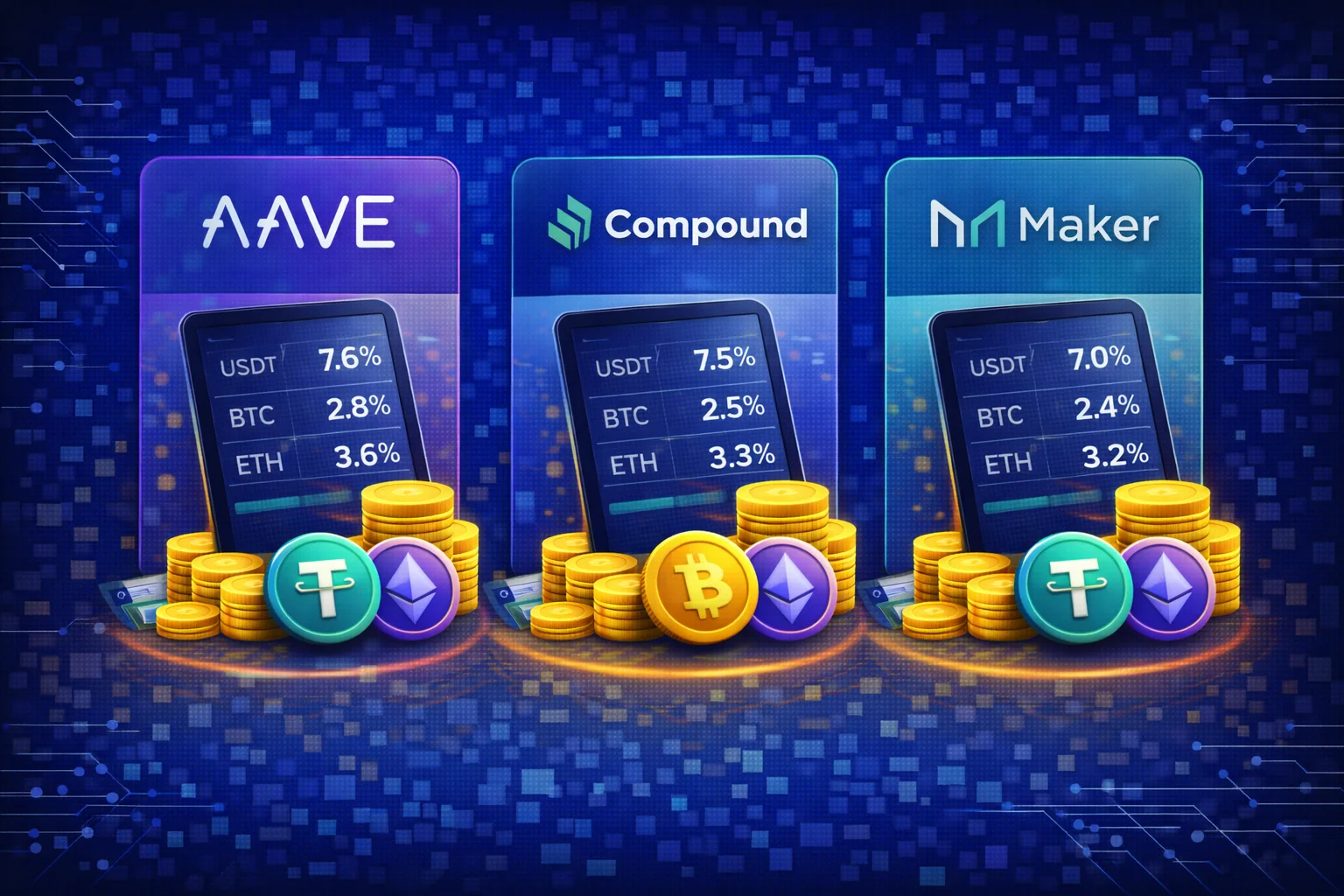
Aave is the largest digital asset lending protocol with over $10 billion in total value locked. It offers both variable and stable interest rates, flash loans, and innovative features like credit delegation.
- Supported Assets: 30+ cryptocurrencies including ETH, USDC, DAI, WBTC
- Key Features: Flash loans, stable rates, credit delegation, governance token (AAVE)
- Interest Rates: Variable rates from 0.5% to 15% depending on asset and utilisation
- Safety Features: Insurance fund, decentralised governance, battle-tested smart contracts
2. Compound
Compound pioneered algorithmic interest rates in DeFi and remains one of the most trusted lending protocols. It features a simple interface and has undergone extensive auditing.
- Supported Assets: 15+ major cryptocurrencies
- Key Features: Algorithmic interest rates, cToken system, COMP governance token
- Interest Rates: Dynamic rates based on supply and demand
- Advantages: Simple interface, proven track record, strong security
3. MakerDAO
MakerDAO focuses on DAI stablecoin generation through collateralised debt positions (CDPs). It's unique in that it allows users to mint DAI against various collateral types.
- Primary Function: DAI stablecoin minting and borrowing
- Collateral Types: ETH, WBTC, USDC, and other approved assets
- Stability Fee: Interest rate for borrowing DAI (typically 1-8%)
- Governance: MKR token holders control protocol parameters
4. Morpho
Morpho is a newer protocol that optimises lending rates by matching lenders and borrowers peer-to-peer, while using Aave and Compound as fallback liquidity sources.
- Innovation: Peer-to-peer matching for better rates
- Fallback: Uses Aave/Compound when no direct match available
- Benefits: Higher yields for lenders, lower rates for borrowers
- Status: Growing rapidly with institutional adoption
Protocol-Based Lending Strategies
Conservative Lending Strategy
Focus on established protocols and stablecoins for steady, low-risk returns:
- Asset Selection: USDC, USDT, DAI on Aave or Compound
- Expected Returns: 3-8% APY with minimal volatility risk
- Risk Level: Low to moderate
- Time Commitment: Minimal monitoring required
Yield optimisation Strategy
Actively move funds between protocols to maximise returns:
- Tools: Use yield aggregators like Yearn Finance or Beefy
- Approach: Automatically compound rewards and optimise for highest APY
- Expected Returns: 8-15% APY depending on market conditions
- Risk Level: Moderate due to smart contract complexity
Leveraged Lending Strategy
Use borrowed funds to increase lending positions for higher returns:
- Method: Deposit collateral, borrow stablecoins, lend borrowed funds
- Leverage: 2-3x leverage depending on risk tolerance
- Expected Returns: 15-25% APY in favorable conditions
- Risk Level: High due to liquidation risk and market volatility
Understanding Smart Contract Lending Risks
Smart Contract Risk
Smart contracts may contain bugs or vulnerabilities that could lead to fund loss:
- Mitigation: Use audited protocols with proven track records
- Research: Check audit reports and bug bounty programs
- Diversification: Spread funds across multiple protocols
Liquidation Risk
Borrowers face liquidation if collateral value drops below required ratios:
- Prevention: Maintain conservative collateral ratios (200%+)
- Monitoring: Set up alerts for collateral ratio changes
- Emergency Plans: Keep funds available to add collateral quickly
Impermanent Loss
When providing liquidity to AMM pools, token price divergence can cause losses:
- Understanding: Loss occurs when token prices change relative to each other
- Mitigation: Use stablecoin pairs or correlated assets
- Compensation: Trading fees and rewards may offset impermanent loss
Regulatory Risk
Changing regulations could impact DeFi protocol operations:
- Monitoring: Stay informed about regulatory developments
- Compliance: Use protocols with strong legal frameworks
- Diversification: Consider protocols in different jurisdictions
Getting Started with Protocol Lending
Step 1: Set Up Your Wallet
Choose a compatible wallet that supports DeFi interactions:
- MetaMask: Most popular browser extension wallet
- WalletConnect: Connect mobile wallets to DeFi apps
- Hardware Wallets: Ledger or Trezor for maximum security
Step 2: Fund Your Wallet
Acquire cryptocurrencies and ETH for gas fees:
- Exchanges: Buy crypto on Kraken or Binance
- Gas Fees: Keep 0.1-0.5 ETH for transaction costs
- Stablecoins: Start with USDC or USDT for lower volatility
Step 3: Choose a Protocol
Start with established protocols for your first protocol-based lending experience:
- Beginners: Aave or Compound for simplicity and security
- Advanced: Explore Morpho or specialised protocols
- Research: Compare interest rates and features
Step 4: Make Your First Deposit
Start small to familiarise yourself with the process:
- Amount: Begin with $100-500 to learn the interface
- Asset: Choose a stablecoin for predictable returns
- Confirmation: Verify transaction details before confirming
Advanced Protocol Lending Concepts
Flash Loans
Flash loans allow borrowing large amounts without collateral, provided the loan is repaid within the same transaction:
- Use Cases: Arbitrage, liquidations, collateral swapping
- Requirements: Advanced programming knowledge
- Risks: Failed transactions result in gas fee loss
Credit Delegation
Aave's credit delegation allows users to delegate borrowing power to others:
- Mechanism: Depositors can allow others to borrow against their collateral
- Benefits: Earn fees from delegation while maintaining collateral ownership
- Risks: Delegated borrower's default affects your collateral
Rate Switching
Some protocols allow switching between variable and stable interest rates:
- Variable Rates: Change based on market conditions
- Stable Rates: Fixed for a period but may be rebalanced
- Strategy: Switch based on market outlook and rate predictions
Tax Considerations for DeFi Lending
Income Recognition
Interest earned from digital asset lending is generally considered taxable income:
- Timing: Income recognised when earned, not when withdrawn
- Valuation: Use fair market value at time of earning
- Records: Keep detailed records of all transactions
Capital Gains
Token price changes may trigger capital gains or losses:
- Pool Tokens: Changes in pool token value may be taxable
- Rewards: Governance tokens received as rewards are taxable
- Professional Help: Consult tax professionals for complex situations
DeFi Lending vs Traditional Lending
Advantages of Digital Asset Lending
Protocol-based lending offers several advantages over traditional banking:
- Higher Yields: DeFi protocols often offer 3-15% APY compared to 0.1-2% in traditional savings
- Global Access: Available 24/7 worldwide without geographical restrictions
- No Credit Checks: Lending based on collateral, not credit history
- Transparency: All transactions and rates visible on blockchain
- Programmable: Automated processes reduce human error and bias
- Composability: Protocols can interact to create complex financial products
- Permissionless: No KYC requirements or account approvals needed
Disadvantages of Blockchain Lending
However, digital asset lending also has limitations:
- Technical Complexity: Requires understanding of wallets, gas fees, and smart contracts
- No Insurance: Most protocols lack traditional deposit insurance
- Volatility Risk: Cryptocurrency price fluctuations affect returns
- Smart Contract Risk: Bugs or exploits can lead to fund loss
- Regulatory Uncertainty: Unclear legal status in many jurisdictions
- Gas Fees: Ethereum network fees can be expensive during congestion
- Irreversible Transactions: Mistakes cannot be easily reversed
Security Best Practices for DeFi Lending
Wallet Security
Protecting your wallet is crucial for DeFi safety:
- Hardware Wallets: Use Ledger or Trezor for large amounts
- Seed Phrase Security: Store recovery phrases offline in multiple secure locations
- Regular Updates: Keep wallet software updated to latest versions
- Phishing Protection: Always verify website URLs and never share private keys
- Multi-Signature: Consider multi-sig wallets for institutional amounts
Protocol Due Diligence
Research protocols thoroughly before depositing funds:
- Audit Reports: Review security audits from reputable firms
- Track Record: Check protocol history and past security incidents
- Team Transparency: Research the development team and their backgrounds
- Community: Active community and developer engagement
- Bug Bounties: Protocols with active bug bounty programs
- Insurance: Some protocols offer insurance coverage
Risk Management Strategies
Implement proper risk management for DeFi protocols:
- Diversification: Spread funds across multiple protocols and assets
- Position Sizing: Never invest more than you can afford to lose
- Regular Monitoring: Check positions and protocol health regularly
- Exit Strategy: Have clear criteria for when to withdraw funds
- Emergency Fund: Keep funds available for gas fees and emergencies
Layer 2 and Alternative Chain Lending
Polygon (MATIC) Lending
Polygon offers faster and cheaper protocol lending alternatives:
- Protocols: Aave, Compound, QuickSwap available on Polygon
- Benefits: Sub-cent transaction fees and instant confirmations
- Yields: Often higher than Ethereum mainnet due to incentives
- Bridge Risk: Consider risks when moving assets between chains
Arbitrum and Optimism
Ethereum Layer 2 solutions provide scaling for protocol lending:
- Arbitrum: GMX, Radiant Capital, and other lending protocols
- Optimism: Aave, Synthetix, and native lending applications
- Security: Inherit Ethereum's security while reducing costs
- Liquidity: Growing but still smaller than mainnet
Avalanche and Other Chains
Alternative blockchains offer unique lending opportunities:
- Avalanche: Benqi, Trader Joe lending markets
- Solana: Solend, Mango Markets for high-speed lending
- BSC: Venus Protocol, PancakeSwap lending
- Considerations: Different risk profiles and decentralisation levels
Yield Farming and Liquidity Mining
Understanding Yield Farming
Yield farming combines lending with additional reward mechanisms:
- Concept: Earn lending interest plus protocol governance tokens
- Rewards: Additional APY from token incentives
- Complexity: Requires understanding of multiple protocols
- Risks: Impermanent loss and token price volatility
Liquidity Mining Strategies
Optimise returns through strategic liquidity provision:
- Stablecoin Pairs: USDC/USDT pairs for minimal impermanent loss
- Correlated Assets: ETH/stETH or similar correlated pairs
- Reward Tokens: Evaluate tokenomics of reward tokens
- Auto-Compounding: Use yield aggregators for automatic reinvestment
Popular Yield Aggregators
Yield aggregators automate complex DeFi strategies:
- Yearn Finance: Pioneer in automated yield optimisation
- Beefy Finance: Multi-chain yield farming platform
- Harvest Finance: Automated farming with FARM token rewards
- Convex Finance: optimises Curve Finance yields
Institutional Protocol Lending
Institutional Adoption Trends
Traditional finance is increasingly embracing protocol lending:
- Banks: JPMorgan, Goldman Sachs exploring DeFi integration
- Asset Managers: Fidelity, BlackRock offering crypto services
- Hedge Funds: Using DeFi for yield generation and arbitrage
- Insurance: Nexus Mutual and other DeFi insurance protocols
Compliance and Regulation
Regulatory frameworks are evolving for protocol lending:
- KYC/AML: Some protocols implementing identity verification
- Licensing: Regulatory licenses for DeFi service providers
- Reporting: Tax reporting requirements for DeFi activities
- Consumer Protection: Investor protection measures
Institutional-Grade Protocols
Protocols designed for institutional participation:
- Maple Finance: Institutional lending with credit assessment
- TrueFi: Uncollateralized lending to institutions
- Goldfinch: Real-world lending through DeFi
- Centrifuge: Asset tokenization and institutional lending
Troubleshooting Common Issues
Transaction Failures
Common reasons for failed DeFi transactions:
- Insufficient Gas: Set appropriate gas limits for complex transactions
- Slippage: Adjust slippage tolerance for volatile markets
- Network Congestion: Wait for lower network activity or increase gas price
- Smart Contract Issues: Protocol may be paused or experiencing issues
Stuck Transactions
Solutions for transactions that won't confirm:
- Speed Up: Increase gas price to accelerate transaction
- Cancel: Send 0 ETH to yourself with the same nonce and higher gas
- Wait: Transactions eventually expire if gas price is too low
- Reset Account: Reset MetaMask account to clear pending transactions
Withdrawal Issues
Common problems when withdrawing from lending protocols:
- Liquidity Shortage: Protocol may have insufficient liquidity
- Cooldown Periods: Some protocols have withdrawal delays
- Minimum Amounts: Check minimum withdrawal requirements
- Gas Estimation: Ensure sufficient ETH for withdrawal gas fees
Future of DeFi Lending
Technological Innovations
Emerging technologies shaping protocol-based lending's future:
- Zero-Knowledge Proofs: Privacy-preserving lending protocols
- Account Abstraction: Simplified user experiences
- AI Integration: Automated risk assessment and optimisation
- Cross-Chain Protocols: Seamless multi-chain lending
Institutional Adoption
Traditional financial institutions are increasingly exploring blockchain lending:
- Compliance: Development of regulatory-compliant DeFi protocols
- Integration: Traditional banks offering digital asset lending services
- Liquidity: Institutional participation increasing overall liquidity
- Infrastructure: Professional custody and risk management solutions
Cross-Chain Lending
Multi-chain protocols are expanding lending opportunities:
- Networks: Ethereum, Polygon, Avalanche, Arbitrum integration
- Benefits: Lower fees and faster transactions
- Challenges: Bridge security and liquidity fragmentation
- Solutions: Improved bridge technology and cross-chain protocols
Real-World Assets
Tokenisation of real-world assets is expanding protocol lending collateral:
- Assets: Real estate, commodities, and traditional securities
- Opportunities: New lending markets and yield sources
- Regulation: Requires clear regulatory frameworks
- Infrastructure: Oracles and legal frameworks for asset tokenization
Building a DeFi Lending Portfolio
Portfolio Allocation Strategies
Structure your smart contract lending portfolio for optimal risk-return:
- Conservative (60%): Stablecoins on established protocols (Aave, Compound)
- Moderate (30%): Blue-chip tokenised lending (ETH, WBTC)
- Aggressive (10%): High-yield opportunities and new protocols
- Rebalancing: Review and adjust allocation quarterly
Risk Assessment Framework
Evaluate lending opportunities systematically:
- Protocol Risk: Audit history, team, and track record
- Asset Risk: Volatility, liquidity, and correlation
- Market Risk: Interest rate changes and market conditions
- Technical Risk: Smart contract complexity and dependencies
Performance Monitoring
Track your blockchain lending performance effectively:
- Yield Tracking: Monitor APY changes and compound returns
- Risk Metrics: Track volatility and maximum drawdown
- Gas Costs: Factor transaction costs into return calculations
- Tax Implications: Maintain records for tax reporting
Advanced DeFi Lending Tools and Analytics
Portfolio Management Tools
Use specialised tools to manage your digital asset lending positions:
- DeFi Pulse: Track total value locked and protocol rankings
- Zapper: Portfolio management and yield farming dashboard
- DeBank: Comprehensive DeFi portfolio tracking
- Zerion: Mobile-first DeFi portfolio management
- APY.vision: Impermanent loss tracking and yield analysis
Yield optimisation Strategies
Maximise returns through strategic yield optimisation:
- Rate Shopping: Compare rates across protocols regularly
- Incentive Hunting: Target protocols with token rewards
- Compound Strategies: Reinvest rewards for compound growth
- Arbitrage Opportunities: Exploit rate differences between protocols
- Seasonal Patterns: Understand cyclical yield patterns
Risk Monitoring Systems
Implement comprehensive risk monitoring for DeFi positions:
- Price Alerts: Set alerts for collateral ratio changes
- Protocol Monitoring: Track protocol health and governance changes
- Liquidation Alerts: Early warning systems for liquidation risk
- Gas Price Tracking: Monitor network congestion and fees
- Security Feeds: Stay informed about security incidents
DeFi Lending Market Analysis
Market Size and Growth
The blockchain lending market has experienced explosive growth:
- Total Value Locked: Over $50 billion across all lending protocols
- Growth Rate: 300%+ annual growth in 2021-2024
- User Adoption: Millions of unique addresses using digital asset lending
- Protocol Diversity: 100+ lending protocols across multiple chains
Competitive Landscape
Understanding the competitive dynamics in blockchain lending:
- Market Leaders: Aave and Compound dominate with 60%+ market share
- Emerging Protocols: Morpho, Euler, and others gaining traction
- specialisation: Protocols focusing on specific assets or use cases
- Innovation: New features like flash loans and credit delegation
Interest Rate Dynamics
Factors influencing protocol-based lending rates:
- Supply and Demand: Basic economics drive rate changes
- utilisation Rates: Higher utilisation leads to higher rates
- Token Incentives: Protocol rewards can boost effective yields
- Market Conditions: Bull/bear markets affect lending demand
- Regulatory Events: Policy changes impact market dynamics
Case Studies and Success Stories
Conservative Lending Strategy Case Study
Example of a successful conservative peer-to-peer lending approach:
- Initial Capital: $10,000 in USDC
- Strategy: Split between Aave (60%) and Compound (40%)
- Results: 6.5% average APY over 12 months
- Risk Management: No liquidations, minimal volatility
- Lessons: Consistency and safety over maximum returns
Yield Farming Success Story
Advanced strategy combining lending with yield farming:
- Initial Capital: $50,000 mixed portfolio
- Strategy: Lending + liquidity provision + token rewards
- Results: 25% APY during favorable market conditions
- Challenges: High gas costs and active management required
- Lessons: Higher returns require higher risk and effort
Institutional Adoption Example
How institutions are approaching peer-to-peer lending:
- Institution: Mid-size hedge fund
- Allocation: 5% of AUM in peer-to-peer lending
- Approach: Conservative protocols with institutional custody
- Results: Consistent 4-8% returns with managed risk
- Infrastructure: Professional custody and compliance systems
Common Mistakes and How to Avoid Them
Beginner Mistakes
Avoid these common pitfalls when starting peer-to-peer lending:
- Insufficient Gas: Always keep extra ETH for transaction fees
- FOMO Investing: Don't chase unsustainably high yields
- Poor Research: Always audit protocols before depositing
- Overexposure: Don't put all funds in a single protocol
- Ignoring Risks: Understand all risks before investing
Advanced Mistakes
Even experienced users can make these errors:
- Leverage Addiction: Excessive leverage increases liquidation risk
- Yield Chasing: Constantly moving funds for marginal gains
- Ignoring Taxes: Poor record keeping for tax reporting
- Protocol Concentration: Too much exposure to single protocols
- Timing Mistakes: Poor entry/exit timing in volatile markets
Risk Management Failures
Critical risk management mistakes to avoid:
- No Exit Strategy: Always have clear exit criteria
- Inadequate Monitoring: Regular position monitoring is essential
- Emotional Decisions: Stick to predetermined strategies
- Insufficient Diversification: Spread risk across protocols and assets
- Ignoring Correlations: Understand asset correlations in portfolios
Professional Implementation Strategies
Professional DeFi lending implementation requires sophisticated risk management frameworks and systematic optimisation procedures that enable superior returns while maintaining appropriate security standards and operational efficiency in the competitive lending environment through strategic excellence and professional mastery designed for sustainable success.
Advanced DeFi Lending Strategies and Professional Implementation
Institutional DeFi Lending and Enterprise Applications
Professional DeFi lending requires sophisticated frameworks that address institutional security requirements, regulatory compliance obligations, and operational efficiency needs while maintaining the decentralised principles that define DeFi value propositions. Enterprise applications include comprehensive multi-signature governance structures, advanced authentication mechanisms, and sophisticated risk management systems that enable institutional DeFi adoption while maintaining appropriate oversight and control mechanisms through professional-grade DeFi infrastructure and institutional security protocols designed for enterprise cryptocurrency operations.
Institutional implementations require comprehensive understanding of corporate governance requirements, systematic risk assessment procedures, and advanced operational frameworks that enable professional DeFi lending while meeting fiduciary obligations and regulatory requirements across multiple jurisdictions. Professional users implement automated monitoring systems, comprehensive audit trails, and sophisticated reporting capabilities that ensure appropriate institutional oversight while maintaining operational efficiency and security standards for enterprise DeFi operations and corporate treasury management strategies through systematic implementation and professional excellence.
Cross-Protocol Yield optimisation and Advanced Arbitrage
Advanced DeFi lending participants implement sophisticated arbitrage strategies that capitalise on interest rate differentials across multiple protocols, maximising returns through strategic capital allocation and automated optimisation systems. Professional arbitrage operations require comprehensive monitoring of rates across protocols, understanding of withdrawal timeframes, and implementation of automated systems that execute optimal allocation decisions while managing transaction costs and protocol risks through systematic optimisation and professional arbitrage excellence designed for institutional DeFi operations.
Yield optimisation strategies include utilising flash loans for capital-efficient arbitrage, implementing automated rate monitoring systems, and developing sophisticated algorithms that optimise allocation across multiple protocols whilstaccounting for transaction costs, protocol risks, and liquidity requirements that affect overall strategy profitability and risk management effectiveness through advanced DeFi strategies and professional yield optimisation designed for sustainable competitive advantages in the evolving DeFi lending ecosystem.
Advanced DeFi Lending Strategies and Institutional Applications
Sophisticated Yield optimisation Techniques
Advanced DeFi lending strategies employ sophisticated mathematical models and algorithmic approaches to maximise yield generation while maintaining optimal risk-adjusted returns. Professional yield optimisation utilises dynamic asset allocation algorithms that continuously monitor interest rate differentials across multiple protocols, automatically rebalancing positions to capture optimal lending opportunities while minimising transaction costs and slippage impact on overall portfolio performance.
Delta-neutral lending strategies represent cutting-edge approaches where institutions simultaneously hold long lending positions while maintaining short derivatives positions to eliminate directional market risk. These strategies utilise perpetual futures contracts, options strategies, and synthetic instruments to create market-neutral positions that generate consistent yield regardless of underlying asset price movements, enabling predictable returns for institutional capital allocation requirements.
Institutional Risk Management Frameworks
Professional DeFi lending operations implement comprehensive risk management frameworks incorporating Value-at-Risk (VaR) calculations, stress testing scenarios, and Monte Carlo simulations to quantify potential losses under adverse market conditions. These frameworks utilise sophisticated statistical models to assess correlation risks between different lending protocols, enabling optimal diversification strategies that minimise portfolio-level risk whilstmaximising risk-adjusted returns through scientific portfolio construction methodologies.
Institutional lending operations employ advanced liquidation risk management systems that continuously monitor collateralization ratios across multiple positions, implementing automated rebalancing mechanisms that maintain optimal safety margins. These systems utilise real-time price feeds from multiple oracle networks, implementing redundant data sources and outlier detection algorithms to prevent manipulation attacks while ensuring accurate risk assessment and position management capabilities.
Protocol-Specific Technical Implementation
Advanced Aave lending strategies utilise rate switching mechanisms between stable and variable interest rates based on predictive models that analyse historical rate patterns, market volatility indicators, and protocol utilisation metrics. Professional implementations employ automated smart contracts that execute rate switches based on predetermined criteria, optimising interest income while minimising exposure to adverse rate movements through systematic decision-making processes.
Compound lending optimisation utilises cToken mechanics to implement sophisticated leveraged lending strategies where borrowed assets are recursively re-lent to amplify yield generation. These strategies employ mathematical optimisation algorithms to determine optimal leverage ratios that maximise expected returns while maintaining acceptable liquidation risk levels, utilising dynamic position sizing based on market volatility and protocol-specific risk parameters.
Cross-Protocol Arbitrage and Yield Farming
Professional arbitrage strategies exploit interest rate differentials between different lending protocols through automated systems that continuously monitor rate spreads and execute profitable trades when opportunities exceed transaction costs and slippage thresholds. These systems utilise flash loans to execute capital-efficient arbitrage trades without requiring significant upfront capital, generating risk-free profits from market inefficiencies while providing valuable price discovery services to the broader DeFi ecosystem.
Advanced yield farming strategies combine lending positions with liquidity provision across multiple automated market makers (AMMs), utilising sophisticated optimisation algorithms to determine optimal allocation between lending protocols and liquidity pools. These strategies employ impermanent loss hedging techniques using derivatives instruments to protect against adverse price movements whilstcapturing both lending yields and trading fee revenues from liquidity provision activities.
Institutional Custody and Operational Security
Professional DeFi lending operations implement multi-signature wallet architectures with hardware security modules (HSMs) and threshold signature schemes to ensure institutional-grade security for large-scale lending operations. These systems utilise time-locked transactions, emergency pause mechanisms, and distributed key management systems to prevent unauthorised access while maintaining operational efficiency for routine lending activities and portfolio rebalancing operations.
Institutional implementations employ comprehensive audit trails and compliance monitoring systems that track all lending activities, interest accruals, and risk metrics for regulatory reporting requirements. These systems integrate with traditional financial reporting infrastructure while maintaining compatibility with blockchain-native analytics tools, enabling seamless integration between DeFi lending operations and existing institutional risk management and compliance frameworks.
Advanced Analytics and Performance Attribution
Professional DeFi lending operations utilise sophisticated analytics platforms that decompose portfolio performance into constituent components including base lending yields, protocol token rewards, impermanent loss impacts, and transaction cost effects. These systems employ attribution analysis methodologies adapted from traditional finance to identify sources of alpha generation and optimise strategy allocation across different lending opportunities and market conditions.
Machine learning algorithms analyse historical lending data to identify patterns and predict optimal entry and exit points for different lending strategies. These systems utilise natural language processing to analyse protocol governance proposals, social media sentiment, and developer activity metrics to assess protocol health and predict potential risks or opportunities that may impact lending performance and portfolio optimisation decisions.
Regulatory Compliance and Institutional Integration
Institutional DeFi lending implementations incorporate comprehensive Know Your Customer (KYC) and Anti-Money Laundering (AML) procedures adapted for decentralised protocols, utilising zero-knowledge proof systems to maintain privacy while ensuring regulatory compliance. These systems enable institutional participation in DeFi lending while meeting fiduciary responsibilities and regulatory requirements through innovative cryptographic techniques that preserve user privacy while enabling necessary compliance monitoring and reporting capabilities.
Professional implementations integrate DeFi lending activities with traditional portfolio management systems through standardised APIs and data feeds that enable real-time monitoring and risk management across both traditional and decentralised financial instruments. These integration frameworks enable institutional investors to incorporate DeFi lending into existing investment processes while maintaining comprehensive risk oversight and performance attribution across all investment activities and asset classes.
Conclusion
Protocol lending represents a paradigm shift in how we think about borrowing and lending money. With yields often exceeding those of traditional savings accounts and the ability to access global liquidity 24/7, peer-to-peer lending presents compelling opportunities for both conservative and aggressive investors.
The key to success in protocol lending lies in education, risk management, and gradual exposure. Start with small amounts on established protocols like Aave or Compound, understand the underlying mechanics, and slowly expand your knowledge and positions as you gain confidence.
Whilst protocol lending offers unprecedented opportunities, it also requires active management and continuous learning. Stay informed about protocol updates, security developments, and regulatory changes that could affect your positions.
As the DeFi ecosystem continues to mature, we can expect more sophisticated lending products, better user experiences, and increased institutional adoption. The integration of real-world assets, cross-chain functionality, and improved security measures will likely make peer-to-peer lending even more attractive and accessible.
The future of blockchain lending looks bright, with innovations like zero-knowledge proofs for privacy, account abstraction for better UX, and AI-powered risk management on the horizon. These developments will likely make blockchain lending more secure, efficient, and user-friendly.
For those willing to navigate the learning curve and manage the associated risks, peer-to-peer lending offers unprecedented opportunities to earn yield on cryptocurrency holdings while participating in the future of finance. Start small, learn continuously, and always prioritise security and risk management in your peer-to-peer lending journey.
The regulatory landscape for DeFi lending will continue to evolve, with clearer frameworks likely to emerge that balance innovation with consumer protection. This regulatory clarity will encourage further institutional adoption and improve the overall security and reliability of DeFi lending platforms, making them more attractive to mainstream investors.
Risk management tools and insurance products for DeFi lending are becoming more sophisticated, providing additional layers of protection for participants. These developments, combined with improved user interfaces and educational resources, will make DeFi lending more accessible to a broader audience while maintaining the core benefits of decentralisation and transparency.
The integration of artificial intelligence and machine learning into DeFi protocols will enable more sophisticated risk assessment, dynamic interest rate models, and automated portfolio management. These technological advances will help optimise returns while minimising risks, making DeFi lending more efficient and user-friendly for participants at all levels.
Sources & References
Frequently Asked Questions
- What is tokenised lending?
- Tokenized lending is the practice of lending and borrowing cryptocurrencies through decentralised protocols built on blockchain networks. It eliminates intermediaries like banks, allowing users to interact directly with smart contracts for transparent, permissionless lending and borrowing.
- Is digital asset lending safe?
- Digital asset lending carries risks including smart contract vulnerabilities, liquidation risk, and protocol exploits. However, established protocols like Aave and Compound have strong security track records. Always start with small amounts, use audited protocols, and diversify across multiple platforms.
- How much can I earn from protocol-based lending?
- Yields vary by asset and protocol. Stablecoins typically offer 3-8% APY on established protocols, while volatile assets can offer higher yields but with increased risk. Rates fluctuate based on supply and demand dynamics.
- What are the main risks of digital asset lending?
- Main risks include smart contract bugs, liquidation risk for borrowers, impermanent loss for liquidity providers, protocol governance risks, and market volatility. Always research protocols thoroughly and never invest more than you can afford to lose.
- Do I need technical knowledge to start blockchain lending?
- Basic understanding is sufficient to start. You need to know how to use a crypto wallet (like MetaMask), understand gas fees, and follow protocol instructions. Start with user-friendly protocols like Aave or Compound, which have intuitive interfaces.
- What's the difference between protocol-based lending and traditional lending?
- Protocol-based lending is permissionless (no credit checks), transparent (all transactions on-chain), operates 24/7 globally, and typically offers higher yields. Traditional lending requires credit checks, has limited hours, and involves intermediaries like banks.
- How do I choose a digital asset lending protocol?
- Consider factors like total value locked (TVL), security audits, track record, supported assets, interest rates, and community reputation. Start with established protocols like Aave, Compound, or MakerDAO that have proven security and reliability.
- Are blockchain lending earnings taxable?
- Yes, in most jurisdictions. Interest earned from blockchain lending is typically taxed as ordinary income when received. Consult a tax professional familiar with cryptocurrency taxation in your jurisdiction for specific guidance.
Related Guides
← Back to Crypto Investing Blog Index
Financial Disclaimer
This content is not financial advice. All information provided is for educational purposes only. Cryptocurrency investments carry significant investment risk, and past performance does not guarantee future results. Always do your own research and consult a qualified financial advisor before making investment decisions.