Best Crypto Borrowing Platforms: Nexo
Compare top cryptocurrency lending services, including Nexo, Aave, Compound, and Sky. Detailed analysis of rates, features, security, and user experience.
Introduction
Need liquidity without selling your Bitcoin or Ethereum? Crypto borrowing platforms let you deposit digital assets as collateral and receive a loan in stablecoins or fiat. In 2025, your options split into two camps: centralised finance (CeFi) platforms like Nexo (~2.9-18.9% APR, instant approval) and decentralised finance (DeFi) protocols like Aave (2-9% APR, no KYC). The right choice depends on whether you prioritise convenience or self-custody.
The rate differences are significant. Nexo Platinum members borrow at 0% APR if they hold 10% of their portfolio in NEXO tokens. Aave charges variable rates that fluctuate with utilisation — USDC borrowing now sits around 5% APR, whilst ETH borrowing costs 2-4%. Compound offers similar DeFi rates at 4-10% for USDC. Sky stands apart with its 1% stability fee on USDC collateral, though it only lets you mint DAI.
Liquidation mechanics differ sharply between CeFi and DeFi. On Nexo, if your collateral drops to 83.33% LTV, the platform liquidates enough to restore your ratio — but you get margin call warnings and time to add collateral. On Aave, liquidation is automated and immediate: once your health factor drops below 1.0, up to 50% of your debt gets repaid through a liquidation that carries a 5-15% penalty. That 50% cap holds only while the health factor stays above 0.95 and both sides of the pair are worth at least $2,000; below either, the whole position can be cleared at once. Compound applies an 8% liquidation incentive for third-party liquidators. Sky is the strictest, requiring 170% minimum collateralisation for ETH vaults, with a 13% liquidation penalty if you fall below.
CeFi platforms carry custody risk — you hand your keys to the platform, and if it becomes insolvent (as Celsius and BlockFi demonstrated in 2022), your assets may be locked or lost entirely. DeFi eliminates custody risk since your collateral sits in audited smart contracts but introduces code vulnerability risk. Aave's lending code has never been breached, though an oracle fault wrongly liquidated $27.8M of user positions in March 2026. For most borrowers, splitting between a CeFi platform for convenience and a DeFi protocol for self-custody provides the best risk balance.
This guide compares the major platforms side by side — rates, liquidation mechanics, collateral requirements, and insurance coverage — so you can match your borrowing strategy to your risk tolerance and technical comfort level. Whether you need a quick £5,000 loan against Bitcoin holdings or want to build a multi-platform borrowing strategy across CeFi and DeFi, the platform breakdowns below give you the numbers you need to decide.
Crypto Lending Services Overview
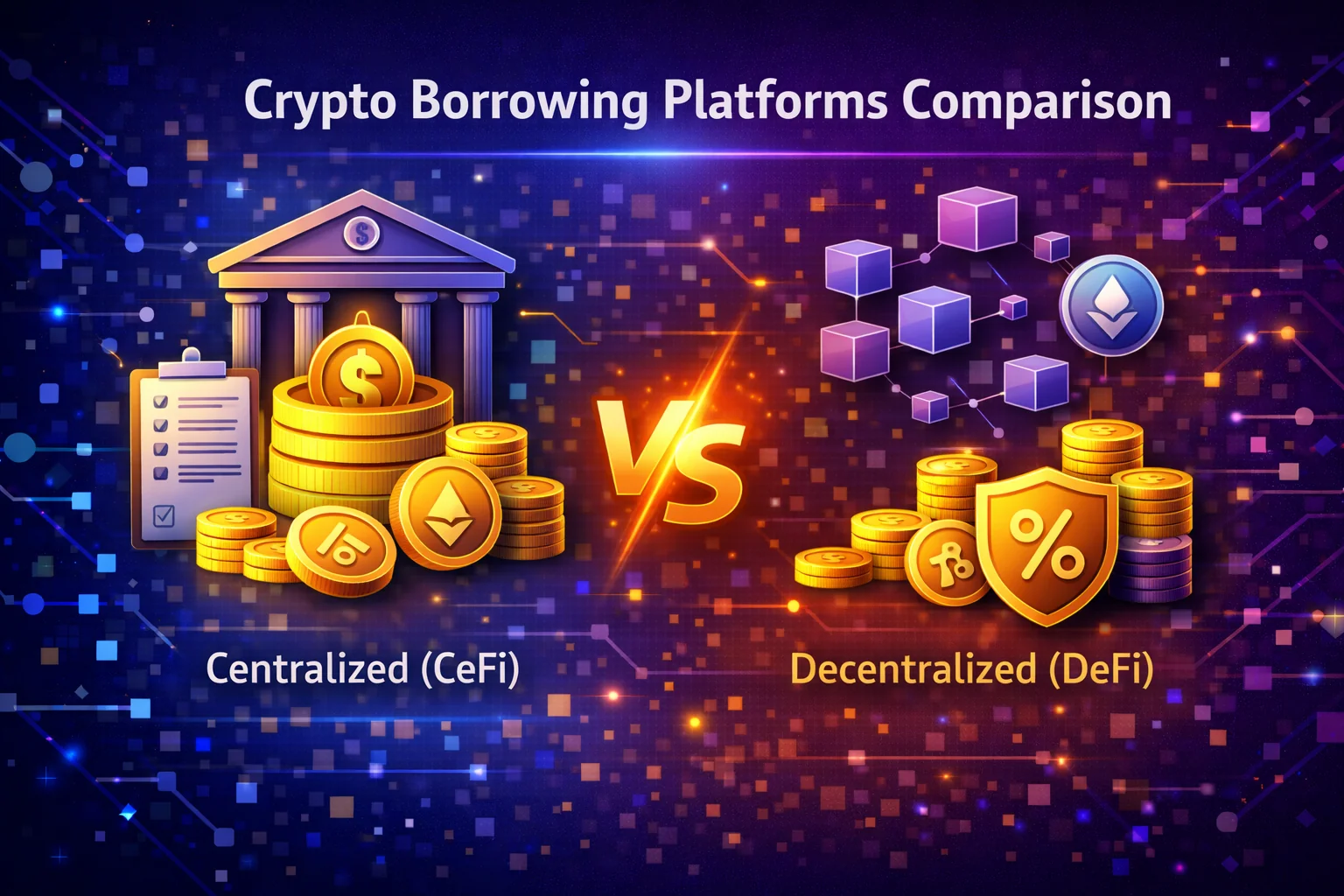
The digital asset lending landscape divides into two main categories: centralised finance (CeFi) platforms and decentralised finance (DeFi) protocols. Each offers distinct advantages and trade-offs.
CeFi vs DeFi: Understanding the Fundamental Divide
CeFi platforms like Nexo and Crypto.com operate much like traditional banks: you deposit collateral, the platform holds it in custody, and you receive a loan into your account or bank. The experience is familiar, with mobile apps, customer support teams, and instant loan approval that requires nothing more than a few taps on your phone. The trade-off is that you surrender custody of your crypto to the platform. If the platform becomes insolvent, as Celsius and BlockFi demonstrated in 2022, your collateral may be locked or lost entirely regardless of your loan status.
DeFi protocols like Aave, Compound, and Sky (formerly MakerDAO) operate entirely through smart contracts on public blockchains. Your collateral sits in audited code rather than in a company's custody, and you interact directly with the protocol through a crypto wallet without intermediaries. There are no customer support teams, no KYC requirements, and no approval processes. The risk profile is different: instead of custody risk, you face smart contract risk, where a bug or exploit in the code could drain the protocol. Aave holds over $18 billion in deposits and its lending code has never been breached, though unbacked KelpDAO collateral left it with nine-figure bad debt in April 2026.
For most UK-based borrowers, the practical question is not which model is theoretically superior but which one matches your technical confidence and risk tolerance. If you have never used a self-custody wallet and do not understand gas fees, starting with a CeFi platform like Nexo is the safer path. If you are comfortable managing MetaMask or a hardware wallet, DeFi protocols offer lower rates and eliminate the counterparty risk that destroyed billions in the 2022 CeFi collapse. Many experienced users split their borrowing across both categories. Learn fundamentals in our cryptocurrency lending guide.
Best CeFi Lending Services
1. Nexo - Best Overall CeFi Platform
Rating: 4.8/5
Nexo is the most polished CeFi lending platform available in 2025, and it earns that position through a combination of instant loan approval, flexible repayment terms, and the industry's widest range of accepted collateral at over 40 digital assets. When you deposit Bitcoin as collateral, Nexo offers up to 50% loan-to-value, meaning £10,000 worth of BTC collateral gives you access to a £5,000 loan. For altcoins, the LTV drops to 33%, reflecting the higher volatility risk. There is no fixed repayment schedule — you can hold the loan indefinitely and repay any amount at any time, which gives you flexibility that traditional lenders simply cannot match.
The interest rate structure is where Nexo becomes genuinely compelling. The base rate sits at 6.9% APR, which is competitive with personal loans from UK high-street banks but requires no credit check and no income verification. If you hold 5% of your portfolio in NEXO tokens, your rate drops to 5.9% APR (Gold tier). At 10% NEXO token allocation, you reach Platinum tier with a 0% APR rate. To put this in real terms, a £10,000 loan held for six months costs £345 at the base rate, £295 at Gold, and absolutely nothing at Platinum. The catch is that NEXO token price risk means your £1,000 in NEXO tokens could lose 30-40% of their value during a crypto downturn, partially negating the interest savings.
Nexo holds no MiCA CASP authorisation: no Nexo entity appears among the 335 entries on ESMA's register of authorised crypto-asset service providers (register last updated 31 July 2026, checked 23 August 2026), and whether an application is in progress is not something Nexo publishes. It delivers EEA services through partner licences rather than holding EU regulatory licences directly.
Its custodial-hack cover comes from the custodians, not from Nexo’s own balance sheet. Ledger publishes a crime programme of up to $150 million for the Ledger Vault platform, underwritten by Arch Insurance (UK) Limited. Ledger’s own material calls that programme pooled: one limit shared across every client on the platform, not an amount set aside for Nexo or for your collateral (Ledger Enterprise insurance material; policy placed November 2019, read 22 August 2026). The ~$775 million often quoted was a 2022-23 Nexo aggregate across several custodians, not a figure Ledger stands behind. Cover of this kind answers custodian theft or hacking rather than platform insolvency, and Ledger’s own summary lists theft by remote cyber-attack as excluded.
There is no live proof-of-reserves attestation to check. Nexo announced a real-time reserves attestation by Moore Johannesburg on 24 April 2023, but it was published on the auditor's own domain at trustreserve.co/nexo, and that page has returned 404 since at least 19 November 2023 (rechecked 23 August 2026); nexo.com publishes nothing in its place. What Nexo does publish is SOC 2 Type 2 and SOC 3 controls audits by A-LIGN (Nexo blog post dated 1 August 2025), and those evidence how Nexo runs its systems rather than whether its reserves cover its liabilities.
For UK users specifically, Nexo offers instant GBP loan disbursement via Faster Payments directly to your UK bank account, which makes it the fastest path from crypto collateral to spendable pounds. The 24/7 customer support team responds within minutes through live chat, which is a meaningful advantage when you need to add collateral urgently during a market downturn at 3 am. The main downside is custody risk: you hand your crypto to Nexo, and if the platform fails, your assets are at risk despite the insurance. Read our full Nexo review for a deeper analysis.
2. Crypto.com - Best for Card Integration
Rating: 4.5/5
Crypto.com's borrowing product stands out for its integration with the platform's Visa card, which lets you spend borrowed funds directly at merchants and ATMs without an intermediate transfer step. You can borrow up to $1 million against your crypto collateral, with LTV ratios up to 50% depending on your CRO staking tier and the asset you pledge. Borrowing is available in multiple fiat currencies including USD, EUR, GBP, and SGD, which makes it practical for users across different regions who want to receive loan proceeds in their local currency.
Crypto.com's base rate of 8% APR sits inside Nexo's dynamic 2.9-18.9% range — dearer than Nexo's top-tier, low-LTV rates but cheaper than Nexo's Base tier, so which is cheaper depends on your loyalty tier and LTV. On a £10,000 loan held for six months, Crypto.com's 8% works out at roughly £400 in interest; the equivalent on Nexo swings from far less at a top tier and low LTV to considerably more at the Base tier. CRO token staking reduces the rate for higher-tier users, but the discount requires locking substantial amounts of CRO, which introduces the same token price risk as Nexo's NEXO token requirement. The mobile app experience is exceptionally well-designed, arguably the best in the CeFi space, with clear loan management dashboards and real-time collateral monitoring. However, borrowing is limited to the Crypto.com ecosystem, meaning you cannot use collateral held on other platforms without first transferring it.
3. YouHodler - Best for Trading Features
Rating: 4.3/5
YouHodler differentiates itself through aggressive LTV ratios and trading-oriented features that appeal to experienced users willing to accept higher risk for greater capital efficiency. The platform offers up to 90% LTV on stablecoin collateral and 70% on BTC and ETH, which means a £10,000 Bitcoin deposit can secure a loan of up to £7,000. This is significantly more capital-efficient than Nexo's 50% LTV, but the flip side is that your liquidation buffer is much thinner. A 15% price drop on 70% LTV collateral puts you dangerously close to liquidation, whereas the same drop on 50% LTV leaves ample room to add collateral.
Interest rates range from 7-12% APR on crypto loans and 8% APR on fiat loans, which places YouHodler at the higher end of CeFi borrowing costs. The unique multi-loan feature allows you to borrow against the same collateral multiple times in a chain, effectively creating leveraged positions of up to 50x. This turbocharge feature is powerful in rising markets but devastating in downturns — a 2% price decline on a 50x leveraged position wipes out your entire collateral.
YouHodler is not FINMA-licensed — its Swiss cover is AML-only PolyReg/SRO membership rather than a banking or e-money licence — and the platform has less liquidity and a smaller user base than Nexo or Crypto.com. It is not FCA-authorised and carries no UK consumer protections, but UK residents can still open accounts: GBP deposits and withdrawals via Faster Payments and crypto-backed lending up to 90% LTV remain available. The withheld list is longer than the promotions, though: YouHodler names referral bonuses, sign-up discounts, the loyalty programme, the Miner and the Yield Account as unavailable to UK retail users. This is separate from YouHodler's suspension of new EU/EEA account onboarding since July 1, 2026 under MiCA, which does not affect the UK.
Best DeFi Borrowing Protocols

1. Aave - Best Overall DeFi Protocol
Rating: 4.9/5
Aave is the dominant DeFi lending protocol by most metrics: over $18 billion in total value locked, deployment across seven major blockchains (Ethereum, Polygon, Avalanche, Arbitrum, Optimism, Base, and Metis), support for 30+ collateral and borrowing assets, and more than six years of operation with no breach of its lending code. The protocol has undergone multiple security audits by Trail of Bits, OpenZeppelin, and Consensys, and maintains an active bug bounty programme with rewards up to $250,000 for critical vulnerability discoveries.
Variable borrowing rates fluctuate based on pool utilisation. As of early 2026, USDC borrowing typically costs 3-8% APR, DAI runs at 4-9%, ETH at 2-6%, and WBTC at 2-5%. These rates adjust algorithmically in real time — when demand for borrowing a particular asset increases, the rate rises to attract more lenders, and vice versa. Aave's E-Mode feature allows dramatically higher LTV (up to 97%) when you borrow and collateralise with correlated assets, such as borrowing USDC against USDT. This makes Aave exceptionally capital-efficient for stablecoin strategies but requires careful monitoring because a 3% move between theoretically correlated assets can trigger liquidation at 97% LTV.
The core advantage of Aave over any CeFi platform is that your collateral never leaves your control in a meaningful sense. It sits in audited smart contracts on a public blockchain, visible and verifiable by anyone. There is no company that can freeze your account, no customer support team that might refuse to process your withdrawal during a crisis, and no corporate entity whose insolvency could trap your funds. The trade-offs are equally clear: you need a crypto wallet, you pay gas fees on every interaction, there is no customer support if you make a mistake, and smart contract risk remains a theoretical possibility despite Aave's strong track record. For users with technical confidence, Aave on Arbitrum offers the best combination of low borrowing costs and low transaction fees available in the market today.
2. Compound - Best for Simplicity
Rating: 4.6/5
Compound pioneered the algorithmic lending model that Aave later refined, and it remains the most accessible DeFi borrowing protocol for users making their first foray into decentralised finance. The interface strips away complexity, presenting a clean dashboard showing your supplied collateral, borrowed amounts, and current interest rates. When you supply collateral, you receive cTokens — interest-bearing representations of your deposit that automatically accrue value over time. This means your collateral earns yield even whilst it secures your loan, partially offsetting the borrowing cost.
Borrowing rates on Compound are slightly higher than Aave's: USDC typically costs 4-10% APR, DAI runs at 5-11%, and ETH at 3-7%. The protocol has over $3 billion in total value locked and more than six years of continuous operation, making it one of the most battle-tested codebases in all of DeFi. Security audits from Trail of Bits and OpenZeppelin provide additional assurance. Borrowers also earn COMP governance tokens as a reward, though the value of these tokens fluctuates and should not be factored into your cost calculations as a reliable offset. The main limitation is that Compound operates only on the Ethereum mainnet, meaning gas fees of £5-50 per transaction apply. For smaller loans below £5,000, these gas costs can significantly erode the interest rate advantage over CeFi alternatives. The upcoming Base deployment should address this limitation for users willing to bridge their assets to a Layer 2 network.
3. Sky - Best for Stablecoin Borrowing
Rating: 4.7/5
Sky, which operated as MakerDAO until its 2024 rebrand, is the oldest DeFi protocol, launched in 2017, and it pioneered the concept of borrowing a decentralised stablecoin (DAI) against crypto collateral through what it calls Vaults (originally Collateralised Debt Positions or CDPs). Unlike Aave and Compound, where you borrow existing tokens from liquidity pools, Sky actually creates new DAI when you open a vault. This fundamental difference means there is no supply-side constraint on DAI borrowing — the protocol can always mint more DAI as long as sufficient collateral backs it. Sky supports ETH, WBTC, stablecoins, and increasingly real-world assets as collateral types.
The interest rates, called stability fees, are set by Sky governance and remain predictable rather than fluctuating algorithmically. The ETH-A vault charges 3.5% APR with a minimum collateral ratio of 170%, meaning you need at least £17,000 in ETH to borrow £10,000 in DAI. The WBTC-A vault costs 4.5% APR at a 175% minimum collateral ratio. The most cost-effective option is the USDC-A vault at just 1% APR with only 101% minimum collateral, though this is designed primarily for arbitrage and liquidity management rather than typical borrowing. With over $5 billion in total value locked and fully decentralised governance, Sky is the most resilient lending protocol in the ecosystem.
The drawbacks are significant for general-purpose borrowers. You can only borrow DAI, which means if you need USDC, ETH, or fiat currency, you must take an additional conversion step after borrowing. Vault management is more complex than Aave's streamlined interface, requiring active monitoring of your collateral ratio. The minimum collateral requirements are considerably higher than competing protocols, reducing capital efficiency. And because Sky operates only on the Ethereum mainnet, gas costs for opening, managing, and closing vaults can run £20-100 per transaction during periods of network congestion. Despite these limitations, Sky remains the premier choice for users who value maximum decentralisation and are comfortable with the higher collateral requirements.
4. Curve Finance - Best for Stablecoin Efficiency
Rating: 4.4/5
Curve Finance introduced its lending product with crvUSD, a native stablecoin that uses an innovative mechanism called LLAMMA (Lending-Liquidating AMM Algorithm) to handle liquidations gradually rather than as a single catastrophic event. On traditional lending protocols, if your collateral drops below the liquidation threshold, a liquidator instantly sells a chunk of your position at a 5-13% penalty. On Curve, your collateral is gradually converted into the borrowed stablecoin as its price declines, and gradually converted back if the price recovers. This soft liquidation mechanism means you lose less during temporary price dips and have a better chance of retaining most of your position through volatile periods.
Borrowing rates on Curve are variable, typically ranging from 2-8% APR depending on utilisation, with stablecoin collateral attracting lower rates due to reduced volatility risk. The protocol offers up to 90% LTV on stablecoin collateral, making it the most capital-efficient option for users who want to leverage stablecoin holdings. However, Curve's lending product is newer than its competitors, having launched in 2023, which means it has less battle-testing and a shorter track record for security. You can only borrow crvUSD, which has less market liquidity than DAI or USDC. The mechanics are genuinely complex even by DeFi standards, and understanding how soft liquidation affects your position requires studying the LLAMMA algorithm in detail before depositing significant capital. For experienced DeFi users who understand the trade-offs, Curve's soft liquidation provides a genuinely superior risk management mechanism compared to the binary liquidation events on Aave and Compound.
Platform Comparison Table
Quick Comparison Overview
Amongst CeFi platforms, Nexo leads with interest rates from 0-6.9% APR, up to 50% LTV, instant loan approval, and KYC verification required. Crypto.com is tiered from 2% APR at 25% LTV up to 8% at higher LTV, with 50% maximum and integrates directly with its Visa card for spending borrowed funds. YouHodler offers the highest LTV at up to 90% on stablecoins, but charges 7-12% APR and targets traders rather than straightforward borrowers. All three CeFi platforms require full identity verification before you can access any borrowing features.
On the DeFi side, Aave provides the most comprehensive offering at 2-9% APR with 80% LTV across multiple blockchains and no KYC requirement. Compound offers similar rates at 3-11% APR with 75% LTV, but operates only on Ethereum with higher gas costs. Sky stands apart with the lowest rates (1-4.5% APR) but requires 170% minimum collateralisation and only lets you borrow DAI. Curve Finance offers 2-8% APR with up to 90% LTV and its innovative soft liquidation mechanism, though it is the newest and least battle-tested of the group, with borrowing limited to crvUSD.
Feature Comparison in Practice
User experience varies dramatically across these platforms. Nexo and Crypto.com provide polished mobile apps with intuitive loan management, real-time notifications, and 24/7 customer support chat. A complete beginner can go from downloading the app to funding a loan within a few hours. Aave and Compound require a crypto wallet (MetaMask, Ledger, or similar), familiarity with blockchain transactions, and the ability to manage gas fees, which places them at a moderate difficulty level. Sky and Curve demand the most technical understanding, with complex vault mechanics and liquidation algorithms that require careful study before committing significant capital.
Liquidity determines how quickly and reliably you can enter and exit borrowing positions. Aave's $18 billion in total value locked makes it the deepest DeFi lending pool, meaning even large positions can be opened and closed without moving the market rate. Nexo processes instant loans from its own reserves. Sky ($5B TVL) and Compound ($3B TVL) provide ample liquidity for most retail borrowers, though very large positions above £500,000 may experience slippage. Curve and YouHodler are growing but have thinner liquidity, which can result in wider rate fluctuations and slower execution during high-demand periods.
How to Choose the Right Platform
When CeFi Is the Right Choice
CeFi platforms make sense if you value simplicity and speed above all else. If you have never used a self-custody crypto wallet, need customer support available around the clock, or want a loan disbursed to your UK bank account within minutes, a platform like Nexo provides that experience. The KYC verification process takes 24-48 hours initially, but once approved, subsequent loans are instant. For borrowers who need GBP quickly against their crypto holdings — for a property deposit, an unexpected expense, or a business cash flow gap — CeFi is the fastest path from collateral to spendable pounds.
When DeFi Is the Right Choice
DeFi protocols suit borrowers who want to maintain control of their private keys and eliminate counterparty risk. If the 2022 CeFi collapses taught you that platform insolvency is a real threat, DeFi removes that specific risk by keeping your collateral in audited smart contracts rather than a company's balance sheet. The absence of KYC means faster access for new users without identity verification delays, though converting borrowed stablecoins to GBP still requires a KYC-compliant on-ramp like Coinbase. If you are technically comfortable with wallet management and gas fees, DeFi consistently offers lower borrowing rates than CeFi equivalents.
Platform Selection Criteria
1. Interest Rates and Total Cost
Interest rates vary enormously across platforms, and the headline rate is not always the most important number. Nexo Platinum offers 0% APR, but achieving that rate requires holding 10% of your portfolio in NEXO tokens, which introduces token price risk. Sky charges just 1% on stablecoin-collateralised vaults, but gas costs for opening and managing a vault on Ethereum mainnet can add hundreds of pounds to the total cost for smaller loans. Aave on Arbitrum charges 3-8% APR for USDC borrowing, with gas costs under £0.20 per transaction, making it the cheapest total-cost option for loans between £2,000 and £50,000. For a £10,000 loan held for six months, you should calculate the total cost, including interest, gas fees, conversion costs (if borrowing stablecoins but needing GBP), and any token-holding requirements before choosing a platform.
2. Loan-to-Value and Liquidation Risk
Higher LTV ratios give you more borrowing power per pound of collateral, but they also reduce your buffer against price drops. Sky's conservative approach requires a minimum collateralisation of 170%, meaning you can borrow at most 59% of your collateral value. This feels restrictive, but it also means Bitcoin would need to fall over 40% from your entry point before liquidation becomes a concern. Aave's standard 80% LTV on major assets gives you more capital efficiency, but a 20% price drop puts you at the liquidation threshold. YouHodler's aggressive 90% LTV on stablecoins works well for stable assets but leaves virtually no room for error on volatile collateral. Choose your LTV based on how actively you can monitor your position and how quickly you can add collateral in an emergency.
3. Geographic Availability and GBP Access
All DeFi protocols are permissionless and accessible globally, but CeFi platforms vary significantly by jurisdiction. For UK residents, Crypto.com holds FCA registration. Nexo is not on the FCA register, and it is not on ESMA's register of authorised CASPs either, though both platforms offer Faster Payments integration for GBP. YouHodler, by contrast, holds no FCA authorisation and offers no UK consumer protections, though it still serves UK residents for GBP deposits, withdrawals and crypto-backed lending. What it withholds from them goes beyond promotions: the loyalty programme, the Miner and the Yield Account are unavailable to UK retail users as well. Security track records range from MakerDAO's eight years of operation (launched 2017) to Curve lending's launch in 2023. Older protocols have survived more market cycles, more attack attempts, and more governance challenges, which provides a form of stress-testing that newer protocols simply have not yet endured.
Risk Management Considerations
Regardless of which platform you choose, the same risk principles apply. The 2022 collapses of Celsius, Voyager, and BlockFi all shared a common pattern: users had concentrated their entire borrowing on a single platform with no fallback. If you split a $50,000 borrowing strategy across Nexo ($25,000 CeFi) and Aave ($25,000 DeFi), the failure of either platform affects only half your position rather than everything.
The first rule of safe borrowing is to never borrow at the maximum LTV your platform allows. If Aave permits 80% LTV on ETH collateral, you should borrow at 55-60% at most, leaving a 20-25% buffer between your current position and the liquidation threshold. This buffer is your margin of safety during volatile periods. A 25% buffer means ETH needs to drop approximately 30% before liquidation becomes imminent, giving you time to react by adding collateral or partially repaying the loan. At maximum LTV, a 5% price decline could trigger liquidation within hours.
Maintaining an emergency collateral reserve is equally critical. Keep at least 20% of your total collateral value in a separate wallet or exchange account, ready to transfer and deposit within minutes if prices drop sharply. On Aave, enable the built-in health factor notifications so you receive an alert when your position approaches danger. On Nexo, turn on push notifications for margin call warnings. For additional safety, set price alerts on TradingView or CoinGecko at a price level 20% above your liquidation trigger, giving you advance warning before the situation becomes urgent.
Platform diversification protects against the specific risk that destroyed billions during the 2022 collapses. If you hold all your collateral on a single CeFi platform and that platform suspends withdrawals, your entire borrowing strategy is frozen regardless of market conditions. Splitting between CeFi and DeFi ensures that the failure of either category leaves you with a functioning position on the other side. Finally, before depositing a single pound of collateral, make certain you understand your chosen platform's exact liquidation mechanics: the penalty percentage, the proportion of your position that gets liquidated, whether liquidation is partial or total, and what happens to any remaining collateral after the liquidation event concludes.
Learn risk management in our borrowing risks guide.
Advanced Borrowing Strategies
Looping: Leveraged Yield on Stablecoins
One popular DeFi strategy involves depositing USDC as collateral on Aave, borrowing USDT at 5% APR, then depositing that USDT back as collateral to borrow more. Each loop increases your yield but also your liquidation risk. With Aave's E-Mode (97% LTV for correlated stablecoins), three loops on a $10,000 deposit can generate roughly $28,000 in earning positions - but a stablecoin depeg of just 3% could trigger cascading liquidations. Only use this with stablecoin pairs you trust and keep your aggregate health factor above 1.5.
Rate Arbitrage Between CeFi and DeFi
When Nexo Platinum offers 0% APR borrowing, and Aave supply rates for USDC sit at 4-6%, you can borrow on Nexo and supply on Aave to pocket the spread. The catch: you need 10% portfolio allocation to NEXO tokens, and you carry custody risk on the CeFi side whilst earning on DeFi. This strategy works best with at least $50,000 in collateral, where the yield differential covers gas fees and NEXO token exposure risk.
Hedging Collateral With Perpetuals
If you deposit 1 BTC as collateral on Nexo and borrow $30,000 USDT, a 40% Bitcoin crash would trigger liquidation. You can hedge by opening a short perpetual position on Binance for 0.5 BTC. This reduces your effective exposure: if Bitcoin drops 40%, your collateral loses $28,000 but your short gains roughly $14,000, keeping your loan safe. The cost is funding rate payments on the short position (typically 0.01-0.03% per 8 hours in neutral markets) plus reduced upside if Bitcoin rallies.
Tax Considerations for Crypto Borrowing
In most jurisdictions, borrowing against crypto is not a taxable event - you do not trigger capital gains by depositing collateral. However, liquidation is taxable because the platform sells your crypto. Interest payments may be deductible against investment income in some countries (check with a tax professional). Keep detailed records of every collateral deposit, interest payment, and loan repayment for accurate tax reporting.
Key Records to Maintain for Tax Compliance
- Collateral deposits: Date, amount, asset type, and market value at time of deposit for each collateral top-up
- Interest payments: Date, amount, currency, and GBP equivalent for every interest charge or payment made
- Liquidation events: Full details including the amount liquidated, the penalty paid, and the market price at liquidation
- Collateral swaps: Any change of collateral type constitutes a disposal and acquisition, requiring both values at the transaction time
- Loan repayments: Date and amount of each repayment, including whether paid in fiat or crypto and the source of funds
Future of Crypto Borrowing
Regulatory Shifts Already Affecting Platform Access
MiCA (Markets in Crypto-Assets), which entered into force in June 2023 and reached full application in December 2024, requires any platform offering crypto lending to EU residents to hold an appropriate licence and meet capital adequacy thresholds. Several smaller platforms have already exited the EU market rather than comply. For UK borrowers, the FCA does not currently regulate crypto-to-crypto lending, but its consultation on a broader crypto regulatory framework (expected 2026) may change this. If you are using a CeFi platform, verify its regulatory status in your jurisdiction before depositing collateral — a platform that loses its licence may freeze withdrawals during the transition.
Layer 2 Lending: Cheaper and More Accessible
The most practical development for retail borrowers is the migration of DeFi lending to Layer 2 networks. Aave V3 on Arbitrum charges $0.05-0.20 per transaction versus $5-50 on Ethereum mainnet. This makes positions as small as $2,000 economically viable for yield loops that were previously only profitable above $50,000. Compound is launching on Base (Coinbase's L2), and Sky's SubDAO structure is expanding DAI minting across multiple chains. If you have been priced out of DeFi lending by Ethereum gas costs, L2 deployments remove that barrier entirely.
Real-World Asset Collateral
Sky now accepts tokenised US Treasury bills as collateral for DAI loans through partnerships with Centrifuge and BlockTower. This means you can use a yield-bearing asset (4-5% on T-bills) as collateral while borrowing DAI at 3.5%—effectively getting paid to borrow. Aave's governance has approved similar RWA proposals. For institutional borrowers, this is a meaningful development: the collateral earns a return that partially or fully offsets the borrowing cost, making crypto loans genuinely competitive with traditional secured lending for the first time.
Account Abstraction and Automated Management
ERC-4337 account abstraction enables smart contract wallets that can automate borrowing operations without requiring the user to sign each transaction. Instadapp and DeFi Saver already offer automated health factor management: if your Aave health factor drops below 1.5, the system automatically sells collateral or adds from a pre-funded wallet without your intervention. Gas costs for these automated actions are deducted from your position. For anyone managing positions above £10,000, this automation is worth the 0.2-0.3% per-trigger fee to avoid 5-13% liquidation penalties.
Credit Scoring on Chain
Protocols like Spectral Finance and Credora are building on-chain credit scores based on wallet history: repayment track record, liquidation history, protocol usage duration, and multi-platform borrowing patterns. These scores could eventually enable lower collateral requirements for borrowers with strong on-chain reputations—a middle ground between fully overcollateralised DeFi and fully KYC'd institutional lending. The technology is still early (launched in 2024), but if it matures, borrowers who build a clean on-chain history now may benefit from preferential terms in 2-3 years.
UK-Specific Borrowing Guide
Tax Treatment of Crypto Loans for UK Residents
Borrowing against crypto is not a taxable event under current HMRC guidance. Depositing ETH as collateral on Aave or Nexo does not count as a disposal, and no Capital Gains Tax is triggered by pledging your assets. This is the fundamental tax advantage of crypto borrowing: you access liquidity without creating a CGT liability, which is particularly valuable for UK residents — following the October 30, 2024 budget, CGT on disposals made on or after that date is charged at 18% (basic-rate band) and 24% (higher- and additional-rate bands), so a higher-rate taxpayer would otherwise owe 24% on gains above the £3,000 annual allowance.
However, several related actions during the borrowing lifecycle create taxable events that borrowers overlook until they face an unexpected tax bill. If your collateral gets liquidated, HMRC treats this as a disposal at the market price when the liquidation executes. Any gain above your Section 104 pool cost basis is reportable, even though you did not choose to sell. Whether CGT is payable on it depends on your annual exempt amount and your other disposals that tax year. A forced liquidation of 5 ETH bought at £1,000 each and liquidated at £3,000 each creates a £10,000 gain — £7,000 taxable after the £3,000 annual allowance, costing £1,680 at the post-budget 24% higher-rate CGT (versus £1,400 at the pre-30-October-2024 20% rate).
Moving from one collateral asset to another, such as swapping ETH for WBTC within an Aave position, constitutes a disposal of the first asset and an acquisition of the second — creating two separate taxable events in what feels like a single transaction.
Yield loop strategies create additional tax complexity. When you borrow USDC and swap it to ETH for re-deposit as additional collateral, the USDC-to-ETH conversion is a CGT event even though you are using the ETH purely as collateral. Similarly, if you pay loan interest in a cryptocurrency that has appreciated since you acquired it, the payment itself triggers a disposal at current market value. For UK borrowers using DeFi protocols where interest accrues and is paid in crypto tokens, each interest payment potentially creates a micro-disposal that must be tracked and reported. Using a crypto tax tool like Koinly that can import on-chain transaction data is practically essential for anyone running borrowing strategies across multiple platforms.
Which Platforms Are Available to UK Residents?
All DeFi protocols including Aave, Compound, Sky, and Curve are accessible from UK wallets without restriction. These protocols operate on public blockchains and do not implement geographic blocking, so any UK resident with a crypto wallet can interact with them directly. The question for UK users is therefore limited to CeFi platform availability, where regulatory status varies significantly.
Nexo operates in the UK via financial-promotion arrangements but is not on the FCA register, and holds no MiCA CASP authorisation either. It offers instant GBP loan disbursement via Faster Payments and is a reliable CeFi option for UK borrowers who want pounds in their bank account within minutes. Crypto.com is also available in the UK with FCA registration, offering GBP deposits via Faster Payments and card integration that lets you spend borrowed funds directly.
YouHodler is not FINMA-licensed — its Swiss cover is AML-only PolyReg/SRO membership, not a banking or e-money licence — and it holds no FCA authorisation, so it carries no UK consumer protections. It does, however, still serve UK residents for GBP deposits and withdrawals via Faster Payments and crypto-backed lending up to 90% LTV. Its withheld list runs past the promotions, however — the loyalty programme, the Miner and the Yield Account are all unavailable to UK retail users. Binance Loans have had inconsistent UK availability following FCA restrictions imposed in 2021, and you should verify its current status before depositing collateral.
The critical fact that every UK borrower must understand is that no CeFi crypto borrowing product is covered by the Financial Services Compensation Scheme. If the platform becomes insolvent, your collateral is at risk with no government-backed protection up to £120,000, which is what you would receive with a regulated UK bank. This is the single most important difference between crypto borrowing and a traditional secured loan. It is the strongest argument for maintaining at least a portion of your borrowing on DeFi protocols where smart contract custody eliminates platform insolvency risk.
GBP Borrowing: Practical Costs
If you need GBP specifically for a property deposit, business expense, or personal liquidity, two main paths are available. The cost-effective route is to borrow USDC or DAI on a DeFi protocol at 3-8% APR, then convert to GBP via Coinbase at 0.5% fee or another GBP on-ramp. The convenient route is Nexo, which offers direct GBP loans at dynamic rates (~2.9-18.9% APR by loyalty tier and LTV), paid instantly to your UK bank account via Faster Payments with no intermediate conversion step needed.
For a £10,000 loan held for six months, the cost comparison reveals meaningful differences. Nexo Platinum tier costs £0 in interest but requires holding over £1,000 in NEXO tokens, exposing you to token price volatility that could offset the interest saving. Nexo base tier charges £345 in interest over the six months with no token holding requirement. Aave on Arbitrum costs £150-400 in interest (depending on rate fluctuations) plus approximately £50 in conversion fees to move from USDC to GBP, plus under £5 in gas fees on Layer 2, totalling £205-455. A traditional unsecured personal loan from a UK high-street bank charges £250-600 at 5-12% APR but requires a credit check, income verification, and potentially weeks of processing time.
For UK borrowers comfortable with DeFi wallet management, Aave on Arbitrum delivers the lowest total cost for loans above £5,000, where the conversion fee becomes a small percentage of the overall amount. For convenience and speed, Nexo's instant GBP loans justify paying the rate premium, particularly when you need funds within the hour rather than within the day. Below £5,000, DeFi gas costs on Ethereum mainnet can erode savings significantly, making Arbitrum essential for cost-effective small loans. If Arbitrum feels too complex, Nexo at base rate remains cheaper than most UK overdraft facilities and credit cards for short-term borrowing against crypto collateral.
Professional Borrowing Implementation
Worked Example: $100,000 Multi-Platform Strategy
Suppose you hold 2 BTC and 20 ETH ($100,000 total). A diversified borrowing approach might allocate 1 BTC to Nexo (50% LTV = $35,000 loan at 0% APR if Platinum) and 10 ETH to Aave (75% LTV = roughly $22,500 at 3% variable APR). You keep the remaining crypto unlocked as an emergency collateral buffer. If Bitcoin drops 25%, your Nexo position moves from 50% to 67% LTV — uncomfortable but still below the 83.33% liquidation threshold. Your Aave position, being on ETH with independent price action, may not be affected at all.
Monitoring Tools
For DeFi positions, use DefiLlama's lending dashboard to compare live rates across protocols. Set up Aave's built-in email alerts for health factor warnings. On Nexo, enable push notifications for margin call alerts. For advanced users, DeFi Saver offers automated collateral top-ups on Aave and Sky that trigger when your health factor drops below a threshold you set — this costs gas but can prevent costly liquidation penalties.
Essential Monitoring Checklist
- Health factor alerts: Set notifications at 1.5 and 1.2 on Aave to give yourself time to react before the 1.0 liquidation threshold
- Rate monitoring: Check borrowing rates weekly on DefiLlama, as variable rates can double within days during high-demand periods
- Collateral ratio tracking: Monitor your LTV daily during volatile markets and weekly during stable periods
- Platform status: Follow official channels for maintenance windows, governance votes that could change rates, and security incident disclosures
- Tax record keeping: Export transaction data monthly rather than annually to avoid the painful process of reconstructing a year of activity at tax time
Practical GBP Borrowing Scenarios: Worked Examples
Scenario 1: Emergency Property Deposit
Tom holds 2 BTC (worth approximately £100,000 at current prices) and needs £25,000 urgently for a property deposit. Selling half a Bitcoin would trigger a capital gains tax liability on the appreciation since his original purchase. By borrowing against his BTC instead, he accesses the £25,000 without a disposal event. On Nexo at 50% LTV, he pledges 1 BTC (£50,000) as collateral and borrows £25,000 at 6.9% APR. His monthly interest cost is approximately £144. Once his property purchase is completed, and he receives rental income or salary, he can repay the loan gradually over six to twelve months. The total interest cost over nine months would be approximately £1,294, which may be significantly less than the capital gains tax he would have owed on selling £25,000 worth of appreciated Bitcoin.
The same loan through Aave on Arbitrum would require Tom to deposit 1 WBTC as collateral, borrow USDC at approximately 5% APR (saving roughly £475 in annual interest compared to Nexo's base rate), then convert the USDC to GBP through Coinbase at a 0.5% fee (£125). His total cost over nine months would be approximately £938 plus the £125 conversion fee, totalling £1,063. The DeFi route saves roughly £231 compared to Nexo's base rate but requires Tom to manage a self-custody wallet, pay gas fees, and handle the USDC-to-GBP conversion himself. For someone comfortable with DeFi operations, the savings justify the additional steps. For someone who needs the funds immediately and prefers a single-click experience, Nexo's instant GBP disbursement via Faster Payments is worth the rate premium.
Scenario 2: Bridging a Business Cash Flow Gap
Sarah runs a small e-commerce business and holds 15 ETH (approximately £45,000) that she intends to keep long-term. She needs £15,000 to pay suppliers ahead of the holiday season but expects to recoup the funds from sales within three months. A traditional business overdraft from her bank would charge 12-15% APR and require extensive paperwork. On the Nexo Gold tier (5% NEXO holdings), she borrows £15,000 at 5.9% APR against her ETH. The three-month interest cost is approximately £221. Her ETH remains invested and continues to benefit from any price appreciation during the borrowing period. When holiday sales generate sufficient revenue, she repays the loan and reclaims her collateral.
The risk that Sarah must manage carefully is a sharp decline in ETH price during those three months. If ETH drops 35% from her entry point, her collateral value falls from £45,000 to roughly £29,250, pushing her LTV from 33% to approximately 51%, which approaches Nexo's margin call territory. She should set price alerts at 20% below the current ETH price and keep an additional £5,000 in fiat ready to add as collateral if the market turns against her. The cost of maintaining this emergency buffer — even if she keeps it in a savings account earning 4-5% — is negligible compared to the 5-13% liquidation penalty she would face if her collateral were forcibly sold.
Scenario 3: Tax-Efficient Portfolio Rebalancing
James holds a concentrated position of £200,000 in Bitcoin and wants to diversify into ETH and Solana without triggering a £40,000 capital gains bill from selling his appreciated BTC. Instead of selling, he deposits £100,000 worth of BTC on Aave (Arbitrum) at 40% LTV, borrows £40,000 in USDC at 4% APR, and uses the borrowed USDC to purchase ETH and SOL. His effective portfolio now has exposure to three assets whilst maintaining his full Bitcoin position. The annual interest cost of £1,600 is substantially less than the CGT he would owe on a direct sale, particularly for higher-rate taxpayers in the UK who face 24% CGT on crypto gains above the £3,000 annual allowance.
This strategy requires active management because James now has correlated risk: if the entire crypto market drops 40%, his BTC collateral loses value whilst his borrowed USDC debt remains fixed, potentially triggering liquidation. He mitigates this by maintaining a conservative 40% LTV rather than borrowing at the maximum 80% that Aave allows. At 40% LTV, Bitcoin would need to fall approximately 50% before his health factor drops below the liquidation threshold, giving him substantial room to add collateral or partially repay the loan during a downturn. For UK residents in the higher-rate tax bracket, this approach can save £6,000-8,000 in immediate tax liability on a £40,000 rebalancing transaction.
Conclusion
The cryptocurrency borrowing landscape in 2025 offers genuine utility for accessing capital without selling appreciated assets. The platform ecosystem has matured significantly since the 2022 CeFi collapses, with surviving platforms strengthening their reserves, improving transparency, and obtaining regulatory licences. For UK borrowers, the practical choice narrows to Nexo for convenient GBP access and Aave on Arbitrum for cost-effective DeFi borrowing, with the optimal strategy for most users being a split across both platforms to balance convenience against counterparty risk.
The most important principle for any crypto borrowing strategy is conservative positioning. Start with loan-to-value ratios well below the platform's maximum — if Nexo allows 50% LTV, borrow at 30-35% to give yourself a substantial buffer against price volatility. Diversify across at least two platforms, ideally one CeFi and one DeFi, so that the failure of either platform leaves you with an operational backup. Keep detailed records of every deposit, withdrawal, interest payment, and collateral adjustment for tax reporting purposes, particularly in the UK where HMRC is increasingly scrutinising crypto transactions.
If you are new to crypto borrowing, the safest path is to start with a small position on an established platform to learn the mechanics before committing significant capital. Open a £1,000 loan on Nexo or deposit £1,000 in collateral on Aave, and spend two weeks monitoring how rates fluctuate, how margin calls work, and how quickly you can add collateral in an emergency. This hands-on experience is worth more than any guide, because it reveals the operational realities that theoretical comparisons cannot capture, including how stressful it feels to watch your collateral ratio approach the liquidation threshold during a sudden market downturn.
For UK-based borrowers specifically, the combination of Nexo for convenient GBP access and Aave on Arbitrum for cost-effective DeFi borrowing covers most use cases. Nexo provides instant GBP loans when you need cash quickly, whilst Aave offers lower rates for longer-term borrowing where the conversion from USDC to GBP adds only a small additional cost. As MiCA regulations reshape the European landscape and the FCA develops its own crypto framework, platform availability may shift over the coming years. Stay informed about regulatory changes in your jurisdiction and maintain the flexibility to adjust your strategy as the market evolves.
Sources & References
- DeFi Llama. (2025). "DeFi TVL Rankings". Real-time lending protocol statistics and comparisons.
- Messari. (2025). "Crypto Lending Research". Platform analysis and market data.
- CoinGecko. (2025). "Lending Platform Rates". Interest rate comparisons across platforms.
Frequently Asked Questions
- What is the best platform for digital asset loans?
- For CeFi: Nexo offers the best combination of rates, security, and user experience with instant loans and 0% APR for Platinum members. For DeFi, Aave provides the most features, liquidity, and multichain support. Your choice depends on preference for centralised vs decentralised platforms.
- Which platform has the lowest interest rates?
- The Nexo Platinum tier offers 0% APR (requires 10% NEXO holdings). For DeFi, Sky offers a 1% interest rate on stablecoin collateral. Aave and Compound typically offer APRs of 2-9%, depending on the asset and utilisation.
- Is it safer to borrow on CeFi or DeFi platforms?
- Different risk profiles: CeFi has custody risk and platform insolvency risk but offers insurance and customer support. DeFi has smart contract risk but is noncustodial and transparent. Diversify across both for balanced risk.
- Do I need KYC to borrow crypto?
- CeFi platforms (Nexo, Crypto.com, YouHodler) require KYC verification. DeFi protocols (Aave, Compound, Sky) are permissionless and require no identity verification, just a crypto wallet.
- What is the maximum LTV I can get?
- Varies by platform and collateral: YouHodler and Curve offer up to 90% LTV on stablecoins. Nexo offers 50% on Bitcoin. Aave offers 80% on significant assets. Sky requires a minimum of 170% collateral, with a maximum loan-to-value ratio (LTV) of 59%.
- Can I borrow without collateral?
- True zero-collateral loans are scarce. Flash loans on Aave allow borrowing without collateral, but they must be repaid within the same transaction. Some institutional platforms offer undercollateralised loans with extensive KYC and credit checks.
- Which platform is best for beginners?
- Nexo is best for beginners due to its simple interface, instant approval, mobile app, and 24/7 customer support. For DeFi beginners, Compound offers the most straightforward interface amongst decentralised protocols.
- How do interest rates compare to traditional loans?
- Crypto loan rates (0-12% APR) are typically lower than credit cards (15-25% APR) but higher than secured traditional loans (3-8% APR). Rates vary based on the quality of collateral and the platform.
← Back to Crypto Investing Blog Index
Financial Disclaimer
This content is not financial advice. All information provided is for educational purposes only. Cryptocurrency investments carry significant investment risk, and past performance does not guarantee future results. Always do your own research and consult a qualified financial advisor before making investment decisions.