Best DeFi Apps: Aave, Lido, Curve
Decentralised finance is evolving rapidly - here are the tools leading the way in lending, staking, DAOs, and more.
Introduction
What is DeFi? Decentralised Finance (DeFi) has revolutionised the financial landscape. It creates an open, permissionless ecosystem. You get financial services built on blockchain technology.
How big is DeFi in 2025? In 2025, the DeFi space has matured significantly. Total value locked (TVL) exceeds $200 billion. Institutional adoption reaches unprecedented levels.
What can you do with DeFi? This evolution has created a sophisticated ecosystem. You get applications that offer everything. Try basic lending and borrowing. Access complex derivatives. Use automated yield-optimisation strategies.
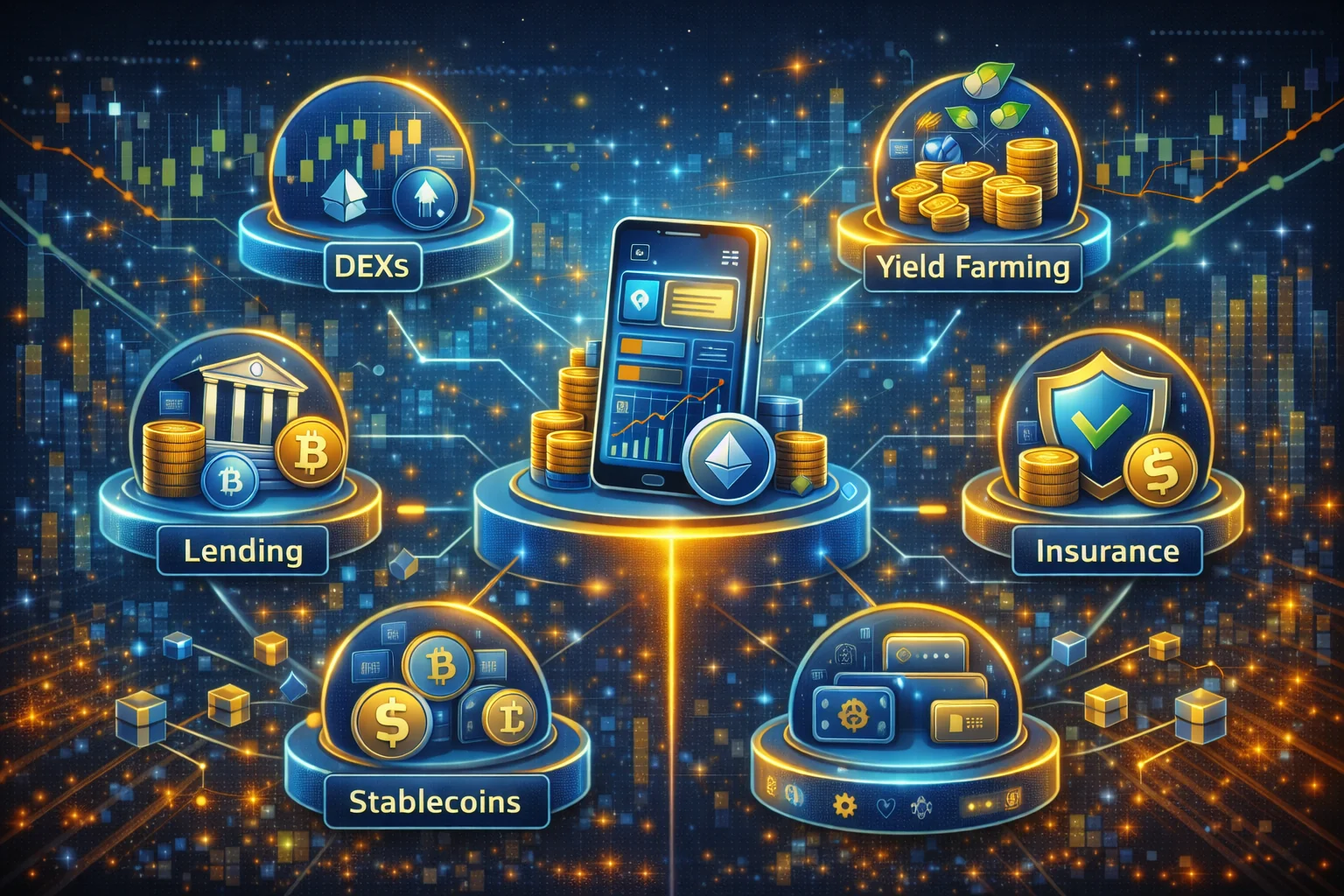
What types of DeFi apps exist? The diversity of DeFi applications reflects rapid innovation. You see specialisation within the ecosystem.
Which platforms lead the market? Leading platforms have emerged in every major category. Lending protocols like Aave and Compound enable you to earn interest. You can access liquidity through overcollateralised loans.
How do DEXs work? Decentralised exchanges like Uniswap and Curve facilitate trustless token swaps. Yield farming platforms offer sophisticated strategies. You can maximise returns on your digital asset holdings.
What makes DeFi special? What sets DeFi apart is its composability, transparency, and accessibility.
How do DeFi protocols interact? DeFi protocols are built as open-source smart contracts. They can compose with each other through standardised token interfaces (ERC-20, ERC-721). This creates a "money Lego" ecosystem. You can construct complex financial products. Simply combine simple building blocks.
What innovations does composability enable? This composability has enabled innovations. You get flash loans. Try automated market makers. Use yield-optimisation strategies. These would be impossible in traditional finance.
How has DeFi improved in 2025? The maturation of DeFi has brought improved security. You get better user experiences. Clearer regulatory frameworks exist.
Is DeFi safe now? Major protocols have undergone extensive audits. They implemented governance-controlled risk parameters and emergency-pause mechanisms. Some also run staking-backed safety modules, and optional third-party cover (such as Nexus Mutual) can be purchased separately — though neither guarantees your funds.
Are DeFi apps easy to use? User interfaces have evolved. They moved from complex, developer-focused tools. Now you get intuitive applications. These rival traditional financial services in usability and functionality.
What will you learn here? This comprehensive comparison examines the leading DeFi applications available in 2025. We analyse their functionality, protection protocols, and yield potential. You'll understand user experience and overall value proposition. Whether you're new to DeFi or experienced, understanding each platform's strengths helps you navigate this dynamic ecosystem successfully.
Top Picks
| App | Category | Main Use Case | Strength | Blockchain |
|---|---|---|---|---|
| Aave | Lending | Borrow/lend crypto assets | High liquidity & multichain | Ethereum, Avalanche |
| Lido | Staking | Liquid staking ETH & others | Easy access to ETH staking | Ethereum, Solana |
| Yearn Finance | Yield Aggregator | optimised vault strategies | Auto-compounding returns | Ethereum |
| Curve | DEX / Liquidity | Stablecoin swaps | Low slippage & deep liquidity | Ethereum + multichain |
| Aragon | DAO Tools | Create and manage DAOs | No-code DAO setup | Ethereum |
| Compound | Lending | Algorithmic lending protocol | Governance token rewards | Ethereum |
| Sky (formerly MakerDAO) | Stablecoin | DAI stablecoin minting | decentralised stablecoin | Ethereum |
| Synthetix | Derivatives | Synthetic asset trading | Exposure to any asset | Ethereum (Optimism deployment wound down) |
The DeFi Ecosystem
How mature is DeFi in 2025? In 2025, decentralised finance has matured significantly. It's now a comprehensive financial ecosystem. It rivals traditional finance in sophistication. Yet it maintains core principles. You get decentralisation, transparency, and permissionless access. These applications represent the cutting edge of financial innovation.
Market Evolution and Trends
How has DeFi evolved? The DeFi space has evolved from experimental protocols. Now you get battle-tested financial infrastructure. Following the market corrections of 2022-2023, the sector shifted focus. It prioritises sustainability, security, and real utility. Speculative yields are no longer the main goal.
Key Innovation Areas
- Liquid Staking: Can you stay liquid while staking? You maintain liquidity while earning staking rewards
- Yield optimisation: Want automated returns? Automated strategies maximise your returns
- Cross-Chain Integration: Need multichain access? Bridge-mediated operations across Ethereum, Solana, and L2s (bridge risk applies)
- Real-World Assets: Want traditional assets? Tokenisation of traditional financial instruments
- Institutional Products: Looking for professional tools? Professional-grade DeFi tools and services
Comprehensive Platform Analysis
Aave - Lending Protocol Leader
Why choose Aave? Aave has established itself as the premier DeFi lending protocol. It offers sophisticated features. You get flash loans, credit delegation, and multi-chain deployment.
Key Features
- Multi-Chain Presence: Where can you use it? Ethereum, Polygon, Avalanche, and more
- Flash Loans: Need instant capital? Uncollateralised loans for arbitrage and liquidations
- Credit Delegation: Can you lend credit? Lend credit lines to trusted parties
- Rate Switching: Want flexibility? Choose between stable and variable interest rates
- Safety Module: How is it protected? AAVE token staking for protocol insurance
Lido - Liquid Staking Pioneer
What makes Lido special? Lido revolutionised staking by solving the liquidity problem. You can stake ETH while receiving liquid stETH tokens. These can be used throughout DeFi.
Innovation Leadership
- Liquid Staking Tokens: What do you receive? stETH, mSOL for continued DeFi use
- No Minimum Stakes: Can you start small? Stake any amount without validator requirements
- Decentralised Governance: Who controls it? Community-driven protocol development
- Validator Diversity: Is it safe? Distributed across multiple professional operators
Yearn Finance - Yield Optimisation
How does Yearn help you? Yearn Finance automates complex yield farming strategies. You can access sophisticated investment strategies. No manual management needed.
Automated Excellence
- Strategy Automation: Want hands-off investing? Professional yield farming without manual management
- Gas optimisation: Worried about fees? Efficient strategies minimise transaction costs
- Risk Management: How safe is it? Diversified strategies across multiple protocols
- Community Driven: Who creates strategies? Strategies developed and audited by experts
Curve - Stablecoin DEX Specialist
What is Curve best for? Curve Finance specialises in efficient stablecoin trading. It handles similar-asset trading. You get deep liquidity with minimal slippage for large trades.
Specialised Features
- Low Slippage: Need efficient swaps? optimised for stablecoin and similar-asset swaps
- Deep Liquidity: Billions in total value locked across pools
- Gauge System: Vote-locked CRV for boosted rewards
- Cross-Chain: Deployed on multiple networks
Aragon - DAO Infrastructure
Aragon provides the infrastructure for creating and managing decentralised autonomous organisations, enabling community governance and decision-making.
Governance Tools
- No-Code DAO Creation: Easy setup without technical expertise
- Voting Systems: Multiple governance mechanisms
- Treasury Management: Multi-signature and automated treasury tools
- Plugin Ecosystem: Extensible functionality through plugins
Selection Guide and Best Practices
By User Experience Level
Beginners
- Recommended: Where should you start? Lido for simple staking, Aave for basic lending
- Features: What helps beginners? Clear interfaces, extensive documentation, community support
- Strategy: How to begin safely? Start with small amounts and well-established protocols
Intermediate Users
- Recommended: Ready for more? Curve for LP strategies, Yearn for automated yield
- Features: What's available? More complex strategies with higher potential returns
- Strategy: How to grow? Diversify across multiple protocols and strategies
Advanced Users
- Recommended: Want full control? All platforms with custom strategies
- Features: What can you do? Flash loans, governance participation, strategy development
- Strategy: How to maximise? Active management and protocol governance participation
Risk Management Framework
- Protocol Research: How to verify safety? Verify audits, track record, and team reputation
- Diversification: How to reduce risk? Spread funds across multiple protocols and strategies
- Position Sizing: How much to invest? Never risk more than you can afford to lose
- Monitoring: How often to check? Regularly check positions and protocol health
- Exit Strategies: What if things go wrong? Have clear plans for various market scenarios
Technical Considerations
Gas Optimisation Strategies
- Batch Transactions: Combine multiple operations to reduce gas costs
- Layer 2 Solutions: Use Polygon, Arbitrum, or Optimism for lower fees
- Gas Price Monitoring: Time transactions during low network congestion
- Aggregator Services: Use 1inch or similar for optimised routing
Security Best Practices
- Hardware Wallets: Use Ledger or Trezor for large positions
- Contract Verification: Always verify contract addresses
- Phishing Protection: Bookmark official sites and double-check URLs
- Permission Management: Regularly review and revoke unnecessary approvals
Portfolio Management
- Tracking Tools: Use Zapper, DeBank, or similar for portfolio overview
- Tax Reporting: Maintain records for regulatory compliance
- Performance Analysis: Track returns throughout various strategies
- Rebalancing: Regularly adjust positions based on performance
Future Outlook and Trends
Emerging Technologies
- Account Abstraction: Simplified user experiences with smart contract wallets
- Intent-Based Systems: Express desired outcomes rather than specific transactions
- AI Integration: Automated strategy optimisation and risk management
- Cross-Chain Protocols: Bridge-mediated operations across L1s and L2s
Regulatory Evolution
- Compliance Tools: Built-in KYC/AML for institutional adoption
- Regulatory Clarity: Clearer frameworks enabling broader participation
- Institutional Products: Professional-grade DeFi services
- Traditional Integration: Banks and fintechs adopting DeFi infrastructure
DeFi Apps Comparison Table
| Protocol | Category | TVL | Risk Level | Best For |
|---|---|---|---|---|
| Lido | Liquid Staking | $20B+ | Low | ETH staking with liquidity |
| Aave | Lending | $10B+ | Low-Medium | Borrowing and lending |
| Curve | DEX | $5B+ | Low-Medium | Stablecoin swaps |
| Yearn Finance | Yield Aggregator | $500M+ | Medium | Automated yield farming |
Advanced Strategy Implementation
Multi-Protocol Yield Strategies
- Staking + DeFi Combo: Stake ETH on Lido, use stETH in Curve pools for additional yield
- Lending Arbitrage: Borrow on Aave, lend on higher-yield platforms
- Automated Compounding: Use Yearn vaults for hands-off yield optimisation
- Cross-Chain Opportunities: Compare yields across Ethereum, Polygon, and Avalanche
Risk-Adjusted Portfolio Construction
Conservative Portfolio (60% allocation)
- 40% Lido stETH: Stable ETH staking rewards with liquidity
- 30% Aave Lending: USDC/USDT lending for stable returns
- 20% Curve Stablecoin LP: Low-risk liquidity provision
- 10% Cash Reserve: For opportunities and gas fees
Balanced Portfolio (30% allocation)
- 50% Yearn Vaults: Automated yield farming strategies
- 30% Multi-Asset LP: Diversified liquidity provision
- 20% Governance Tokens: Protocol tokens for additional rewards
Aggressive Portfolio (10% allocation)
- 40% New Protocols: Early-stage but audited platforms
- 30% Leveraged Strategies: Carefully managed leverage
- 30% Experimental: Testing new DeFi innovations
Performance Optimisation Techniques
- Yield Compounding: Reinvest rewards regularly for compound growth
- Gas Efficiency: Batch transactions and use Layer 2 solutions
- Timing Strategies: Enter/exit positions based on market cycles
- Tax optimisation: Consider holding periods and tax implications
Innovation Spotlight
Emerging Protocol Categories
Real-World Asset (RWA) Protocols
- Tokenised Bonds: Government and corporate bonds on-chain
- Real Estate Tokens: Fractional property ownership and yields
- Commodity Exposure: Gold, oil, and agricultural products
- Credit Markets: Traditional lending brought to DeFi
AI-Enhanced DeFi
- Automated Strategies: AI-driven yield optimisation
- Risk Assessment: Machine learning for protocol evaluation
- Market Prediction: AI models for timing strategies
- Portfolio Management: Automated rebalancing and optimisation
Social DeFi Innovations
- Copy Trading: Follow successful DeFi strategies automatically
- Social Governance: Community-driven protocol decisions
- Reputation Systems: On-chain credit scores and trust metrics
- Collaborative Pools: Group strategies and shared risk management
Infrastructure Improvements
- Account Abstraction: Simplified user experiences with smart wallets
- Intent-Based Trading: Express goals rather than specific transactions
- Cross-Chain Bridges: Asset movement between networks (subject to bridge fees, settlement delay, and bridge-contract risk)
- MEV Protection: Better protection against front-running and sandwich attacks
Monitoring and Maintenance Framework
Essential Tracking Tools
- Portfolio Trackers: Zapper, DeBank, Zerion for comprehensive overview
- Yield Monitoring: DefiLlama for protocol comparison
- Risk Assessment: DeFiSafety, Rugdoc for protocol evaluation
- Transaction Analysis: Etherscan, Polygonscan for on-chain verification
- News Aggregation: DeFi newsletters and protocol announcements
Regular Maintenance Schedule
Daily (5 minutes)
- Check major protocol announcements and security alerts
- Monitor significant market movements affecting positions
- Verify no unusual activity in wallet or positions
Weekly (30 minutes)
- Review portfolio performance and yield changes
- Assess new opportunities and protocol updates
- Rebalance small positions if needed
- Update tracking spreadsheets or tools
Monthly (2 hours)
- Comprehensive portfolio review and strategy assessment
- Research new protocols and emerging opportunities
- Major rebalancing based on performance and market conditions
- Tax record maintenance and transaction categorisation
Emergency Response Procedures
- Protocol Exploit: Immediate withdrawal procedures and alternative platforms
- Market Crash: Liquidation prevention and position management
- Regulatory Changes: Compliance adjustments and geographic considerations
- Technical Issues: Backup wallet access and recovery procedures
Getting Started Checklist
- Education: Understand DeFi basics and specific protocol mechanics
- Wallet Setup: Configure a secure wallet (MetaMask, hardware wallet)
- Small Start: Begin with small amounts on established protocols
- Research: Verify audits, read documentation, check community feedback
- Risk Management: Diversify across protocols and maintain emergency funds
- Monitoring: Set up tracking tools and regular portfolio reviews
- Gradual Expansion: Slowly explore more complex strategies as knowledge grows
DeFi Ecosystem Evolution and Future Developments
Cross-Chain Integration and Interoperability Solutions
How is cross-chain DeFi evolving? The decentralised finance ecosystem continues evolving. It moves towards comprehensive cross-chain functionality. This enables consolidated asset management. You get protocol interaction across multiple blockchain networks. Sophisticated bridging technologies help. Interoperability solutions make it possible.
What advanced features exist? Advanced cross-chain implementations include atomic swaps. You get multi-chain liquidity pools. Universal protocol standards eliminate network-specific complexity. They maintain security and decentralisation principles. This works across diverse blockchain ecosystems.
How do interoperability tools help you? Interoperability developments include automated network selection. You get intelligent routing protocols. Unified asset management systems optimise transaction costs. They improve execution speed. They maintain security standards. You keep control over your digital assets.
What can professional users do? Professional users leverage cross-chain capabilities. They implement sophisticated return optimisation strategies. You can find arbitrage opportunities. Try portfolio optimisation techniques. These span multiple blockchain networks. Secure and efficient cross-chain protocol integration helps.
Institutional Adoption and Enterprise Integration
How are institutions using DeFi? decentralised finance applications increasingly serve institutional users. They offer enhanced security features. You get regulatory compliance tools. Enterprise-grade infrastructure meets professional standards. It preserves the decentralised principles that define DeFi protocols.
What do institutions need? Institutional adoption includes comprehensive custody solutions. You get advanced risk management frameworks. Regulatory reporting capabilities enable professional asset managers. Corporate treasuries can participate in DeFi. They maintain fiduciary standards. They meet compliance requirements.
How is DeFi integrating with traditional finance? Enterprise integration includes partnerships with traditional financial institutions. You see integration with the existing financial infrastructure. The development of hybrid products combines traditional financial stability. You get DeFi innovation and return optimisation capabilities.
What does this mean for you? These developments enable broader adoption. They create new opportunities. You get sophisticated financial products and services. These serve both institutional and retail users. Comprehensive DeFi ecosystem participation helps everyone.
Advanced Security and Risk Management Evolution
DeFi security continues advancing through sophisticated audit frameworks. Formal verification methodologies are implemented. Opt-in cover products from third-party protocols such as Nexus Mutual can offset some smart-contract risk. They enable confident participation in decentralised finance protocols. Security innovations include multi-signature implementations. Time-locked transactions are standard. Advanced monitoring systems detect and prevent various attack vectors. They maintain the permissionless nature of DeFi protocols.
Risk management evolution includes comprehensive protocol analysis. Systematic vulnerability assessment is crucial. Third-party cover protocols offer opt-in policies for specific smart-contract risks. Such cover is bought separately, carries limits and exclusions, and does not automatically extend to every economic attack or operational failure.
Professional users implement sophisticated risk management frameworks. They incorporate multiple security layers. Diversification strategies are essential. Comprehensive monitoring systems enable confident participation in DeFi. They maintain appropriate protection. Various risk categories are covered. Potential loss scenarios are addressed.
Regulatory Compliance and Legal Framework Development
The regulatory landscape for decentralised finance continues to develop with various jurisdictions implementing frameworks that balance innovation encouragement with consumer protection and financial stability considerations. Regulatory developments include clarity on token classifications, oversight of DeFi protocols, and compliance requirements that affect protocol development and user participation, while preserving the decentralised and permissionless characteristics that define DeFi applications and services.
Compliance evolution includes the development of privacy-preserving compliance tools, automated regulatory reporting systems, and legal frameworks that enable DeFi participation while meeting regulatory requirements throughout various jurisdictions and user categories. Professional practitioners work with specialised legal professionals to implement appropriate compliance strategies that enable confident DeFi participation while maintaining regulatory compliance and legal protection for multiple investment structures and operational requirements.
Innovation Trends and Technological Advancement
DeFi innovation continues advancing through artificial intelligence integration, automated strategy optimisation, and sophisticated financial products that expand the capabilities and accessibility of decentralised finance applications. Technological developments include machine learning applications for yield optimisation, automated risk evaluation systems, and intelligent asset management tools that enable sophisticated DeFi strategies while maintaining user control and decentralised protocol characteristics.
Future innovation trends include integration with emerging technologies, enhanced user experience design, and development of new financial primitives that expand DeFi capabilities while maintaining security and decentralisation principles. The innovation focus includes improving accessibility for mainstream users, developing institutional-grade features, and creating new opportunities for return optimisation and financial innovation through the continued advancement of decentralised finance technology and protocol development initiatives.
Security Considerations and Risk Management
Smart Contract Security Assessment
DeFi applications require a comprehensive security evaluation, including smart contract audits, formal verification processes, and ongoing monitoring for potential vulnerabilities. Users must understand that smart contract risks include coding errors, economic exploits, and governance attacks that could result in loss of funds. A professional security assessment includes reviewing audit reports, understanding protocol mechanics, and evaluating the track record of development teams.
Risk mitigation strategies include diversifying across multiple protocols, limiting exposure to experimental applications, and staying informed about security best practices. Advanced users implement additional security measures, including hardware wallet usage, transaction simulation, and careful review of smart contract interactions before execution.
Regulatory Compliance and Legal Considerations
DeFi applications operate in evolving regulatory environments that vary significantly across jurisdictions. Users must understand their local legal requirements regarding cryptocurrency activities, tax obligations, and compliance with financial regulations. Professional legal advice is recommended for significant DeFi participation, particularly for institutional users or those operating in highly regulated jurisdictions.
Compliance strategies include maintaining detailed transaction records, understanding tax implications of DeFi activities, and staying informed about regulatory developments that may affect DeFi participation. Some jurisdictions require specific licences or registrations for certain DeFi activities, making legal consultation essential for serious participants.
Market Risk and Volatility Management
DeFi applications expose users to various market risks, including price volatility, liquidity risks, and correlation risks during market downturns. Understanding these risks is essential for effective position management and long-term success in decentralised finance. Risk assessment includes evaluating token economics, protocol sustainability, and market conditions that affect DeFi performance.
Advanced risk management includes implementing stop-loss strategies, maintaining diversified portfolios, and understanding the relationship between different DeFi protocols and market cycles. Professional users employ sophisticated risk models that account for correlation patterns, volatility metrics, and scenario analysis to optimise risk-adjusted returns while protecting against adverse market conditions.
Advanced DeFi Application Strategies and Integration
Professional DeFi application usage requires a sophisticated understanding of protocol mechanics, yield optimisation techniques, and risk management strategies that maximise returns while maintaining appropriate security standards. Advanced users implement comprehensive strategies that leverage multiple applications simultaneously, optimise gas fees, and maintain diversified exposure throughout various DeFi sectors including lending, trading, yield farming, and governance participation through systematic approaches and professional-grade tools.
Strategic application integration involves systematic evaluation of protocol fundamentals. Security audits are essential. Long-term sustainability factors influence application success. They affect user outcomes significantly.
Professional approaches encompass automated portfolio management. Cross-platform yield optimisation is crucial. Sophisticated risk assessment techniques ensure optimal capital allocation. They enable sustainable growth. Diversified DeFi participation is key. Strategic application selection is based on comprehensive market analysis. Protocol evaluation maximises opportunities. Appropriate risk management standards are maintained.
Advanced DeFi strategies include liquidity mining optimisation. Governance token accumulation is important. Strategic participation in protocol development enhances long-term returns. It contributes to ecosystem growth.
Professional users leverage sophisticated tools. Comprehensive analytics are essential. Systematic approaches to DeFi application usage maximise opportunities. They maintain appropriate risk management. Diversified strategies are implemented. Ongoing monitoring of protocol developments is crucial. Market conditions are tracked. Emerging opportunities affect overall portfolio performance. Strategic optimisation improves investment outcomes. Professional portfolio management techniques are applied.
Future of DeFi Applications
The DeFi landscape continues to evolve rapidly, with new applications and protocols launching regularly to address emerging market needs. Cross-chain interoperability is becoming increasingly important: access to DeFi services on other blockchain networks still runs through bridges, with the bridge fees, settlement delay and bridge-contract risk that entails, and interoperability solutions such as atomic swaps and intelligent routing aim to cut those costs and delays.
Institutional adoption of DeFi protocols is accelerating, bringing additional liquidity and legitimacy to the space. As regulatory frameworks develop, we can expect to see more compliant DeFi applications that bridge traditional finance with decentralised protocols, creating new opportunities for both retail and institutional users.
Conclusion
The DeFi ecosystem in 2025 represents a mature and sophisticated financial infrastructure that offers unprecedented opportunities for return optimisation, trading, and financial innovation across multiple blockchain networks and decentralised protocols worldwide. The applications reviewed in this comprehensive comparison demonstrate the evolution from experimental protocols to battle-tested platforms that handle billions in total value locked while maintaining the core principles of decentralisation and transparency.
For newcomers to DeFi, starting with established protocols like Aave for lending or Uniswap for trading provides a solid foundation with proven security records and extensive documentation available online today worldwide. These platforms offer user-friendly interfaces while maintaining the transparency and permissionless access that define decentralised finance throughout various blockchain networks globally. As confidence and knowledge grow, users can explore more specialised applications like Curve for stablecoin trading or Lido for liquid staking.
The key to success in DeFi lies in understanding the risks, starting with small amounts, and gradually building expertise throughout various protocol types and blockchain networks worldwide. Smart contract risks, impermanent loss, and gas fees remain important considerations, but the maturation of the ecosystem has significantly reduced many early-stage risks through extensive auditing, optional third-party cover protocols, and improved user interfaces amongst multiple platforms.
Looking ahead, the convergence of traditional finance features with DeFi innovation will likely drive broader adoption while maintaining the efficiency and accessibility that make decentralised applications compelling for modern users worldwide today. Whether you're seeking yield optimisation, trading opportunities, or simply exploring the future of finance, the current generation of DeFi applications provides transparent, on-chain, composable solutions for modern digital asset users at various experience levels.
Advanced DeFi strategies in 2025 include cross-chain yield farming, automated portfolio rebalancing, and sophisticated arbitrage opportunities that leverage multiple protocols simultaneously throughout various blockchain ecosystems. Professional users implement risk management frameworks that include position sizing, diversification amongst protocols, and continuous monitoring of smart contract risks and market conditions. These strategies require technical expertise but can generate superior risk-adjusted returns compared to traditional investment approaches while maintaining appropriate security measures and regulatory compliance standards.
Professional cryptocurrency users develop systematic approaches that address platform evaluation, risk assessment, and strategic implementation throughout various ecosystems. These methodologies evolve continuously as the cryptocurrency ecosystem matures and new opportunities emerge amongst multiple blockchain networks and financial services.
Sources & References
- Lido Finance - Liquid Staking Protocol
- Aave - DeFi Lending Platform
- Curve Finance - Stablecoin DEX
- DeFi Llama - TVL Rankings
Advanced DeFi Strategy Implementation
Professional DeFi users implement sophisticated strategies that combine multiple protocols to optimise yields while minimising risks through diversification and systematic approach to decentralised finance participation. Advanced techniques include cross-protocol arbitrage, automated yield farming through smart contract integration, and systematic liquidity provision across multiple automated market makers that maximise returns while maintaining appropriate risk management and capital preservation objectives.
Institutional DeFi strategies encompass comprehensive portfolio management approaches that leverage protocol composability, yield optimisation algorithms, and systematic risk assessment frameworks. Professional users benefit from advanced analytics, automated rebalancing systems, and sophisticated monitoring tools that enable optimal DeFi participation while maintaining institutional-grade risk management and operational excellence standards for sustainable long-term performance.
DeFi Security and Risk Management Excellence
Professional DeFi participation requires comprehensive security frameworks that protect assets while enabling optimal protocol interaction and yield generation activities. Security best practices include multi-signature wallet implementation, hardware wallet integration, and systematic smart contract audit review processes that minimise risks while maintaining access to innovative DeFi opportunities and yield generation mechanisms.
Risk management strategies encompass diversification across multiple protocols, systematic position sizing, and optional cover purchased through third-party decentralised insurance protocols. Advanced users implement automated monitoring systems, emergency exit procedures, and systematic risk assessment frameworks that enable confident DeFi participation while maintaining appropriate capital preservation and operational security standards for professional cryptocurrency portfolio management.
Frequently Asked Questions
- Are DeFi apps safe to use in 2025?
- Many DeFi protocols undergo audits and offer bug bounty programs, but risks remain. Established protocols such as Aave, Lido, and Curve have strong track records; however, always conduct your own research and manage exposure carefully. Start with small amounts and scale up as you gain experience.
- Can beginners use DeFi tools?
- Some apps like Lido or Yearn are user-friendly with clear interfaces, while others require more technical knowledge. Use trusted interfaces, follow official guides, and start with simple strategies before exploring premium capabilities. Many protocols now provide educational resources and active community support.
- What are the main costs of using DeFi apps?
- Expect network gas fees (different across blockchains), protocol fees (typically 0.1–2%), and potential slippage on trades. Layer 2 networks, such as Polygon, offer significantly lower transaction costs. Always consider fees when planning strategies, especially if operating with small amounts.
- How do I choose between different DeFi strategies?
- Consider your risk tolerance, technical expertise, and investment timeline. Conservative users may focus on established protocols such as Lido staking or Aave lending. More experienced users can explore yield farming, liquidity provision, or automated yield strategies via Yearn Finance.
- What should I know about DeFi taxes?
- DeFi activities generate taxable events including token swaps, yield farming rewards, and liquidity provision. Keep detailed records of all transactions and consult a tax professional familiar with digital asset regulations in your jurisdiction.