Crypto Lending Risks: Complete Analysis
Understanding the risks of crypto lending is crucial for protecting your investments in the evolving DeFi and CeFi landscape. Learn about platform risks, smart contract vulnerabilities, oracle manipulation, liquidation cascades, regulatory concerns, and proven strategies to minimise exposure while earning yield on digital assets.
Introduction
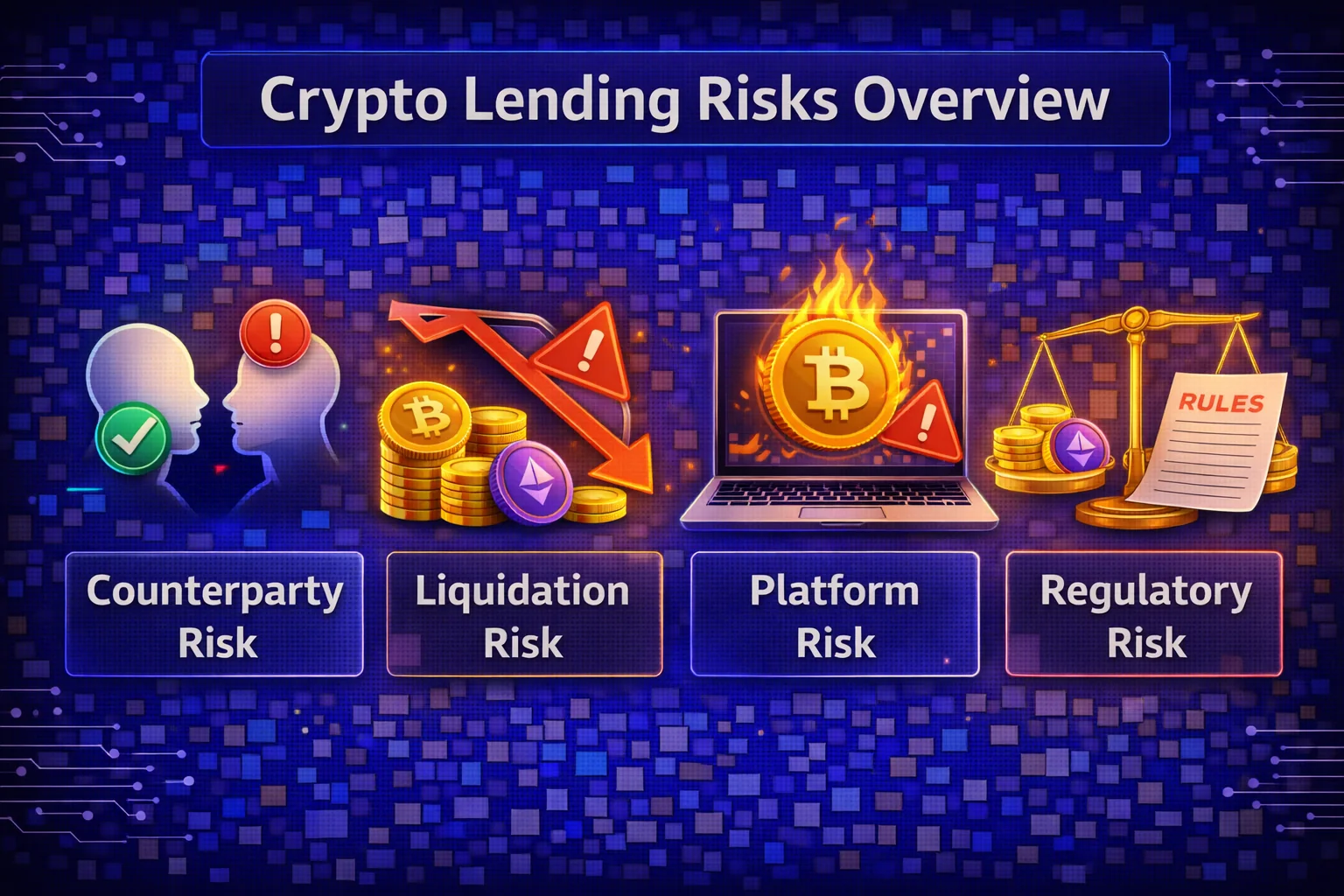
Cryptocurrency lending has emerged as one of the most popular methods for generating passive income from digital assets. Billions of dollars are locked in various lending platforms and protocols across the decentralised finance ecosystem. However, the attractive yields offered by these platforms come with significant risks. Every investor must understand these before committing their digital assets to lending activities. The collapse of major lending platforms like Celsius, BlockFi, and Voyager in 2022 demonstrated that even well-established platforms with strong reputations can face catastrophic failures. This resulted in billions of dollars in user losses. It highlighted the critical importance of comprehensive risk assessment.
The risk landscape in cryptocurrency lending is fundamentally different from traditional finance. It encompasses unique challenges such as smart contract vulnerabilities, regulatory uncertainties, custody risks, and the irreversible nature of blockchain transactions. Unlike traditional banking systems with established deposit insurance and regulatory frameworks, cryptocurrency lending operates in a relatively nascent environment. Risk management practices vary dramatically between platforms and protocols. This requires investors to conduct thorough due diligence and implement robust risk mitigation strategies.
Understanding cryptocurrency lending risks requires examining multiple layers of potential failure points. These range from platform-level operational risks and smart contract bugs to market volatility and regulatory changes. These can impact platform viability. The distinction between centralised finance (CeFi) and decentralised finance (DeFi) lending platforms creates additional complexity. Each approach presents different risk profiles. These must be carefully evaluated based on individual risk tolerance and investment objectives.
This comprehensive guide examines the current risk landscape in cryptocurrency lending. It analyses real-world incidents. It evaluates platform risk management practices. It provides actionable strategies for minimising exposure whilst maximising earning potential. We explore platform risks, smart contract vulnerabilities, market risks, regulatory uncertainties, and operational challenges. These can impact lending outcomes. We also cover practical risk mitigation techniques that can help protect your investments.
The evolution of cryptocurrency lending has been marked by both innovation and cautionary tales. Early platforms promised high yields with minimal risk disclosure, leading to significant losses when market conditions deteriorated. Modern platforms have learnt from these failures, implementing more robust risk management frameworks, transparent reporting, and enhanced security measures. However, the fundamental risks remain, requiring ongoing vigilance and informed decision-making from participants.
Regulatory developments continue to shape the cryptocurrency lending landscape, with authorities worldwide establishing clearer frameworks for platform operations and consumer protection. These regulatory advances provide greater certainty for participants whilst imposing compliance requirements on platforms. Understanding the regulatory environment and its implications for platform operations is essential for making informed lending decisions and managing long-term risk exposure in this rapidly evolving sector.
The maturation of the cryptocurrency lending market has brought both opportunities and challenges. Whilst improved infrastructure and regulatory clarity have made lending more accessible and potentially safer, the fundamental risks inherent in digital asset lending remain significant. Success in this space requires a balanced approach that combines thorough research, diversified strategies, and ongoing risk monitoring to navigate the complex landscape of cryptocurrency lending platforms and protocols.
Platform and Counterparty Risks

Centralised Platform Failures
Centralised lending platforms face several critical risks that can result in total loss of user funds:
- Bankruptcy Risk: Platforms can become insolvent due to poor risk management, market downturns, or operational failures
- Fraud and Mismanagement: Platform operators may misuse customer funds or engage in fraudulent activities
- Liquidity Crises: Platforms may face bank runs where they cannot meet withdrawal demands
- Regulatory Shutdown: Authorities may force platforms to cease operations
Historical Examples
- Celsius (2022): Filed for bankruptcy, freezing $4.7 billion in user assets
- BlockFi (2022): Ceased operations and filed for bankruptcy
- Voyager (2022): Bankruptcy led to asset liquidation and user losses
- FTX (2022): Collapse affected lending operations and user funds
Due Diligence Checklist
- Check regulatory licences and compliance status
- Review financial audits and proof-of-reserves reports
- Assess management team experience and track record
- Evaluate insurance coverage and user protections
- Monitor platform health through regular reporting
Smart Contract and Technical Risks
Code Vulnerabilities
DeFi lending protocols rely on smart contracts that can contain bugs or vulnerabilities:
- Coding Errors: Bugs in smart contract code can be exploited by attackers
- Logic Flaws: Incorrect implementation of lending mechanics
- Upgrade Risks: Protocol upgrades may introduce new vulnerabilities
- Oracle Manipulation: Price feed attacks can trigger incorrect liquidations
Notable DeFi Exploits
- Major DeFi Protocol (2021): $80 million lost due to comptroller bug
- Cream Finance (2021): Multiple exploits totaling over $130 million
- bZx (2020): Flash loan attacks exploiting price oracle manipulation
- Harvest Finance (2020): $24 million drained through arbitrage attack
Technical Risk Mitigation
- Choose protocols with extensive security audits
- Look for bug bounty programs and responsible disclosure
- Prefer battle-tested protocols with long track records
- Monitor protocol governance and upgrade processes
- Use protocols with insurance coverage or safety modules
Market and Liquidity Risks
Interest Rate Volatility
Digital asset lending rates can fluctuate dramatically based on market conditions:
- Rate Compression: High competition can drive yields to near zero
- Market Cycles: Bear markets typically reduce borrowing demand
- Liquidity Shocks: Sudden market events can cause rate spikes
- Token Incentives: Unsustainable yields often rely on token emissions
Collateral and Liquidation Risks
- Volatile Collateral: Crypto assets used as collateral can lose value rapidly
- Liquidation Cascades: Mass liquidations can create market instability
- Slippage Risk: Large liquidations may not execute at expected prices
- Bad Debt: Undercollateralised positions can create protocol losses
Liquidity Considerations
- Understand withdrawal restrictions and lock-up periods
- Assess protocol utilisation rates and available liquidity
- Consider market depth for underlying assets
- Monitor protocol health and utilisation metrics
Regulatory and Legal Risks
Regulatory Uncertainty
The regulatory landscape for digital asset lending continues to evolve rapidly across multiple jurisdictions. Governments worldwide are developing comprehensive frameworks to address consumer protection, systemic risk, and market integrity concerns. These regulatory changes can significantly impact platform operations, available services, yield rates, and user access. Staying informed about regulatory developments is crucial for managing long-term lending strategy risks and compliance requirements.
- Securities Classification: Lending products may be deemed securities
- Banking Regulations: Platforms may face banking licence requirements
- Consumer Protection: New rules may restrict lending activities
- Tax Implications: Lending income may face changing tax treatment
Jurisdictional Risks
- Geographic Restrictions: Platforms may exit certain jurisdictions
- Compliance Costs: Regulatory compliance may reduce yields
- Legal Recourse: Limited legal protections in some jurisdictions
- Cross-Border Issues: International platforms face complex regulations
Regulatory Developments to Watch
- The US SEC's pivot from enforcement to rulemaking, after it dismissed its 2023–24 cases against Kraken, Coinbase and Consensys during 2025
- Whether a future "MiCA 2.0" extends the EU framework to lending, which currently sits outside its scope
- Implementation of the US GENIUS Act stablecoin law and its reserve and disclosure requirements
- Central bank digital currency (CBDC) developments and their effect on stablecoin demand
Operational and Infrastructure Risks
Technology Infrastructure
Lending platforms depend on complex technology stacks that can fail:
- System Downtime: Technical issues can prevent access to funds
- Cybersecurity Threats: Hacking attempts and data breaches
- Key Management: Private key loss or compromise
- Third-Party Dependencies: Reliance on external services and APIs
Governance Risks
- Centralised Control: Admin keys can be used to drain protocols
- Governance Attacks: Token holders may vote for harmful changes
- Upgrade Risks: Protocol changes may introduce vulnerabilities
- Emergency Actions: Pause mechanisms may lock user funds
Operational Best Practices
- Choose platforms with robust security practices
- Verify multi-signature wallet implementations
- Assess governance token distribution and voting power
- Monitor platform communications and transparency
Risk Mitigation Strategies
Diversification Approaches
Spread risk across multiple dimensions to reduce exposure:
- Platform Diversification: Use multiple lending platforms
- Asset Diversification: Lend different cryptocurrencies
- Strategy Diversification: Mix CeFi and DeFi lending
- Geographic Diversification: Use platforms in different jurisdictions
Position Sizing and Limits
- Never lend more than you can afford to lose
- Limit exposure to any single platform (5-20% max)
- Set maximum allocation to lending activities
- Regularly rebalance based on risk assessment
Monitoring and Risk Management
- Regularly review platform health and metrics
- Set up alerts for significant changes
- Monitor news and regulatory developments
- Have exit strategies for different scenarios
Insurance and Protection Mechanisms
Platform Insurance
Some platforms offer insurance coverage for user funds:
- Custodial Insurance: Coverage for platform custody risks
- Smart Contract Insurance: Protection against code vulnerabilities
- Third-Party Insurance: External insurance providers
- Self-Insurance: Platform-operated insurance funds
DeFi Insurance Protocols
Nexus Mutual is the largest decentralised cover provider, offering discretionary protection against smart contract failure, custodian and stablecoin depeg risks.
The on-chain cover market has consolidated sharply. Several early mutuals that once appeared on lists like this — InsurAce, Unslashed Finance and Bridge Mutual among them — have since wound down or gone dormant, so always confirm that a provider is still actively underwriting and settling claims before you rely on its cover.
Insurance Considerations
- Understand coverage limits and exclusions
- Assess insurance provider financial strength
- Consider cost-benefit of insurance premiums
- Review claim processes and historical payouts
Platform Risk Assessment Framework
Security Evaluation Criteria
Use this framework to assess lending platform security:
- Regulatory Compliance: Licences, audits, legal structure
- Financial Transparency: Regular reporting, proof-of-reserves
- Security Practices: Multi-sig, cold storage, insurance
- Track Record: Operating history, incident response
- Team Credibility: Management experience, public profiles
Red Flags to Avoid
- Unrealistic yield promises (over 20% APY on stablecoins)
- Lack of regulatory compliance or transparency
- Anonymous teams or unclear corporate structure
- No insurance coverage or user protections
- Poor communication or customer support
- Recent security incidents or controversies
Ongoing Monitoring Checklist
- Monthly review of platform health metrics
- Track yield changes and market conditions
- Monitor news and regulatory developments
- Assess platform communication and transparency
- Review insurance coverage and terms
Emergency Response Planning
Crisis Scenarios
Prepare for potential crisis situations:
- Platform Freeze: Sudden suspension of withdrawals
- Regulatory Action: Government intervention or shutdown
- Security Breach: Hacking or fund theft
- Market Crash: Severe crypto market downturn
- Liquidity Crisis: Platform unable to meet obligations
Response Strategies
- Maintain emergency fund outside lending platforms
- Have multiple platform accounts for quick reallocation
- Keep detailed records of all lending activities
- Know your legal rights and recourse options
- Stay informed through official communication channels
Recovery Planning
- Document all losses for tax and legal purposes
- Participate in bankruptcy or recovery proceedings
- Consider insurance claims where applicable
- Learn from incidents to improve future risk management
Safer Lending Alternatives
Lower-Risk Options
Consider these alternatives for more conservative lending:
- Established CeFi Platforms: Reputable centralised platforms with strong track records
- Exchange Lending: OKX Review, Kraken integrated lending
- Staking Instead: Direct staking with lower counterparty risk
- Blue-Chip DeFi: Established DeFi protocols with long track records
Risk-Adjusted Returns
- Consider risk-adjusted returns, not just headline yields
- Factor in potential losses from platform failures
- Account for insurance costs and fees
- Compare to traditional investment alternatives
DeFi-Specific Lending Risks
Automated Market Maker (AMM) Risks
DeFi lending protocols often integrate with AMMs, introducing additional risks:
- Impermanent Loss: Value loss when providing liquidity to AMM pools
- Slippage Risk: Large trades may execute at unfavorable prices
- MEV Exploitation: Maximal Extractable Value attacks by miners/validators
- Flash Loan Attacks: Uncollateralised loans used to manipulate protocols
Governance Token Risks
- Governance Attacks: Malicious proposals to drain protocol funds
- Token Concentration: Whale dominance in voting power
- Proposal Risks: Parameter changes that increase user risk
- Emergency Pauses: Governance-triggered fund freezes
Cross-Chain and Bridge Risks
- Bridge Exploits: Cross-chain bridge vulnerabilities
- Wrapped Token Risks: centralised custody of wrapped assets
- Network Congestion: High gas fees preventing liquidations
- Validator Risks: Proof-of-Stake network security assumptions
Advanced Risk Assessment Metrics
Quantitative Risk Measures
Use these metrics to evaluate lending platform risk:
- Total Value Locked (TVL): Higher TVL indicates greater trust and liquidity
- Utilisation Rate: High utilisation (>90%) may indicate liquidity stress
- Liquidation Ratio: Lower ratios increase bad debt risk
- Reserve Factor: Protocol's safety buffer for unexpected losses
- Borrow Rate Slope: How quickly rates increase with utilisation
On-Chain Analytics
- Whale Concentration: Large holder distribution analysis
- Transaction Volume: Protocol activity and health indicators
- Liquidation Events: Frequency and size of liquidations
- Token Distribution: Governance token holder analysis
- Code Commits: Development activity and maintenance
Essential Risk Management Takeaways
- Never lend more than you can afford to lose completely
- Diversify across multiple platforms and strategies
- Conduct thorough due diligence before choosing platforms
- Monitor your positions and platform health regularly
- Have emergency plans for different crisis scenarios
- Consider insurance and protection mechanisms
- Stay informed about regulatory and market developments
Expert Lending Safety Recommendations
For Beginners: Conservative Approach
Start with small amounts on an established centralised platform that offers a familiar account interface and customer support that can help novice lenders find their feet. Treat platform marketing sceptically, though: no crypto lending programme carries government deposit insurance, and the degree of regulatory oversight varies sharply by jurisdiction, so confirm a platform's current licensing and whether it still serves your country before you deposit.
Begin with stablecoin lending to minimise volatility risk while learning platform mechanics. Allocate no more than 5-10% of your cryptocurrency portfolio to lending activities initially, and gradually increase exposure only after gaining experience and confidence in your risk management abilities.
For Intermediate Users: Diversified Strategy
As you gain experience, explore decentralised finance (DeFi) protocols. DeFi protocols often offer higher yields but require greater technical knowledge and carry additional smart contract risks that must be carefully evaluated.
Implement a diversified lending strategy across multiple platforms and asset types. Consider splitting your lending allocation between 2-3 centralised platforms and 1-2 DeFi protocols to balance yield optimisation with risk mitigation. Monitor platform health indicators and be prepared to withdraw funds quickly if warning signs emerge.
For Advanced Users: Sophisticated Risk Management
Advanced cryptocurrency lenders can explore complex strategies including yield farming, liquidity mining, and cross-platform arbitrage opportunities. These strategies require deep understanding of DeFi mechanics, smart contract interactions, and advanced risk assessment capabilities.
Implement sophisticated monitoring systems using on-chain analytics tools to track protocol health, liquidity conditions, and market sentiment indicators. Consider using automated tools for position management, yield optimisation, and emergency exit strategies to respond quickly to changing market conditions.
Advanced users should also explore institutional-grade platforms that offer enhanced security features, insurance coverage, and regulatory compliance. These platforms often provide access to exclusive lending opportunities and professional-grade risk management tools.
Platform-Specific Risk Considerations
Centralised Exchange Lending
Exchange lending products differ widely by provider and jurisdiction. Coinbase offers bitcoin- and ETH-backed onchain loans plus USDC lending routed through the Morpho protocol, available to US users only; Kraken runs fixed-rate crypto-backed loans for its Pro users alongside an institutional lending desk; and Binance's Loans and Simple Earn products remain available outside the European Economic Area but have been suspended across the EEA since July 2026, after Binance failed to secure a MiCA licence. Exchange lending is often perceived as lower-risk than smaller platforms, but that comfort is easily overstated: no exchange lending programme carries deposit insurance, and regulatory oversight of lending is patchy and jurisdiction-specific rather than a guarantee.
However, exchange lending carries counterparty risk, regulatory risk, and potential liquidity constraints during market stress. Users should evaluate each exchange's financial stability, regulatory compliance, and historical performance during market downturns.
Specialised Lending Platforms
Dedicated lending platforms focus specifically on cryptocurrency lending services. These platforms often offer competitive rates and specialised features, but may carry higher risks due to their concentrated business model.
Evaluate specialised platforms based on their regulatory status, insurance coverage, transparency in operations, and diversification of revenue streams. Platforms with multiple revenue sources and strong regulatory compliance typically offer better risk-adjusted returns.
DeFi Protocol Considerations
Decentralised lending protocols such as Sky (formerly MakerDAO) operate through smart contracts without centralised control. Whilst this eliminates counterparty risk, it introduces smart contract risk, governance risk, and potential technical vulnerabilities.
DeFi protocols require users to maintain custody of their private keys and interact directly with blockchain networks. This increases technical complexity but provides greater transparency and control over lending positions. Users must understand gas fees, transaction mechanics, and protocol-specific risks.
Emergency Response Procedures
Platform Distress Signals
Recognise early warning signs of platform distress, including withdrawal delays, communication blackouts, regulatory investigations, executive departures, and unusual terms of service changes. Develop predetermined response procedures for different crisis scenarios.
Monitor platform health through multiple information sources, including official communications, community forums, regulatory announcements, and third-party analysis. Maintain emergency contact information and understand withdrawal procedures for each platform you use.
Market Crisis Management
During market downturns, lending platforms face increased liquidation risks, reduced liquidity, and potential solvency issues. Prepare for these scenarios by maintaining diversified positions, keeping emergency funds available, and understanding platform-specific crisis procedures.
Consider reducing lending exposure during periods of high market volatility or regulatory uncertainty. Maintain flexibility to quickly adjust your lending strategy based on changing market conditions and platform performance indicators.
Long-Term Risk Management Strategy
Portfolio Integration
Integrate cryptocurrency lending into your broader investment portfolio as a yield-generating component rather than a primary investment strategy. Lending should complement, not replace, traditional investment approaches and should align with your overall risk tolerance and financial goals.
Consider the correlation between lending returns and other portfolio components. Cryptocurrency lending returns often correlate with broader crypto market performance, so ensure adequate diversification across asset classes and investment strategies.
Regulatory Compliance and Tax Planning
Understand the tax implications of cryptocurrency lending in your jurisdiction, including income tax on earned interest and potential capital gains implications. Maintain detailed records of all lending activities for tax reporting purposes.
Stay informed about evolving regulatory requirements that may affect cryptocurrency lending activities. Regulatory changes can significantly impact platform operations, available services, and tax treatment of lending income.
Technology and Security Evolution
The cryptocurrency lending landscape continues to evolve rapidly with new technologies, protocols, and security measures. Stay informed about technological developments that may affect platform security, yield opportunities, and risk profiles.
Regularly update your security practices, including password management, two-factor authentication, and wallet security measures. Consider using hardware wallets for long-term storage and limiting hot wallet exposure for active lending positions.
For Advanced Users: Sophisticated Risk Management
Advanced lenders can explore yield farming, liquidity mining, and complex DeFi strategies, but these require a comprehensive understanding of smart contract risks, impermanent loss, and protocol tokenomics. Use advanced monitoring tools and consider professional risk management software for larger positions.
Implement dynamic allocation strategies that adjust exposure based on market conditions, platform health metrics, and regulatory developments. Consider using insurance protocols and hedging strategies to protect against specific risks while maintaining yield generation capabilities.
Universal Principles
Regardless of experience level, always maintain a conservative approach and treat crypto lending as a high-risk investment category. Never borrow money to lend cryptocurrency, and ensure you have adequate emergency funds outside lending platforms before committing significant capital to yield-generation strategies.
Consider crypto lending as part of a broader investment strategy, not as your primary income source. The potential for high returns comes with equally high risks, and past performance does not guarantee future results. Regular portfolio rebalancing and risk assessment are essential for long-term success.
Crypto Lending Industry Future Outlook
Regulatory Evolution and Compliance
The crypto lending industry continues evolving with improved regulations, better security practices, and more sophisticated risk management tools. Regulatory clarity is increasing in major jurisdictions, though it rarely targets lending directly: the EU's Markets in Crypto-Assets (MiCA) regulation governs exchanges, custodians and stablecoin issuers but expressly leaves the lending and borrowing of crypto-assets outside its scope, so lenders still fall back on national rules. The European Commission's 2026 consultation on a possible "MiCA 2.0" is only now weighing whether to bring lending, staking and DeFi into the framework.
However, regulatory compliance costs may reduce yields over time as platforms invest in compliance infrastructure and insurance coverage. Users should expect more stringent KYC requirements, reporting obligations, and potential geographic restrictions as regulatory frameworks mature worldwide.
Technology Improvements and Innovation
Technological advances are improving lending platform security and user experience. Multi-signature wallets, hardware security modules, and advanced monitoring systems are becoming standard features. Smart contract auditing is becoming more rigorous, with formal verification methods and continuous monitoring reducing technical risks.
Emerging technologies like zero-knowledge proofs and account abstraction may enable new lending models that provide better privacy and security while maintaining regulatory compliance. Cross-chain lending protocols are expanding opportunities while introducing new technical complexities that require careful evaluation.
Market Maturation and Institutional Adoption
Institutional adoption is driving professionalisation of crypto lending markets, with traditional financial institutions entering the space and bringing established risk management practices. This institutional involvement may reduce yields but should improve platform stability and user protection through better capitalisation and professional oversight.
Market maturation is leading to more sophisticated lending products, including structured products, insurance-backed lending, and algorithmic yield optimisation. However, increased competition may compress margins and reduce the exceptional yields that characterised early crypto lending markets.
Emerging Risks and Challenges
New challenges continue to emerge as the market evolves. Quantum computing threats may require cryptographic upgrades, while increasing regulatory scrutiny could limit platform operations or user access. Macroeconomic factors like central bank digital currencies (CBDCs) may fundamentally alter cryptocurrency lending dynamics.
Climate and environmental concerns are driving focus towards energy-efficient blockchain networks, potentially affecting the relative attractiveness of different lending opportunities. Geopolitical tensions and sanctions may create new compliance challenges for international lending platforms.
Future Outlook
The fundamental risks of crypto lending remain despite technological and regulatory improvements. Market volatility, counterparty risk, and regulatory uncertainty will continue affecting lending returns and platform stability. New risks may emerge as the technology and regulatory landscape evolves.
Stay informed about industry developments, regulatory changes, and new risk mitigation technologies. The most successful crypto lenders are those who remain vigilant, diversified, and prepared for various market scenarios while adapting their strategies to changing conditions and emerging opportunities.
Professional Risk Assessment Frameworks and Institutional Implementation
Quantitative Risk Modelling and Advanced Analytics
Professional cryptocurrency lending requires sophisticated quantitative risk modelling that incorporates volatility analysis, correlation assessment, and comprehensive scenario planning across different market conditions and platform configurations. Advanced risk analytics include Monte Carlo simulations, stress testing methodologies, and sophisticated probability modelling that evaluate potential outcomes while enabling informed decision-making through comprehensive risk assessment and professional analytical frameworks designed for institutional cryptocurrency lending operations.
Institutional risk assessment incorporates advanced statistical modelling, comprehensive data analysis, and sophisticated risk measurement techniques that evaluate platform security, market dynamics, and operational reliability across different lending opportunities. Professional risk frameworks include comprehensive due diligence procedures, ongoing monitoring systems, and sophisticated risk evaluation methodologies that enable systematic risk management while maintaining appropriate yield optimisation and capital preservation objectives through institutional-grade risk assessment and professional analytical excellence.
Regulatory Compliance and Legal Risk Management
Comprehensive regulatory compliance for cryptocurrency lending requires an understanding of securities regulations, consumer protection standards, and anti-money laundering requirements across multiple jurisdictions where lending activities occur. Professional compliance frameworks include automated monitoring systems, comprehensive reporting capabilities, and sophisticated legal analysis that ensures lending operations maintain regulatory compliance while adapting to evolving regulatory requirements and market conditions through professional compliance management and regulatory excellence designed for institutional cryptocurrency lending operations and professional risk management.
Institutional Risk Management and Professional Lending Strategies
Corporate Treasury Risk Assessment and Compliance Frameworks
Corporate treasuries engaging in cryptocurrency lending require sophisticated risk assessment frameworks that address fiduciary obligations, regulatory compliance, and stakeholder protection while enabling participation in yield generation opportunities. Institutional risk management includes comprehensive due diligence procedures, sophisticated counterparty assessment, and advanced risk monitoring systems that evaluate platform security, regulatory compliance, and operational reliability across different lending opportunities and market conditions.
Professional compliance frameworks include comprehensive regulatory analysis, automated compliance monitoring, and sophisticated reporting systems that ensure institutional lending activities meet regulatory requirements while maintaining operational efficiency and yield optimisation. Corporate risk management requires advanced analytics, predictive modelling, and comprehensive risk assessment methodologies that enable informed decision-making while maintaining appropriate oversight and control mechanisms that support corporate financial objectives and stakeholder value creation.
Advanced Portfolio Risk Management and Diversification Strategies
Professional cryptocurrency lending requires sophisticated portfolio risk management that addresses concentration risks, platform diversification, and comprehensive risk assessment across multiple lending opportunities and market conditions. Advanced diversification strategies include cross-platform allocation, comprehensive risk correlation analysis, and sophisticated rebalancing systems that optimise risk-adjusted returns while maintaining appropriate diversification and risk management objectives through professional portfolio optimisation techniques.
Portfolio risk management includes comprehensive stress testing, scenario analysis, and sophisticated risk modelling that evaluate potential outcomes across different market conditions and platform scenarios. Professional risk management utilises advanced analytics, predictive modelling, and comprehensive risk assessment that enable optimal portfolio construction while maintaining appropriate risk management and diversification objectives that support sustainable long-term returns through sophisticated risk management and portfolio optimisation strategies.
Regulatory Evolution and Compliance Risk Management
The evolving regulatory landscape for cryptocurrency lending creates complex compliance risks that require comprehensive understanding of regulatory requirements, proactive compliance management, and sophisticated risk assessment across different jurisdictions and regulatory frameworks. Regulatory risk management includes comprehensive compliance monitoring, automated regulatory reporting, and sophisticated legal analysis that ensures lending activities maintain regulatory compliance while adapting to evolving regulatory requirements and market conditions.
Compliance risk management requires comprehensive understanding of securities regulations, anti-money laundering requirements, and consumer protection standards across different jurisdictions where lending activities occur. Professional regulatory compliance includes proactive engagement with regulatory authorities, comprehensive compliance frameworks, and sophisticated risk assessment that enables sustainable lending operations while maintaining appropriate regulatory compliance and stakeholder protection through professional compliance management and regulatory engagement strategies.
Technology Risk Assessment and Operational Security
Cryptocurrency lending platforms present complex technology risks that require comprehensive assessment of smart contract security, platform infrastructure, and operational reliability across different lending protocols and platforms. Technology risk assessment includes comprehensive security audits, ongoing monitoring systems, and sophisticated risk evaluation that assesses platform security, operational reliability, and technical implementation quality across different lending opportunities and platform providers.
Operational security for cryptocurrency lending includes comprehensive assessment of platform security measures, custody solutions, and operational procedures that protect user assets while maintaining operational efficiency and user experience. Technology risk management requires understanding of blockchain security, smart contract risks, and platform operational procedures that enable informed risk assessment while maintaining appropriate security and operational standards that protect lending investments and support sustainable lending operations.
Market Risk Analysis and Volatility Management
Cryptocurrency lending involves significant market risks that require comprehensive analysis of price volatility, liquidity conditions, and market dynamics that affect lending returns and capital preservation objectives. Market risk analysis includes comprehensive volatility assessment, correlation analysis, and sophisticated risk modelling that evaluates potential market impacts on lending investments while enabling informed risk management and portfolio optimisation decisions through professional market analysis and risk assessment techniques.
Volatility management for cryptocurrency lending includes comprehensive hedging strategies, dynamic risk assessment, and sophisticated portfolio management that addresses market volatility while maintaining yield optimisation objectives. Professional market risk management utilises advanced analytics, predictive modelling, and comprehensive risk assessment that enable optimal risk management while maintaining appropriate exposure to cryptocurrency lending opportunities through sophisticated volatility management and market risk assessment strategies.
Insurance and Risk Transfer Strategies
Insurance plays only a limited role in cryptocurrency lending. No policy covers a lender against market volatility or a platform's insolvency, and the cover that does exist is narrow: custodial insurance protects assets held in a qualified custodian's cold storage against theft or physical loss — not platform default — while third-party smart-contract cover such as Nexus Mutual is opt-in and must be bought separately.
Risk Management Conclusion
Digital asset lending offers attractive yields but comes with significant risks that require careful consideration and management. The key to successful cryptocurrency lending is understanding these risks, implementing proper mitigation strategies, and never investing more than you can afford to lose.
By diversifying across platforms, conducting thorough due diligence, monitoring your positions, and having emergency plans in place, you can participate in digital asset lending while minimising your exposure to catastrophic losses.
Remember that the crypto lending landscape continues to evolve rapidly, with new risks and opportunities emerging regularly. Stay informed, remain cautious, and always prioritise capital preservation over yield maximisation.
The maturation of cryptocurrency lending markets has brought both opportunities and challenges that require sophisticated risk management approaches. Whilst institutional adoption and regulatory clarity have improved platform stability, the fundamental risks of smart contract vulnerabilities, market volatility, and operational failures remain significant factors that must be carefully managed through diversification and continuous monitoring.
Successful cryptocurrency lending requires a balanced approach that combines attractive yield opportunities with prudent risk management practices. This includes maintaining appropriate position sizes, diversifying across multiple platforms and strategies, conducting regular platform health assessments, and staying informed about regulatory developments that could impact platform operations and user protections.
The lessons learnt from platform failures in 2022 continue to shape best practices for cryptocurrency lending risk management. These incidents highlighted the importance of transparency, regulatory compliance, proper custody practices, and conservative risk management policies that prioritise user protection over aggressive yield generation strategies that can lead to catastrophic losses.
Moving forwards, the cryptocurrency lending industry will likely see continued consolidation around platforms that demonstrate strong risk management, regulatory compliance, and transparent operations. Investors who prioritise these factors over maximum yield potential will be better positioned to navigate future market volatility and regulatory changes while maintaining sustainable returns on their digital asset investments.
Frequently Asked Questions
- What are the main risks of digital asset lending?
- The main risks include platform bankruptcy, smart contract vulnerabilities, regulatory changes, market volatility, and liquidity crises. Historical examples include the bankruptcies of Celsius, BlockFi, and Voyager in 2022.
- How can I protect myself from digital asset lending risks?
- Diversify across multiple platforms, never lend more than you can afford to lose, choose regulated platforms with insurance, monitor platform health regularly, and consider using established protocols with strong track records.
- Is DeFi lending safer than CeFi lending?
- DeFi lending eliminates counterparty risk but introduces smart contract risks, oracle manipulation risks, and governance risks. Both have different risk profiles - DeFi offers transparency and self-custody, while CeFi may offer insurance and regulatory compliance.
- What should I look for in a digital asset lending platform?
- Look for regulatory compliance, financial transparency, security audits, insurance coverage, a strong management team, proof-of-reserves, multi-signature wallets, and a track record of at least 2+ years without major incidents.
- How much should I allocate to digital asset lending?
- Never allocate more than 5-20% of your crypto portfolio to lending activities, and never more than you can afford to lose completely. Start with smaller amounts (1-5%) until you gain experience and confidence in the platforms.
- What are the warning signs of a risky lending platform?
- Red flags include unrealistic yields (over 20% APY on stablecoins), anonymous teams, lack of regulatory compliance, no insurance coverage, poor communication, recent security incidents, and withdrawal restrictions or delays.
- Can I get insurance for my digital asset lending activities?
- Some platforms offer custodial insurance, and DeFi insurance protocols such as Nexus Mutual provide discretionary coverage for smart contract risks. However, coverage is often limited and may not protect against all risks, and several early cover providers have since wound down — so check that any protocol is still actively underwriting before relying on it.
- What happens if a lending platform goes bankrupt?
- In bankruptcy, user funds may be frozen indefinitely, and recovery depends on the platform's financial situation and legal structure. Users typically become unsecured creditors and may recover only a fraction of their funds, if any.
- How do I calculate risk-adjusted returns for digital asset lending?
- Consider the probability of total loss, insurance costs, platform fees, tax implications, and opportunity costs. A 10% APY with 5% annual default risk may actually provide negative risk-adjusted returns compared to safer alternatives.
- Should I use multiple lending platforms?
- Yes, diversification across 3-5 reputable platforms reduces single-point-of-failure risk. However, this increases operational complexity and monitoring requirements. Never use more platforms than you can effectively monitor.
- What's the difference between lending and staking risks?
- Staking typically involves validator risks, slashing penalties, and lock-up periods, but you maintain custody of your assets. Lending involves counterparty risk, where you relinquish custody, but typically offers higher yields and greater liquidity.
- How do regulatory changes affect digital asset lending?
- Regulatory changes can force platforms to cease operations, restrict services in certain jurisdictions, reduce yields due to compliance costs, or require additional user verification. Stay informed about regulatory developments in your jurisdiction.
Sources & References
← Back to Crypto Investing Blog Index
Financial Disclaimer
This content is not financial advice. All information provided is for educational purposes only. Cryptocurrency investments carry significant investment risk, and past performance does not guarantee future results. Always do your own research and consult a qualified financial advisor before making investment decisions.