Trezor vs Ledger Complete Comparison
Compare the two leading hardware wallet brands to find the best crypto security solution for your needs. This comprehensive analysis covers security features, supported cryptocurrencies, pricing, and user experience.
Introduction
Two pioneering companies have dominated the hardware wallet market since the early days of cryptocurrency: Trezor and Ledger. Both brands have established themselves as the gold standard for cryptocurrency security, protecting billions of dollars in digital assets for millions of users worldwide. In 2026, as cryptocurrency adoption reaches mainstream levels and digital asset values continue to grow, choosing the right hardware wallet solution has become more critical than ever.
Trezor, developed by SatoshiLabs, holds the distinction of being the world's first hardware wallet, created in 2014 and established many of the security principles and user experience standards that define the industry today. The company's commitment to open-source development, transparent security practices, and user education has made Trezor synonymous with trustworthy cryptocurrency storage for privacy-conscious users and security professionals.
Ledger, founded in 2014, has built its reputation on cutting-edge security technology and broad support for cryptocurrencies, becoming the market leader in sales volume and global reach. The company's proprietary Secure Element technology and comprehensive ecosystem of supported cryptocurrencies have made Ledger devices the preferred choice for institutional investors and users with diverse cryptocurrency portfolios.
The choice between Trezor and Ledger goes beyond a simple feature comparison. It reflects different philosophies about security, privacy, and user control in the cryptocurrency space. Trezor emphasises transparency through open-source development and user empowerment. Ledger focuses on advanced security technology with broad compatibility and enterprise-grade features.
Understanding these philosophical differences is crucial for making an informed decision. Your values and security requirements should guide your choice. This comprehensive comparison examines every aspect of both hardware wallet ecosystems. We cover fundamental security architectures and supported cryptocurrencies. User experience, pricing, and long-term viability are analysed. Real-world usage scenarios are evaluated. We assess the strengths and limitations of each approach. This helps you choose the hardware wallet that best meets your needs in 2026.
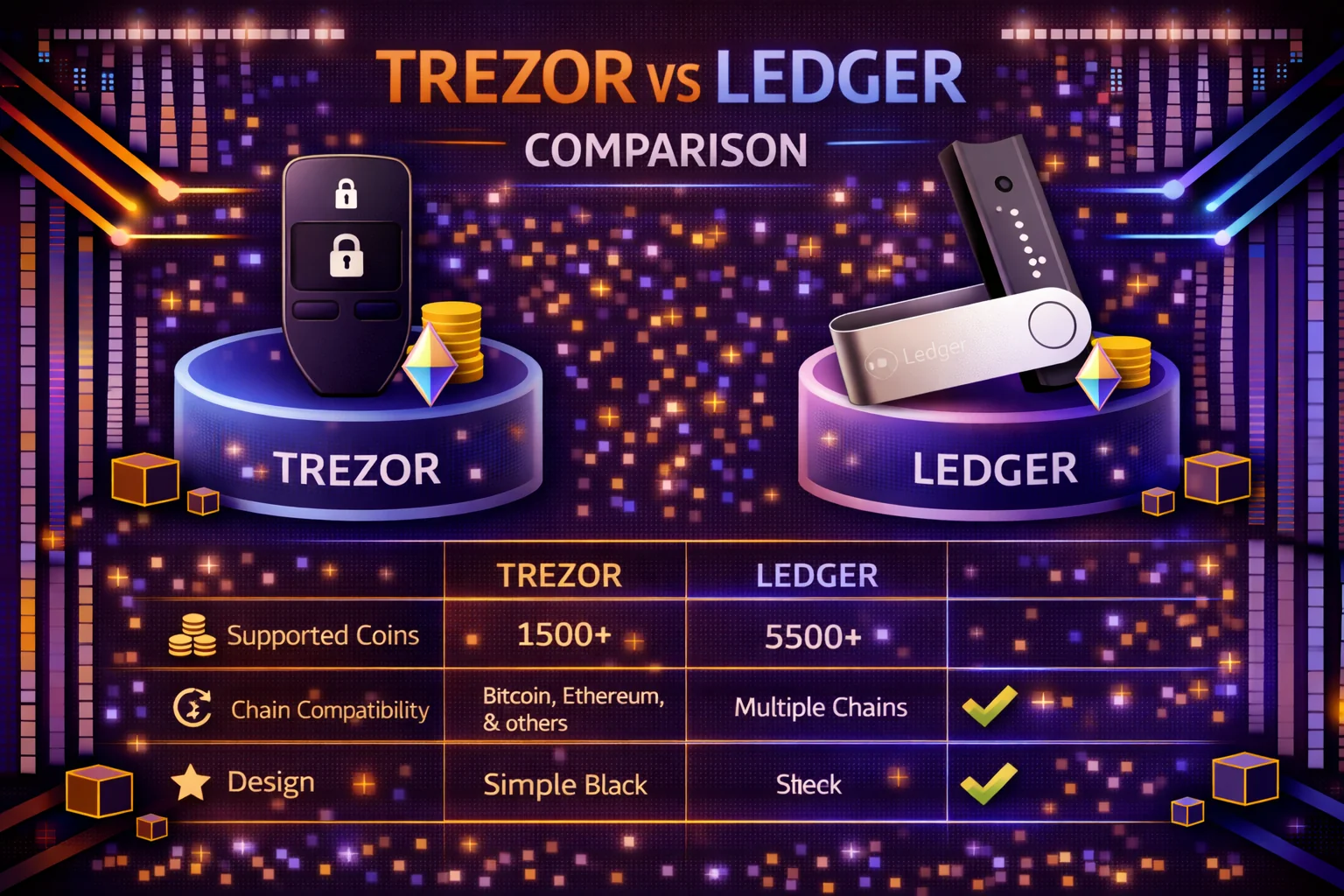
Hardware Wallet Overview
Trezor and Ledger are the two most trusted names in hardware wallet security, each offering unique approaches to protecting your cryptocurrency investments. Both companies have established themselves as industry leaders through years of innovation and security excellence.
Hardware wallets are the gold standard of cryptocurrency security. These physical devices store your private keys offline. This makes them immune to online hacking attempts. Malware and phishing attacks cannot reach them. Software wallets and exchange accounts are constantly under threat.
The choice between Trezor and Ledger often comes down to personal preferences. Security philosophy differs between them. Supported cryptocurrencies vary significantly. User experience takes different approaches. Both brands have proven track records. They take different paths to the same goal: keeping your cryptocurrency safe.
This comprehensive comparison examines every aspect of these two hardware wallet leaders, from their security architectures and supported cryptocurrencies to pricing, user experience, and long-term viability. Whether you're a cryptocurrency beginner looking for your first hardware wallet or an experienced user considering an upgrade, this analysis will help you make an informed decision.
Trezor: The Pioneer
Founded in 2013 by SatoshiLabs, Trezor created the world's first hardware wallet. The company maintains a commitment to open-source development and transparency, making all hardware designs and software code publicly available for security auditing.
Ledger: The Market Leader
Established in 2014, Ledger has become the largest hardware wallet manufacturer by sales volume. The French company focuses on enterprise-grade security through proprietary security chip technology and has sold over 7 million devices worldwide.
| Feature | Trezor | Ledger |
|---|---|---|
| Founded | 2013 | 2014 |
| Open Source | Fully open source | Partially open source |
| Supported Coins | Thousands | 15,000+ |
| Price Range | $59-$249 | $59-$399 |
| Security Chip | Secure Element (EAL6+) | Secure Element (EAL5+/EAL6+) |
Security Comparison
Trezor Security Architecture
Trezor uses a transparent security model, with open-source hardware and software. Every device in the current Safe line — the Safe 3, Safe 5 and Safe 7 — pairs a general-purpose microcontroller with a dedicated EAL6+ secure element, the Infineon Optiga Trust M. The Safe 7 adds the open-source, auditable TROPIC01 secure element alongside its EAL6+ Optiga chip and an STM32U5 microcontroller; the EAL6+ certification belongs to the Optiga, while TROPIC01 is marketed as the world's first auditable secure element rather than an EAL-rated part. This combination closes the gap with proprietary-SE wallets while keeping the firmware auditable. The discontinued Model One and Model T relied on a general-purpose microcontroller alone, with no dedicated SE.
- Secure Element: EAL6+ Optiga Trust M across the Safe line protects PIN and seed against physical extraction
- Open Source: Auditable firmware and, on the Safe 7, an open-source auditable secure element (TROPIC01) alongside the EAL6+ Optiga
- PIN Protection: Device PIN prevents unauthorised access
- Passphrase Support: Additional security layer with BIP39 passphrases
- Multi-share Backup: Shamir (SLIP-39) backup across the Safe 3, Safe 5 and Safe 7
- Firmware Verification: Cryptographic signature verification
Ledger Security Architecture
Ledger implements a dual-chip architecture that combines a general-purpose MCU with a proprietary secure element (SE), certified to CC EAL5+ or EAL6+ depending on the device — CC EAL5+ on the Nano X and CC EAL6+ on the Nano S Plus, Flex and Stax. This design provides hardware-level security comparable to that of banking cards and government ID documents, offering protection against physical attacks and side-channel analysis.
- Secure Element: CC EAL5+/EAL6+ certified chip (EAL5+ on the Nano X, EAL6+ on the Nano S Plus, Flex and Stax) provides tamper-resistant key storage and cryptographic operations
- BOLOS OS: Custom operating system for secure applications enables isolated app execution and secure firmware updates
- PIN Protection: Device PIN with anti-tampering features and increasing delays after failed attempts
- Recovery Phrase: 24-word BIP39 seed phrase enables wallet recovery on any compatible device
- Firmware Attestation: Genuine device verification ensures authentic Ledger hardware and prevents counterfeit devices
Neither vendor's secure-element devices have suffered a documented remote key-extraction attack in real-world use. Physical attacks are a different matter: in 2020 Kraken Security Labs showed that the older, no-secure-element Trezor Model One and Model T could have their seed extracted with physical access and specialist equipment (a voltage-glitching read-protection downgrade taking around fifteen minutes). The current secure-element models on both sides are built specifically to resist this class of attack. The choice between open-source transparency and a proprietary SE reflects different security philosophies rather than objective security differences.
Security Comparison Analysis
Both approaches offer excellent security, but with different philosophies:
- Transparency vs. Proprietary: Trezor's open-source approach allows public security auditing. Ledger's SE provides hardware-level protection
- Physical Security: Both lines now include a dedicated SE for protection against physical attacks. Ledger uses a proprietary secure element certified to CC EAL5+ (Nano X) or EAL6+ (Nano S Plus, Flex, Stax), while every Trezor Safe device carries an EAL6+ Optiga Trust M; the Safe 7 adds the open-source, auditable TROPIC01 alongside that EAL6+ Optiga
- Trust Model: Trezor requires trust in open-source verification, Ledger requires trust in proprietary security certification
Supported Cryptocurrencies
Trezor Cryptocurrency Support
The Trezor Safe line supports thousands of coins and tokens across multiple blockchain networks, with a focus on established cryptocurrencies and strong security implementations.
Major Cryptocurrencies Supported:
- Bitcoin (BTC) and Bitcoin forks
- Ethereum (ETH) and ERC-20 tokens
- Litecoin (LTC)
- Bitcoin Cash (BCH)
- Cardano (ADA)
- Solana (SOL) - Trezor Suite integration
Ledger Cryptocurrency Support
Ledger markets support for over 15,000 crypto assets. This makes it one of the most comprehensive crypto wallets for altcoin enthusiasts and DeFi users.
Extensive Blockchain Support:
- All major cryptocurrencies (BTC, ETH, ADA, SOL, etc.)
- DeFi tokens and protocols
- NFT collections
- Layer 2 solutions (Polygon, Arbitrum, Optimism)
- Newer blockchain networks
- Staking for roughly a dozen proof-of-stake assets (ETH, SOL, XTZ, NEAR, ATOM and more)
Cryptocurrency Support Winner
Both lines support a broad range of assets, with the Trezor Safe range covering thousands of coins and tokens and Ledger marketing support for over 15,000. The practical difference for most portfolios is small. Ledger's edge lies less in raw coin count and more in its deeper native integrations for staking, DeFi, and NFTs through Ledger Wallet, which suits users who manage those assets directly from one app.
Pricing and Models
Trezor Product Line
Trezor Safe 3 ($59)
- Entry-level crypto device (replaced the Model One)
- 0.96" monochrome display with two physical buttons
- EAL6+ secure element (Optiga Trust M)
- USB-C connection, no Bluetooth
- Multi-share (Shamir) backup supported
Trezor Safe 5 ($129)
- Premium crypto wallet (replaced the Model T)
- 1.54" colour touchscreen with haptic feedback
- EAL6+ secure element (Optiga Trust M)
- USB-C, MicroSD slot and aluminium frame
- Multi-share (Shamir) backup supported
Trezor Safe 7 ($249)
- Flagship model with a 2.5" colour touchscreen
- Dual secure elements — the open-source, auditable TROPIC01 alongside an EAL6+ Optiga Trust M — plus an STM32U5 microcontroller (the EAL6+ rating belongs to the Optiga, not the TROPIC01)
- USB-C, Bluetooth 5.0 and Qi2 wireless charging
- Multi-share (Shamir) backup supported
Ledger Product Line
Ledger Nano S Plus ($59)
- Entry-level, with expanded storage
- Supports 15,000+ crypto assets
- Larger screen than original Nano S
- USB-C connectivity
Ledger Nano X ($79)
- Premium portable wallet
- Bluetooth connectivity
- Mobile app support
- Larger screen and battery
- 100+ app storage capacity
Ledger Stax ($399)
- Flagship model with E Ink display
- Curved screen design
- Wireless charging
- Premium materials and build quality
Value Analysis
Trezor offers strong value at the entry level with the Safe 3 at $59, while Ledger spreads across more price points. The Ledger Nano X, at $79, sits a step above the entry-level Nano S Plus and balances features against price for most users.
Total Cost of Ownership Considerations
When evaluating crypto storage investments, the initial purchase price represents only a fraction of the total cost of ownership over the device's operational lifetime. Professional cryptocurrency investors and institutional users must consider ongoing operational expenses, including compatible wallet software licensing, potential subscription services for advanced features, and the cost of integrating with existing cryptocurrency management infrastructure. Both Trezor and Ledger provide comprehensive firmware updates and security patches at no additional cost, ensuring long-term device viability and protection against emerging security threats.
The ecosystem costs attached to each platform can significantly affect the total investment required for comprehensive cryptocurrency security management. Ledger's extensive third-party application ecosystem may require additional software purchases or subscription services for specialised functionality, while Trezor's open-source approach allows cost-effective integration with free and open-source wallet software. Enterprise deployments should also consider training costs, technical support requirements, and potential compliance consulting expenses, which may vary across platforms depending on organisational security policies and regulatory requirements.
Long-term Investment Protection
Both crypto device manufacturers have demonstrated strong commitments to long-term product support and security maintenance, with regular firmware updates that extend device functionality and protect against newly discovered vulnerabilities. Either platform protects holdings that typically far exceed the initial hardware cost, which reduces how much the price difference between models matters when set against the value of the assets being protected. Professional users should evaluate the long-term roadmap and development commitment of each manufacturer to ensure their chosen platform will continue receiving security updates and feature enhancements throughout the device's operational lifetime.
User Experience
Trezor User Experience
Trezor Suite provides a comprehensive desktop and web interface for managing cryptocurrencies, and there is now a Trezor Suite mobile app (iOS 15+ and Android). The mobile app is full-featured with the Safe 7 over Bluetooth, while the Safe 3 and Safe 5 are view-only on mobile. The software emphasises simplicity and security. With a clean, intuitive design.
Trezor Suite Features:
- Desktop, web and mobile applications (mobile full-featured on the Safe 7)
- Portfolio tracking and analytics
- Built-in exchange integration
- Coin control and privacy features
- Regular security updates
Ledger User Experience
Ledger Wallet offers both desktop and mobile applications. It provides flexibility for users who want to manage crypto on the go. The interface is modern and feature-rich.
Ledger Wallet Features:
- Desktop and mobile applications
- Real-time portfolio tracking
- Built-in staking for roughly a dozen proof-of-stake assets
- DeFi access through third-party Discover apps and WalletConnect
- NFT gallery and management
- Third-party app ecosystem
Setup and Onboarding
Both wallets offer straightforward setup processes, but Ledger's mobile app provides a more modern onboarding experience. Trezor's setup is slightly more technical but offers better educational content about security practices.
Customer Support and Documentation
Both manufacturers provide comprehensive support resources, including detailed documentation, video tutorials, and responsive customer service teams. Trezor offers extensive community forums where users share solutions and best practices. Ledger provides multilingual support through email and live chat channels. Both companies maintain active social media presence for quick updates and community engagement.
Learning Resources and Educational Content
Both Trezor and Ledger invest heavily in educational content that helps users understand cryptocurrency security best practices. Trezor's blog features in-depth articles about cryptographic principles, security threats, and proper wallet usage. Ledger Academy provides structured learning paths covering everything from basic cryptocurrency concepts to advanced security techniques. These educational resources prove invaluable for users seeking to deepen their understanding of cryptocurrency security whilst learning to use their hardware wallets effectively and safely in various scenarios.
Features Comparison
| Feature | Trezor | Ledger |
|---|---|---|
| Mobile App | Yes (Suite app; full on Safe 7 via Bluetooth, view-only on Safe 3/5) | Full native app |
| Bluetooth | Yes (Safe 7) | Yes (Nano X, Flex, Stax, Nano Gen5) |
| Staking | Limited support | ~12 proof-of-stake assets |
| DeFi Integration | Basic | Advanced |
| NFT Support | Limited | Full gallery |
| Third-party Apps | Limited | Extensive ecosystem |
| Open Source | Fully open | Partially open |
| Recovery Options | Shamir Backup | Standard BIP39 |
Pros and Cons
Trezor Advantages
- Fully open-source hardware and software
- Pioneer in crypto storage technology
- Transparent security model
- Shamir Backup for advanced users
- Strong privacy focus
- No proprietary dependencies
Trezor Disadvantages
- Limited native DeFi and NFT integration in Trezor Suite
- Suite mobile app is full-featured only on the Safe 7 (over Bluetooth); with the Safe 3 and Safe 5 it is view-only
- Bluetooth only on the flagship Safe 7
- Smaller third-party app ecosystem than Ledger
Ledger Advantages
- Extensive cryptocurrency support (15,000+)
- Full mobile app with Bluetooth
- Advanced DeFi and staking features
- Large third-party app ecosystem
- Security chip hardware protection
- Regular feature updates and new integrations
Ledger Disadvantages
- Proprietary security chip (not fully open-source)
- Past data breach incidents
- More complex software ecosystem
- Higher-end models are expensive
- Dependency on Ledger Wallet software
Our Recommendation
Choose Trezor If:
- You prioritise open-source transparency
- You primarily hold major cryptocurrencies (BTC, ETH, etc.)
- You prefer desktop-based management
- You want the most transparent security model
- You're a privacy-focused user
Choose Ledger If:
- You hold diverse altcoins and DeFi tokens
- You want mobile app functionality
- You're interested in staking and DeFi
- You prefer a larger ecosystem of apps
- You want the latest features and integrations
Best Overall Choice
For most users in 2026, we recommend the Ledger Nano X due to its comprehensive cryptocurrency support, mobile functionality, and advanced features that accommodate diverse portfolios and use cases. However, security-conscious users who prioritise transparency and open-source verification should consider the Trezor Safe 5, which now pairs an EAL6+ secure element with auditable firmware; the Trezor Safe 3 at $59 is the value pick for those who want the same secure element without the touchscreen.
Both brands offer excellent security with proven track records, and your choice should depend on your specific needs, cryptocurrency portfolio composition, and preferences for open-source versus proprietary solutions. Consider your primary use cases, technical expertise, and long-term cryptocurrency strategy when making this important decision that will protect your digital assets for years to come.
The hardware wallet market continues evolving with both manufacturers regularly releasing firmware updates, adding new cryptocurrency support, and improving user experience. Regardless of which brand you choose, ensure you purchase directly from the manufacturer or authorised resellers to avoid counterfeit devices. Follow proper security practices, including secure seed phrase storage, regular firmware updates, and verification of receiving addresses, to maximise the protection of your cryptocurrency holdings.
In-Depth Security Analysis
Hardware Security Architecture
Understanding the security architecture of both devices is crucial for making an informed decision. The current Trezor Safe devices pair a general-purpose microcontroller with a dedicated EAL6+ secure element, the Infineon Optiga Trust M, across the Safe 3, Safe 5 and Safe 7. The Safe 7 additionally carries the open-source, auditable TROPIC01 secure element alongside its EAL6+ Optiga — the EAL6+ rating belongs to the Optiga, not the TROPIC01. Earlier Trezor models, the now-discontinued Model One and Model T, relied on a general-purpose microcontroller alone. Across the range, the open hardware designs let security researchers worldwide audit and verify the implementation.
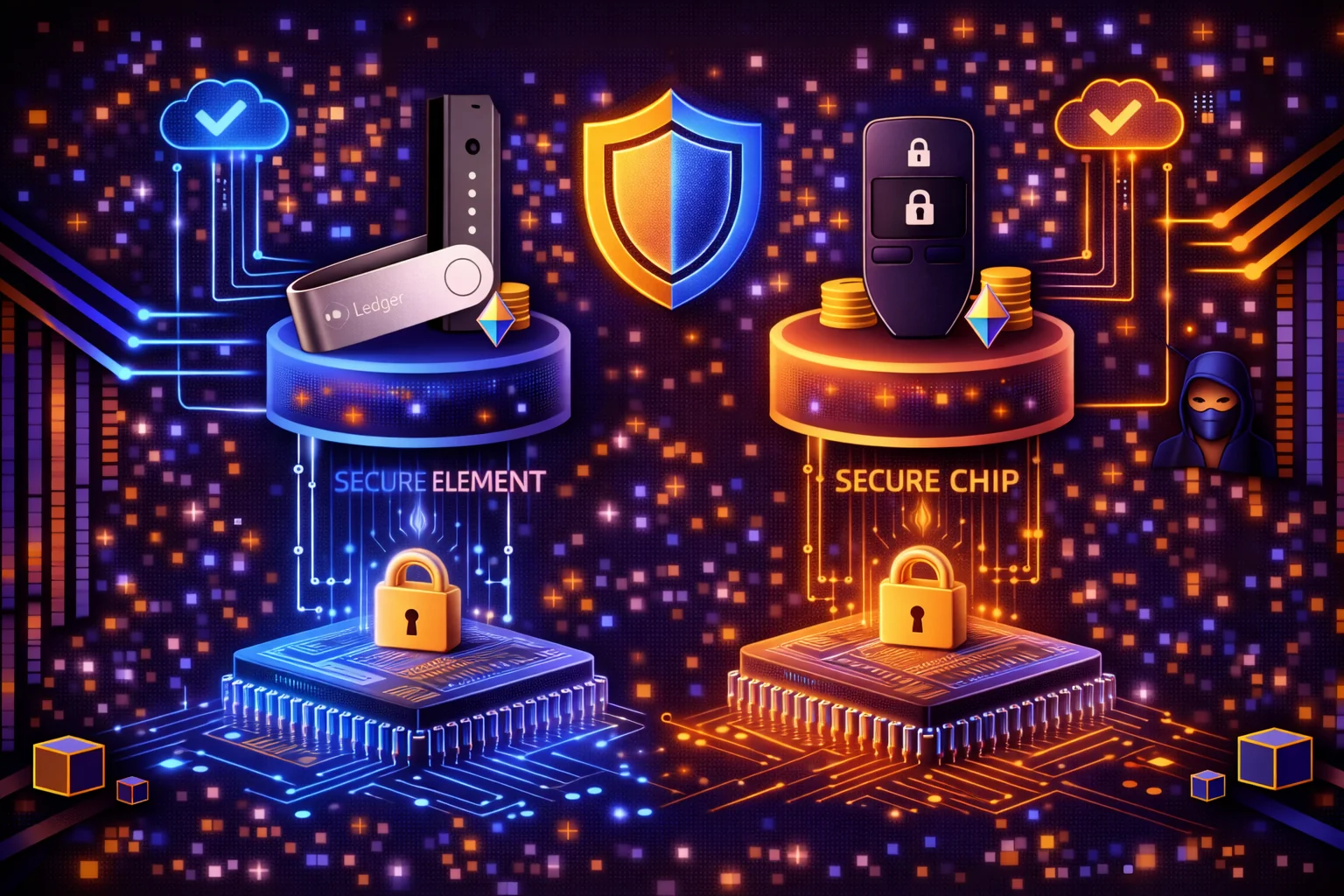
Ledger takes a different approach by incorporating a dedicated secure element (SE) chip, specifically from the ST33 series. These chips are designed to resist physical attacks, including side-channel attacks, fault injection, and invasive probing. The secure element provides hardware-level protection for private keys and cryptographic operations, making it extremely difficult for attackers to extract sensitive information even with physical access to the device.
Firmware and Software Security
Trezor's commitment to open-source extends to all firmware and software components. The Trezor firmware is built using deterministic builds, meaning anyone can verify that the firmware running on their device matches the published source code. This transparency allows for community-driven security audits and ensures no hidden backdoors or vulnerabilities exist in the code.
Ledger's firmware combines open-source components with proprietary elements, particularly those related to the security chip functionality. Whilst this approach may seem less transparent, Ledger argues that keeping certain security-critical components proprietary prevents attackers from gaining detailed knowledge of the implementation, following the principle of security through obscurity as an additional layer of protection.
Attack Resistance and Vulnerability History
Both manufacturers have faced security challenges and have demonstrated their commitment to addressing vulnerabilities promptly. Trezor devices have been subject to various attack attempts, including the "seed extraction" attack that requires physical access and sophisticated equipment. Trezor has addressed these concerns through firmware updates and recommends using strong passphrases as an additional security layer.
Ledger devices have also faced scrutiny, including the discovery of potential vulnerabilities in older firmware versions. However, the security chip architecture has proven resilient against most physical attacks. Ledger's response to security issues has been swift, with regular firmware updates and clear communication about potential risks and mitigation strategies.
Recovery and Backup Security
Both devices use BIP39 mnemonic phrases for wallet recovery, but their implementation and security recommendations differ. Trezor emphasises the importance of secure seed phrase storage and offers detailed guidance on creating secure backups. The device supports advanced features like Shamir's Secret Sharing, which allows users to split their recovery seed into multiple shares, requiring only a subset to recover the wallet.
Ledger provides comprehensive backup solutions through its Recovery Check feature, which allows users to verify their backup without exposing the seed phrase. Ledger also offers the Ledger Recover service (optional and paid), which provides a secure way to backup and recover seed phrases through a distributed key management system. However, this service has been controversial within the cryptocurrency community due to concerns about centralisation.
Multi-Signature and Advanced Security Features
For users requiring enterprise-level security, both devices work with multi-signature configurations, though neither wallet's own software builds multisig in natively — both rely on external coordinators. Trezor's multi-signature setup is straightforward and well-documented, working through compatible wallet software such as Electrum, Sparrow and Specter. (Wasabi Wallet, sometimes cited here, does not support multisig.)
Ledger devices support the same pattern: Ledger Wallet does not create or manage multisig accounts itself, so multisig requires third-party software such as Sparrow, Casa, Unchained or Safe. (Ledger Enterprise, formerly Ledger Vault, is a separate institutional product with its own multi-authorisation controls.) In practice both brands lean on external coordinators for multisig, and on Ledger the secure element still protects each partial signature so that a compromised host computer cannot forge them.
Ecosystem Integration and Future-Proofing
DeFi and Web3 Integration
The decentralised finance (DeFi) ecosystem has become increasingly important for cryptocurrency users, and cold storage integration with DeFi protocols is a key consideration. Ledger has invested in DeFi access, though not as native Ledger Wallet features: protocols such as Uniswap and Aave are reached through third-party "Live Apps" in the Discover catalogue and via WalletConnect, which let users connect to those dApps while the transaction is still signed on the cold-storage device. Staking of a handful of proof-of-stake assets is available through Ledger Wallet's Earn section, but lending and liquidity provision happen inside the third-party apps rather than in Ledger Wallet itself.
Trezor's DeFi integration is more limited within the native Trezor Suite software, but the device connects to popular Web3 interfaces like MetaMask and MyEtherWallet, which run the dApp session with each transaction still signed on the Trezor itself. This approach provides flexibility for advanced users who prefer to use specialised DeFi interfaces while maintaining the security benefits of crypto device transaction signing.
NFT Support and Management
Non-fungible tokens (NFTs) have become a significant part of the cryptocurrency ecosystem, and both manufacturers have adapted their software to support NFT management. Ledger Wallet includes a dedicated NFT gallery that allows users to view, send, and receive NFTs directly within the application. The interface supports popular NFT standards across multiple blockchains, including Ethereum, Polygon, and Solana.
Trezor Suite has also added NFT support, though the implementation is more basic compared to Ledger's offering. Trezor users can manage NFTs through the native software or use third-party applications that support Trezor integration. The open-source nature of Trezor's ecosystem means that community-developed tools often provide additional NFT functionality.
Cross-Chain and Layer 2 Support
As the cryptocurrency ecosystem becomes increasingly multi-chain, support for various blockchains and Layer 2 solutions is crucial. Ledger has been proactive in adding support for new blockchains and Layer 2 networks, with regular updates that add compatibility with emerging protocols. The Ledger Wallet app supports major Layer 2 solutions like Arbitrum, Optimism, and Polygon, allowing users to interact with these networks while maintaining cold storage security.
Trezor's approach to cross-chain support is more conservative but thorough. New blockchain support is added after extensive testing and security audits, ensuring that each supported network meets Trezor's security standards. Whilst this may result in slower adoption of new networks, it provides users with confidence that supported blockchains have been thoroughly vetted.
Conclusion
Both Trezor and Ledger represent excellent choices for cold storage security, each with distinct advantages that cater to different user preferences and security philosophies. After extensive analysis of both ecosystems, it's clear that the decision between these two industry leaders ultimately depends on your specific priorities regarding security transparency, cryptocurrency support, user experience, and long-term ecosystem alignment.
Ledger excels in ecosystem integration. Both lines now cover a broad range of assets — the Trezor Safe range supports thousands of coins and tokens, while Ledger markets support for over 15,000 — so raw coin count is no longer the deciding factor it once was. Ledger's edge lies in its deeper native integrations: the Ledger Wallet application provides a more integrated experience with built-in exchange features, staking capabilities, and advanced portfolio management tools that streamline working with newer altcoins, DeFi tokens, and emerging blockchain networks.
Trezor distinguishes itself through its unwavering commitment to transparency and open-source development principles. Users who prioritise complete transparency in their security solutions will appreciate Trezor's fully open-source approach, which enables independent security audits, community verification of hardware and software components, and greater user control over the security implementation. This transparency extends to Trezor's business practices, security research, and development processes.
From a security perspective, neither vendor's secure-element devices have suffered a documented remote key-extraction attack in real-world use — though the older, no-secure-element Trezor Model One and Model T were shown (by Kraken Security Labs in 2020) to be vulnerable to physical seed extraction, which is exactly what the current secure-element models are designed to prevent. Ledger's Secure Element provides hardware-level protection against physical attacks, while Trezor's open-source approach enables continuous community scrutiny and verification of security implementations. Both approaches have merit, and the choice often reflects personal preferences about security philosophy rather than objective security differences.
For most users, both wallet ecosystems provide more than adequate security for cryptocurrency storage and management. Beginners and users seeking maximum convenience may find Ledger's integrated ecosystem and broader cryptocurrency support more appealing, while privacy-conscious users and security professionals might prefer Trezor's transparency and open-source verification capabilities. The price difference between comparable models is minimal, making cost a secondary consideration in most cases.
Regardless of your choice between Trezor and Ledger, both represent significant security improvements over software wallets, mobile applications, and exchange storage solutions. The most important decision is choosing to use a hardware wallet at all, rather than which specific brand you select. Both companies have proven their commitment to user security, continuous improvement, and adapting to the evolving cryptocurrency landscape, ensuring that either choice will serve you well for years to come.
The hardware wallet market continues evolving with new features, enhanced security measures, and improved user experiences from both manufacturers. Regular firmware updates, expanded cryptocurrency support, and integration with emerging blockchain technologies ensure that both Trezor and Ledger devices remain relevant and secure as the cryptocurrency ecosystem develops. Users benefit from this ongoing competition between manufacturers, which drives innovation and maintains high security standards across the industry.
When making your final decision, consider your specific use case, technical expertise, and long-term cryptocurrency strategy. Users who frequently interact with DeFi protocols, NFT marketplaces, and emerging blockchain networks may find Ledger's broader ecosystem support more practical. Conversely, users who prioritise security transparency, open-source verification, and community-driven development may prefer Trezor's approach. Both choices represent sound investments in cryptocurrency security that will protect your digital assets for years to come.
Remember that proper security practices extend beyond selecting a hardware wallet. Secure seed phrase storage, regular firmware updates, verification of receiving addresses, and awareness of phishing attempts remain crucial regardless of which hardware wallet you choose. The security of your cryptocurrency holdings depends not only on the quality of your hardware wallet but also on your security practices and awareness of potential threats in the cryptocurrency ecosystem.
Sources & References
Frequently Asked Questions
- Which is more secure: Trezor or Ledger?
- Both are strong, and they trade off differently. Trezor's firmware and hardware designs are open source, so anyone can audit them, and the Safe models pair that with a secure element. Ledger's secure element and its firmware are proprietary but certified by an external lab, which is the stronger position against physical extraction and the weaker one against inspection. Neither device has suffered a documented remote key-extraction attack, so the choice is auditability versus certified tamper resistance, not secure versus insecure.
- Which crypto wallet supports more cryptocurrencies?
- The Trezor Safe line supports thousands of coins and tokens. Ledger markets support for over 15,000 crypto assets. Coverage is broad on both; Ledger's advantage is its deeper native integrations for newer altcoins and DeFi tokens.
- Can I use both wallets? With mobile devices?
- Both do. Ledger offers full native mobile apps with Bluetooth connectivity on the Nano X, Flex, Stax and Nano Gen5. Trezor also has a Trezor Suite mobile app (iOS 15+ and Android): it is full-featured with the Safe 7 over Bluetooth, and view-only with the Safe 3 and Safe 5.
- Which wallet is better for DeFi and staking?
- Ledger offers broader DeFi and staking options. Ledger Wallet's Earn section covers roughly a dozen proof-of-stake assets (ETH, SOL, XTZ, NEAR, ATOM and more), and DeFi protocols are reached through third-party apps in the Discover catalogue and WalletConnect rather than as native Ledger Wallet features. Trezor has more limited DeFi and staking capabilities.
- Are both wallets open source?
- Trezor is fully open source: its hardware designs and software code are both public. Ledger is only partly open source, with the secure-element firmware kept proprietary.