Auto-Compounding Yield Aggregation
Master auto-compounding yield strategies across Yearn, Convex, and Beefy. Understand how yield aggregators automate harvest cycles, socialise gas costs, and compound rewards more efficiently than manual strategies — so you can choose the right platform for your assets, position size, and target chains in 2026.

Introduction: Why Auto-Compounding Transforms DeFi Yields
Auto-compounding is the process of automatically reinvesting earned yield back into the principal, allowing compound interest to amplify returns without manual intervention. In traditional finance, compound interest is straightforward — your bank reinvests interest automatically. In DeFi, compounding requires active on-chain transactions: harvesting reward tokens, swapping them for the deposited asset, and redepositing the proceeds. Each step costs gas and demands attention, creating a significant barrier to optimal yield generation.
Yield aggregators like Yearn Finance, Convex Finance, and Beefy Finance emerged to solve this problem by pooling user deposits, executing compound operations on behalf of all depositors, and socialising gas costs across the entire pool. By mid-2026, the dedicated yield-aggregator category manages several billion dollars in total value locked across the major venues — Convex sits near $1.3B in TVL (DeFiLlama, June 2026), Yearn V3 vaults span Ethereum and Layer 2 deployments at several hundred million, and Beefy operates across more than a dozen chains — and these venues have become essential infrastructure for DeFi participants seeking to maximise returns without constant portfolio management. This guide covers the technical mechanics of auto-compounding, analyses the major aggregator architectures, and provides practical strategies for optimising your yield aggregation approach. For the broader yield optimisation context, see our yield optimisation strategies hub.
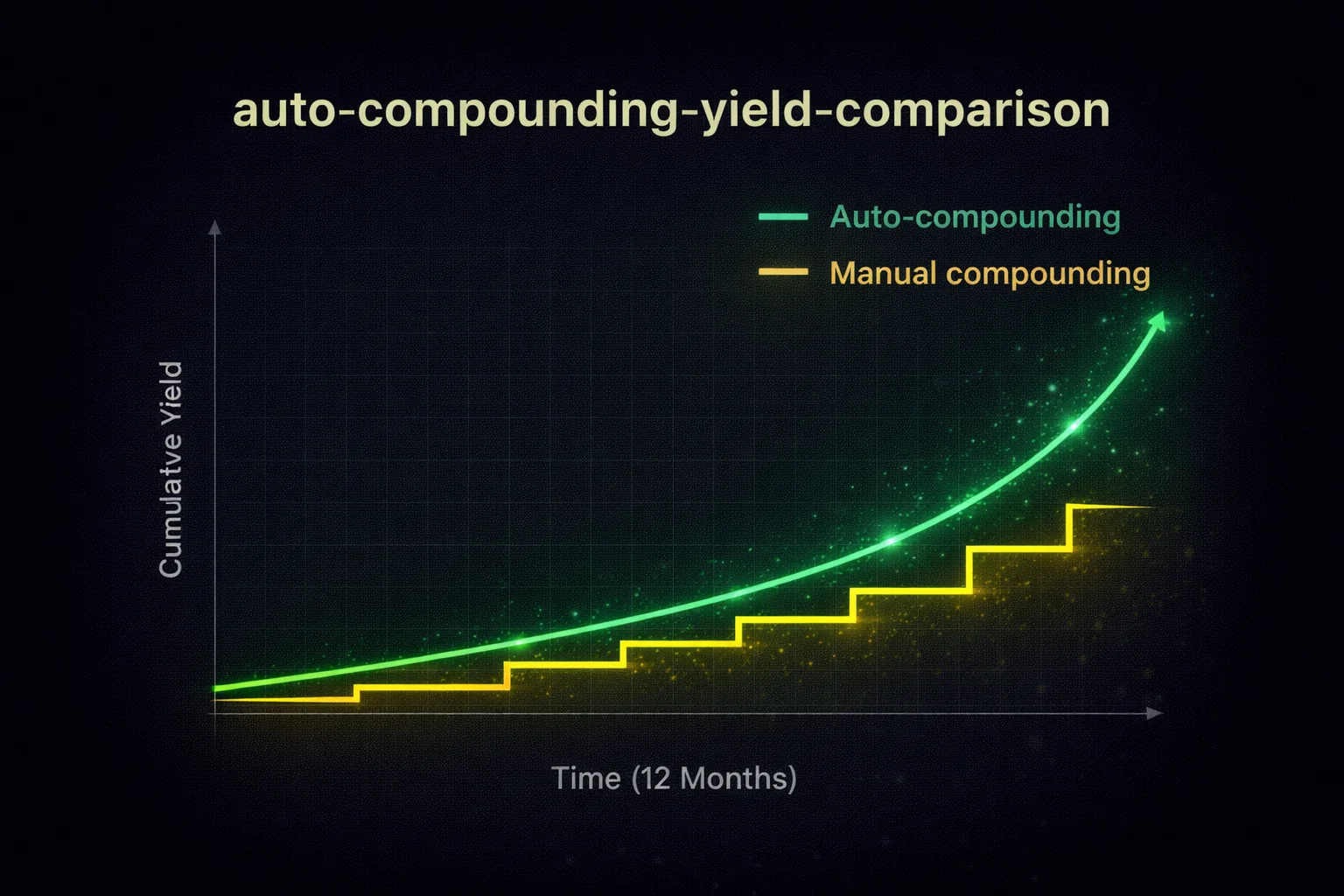
The mathematics of compounding frequency reveals why aggregator architecture matters so much for effective yield generation. A position earning 20% APR compounded annually returns exactly 20% — but the same position compounded daily returns approximately 22.1% APY, and at 50% APR the gap widens to 64.9% APY versus the nominal 50%. These differences compound further over multi-year holding periods, meaning the choice of aggregator and its compounding frequency directly determines long-term portfolio growth. Understanding the relationship between base APR, compounding interval, and net APY after fees is the foundation for evaluating any auto-compounding strategy in the current DeFi landscape.
The aggregator landscape has matured considerably since the early yield farming era of 2020-2021. Yearn Finance established the vault paradigm with its generalised strategy allocation system, deploying capital across multiple protocols simultaneously based on real-time yield conditions. Convex Finance carved out a specialised niche by aggregating veCRV voting power to boost Curve rewards for all depositors, creating a flywheel effect that now controls over 50% of all veCRV supply. Beefy Finance expanded the auto-compounding model across more than fifteen blockchain networks, offering the broadest multichain coverage of any aggregator. Each platform serves a distinct user profile — Yearn for diversified yield seekers, Convex for Curve ecosystem participants, and Beefy for multichain deployers — and selecting the right aggregator depends on your target chains, preferred asset types, and risk tolerance.
Despite the yield advantages, auto-compounding introduces additional layers of smart contract risk that depositors must evaluate carefully. Every aggregator vault adds at least one additional smart contract between your capital and the underlying yield source, and complex strategies may chain through three or four contract layers — the vault itself, the strategy contract, the underlying protocol, and any intermediate wrapper or router contracts. Each layer represents a potential point of failure, and the composability that makes DeFi powerful also creates systemic interdependencies where a vulnerability in one protocol can cascade through aggregator vaults that depend on it. Thorough due diligence on audit history, operational track record, and the specific contract architecture of each vault is essential before committing significant capital to any auto-compounding strategy.
The Mathematics of Auto-Compounding
The difference between simple interest (APR) and compound interest (APY) grows dramatically with higher base rates and more frequent compounding intervals. Understanding this relationship is essential for evaluating yield aggregator performance and comparing opportunities across DeFi protocols.
APR versus APY: The Compounding Premium
APR (Annual Percentage Rate) represents the simple interest rate without compounding — if you earn 20% APR on $10,000, you receive $2,000 in rewards over one year, regardless of when those rewards are claimed. APY (Annual Percentage Yield) accounts for compounding — the same 20% APR compounded daily produces approximately 22.1% APY, yielding $2,213 instead of $2,000. The additional $213 comes entirely from reinvesting earned rewards, so it generates its own returns. At higher base rates, the compounding premium becomes more significant: a 50% APR compounded daily produces 64.8% APY, adding nearly 15 percentage points of additional yield through compounding alone.
Compounding Frequency and Diminishing Returns
More frequent compounding produces higher effective yields, but with diminishing marginal returns. Moving from annual to monthly compounding captures most of the available compounding benefit. Moving from monthly to daily adds a smaller increment. Moving from daily to hourly adds a negligible amount. For a 20% APR position, annual compounding yields 20.0% APY, monthly yields 21.9%, daily yields 22.1%, and hourly yields 22.13%. The practical implication is that daily compounding captures over 99% of the theoretical maximum compounding benefit, making more frequent intervals unnecessary for most strategies. Yield aggregators typically compound between once daily and once every few hours, depending on the vault's TVL and the gas cost economics.
Gas Cost Break-Even Analysis
Every compounding transaction costs gas, creating a break-even threshold below which compounding destroys value rather than creating it. The break-even calculation compares the additional yield generated by one compounding event against the gas cost of executing that event. For a vault holding $10 million with a 20% base APR, a single daily compound generates approximately $5,479 in additional annual yield across all depositors. If the compound transaction costs $30 in gas, the net benefit is overwhelmingly positive. However, for a vault holding only $100,000, the same daily compound generates just $54.79 in additional annual yield — still profitable at a $30 gas cost, but with much thinner margins. Aggregators dynamically adjust compounding frequency based on vault TVL and current gas prices to maintain positive net compounding economics.
- Daily compounding captures over 99% of the theoretical maximum compounding benefit
- Higher base APR rates produce proportionally larger compounding premiums
- Gas cost break-even thresholds determine minimum viable vault TVL for profitable compounding
Yield Aggregator Architecture
Modern yield aggregators share a common architectural pattern: a vault contract that accepts user deposits, a strategy contract that deploys capital to yield-generating protocols, and a harvester mechanism that triggers compounding operations. The separation between vault and strategy enables modularity — a single vault can switch between strategies without requiring users to withdraw and redeposit.
Vault and Strategy Separation
The vault contract manages user deposits and withdrawals, tracking each depositor's share of the total pool through share tokens. When you deposit 1,000 USDC into a Yearn vault, you receive vault shares proportional to your deposit relative to the total vault balance. As the strategy generates yield and compounds it back into the vault, the value per share increases — your same number of shares represents a growing amount of underlying USDC. This share-based accounting eliminates the need for individual reward tracking and simplifies the compounding process to a single vault-level operation.
Harvester Mechanisms and Keeper Networks
Harvesting is the process of claiming earned rewards from underlying protocols, swapping reward tokens for the vault's base asset, and redepositing the proceeds. Aggregators use keeper networks — automated bots that monitor vault conditions and trigger harvest transactions when economically optimal. Yearn uses a custom keeper infrastructure that evaluates gas costs, pending rewards, and the time since the last harvest to determine the optimal harvest time. Convex relies on a combination of automated keepers and community-triggered harvests incentivised by small caller rewards. The keeper infrastructure is critical to aggregator performance — unreliable or slow keepers result in suboptimal compounding frequency and lower effective yields for depositors.
Share Token Mechanics and Accounting
Vault share tokens represent your proportional claim on the vault's total assets. The price per share starts at 1.0 when the vault launches and increases monotonically as yield is compounded. If you deposit when the share price is 1.05 and withdraw when it reaches 1.15, your return is approximately 9.5% regardless of when other depositors entered or exited. This mechanism ensures fair yield distribution without complex reward tracking. Share tokens are typically ERC-20 compatible, meaning they can be used as collateral in other DeFi protocols, traded on secondary markets, or integrated into more complex yield strategies — creating composability that individual manual compounding cannot achieve.
- Vault contracts manage deposits via share tokens that appreciate as yield compounds
- Strategy contracts deploy capital to yield protocols and can be swapped without user action
- Keeper networks automate harvest timing based on gas costs and pending reward thresholds
Yearn Finance: Generalised Vault Strategies
Yearn Finance pioneered the yield aggregator category in 2020 and remains the most sophisticated generalised vault platform in DeFi. Yearn V3, launched in 2023 and refined through 2025-2026, introduced a modular architecture that allows multiple strategies to operate within a single vault, with dynamic allocation based on real-time yield conditions.
Yearn V3 Vault Architecture
Yearn V3 vaults support multiple concurrent strategies with configurable allocation limits. A single USDC vault might simultaneously deploy capital to Have for lending yield, Curve for liquidity-provision fees, and Compound for variable-rate lending—automatically rebalancing between strategies as relative yields shift. The vault's allocator module evaluates each strategy's current APY, risk profile, and capacity constraints to determine optimal capital distribution. This multi-strategy approach provides diversification within a single deposit, reducing the impact of any single protocol's yield compression on your overall returns.
Strategy Development and Governance
Yearn strategies are developed by a community of strategists who earn a share of the performance fees generated by their strategies. Each strategy undergoes peer review, security assessment, and governance approval before deployment. The strategy development process ensures that only well-tested, economically sound strategies reach production vaults. Strategists continuously monitor their deployed strategies and can adjust parameters or migrate capital to updated versions as market conditions evolve. This human-in-the-loop approach combines automated execution with expert oversight, balancing efficiency with risk management.
Fee Structure and Value Proposition
Yearn V3 charges a 10% performance fee on generated yield only — there is no annual management fee on deposited assets, no deposit fee, and no withdrawal fee. The performance fee is deducted only on positive returns, meaning you pay nothing in periods when the vault generates no yield. For a vault delivering 10% gross APY, the effective cost is 1 percentage point, leaving you with approximately 9% net APY. Despite this fee, Yearn vaults frequently outperform manual strategies because aggregated capital improves gas efficiency, multi-strategy allocation captures yield opportunities that individual users would miss, and professional strategy management avoids common mistakes like suboptimal harvest timing or missed rebalancing opportunities.
Convex Finance: Curve-Focused Yield Maximisation
Convex Finance specialises in maximising yields from Curve Finance liquidity pools by aggregating veCRV voting power to boost CRV rewards for all depositors. Unlike Yearn's generalised approach, Convex focuses exclusively on the Curve ecosystem, achieving deeper optimisation within that specific domain.
CRV Boost Aggregation Mechanics
Curve's reward system allows liquidity providers to boost their CRV earnings up to 2.5x based on their veCRV holdings. Achieving maximum boost on large positions requires enormous veCRV balances that most individual users cannot accumulate. Convex solves this by pooling veCRV from all depositors — with over 300 million veCRV locked, Convex provides near-maximum boost to every depositor regardless of their individual position size. When you deposit Curve LP tokens into Convex, you earn boosted CRV rewards, CVX token incentives, and a share of Curve trading fees, all auto-compounded by Convex's harvester infrastructure. For a deeper understanding of the ve-tokenomics that underpin Convex's boost mechanics, see our ve-tokenomics guide.
CVX Token Economics and vlCVX
Convex distributes CVX tokens as additional incentives to depositors. CVX holders can lock their tokens as vlCVX (vote-locked CVX) for 16-week periods to direct Convex's massive veCRV voting power towards specific Curve gauges. This creates a meta-governance layer where vlCVX votes effectively control Curve's emission schedule. The vlCVX system attracts substantial bribe income from protocols seeking gauge votes, making CVX locking a profitable strategy independent of Curve LP yields. Convex's dual value proposition — boosted Curve yields for LP depositors and bribe income for CVX lockers — has made it the dominant force in the Curve ecosystem.
Convex Fee Structure and Comparison
Convex charges a 16% performance fee on CRV rewards — higher than Yearn's 10% performance fee — but this is justified by the superior boost levels Convex achieves through its concentrated veCRV holdings. The net yield after fees on Convex typically exceeds what individual users could earn even at zero fee, because the 2.5x boost multiplier more than compensates for the fee deduction. Neither Convex nor Yearn V3 charges a management fee on deposited principal. For Curve-specific LP positions, you should deposit through Convex because the boost advantage outweighs the fee differential. For non-Curve yield opportunities — lending, multiprotocol strategies, or non-Ethereum assets — Yearn's lower performance fee and broader strategy coverage make it the more efficient choice.
Beefy Finance: Multi-Chain Auto-Compounding
Beefy Finance operates as a multichain yield optimiser deployed across over 20 blockchain networks including Ethereum, Arbitrum, Optimism, Polygon, BNB Chain, and Avalanche. Unlike Yearn's focus on Ethereum maintain or Convex's Curve specialisation, Beefy provides auto-compounding vaults for yield opportunities across the entire DeFi ecosystem regardless of chain.
Multi-Chain Deployment Strategy
Beefy's multichain presence allows it to capture yield opportunities that chain-specific aggregators miss. When a new DeFi protocol launches on Arbitrum with attractive liquidity mining incentives, Beefy can deploy an auto-compounding vault within days, giving depositors immediate access to optimised yields. The platform maintains over 600 active vaults across all supported chains, covering DEX liquidity pools, lending protocols, liquid staking derivatives, and protocol-specific farming opportunities. Each vault operates independently with its own strategy contract, harvester schedule, and fee parameters tailored to the specific chain's gas economics and yield characteristics.
Beefy Safety Score and Vault Classification
Beefy assigns a safety score to each vault based on factors including the underlying protocol's audit status, TVL size, operational history, and smart contract complexity. Vaults are classified into risk tiers that help depositors assess the tradeoffs between yield and security. Higher-risk vaults on newer protocols with limited audit history typically offer higher yields but carry greater smart contract risk. Lower-risk vaults on established protocols like Have or Curve offer more modest yields with stronger security guarantees. This transparent risk classification system helps users make informed decisions about where to allocate capital based on their individual risk tolerance.
Strategy Types and Yield Sources
Yield aggregator strategies can be categorised by their underlying yield source. Understanding these categories helps you evaluate the sustainability and risk profile of different vault opportunities.
Lending and Borrowing Strategies
Lending strategies deposit assets into protocols like Have, Compound, or Morpho to earn interest from borrowers. These strategies carry relatively low risk because the yield comes from genuine economic activity — borrowers pay interest for the utility of accessing capital. Auto-compounding lending strategies reinvest earned interest back into the lending position, growing the principal over time. Some advanced lending strategies employ recursive borrowing — depositing an asset, borrowing against it, redepositing the borrowed amount, and repeating — to amplify the effective lending yield through leverage. Recursive strategies increase both the yield and the liquidation risk proportionally.
Liquidity Provision and Trading Fee Strategies
Liquidity provision strategies deposit token pairs into decentralised exchange pools to earn trading fees. The yield comes from swap fees paid by traders using the pool. Auto-compounding LP strategies harvest earned fees and reinvest them by purchasing additional LP tokens. These strategies carry impermanent loss risk — if the relative price of the paired tokens diverges significantly, the LP position may underperform simply holding the individual tokens. Stable pair pools (USDC/USDT, stETH/ETH) minimise impermanent loss risk while volatile pair pools (ETH/altcoin) carry higher impermanent loss exposure but typically offer higher fee yields to compensate.
Incentive Farming and Emission Strategies
Incentive farming strategies earn yield from protocol token emissions distributed to liquidity providers or stakers. These emissions are typically inflationary — the protocol creates new tokens and distributes them as rewards to attract liquidity. Auto-compounding converts these reward tokens into the deposited asset through automated swaps, crystallising the emission value before potential token price depreciation. The sustainability of emission-based yields depends on the protocol's tokenomics — protocols with declining emission schedules and growing real revenue can sustain attractive yields, while protocols relying purely on inflationary emissions face inevitable yield compression as emission rates decrease.
Real Yield versus Inflationary Rewards
The distinction between real yield and inflationary rewards is critical for evaluating long-term strategy sustainability. Real yield comes from genuine economic activity — trading fees, lending interest, liquidation penalties — and is sustainable as long as the underlying activity continues. Inflationary yield comes from token emissions that dilute existing holders. A vault advertising 50% APY from token emissions may deliver negative real returns if the emission token depreciates faster than the rewards accumulate. Sophisticated aggregators like Yearn prioritise strategies with significant real yield components, while simpler aggregators may chase headline APY figures driven primarily by unsustainable emissions.
Gas Optimisation and Layer 2 Strategies
Gas costs are the primary economic constraint on auto-compounding profitability. The evolution of Layer 2 scaling solutions has fundamentally changed the gas economics of yield aggregation, making strategies viable on L2 that would be unprofitable on Ethereum maintain.
Layer 2 Yield Aggregation Advantages
On Arbitrum and Optimism, transaction costs are 90-95% lower than Ethereum maintain, enabling more frequent compounding intervals and making auto-compounding profitable for smaller positions. A harvest transaction that costs $30 on Ethereum maintains approximately $0.50-2.00 on Arbitrum. This cost reduction allows aggregators to compound hourly rather than daily, capturing additional yield that would be uneconomical on maintain. For positions under $10,000, Layer 2 aggregators provide higher net yields than their maintain equivalents meaningfully because the gas savings compound over hundreds of harvest cycles throughout the year.
Batch Harvesting and Socialised Gas Costs
Aggregators socialise gas costs across all vault depositors by executing a single harvest transaction that benefits every depositor simultaneously. When Yearn harvests a vault holding $50 million from 5,000 depositors, the $30 gas cost is effectively $0.006 per depositor — negligible regardless of position size. This socialisation mechanism is the fundamental economic advantage of aggregators over individual compounding. The larger the vault's TVL, the more efficiently gas costs are distributed, creating a network effect where popular vaults become increasingly cost-effective as more capital flows in.
- Optimal compounding frequency balances gas costs against foregone compound interest
- Higher TVL vaults can compound more frequently as gas cost is shared across depositors
- Automated keepers trigger harvests when accumulated rewards exceed gas cost thresholds
Risk Management for Yield Aggregation
Yield aggregators introduce multiple layers of smart contract risk that compound across the aggregator contract, the underlying protocol contracts, and any intermediate wrapper or bridge contracts involved in the strategy.
Smart Contract Layering Risk Assessment
Each additional smart contract layer in a yield aggregation stack introduces independent failure risk that compounds multiplicatively rather than additively. A Yearn vault deploying capital through a Curve pool via Convex involves at least four contract layers: the Yearn vault contract, the Yearn strategy contract, the Convex staking contract, and the Curve pool contract. If each layer has a 99.5% probability of remaining secure over a given period, the combined probability drops to approximately 98%, which represents a meaningful increase in expected loss for large positions held over extended timeframes. If any single contract in the chain is exploited, the entire vault position may be compromised — mitigating layering risk requires diversifying across aggregators that use different underlying protocol stacks.
Evaluating layered risk requires examining the audit history, time in production, and TVL of each contract in the stack. Protocols that have operated for multiple years with billions in TVL without major incidents — such as Curve's core pool contracts and Convex's staking contracts — provide stronger empirical security guarantees than newer contracts with limited production history. Prioritising strategies that route through battle-tested protocol contracts reduces the overall risk profile of your aggregated positions, even if the gross yield is slightly lower than strategies involving newer, less proven contracts.
TVL Monitoring and Exit Signals
Understanding the complete fee structure of your aggregator position is essential for accurate yield estimation. Major aggregators charge a performance fee on generated yield: Yearn V3 takes 10%, Convex takes 16% on CRV rewards, and Beefy ranges from 3.5% to 9.5% depending on chain and strategy. None of the three charge management fees on deposited principal. These fees are deducted automatically during harvest transactions, so the displayed vault APY already accounts for them — you should always compare net APY figures rather than gross yields. Entry and exit fees, though rare amongst established aggregators, can significantly impact returns on shorter holding periods, so you should verify the complete fee schedule before depositing.
The compounding frequency of an aggregator directly determines the effective APY relative to the stated APR. A vault that compounds daily converts a 10% APR into approximately 10.52% APY, while weekly compounding yields approximately 10.51% and monthly compounding approximately 10.47%. The difference becomes more pronounced at higher base rates — a 50% APR compounds to 64.8% APY daily versus 63.2% monthly. Gas costs constrain compounding frequency on Ethereum maintain, which is why many aggregators batch harvests across all depositors to amortise gas costs. Layer 2 deployments enable more frequent compounding due to lower transaction costs, often resulting in measurably higher effective yields for the same underlying strategy.
Monitoring total value locked trends across your aggregator positions provides early warning signals for potential issues. A sudden decline in vault TVL — particularly when not explained by broader market movements — may indicate that informed participants are withdrawing due to concerns not yet publicly known. Setting alerts for TVL drops exceeding 15-20% within a 24-hour period enables timely evaluation of whether to maintain or exit your positions. Conversely, rapid TVL growth in newer vaults may indicate unsustainable yield incentives that will compress as more capital enters, reducing the attractiveness of the opportunity.
Withdrawal Timing and Harvest Synchronisation
The timing of withdrawals from auto-compounding vaults affects your realised returns because pending yield that has not yet been harvested and reinvested is forfeited upon exit. Most aggregators harvest on a schedule determined by gas cost optimisation algorithms — when the accumulated yield exceeds the gas cost of the harvest transaction by a sufficient margin. Withdrawing immediately before a scheduled harvest means losing the accumulated but unharvested yield, which can represent several days of returns during periods of infrequent harvesting. Monitoring your vault's harvest history through block explorers or aggregator dashboards helps identify optimal withdrawal windows that maximise captured yield.
For large withdrawals that represent a significant portion of the vault's total deposits, the withdrawal itself may trigger slippage in the underlying strategy as the vault liquidates positions to return your capital. This is particularly relevant for vaults deploying capital into concentrated liquidity positions or smaller DeFi pools where large withdrawals can move prices. Splitting large withdrawals across multiple transactions over several hours or days reduces this slippage impact, though it increases total gas costs. The break-even point between slippage savings and additional gas costs depends on the withdrawal size relative to vault TVL and the liquidity depth of the underlying strategy positions.
Strategy-Specific Risk Assessment
Each vault strategy carries unique risks beyond general smart contract exposure. Leveraged lending strategies face liquidation risk if collateral values drop below maintenance thresholds. LP strategies face impermanent loss risk from token price divergence. Emission farming strategies face token depreciation risk as reward tokens are sold by harvesters. Before depositing into any vault, review the strategy description to understand which specific risks apply and whether the offered yield adequately compensates for those risks. Aggregators with transparent strategy documentation and regular security reviews provide better risk visibility than opaque platforms that obscure their underlying mechanics.
Portfolio Diversification Across Aggregators
Distributing capital across multiple aggregators reduces the impact of any single platform failure. A balanced yield aggregation portfolio might allocate 35-40% to Yearn for generalised multi-strategy exposure, 30-35% to Convex for Curve-specific yield maximisation, and 25-30% to Beefy for multichain opportunities. Within each aggregator, further diversify across vault types — mixing stablecoin vaults with volatile asset vaults and lending strategies with LP strategies. This layered diversification approach limits maximum drawdown from any single exploit or strategy failure while maintaining attractive aggregate yields across the portfolio.
Choosing the Right Aggregator
The optimal aggregator choice depends on your specific assets, target chains, risk tolerance, and yield objectives. No single aggregator dominates across all dimensions.
Aggregator Selection Framework
A systematic approach to aggregator selection evaluates four dimensions: yield performance (net APY after all fees), security profile (audit coverage, time-in-production, incident history), operational reliability (uptime, harvest frequency, strategy rebalancing responsiveness), and composability (whether vault shares can be used as collateral or integrated with other DeFi protocols). Weighting these dimensions according to your priorities creates a personalised scoring framework that simplifies comparison across the growing number of aggregator options available in 2026.
For Ethereum maintain positions exceeding $50,000, Yearn's multi-strategy vaults typically offer the best risk-adjusted returns due to professional strategy management and broad diversification. For Curve-specific LP positions of any size, Convex delivers superior net yields through its permanently locked veCRV boost advantage. For multichain portfolios or positions on Layer 2 networks, Beefy's extensive deployment coverage provides the most convenient single-platform solution. Many experienced yield farmers maintain positions across all three aggregators simultaneously, allocating capital based on each platform's comparative advantage for specific asset types and chain deployments.
Asset-Based Aggregator Selection
For Curve LP positions, Convex provides the highest yields through its concentrated veCRV boost — no other aggregator can match Convex's boost levels on Curve pools. For non-Curve assets on Ethereum, Yearn's multi-strategy vaults offer the best risk-adjusted returns through diversified strategy allocation. For assets on Layer 2 networks or alternative chains, Beefy provides the broadest coverage with auto-compounding vaults across 20+ networks. If you hold a mix of assets across multiple chains, using all three aggregators in combination provides comprehensive yield optimisation coverage.
Key Evaluation Criteria
When evaluating a specific vault, consider five factors: the vault's TVL (larger vaults have better gas socialisation), the strategy's audit status (audited strategies carry lower smart contract risk), the historical APY stability (volatile APY suggests unsustainable emission-based yields), the underlying protocol's track record (established protocols like Curve and Have carry lower risk than newer alternatives), and the aggregator's fee structure (compare net yields after all fees rather than gross APY figures). Vaults that score well across all five dimensions represent the most attractive risk-adjusted opportunities for long-term capital deployment.
Advanced Aggregation Techniques
Experienced yield farmers employ advanced techniques that layer aggregator positions with other DeFi primitives to enhance returns beyond what standard vault deposits provide.
Using Vault Shares as Collateral
Many lending protocols accept yield-bearing vault shares as collateral. Depositing Yearn vault shares into Have or Maker allows you to borrow against your auto-compounding position without withdrawing from the vault. The borrowed funds can be deployed to additional yield opportunities, creating leveraged yield exposure. This technique amplifies returns but also amplifies risk — if the vault share value drops or the borrowed asset appreciates, your collateral ratio may trigger liquidation. Conservative leverage ratios of 30-40% loan-to-value provide meaningful yield enhancement while maintaining comfortable liquidation buffers.
Cross-Aggregator Strategy Stacking
Some advanced strategies stack multiple aggregator layers. For example, depositing into a Curve pool, staking the LP tokens on Convex for boosted CRV rewards, then depositing the Convex receipt tokens into a Yearn vault that auto-compounds the Convex rewards. Each layer adds yield but also adds smart contract risk and fee exposure. The marginal yield from each additional layer decreases while the marginal risk increases, creating a natural limit to profitable stacking depth. In practice, two layers (protocol plus one aggregator) capture most of the available yield optimisation, while three or more layers rarely justify the additional complexity and risk.
Tracking cross-aggregator positions requires dedicated portfolio monitoring because each aggregator reports yields independently without awareness of your allocations on competing platforms. Tools like DeBank, Zapper, and DefiLlama provide consolidated dashboards that aggregate vault positions across Yearn, Convex, and Beefy into a unified portfolio view, enabling accurate total yield calculation and risk exposure assessment across your entire aggregator allocation.
Conclusion
Auto-compounding yield aggregation has matured from an experimental DeFi concept into essential infrastructure for capital-efficient yield generation. The three major aggregators — Yearn Finance for generalised multi-strategy vaults, Convex Finance for Curve-specific yield maximisation, and Beefy Finance for multichain coverage — each serve distinct use cases within a comprehensive yield optimisation portfolio.
The compounding frequency advantage grows with the base rate: the gap between simple APR and compounded APY widens as yields rise. When base APR exceeds 15%, the difference between daily and weekly compounding can represent several percentage points of additional annual return. Yield aggregators that optimise their harvest frequency based on gas costs and reward accumulation rates deliver measurably better outcomes than fixed-interval compounding schedules. This dynamic optimisation is one of the primary value propositions that justifies aggregator fees for most depositors, particularly for smaller positions where manual harvesting gas costs would consume a disproportionate share of earned rewards.
The evolution of yield aggregation towards multichain deployment has expanded the addressable market significantly. Beefy Finance's presence across over 20 networks demonstrates that auto-compounding demand exists wherever DeFi yield opportunities emerge. Layer 2 networks like Arbitrum and Optimism have become particularly attractive for aggregator strategies because the reduced gas costs make compounding economically viable for smaller positions and at higher frequencies than Ethereum maintains permits. This accessibility improvement means that yield aggregation is no longer restricted to large capital allocators who can absorb maintain gas costs, democratising access to compound interest mechanics across the DeFi ecosystem.
Risk management remains the critical differentiator between successful and unsuccessful yield aggregation strategies. The layered smart contract exposure inherent in aggregator positions — your capital passes through the aggregator contract, the strategy contract, and the underlying protocol contracts — creates a multiplicative risk surface that demands careful evaluation. Diversifying across aggregators, strategy types, and underlying protocols limits the impact of any single point of failure. Monitoring vault TVL trends, strategy allocation changes, and underlying protocol health provides early warning signals that enable proactive risk management rather than reactive loss mitigation. The most resilient yield aggregation portfolios combine positions across multiple aggregators with different strategy philosophies, ensuring that no single protocol failure can compromise the entire yield-generating allocation.
The key to successful yield aggregation in 2026 is matching your assets and risk tolerance to the appropriate aggregator and strategy type. Prioritise real yield strategies over inflationary emission farming, diversify across aggregators and strategy types to limit smart contract layering risk, and leverage Layer 2 deployments for smaller positions where maintaining gas costs would erode returns. For the complete yield optimisation framework including ve-tokenomics and yield tokenisation strategies, return to our yield optimisation strategies hub.
Sources and References
- Yearn Finance — V3 Vault Documentation and Strategy Architecture
- Convex Finance — Protocol Documentation and CRV Boosting Mechanics
- Beefy Finance — Multi-Chain Vault Documentation and Safety Scores
- Curve Finance — Reward Gauges Documentation (CRV Boosting)
- Yield Optimisation Strategies 2026
- ve-Tokenomics Explained 2026
Frequently Asked Questions
- How does auto-compounding increase yield compared to manual harvesting?
- Auto-compounding reinvests earned rewards back into the principal position automatically at regular intervals, allowing subsequent rewards to generate their own returns. The frequency of compounding directly affects the effective annual yield — daily compounding on a 20% base APR produces approximately 22.1% APY, while weekly compounding yields roughly 21.5% APY. Manual harvesting typically occurs less frequently due to gas costs and attention requirements, resulting in lower effective yields. The mathematical advantage grows with higher base rates and more frequent compounding intervals, making auto-compounding particularly valuable for high-yield DeFi strategies where rewards accrue rapidly.
- What fees do yield aggregators like Yearn and Convex charge?
- Yearn Finance V3 vaults charge a 10% performance fee on generated yield only — there is no annual management fee on deposited assets, and no deposit or withdrawal fees. Convex Finance takes a 16% fee on CRV rewards split between coxCRY stakers (10%), vlCVX holders (5%), and the protocol treasury (1%). Beefy Finance charges variable performance fees typically ranging from 3.5% to 9.5% depending on the strategy and chain. Despite these fees, aggregators often deliver higher net yields than manual strategies because pooled capital achieves better gas efficiency, higher boost levels, and access to optimised strategy routing that individual users cannot replicate cost-effectively. You should compare net APY figures after fees rather than gross yields when choosing between aggregators.
- Is it safe to deposit funds into yield aggregator vaults?
- Yield aggregator vaults carry smart contract risk from multiple layers — the aggregator contract itself, the underlying protocol contracts, and any intermediate wrapper contracts. Yearn Finance has operated since 2020 with multiple security audits from firms including Trail of Bits and ChainSecurity, plus an active bug bounty programme. Convex Finance has similarly operated without major exploits since launch. You should evaluate each vault individually based on its audit history, TVL size, operational track record, and the complexity of its underlying strategy. Diversifying across multiple vaults and aggregators reduces the impact of any single smart contract failure.
- What is the difference between Yearn vaults and Convex pools?
- Yearn vaults are generalised yield aggregators that deploy capital across multiple DeFi protocols using automated strategies — a single vault may allocate funds to Have, Compound, Curve, and other protocols simultaneously. Convex pools are specifically focused on maximising Curve Finance yields by aggregating veCRV voting power to boost CRV rewards for all depositors. Yearn offers broader diversification across protocols and strategy types, while Convex provides deeper specialisation within the Curve ecosystem with typically higher yields on Curve-specific positions. Many sophisticated users combine both platforms for comprehensive yield coverage.
- How do gas costs affect auto-compounding profitability?
- Gas costs are the primary constraint on compounding frequency. On Ethereum maintain, a harvest transaction typically costs 15-50 USD depending on network congestion. Yield aggregators solve this by socialising gas costs across all vault depositors — when Yearn harvests a vault holding 50 million USD in deposits, the gas cost is split across thousands of depositors, making each individual share negligible. Layer 2 deployments on Arbitrum and Optimism reduce gas costs by 90-95%, making individual auto-compounding practical for positions as small as 1,000 USD. The break-even deposit size depends on the compounding frequency, gas price, and base yield rate.
← Back to Crypto Investing Blog Index
Financial Disclaimer
This content is not financial advice. All information provided is for educational purposes only. Cryptocurrency investments carry significant investment risk, and past performance does not guarantee future results. Always do your own research and consult a qualified financial advisor before making investment decisions.