Compare Crypto Exchange Fees in 2026
Side-by-side fee comparison of Binance, OKX, Kraken, Bybit, and Coinbase — with the cheapest exchange for every use case.
Introduction
Choosing a cryptocurrency exchange based on fees alone is a mistake — but ignoring fees is an equally expensive one. The difference between the cheapest and most expensive major exchange can cost you £50-500 per year depending on your trading volume, deposit method, and withdrawal frequency. This comparison breaks down every fee category across five major exchanges so you can make an informed choice based on how you actually use the platform.
The five exchanges in this comparison — Binance, OKX, Kraken, Bybit, and Coinbase — represent the most popular options available to UK cryptocurrency investors in 2026. Their UK regulatory standing varies: Coinbase (CB Payments Ltd) and Kraken (Payward Ltd) are on the FCA cryptoasset register, while Binance, OKX and Bybit are not registered and serve UK users under the financial-promotions regime; none holds full FCA authorisation. We compare spot trading fees (maker and taker at the base tier), deposit fees (bank transfer and card), withdrawal fees (BTC, ETH, USDT across different blockchain networks), and hidden costs (spread, convert markup, inactivity fees) that you might not see on the headline fee page.
If you want a deeper explanation of how each fee type works and five tactics to reduce your costs, read our exchange fees minimisation guide. If you are completely new to exchanges, start with our first 30 days guide.
All fees quoted below are accurate as of April 2026 at the base (non-VIP) tier. Rates change — you should verify the current fee schedule on each exchange before making your final decision. Higher VIP tiers reduce trading fees on all platforms, but they require significant monthly volume (typically $1M+ on Binance) that most beginners will not reach.
Beyond trading fees, this comparison also covers the costs you encounter when using earn products (staking yield and APY on savings), when withdrawing cryptocurrency to your own private key wallet, and when using simplified Convert features instead of the full spot trading order book. Understanding all these costs together helps you pick the exchange that is cheapest for your specific usage pattern — not just the one with the lowest headline rate.
Trading Fees Comparison
Spot Trading: Maker and Taker Rates
Trading fees are the cost you pay every time you buy or sell cryptocurrency on the spot market. The fee is calculated as a percentage of your trade value. Maker fees apply when your limit order adds liquidity to the order book. Taker fees apply when your market order (or aggressive limit order) removes liquidity. You should always use limit orders to pay the lower maker rate.
Here is what each exchange charges you at the base tier. You should pay close attention to the maker rate, as that is what you pay when you use limit orders for your regular purchases:
| Exchange | Maker fee | Taker fee | With token discount | Notes |
|---|---|---|---|---|
| Binance | 0.10% | 0.10% | 0.075% with BNB (25% off) | Cheapest effective rate with BNB discount |
| OKX | 0.08% | 0.10% | 0.072% with OKB | Lowest base maker without needing a token |
| Kraken | 0.25% | 0.40% | No native token | Widest maker/taker gap — limit orders save 38% |
| Bybit | 0.10% | 0.10% | No spot token discount | Identical to Binance base rates |
| Coinbase | 0.40% | 0.60% | 0.40%/0.60% on Advanced (vs spread + fee on the retail interface) | Most expensive at the standard tier |
| KuCoin (not available to US residents — permanent ban, March 2026) | 0.10% | 0.10% | 0.080% with KCS (20% off) | Similar to Binance with native token discount |
| Binance VIP 1 | 0.09% | 0.10% | 0.0675% with BNB | Unlocked at ~£850,000 30-day volume or 5 BNB balance |
| OKX VIP 1 | 0.07% | 0.09% | 0.063% with OKB | Unlocked at ~£80,000 assets or ~£800,000 30-day volume |
| Coinbase Advanced | 0.40% | 0.60% | 0.25%/0.40% above ~£40k/mo; sub-0.10% only at institutional volume | Advanced's saving comes from removing the retail interface's spread + fee, not a low base rate |
What This Costs You Per Year
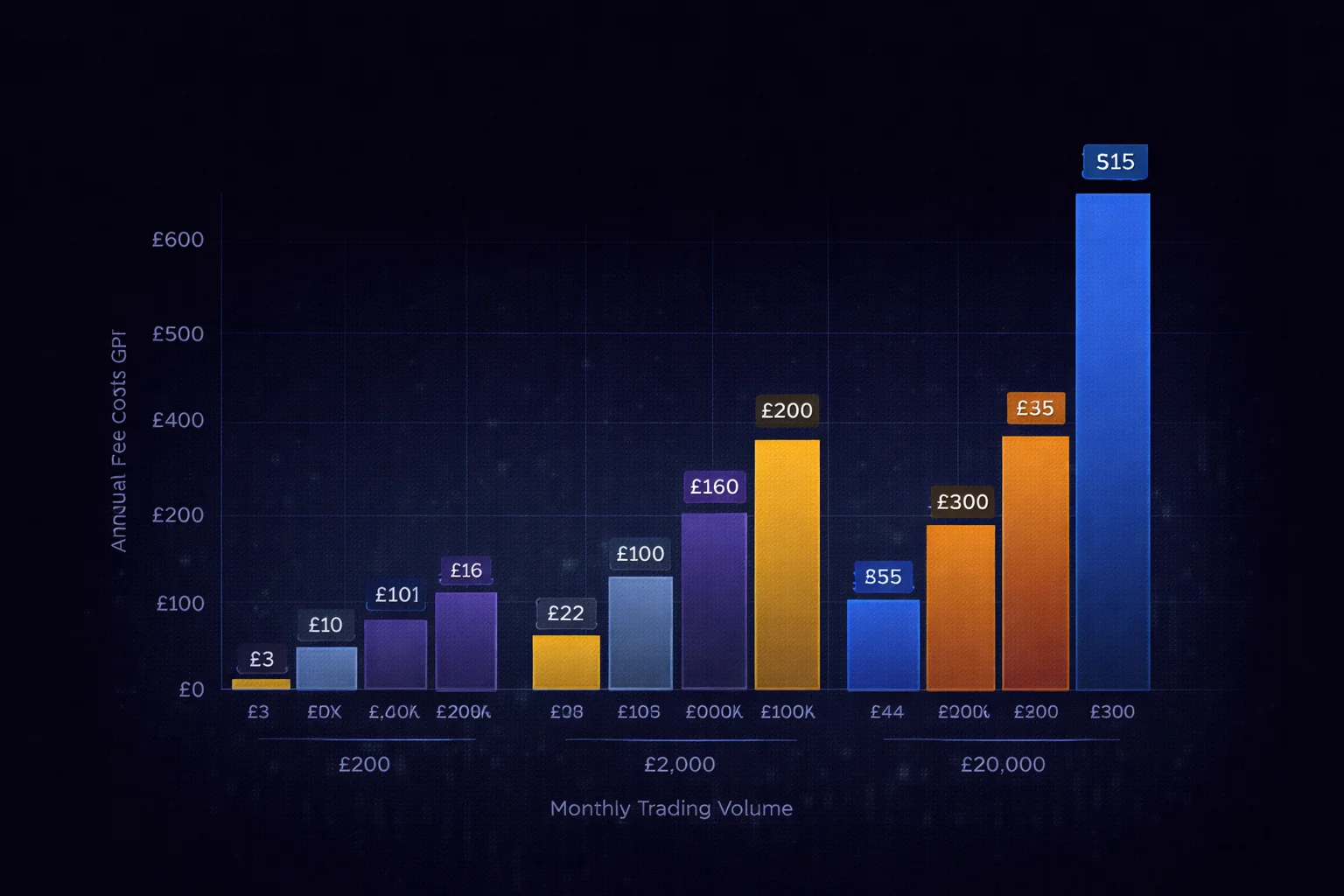
How much do these differences actually cost you per year? Here is the annual trading fee for a UK investor making £500/month in purchases using limit orders at the maker rate on each exchange:
- Binance (with BNB) — £500 × 12 × 0.075% = £4.50/year
- OKX — £500 × 12 × 0.08% = £4.80/year
- Binance (without BNB) / Bybit — £500 × 12 × 0.10% = £6.00/year
- Kraken — £500 × 12 × 0.25% = £15.00/year
- Coinbase standard — £500 × 12 × 0.40% = £24.00/year
The difference between cheapest (Binance with BNB at £4.50/year) and most expensive (Coinbase standard at £24/year) is £19.50 on £6,000 annual volume. At £50,000 annual volume, the gap widens to £162.50 — real money that compounds when you reinvest it. Does this mean you should always pick the cheapest exchange? Not necessarily. For casual investors, the fee difference is under a takeaway coffee per month. For active traders doing £5,000+/month, you should optimise aggressively because the savings compound over your trading career.
The numbers above assume a clean limit-order workflow with no market-order slippage and no taker fees. In reality, beginners place a meaningful share of their orders as market orders during volatility spikes, which moves the effective rate up by 25-50% on Binance and OKX (because the taker rate is higher than the maker rate by that proportion). On Kraken the base gap is wider — 0.25% maker versus 0.40% taker — so a 50/50 split between order types pushes your blended cost to around 0.325%, close to Coinbase's standard 0.40% than to Binance's 0.075%. The lesson is that the fee schedule comparison only delivers its full advantage when you also commit to using limit orders consistently, and the choice of exchange compounds with the choice of order type rather than substituting for it.
One additional factor specifically for UK readers: the Binance, OKX, and Bybit numbers above assume you have applied any applicable referral discount, which typically knocks 10-20% off your trading fees on top of native-token discounts. Without the referral code, the Binance "with BNB" rate moves from 0.075% closer to 0.090% on the same volume. The £4.50/year baseline in the bullet list above becomes £5.40/year — still cheap, but worth knowing where the saving actually comes from. Kraken and Coinbase do not offer permanent retail referral discounts on their fee schedules, which is one of several quiet reasons their effective rates run higher than the headline numbers suggest at the casual end of the market.
Deposit Fees Comparison
Bank Transfer (Faster Payments)
For UK investors, Faster Payments is the cheapest way to deposit GBP into any exchange. Here is what each platform charges you:
- Binance — Free via Faster Payments. Your deposit typically arrives within 5-15 minutes.
- OKX — Free via Faster Payments. Processing time is similar to Binance.
- Kraken — Free via Faster Payments. Kraken has a strong track record for reliable GBP banking.
- Bybit — Free via Faster Payments for most UK users. Availability can vary by payment provider.
- Coinbase — Free via Faster Payments. Coinbase also supports Open Banking for instant verification.
The verdict on bank deposits is simple: all five exchanges offer free Faster Payments deposits. If you have a UK bank account, you should never pay a deposit fee. Always use bank transfer instead of card for your planned purchases — this single habit saves you more money per year than any trading fee optimisation.
Card Deposits (Visa/Mastercard)
Card deposits are instant but expensive. Should you ever use them? Only in a genuine emergency when you need to buy crypto immediately and cannot wait for a bank transfer. Here is what each exchange charges you:
- Binance — 1.8% per card deposit. A £1,000 deposit costs you £18.
- OKX — 1.5-3.5% depending on the card provider and payment processor.
- Kraken — 3.75% per card deposit. The most expensive card option amongst the five.
- Bybit — 2-3% depending on the provider. Rates vary by region.
- Coinbase — 3.99% per card deposit on the standard interface. One of the most expensive.
On a £200/month DCA funded by card, your annual deposit fees would range from £43.20 (Binance) to £95.76 (Coinbase). Compare this to £0 for bank transfer. Card deposits are the single biggest unnecessary cost most beginners pay. If your bank blocks Faster Payments to crypto exchanges, you should try a different bank account before resorting to card deposits.
Withdrawal Fees Comparison
Crypto Withdrawals by Network
Withdrawal fees depend on the blockchain network you choose, not just the exchange. The same USDT can cost you £0.20 on Arbitrum or £10 on Ethereum mainnet — a 50x difference for the identical token. You should always check the network options before confirming any withdrawal. Here is a comparison across the most common scenarios:
BTC (Bitcoin mainnet):
- Binance — dynamic, ~0.0002 BTC (approximately £10 at ~£48,000/BTC, June 2026)
- OKX — 0.0001-0.0003 BTC (approximately £5-15)
- Kraken — 0.00015 BTC (approximately £7.50) — cheapest for BTC mainnet
- Bybit — 0.0002 BTC (approximately £10)
- Coinbase — dynamic, typically 0.0001-0.0005 BTC
USDT (TRC-20 — cheapest stablecoin network):
- Binance — 1 USDT (approximately £0.80)
- OKX — 0.1-1 USDT (approximately £0.08-0.80)
- Kraken — not available on TRC-20 (use Arbitrum instead)
- Bybit — 1 USDT
- Coinbase — not available on TRC-20 (use Polygon or Arbitrum)
ETH (Arbitrum — cheapest Ethereum Layer 2):
- Binance — 0.0001 ETH (approximately £0.25)
- OKX — 0.0001 ETH (approximately £0.25)
- Kraken — 0.00025 ETH (approximately £0.60)
- Bybit — 0.0001 ETH (approximately £0.25)
- Coinbase — 0.0001 ETH (approximately £0.25)
GBP Fiat Withdrawals
When you want to cash out to your UK bank account, here is what you pay:
- Binance — Free via Faster Payments. Your money arrives within 30 minutes.
- OKX — Free via Faster Payments.
- Kraken — £1.95 per withdrawal via Faster Payments.
- Bybit — Free for most withdrawal methods.
- Coinbase — Free via Faster Payments.
If you withdraw GBP monthly, Kraken costs you £23.40/year more than Binance, OKX, or Coinbase. Is this a deal-breaker? Not on its own — but you should factor it in if you frequently move money back to your bank account.
Staking and Earn Product Fee Comparison
Staking Commission Rates
When you stake proof-of-stake tokens like ETH or SOL through your exchange, the platform takes a commission from your staking rewards before passing the remainder to you. This commission is the exchange's fee for running validator nodes, managing the consensus infrastructure, and handling the technical complexity of blockchain staking on your behalf. Note that Bitcoin uses proof-of-work mining rather than staking, so you cannot stake BTC — you can only earn yield on BTC through savings/lending products. Here is what each exchange charges you for staking:
- Binance — approximately 10% commission on ETH staking rewards. Your net APY: approximately 2.7% (from a base protocol yield of ~3%).
- OKX — approximately 2-5% commission. Your net APY: approximately 2.9%. OKX's On-Chain Earn feature lets you bypass the commission entirely by staking through DeFi protocols like Lido directly.
- Kraken — approximately 25% commission. Your net APY: approximately 2.25%.
- Bybit — approximately 20% commission. Your net APY: approximately 2.5-3.0%.
- Coinbase — approximately 25% commission on ETH staking. Your net APY: approximately 2.25%. Amongst the highest commission rates of the five exchanges, alongside Kraken.
Flexible Savings APY Comparison
Flexible savings products lend your tokens to margin traders and generate yield from borrower interest. Your rate fluctuates with market demand. Approximate current rates for USDT flexible savings:
- Binance — 1.5-3% APY
- OKX — 1-3% APY
- Kraken — 1-2.5% APY
- Bybit — 1-3% APY
- Coinbase — 2-4.5% APY (higher rates partly reflect the Coinbase premium pricing model)
For staking and earn products, the fee differences matter more than you might think. A 10% commission gap (Kraken at 15% vs Coinbase at 25%) costs you approximately £3-5/year on a £1,000 staked ETH position. On a £10,000 position, the gap is £30-50/year. Should you switch exchanges just for better staking rates? Not if you are happy with your trading experience — but you should compare your actual net yield (not the advertised headline) across platforms before committing large amounts to any single exchange's earn product.
Promotional Periods, Sign-Up Bonuses, and Fee Holidays
Headline rate cards understate one important variable: every major exchange runs periodic promotions that temporarily reduce or eliminate fees on specific pairs or for new users. Treating the published schedule as the only number that matters can lead to a strictly worse choice if a competitor is currently running a meaningful promotion that fits your trading profile. The promotions are not advertised aggressively to existing users — you generally have to look for them on the exchange's "Rewards" or "Activity" page.
Zero-Fee Trading Periods
Binance has historically run zero-fee promotions on selected BTC pairs (BTC/TUSD, BTC/FDUSD, BTC/USDC at various points) where both maker and taker fees drop to 0% for a defined window — sometimes a quarter, sometimes longer. These promotions are real: a £1,000 buy that would normally cost £1 in fees costs nothing during the promo period. The catch is that you must trade against the specific stablecoin pair the promotion targets, which means converting your USDT or GBP to that stablecoin first if you do not already hold it. The conversion cost is usually under 0.05% on a major stablecoin pair, so the net saving is still meaningful for active traders.
OKX runs occasional fee-back promotions where you receive a percentage of paid fees back as USDT after a defined period, effectively reducing your taker rate from 0.10% to around 0.07% during the promo window. Kraken does this less often but has run "first 30 days fee-free" promos for new institutional customers. Bybit runs regular weekly trading competitions with rebates for top-volume participants, which is irrelevant for casual retail users but is worth knowing about if your trading activity grows substantially over the course of a year and you find yourself in the upper volume cohort on any single venue for several consecutive months.
New-User Sign-Up Bonuses
Sign-up bonuses are the headline marketing tool for every exchange targeting UK users. They look generous but the realised value is usually much lower than the headline number. Binance frequently advertises "up to $100" in welcome rewards — the realised average is closer to £5-15 because most of the bonus is locked behind futures trading volume requirements. OKX advertises "mystery box up to $10,000" — the realised median for retail sign-ups is around £10-30 of token credit that vests over a period of trading activity. Coinbase periodically gives a £5-10 BTC reward for completing the educational quizzes in the Learn section, though the eligible quizzes rotate frequently and the reward amount paid out per individual quiz has trended downwards fairly consistently over the past two years. Kraken does not run conventional sign-up bonuses but compensates with a more transparent fee schedule.
The honest summary on bonuses: take them when they require nothing extra (a referral link instead of plain registration), but never let a sign-up bonus drive your choice of exchange. The decision should be based on long-run fee structure, GBP banking quality, security history, customer support responsiveness, and regulatory standing in your jurisdiction. A £20 sign-up bonus on a worse exchange is dwarfed within a few months by the cost of a worse ongoing fee schedule, a slower or more invasive KYC process, less reliable banking integration when you need to deposit at short notice, or a customer support queue that takes days rather than hours to respond when something genuinely goes wrong with your account.
Cheapest Exchange by Use Case
Casual DCA Investor (£200/month)
If you buy £200 of Bitcoin or Ethereum once per month via bank transfer and withdraw to a hardware wallet quarterly, your annual fees look like this. On Binance with BNB discount: £1.80 trading + £0 deposit + £1.00 withdrawals (Arbitrum × 4) = £2.80/year. On OKX: £1.92 trading + £0 deposit + £1.00 withdrawals = £2.92/year. On Coinbase standard: £9.60 trading + £0 deposit + £1.00 = £10.60/year.
Winner: Binance (with BNB discount). But at this volume, the annual difference between all exchanges except Coinbase is under £2. Should you switch exchanges to save £2/year? No — you should choose by features, security, and trust instead.
Active Trader (£5,000/month)
If you make 20 trades per month averaging £250 each, with monthly withdrawals to self-custody, your costs scale differently. On Binance with BNB: £45 trading + £0 deposit + £3 withdrawals = £48/year. On Kraken: £150 trading + £0 deposit + £7.20 withdrawals + £23.40 fiat = £180.60/year. On Coinbase standard: £240 trading + £0 deposit + £3 = £243/year.
Winner: Binance. At this volume, the fee difference is meaningful — Binance saves you about £133/year versus Kraken and £195/year versus Coinbase standard. If you trade actively, the exchange choice matters significantly for your bottom line.
DeFi User (Frequent Withdrawals to Wallet)
If you frequently withdraw crypto to your own wallet for use in DeFi protocols — staking via Lido, lending via Aave, providing liquidity on decentralised exchanges, or restaking via EigenLayer — withdrawal fees and gas fee costs dominate your total spend. The cheapest withdrawal network matters more to you than the trading fee. OKX and Binance offer the widest range of cheap withdrawal networks (Arbitrum, Optimism, TRC-20, BEP-20). Kraken supports fewer Layer 2 networks. Coinbase supports Arbitrum and Optimism but not TRC-20.
Winner: OKX (widest network support at the lowest withdrawal fees). Binance is a close second. If you interact with DeFi protocols regularly, you should prioritise withdrawal network availability over trading fee differences.
Verdict: Which Exchange Should You Choose?
Best overall value: Binance. You get the lowest effective trading fees with BNB discount (0.075%), free GBP deposits and withdrawals, the widest range of withdrawal networks, and the most comprehensive earn and Auto-Invest features for your DCA strategy. The 20% referral discount stacks with BNB payment for an effective rate of approximately 0.06%. For most UK investors — from casual DCA to active trading — Binance gives you the best combination of low fees and features.
Best for low base fees without tokens: OKX. If you do not want to hold an exchange native token, OKX gives you the lowest base maker fee at 0.08%. You also get the widest selection of cheap withdrawal networks and competitive earn products. The interface is clean and the OKX Web3 wallet integration makes it easy for you to bridge to DeFi protocols when you are ready to graduate from centralised exchange earn.
Best for regulatory trust: Kraken. Kraken has the longest operating history amongst major exchanges (founded 2011) and strong regulatory standing. You pay more in trading fees (0.25% maker) and GBP withdrawal fees (£1.95), but if you prioritise regulatory trust and transparency over saving a few pounds per month, Kraken gives you peace of mind that newer platforms cannot match.
Avoid for beginners: Coinbase standard. Coinbase standard charges you 0.40-0.60% per trade with an additional spread markup. Coinbase Advanced reduces this dramatically, but the standard interface — which most beginners use — is 4-8x more expensive than Binance or OKX. If you choose Coinbase, you must switch to Coinbase Advanced immediately to avoid overpaying on every single trade you make.
How should you make your final decision? Consider your total annual cost across all fee categories — trading, deposit, withdrawal, staking commission, and hidden costs — not just the headline trading rate. If you trade £500/month, deposit via bank transfer, withdraw quarterly to a hardware wallet, and stake your ETH, your total annual cost on Binance is approximately £8-12. On OKX it is £9-13. On Kraken it is £20-30. On Coinbase standard it is £35-50. Your savings from choosing the right exchange compound every year you stay on the platform.
Should You Switch Exchanges to Save on Fees?
If you are already using one exchange and considering switching to another purely for lower fees, here is how to think about it. Calculate your total annual cost on your current exchange across all categories: trading fees, deposit fees, withdrawal fees, staking commission, and any hidden costs. Then calculate the same total on the exchange you are considering. If the annual saving is under £20, switching is probably not worth your time — the effort of setting up a new account, completing KYC, and transferring your assets outweighs the saving.
If the saving exceeds £50/year, you should seriously consider switching. You can run both exchanges in parallel during the transition: set up your new account, make a small test deposit, execute a few trades to verify you are comfortable with the interface, then gradually move your DCA and earn subscriptions to the new platform. You do not need to transfer your existing holdings — you can leave them on the old exchange and simply direct all new purchases to the cheaper one.
What if you want the best of both? Some experienced investors split their activity: they trade on Binance (lowest fees with BNB) and withdraw to self-custody via OKX (widest Layer 2 support). You can use multiple exchanges strategically, choosing each one for the feature where it excels. This adds complexity but can save you money if your volume justifies the effort.
UK Regulatory Standing as a Tiebreaker
Fees are not the only dimension worth weighting. UK readers should also factor in each exchange's standing with the Financial Conduct Authority. The FCA maintains a register of crypto firms approved for anti-money-laundering compliance, and being on or off that register affects which marketing material a platform can show to UK users, which payment providers will work with the platform for Faster Payments, and how UK banks treat outbound transfers to the exchange. None of the exchanges in this comparison hold full FCA authorisation in the way an investment firm would, but their AML registration status varies and changes over time. A platform that loses its registration mid-year can suddenly find that several major UK banks block transfers to its deposit addresses, which is a much larger practical cost than any fee difference.
The historical record on this is uneven. Binance restricted some UK services for a period after the FCA issued a consumer warning in 2021 and has since restored most functionality through a partner arrangement that handles the regulated portions of the customer relationship for UK residents. Bybit operated for several years with limited UK access and only normalised its position more recently as the broader UK regulatory framework for crypto firms matured.
Kraken and Coinbase have generally maintained the most stable UK standing of the five exchanges in this comparison, which is one of the practical reasons their slightly higher headline fees are still acceptable to many UK retail users who value banking continuity and predictable account access over the absolute cheapest published trading rate on offer elsewhere.
Before you switch primarily for fee optimisation reasons, check the current FCA register entry for the destination platform and verify that your specific bank does not block transfers to its deposit addresses — a £20 to £50 per year fee saving is not worth a frozen deposit when you actually need to fund a position quickly during a market move that will not wait for you.
Conclusion
The fee difference between exchanges matters most at two extremes: if you use Coinbase standard (where fees are 4-8x higher than competitors) or if you trade actively at £5,000+/month (where small percentage differences compound into real money). For everyone in between — a casual DCA investor doing £200-500/month — the annual fee difference between Binance, OKX, Bybit, and Kraken is under £10. At that level, you should choose your exchange based on features, interface preference, earn products, and regulatory trust rather than optimising for the lowest possible fee.
Three actions that save you more than switching exchanges: first, always deposit via Faster Payments bank transfer instead of card (saves you £40-100/year on a £200/month DCA). Second, use limit orders instead of market orders for every routine purchase (saves you 0-0.10% per trade and gives you a better execution price). Third, choose the cheapest withdrawal network — TRC-20 or Arbitrum instead of Ethereum mainnet — for every crypto withdrawal to your wallet (saves you £10-100+/year). These three habits matter more than which exchange you choose.
For the full explanation of each fee type and all five cost-reduction tactics, read our exchange fees minimisation guide. For the complete beginner roadmap, return to our first 30 days on a crypto exchange hub.
Sources and References
Frequently Asked Questions
- Which crypto exchange has the lowest trading fees?
- OKX has the lowest base maker fee at 0.08%. Binance matches this at 0.075% when you enable BNB fee payment (a 25% discount). Bybit charges 0.10% for both maker and taker. Kraken and Coinbase are significantly more expensive at the base tier. For most UK beginners, Binance with BNB discount or OKX offers you the best fee structure for regular cryptocurrency purchases.
- Which exchange is cheapest for GBP deposits?
- All five major exchanges — Binance, OKX, Kraken, Bybit, and Coinbase — offer free GBP deposits via Faster Payments bank transfer. Card deposits are where the costs differ: 1.8% on Binance, 1.5-3.5% on OKX, 3.75% on Kraken, and 3.99% on Coinbase. You should always use bank transfer for your planned deposits — the savings add up to £40-100/year on a regular DCA schedule.
- Which exchange has the cheapest withdrawal fees?
- Withdrawal fees depend primarily on the blockchain network you choose, not the exchange itself. All five exchanges offer TRC-20 and Arbitrum withdrawals for under £1. For BTC mainnet withdrawals, Kraken is typically cheapest (~0.00015 BTC versus Binance's dynamic ~0.0002 BTC). For GBP fiat withdrawals back to your UK bank, Binance and OKX are free via Faster Payments while Kraken charges £1.95 per withdrawal.
- Is it worth switching exchanges purely to save on fees?
- Calculate your total annual cost across trading, deposit, withdrawal, and staking commission on both platforms before you commit. If the saving is under £20/year, the operational overhead of a fresh KYC process and asset transfer is rarely worth your time. If the saving exceeds £50/year, it usually is. UK regulatory standing and your bank's willingness to send Faster Payments to the destination address matter more than headline fees — verify both before switching, because a £30 annual saving disappears the first time your bank blocks a transfer to an unfamiliar exchange.
- Do exchange staking commissions affect my real APY?
- Yes, significantly. Commissions vary by platform: Binance keeps roughly 10% of ETH staking rewards, OKX about 2-5%, and Kraken and Coinbase about 25% each. On a £10,000 ETH stake at ~3% gross APR, the gap between the cheapest (~2-5%) and the most expensive (~25%) commission is roughly £60/year. That sounds modest in year one but compounds noticeably over multiple years of staking on the same platform — and the commission is the single biggest variable to optimise around if exchange staking yield is the main reason you hold ETH on a centralised venue.
Financial Disclaimer
This content is not financial advice. All information provided is for educational purposes only. Cryptocurrency investments carry significant investment risk, and past performance does not guarantee future results. Always do your own research and consult a qualified financial advisor before making investment decisions.