Delegation vs yield farming 2025
Choosing between staking and yield generation for earning opportunities in crypto? This comprehensive 2025 guide compares risks, rewards, complexity, and strategies to help you make informed decisions for your investment goals.
Introduction
The cryptocurrency ecosystem in 2025 offers numerous opportunities. You can generate passive income from digital asset holdings. Staking and liquidity mining are amongst the most popular strategies. They are accessible for earning returns on cryptocurrency investments. Both approaches have evolved significantly since their inception. They offer sophisticated investors multiple pathways. You can optimise your portfolio performance. You contribute to the security and liquidity of blockchain networks. You support decentralised finance protocols.
Staking has emerged as the cornerstone of proof-of-stake blockchain networks. It allows token holders to participate in consensus mechanisms. You earn rewards for securing the network. This approach appeals to investors seeking predictable returns. It has a relatively low risk. Staking rewards are typically distributed according to well-defined protocols. They use mathematical formulas. These provide transparency and predictability in income generation.
Liquidity provision represents a more dynamic approach. It is potentially more lucrative for generating cryptocurrency income. You participate in decentralised finance protocols. This strategy involves providing liquidity to automated market makers. You lend assets on money market protocols. You participate in various DeFi yield optimisation strategies. These can generate significantly higher returns than traditional staking. However, they come with increased complexity and risk exposure.
The choice between staking and DeFi farming often reflects broader investment philosophies. It shows risk tolerance levels. Conservative investors typically gravitate towards staking. They value its simplicity, predictability, and lower risk profile. More aggressive investors pursue yield farming opportunities. They seek potential to generate superior returns. They use active portfolio management and sophisticated DeFi strategies.
Major blockchain networks like Ethereum, Cardano, Solana, and Polkadot have implemented sophisticated staking mechanisms. They offer annual percentage yields ranging from 4% to 15%. This depends on network parameters, validator performance, and overall network participation rates. These rewards are generated through transaction fees. They come from block rewards and inflation mechanisms. These are designed to incentivise long-term network security. They promote decentralisation.
The DeFi ecosystem has matured considerably since 2020. Protocols like Aave, Compound, Uniswap, and Curve Finance offer sophisticated liquidity mining opportunities. These can generate returns ranging from 5% to over 100% annually. This depends on market conditions, protocol incentives, and risk factors. These high yields often come from protocol token rewards. They include trading fees and liquidity mining programs. These are designed to bootstrap protocol adoption and liquidity.
Market conditions in 2025 have created unique opportunities for both strategies. Institutional adoption is driving increased staking participation. DeFi innovation continues to create new DeFi earning mechanisms. Regulatory clarity has improved for both approaches. Many jurisdictions provide clearer guidelines. These cover tax treatment and compliance requirements. This makes these strategies more accessible to mainstream investors.
Understanding the fundamental differences is essential. You need to know risk profiles, return expectations, and implementation requirements. This helps you make informed decisions about generating cryptocurrency income. This comprehensive analysis examines every aspect of staking versus yield farming. It provides practical guidance for choosing the approach. This should align with your investment goals, risk tolerance, and technical expertise. It supports your long-term cryptocurrency investment strategy in 2025 and beyond.
The decision between staking and yield farming ultimately depends on individual circumstances. Consider your investment objectives and risk tolerance levels. This guide provides the comprehensive analysis needed. You can make informed decisions about which approach best suits your specific situation. It supports your long-term cryptocurrency investment strategy. For platform-specific guidance, explore our Lido staking review and staking vs lending comparison.
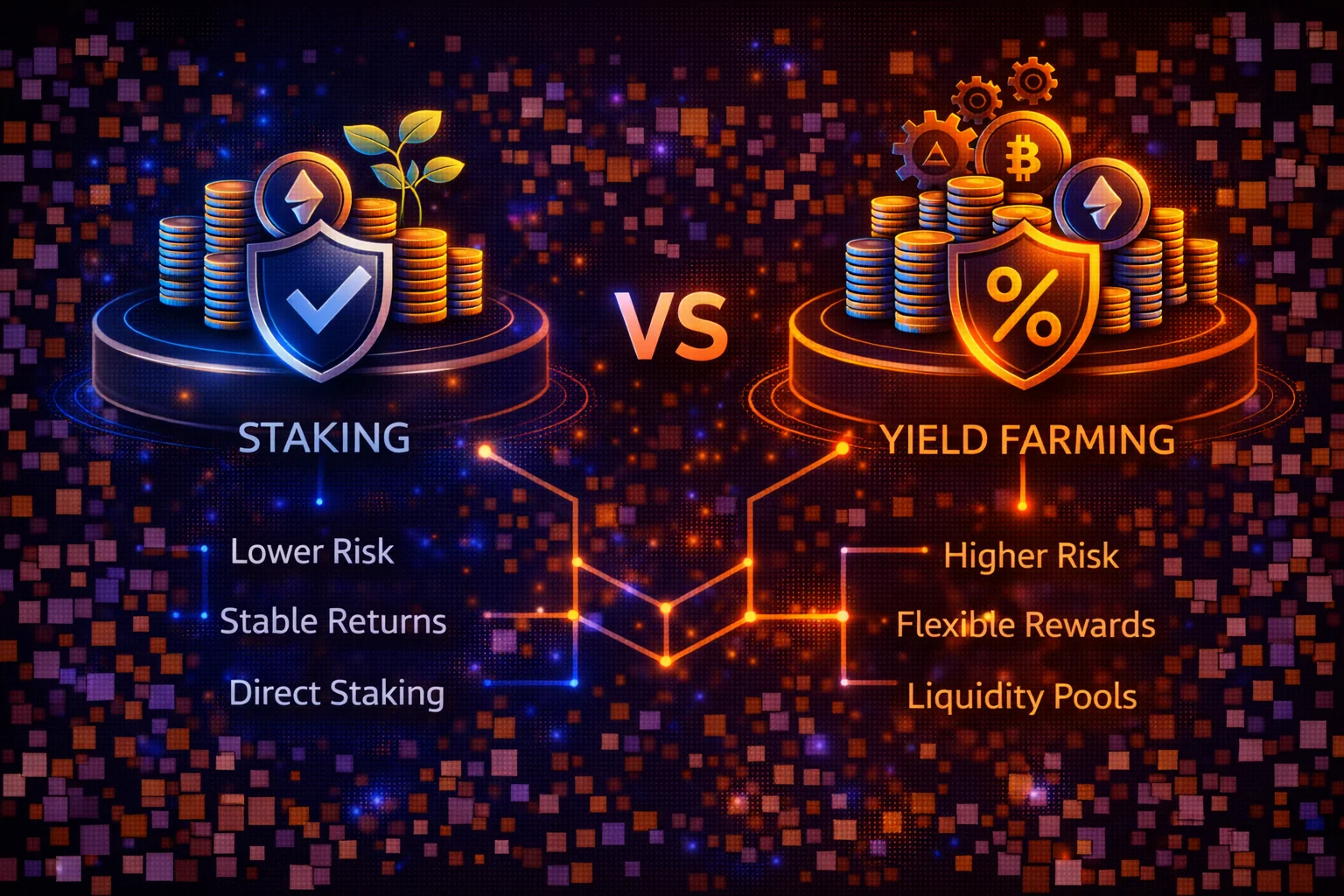
Understanding the Fundamentals
Both staking and DeFi farming represent ways to generate income from your cryptocurrency holdings, but they operate on fundamentally different principles. Staking involves participating in blockchain consensus mechanisms, while LP provision focuses on providing liquidity to decentralised finance (DeFi) protocols. Understanding these differences is crucial for making informed investment decisions.
The choice between staking and LP rewards often comes down to your risk tolerance, technical expertise, and investment timeline. Each strategy has distinct advantages and drawbacks that can significantly impact your returns and overall portfolio performance.
What is Crypto Staking?
Staking involves locking your cryptocurrency tokens to support the operations of a blockchain network. In proof-of-stake (PoS) networks, validators are chosen to create new blocks and validate transactions based on the amount of cryptocurrency they have staked. As a staker, you delegate your tokens to validators and earn rewards for helping secure the network.
How Staking Works
When you stake your tokens, you're essentially putting them up as collateral to participate in network consensus. The blockchain protocol distributes rewards to stakers based on factors like:
- Amount of tokens staked
- Duration of staking period
- Network inflation rate
- Total amount staked across the network
- Validator performance and uptime
Popular Staking Networks
Major blockchain networks offering staking opportunities include:
- Ethereum (ETH): 3-6% APY with 32 ETH minimum for solo staking
- Cardano (ADA): 4-6% APY with no minimum and no lock-up period
- Solana (SOL): 6-8% APY with flexible staking options
- Polkadot (DOT): 10-14% APY with 28-day unbonding period
- Cosmos (ATOM): 8-12% APY with 21-day unbonding period
Staking Methods
You can stake through various methods:
- Solo Staking: Run your own validator node (requires technical knowledge)
- Delegated Staking: Delegate to existing validators through wallets
- Pool Staking: Join staking pools to meet minimum requirements
- Exchange Staking: Stake through centralised exchanges (easiest but less control)
- staking derivatives: Receive tradeable tokens representing staked assets
What is farming incentives in DeFi?
farming protocols involve providing liquidity or lending assets to decentralised protocols in exchange for rewards. These rewards can include interest payments, trading fees, governance tokens, or incentives for LP rewards. Yield farmers actively move their capital between different protocols to maximise returns.
How DeFi farming Works
farming incentives strategies typically involve:
- Providing liquidity to automated market makers (AMMs)
- Lending assets on money market protocols
- Participating in yield farming programs
- Staking LP tokens for additional rewards
- Compounding rewards through reinvestment
Popular yield generation Protocols
Leading DeFi platforms for DeFi farming include (see our DeFi platform comparison for detailed analysis):
- Uniswap: Earn trading fees by providing liquidity to token pairs
- Aave: Lend assets and earn interest plus AAVE token rewards (read our Aave review)
- Compound: Supply assets to earn interest and COMP governance tokens
- Curve: Provide liquidity to stablecoin pools with low slippage
- PancakeSwap: LP rewards on Binance Smart Chain with CAKE rewards
- SushiSwap: Earn SUSHI tokens through providing liquidity
farming protocols Strategies
Common market making approaches include:
- Simple Lending: Deposit assets to earn interest
- AMM participation: Add tokens to AMM pools for trading fees
- Leveraged Farming: Borrow assets to increase farming positions
- Multi-Protocol Farming: Diversify across multiple platforms
- Auto-Compounding: Use yield aggregators for automatic reinvestment
Staking: Advantages and Disadvantages
Advantages of Staking
- Simplicity: Easy to understand and implement, especially through exchanges
- Predictable Returns: More stable APY compared to volatile LP provision
- Lower Risk: Fewer smart contract interactions reduce vulnerability exposure
- Network Support: Contributes to blockchain security and decentralisation
- yield opportunities: Set-and-forget approach with minimal active management
- No IL risk: Staked tokens maintain their original composition
Disadvantages of Staking
- Lock-up Periods: Funds may be inaccessible for weeks or months
- Slashing Risk: Validator misbehavior can result in token penalties
- Lower Returns: Generally offers lower APY than providing liquidity
- Inflation Risk: Token inflation may erode real returns
- Validator Risk: Dependence on validator performance and honesty
- Opportunity Cost: Missing out on potentially higher DeFi yields
Staking Risk Management
To minimise staking risks:
- Research validator track records and commission rates
- Diversify across multiple validators
- Understand unbonding periods before staking
- Monitor validator performance regularly
- Consider flexible staking for more flexibility
farming incentives: Advantages and Disadvantages
Advantages of DeFi farming
- Higher Returns: Potential for significantly higher APY than staking
- Multiple Revenue Streams: Earn from fees, rewards, and token appreciation
- Flexibility: Can move capital quickly between opportunities
- Innovation Access: Early access to new protocols and tokens
- Capital Efficiency: maximise returns through leverage and compounding
- Governance Participation: Earn governance tokens for protocol voting
Disadvantages of yield generation
- Complexity: Requires understanding of multiple protocols and strategies
- liquidity risk: Risk of losing value when providing liquidity
- Smart Contract Risk: Vulnerability to bugs and exploits
- High Gas Fees: Ethereum network fees can eat into profits
- Market Volatility: Returns highly dependent on market conditions
- Active Management: Requires constant monitoring and optimisation
- Rug Pull Risk: New protocols may be fraudulent or poorly designed
farming protocols Risk Management
To minimise market making risks:
- Start with established, audited protocols
- Diversify across multiple platforms and strategies
- Understand price divergence loss calculations
- Monitor smart contract audits and security reports
- Use stop-loss strategies for volatile positions
- Keep emergency funds for gas fees and exits
Risk Comparison: Staking vs yield farming
Risk Levels by Category
| Risk Factor | Staking | DeFi farming |
|---|---|---|
| Smart Contract Risk | Low | High |
| temporary loss | None | High |
| Liquidity Risk | Medium | Low |
| Complexity Risk | Low | High |
| Market Risk | Medium | High |
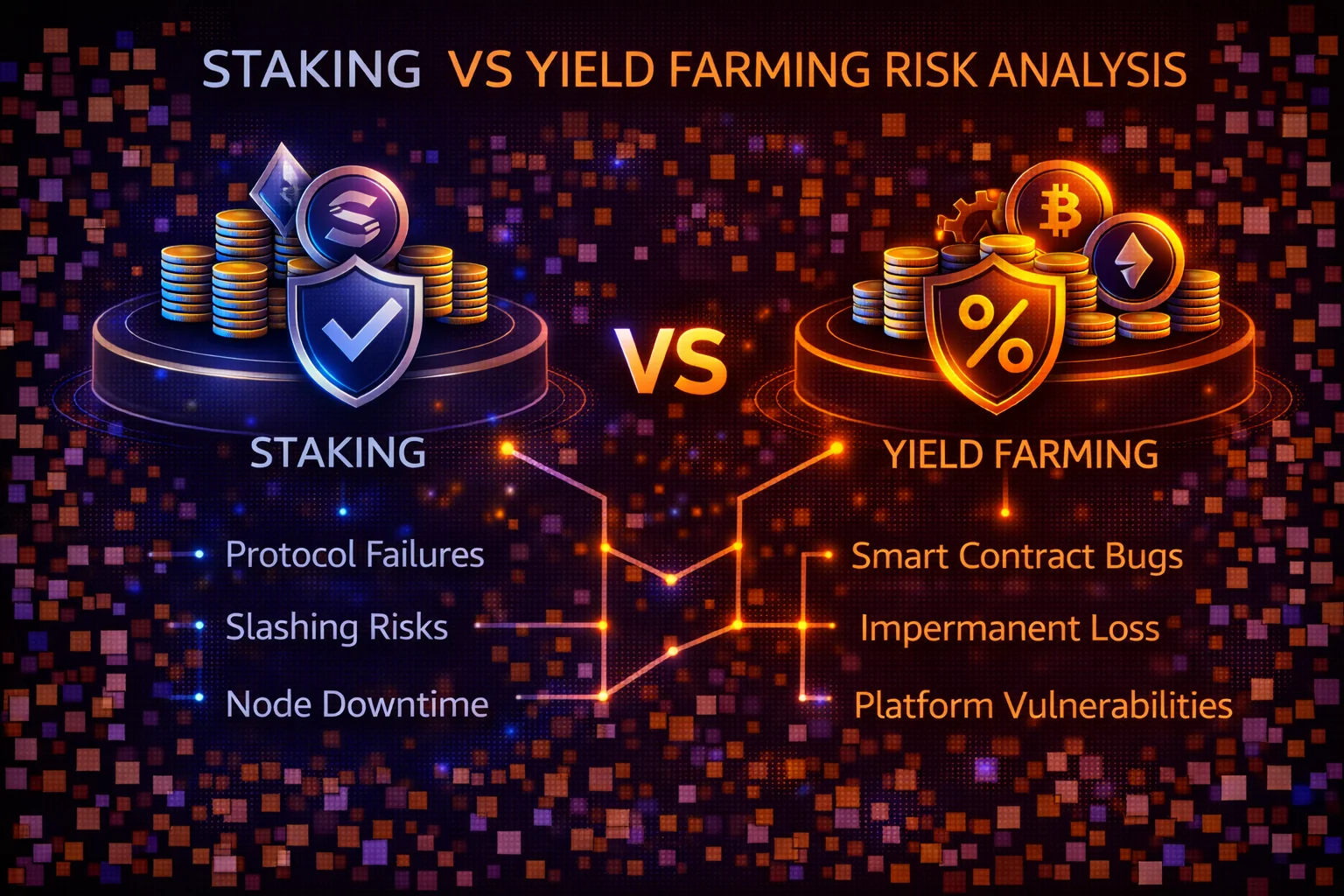
Understanding IL risk
Temporary loss is a unique risk in LP provision that occurs when the price ratio of tokens in a liquidity pool changes. If you provide liquidity to an ETH/USDC pool and ETH's price doubles, you'll have less ETH and more USDC than if you had simply held the tokens. This "loss" is only realised when you withdraw from the pool.
Return Comparison and Expectations
Typical Return Ranges
- Staking Returns: 3-15% APY depending on network and conditions
- yield generation Returns: 10-100%+ APY but highly variable and risky
- Hybrid Strategies: 5-25% APY combining both approaches for balanced risk-reward
Factors Affecting Returns
Staking Returns Depend On:
- Network inflation rate and monetary policy
- Total amount staked (higher participation = lower individual rewards)
- Validator performance and commission fees
- Network usage and transaction fees
farming protocols Returns Depend On:
- Protocol incentives and token emissions
- Trading volume and fee generation
- Market volatility and IL risk
- Competition from other liquidity providers
- Token price appreciation/depreciation
Advanced Return optimisation Strategies
Professional yield optimisation requires sophisticated understanding of protocol mechanics, market dynamics, and risk management frameworks that maximise returns whilst maintaining appropriate capital preservation standards. Advanced practitioners utilise automated yield aggregators, cross-chain arbitrage opportunities, and strategic position rebalancing to enhance overall portfolio performance across diverse market conditions and volatility environments.
Yield compounding strategies significantly enhance long-term returns through systematic reinvestment of earned rewards into productive positions. Automated compounding protocols eliminate manual intervention whilst optimising gas costs and timing for maximum efficiency. Understanding compound interest mathematics and implementing systematic reinvestment schedules can dramatically improve overall investment performance over extended timeframes.
Multi-protocol yield strategies diversify risk whilst capturing opportunities across different DeFi ecosystems. Professional investors allocate capital across staking, lending, liquidity provision, and yield farming positions to optimise risk-adjusted returns. This diversification approach reduces exposure to single-protocol failures whilst maintaining attractive overall yield generation capabilities through strategic asset allocation and continuous performance monitoring.
Which Strategy is Right for You?
Choose Staking If You:
- Prefer predictable, steady returns over high-risk/high-reward scenarios
- Want a simple, set-and-forget crypto earnings strategy
- Are new to crypto and want to minimise complexity
- Believe in the long-term value of specific blockchain networks
- Don't want to manage your investments
- Are risk-averse and prioritise capital preservation
Choose liquidity mining If You:
- Are comfortable with higher risk for potentially higher returns
- Have experience with DeFi platforms and smart contracts
- Can actively monitor and manage your positions
- Understand liquidity risk and how to mitigate it
- Want to participate in new protocol launches and governance
- Have sufficient capital to absorb gas fees and potential losses
Hybrid Approach: Combining Both Strategies
Many successful crypto investors use a balanced approach:
- Conservative Portfolio: 80% staking, 20% providing liquidity
- Balanced Portfolio: 60% staking, 40% market making
- Aggressive Portfolio: 40% staking, 60% liquidity provision
This diversification helps balance risk and reward while providing exposure to both stable and high-growth opportunities.
Getting Started: Practical Steps
Starting with Staking
- Choose Your Network: Research different PoS networks and their staking requirements
- Select a Method: Decide between exchange staking, delegated staking, or tokenised staking
- Pick a Validator: Research validator performance, fees, and reputation
- Start Small: Begin with a small amount to understand the process
- Monitor Performance: Track rewards and validator performance regularly
Starting with DeFi farming
- Learn the Basics: Understand blockchain protocols, AMMs, and impermanent loss
- Start with Established Protocols: Begin with audited, well-known platforms
- Use Stablecoins: Reduce impermanent loss risk with stablecoin pairs
- Calculate Costs: Factor in gas fees and potential losses
- Monitor Actively: Track positions and market conditions daily
Tax Considerations
Both staking and LP rewards are typically treated as taxable income in most jurisdictions. Key considerations include:
- Income Tax: Rewards are taxed as income at fair market value when received
- Capital Gains: Additional tax when you sell rewards or exit positions
- Record Keeping: Track all transactions, rewards, and fair market values
- Professional Advice: Consult tax professionals for complex strategies
Institutional Yield Strategies and Professional Implementation
Enterprise Staking and Yield Farming Portfolio Integration
Professional cryptocurrency yield generation requires sophisticated strategies that optimise allocation between staking and yield farming opportunities while managing risk profiles, regulatory compliance, and operational efficiency for institutional cryptocurrency operations. Enterprise applications include systematic multi-strategy yield optimisation, comprehensive risk management frameworks, and advanced portfolio allocation techniques that balance staking stability with yield farming opportunities while maintaining appropriate diversification and security standards for institutional cryptocurrency treasury management and professional digital asset operations across evolving market conditions and regulatory frameworks.
Advanced institutional strategies require comprehensive understanding of staking mechanics, DeFi protocol dynamics, and yield optimisation techniques that enable sophisticated cryptocurrency operations while maintaining fiduciary responsibilities and institutional risk management standards. Professional users implement systematic allocation strategies, comprehensive performance monitoring, and advanced risk assessment procedures that maximise risk-adjusted returns while managing protocol risks, market volatility, and operational complexity for institutional cryptocurrency operations and professional yield generation across multiple blockchain networks and DeFi protocols.
Institutional yield integration requires sophisticated compliance frameworks that address staking rewards taxation, DeFi protocol risks, and regulatory requirements whilstleveraging yield generation benefits for professional cryptocurrency operations. Professional users implement comprehensive compliance monitoring systems, systematic reporting procedures, and advanced legal frameworks that ensure appropriate institutional adoption whilstmaximising yield generation and maintaining operational efficiency across evolving regulatory requirements and institutional security standards for professional cryptocurrency operations and institutional digital asset management.
Advanced Risk Management and Performance optimisation
Professional yield strategy risk management requires comprehensive frameworks that address staking risks, DeFi protocol vulnerabilities, and market volatility while optimising yield generation for institutional cryptocurrency operations. Advanced users implement systematic risk assessment procedures, comprehensive hedging strategies, and sophisticated monitoring systems that minimise downside exposure while maintaining optimal yield potential for professional cryptocurrency operations and institutional digital asset management across various market conditions and protocol developments.
Performance optimisation strategies include systematic yield analysis, comprehensive protocol evaluation, and advanced allocation techniques that maximise risk-adjusted returns while managing operational complexity and regulatory compliance. Professional users implement automated monitoring systems, comprehensive performance tracking, and systematic rebalancing procedures that ensure consistent yield optimisation while maintaining appropriate risk management and operational efficiency for institutional cryptocurrency operations and professional digital asset management across evolving yield opportunities and market conditions.
Risk optimisation requires systematic analysis of protocol-specific risks, comprehensive market evaluation, and advanced contingency planning that ensures appropriate protection against various yield generation risks while maintaining optimal performance. Professional users implement comprehensive insurance strategies, systematic backup procedures, and advanced monitoring systems that provide early warning of potential issues while maintaining operational efficiency and regulatory compliance for institutional cryptocurrency operations and professional digital asset management across evolving risk landscapes and yield generation opportunities.
Regulatory Compliance and Tax optimisation
Institutional yield generation requires comprehensive regulatory compliance frameworks that address staking and yield farming tax implications, reporting requirements, and fiduciary responsibilities whilstleveraging yield benefits for professional cryptocurrency operations. Professional users implement systematic tax optimisation strategies, comprehensive audit trail management, and advanced reporting systems that ensure appropriate regulatory compliance whilstmaximising after-tax returns and maintaining operational efficiency for institutional cryptocurrency operations and professional digital asset management across multiple jurisdictions and evolving regulatory frameworks.
Tax optimisation strategies include systematic harvest timing, comprehensive loss realisation techniques, and advanced accounting methods that minimise tax liabilities while maintaining optimal yield generation performance. Professional users implement sophisticated tax planning procedures, systematic documentation requirements, and comprehensive compliance monitoring that ensures appropriate tax efficiency while maintaining regulatory compliance and operational excellence for institutional cryptocurrency operations and professional digital asset management across complex tax environments and evolving compliance requirements for professional yield generation activities.
Advanced Strategies and Combinations
Experienced investors often combine staking and yield generation strategies to optimise their returns while managing risk. These hybrid approaches can provide diversification benefits and help capture opportunities across different market conditions.
Portfolio Allocation Strategies
A balanced crypto earning portfolio might allocate 60% to staking for stable base returns, 30% to established DeFi protocols for moderate farming protocols, and 10% to experimental high-yield opportunities. This allocation provides steady income while allowing for growth potential.
Conservative investors might prefer 80% staking and 20% liquidity mining, focusing on blue-chip protocols with proven track records. Aggressive investors could reverse this ratio, accepting higher risk for potentially greater rewards through concentrated DeFi exposure.
Seasonal Strategy Adjustments
Market cycles often favour different strategies. During bull markets, DeFi farming opportunities multiply as new protocols launch and trading volumes increase. Bear markets typically favor staking as it provides steady returns regardless of price movements.
Smart investors adjust their allocation based on market conditions, increasing staking exposure during uncertain times and expanding yield generation activities when opportunities are abundant and risks are better understood.
Cross-Chain Opportunities
Multi-chain strategies allow investors to capture the best opportunities across different blockchain ecosystems. Ethereum offers the most mature DeFi protocols, while newer chains like Solana, Avalanche, and Polygon provide higher yields with different risk profiles.
Cross-chain farming protocols require careful consideration of bridge risks, gas costs, and liquidity differences. However, it can provide access to emerging protocols and higher yields not available on single chains.
Comprehensive Risk Management Framework
Successful long-term crypto earning requires a systematic approach to risk management that goes beyond basic diversification. Understanding and mitigating various risk factors is essential for sustainable returns.
Smart Contract Risk Assessment
Before participating in any DeFi protocol, evaluate the smart contract's security through multiple lenses. Check for completed audits by reputable firms, review the protocol's bug bounty program, and assess the development team's track record.
Look for protocols with time-tested code, gradual feature rollouts, and transparent governance processes. Avoid protocols with anonymous teams, rushed launches, or promises of unsustainably high yields that often indicate potential risks.
Liquidity Risk Management
Liquidity risk affects both staking and liquidity mining, but in different ways. Staking typically involves lock-up periods where funds cannot be withdrawn immediately. DeFi farming faces risks from declining pool liquidity or token price volatility affecting exit strategies.
Manage liquidity risk by staggering unlock dates, maintaining emergency funds outside of earning protocols, and understanding the withdrawal processes for each platform. Never commit funds you might need for unexpected expenses.
Regulatory Risk Considerations
The regulatory landscape for cryptocurrency earning continues evolving. Different jurisdictions treat staking and yield generation differently for tax and compliance purposes. Stay informed about local regulations and consider consulting tax professionals for significant positions.
Some protocols implement geographic restrictions or KYC requirements. Understand these limitations before committing funds, and consider how regulatory changes might affect your ability to access or withdraw funds from various platforms.
Technology Trends Shaping the Future
Emerging technologies are rapidly transforming both staking and yield farming landscapes. Understanding these trends helps investors position themselves for future opportunities and avoid obsolete strategies.
Layer 2 Scaling Solutions
Layer 2 networks like Arbitrum, Optimism, and Polygon have dramatically reduced transaction costs for DeFi activities. This makes smaller positions economically viable and enables more frequent rebalancing and compounding strategies.
Lower fees also make it practical to explore multiple protocols simultaneously, test new strategies with smaller amounts, and implement more sophisticated portfolio management techniques that were previously cost-prohibitive.
Liquid Staking Evolution
Liquid staking protocols are bridging the gap between traditional staking and DeFi yield farming. These platforms allow users to stake assets while receiving liquid tokens that can be used in other DeFi protocols, effectively combining both strategies.
This innovation eliminates the opportunity cost of staking by enabling users to earn staking rewards while simultaneously participating in yield farming with their liquid staking tokens. It represents the future convergence of these previously separate strategies.
Automated Strategy Platforms
Yield aggregators and automated strategy platforms are making sophisticated DeFi strategies accessible to average users. These platforms automatically optimise yields, compound rewards, and rebalance positions based on market conditions.
Whilst these platforms reduce the complexity of yield farming, they introduce additional smart contract risks and fees. Evaluate them carefully, understanding their strategies, fee structures, and risk management approaches before committing significant funds.
Advanced Comparison Analysis and Professional Implementation
Quantitative Metrics and Performance Benchmarking
Professional cryptocurrency yield generation requires sophisticated quantitative analysis frameworks. These evaluate risk-adjusted returns, volatility metrics, and correlation coefficients. You compare staking and yield farming strategies across different market conditions. Advanced practitioners utilise Sharpe ratios and maximum drawdown calculations. They use Value-at-Risk models to assess portfolio performance. They optimise allocation strategies between conservative staking and aggressive yield farming.
Institutional benchmarking includes establishing baseline performance metrics. You implement systematic tracking of key performance indicators. You develop comprehensive reporting frameworks. These enable data-driven decision-making for cryptocurrency yield optimisation. Professional analysis incorporates statistical significance testing. It uses regression analysis and Monte Carlo simulations. These evaluate the effectiveness of the strategy and predict future performance.
Institutional Strategy Selection
Enterprise-level cryptocurrency investment requires sophisticated decision-making frameworks. These evaluate staking versus yield farming opportunities. You conduct comprehensive risk assessment and regulatory compliance analysis. You consider operational efficiency. Institutional strategy selection includes evaluating the governance structures of protocols. You understand smart contract audit results. You implement comprehensive due diligence procedures.
Professional portfolio integration includes establishing governance procedures. You implement comprehensive monitoring systems. You develop risk management protocols. These address fiduciary responsibilities. They leverage cryptocurrency yield opportunities. Institutional users benefit from a dedicated support infrastructure. They get customised reporting interfaces and comprehensive compliance frameworks.
Implementation Framework
Systematic implementation of cryptocurrency yield strategies requires comprehensive operational frameworks. These address technology infrastructure, security protocols, and performance monitoring systems. Professional implementation includes establishing multi-signature wallet systems. You implement automated monitoring alerts. You develop comprehensive backup procedures.
Operational excellence encompasses establishing clear procedures for strategy execution. You implement comprehensive risk management protocols. You develop systematic approaches to performance optimisation. These maximise yield generation. They maintain appropriate security and compliance standards.
Performance Optimisation Strategies
Yield Maximisation Through Strategic Asset Allocation
Professional yield optimisation requires sophisticated asset allocation strategies. These balance risk-adjusted returns across staking and yield farming opportunities. You maintain appropriate diversification and liquidity management. Advanced allocation includes dynamic rebalancing procedures. It uses correlation analysis implementation and systematic performance measurement.
Strategic optimisation encompasses comprehensive market analysis. It includes advanced timing strategies and sophisticated risk management frameworks. These enable maximum yield generation. They maintain capital preservation objectives. Professional techniques include implementing automated optimisation algorithms. They use comprehensive performance attribution analysis.
Technology Integration and Automation
Modern yield optimisation leverages advanced technology integration. It uses automated systems for enhanced efficiency. These provide comprehensive analytics and automated rebalancing capabilities. They offer real-time risk assessment tools. These enable professional-grade yield generation strategies. Advanced automation includes smart contract integration and algorithmic position management.
Professional Implementation Strategies and Best Practices
Strategic Planning and Risk Assessment
Earning strategy optimisation employs allocation diversification. You spread across staking networks, yield farming protocols, and liquidity provision opportunities. This minimises single-point failures. It maintains yield generation. Regular strategy evaluation is essential. You need a risk assessment and allocation adjustment. These ensure optimal returns in evolving DeFi markets.
Advanced Security and Operational Excellence
Staking and yield farming security protocols include validator verification procedures. They use smart contract risk assessment and comprehensive position monitoring systems. These protect against slashing penalties and protocol vulnerabilities. Professional yield farmers implement diversification strategies. They use emergency exit procedures. These minimise exposure to platform risks.
Market Intelligence and Competitive Analysis
Staking versus yield farming comparison involves evaluating risk profiles. You assess return potential and operational complexity. These inform optimal earning strategy selection. Professional investors utilise yield calculators. They use impermanent loss modelling and platform security assessments. These optimise capital allocation decisions.
Staking offers predictable returns with lower risk. Yield farming provides higher potential yields. However, it requires active management. It carries additional smart contract risks.
Conclusion
The choice between staking and yield farming ultimately depends on your risk tolerance, investment goals, and level of involvement you want in managing your crypto portfolio. Staking offers a more straightforward path to passive income with lower risk, while yield farming offers higher returns but comes with greater complexity and risk.
For most investors, a balanced approach combining both strategies provides the best risk-adjusted returns. Start with staking to build a foundation of steady income, then gradually explore yield farming as you gain experience and confidence in DeFi protocols.
Staking has proven itself as a reliable income generation method, with major networks like Ethereum, Cardano, and Solana offering consistent returns ranging from 4% to 15% annually. The predictability and simplicity of staking make it an excellent choice for conservative investors seeking passive income without the complexity of active DeFi participation.
Yield farming, while more complex, offers significantly higher potential returns for those willing to invest time in learning DeFi protocols and actively managing their positions. The ability to earn 20% to 100%+ APY through liquidity provision, lending, and protocol incentives makes yield farming attractive for experienced investors seeking maximum returns.
The regulatory landscape in 2025 has become more favourable for both strategies, with clearer tax guidelines and compliance frameworks making these income generation methods more accessible to mainstream investors. This regulatory clarity has also attracted institutional participation, increasing the overall stability and legitimacy of both staking and yield farming ecosystems.
Technology improvements have made both strategies more user-friendly, with liquid staking derivatives eliminating lock-up periods and yield aggregators simplifying DeFi participation. These innovations have lowered barriers to entry while maintaining the core benefits of each approach.
Remember that both strategies require ongoing education and risk management. The crypto landscape evolves rapidly, and staying informed about new developments, security best practices, and regulatory changes is essential for long-term success. Never invest more than you can afford to lose, and always diversify your approach across multiple platforms and strategies to minimise risk whilst maximising investment opportunities effectively.
The emergence of liquid staking derivatives has revolutionised traditional staking by eliminating lock-up periods whilst maintaining staking rewards. Protocols like Lido and Rocket Pool enable users to stake ETH and receive liquid tokens that can be used in DeFi applications, effectively combining the security of staking with the flexibility of yield farming. This innovation represents a significant advancement in capital efficiency for cryptocurrency investors.
Cross-chain yield opportunities have expanded dramatically, with protocols now offering staking and farming options across Ethereum, Binance Smart Chain, Polygon, Arbitrum, and numerous other networks. Understanding the security trade-offs and technical requirements of each chain is crucial for optimising returns whilst managing risk exposure across diverse blockchain ecosystems.
Automated yield optimisation protocols have simplified DeFi participation by automatically reallocating funds to the highest-yielding opportunities whilst managing gas costs and rebalancing positions. These yield aggregators provide professional-grade portfolio management accessible to retail investors, though users must still understand the underlying strategies and associated risks.
The integration of real-world assets into DeFi protocols is creating new hybrid opportunities that combine traditional finance yields with cryptocurrency benefits. Tokenised treasury bills, real estate, and corporate bonds now offer yield farming opportunities backed by tangible assets, potentially reducing volatility whilst maintaining attractive returns.
Governance participation has become an increasingly important aspect of both staking and yield farming strategies. Many protocols reward active governance participants with additional tokens, creating incentives for engaged community members who contribute to protocol development and decision-making processes. Understanding governance mechanisms and participating actively can significantly enhance overall returns.
Risk management tools have evolved substantially, with on-chain insurance protocols, automated stop-loss mechanisms, and portfolio monitoring services providing institutional-grade protection for retail investors. Utilising these tools appropriately can significantly reduce downside risk whilst maintaining exposure to upside potential in both staking and yield farming strategies.
The future of passive income in cryptocurrency likely involves increasing convergence between staking and yield farming, with hybrid protocols offering customisable risk-return profiles that adapt to individual investor preferences. Staying consistently informed about these important developments and continuously refining your strategy based on market conditions and personal circumstances remains essential for long-term sustainable success in cryptocurrency income generation strategies.
Ready to start earning from your crypto? Explore our Lido staking review for liquid staking options, or check our staking vs lending comparison for more earning strategies.
Sources & References
Frequently Asked Questions
- Which is safer: staking or liquidity provision?
- Staking is generally considered safer due to lower risk exposure, especially when done with established networks like Ethereum. It involves fewer smart contract interactions and has more predictable risk profiles.
- Which offers higher returns?
- Liquidity mining can offer higher returns (10–100%+ APY) but also carries greater risk, including impermanent loss and smart contract vulnerabilities. Staking typically offers an APY of 3–15% with lower risk.
- Can I combine both strategies?
- Yes, many investors diversify by allocating funds to both staking and liquidity mining to balance risk and reward. A common approach is a 70% staking and 30% liquidity provision split.
- How much capital do I need to start?
- Staking can start as low as $10–$ 100 on most platforms. Liquidity mining may require more capital ($500–$1000+) due to gas fees and minimum pool requirements on certain protocols.
- How are staking and LP rewards taxed?
- Both staking and LP rewards are typically taxed as income upon receipt. An additional capital gains tax may apply when you sell the rewards. Consult a tax professional for specific guidance.
← Back to Crypto Investing Blog Index
Financial Disclaimer
This content is not financial advice. All information provided is for educational purposes only. Cryptocurrency investments carry significant investment risk, and past performance does not guarantee future results. Always do your own research and consult a qualified financial advisor before making investment decisions.