Top Crypto Trends: Market Analysis
2025 is over, so this is a retrospective: from Layer 2 scaling to AI and real-world asset tokenisation, here is how the year's defining crypto trends actually played out — what delivered, what faded, and what is still being decided into mid-2026.
Introduction
Five trends defined crypto markets in 2025, and not all of them deserved the hype they received. Layer 2 scaling delivered on its promise: in 2025 Arbitrum processed tens of millions of transactions monthly at $0.01-0.10 each versus $5-50 on Ethereum mainnet, and aggregate L2 TVL exceeded $20 billion. (By mid-2026 that aggregate had roughly doubled to about $48 billion, with Coinbase's Base rising alongside Arbitrum at the top.)
Real-world asset tokenisation was a genuine breakout: tokenised US treasuries stood at roughly $3.6 billion in early 2025 across Ondo Finance, Franklin Templeton and BlackRock's market-leading BUIDL fund. (They reached around $15 billion by mid-2026.) Bitcoin and Ethereum ETFs had drawn $30+ billion in net inflows by 2025, bringing institutional capital into crypto at scale for the first time. For a fundamental view of the two assets driving these inflows, see our Bitcoin vs Ethereum 2025 comparison.
Other trends warranted scepticism, and 2025 bore that out. The AI-blockchain narrative generated enormous buzz but mostly thin utility — and across 2025 AI-crypto tokens shed roughly three-quarters of their value in an "AI winter", even as a handful of genuine infrastructure projects (Bittensor, Render) kept building.
Restaking through EigenLayer had accumulated about $15 billion in TVL by early 2025, with critics (including Ethereum co-founder Vitalik Buterin) warning it stacked systemic risk on Ethereum's consensus layer; when EigenLayer's slashing finally went live in April 2025, restaking TVL fell sharply before recovering — a story still being decided into mid-2026. The honest assessment held: some trends built real infrastructure, others were speculative narratives riding hype cycles. For specific platform analysis, see our Binance platform review and crypto exchanges comparison.
For individual investors, the practical question was which trends created real opportunities versus which faded — and with 2025 now closed, this review marks each to its actual outcome.
In previous cycles, the most hyped narratives (NFT gaming in 2021, metaverse tokens in 2022) produced the most painful losses. The trends that created lasting value — DEX infrastructure, liquid staking, L2 scaling — were often dismissed as "boring" at the time. This guide applies the same filter to 2025's trend landscape so you can allocate capital based on fundamentals rather than narrative momentum. Readers weighing crypto exposure against the traditional equity markets can cross-reference our crypto vs stocks 2025 comparison.
Each trend section below includes concrete data points — TVL, transaction volumes, protocol revenue — alongside an honest hype assessment. Where a trend is delivering real value, we identify the specific protocols and tokens benefiting from it. Where a trend is mostly speculation, we explain why and suggest what to watch for before committing capital.
This review examines each major trend with specific data points, an honest assessment of what proved overhyped versus genuinely transformative, and practical investment considerations.
The EU's MiCA regulation came fully into force in 2025 (its CASP rules applied from 30 December 2024), the US SEC approved spot ETH ETFs, and in July 2025 the US passed the GENIUS Act — its first federal stablecoin law. Institutional custody infrastructure from Coinbase, Fidelity and BlackRock supports billions in assets. The regulatory environment matured enough that "regulatory risk" was no longer the existential threat it was in 2022 — though a broader US market-structure bill, the CLARITY Act, remained stuck in the Senate into mid-2026, and specific rules around DeFi and lending stayed in flux.
Crypto Market Overview
The cryptocurrency market in 2025 delivered maturation and extreme volatility in equal measure. Spot ETFs, clearer regulation, RWA tokenisation and deepening institutional adoption were all real — but so was the price action.
Bitcoin opened the year around $110,000, crashed roughly 30% to about $74,000 in April, set a fresh all-time high near $126,000 on 6 October, then a record ~$19 billion liquidation event drove a sharp fourth-quarter correction to a year-end close around $87,000-$93,000. Total crypto market capitalisation briefly touched ~$4.4 trillion in the third quarter before ending 2025 near $3.0 trillion.
By mid-2026 the total had slipped to about $2.1-2.2 trillion, with Bitcoin near $64,000. The maturation thesis held — but as a volatile ride, not the smooth ascent the headline trends alone suggest.
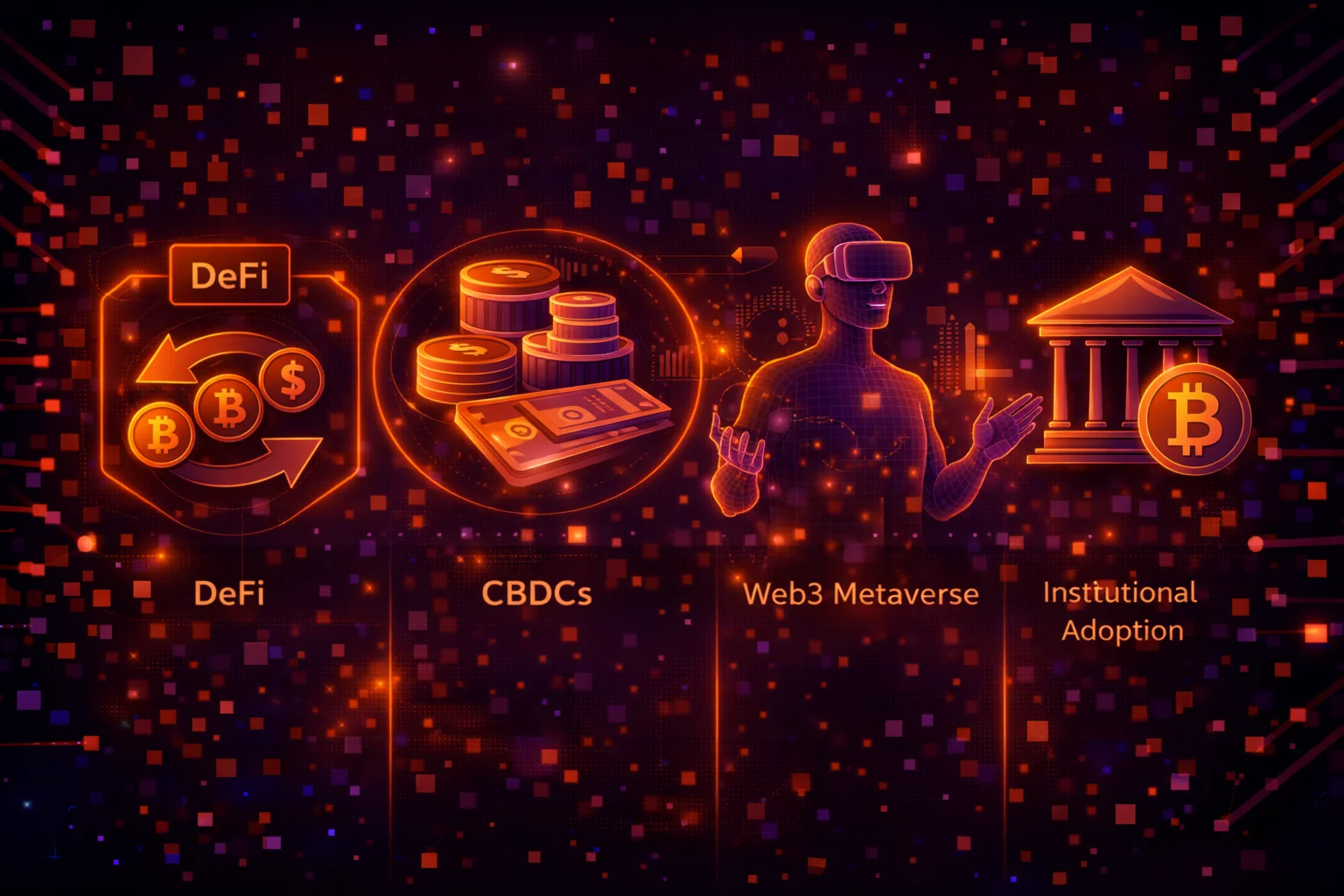
Key Market Drivers
- Institutional Adoption: Major corporations and governments embracing blockchain technology
- Regulatory Clarity: Clearer structures enabling compliant innovation
- Technical Maturity: Scalable solutions addressing previous limitations
- Real-World Integration: Blockchain solving actual business problems
Market Maturation Indicators
- Sustainable Business Models: Focus on fee-based revenue over token emissions
- Professional Infrastructure: Enterprise-grade custody and compliance tools
- User Experience Improvements: Simplified interfaces and better onboarding
- Cross-Chain Interoperability: Bridge systems and cross-L2 communication moving assets between networks
| Trend | Market Impact | Investment Opportunity | Risk Level |
|---|---|---|---|
| Layer 2 Scaling | High - Mass adoption enabler | Infrastructure tokens, DeFi systems | Medium |
| RWA Tokenisation | Very High - Trillion-dollar market | Tokenisation platforms, yield systems | Medium-High |
| AI Integration | High - Automation and efficiency | AI-crypto hybrid projects | High |
| Restaking/LSDfi | Medium - Enhanced yields | Liquid staking tokens, restaking systems | Medium-High |
Layer 2 Scaling Revolution
Layer 2 rollups became the backbone of Ethereum's scalability in 2025, enabling mass adoption through dramatically reduced fees and faster transactions — exactly as the trend predicted. Aggregate L2 TVL exceeded $20 billion during 2025 and roughly doubled to about $48 billion by mid-2026, as the market consolidated around two leaders: Arbitrum and Coinbase's Base.
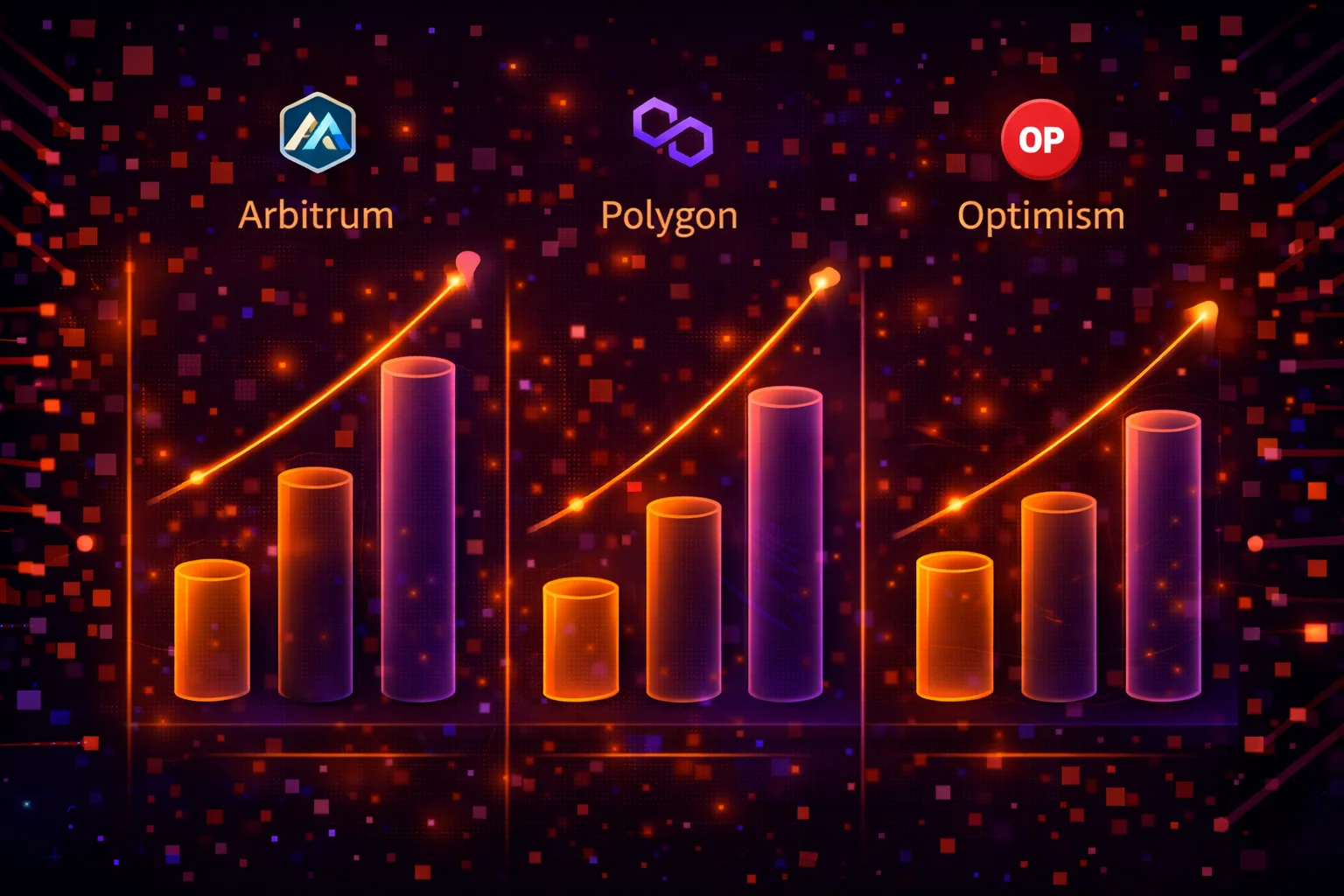
Leading Layer 2 Networks
Arbitrum - Optimistic Rollup Pioneer
- Value secured: ~$11.3 billion (L2Beat) — overtaken by Base in mid-2026, now the second-largest L2
- Advantages: EVM compatibility, deep ecosystem, proven security
- Use cases: DeFi protocols, NFT marketplaces, gaming applications
- Investment angle: ARB token, ecosystem projects
Base - Coinbase's Breakout L2
- Value secured: ~$12.5 billion (L2Beat) — the #1 L2 by value, ahead of Arbitrum's ~$11.3 billion — and #1 among major L2s by daily transactions
- Backing: incubated by Coinbase, built on the OP Stack
- Why it matters: the standout L2 story of 2025-2026, now at the top of the rollup market
Polygon zkEVM - Zero-Knowledge Innovation
Update: Polygon zkEVM Mainnet Beta was sunset on 1 July 2026 as Polygon Labs consolidated around its other scaling stack — a reminder that even validity-proof (zk) rollups faced shakeout. It is included here as 2025-era context, not a live recommendation; the live zk-rollups by mid-2026 are zkSync Era, Linea, Scroll and Starknet.
- Technology: zkSNARK-based validity proofs
- Advantages: Instant finality, enhanced privacy, lower costs
- Partnerships: Major brands and enterprises
- Investment angle: POL token — which replaced MATIC one-for-one in September 2024 — and zkEVM-native projects
Optimism - Retroactive Public Goods Funding
- Unique model: RetroPGF for system development
- Governance: Citizen and token holder involvement
- Growth: Strong developer adoption and user base
- Investment angle: OP token, governance involvement
Layer 2 Investment Strategies
Infrastructure Play
- Direct tokens: ARB, OP, POL for network exposure
- Sequencer tokens: Future decentralised sequencer opportunities
- Bridge systems: Cross-chain system providers
Ecosystem Development
- Native DeFi: Protocols built specifically for L2s
- Gaming projects: Blockchain games leveraging low fees
- Social applications: Web3 social networks on L2s
Technical Developments
Data Availability Solutions
Projects like Celestia and EigenDA are solving the data availability problem, enabling even cheaper L2 operations and new scaling architectures.
Interoperability Improvements
Cross-L2 communication systems are maturing, creating a more connected multi-chain system: bridge systems carry assets between different Layer 2 networks, linking each rollup's ecosystem to the others.
Layer 2 Performance Metrics
- Transaction Throughput: 1000+ TPS on major L2 networks
- Cost Reduction: 90%+ lower fees compared to Ethereum mainnet
- Settlement Time: Near-instant finality for most transactions
- Security Inheritance: Full Ethereum security for rollup-based solutions
Real-World Asset Tokenisation
RWA tokenisation was one of 2025's genuine breakouts, because it involves actual cash flows rather than speculative token value.
The narrow on-chain RWA measure crossed about $6 billion in early 2025, and the broader tokenised-RWA universe grew strongly through the year. (By mid-2026 it had reached roughly $30 billion, with RWA protocols overtaking decentralised exchanges in DeFi TVL.)
Tokenised US treasuries stood at roughly $3.6 billion in early 2025 — led by Ondo Finance (OUSG, then yielding ~5.1% from short-duration treasuries), Franklin Templeton's BENJI/FOBXX fund and, the market leader the original trend lists missed, BlackRock's BUIDL. (By mid-2026 tokenised treasuries had grown to around $15 billion.) Maker — which rebranded from MakerDAO to Sky in August 2024 — backed a large share of its DAI/USDS stablecoin with real-world assets rather than purely crypto collateral, changing its risk profile.
Asset Categories Being Tokenised
Real Estate
- Residential properties: Fractional ownership of homes and flats
- Commercial real estate: Office buildings, retail spaces, warehouses
- REITs on-chain: Traditional REITs moving to blockchain
- Benefits: 24/7 trading, fractional ownership, global access
Financial Instruments
- Government bonds: Treasury bills and bonds as tokens
- Corporate debt: Company bonds and credit instruments
- Structured products: Complex financial derivatives
- Private credit: Alternative lending markets
Commodities and Natural Resources
- Precious metals: Gold, silver, platinum tokens
- Energy assets: Oil, gas, renewable energy projects
- Agricultural products: Farmland, crop futures, livestock
- Carbon credits: Environmental assets and offsets
Leading RWA Platforms
Centrifuge - DeFi Infrastructure for RWAs
- Focus: Bringing real-world assets to DeFi
- Mechanism: Asset originators create pools backed by real assets
- Investors: Earn yield from real-world cash flows
- Token: CFG for governance and staking
Sky (formerly MakerDAO) RWA Integration
- Strategy: Diversifying DAI/USDS backing with real-world assets
- Assets: US Treasury bonds, corporate bonds, trade finance
- Impact: Reducing reliance on crypto collateral
- Governance: token holders vote on RWA additions (MKR converted to SKY after the August 2024 rebrand)
Goldfinch - Decentralised Credit Protocol (winding down, 2026)
- Model: Originally retail-facing uncollateralised lending to real-world borrowers; by 2025-2026 it had pivoted towards institutional access ("Goldfinch Prime")
- Backers: Evaluate and fund loan pools
- Liquidity: Senior/junior tranches for different risk profiles
- Token: GFI for governance and rewards
Investment Opportunities
Platform Tokens
- Infrastructure providers: Tokens of RWA platforms and systems
- Governance involvement: Voting on asset additions and parameters
- Fee sharing: Revenue from platform usage and transactions
Tokenised Assets Direct Investment
- Yield-bearing tokens: Direct exposure to real-world cash flows
- Diversification: Uncorrelated returns from traditional assets
- Liquidity premium: 24/7 trading of traditionally illiquid assets
Regulatory Considerations for RWA
RWA tokenisation needs careful navigation of securities laws, banking regulations, and cross-border compliance.
Successful projects work closely with regulators and maintain proper legal structures to ensure compliance and investor protection.
Market Size and Growth Potential
- Global Real Estate: $280+ trillion market opportunity
- Bond Markets: $130+ trillion in government and corporate debt
- Private Credit: $1.5+ trillion alternative lending market
- Commodities: $20+ trillion in physical commodity markets
AI and Blockchain Integration
AI-blockchain was the most overhyped trend of 2025, and that scepticism aged well. The total market cap of "AI crypto" tokens peaked near $70 billion in early 2025, but most projects were thin wrappers around centralised AI APIs (ChatGPT, Claude, Midjourney) with a governance token bolted on.
Across 2025 the sector shed roughly three-quarters of its value — an "AI winter" — falling to about $22 billion by mid-2026, even as the broader, non-crypto AI market kept booming.
Genuine infrastructure was the exception that held up: Bittensor (TAO) remained the leading AI token — it completed its first halving in December 2025 and drew a Grayscale ETF filing — Render provides decentralised GPU computing and rallied again in 2026, and Chainlink's oracle feeds improved data quality. Before investing in any AI-crypto project, ask: does this project actually need a blockchain, or is the token just a fundraising mechanism?
AI-Enhanced Blockchain Applications
Automated Smart Contracts
- Dynamic parameters: Contracts that adjust based on market conditions
- Predictive execution: AI-driven contract triggers and optimisations
- Risk management: Automated risk assessment and mitigation
- Yield optimisation: AI-powered DeFi strategy automation
Decentralised AI Marketplaces
- Compute sharing: Distributed AI training and inference
- Model trading: Buying and selling AI models as NFTs
- Data monetisation: Tokenising and trading training data
- AI services: On-demand AI capabilities via blockchain
Leading AI-Crypto Projects
SingularityNET (AGIX) - Decentralised AI Network
- Vision: Global AI marketplace and collaboration platform
- Services: AI algorithms accessible via blockchain
- Governance: Community-driven AI development
- Partnerships: Integration with major AI research initiatives
Fetch.ai (FET, now part of the ASI Alliance) - Autonomous Economic Agents
- Technology: AI agents that can transact and negotiate
- Use cases: Supply chain optimisation, energy trading, mobility
- Structure: Fetch.ai and SingularityNET (above) merged into the Artificial Superintelligence (ASI) Alliance under the FET token; Ocean Protocol withdrew from the alliance in October 2025
- Development: Tools for building autonomous agents
Ocean Protocol (OCEAN) - Data Economy
- Focus: decentralised data sharing and monetisation
- Privacy: Compute-to-data for sensitive information
- Marketplace: Data assets as tradeable tokens
- AI training: Secure access to training datasets
Emerging AI-Crypto Trends
AI-Powered DeFi
- Yield farming bots: Automated strategy execution
- Risk assessment: AI-driven credit scoring and lending
- Market making: Intelligent liquidity provision
- Portfolio management: Automated rebalancing and optimisation
Prediction Markets Enhancement
- Oracle improvements: AI-verified real-world data
- Market efficiency: AI traders improving price discovery
- Event detection: Automated market creation for events
- Sentiment analysis: Social media and news sentiment integration
AI-Crypto Investment Framework
Technology Risks
- AI reliability: Potential for AI system failures or biases
- Complexity: Increased system complexity and attack vectors
- Regulation: Uncertain regulatory treatment of AI-crypto hybrids
- Competition: Rapid technological advancement and obsolescence risk
Investment Opportunity Areas
- Infrastructure tokens: Platforms enabling AI-blockchain integration
- Compute tokens: decentralised AI computation networks
- Data tokens: Valuable datasets for AI training
- Service tokens: Access to specific AI capabilities
AI-Crypto Market Projections
- Market Size: $50+ billion projected by 2030
- Growth Rate: 40%+ annual growth expected
- Adoption Timeline: Mainstream adoption in 3-5 years
- Key Drivers: Enterprise AI demand and blockchain scalability
Restaking and LSDfi Evolution
Liquid staking and restaking created new yield opportunities in 2025 while enhancing network security — but the two diverged. Liquid staking proved the durable winner the trend predicted, whereas restaking went through a real stress test rather than a clean breakout, and its long-term value capture is still being decided into mid-2026.
Restaking Fundamentals
EigenLayer - Ethereum Restaking Pioneer
- Concept: Reuse staked ETH to secure additional systems
- Actively Validated Services (AVS): Protocols that benefit from restaked security
- Slashing risks: Additional penalties for misbehavior across services
- Rewards: Extra yield from multiple protocol involvement
Restaking Strategies
- Native restaking: Direct ETH staking with restaking enabled
- LST restaking: Using liquid staking tokens (stETH, rETH) for restaking
- Operator delegation: Delegating to professional node operators
- Risk management: Diversifying across multiple AVS to reduce slashing risk
Restaking Risk Assessment
EigenLayer's model stacks additional slashing conditions on top of Ethereum's base staking penalties: if an Actively Validated Service (AVS) fails, restaked ETH can be slashed by both the AVS and Ethereum consensus.
That scenario stopped being hypothetical in April 2025, when EigenLayer turned on slashing on mainnet. The repricing was sharp — restaking TVL fell from a ~$15 billion early-2025 peak to roughly $7 billion and the EIGEN token dropped around 86% — before recovering to about $18 billion in restaked ETH by early 2026. Crucially, the feared correlated-slashing cascade did not occur.
Even so, the additional 2-4% APY from restaking may not compensate for the tail risk, and whether restaking captures durable value remains an open question rather than a settled win. If you restake, diversify across multiple AVS operators and limit restaking exposure to 20-30% of your total staked ETH.
Liquid Staking Derivatives (LSDfi)
Major LST Protocols
Lido (stETH) - Market Leader
- Market share: ~24-28% of staked ETH (still the leader, though down from a peak above 32% in 2023)
- Liquidity: Deep markets across DeFi systems
- Governance: LDO token for protocol decisions
- Yield: Ethereum staking rewards + potential LDO incentives
Rocket Pool (rETH) - Decentralised Alternative
- Model: Permissionless node operator network
- Collateral: RPL token required for node operators
- Decentralisation: No single point of control
- Yield: ETH staking + RPL rewards for operators
Frax Ether (frxETH/sfrxETH) - Dual Token Model
- frxETH: Non-yield bearing ETH representation
- sfrxETH: Staked version earning validator rewards
- Flexibility: Choose between liquidity and yield
- Integration: Deep Frax system integration
LSDfi Applications
Yield Enhancement Protocols
- Pendle: Yield tokenisation and trading for LSTs
- Instadapp: Automated LST yield strategies
- Yearn: LST vault strategies and optimisation
- Convex: Boosted rewards for Curve LST pools
Lending and Borrowing
- Aave: LST collateral for borrowing
- Compound: LST money markets
- Sky (formerly MakerDAO): LST-backed DAI/USDS minting
- Liquity: LST-collateralised stablecoin systems
Investment Strategies
Direct LST Holding
- stETH: Largest liquidity, widest DeFi integration
- rETH: decentralisation premium, potential upside
- sfrxETH: Competitive yields, Frax system benefits
- Diversification: Spread across multiple LST providers
Protocol Token Investment
- LDO: Governance of largest LST protocol
- RPL: Required collateral for Rocket Pool operators
- FXS: Frax system governance and value accrual
- EIGEN: Future EigenLayer governance token
Yield Farming Strategies
- Curve pools: LST/ETH pools for trading fees + rewards
- Pendle strategies: Yield trading and fixed-rate opportunities
- Restaking rewards: Additional yield from AVS involvement
- Leverage strategies: Borrowing against LSTs for enhanced exposure
Risks and Considerations
Technical Risks
- Slashing: Validator penalties affecting LST value
- Smart contract risk: Protocol vulnerabilities
- Liquidity risk: LST/ETH depeg during market stress
- Restaking complexity: Additional slashing conditions from AVS
Market Risks
- Competition: New LST systems entering the market
- Regulation: Potential regulatory treatment of staking
- Ethereum changes: Protocol upgrades affecting staking
- Centralisation concerns: Large LST providers' influence on Ethereum
DeFi Maturation and Sustainability
DeFi continued maturing in 2025, from high-risk experiments towards sustainable, fee-generating protocols — and the "real yield" thesis was validated, though mostly through buyback-and-burn rather than direct payouts to stakers.
Sustainable Yield Models
Fee-Based Revenue
- Trading fees: DEX systems earning from transaction volume
- Lending spreads: Interest rate differentials in money markets
- Management fees: Automated strategy and vault systems
- Performance fees: Success-based compensation models
Real Yield Protocols
- GMX: Perpetual trading fees distributed to token holders (note: GMX V1 suffered a ~$42M reentrancy hack in July 2025; funds were largely returned)
- Uniswap: the long-debated protocol fee switch finally activated in December 2025, directing v2/v3 fees to UNI buyback-and-burn (not direct staker payouts)
- Aave: protocol revenue from lending/borrowing spreads, funding a ~$50M/year AAVE buyback approved in October 2025 — cut in March 2026 and paused since April 2026
- Curve: Trading fees and bribes for gauge voting
Protocol Maturation Trends
Governance Evolution
- Progressive decentralisation: Gradual transition from core teams to DAOs
- Delegate systems: Professional governance participants
- Execution structures: Streamlined proposal implementation
- Treasury management: Sustainable funding for development
Risk Management Improvements
- Insurance systems: Coverage for smart contract risks
- Audit standards: Comprehensive security reviews
- Gradual rollouts: Staged deployment of new features
- Emergency procedures: Pause methods and upgrade paths
Institutional DeFi Adoption
Compliance-Focused Protocols
- Permission pools: KYC/AML compliant DeFi access
- Regulatory reporting: Built-in compliance and reporting tools
- Institutional custody: Integration with qualified custodians
- Risk controls: Enterprise-grade risk management features
Traditional Finance Integration
- Bank partnerships: Traditional banks offering DeFi services
- Asset managers: DeFi strategies in traditional portfolios
- Payment systems: DeFi rails for cross-border payments
- Trade finance: Blockchain-based trade financing solutions
DeFi Investment Strategies
Blue-Chip DeFi Protocols
For detailed reviews and comparisons, see our DeFi protocol comparison:
- Uniswap (UNI): Leading DEX with potential fee sharing
- Aave (AAVE): Dominant lending protocol with real revenue (see our Aave review)
- Curve (CRV): Stablecoin trading system
- Sky (formerly MakerDAO, SKY): decentralised stablecoin (DAI/USDS) with fee-driven buyback
Emerging Sustainable Protocols
- GMX (GMX): Real yield from perpetual trading
- Gains Network (GNS): decentralised leveraged trading
- Camelot (GRAIL): Next-generation DEX with real yield
DeFi Performance Metrics (2025)
- Total Value Locked: $100B+ across all protocols
- Daily Volume: $5B+ in DEX trading volume
- User Growth: 10M+ active DeFi users
- Protocol Revenue: $2B+ in annual fees generated
By mid-2026, DeFi TVL sat in a volatile ~$105-160 billion band — above 2025's floor but still short of the December 2021 peak of roughly $212 billion.
Regulatory Clarity and Adoption
2025 proved a turning point for US cryptocurrency regulation. The landmark was the GENIUS Act — the first US federal stablecoin law, passed by the Senate in June and signed on 18 July 2025 — alongside spot ETF approvals and the EU's MiCA coming fully into force. A broader US market-structure bill, the CLARITY Act, passed the House but remained stuck in the Senate into mid-2026, so "clarity" arrived for stablecoins well before token classification.
Global Regulatory Developments
United States
- SEC clarity: Clearer guidance on token classifications
- CFTC oversight: Commodity treatment for major cryptocurrencies
- Banking integration: Traditional banks offering crypto services
- ETF approvals: Spot Bitcoin and Ethereum ETFs trading
European Union
- MiCA implementation: Markets in Crypto-Assets regulation in effect (CASP rules from 30 December 2024)
- Stablecoin rules: Clear structure for euro-denominated stablecoins
- DeFi guidance: Regulatory approach to decentralised systems
- Digital euro: Central bank digital currency development
- Cross-border compliance: Harmonised regulatory standards across member states
- Consumer protection: Enhanced safeguards for retail cryptocurrency investors
Asia-Pacific Region
- Singapore leadership: Comprehensive digital asset structure with clear licensing requirements
- Hong Kong hub: Retail trading permissions and enterprise custody services
- Japan innovation: Web3 promotion policies and blockchain technology advancement
- Australia progress: Digital asset regulatory structure and taxation clarity
- South Korea adoption: Institutional investment permissions and exchange regulations
Institutional Adoption Acceleration
Regulatory clarity drives new enterprise cryptocurrency adoption across traditional finance sectors. Major banks, asset managers, and corporations integrate digital assets into their core business operations, creating sustainable demand and market stability.
Corporate Treasury Adoption
- Fortune 500 companies: Bitcoin and Ethereum treasury allocations increasing
- Payment integration: Cryptocurrency payment processing for international transactions
- Supply chain finance: Blockchain-based trade finance and settlement systems
- Cross-border efficiency: Reduced settlement times and transaction costs
Traditional Finance Integration
- Investment banks: Cryptocurrency trading desks and custody solutions
- Asset managers: Digital asset funds and portfolio allocation strategies
- Insurance companies: Cryptocurrency coverage and DeFi protocol insurance
- Pension funds: Long-term cryptocurrency investment allocations
Asia-Pacific
- Japan: Comprehensive crypto structure and exchange licensing
- Singapore: Clear guidelines for crypto businesses and DeFi
- Hong Kong: Retail crypto trading and enterprise services
- Australia: crypto is not legal tender (the ATO treats it as property for capital-gains tax); the Digital Assets Framework Act 2026 — Royal Assent April 2026, commencing April 2027 — will require digital asset platforms and custodians to hold an AFSL, with a separate AUSTRAC AML/CTF registration regime from July 2026
Institutional Adoption Drivers
Corporate Treasury Adoption
- Bitcoin reserves: Companies adding BTC to balance sheets
- Payment integration: Crypto payments for goods and services
- Treasury management: Yield generation on corporate crypto holdings
- Cross-border efficiency: Crypto for international business payments
Financial Services Integration
- Custody services: Banks offering crypto custody solutions
- Trading desks: Traditional brokers adding crypto trading
- Wealth management: Crypto allocation in investment portfolios
- Insurance products: Crypto-specific insurance offerings
Regulatory Investment Framework
Compliance-First Investment Strategy
- Regulatory advantage: Projects built with compliance in mind
- Institutional access: Protocols accessible to regulated entities
- Reduced regulatory risk: Lower probability of enforcement action
- Mainstream adoption: Easier integration with traditional systems
Infrastructure Investment Opportunities
- Custody providers: Qualified custodians for enterprise crypto
- Compliance tools: KYC/AML and reporting solutions
- Bridge systems: Compliant cross-chain system
- Stablecoin issuers: Regulated stablecoin providers
Regulatory Timeline and Milestones
- Dec 2024 - Q1 2025: EU MiCA CASP rules came into full force
- Jun-Jul 2025: US GENIUS Act passed (Senate in June, signed 18 July) — the first federal stablecoin law
- 2025: the US banned a domestic central bank digital currency (CBDC) by executive order; the CLARITY market-structure bill passed the House
- Into 2026: CLARITY Act still awaiting Senate passage; cross-border regulatory coordination ongoing
Gaming and Metaverse Development
Blockchain gaming and the metaverse were the trend that went the other way in 2025: rather than maturing, the sector collapsed. By 2026, industry reports estimated that over 90% of Web3 games had effectively died, 300+ had shut down, and sector tokens had fallen roughly 95% from their 2022 peaks as funding and attention shifted to AI and real-world assets. The original "evolving towards sustainable gaming economies" framing did not hold — the lone bright spot was infrastructure (see Immutable below).
Gaming Evolution
Sustainable Game Economics
- Skill-based rewards: Earnings tied to player skill and contribution
- Deflationary mechanics: Token burning through gameplay activities
- Utility-driven NFTs: In-game items with real utility beyond speculation
- Long-term engagement: Games designed for years of play, not quick extraction
AAA Game Integration
- Major studios: Traditional game companies adding blockchain elements
- Hybrid models: Optional blockchain features in traditional games
- Cross-game assets: NFTs usable across multiple games
- Player ownership: True ownership of in-game assets and progress
Leading Gaming Projects
Axie Infinity - the Play-to-Earn Pioneer that Faded
- Outcome: the pioneering play-to-earn game did not transition to "sustainable gaming" — daily active users fell from a ~2.7 million peak to roughly 5,500, and the AXS token dropped about 99% from its high
- Ronin network: dedicated gaming blockchain with low fees
- Governance: AXS token for ecosystem decisions
The Sandbox - a Metaverse Platform that Emptied Out
- Outcome: active users dwindled to the low thousands and the SAND token fell ~97% from its 2021 peak; the company reportedly cut around half its staff and pivoted away from virtual-world development towards meme-coin launches
- Land ownership: virtual real estate was sold as NFTs, but secondary demand collapsed
- SAND token: governance and in-world currency
Immutable - Gaming Infrastructure (the Survivor)
- Outcome: the clear exception — the SEC closed its IMX investigation, and Immutable reported 500+ games plus mainstream partnerships, though it still cut roughly a third of its staff and shifted towards mobile and AI
- Layer 2 solution: gas-free NFT trading and gaming (the original "Immutable X" StarkEx rollup now sits under the broader Immutable/zkEVM brand)
- IMX token: staking and governance for the ecosystem
Metaverse Development
Virtual Real Estate
- Digital land: Scarce virtual real estate with development rights
- Commercial use: Virtual stores, offices, and event spaces
- Rental markets: Leasing virtual land for events and experiences
- Development tools: Platforms for creating virtual experiences
Social and Economic Systems
- Virtual economies: Complete economic systems within virtual worlds
- Social interactions: Meaningful social connections and communities
- Digital identity: Persistent avatars and reputation systems
- Governance: Democratic decision-making in virtual communities
Investment Strategies
Infrastructure Investment
- Gaming blockchains: specialised networks for gaming applications
- Development platforms: Tools and services for game developers
- NFT marketplaces: Trading platforms for gaming assets
- Scaling solutions: Layer 2 networks optimised for gaming
Direct Gaming Exposure
- Game tokens: Native currencies of successful games
- Gaming NFTs: Valuable in-game assets and collectibles
- Virtual land: Digital real estate in popular metaverses
- Gaming guilds: Organisations that invest in gaming assets
Sustainability and Green Crypto
Green crypto played out differently than expected in 2025. The technical facts held — Ethereum's Merge cut its energy use by ~99.95%, proof-of-stake dominated new chains, and Bitcoin's sustainable-energy mix kept rising (past ~52% by 2025). But sustainability faded as a prominent crypto narrative: the energy debate moved decisively to AI data centres, which by 2024-2025 consumed roughly twice Bitcoin mining's electricity (~415 TWh versus ~205 TWh) while drawing far less scrutiny.
Carbon-credit tokenisation and regenerative finance (ReFi) stayed a small, volatile niche rather than the mainstream adoption driver the trend anticipated.
Energy-Efficient Consensus
Proof-of-Stake Dominance
- Ethereum transition: 99.95% energy reduction after The Merge
- New networks: Most new blockchains launching with PoS
- Validator economics: Sustainable security through staking rewards
- Liquid staking: Maintaining liquidity. securing networks
Alternative Consensus Mechanisms
- Proof-of-History: Solana's time-based consensus for efficiency
- Delegated PoS: Representative validation for faster consensus
- Proof-of-Authority: Permissioned networks for enterprise use
- Hybrid models: Combining multiple consensus methods
Carbon-Neutral Initiatives
Carbon Offset Programs
- Protocol-level offsets: Blockchains buying carbon credits
- Validator requirements: Mandating renewable energy use
- User-driven offsets: Optional carbon offsetting for transactions
- Transparent tracking: On-chain carbon accounting and reporting
Green Mining Initiatives
- Renewable energy: Bitcoin mining powered by solar, wind, and hydro
- Stranded energy: utilising otherwise wasted energy sources
- Grid stabilisation: Mining as demand response for renewable grids
- Methane capture: Converting waste methane to mining power
Environmental Applications
Carbon Credit Tokenisation
- Transparent markets: Blockchain-based carbon credit trading
- Fractional ownership: Smaller participants in carbon markets
- Verification systems: Immutable records of environmental impact
- Automated offsetting: Smart contracts for automatic carbon offsetting
Regenerative Finance (ReFi)
- Nature-backed assets: Tokens representing natural capital
- Conservation funding: Crypto-based environmental project funding
- Biodiversity credits: Tokenising system preservation efforts
- Sustainable agriculture: Blockchain tracking of sustainable farming
Investment Opportunities
Green Blockchain Networks
- Algorand: markets itself as a carbon-negative blockchain via its own offset programme (an attributed claim rather than an independently verified one)
- Tezos: Energy-efficient PoS with sustainability initiatives
- Hedera: Low-energy consensus with carbon offset programs
- Cardano: Research-driven sustainable blockchain development
Environmental Tokens
- Carbon credit tokens: Tokenised carbon offsets and credits
- ReFi systems: Regenerative finance platform tokens
- Green energy tokens: Renewable energy project financing
- Conservation tokens: Biodiversity and system preservation
Real-World Success Stories: Trends in Action
Layer 2 Adoption: Arbitrum's DeFi Ecosystem
Arbitrum held roughly $2-2.5 billion in total value locked through mid-2025, demonstrating the real-world impact of Layer 2 scaling. (It now secures about $11.3 billion on L2Beat, second to Base.)
GMX, a decentralised perpetual exchange on Arbitrum, processed hundreds of millions of dollars in daily trading volume with fees well under $1 per transaction, distributing real yield to token holders.
Traders who previously avoided DeFi over high fees became active participants.
GMX did, however, suffer a ~$42 million reentrancy exploit on its V1 contracts in July 2025 (funds were largely returned through a white-hat arrangement) — a reminder that low fees do not eliminate smart-contract risk.
Key points (2025):
- Per-transaction costs on Arbitrum fell from $15-30 on mainnet to well under $1
- Daily active users grew strongly year-over-year
- GMX generated meaningful real yield from trading fees
- The July 2025 GMX V1 exploit (~$42M, largely recovered) is the key caveat to the "real yield" story
RWA Tokenisation: Maker/Sky's Treasury Diversification
Maker — rebranded from MakerDAO to Sky in August 2024 — diversified its stablecoin treasury from largely crypto-backed to substantially real-world-asset-backed by 2025, holding US Treasury bonds and similar instruments generating yields broadly in the 4-5% range.
This diversification helped stabilise its DAI/USDS stablecoin during crypto downturns and attracted users seeking stablecoin exposure with real-world backing.
Impact (2025):
- RWA backing became a major share of stablecoin collateral
- RWA yields became a significant protocol revenue source
- Institutional interest grew alongside compliant RWA backing
- Following the rebrand, MKR converted to the SKY governance token
AI x Crypto: a Narrative that Deflated
The AI-crypto story is a cautionary one rather than a success. Across 2025 the sector's token market cap fell roughly three-quarters (an "AI winter") to about $22 billion by mid-2026, even as mainstream AI boomed. Widely-repeated claims that Fetch.ai had deployed "10,000+ autonomous agents" for a European energy utility — with specific waste-reduction and revenue figures — could not be independently verified and read as promotional, so we no longer present them as fact.
What did hold up was infrastructure: Bittensor (TAO) remained the leading AI token and Render kept building.
Fetch.ai itself merged with SingularityNET into the Artificial Superintelligence (ASI) Alliance under the FET token, from which Ocean Protocol withdrew in October 2025.
What actually happened:
- AI-crypto token market cap fell ~75% across 2025 to ~$22 billion by mid-2026
- Infrastructure projects (Bittensor, Render) outlasted the "API-wrapper" tokens
- Fetch.ai folded into the ASI Alliance; Ocean Protocol exited in October 2025
- Unverified single-source "case study" metrics have been removed
Restaking: EigenLayer's Stress Test
EigenLayer turned on slashing on Ethereum mainnet in April 2025 — the moment the model was finally tested at scale. Restaking TVL, which had peaked near $15 billion, fell to roughly $7 billion as the EIGEN token dropped about 86%, before recovering to around $18 billion in restaked ETH by early 2026. Restakers earn an additional 2-4% APY on top of base Ethereum staking rewards.
New projects can access Ethereum's security without building validator sets from scratch, and the feared correlated-slashing cascade did not materialise. But restaking's durable value capture is still being decided rather than settled.
How it actually played out:
- Slashing went live on mainnet in April 2025 (the "tested at scale" event)
- TVL fell from ~$15B to ~$7B, then recovered to ~$18B by early 2026
- Additional 2-4% APY for restakers; no correlated-slashing cascade occurred
- Whether restaking delivers lasting value remains an open question
Sustainable DeFi: Uniswap's Fee Switch Activation
After years of debate, Uniswap finally activated its protocol fee switch in December 2025 (the "UNIfication" proposal). Rather than distributing fees directly to stakers, it directs v2/v3 protocol fees to a UNI buyback-and-burn, and retroactively removed roughly 100 million UNI (about 10% of supply).
This moved UNI from a pure governance token towards a value-accruing asset, reinforcing the wider 2025 shift — including Aave's ~$50M/year buyback, now paused — towards returning protocol revenue to token holders via buyback-and-burn.
What actually happened:
- Fee switch activated December 2025 — not earlier in the year
- Mechanism is buyback-and-burn, not direct distribution to "stakers"
- ~100 million UNI (~10% of supply) retroactively removed from supply
- Part of a broader real-yield/buyback trend alongside Aave
Regulatory Compliance: Circle's USDC and the GENIUS Act
2025's stablecoin-regulation clarity — the GENIUS Act — made Circle one of the year's biggest winners.
Circle went public on the NYSE (ticker CRCL) on 5 June 2025, with its market value surging to around $63 billion, and USDC circulation grew about 90% year-over-year to roughly $61 billion in the second quarter of 2025. (It rose past ~$75 billion by mid-2026, holding around a quarter of the stablecoin market.)
Growth (2025):
- USDC circulation grew ~90% year-over-year to ~$61 billion
- Circle IPO'd on the NYSE (CRCL) on 5 June 2025 at a ~$63 billion valuation
- The GENIUS Act established a federal framework for payment stablecoins
- USDC held roughly a quarter of the stablecoin market
Investment Strategies
Successful crypto investing in 2025 needs a balanced approach that considers both emerging trends and established systems, with careful attention to risk management and portfolio diversification.
Portfolio Allocation Framework
Core Holdings (40-60%)
- Bitcoin (BTC): Digital gold and store of value (20-30%) — see our Bitcoin investment analysis for current positioning
- Ethereum (ETH): Smart contract platform and DeFi base layer (15-25%)
- Major altcoins: Established L1s and blue-chip DeFi (5-15%)
Growth Opportunities (20-40%)
- Layer 2 tokens: Scaling solution governance tokens (5-10%)
- RWA platforms: Real-world asset tokenisation systems (5-10%)
- AI-crypto hybrids: Artificial intelligence blockchain projects (3-8%)
- Sustainable DeFi: Real yield generating systems (5-12%)
Speculative/Emerging (10-20%)
- Gaming tokens: Blockchain gaming and metaverse projects (3-8%)
- New narratives: Emerging trends and early-stage projects (2-7%)
- Meme coins: Community-driven speculative assets (1-5%)
Trend-Based Investment Strategies
Layer 2 Infrastructure Play
- Direct tokens: ARB, OP, POL for network governance
- Ecosystem projects: Native DeFi systems on L2s
- Bridge systems: Cross-chain system providers
- Data availability: Solutions like Celestia for L2 data needs
Real-World Asset Exposure
- Platform tokens: CFG, MKR, GFI for RWA system
- Tokenised assets: Direct investment in tokenised real estate, bonds
- Yield strategies: Earning from real-world cash flows
- Compliance leaders: Projects with strong regulatory structures
Sustainable Yield Farming
- Real yield systems: GMX, Uniswap, Aave for fee-based returns
- Liquid staking: stETH, rETH for Ethereum staking rewards
- Restaking strategies: EigenLayer for enhanced ETH yields
- Stablecoin yields: Low-risk returns from stablecoin systems
Risk Management Strategies
Diversification Principles
- Sector diversification: Spread across different crypto sectors
- Network diversification: Don't concentrate on single blockchain
- Geographic diversification: Consider regulatory jurisdictions
- Temporal diversification: Dollar-cost averaging for entries
Risk Assessment Framework
- Technical risk: Smart contract audits and security track record
- Market risk: Liquidity, volatility, and correlation analysis
- Regulatory risk: Compliance status and regulatory clarity
- Execution risk: Team experience and development progress
Timing and Entry Strategies
Market Cycle Awareness
- Accumulation phases: Building positions during market downturns
- Growth phases: Selective additions during uptrends
- Distribution phases: Taking profits during euphoric periods
- Correction phases: Rebalancing and opportunity assessment
Entry and Exit Strategies
- Dollar-cost averaging: Regular purchases regardless of price
- Value averaging: Adjusting purchase amounts based on performance
- Momentum strategies: Following confirmed trend directions
- Contrarian approaches: Buying fear and selling greed
Monitoring and Rebalancing
Performance Tracking
- Portfolio tools: Use professional tracking software
- Benchmark comparison: Compare against crypto indices
- Risk metrics: Monitor volatility, drawdowns, and correlations
- Tax optimisation: Consider tax implications of rebalancing
Rebalancing Triggers
- Time-based: Quarterly or semi-annual rebalancing
- Threshold-based: Rebalance when allocations drift 5-10%
- Volatility-based: Increase rebalancing frequency during high volatility
- Opportunity-based: Tactical adjustments for major market events
Overhype Assessment: Separating Signal from Noise
Genuinely Transformative (Back with Data)
- Layer 2 scaling: 40M+ monthly transactions on Arbitrum alone, $0.01-0.10 fees. This is working infrastructure, not a promise.
- RWA tokenisation: ~$6B+ on-chain in 2025 by the narrow measure (the broader tokenised-RWA universe reached ~$30B by mid-2026), with real cash flows from US treasuries and corporate debt. Maker (now Sky) earned meaningful annual revenue from RWA backing, and BlackRock's BUIDL became the market-leading tokenised-treasury fund.
- Spot ETFs: $30B+ in net inflows by end-2025. BlackRock's IBIT holds more BTC than most corporate treasuries. Institutional demand is measurable, not speculative.
- Liquid staking: Lido held ~24-28% of staked ETH (the leader, down from a 2023 peak above 32%). stETH survived multiple depegging scares and emerged as a genuine DeFi primitive.
Overhyped (Proceed with Caution)
- AI-crypto: the sector's token market cap fell roughly 75% across 2025 to about $22B by mid-2026 (from a ~$70B early-2025 peak), for a sector where ~90% of projects are API wrappers with governance tokens. Render and Bittensor have real utility; most others do not.
- Restaking: EigenLayer's slashing went live on mainnet in April 2025 — the "tested at scale" moment — and TVL swung from a ~$15B peak down to ~$7B and back to ~$18B by early 2026. Vitalik Buterin had publicly warned about systemic risk; no correlated cascade occurred, but the additional 2-4% APY may still not compensate for the tail risk, and durable value capture is unproven.
- Gaming/metaverse: the sector collapsed — over 90% of Web3 games effectively died, Axie Infinity's users fell ~99% from peak, and The Sandbox emptied out. Infrastructure (Immutable) survived; the consumer play-to-earn and metaverse thesis did not.
- Carbon credit tokens: interesting concept but a small, volatile niche (a few billion dollars of tokenised credits), with no clear path to mainstream scale without a regulatory mandate.
How to Track These Trends
Monitor L2 adoption via L2Beat.com (TVL, transaction counts, fees across all rollups). Track RWA growth on RWA.xyz (total tokenised assets by category). Follow ETF flows on The Block or Bloomberg Terminal.
For DeFi protocol revenue, Token Terminal provides real-time data on fee generation versus token emissions — the ratio between the two is the clearest indicator of whether a protocol's economics are sustainable.
Set quarterly review dates to reassess allocation. Trends that stall for two consecutive quarters (declining TVL, flat user growth) should trigger position reductions. Trends showing accelerating adoption (rising TVL, growing protocol revenue) merit increased allocation.
Conclusion
Two trends have delivered measurably in 2025: Layer 2 scaling (40M+ monthly Arbitrum transactions at $0.01-0.10 each) and RWA tokenisation ($6B+ on-chain with real cash flows).
Bitcoin and Ethereum ETFs brought $30B+ in institutional capital by end-2025. These are not narratives — they are real infrastructure with verifiable usage metrics.
Two trends warranted scepticism, and 2025 confirmed it: AI-crypto (whose token market fell roughly 75% in an "AI winter", though Bittensor and Render kept building) and restaking (whose slashing finally went live in April 2025, triggering a sharp TVL drawdown and recovery — durable value still unproven). And one trend the page once treated as evolving — gaming and the metaverse — collapsed outright. Invest in trends backed by growing protocol revenue and user counts, not by token emissions and social-media hype.
Check L2Beat for L2 data, RWA.xyz for tokenised asset growth, and Token Terminal for protocol revenue before making allocation decisions.
For portfolio positioning, consider allocating based on trend maturity. L2 scaling and ETFs are established — exposure through ETH (which benefits from L2 activity via fee burning) and direct ETF holdings carries relatively lower risk.
RWA tokenisation is in a growth phase where early movers like Ondo (ONDO) have upside but also face regulatory uncertainty as securities law catches up with on-chain representations of traditional assets.
AI-crypto and restaking are speculative — if you participate, keep position sizes small (1-2% of portfolio) and be prepared to exit quickly if the narrative shifts. Set clear exit criteria before entering any speculative position.
The most reliable signal for distinguishing durable trends from temporary hype remains protocol revenue. A trend that generates real fees from real users — not just token trading volume — is building something people are willing to pay for.
That distinction has been the best predictor of which trends survive bear markets, and it applies equally well to whatever narratives emerge in 2026 and beyond.
Explore our Binance platform review for complete trading, or check our staking platforms comparison to benefit from trending opportunities. For the trend this retrospective rates highest on delivered usage, our Ethereum L2 Complete Guide 2026 covers the rollups behind those transaction numbers.
See also: Top Crypto Newsletters
Sources & References
- ASIC. (2026). "Digital Assets Framework Act 2026 implementation roadmap". Australian regulator source for the framework status, April 2027 commencement, and AFSL/AUSTRAC regimes.
- CoinDesk. (2025). "Crypto News and Analysis". Leading source for cryptocurrency market trends and developments.
- Messari. (2025). "Crypto Research Reports". In-depth analysis of emerging crypto trends and systems.
- The Block. (2025). "Blockchain Research". Comprehensive blockchain industry research and data.
- DefiLlama. "DeFi and RWA TVL by category". Used for the 2025 and mid-2026 TVL figures.
- L2Beat. "Scaling summary: value secured by rollup". Live source for the Base and Arbitrum value-secured figures.
- RWA.xyz. "Tokenised real-world asset data". Tokenised-treasury and RWA market sizing.
- CoinDesk. (2026). "More than 90% of Web3 games failed after $15 billion boom". Source for the gaming-sector collapse.
- What is DeFi? Complete Guide 2025
- Ethereum Staking Guide - CryptoInvesting
- OKX Exchange Review
- Aave Protocol Guide
Frequently Asked Questions
- Which crypto trends look sustainable in 2025?
- The most sustainable trends include Layer 2 scaling solutions, real-world asset tokenisation, sustainable DeFi systems with real yield, and regulatory-compliant projects. These trends address real problems and have clear business models, rather than relying on speculation.
- Are emissions-driven APYs still attractive?
- Whilst emissions-driven yields can provide short-term opportunities, they're generally unsustainable long-term. Focus on systems that generate real revenue from fees, real-world assets, or other sustainable sources, rather than purely inflationary rewards.
- What risks should I watch in 2025?
- Key risks include smart contract exploits, regulatory changes, market manipulation, liquidity crunches during stress periods, and the complexity risks of new technologies like restaking and AI integration. Always diversify and never invest more than you can afford to lose.
- How should beginners position themselves for 2025 trends?
- Start with established systems: Bitcoin and Ethereum as core holdings, add liquid staking tokens like stETH for yield, then gradually explore Layer 2 tokens and sustainable DeFi systems. Avoid high-risk strategies until you understand the technology and risks.
- What is the biggest crypto trend in 2025?
- Layer 2 scaling solutions and real-world asset tokenisation are the two biggest trends. L2S enable mass adoption through lower costs, while RWA tokenisation brings trillions of dollars of traditional assets on-chain, bridging DeFi with traditional finance.
- Will AI greatly impact blockchain in 2025?
- Yes, AI integration is accelerating with automated smart contracts, AI-powered DeFi strategies, decentralised AI marketplaces, and intelligent prediction markets. However, this remains a higher-risk area due to the complexity of combining two rapidly evolving technologies.
- How important is regulatory compliance for crypto investments?
- Significant in 2025. Projects with clear regulatory compliance are more likely to achieve enterprise adoption, reduce regulatory risk, and sustain long-term growth. Avoid projects that ignore or actively circumvent regulations.
- Should I invest in gaming and metaverse tokens?
- Gaming and metaverse tokens were amongst 2025's worst performers — by 2026 over 90% of Web3 games had effectively died and flagship tokens such as AXS and SAND had fallen roughly 95-99% from their peaks. Treat the sector as highly speculative; infrastructure providers like Immutable held up far better than consumer game tokens, but the play-to-earn and metaverse thesis did not deliver.
← Back to Crypto Investing Blog Index
Financial Disclaimer
This content is not financial advice. All information provided is for educational purposes only. Cryptocurrency investments carry significant investment risk, and past performance does not guarantee future results. Always do your own research and consult a qualified financial advisor before making investment decisions.