AWS Review: Cloud Hosting Guide
Comprehensive review of Amazon Web Services for cryptocurrency and blockchain projects. Analysis of pricing, security, blockchain services, and infrastructure solutions.
Amazon Web Services has established itself as the dominant force in cloud computing, powering a significant portion of the internet's infrastructure. This includes many of the world's largest cryptocurrency exchanges and blockchain projects.
With over 200 fully-featured services and a global infrastructure spanning 31 regions, AWS provides the scalability and reliability that crypto businesses demand.
For cryptocurrency and blockchain companies, AWS offers specialised services that address the unique challenges of the industry. From Amazon Managed Blockchain for enterprise blockchain networks to high-performance computing instances for cryptocurrency mining operations, AWS has built a comprehensive ecosystem tailored to the needs of the crypto industry.
Major cryptocurrency exchanges. This includes Coinbase, Binance, and Kraken, which rely on AWS infrastructure to handle millions of transactions daily. The platform's enterprise-grade security, compliance certifications, and 99.99% uptime SLA make it the preferred choice for institutional enterprises.
These companies cannot afford downtime or security breaches, making AWS's reliability crucial for its operations.
AWS's blockchain services have evolved significantly since 2018, now offering managed Ethereum nodes, Hyperledger Fabric networks, and quantum-resistant cryptography services. The platform's global reach enables enterprises to deploy infrastructure close to their users worldwide.
This geographic distribution reduces latency and improves user experience. Across different markets.
The platform's pay-as-you-use pricing model allows crypto startups to scale efficiently without significant upfront investments. Enterprise features like dedicated instances and private clouds serve the needs of larger cryptocurrency organisations.
AWS also provides specialised support for financial services, helping enterprises navigate regulatory compliance requirements.
This comprehensive review examines AWS's blockchain services, security features, pricing structure, and overall value proposition for cryptocurrency and blockchain projects in 2025. We'll analyse everything from basic hosting needs to advanced blockchain infrastructure, helping you determine if AWS meets your crypto project's requirements.
Start with AWS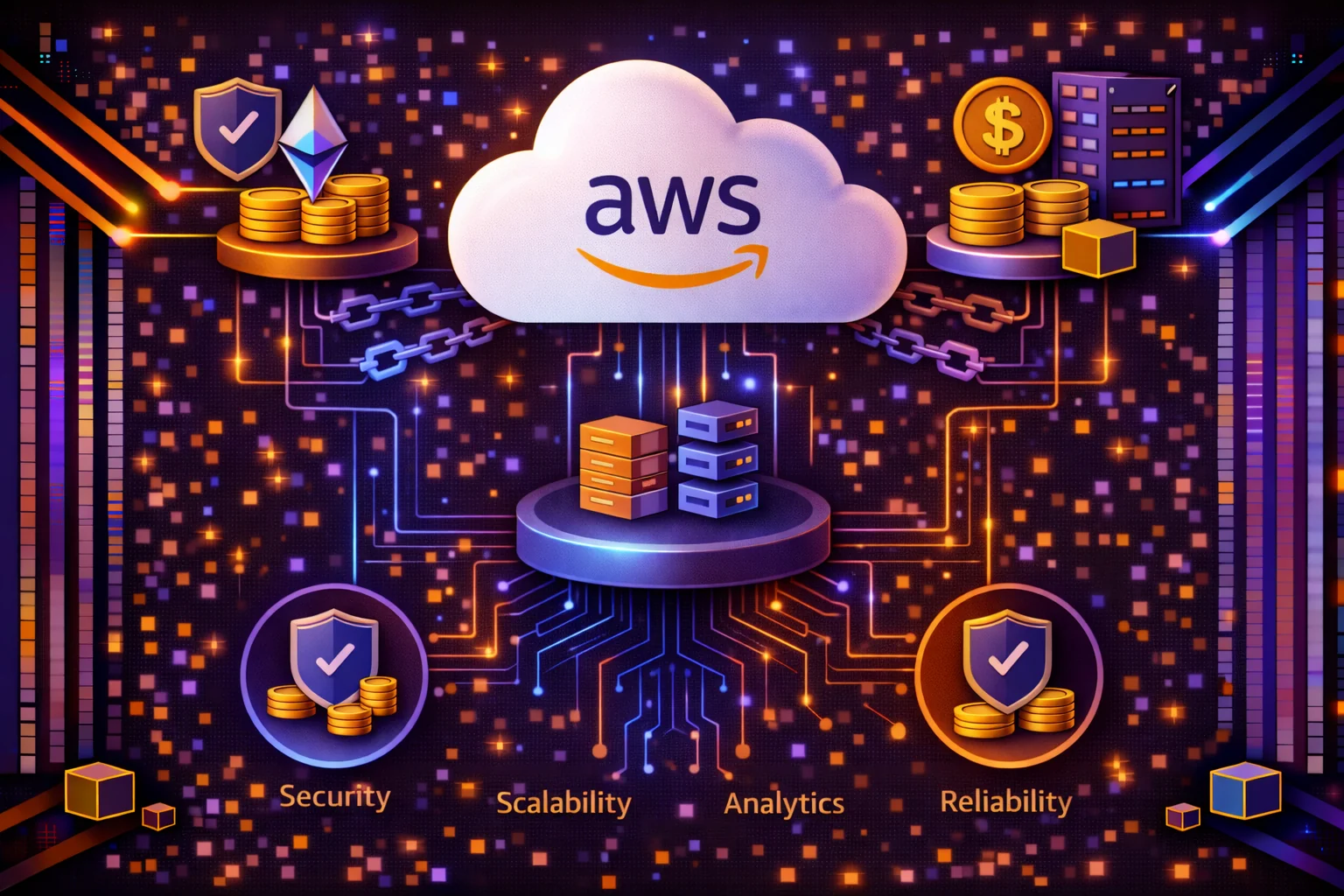
Introduction
Amazon Web Services has emerged as the backbone of the modern internet infrastructure. It powers everything from small startups to Fortune 500 companies. In the cryptocurrency and blockchain space, AWS has become the preferred cloud platform for you. Major exchanges, DeFi protocols, and institutional enterprises require enterprise-grade reliability, security, and scalability. The platform's comprehensive suite of over 200 services provides everything you need to build, deploy, and scale crypto platforms globally.
The cryptocurrency industry's unique requirements for high availability, low latency, and robust security make selecting cloud infrastructure critical to your success. AWS addresses these challenges. Through its global network of 31 regions and 99 availability zones, enabling crypto applications to serve users worldwide with minimal latency. The platform's 99.99% uptime SLA and enterprise-grade security features have made it the foundation for some of the world's largest cryptocurrency exchanges and blockchain networks.
AWS's blockchain-specific services have evolved significantly since 2018. The platform now offers managed blockchain networks, cryptocurrency node hosting, and specialised analytics tools for blockchain data. These services enable you to focus on your core business logic. leveraging AWS's expertise in infrastructure management, security, and compliance. The platform's pay-as-you-use pricing model also allows crypto startups to scale efficiently without large upfront capital investments.
Security and compliance are paramount concerns for you, given the high value of cryptocurrency holdings and the strict regulatory requirements. AWS provides comprehensive security tools. This includes encryption at rest and in transit, identity and access management, DDoS protection, and compliance with major standards like SOC 2, ISO 27001, and PCI DSS. These features are essential for you if you're handling user funds and sensitive financial data.
This comprehensive review examines AWS's suitability for cryptocurrency and blockchain projects in 2025, analysing its blockchain services, security features, pricing structure, performance characteristics, and overall value proposition. We'll explore how different types of crypto businesses can leverage AWS infrastructure, from simple hosting needs to complex multi-region deployments, helping you determine whether AWS is the right cloud platform for your cryptocurrency project's specific requirements and growth objectives.
AWS Overview
Amazon Web Services (AWS) is the world's leading cloud computing platform. It provides comprehensive infrastructure and services for businesses of all sizes. For cryptocurrency and blockchain projects, AWS offers specialised services and robust infrastructure.
AWS dominates the cloud market with unmatched scale and reliability serving millions of customers globally. Major cryptocurrency exchanges rely on AWS infrastructure whilst blockchain startups choose AWS for rapid scaling capabilities. Enterprise adoption continues growing steadily as innovation drives continuous service improvements across the platform.
The platform's comprehensive service portfolio addresses every infrastructure need imaginable. Computing resources scale from micro instances to massive clusters for any workload. Storage solutions range from object storage to high-performance databases with various options. Networking capabilities enable global content delivery with low latency worldwide. Security features meet stringent compliance requirements for regulated industries. Management tools simplify complex operations through intuitive interfaces.
AWS's global infrastructure provides unparalleled reach and redundancy across continents. Data centres span six continents strategically positioned for optimal coverage. Multiple availability zones ensure high availability for critical applications. Edge locations accelerate content delivery worldwide with minimal latency. Regional expansion continues annually with new locations added. Network backbone delivers consistent performance across all regions.
Key Features for Crypto Projects
- Amazon Managed Blockchain: Fully managed blockchain service supporting Ethereum and Hyperledger Fabric networks
- Global Infrastructure: 31 regions with 99 availability zones providing worldwide coverage and redundancy
- Enterprise Security: Advanced security and compliance features including encryption, IAM, and DDoS protection
- Scalable Computing: EC2 instances for any workload size from small nodes to large mining operations
- Database Services: Multiple database options for blockchain data including DynamoDB, RDS, and DocumentDB
Why Choose AWS for Crypto?
- Proven reliability with 99.99% uptime SLA for mission-critical applications
- Comprehensive security tools protecting billions in digital assets
- Flexible pricing models allowing cost-effective scaling from startup to enterprise
- Extensive compliance certifications meeting regulatory requirements worldwide
- 24/7 enterprise support with dedicated account management available
Cryptocurrency projects benefit from AWS's specialised capabilities designed for blockchain workloads. Managed blockchain services simplify network deployment without infrastructure management overhead. High-performance computing supports mining operations with GPU instances available. Distributed databases handle transaction volumes with automatic scaling capabilities. Content delivery networks serve global users with edge caching worldwide. Security services protect digital assets through multiple layers of defence.
The platform's flexibility accommodates diverse blockchain architectures. Public blockchain nodes run reliably. Private consortium networks deploy easily. Hybrid solutions combine both approaches. Smart contract platforms integrate seamlessly. DeFi applications scale automatically.
Market Position
- Market Leader: 32% of cloud market share
- Crypto Adoption: Used by major crypto exchanges and projects
- Enterprise Focus: Preferred by institutional enterprises
- Innovation Leader: Continuous development of blockchain services
AWS's market leadership reflects consistent execution and innovation. Revenue growth exceeds industry averages. Customer satisfaction ratings remain high. Partner ecosystem expands continuously. Technology leadership drives adoption. Competitive advantages strengthen over time.
Major cryptocurrency platforms trust AWS infrastructure. Leading exchanges process billions in daily volume. Blockchain networks achieve consensus reliably. Wallet providers ensure transaction security. DeFi protocols handle complex operations. NFT marketplaces serve millions of users.
Enterprise adoption validates AWS's capabilities for mission-critical workloads. Financial institutions migrate core systems. Healthcare providers ensure HIPAA compliance. Government agencies meet security requirements. Startups scale from prototype to production. Global corporations standardise on AWS.
Service Breadth and Depth
When you explore AWS, you will find over 200 fully featured services across multiple categories. Your computing options include virtual machines, containers, and serverless functions, whilst your storage choices range from object storage to archival solutions. You can leverage database services for relational, NoSQL, and graph databases, build complex networking architectures, process massive datasets with analytics tools, and accelerate AI development with machine learning services.
How do these services work together? The platform's service integration creates powerful synergies where your services communicate seamlessly through APIs, data flows between them automatically, and security policies apply consistently across your entire architecture.
Innovation and Development
You benefit from AWS's continuous investment in research and development, with new services launching regularly throughout the year and existing services receiving continuous improvements driven by customer feedback and industry standards.
The platform's innovation pace can accelerate your competitive advantages significantly. Serverless computing revolutionised how you develop applications, container orchestration simplified your deployments, and machine learning services democratised AI adoption for your projects.
Global Infrastructure Excellence
Your infrastructure on AWS spans the globe with strategic precision, where each region contains multiple availability zones for redundancy connected through high-bandwidth, low-latency networking. You can use Direct Connect for dedicated network connections, Transit Gateway to simplify your network architecture, and Global Accelerator to optimise your application performance.
What level of reliability can you expect? AWS's service level agreements guarantee uptime, redundancy eliminates single points of failure, and disaster recovery capabilities ensure your business continuity with proactive monitoring systems that detect issues before they affect your users.
Ecosystem and Community
You can tap into AWS's partner network of thousands of companies globally, including technology partners who integrate their solutions, consulting partners who provide implementation expertise, and marketplace vendors who offer ready-to-use solutions that accelerate your deployments.
The ecosystem's strength multiplies the value you receive from AWS. Pre-built solutions accelerate your deployments, expert consultants reduce your implementation risks, and training programmes build your internal capabilities whilst community support supplements official documentation.
Compliance and Certifications
AWS maintains extensive compliance certifications that simplify your regulatory obligations. SOC reports validate security controls, ISO certifications demonstrate quality management, PCI DSS compliance enables your payment processing, and GDPR compliance addresses your European data requirements.
How does the shared responsibility model benefit you? The platform's compliance programme reduces your audit burden by clarifying obligations, providing compliance documentation, and enabling regulatory requirements through built-in encryption capabilities and access controls.
Blockchain & Crypto Services
Amazon Managed Blockchain
- Hyperledger Fabric: Enterprise blockchain framework
- Ethereum Support: Managed Ethereum nodes
- Easy Setup: Deploy blockchain networks in minutes
- Automatic Scaling: Handles network growth automatically
- Monitoring: Built-in monitoring and logging
Blockchain Node Services
- Bitcoin Nodes: Run full Bitcoin nodes on EC2
- Ethereum Nodes: Geth, Parity, and other clients
- Custom Blockchains: Support for various blockchain protocols
- High Availability: Multi-AZ deployment options
Data Analytics for Crypto
- Amazon Redshift: Data warehousing for blockchain analytics
- AWS Glue: ETL services for blockchain data
- Amazon Kinesis: Real-time data streaming
- QuickSight: Business intelligence and visualization
API and Integration Services
- API Gateway: Manage crypto APIs at scale
- Lambda Functions: Serverless crypto applications
- SQS/SNS: Message queuing for trading systems
- EventBridge: Event-driven architectures
Cryptocurrency Exchange Infrastructure
If you are building a cryptocurrency exchange, AWS provides enterprise-grade infrastructure where high-performance computing instances handle your order matching engine processing thousands of trades per second, and distributed databases maintain your order books reliably across multiple availability zones.
Exchange security requires multiple layers of protection working together seamlessly. Web application firewalls block malicious traffic before it reaches your infrastructure. DDoS protection maintains availability during attacks with automatic mitigation capabilities. Encryption secures data in transit and at rest using industry-standard protocols. Key management services protect private keys with hardware security module integration. Identity and access management controls permissions with fine-grained policies. Security monitoring detects threats continuously using machine learning algorithms.
Blockchain Node Hosting
When you run blockchain nodes on AWS, you gain significant advantages over traditional hosting. You can size your EC2 instances appropriately for any blockchain, use EBS volumes for high-performance storage with consistent IOPS, and rely on CloudWatch to monitor your node health with custom metrics and automated alerting.
As a node operator, you benefit from AWS's global infrastructure spanning multiple continents. You can distribute your nodes geographically across multiple regions for improved network participation, use availability zones for redundancy, and leverage low-latency networking to improve synchronisation with other nodes.
Smart Contract Development
You can manage your entire smart contract development lifecycle on AWS, from coding to deployment. Cloud9 provides you with integrated development environments accessible from any browser, CodeCommit manages your source code repositories, and CodePipeline orchestrates your workflows connecting all development stages together.
Testing infrastructure ensures contract reliability before mainnet deployment reducing costly bugs. Lambda functions simulate contract interactions without deploying to expensive testnets. DynamoDB stores test data with fast access and flexible schemas. API Gateway exposes test endpoints for integration testing with frontends. CloudWatch logs capture execution details for debugging and analysis. Step Functions coordinate complex tests involving multiple contracts and transactions. Cost Explorer tracks testing expenses helping optimise development budgets.
DeFi Protocol Infrastructure
DeFi protocols require robust and scalable infrastructure handling millions in daily volume. Application Load Balancers distribute user requests across multiple backend servers. Auto Scaling groups handle traffic variations automatically adding capacity during peaks. RDS databases store protocol state with automatic backups and point-in-time recovery. ElastiCache accelerates data access reducing database load and improving response times. CloudFront delivers frontend assets with edge caching for global users. Route 53 manages DNS routing with health checks and automatic failover.
Protocol security demands comprehensive measures protecting user funds and protocol integrity. WAF rules protect against exploits like SQL injection and cross-site scripting. Shield Advanced mitigates DDoS attacks with 24/7 response team support. GuardDuty detects threats using machine learning on network and API logs. Security Hub centralises findings from multiple security services in one dashboard. Config tracks configuration changes ensuring compliance with security policies. CloudTrail audits API calls creating immutable logs for forensic analysis.
NFT Marketplace Solutions
If you are building an NFT marketplace, you can leverage AWS's content delivery capabilities for optimal user experience. S3 stores your NFT metadata and media with 99.999999999% durability guarantees, CloudFront distributes your content globally with edge locations in over 400 cities, and Lambda@Edge customises delivery based on your users' location and device type.
Marketplace backends require scalable databases handling high transaction volumes. DynamoDB handles high-throughput operations with single-digit millisecond latency. Aurora provides relational data storage with MySQL and PostgreSQL compatibility. Neptune manages graph relationships between users, creators, and collections. ElastiCache speeds up queries with in-memory caching of frequently accessed data. Redshift analyses marketplace data with petabyte-scale data warehousing. Athena queries S3 data directly without requiring data loading or transformation.
Crypto Wallet Services
As a wallet provider, you can build on AWS's secure infrastructure to meet stringent security requirements. KMS manages your encryption keys with automatic rotation and audit logging, Secrets Manager stores your sensitive credentials, and CloudHSM provides hardware security modules with FIPS 140-2 Level 3 validation for your most critical operations.
Wallet backends scale with user growth from thousands to millions of users. ECS runs containerised services with automatic scaling and load balancing. EKS orchestrates Kubernetes workloads with managed control plane and worker nodes. Fargate provides serverless containers eliminating infrastructure management overhead. App Runner simplifies deployments with automatic scaling and load balancing. Elastic Beanstalk manages applications with automatic capacity provisioning. Lightsail offers simple hosting for smaller wallet implementations and MVPs.
Blockchain Analytics Platforms
Analytics platforms process massive blockchain datasets extracting valuable insights. EMR runs big data frameworks like Spark and Hadoop at scale. Glue prepares data for analysis with ETL jobs and data cataloguing. Athena queries data lakes using standard SQL without infrastructure management. Redshift warehouses structured data with columnar storage and parallel processing. QuickSight visualises insights with interactive dashboards and embedded analytics. SageMaker builds predictive models using machine learning on blockchain data.
Real-time analytics enable immediate insights into blockchain activity and trends. Kinesis streams blockchain events with sub-second latency and automatic scaling. Lambda processes data in flight applying transformations and enrichments. DynamoDB stores aggregated metrics with single-digit millisecond read latency. OpenSearch indexes searchable data enabling full-text search and complex queries. CloudWatch dashboards display metrics with customisable visualisations and alerts. SNS alerts on anomalies sending notifications via email, SMS, or webhooks.
Infrastructure Solutions
Compute Services
| Service | Use Case | Pricing |
|---|---|---|
| EC2 Instances | Blockchain nodes, trading bots | $0.0116/hour (t3.micro) |
| ECS/EKS | Containerized crypto applications | $0.10/hour per cluster |
| Lambda | Serverless crypto functions | $0.20 per 1M requests |
| Batch | Large-scale crypto mining calculations | Pay for underlying resources |
Storage Solutions
- S3: Object storage for blockchain data and backups
- EBS: Block storage for database and node storage
- EFS: Shared file systems for distributed applications
- Glacier: Long-term archival of blockchain data
Database Services
- RDS: Relational databases for crypto applications
- DynamoDB: NoSQL for high-performance trading systems
- DocumentDB: MongoDB-compatible for blockchain data
- Neptune: Graph database for blockchain analysis
Networking
- VPC: Isolated network environments
- CloudFront: CDN for crypto websites and APIs
- Route 53: DNS management
- Direct Connect: Dedicated network connections
Advanced Infrastructure Capabilities
You can choose from hundreds of EC2 instance types optimised for different workloads in your cryptocurrency operations. Compute-optimised instances accelerate your blockchain validation, memory-optimised instances handle your large datasets, and GPU instances enable mining operations with Graviton processors delivering cost-effective performance.
Your storage infrastructure on AWS scales to petabyte levels seamlessly. You can use S3 for unlimited object storage, EBS volumes for consistent performance, EFS for shared file access, and FSx for specialised file systems, whilst Storage Gateway bridges your on-premises systems and automated backup services protect your data.
Which database service should you choose? RDS manages your relational databases automatically, Aurora delivers MySQL and PostgreSQL compatibility, DynamoDB provides single-digit millisecond latency for your applications, and Neptune enables graph queries for complex relationship data.
Your monitoring and management tools provide operational visibility across your entire infrastructure. CloudWatch monitors your resources with detailed metrics and alarms, CloudTrail audits your API calls for security compliance, and Trusted Advisor recommends optimisations for your cost, performance, and security posture.
How can you control your AWS spending? Cost Explorer analyses your spending patterns with detailed breakdowns, Budgets control your costs with alerts and automated actions, and Compute Optimiser recommends instance types based on your actual usage patterns to reduce waste.
When you need to migrate to AWS, Migration Hub coordinates your transition from on-premises to cloud whilst Application Discovery Service maps your dependencies for planning. You can transfer your databases with minimal downtime using Database Migration Service, and for petabyte-scale offline transfers, the Snow Family handles your data efficiently.
Security Features
Identity and Access Management
- IAM: Fine-grained access control
- Multi-Factor Authentication: Enhanced security for accounts
- Role-Based Access: Principle of least privilege
- AWS SSO: Single sign-on for teams
Encryption and Key Management
- KMS: Hardware security modules for key management
- CloudHSM: Dedicated hardware security modules
- Encryption at Rest: All storage services support encryption
- Encryption in Transit: TLS/SSL for all communications
Monitoring and Compliance
- CloudTrail: API call logging and auditing
- CloudWatch: Monitoring and alerting
- Config: Configuration compliance monitoring
- Security Hub: centralised security findings
Compliance Certifications
- SOC 1/2/3: Service organisation controls
- ISO 27001: Information security management
- PCI DSS: Payment card industry compliance
- GDPR: European data protection compliance
Advanced Security for Crypto Projects
AWS provides enterprise-grade security infrastructure specifically designed for financial and crypto platforms. The platform's security model follows a shared responsibility model. AWS secures the underlying infrastructure. Customers secure their applications and data. This approach gives crypto projects the flexibility to implement custom security measures. leveraging AWS's robust foundation.
For cryptocurrency exchanges and wallet services, AWS offers dedicated security features that address the unique challenges of crypto management. The AWS Shield service provides automatic DDoS protection at no additional cost, with Shield Advanced offering enhanced protection against sophisticated attacks. This is critical for crypto platforms that are frequent targets of distributed denial-of-service attacks aimed at disrupting trading operations.
Network Security and Isolation
AWS Virtual Private Cloud (VPC) enables crypto projects to create isolated network environments with complete control over IP addressing, subnets, and routing tables. This network isolation is essential for separating hot wallets from cold storage systems and implementing defence-in-depth security strategies. Security groups and network access control lists provide stateful and stateless firewall capabilities to control inbound and outbound traffic at the instance and subnet levels.
For projects requiring additional network security, AWS offers AWS PrivateLink for private connectivity between VPCs and AWS services without exposing traffic to the public internet. This is particularly valuable for blockchain node infrastructure that needs to communicate with other services and maximum security isolation.
Data Protection and Backup
AWS provides comprehensive data protection capabilities essential for cryptocurrency operations. Amazon S3 offers 99.999999999% durability for storing critical data like transaction logs, blockchain snapshots, and backup keys. S3 supports versioning, allowing recovery from accidental deletions or modifications, and cross-region replication for geographic redundancy.
AWS Backup provides centralised backup management. Across AWS services, enabling automated backup policies that meet regulatory requirements for financial data retention. For crypto projects, this means automated, encrypted backups of databases, file systems, and blockchain data with configurable retention periods and recovery point objectives.
Incident Response and Forensics
When security incidents occur, AWS provides tools for rapid response and forensic analysis. CloudTrail logs every API call made in your AWS account, creating an immutable audit trail essential for investigating security events. These logs can be automatically analysed using Amazon GuardDuty, which uses machine learning to detect anomalous behaviour and potential security threats.
For crypto projects, maintaining detailed audit logs is not just a security best practice but often a regulatory requirement. AWS's logging and monitoring capabilities enable real-time alerting on suspicious activities, such as unauthorised access attempts, unusual API calls, or configuration changes that could compromise security.
Security Best Practices for Crypto on AWS
Implementing security best practices on AWS requires systematic approach and continuous vigilance throughout your infrastructure. Enable multi-factor authentication for all user accounts, especially those with administrative privileges. Use IAM roles instead of access keys for applications and services. Implement least privilege access policies granting only necessary permissions. Encrypt all sensitive data at rest and in transit using KMS or CloudHSM. Enable CloudTrail logging across all regions for complete audit trails. Configure CloudWatch alarms for security events and anomalous behaviour. Regularly review and audit security configurations using automated tools. Implement automated compliance checking with AWS Config rules. Maintain current security patches using Systems Manager Patch Manager. Conduct regular security assessments and penetration testing exercises.
If you are running a cryptocurrency project on AWS, you face unique security challenges requiring specialised measures. You should separate your hot and cold wallet infrastructure completely using different AWS accounts, implement multi-signature requirements for transactions exceeding certain thresholds, and use CloudHSM hardware security modules for your most critical key storage operations.
How do AWS's security services work together to protect your infrastructure? GuardDuty monitors for threats continuously using machine learning, Security Hub centralises your security findings in one dashboard, and Inspector assesses your application security with automated vulnerability scanning whilst Macie discovers sensitive data across your storage.
Implementing security on AWS requires following established best practices consistently across your organisation. Enable MFA on all accounts, especially root accounts with administrative privileges and access to sensitive resources. Use IAM roles instead of long-term access keys for applications, and implement the principle of least privilege by granting only the minimum permissions necessary for each role to function properly.
Encrypt all data at rest using AWS KMS or CloudHSM with appropriate key rotation policies, and ensure all data in transit uses TLS 1.2 or higher encryption standards. Regularly rotate credentials and encryption keys according to your security policy, and use AWS Secrets Manager to securely store and automatically rotate database credentials, API keys, and other sensitive information. For cryptocurrency private keys, consider using AWS CloudHSM, which provides FIPS 140-2 Level 3-validated hardware security modules with dedicated single-tenant access.
Pricing Analysis
Typical Crypto Project Costs
| Project Size | Monthly Cost | Included Services |
|---|---|---|
| Small Startup | $100-500 | Basic EC2, RDS, S3 |
| Growing Project | $500-2,000 | Multiple instances, load balancing |
| Enterprise | $2,000-10,000+ | Full infrastructure, managed services |
| Major Exchange | $10,000-100,000+ | Global infrastructure, premium support |
Cost optimisation Strategies
- Reserved Instances: Up to 75% savings for predictable workloads
- Spot Instances: Up to 90% savings for flexible workloads
- Auto Scaling: Automatic resource adjustment
- S3 Intelligent Tiering: Automatic storage cost optimisation
Cost Management for Crypto Projects
Managing AWS costs effectively is crucial for cryptocurrency projects, especially during market volatility. When trading volumes and infrastructure demands can fluctuate dramatically. AWS provides several tools and strategies to optimise spending, performance, and reliability.
The AWS Cost Explorer tool enables detailed analysis of spending patterns, helping identify cost optimisation opportunities. For crypto exchanges, this might reveal that certain blockchain node instances are underutilised during off-peak hours, presenting opportunities to downsize or use auto-scaling to match capacity with demand. Setting up billing alerts ensures you're notified. When spending exceeds predefined thresholds, preventing unexpected cost overruns.
Crypto startups should leverage AWS's free tier extensively during development and testing phases. The free tier includes 750 hours of EC2 t2.micro instances monthly, sufficient for running development blockchain nodes or testing environments. Combined with free tiers for S3 storage, RDS databases, and Lambda functions, startups can build and test their infrastructure with minimal initial investment.
For production workloads, consider using Savings Plans, which offer flexibility compared to Reserved Instances. still providing significant discounts. Savings Plans commit to a consistent usage amount (measured in dollars per hour) for 1 or 3 years. It offers up to 72% savings compared to on-demand pricing. This works well for crypto projects with predictable baseline infrastructure needs but variable peak demands.
Which Pricing Model Suits Your Project?
- On-Demand: Best for unpredictable workloads and short-term projects with no upfront commitment
- Reserved Instances: Ideal for stable baseline capacity with 1-3 year commitment saving up to 75%
- Spot Instances: Perfect for fault-tolerant workloads like batch processing saving up to 90%
- Savings Plans: Flexible commitment-based pricing for mixed workloads saving up to 72%
- Dedicated Hosts: Compliance-focused physical servers for regulatory requirements with per-host pricing
Free Tier Benefits
- EC2: 750 hours per month (t2.micro) for compute workloads and testing environments
- S3: 5GB storage, 20,000 GET requests, 2,000 PUT requests for object storage
- RDS: 750 hours db.t2.micro instance, 20GB storage for database testing
- Lambda: 1M free requests per month, 400,000 GB-seconds compute time
- CloudFront: 50GB data transfer out, 2M HTTP/HTTPS requests for CDN
- DynamoDB: 25GB storage, 25 read/write capacity units for NoSQL databases
Cost Optimisation Best Practices
- Monitor spending daily using Cost Explorer and set up billing alerts for budget control
- Right-size instances based on actual usage patterns using Compute optimiser recommendations
- Implement auto-scaling to match capacity with demand automatically reducing waste
- Use S3 Intelligent-Tiering for automatic storage class optimisation saving up to 70%
- Delete unused resources like old snapshots, unattached volumes, and idle instances
- Leverage spot instances for non-critical workloads achieving up to 90% cost savings
- Purchase Reserved Instances or Savings Plans for predictable baseline workloads
- Enable AWS Budgets to track spending against targets with automated alerts
Pros and Cons
Advantages
- Market Leader: Most comprehensive cloud platform
- Global Reach: Worldwide infrastructure availability
- Enterprise Security: Bank-grade security and compliance
- Blockchain Services: specialised crypto and blockchain tools
- Scalability: Handle any size crypto project
- Ecosystem: Vast marketplace of third-party integrations
- Support: 24/7 enterprise support available
- Innovation: Continuous new service development
Disadvantages
- Complexity: Steep learning curve for beginners
- Cost: Can be expensive for large-scale operations
- Vendor Lock-in: Difficult to migrate away from AWS
- Billing Complexity: Complex pricing structure
- Over-Engineering: May be overkill for simple projects
Best For
- Enterprise Crypto Companies: Need enterprise-grade infrastructure
- Crypto Exchanges: Require high availability and security
- Blockchain Startups: Need to scale quickly
- DeFi Protocols: Require reliable infrastructure
- Institutional Projects: Need compliance and security
Not Ideal For
- Simple Websites: Overkill for basic crypto sites
- Budget-Conscious Projects: May be too expensive
- Beginners: Complex for those new to cloud computing
- Privacy-Focused Projects: Concerns about data sovereignty
Key Considerations Before Choosing AWS
- Evaluate your budget carefully as costs can escalate with scale
- Assess your team's cloud expertise and training needs
- Consider compliance requirements and AWS's certification coverage
- Plan for vendor lock-in and potential migration challenges
- Review pricing models and optimisation strategies thoroughly
- Test services with free tier before committing to production
- Engage with AWS support to understand service limitations
- Compare alternatives like DigitalOcean for simpler use cases
AWS vs Competitors
Why AWS Leads the Market
- First-mover advantage with 15+ years of cloud infrastructure experience
- Largest service portfolio with 200+ services covering every use case
- Most extensive global infrastructure with 31 regions and 99 availability zones
- Strongest enterprise adoption with Fortune 500 companies as customers
- Continuous innovation with new services launched quarterly
- Comprehensive compliance certifications meeting global regulatory requirements
- Mature ecosystem with thousands of third-party integrations available
- Professional support options including dedicated account management
Common Questions About AWS for Crypto
Which AWS services are essential for crypto exchanges? EC2 for compute, RDS for databases, S3 for storage, CloudFront for CDN, and Shield for DDoS protection form the core infrastructure. Add Load Balancers for high availability and Auto Scaling for traffic spikes.
How much does AWS cost for a crypto startup? Expect $100-500 monthly for small projects, $500-2000 for growing platforms, and $2000+ for enterprise operations. Use the free tier extensively during development to minimise initial costs.
Is AWS secure enough for cryptocurrency? Yes, AWS provides enterprise-grade security with encryption, HSM, DDoS protection, and compliance certifications. However, you're responsible for securing your application layer and managing private keys properly.
Can I run blockchain nodes on AWS? Absolutely, AWS is ideal for running blockchain nodes with EC2 instances, EBS storage, and VPC networking. Many major blockchain networks have nodes running on AWS infrastructure globally.
Should I choose AWS or DigitalOcean for my crypto project? Choose AWS for enterprise requirements, global reach, and advanced features. Choose DigitalOcean for simplicity, lower costs, and straightforward pricing. Your decision depends on project complexity and budget.
What's the learning curve for AWS? Expect 2-3 months to become proficient with core services. AWS provides extensive documentation, training courses, and certification programmes. Start with the free tier and gradually expand your knowledge.
Does AWS support all major blockchains? Yes, AWS supports Bitcoin, Ethereum, and most major blockchain networks through EC2 instances and managed blockchain services. You can run nodes for virtually any blockchain protocol on AWS infrastructure.
How reliable is AWS for crypto exchanges? AWS offers 99.99% uptime SLA with multi-region redundancy. Major exchanges like Coinbase and Binance use AWS infrastructure. The platform handles billions in daily trading volume reliably.
AWS Success Stories in Crypto
- Coinbase uses AWS for global exchange infrastructure serving millions of users
- Binance leverages AWS for high-frequency trading and order matching engines
- Ethereum Foundation runs nodes on AWS for network participation
- Chainalysis uses AWS for blockchain analytics and compliance tools
- OpenSea built NFT marketplace on AWS handling billions in transactions
- Polygon network uses AWS for validator nodes and infrastructure
AWS Implementation Checklist for Crypto Projects
- Set up multi-region deployment for high availability and disaster recovery
- Configure VPC with proper network isolation and security groups
- Enable CloudTrail logging for complete audit trail of all API calls
- Implement auto-scaling groups to handle traffic spikes automatically
- Set up CloudWatch alarms for critical metrics and system health
- Configure AWS Backup for automated data protection and recovery
- Enable AWS Shield for DDoS protection on all public endpoints
- Use AWS KMS or CloudHSM for encryption key management
- Implement IAM roles with least privilege access policies
- Set up Cost Explorer and budgets to monitor spending
AWS vs Other Cloud Providers (Quick Summary)
- Pricing: AWS is flexible but complex; DigitalOcean is simplest; Google Cloud is usually mid-range.
- Ease of Use: DigitalOcean is easiest, Google Cloud is moderate, AWS has the steepest setup curve.
- Service Breadth: AWS offers the largest catalogue, Google Cloud is broad, DigitalOcean stays focused on core infra.
- Blockchain Features: AWS has managed options; alternatives rely more on standard VPS workflows.
- Global Reach: AWS and Google Cloud lead on coverage.
- Best Fit: AWS for enterprise scale, DigitalOcean for lean teams, Google Cloud for AI-heavy stacks.
AWS Implementation Validation Loop
Treat AWS setup as a repeatable validation loop instead of a one-time launch task, because cloud reliability for crypto workloads depends on what you test after deployment, not only what you provision on day one. If you run exchange APIs, staking dashboards, or wallet backends, you should verify failure handling under realistic traffic before you increase user exposure.
Start with one controlled operating cycle: first, benchmark latency and error rates for your core endpoints; next, trigger a failover simulation across availability zones; then, test backup restore time against your recovery target; finally, review CloudWatch and CloudTrail logs to confirm that alerts fire for the events you actually care about. This sequence gives you measurable evidence that your stack is ready for volatility, not just marketing-level uptime assumptions.
For example, if your project serves both trading execution and long-term custody operations, compare AWS controls with a leaner alternative in the DigitalOcean review, then map exchange-side security requirements against the crypto exchanges comparison before you choose your final architecture.
Re-run this loop every month and after each major infrastructure change, because configuration drift, new services, and security policy updates can silently weaken a previously stable setup. A disciplined review cadence improves incident response quality, protects customer trust, and lowers the risk of expensive emergency fixes during peak market periods.
Conclusion
Amazon Web Services stands as the undisputed leader in cloud infrastructure for cryptocurrency and blockchain projects, offering unmatched scalability, security, and global reach that have made it the foundation for the world's largest crypto exchanges and institutional blockchain networks. The platform's comprehensive suite of services, from basic compute instances to specialised blockchain solutions, provides everything needed to build, deploy, and scale crypto platforms in the competitive digital asset landscape of 2025.
Whilst AWS's complexity and pricing can present challenges for smaller projects, the platform's enterprise-grade features, 99.99% uptime SLA, and extensive compliance certifications provide the reliability and security that institutional enterprises require. The continuous innovation in blockchain services, including managed blockchain networks and cryptocurrency node hosting, demonstrates AWS's commitment to supporting the evolving needs of the crypto industry as it matures and faces increasing regulatory scrutiny.
For enterprises seeking professional-grade infrastructure with global reach and institutional-level security, AWS remains the optimal choice despite higher costs compared to alternatives. The platform's comprehensive service ecosystem, extensive documentation, and professional support make it particularly suitable for enterprises requiring maximum reliability and regulatory compliance in their blockchain operations.
For cryptocurrency exchanges, DeFi protocols, and blockchain startups planning to scale globally, AWS provides the infrastructure foundation needed to handle millions of users and transactions, as well as the security and compliance standards required by regulators and institutional investors. The platform's pay-as-you-use model allows for efficient scaling during growth phases, while dedicated support and professional services ensure optimal performance during critical periods and market volatility.
Final Verdict
Recommendation
AWS is the gold standard for crypto and blockchain infrastructure, especially for enterprise and institutional projects. Whilst it can be complex and expensive, the comprehensive services, security, and global reach make it the top choice for serious crypto businesses.
Choose AWS if you need enterprise-grade infrastructure, have complex requirements, or plan to scale significantly. For simpler projects or budget constraints, consider alternatives like DigitalOcean.
When to Choose AWS
- Enterprise-grade infrastructure requirements with 99.99% uptime SLA needed
- Global reach across multiple continents and regions required
- Complex compliance requirements like SOC 2, ISO 27001, PCI DSS
- Significant scaling plans from thousands to millions of users
- Advanced security features including HSM and dedicated infrastructure
- 24/7 enterprise support with dedicated account management
- Integration with existing AWS services and infrastructure
- Budget allows for premium pricing in exchange for reliability
The platform's comprehensive service portfolio addresses virtually every infrastructure requirement imaginable. Computing options range from simple virtual machines to complex container orchestration systems. Storage solutions accommodate any data type or access pattern with appropriate performance. Database services support diverse application architectures from relational to NoSQL. Networking capabilities enable sophisticated topologies with global reach and redundancy. Security features meet stringent compliance requirements across multiple regulatory frameworks. Management tools simplify operations at scale with automation and monitoring.
AWS's global infrastructure provides unmatched reach and reliability for worldwide operations. Data centres span every major geographic region with consistent service availability. Multiple availability zones ensure high availability within each region for redundancy. Edge locations accelerate content delivery with caching closer to end users. Network backbone delivers consistent performance with low latency globally. Regional expansion continues annually with new locations added regularly. Infrastructure investments exceed competitors significantly demonstrating long-term commitment.
Cryptocurrency projects benefit from specialised capabilities designed for blockchain workloads. Managed blockchain services simplify network deployment without infrastructure expertise. High-performance computing supports intensive operations like mining and validation. Distributed databases handle transaction volumes with automatic scaling capabilities. Content delivery networks serve global users with low latency worldwide. Security services protect digital assets comprehensively with multiple layers.
Cost management requires attention and expertise to optimise spending effectively. Pay-as-you-go pricing provides flexibility without long-term commitments. Reserved instances offer significant discounts up to 75% for predictable workloads. Savings plans reduce long-term costs with flexible commitment options. Spot instances enable cost-effective computing for fault-tolerant workloads. Cost Explorer identifies optimisation opportunities with detailed analysis. Budgets and alerts prevent overspending with automated notifications.
Security features exceed industry standards consistently across all services. Encryption protects data comprehensively both at rest and in transit. Access controls enforce least privilege with fine-grained IAM policies. Network isolation prevents unauthorised access using VPC and security groups. Threat detection identifies anomalies using machine learning algorithms. Compliance certifications validate controls with third-party audits. Security services integrate seamlessly providing defence in depth.
Getting Started
- Free Tier: Start with AWS free tier to test services
- Well-Architected Framework: Follow AWS best practices
- Cost Calculator: Use AWS pricing calculator for estimates
- Training: Invest in AWS training and certifications
- Support Plan: Consider paid support for production workloads
Common AWS Mistakes to Avoid
What mistakes do beginners make with AWS? Common errors include leaving resources running unnecessarily, not setting up billing alerts, using root account instead of IAM users, ignoring security best practices, and failing to enable MFA. Avoid these by following AWS Well-Architected Framework from the start.
Next Steps
- Create AWS account and explore free tier services
- Review AWS Well-Architected Framework for crypto projects
- Join AWS community forums and user groups
- Start with simple EC2 instance for testing
- Configure CloudWatch monitoring for visibility
- Set up billing alerts to control costs
Sources & References
Frequently Asked Questions
- Is AWS good for crypto projects?
- Yes, AWS is excellent for crypto projects, offering blockchain services like Amazon Managed Blockchain, secure infrastructure, and global scalability. Many major crypto exchanges and blockchain projects run on AWS infrastructure.
- How much does AWS cost for a crypto startup?
- Costs vary widely based on usage. A small crypto startup might spend $100-500/month, while larger projects can spend thousands. AWS offers a free tier for 12 months to help startups get started with limited resources.
- Can I run a blockchain node on AWS?
- Yes, you can run blockchain nodes on AWS EC2 instances. Many projects run Bitcoin, Ethereum, and other blockchain nodes on AWS. Amazon Managed Blockchain also provides managed node infrastructure for supported blockchains.
- Is AWS secure enough for crypto applications?
- AWS provides enterprise-grade security, including encryption, DDoS protection, and compliance certifications, however application-level security is your responsibility. Use AWS security best practices and consider additional security measures for crypto applications.
- What's the difference between AWS and DigitalOcean for crypto?
- AWS offers more services and scalability, but is more complex and expensive. DigitalOcean is simpler, more affordable, and easier to use for smaller projects. Choose AWS for enterprise needs, DigitalOcean for simplicity and cost-effectiveness.
Affiliate Disclosure
This page contains affiliate links. When you sign up through our referral links, we may earn a commission at no additional cost to you. This helps support our platform and allows us to continue providing valuable content and recommendations.