Nexo vs Aave: Crypto Borrowing Compared
Choosing between Nexo and Aave for crypto loans? This comprehensive comparison covers rates, features, security, and user experience to help you decide which platform fits your borrowing needs.
Introduction
The cryptocurrency borrowing landscape in 2026 presents users with two fundamentally different approaches: centralised finance (CeFi) platforms like Nexo and decentralised finance (DeFi) protocols like Aave. Understanding these philosophical and operational differences is crucial for making an informed borrowing decision that aligns with your risk tolerance, technical expertise, and financial objectives.
Both platforms have evolved significantly since their inception, with Nexo establishing itself as a leading regulated cryptocurrency lending institution and Aave pioneering innovative DeFi lending mechanisms. The choice between these platforms represents more than just comparing interest rates—it's a decision between traditional financial structures adapted for cryptocurrency and entirely new decentralised financial systems.
Nexo: CeFi Lending Platform
Nexo is a centralised cryptocurrency lending platform founded in 2018 that operates like a traditional financial institution but for crypto assets. When you borrow on Nexo, you deposit collateral with the company, and they manage the lending process through their internal systems and risk management protocols. Nexo's own figures, dated Q1 2026, are over $430 billion in cumulative transaction volume and collateralised credit since 2018, and more than $7 billion under management — vendor numbers, not audited disclosures.
Nexo's approach mirrors traditional banking, where the institution assumes custody of your assets and provides lending services in exchange for interest payments. This model offers familiar user experiences and regulatory compliance but requires trust in the centralised entity. The platform operates under several financial licences and uses named external custodians. What it does not offer is insurance: as of August 2026 Nexo makes no insurance claim anywhere on its own site.
Key characteristics:
- Available to US clients again — Nexo announced its US wind-down in December 2022, settled with the SEC and state regulators in January 2023, and relaunched fully on 16 February 2026 through Nexo Financial LLC, with Bakkt supplying US custody
- Custodial service — Nexo holds your collateral with external custodians, not in your own wallet
- User-friendly interface similar to traditional banking applications
- 24/7 customer support via live chat with human representatives
- No insurance cover published on Nexo's own site as of August 2026; it publishes security certifications instead, which audit process rather than protect assets
- Fiat currency borrowing options with bank account withdrawals
Aave: DeFi Lending Protocol
Aave represents the cutting edge of decentralised finance, operating as a non-custodial protocol where users maintain control of their assets throughout the borrowing process. Launched in 2020, Aave is the largest DeFi lending protocol, with roughly $14.5 billion locked across its versions on 4 August 2026, spread over Ethereum, Base, Arbitrum, Avalanche, Polygon and a dozen more networks.
Unlike traditional lending platforms, Aave operates through smart contracts that automatically execute lending and borrowing transactions without human intervention. Users interact directly with the protocol through their own cryptocurrency wallets, maintaining full custody of their assets while accessing lending services. This approach eliminates counterparty risk associated with centralised platforms but requires users to understand blockchain technology and manage their own security.
Which version you land on matters. V3 carries about 98% of Aave's $11.2 billion of outstanding borrows. V4 launched on Ethereum on 30 March 2026 with a hub-and-spoke design, but is still roughly 1% of borrowing and uses different liquidation rules. V2 is frozen — borrowing is disabled on its major Ethereum reserves, so you can only repay and withdraw. Every Aave parameter below is V3 on Ethereum unless stated.
Key characteristics:
- Non-custodial protocol - users maintain control of their private keys and assets
- Smart contract automation with transparent, auditable code on blockchain
- Multi-chain deployment across Ethereum, Polygon, Avalanche, and other networks
- Innovative features like flash loans, rate switching, and collateral swapping
- Governance token (AAVE) allowing community participation in protocol decisions
- Open-source development with continuous community contributions and improvements
The fundamental difference between these platforms extends beyond technical implementation to philosophical approaches to finance. Nexo represents the evolution of traditional banking for the cryptocurrency era, whilst Aave embodies the revolutionary potential of decentralised finance to eliminate intermediaries entirely.
Quick Comparison Table
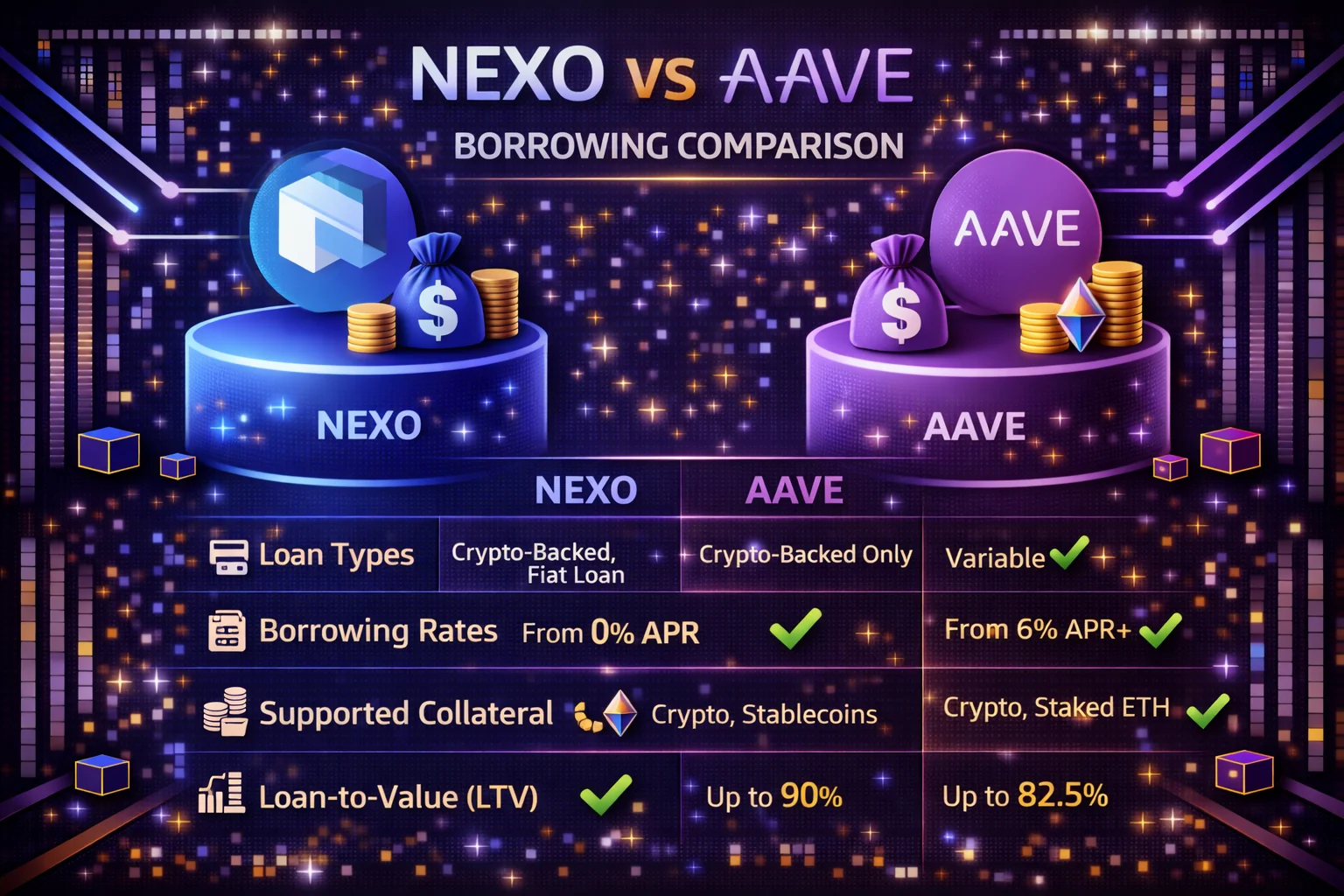
| Feature | Nexo (CeFi) | Aave (DeFi) |
|---|---|---|
| Platform Type | centralised (CeFi) | decentralised (DeFi) |
| Interest Rates | Advertised "from 1.9%"; no tier table published | Variable, set by utilisation (USDC ~4.2% APY, WETH ~2.1%, 4 Aug 2026) |
| KYC Required | Yes | No |
| Custody | Nexo holds funds | Non-custodial (you control) |
| Max LTV | BTC/ETH 50%, stablecoins 90%, NEXO 15% | WETH 80.5%, WBTC 73%, USDC/USDT 75%, E-Mode to 93% |
| Supported Chains | Single platform | Ethereum, Polygon, Avalanche, Arbitrum, Optimism, Base |
| Customer Support | 24/7 live support | Community forums only |
| Best For | Beginners, convenience | Advanced users, privacy |
Interest Rates and Borrowing Costs
Interest rates represent the most immediate cost consideration when choosing between Nexo and Aave for cryptocurrency borrowing. However, the rate structures, calculation methods, and additional fees differ significantly between these platforms, making direct comparison more complex than simply comparing advertised rates.
Nexo Interest Rate Structure
Nexo employs a tiered interest rate system based on your loyalty level within their ecosystem. Rates are set by loan-to-value (LTV) ratio, collateral type and your NEXO token holdings. What Nexo publishes, though, is only a floor: its borrow page states "Rates start at 1.9% per year." There is no per-tier table and no upper bound on any public Nexo page, so the figure you will actually pay appears only in the app, once your tier and LTV are known.
Nexo rate factors:
- Loyalty tier (Base, Silver, Gold, Platinum) based on NEXO token holdings
- Loan-to-value ratio - lower LTV ratios receive better rates
- Collateral type - Bitcoin and Ethereum typically offer the best rates
- Loan amount and duration - larger, longer-term loans may receive preferential rates
- Geographic location - rates may vary based on regulatory requirements
Your rate falls as your tier rises and your LTV drops, but Nexo does not disclose where that ladder begins or ends. Tiers are set by NEXO holdings measured against the rest of your portfolio, not the total: Base needs none, Silver 1%, Gold 5%, Platinum 10%. Nexo's worked example is $50,000 of BTC plus $2,000 of NEXO, which gives 4% and lands on Silver.
One gate is easy to miss. Nexo requires a portfolio balance of at least $5,000 to access the Loyalty Programme at all, with a seven-day cure period if you drop below it. Under that balance the advertised low rates are unreachable. Fiat lending in USD, EUR and GBP is priced within the same undisclosed structure.
Aave Interest Rate Mechanism
Aave's rate model adjusts automatically with supply and demand in each asset pool. Stable-rate borrowing has been retired on V3, so every borrow is variable and repriced as utilisation moves. Interest accrues per second, not per block, and the APY shown in the interface is the on-chain APR compounded per second. The approach keeps capital efficient but leaves borrowers carrying the rate risk.
Aave rate determinants:
- Utilisation rate - percentage of available liquidity currently borrowed
- Asset-specific risk parameters set by Aave governance
- Market conditions and overall DeFi lending demand
- Blockchain network congestion affecting transaction costs
- Protocol reserve factors and safety mechanisms
The curve has two slopes and a kink. Below the kink the rate climbs gently; above it a much steeper slope takes over. USDC and WETH on Ethereum kink at 92% utilisation, WBTC and wstETH at 80%. Past the kink each further point of USDC utilisation adds about 1.25 percentage points, which is why rates can jump within a day in a liquidity crunch. On 4 August 2026 USDC sat just above its kink at roughly 4.2% APY, USDT at 3.7% and WETH at 2.1% — spot readings, so check the live app before sizing a loan.
Hidden Costs and Fee Comparison
Beyond headline interest rates, both platforms impose additional costs that significantly impact the total borrowing expense. Understanding these fees is crucial for accurate cost comparison and budgeting.
Nexo additional costs:
- No published origination fee for crypto-backed credit lines
- Voluntary repayment costs 0.26% in crypto and 0% in stablecoins or Nexo's own EURx, GBPx and USDx; only the last route is exempt from the exchange spread
- Repay within 45 calendar days of your last drawdown and the repayment is priced at Base-tier rates for the rest of that window, whatever tier you hold — the costliest surprise in the fee schedule
- Liquidation fee of 2% to 3.5% on crypto collateral and 1% on stablecoins, plus the exchange spread on the forced sale
- Withdrawal fees for cryptocurrency transfers (network dependent)
Aave transaction costs:
- Ethereum gas: a supply ran roughly 150,000-270,000 gas and a borrow 250,000-320,000 gas on 4 August 2026, about $0.03-$0.25 at that day's sub-gwei base fee, plus a one-off approval of about $0.02
- No separate platform fee — the protocol's cut is the reserve factor, taken out of the interest you already pay rather than added to it: 10% on USDC and USDT, 15% on WETH, 50% on WBTC
- Liquidation bonus paid to whoever liquidates you: 4.5% to 6% on the major markets, 1%-4% in E-Mode
- Bridge fees when moving collateral between deployments
- MEV (Maximum Extractable Value) costs during high-volatility periods
Collateral Requirements and LTV Ratios
Collateral requirements determine how much you can borrow against your cryptocurrency holdings and represent a critical factor in platform selection. Both Nexo and Aave employ different approaches to collateral management, risk assessment, and loan-to-value calculations that significantly impact borrowing capacity and liquidation risk.
Nexo Collateral Framework
Nexo's borrow page advertises "100+ other assets" alongside BTC and ETH as acceptable collateral. The platform employs conservative LTV ratios designed to protect both lenders and borrowers from market volatility, with maximum ratios varying based on asset volatility and liquidity characteristics.
Nexo LTV ratios by asset class:
- Bitcoin (BTC): up to 50% LTV
- Ethereum (ETH): up to 50% LTV
- PAX Gold (PAXG): up to 50% LTV
- Stablecoins (USDT, USDC): up to 90% LTV
- NEXO token: up to 15% LTV — the lowest on the panel, despite its role in the loyalty tiers
- Everything else: set per asset, which Nexo says is done dynamically "depending on their volatility and market liquidity". The full table sits in a geo-restricted support article, so read the asset panel in-app before sizing a position
Nexo's published rule is an automatic trigger, not a negotiated one. Once LTV reaches 83.33% the system sells part or all of the collateral to bring the ratio back down; Nexo's own worked example is a 50,000 xUSD loan against crypto-only collateral being repaid automatically once that collateral falls to $60,000. That 83.33% level applies only when collateral is exclusively crypto — mix in stablecoins and Nexo says the threshold varies with the composition.
There is no published margin-call level. Nexo says only that you "may receive margin call emails" as LTV approaches the trigger — "may", not "will", with no number attached. Any source quoting a specific Nexo margin-call percentage has invented it. Plan on the 83.33% trigger and treat warnings as a courtesy, not a protection.
Aave Collateral Mechanics
Aave V3 collateral sits in one shared pool per market with per-asset risk parameters set by governance, not a separate pool per asset. Some assets carry extra flags: an Isolated asset can only borrow approved stablecoins up to a debt ceiling and blocks all other collateral while enabled, and a siloed asset can only be borrowed on its own. Neither flag applies to WETH, wstETH, WBTC, USDC or USDT. Supply and borrow caps do bite, though — USDC sat close to both in August 2026, and a full cap blocks a deposit or borrow outright.
Aave LTV parameters (Ethereum mainnet):
- WETH: 80.5% LTV with an 83% liquidation threshold
- Wrapped Bitcoin (WBTC): 73% LTV with a 78% liquidation threshold
- USDC and USDT: 75% LTV with a 78% liquidation threshold
- wstETH: 78.5% LTV with an 81% threshold, but borrowing is disabled — it is collateral only
- GHO: LTV of zero. Aave's own stablecoin cannot be used as collateral in this market
- These are governance-adjusted continuously; read them from the app on the day you borrow
Aave liquidation is permissionless and immediate. Health factor is your collateral value multiplied by its weighted liquidation threshold, divided by your debt; below 1.0, anyone on the network can repay part of your debt and take collateral at a bonus. The close factor is not a flat 50%, which is the detail most guides get wrong. Half your debt is the maximum only when health factor is still above 0.95 and both the collateral and the debt in the pair are worth at least $2,000 each. Fail either condition and the whole debt can go in one transaction. A partial liquidation must also leave $1,000 of collateral and $1,000 of debt behind, or the position is closed in full.
The bonus is per asset: 4.5% on USDC and USDT, 5% on WETH and WBTC, 6% on wstETH, dropping to 1%-4% inside E-Mode. There is no user-facing grace period. V4 replaces this scheme with a target health factor and an auction-style bonus that grows as health falls, so V3's numbers do not carry across.
Risk Management Comparison
The real difference is visibility, not whether a human steps in. Both platforms close a failing position automatically. Nexo's trigger fires at a published LTV and its remedies are self-service — top up, repay, or watch the system sell; there is no documented manual review and no negotiated hold. Aave's is automatic too, but permissionless and readable on-chain, so you can see the exact threshold and the exact penalty before you borrow.
Nexo risk management features:
- In-app health bands from Nexo's crypto-only example: good below about 71%, moderate to roughly 77%, poor up to the 83.33% trigger — flagged as illustrative and "not a commitment"
- Margin-call emails as LTV approaches the trigger, with no published notice period and no guarantee one is sent
- Partial rather than total sale where that is enough: Nexo says the system sells "part or all" of the collateral to bring the ratio back down
- Self-service remedies only — add collateral or repay before the trigger. Nexo publishes no manual review, no negotiated resolution and no support-desk hold on an automatic repayment
Aave risk management mechanisms:
- Real-time health factor monitoring with transparent calculations
- Automatic liquidation execution without human intervention
- Umbrella backstop: stakers deposit aUSDC, aUSDT, aWETH or GHO and are slashed automatically, per asset and per network, when a pool deficit exceeds its offset. Legacy staked AAVE no longer backstops anything
- Governance-controlled risk parameter adjustments
- Multi-signature emergency pause functionality for extreme market conditions
User Experience and Platform Accessibility
The user experience represents a critical differentiator between Nexo and Aave, particularly for newcomers to cryptocurrency borrowing. The complexity, learning curve, and support systems vary dramatically between these platforms, influencing both accessibility and long-term user satisfaction.
Nexo User Interface and Experience
Nexo provides a traditional banking-style interface designed for users familiar with conventional financial services. The platform prioritises simplicity and guided workflows, making it accessible to users regardless of their technical cryptocurrency knowledge. The web application and mobile apps offer intuitive navigation with clear explanations of borrowing terms and conditions.
Nexo interface highlights:
- Dashboard showing portfolio overview, active loans, and available credit
- One-click borrowing with automatic collateral calculation
- Integrated wallet management with deposit and withdrawal functionality
- Account and transaction notifications by email and in-app; margin-call emails are discretionary, with no published notice period
- Educational resources and tutorials integrated into the platform
- Multi-language support covering 15+ languages
The platform's customer support infrastructure includes 24/7 live chat, email support, and phone assistance for premium tier customers. Response times typically range from minutes for urgent issues to 24 hours for complex inquiries, with support staff trained specifically in cryptocurrency lending concepts.
Aave Protocol Interaction
Aave requires users to interact directly with smart contracts through Web3 wallets, creating a more complex but ultimately more powerful user experience. The protocol interface assumes familiarity with decentralised finance concepts and blockchain technology, making it less suitable for beginners but offering advanced users complete control and transparency.
Aave interaction requirements:
- Compatible Web3 wallet (MetaMask, WalletConnect, Coinbase Wallet)
- Understanding of gas fees and transaction confirmation processes
- Knowledge of smart contract interactions and approval mechanisms
- Ability to monitor and manage positions independently
- Familiarity with DeFi concepts like health factors and liquidation risks
The Aave interface provides comprehensive data and analytics, including real-time interest rates, utilisation statistics, and detailed position management tools. However, users must understand these metrics independently, as the protocol provides no customer support or guided assistance.
Security and Regulatory Compliance
Security and regulatory compliance represent fundamental considerations when choosing between centralised and decentralised borrowing platforms. The approaches, risks, and protections differ significantly between Nexo's regulated, custodial model and Aave's decentralised, non-custodial protocol.
Nexo Security Infrastructure
Nexo runs a conventional financial security model: external institutional custodians, security certifications and regulatory registrations. It holds SOC 2 Type 2 and SOC 3 Type 2 attestations, ISO/IEC 27001:2022, 27017 and 27018, CSA STAR Level 1 and CCSS Level 3. Each of those audits process and controls; none is insurance, and none covers insolvency, counterparty failure, market losses or liquidation losses.
Nexo security measures:
- Custody delegated to four named providers: Ledger Vault (now Ledger Enterprise) and Fireblocks globally, Bakkt for the US, Tangany (BaFin-regulated, Munich) for the EEA. Nexo publishes no hot-to-cold storage split
- Real-time transaction monitoring and fraud detection systems
- Two-factor authentication and biometric security options
- No insurance cover of any kind published on Nexo's own site as of August 2026
- Regular penetration testing and security audits by leading firms
- Compliance with GDPR, PCI DSS, and other international standards
Nexo lists six licences and registrations, each held by a different group entity: a California DFPI Financing Law licence (60DBO-109416), a VASP registration with Argentina's CNV, an AUSTRAC digital currency exchange registration, a Hong Kong trust or company service provider licence, Poland's register of virtual currency activities, and a Seychelles FSA securities dealer licence. Worth noting what is absent: no FCA registration, no SEC registration, and no MiCA CASP licence in Nexo's own name.
Aave Protocol Security Model
Aave's security relies on smart contract audits, decentralised governance, and the inherent transparency of blockchain technology. The protocol has undergone extensive security reviews by leading audit firms and maintains a bug bounty programme to incentivise ongoing security research.
Aave security features:
- Open-source smart contracts audited by multiple security firms
- Decentralised governance preventing single points of failure
- Umbrella staking as the current backstop, replacing the legacy staked-AAVE Safety Module, which no longer slashes
- Time-locked upgrades allowing community review of protocol changes
- Immunefi bug bounty paying $50,000 to $1,000,000 for critical vulnerabilities, with a proof of concept mandatory
- Formal verification of critical smart contract components
The non-custodial nature of Aave means users maintain control of their private keys and assets, eliminating counterparty risk associated with centralised platforms. However, this approach also places full responsibility for security on individual users, including wallet management and transaction verification.
Regulatory Compliance and Legal Protections
Regulatory compliance varies dramatically between these platforms, reflecting the current uncertain legal landscape surrounding decentralised finance and cryptocurrency services.
Nexo regulatory status (as of mid-2026):
- US clients are served again. Nexo announced its US wind-down in December 2022, then settled in January 2023 — $22.5m to the SEC over its unregistered Earn Interest Product and a further $22.5m to state regulators — and relaunched on 16 February 2026 through Nexo Financial LLC. The cease-and-desist stands; no ongoing monitorship has been reported
- No MiCA CASP licence in Nexo's own name. It serves the EEA through licensed third parties: Tangany for custody and DLT Securities GmbH for brokerage, both BaFin-supervised and MiCAR-licensed
- Anti-money laundering (AML) and know-your-customer (KYC) procedures
- Regular regulatory reporting in the jurisdictions where it is authorised
- Consumer protection mechanisms and dispute resolution processes
Aave regulatory considerations:
- Decentralised protocol with no central controlling entity
- Governance token holders collectively manage protocol decisions
- No KYC requirements or geographic restrictions at protocol level
- Regulatory uncertainty regarding DeFi classification and oversight
- Individual users responsible for tax reporting and compliance
- Limited legal recourse in case of smart contract vulnerabilities or exploits
Risk Assessment and Mitigation
Understanding the different risk profiles helps users make informed decisions based on their risk tolerance and security priorities.
Nexo risk factors:
- Counterparty risk - reliance on Nexo's financial stability and operations
- Regulatory risk - potential changes in cryptocurrency regulations
- Custody risk - centralised storage of customer assets
- Operational risk - platform downtime or technical issues
- No insurance at all - Nexo publishes no cover, so there is no backstop beyond the company itself
Aave risk factors:
- Smart contract and oracle risk - the April 2026 KelpDAO bridge compromise let roughly $292m of unbacked rsETH be minted and borrowed against, leaving an estimated $177m-$236m of bad debt. The fault sat in the bridge, not Aave's code, but Aave's depositors carried it
- Residual bad debt - the Ethereum V3 market still showed a deficit of about 52,964 WETH (roughly $99m) on 4 August 2026; other reserves are effectively clean
- Governance risk - malicious or poorly designed protocol upgrades
- Liquidity risk - potential inability to withdraw funds during market stress
- User error risk - mistakes in wallet management or transaction execution
- Regulatory risk - potential government restrictions on DeFi protocols
The fundamental difference: Nexo is a company you trust with your funds, while Aave is code you interact with directly. This distinction affects everything from user experience and security models to regulatory compliance and available features.
Interest Rates Comparison
Nexo Interest Rates
Nexo prices by loyalty tier and loan-to-value ratio, but discloses very little of the ladder:
- Published floor: "from 1.9% per year" — the only rate figure on any current Nexo page
- Not published: the per-tier table and the upper end of the range. Your rate appears in the app once tier and LTV are set
- Access gate: the Loyalty Programme, and with it the lower rates, requires a portfolio of at least $5,000
Rate advantages:
- Priced off your tier rather than pool utilisation, so it does not spike when borrowing demand does
- A separate Zero-interest Credit product exists, but it is a structured product, not a plain loan: BTC, ETH, SOL or XRP collateral, 5 days to 12 months, $5m maximum, and your collateral is sold if price exceeds the agreed range. The 0% is paid for in forgone upside, and renewal is not guaranteed
- No published origination fee, though repaying in crypto costs 0.26% and repaying within 45 days of drawdown is repriced at Base-tier rates
Aave Interest Rates
Aave uses algorithmic variable rates based on supply and demand:
- Variable only: V3 has retired stable-rate borrowing, so there is no fixed option to switch to
- Set by utilisation: a two-slope curve per asset, kinking at 92% for USDC and WETH and 80% for WBTC and wstETH, with the rate climbing steeply above the kink
- E-Mode: raises LTV and cuts the liquidation penalty on correlated assets. It does not reduce the interest rate — a common misconception
Rate advantages:
- Often lower than CeFi during low demand periods
- E-Mode raises borrowing power rather than cutting cost, reaching 93% LTV on the ETH-correlated category
- Transparent rate calculation visible on-chain
Which Has Better Rates?
Nexo wins if: your NEXO holdings put you in a high loyalty tier, you clear the $5,000 balance gate, and you value a rate that does not move with pool utilisation.
Aave wins if: you want a rate you can verify before committing, you are borrowing a deep market such as USDC or WETH, or you want to optimise across several chains.
The comparison is asymmetric. On 4 August 2026 Aave's Ethereum V3 market charged roughly 4.2% APY on USDC and 2.1% on WETH, readable on-chain by anyone. Nexo publishes a 1.9% floor and nothing else, so its cost cannot be checked from outside the app.
Supported Assets
Nexo Supported Assets
Collateral options (Nexo advertises 100+ assets):
- Bitcoin (BTC), Ethereum (ETH), Litecoin (LTC)
- Stablecoins: USDT, USDC, DAI, TUSD
- Altcoins: XRP, ADA, DOT, LINK, POL (formerly MATIC), SOL
- Nexo token (NEXO) for rate discounts
Borrowing options: USDT, USDC, USD, EUR, GBP (fiat currencies)
Aave Supported Assets
Varies by chain, but typically includes:
- Ethereum: 30+ assets including ETH, WBTC, stablecoins, DeFi tokens
- Polygon: 15+ assets with lower gas fees
- Avalanche: 10+ assets including AVAX
- Arbitrum/Optimism: Major assets with L2 efficiency
Unique options: Liquid staking derivatives (stETH, rETH), governance tokens (AAVE, CRV), real-world assets (experimental)
Asset Availability Winner
Nexo: Better for fiat borrowing and simple asset selection.
Aave: Better for DeFi tokens, liquid staking derivatives, and multi-chain flexibility.
LTV Ratios Comparison
Nexo LTV Limits
| Asset Type | Max LTV | Liquidation LTV |
|---|---|---|
| Bitcoin (BTC) | 50% | 83.33% |
| Ethereum (ETH) | 50% | 83.33% |
| PAX Gold (PAXG) | 50% | 83.33% |
| Stablecoins (USDT, USDC) | 90% | Varies with mix |
| NEXO token | 15% | Varies with mix |
The 83.33% trigger is Nexo's published figure for collateral held exclusively in crypto. Where collateral mixes crypto and stablecoins, Nexo says the threshold moves with the composition and does not publish the resulting values.
Aave LTV Limits
| Asset Type | Max LTV | Liquidation LTV |
|---|---|---|
| WETH | 80.5% | 83% |
| WBTC | 73% | 78% |
| USDC, USDT | 75% | 78% |
| wstETH (collateral only) | 78.5% | 81% |
| E-Mode, ETH-correlated | 93% | 95% |
Read on-chain from Ethereum V3 Core on 4 August 2026. Governance adjusts these continuously, and eleven E-Mode categories are live, from ETH-correlated at 93%/95% down to the BTC pairs at 83%-84%/85%-86%.
Key differences:
- Aave offers higher LTV on BTC and ETH — 73% and 80.5% against Nexo's 50% for each
- Nexo is the more generous on stablecoins, at 90% versus Aave's 75%
- Nexo's buffer between max LTV and trigger is wider on crypto (50% to 83.33%); Aave's is deliberately thin (80.5% to 83% on WETH)
- Both adjust parameters with volatility, but only Aave's are readable on-chain
Security & Risks
Nexo Security
Strengths:
- Institutional custody through Ledger Vault (now Ledger Enterprise), Fireblocks, Bakkt and Tangany rather than in-house wallets
- Military-grade encryption for user data
- SOC 2 Type 2 and SOC 3 Type 2 attestations, plus ISO/IEC 27001:2022 and CCSS Level 3
- Regulated entity with compliance oversight
- 24/7 security monitoring
Risks:
- Counterparty risk - you trust Nexo with your funds, uninsured
- Regulatory risk - subject to government actions
- Company risk - business failure could affect users
- Centralised control - Nexo can freeze accounts
Aave Security
Strengths:
- Non-custodial - you control private keys
- Open-source code audited by Trail of Bits, OpenZeppelin, ABDK
- Umbrella backstop that slashes staked aTokens automatically to cover pool deficits, with a 20-day cooldown on withdrawals
- Battle-tested protocol, around $14.5bn TVL in August 2026
- No single point of failure
Risks:
- Smart contract risk - code vulnerabilities possible
- No customer support - you're responsible for mistakes
- Liquidation risk - automated and irreversible
- Oracle risk - price feed manipulation potential
- Governance risk - token holders control protocol changes
Security Verdict
Nexo: Better for users who want named custodians and a support desk, and accept that the collateral is uninsured.
Aave: Better for users who prioritise self-custody and trust code over institutions.
User Experience
Nexo User Experience
Ease of use: 9/10
- Simple web and mobile apps
- One-click borrowing process
- Automatic collateral management
- 24/7 live chat support
- Email notifications for account activity
Onboarding: KYC required, then instant deposits and borrowing.
Aave User Experience
Ease of use: 6/10
- Requires crypto wallet (MetaMask, Ledger, etc.)
- Understanding of gas fees and blockchain transactions
- Manual health factor monitoring
- No customer support - community forums only
- Multiple interfaces (Aave.com, DeFi Saver, Instadapp)
Onboarding: No KYC, but requires wallet setup and understanding of DeFi concepts.
User Experience Winner
Nexo wins for: Beginners, users wanting support, those comfortable with KYC.
Aave wins for: Experienced DeFi users, privacy advocates, and those wanting full control.
Which Platform Should You Choose?
Choose Nexo If You:
- Are new to crypto borrowing and want a simple interface
- Value customer support and named institutional custodians, accepting that no insurance is published
- Want to borrow fiat currencies (USD, EUR, GBP)
- Hold enough NEXO, and at least $5,000 in the account, to reach a high loyalty tier
- Prefer a rate tied to your tier rather than to pool utilisation
- Don't mind KYC and centralised custody
Choose Aave If You:
- Are experienced with DeFi and comfortable managing wallets
- Prioritise privacy and don't want to complete KYC
- Want non-custodial control of your assets
- Need multi-chain flexibility (Ethereum, Polygon, Arbitrum, etc.)
- Want to borrow DeFi tokens or liquid staking derivatives
- Prefer variable rates that can be lower during low demand
Can You Use Both?
Yes! Many advanced users diversify across both platforms:
- Nexo for: Fiat borrowing and a single-account view of mixed collateral
- Aave for: DeFi token borrowing, multi-chain access, privacy
- Both for: Portfolio diversification and risk management across CeFi and DeFi
This strategy reduces platform risk and lets you optimise rates across different use cases.
Conclusion
The choice between Nexo and Aave for cryptocurrency borrowing ultimately depends on your experience level, risk tolerance, and specific borrowing needs. Both platforms offer compelling advantages that serve different segments of the crypto borrowing market.
Nexo excels as a user-friendly, licensed platform bridging traditional finance and crypto lending. Fiat drawdowns, named custodians and real customer support make it workable for beginners. But it publishes no insurance cover and no rate table beyond a 1.9% floor, so both your downside and your cost stay opaque until you are inside the product.
Aave represents the cutting edge of decentralised finance, offering non-custodial borrowing with complete user control over funds. Its multi-chain support, innovative features like flash loans, and typically lower interest rates appeal to experienced DeFi users who value privacy and technical flexibility. The protocol's transparent governance and extensive security audits demonstrate the maturity of decentralised lending.
For most users, the decision comes down to whether they prefer the safety and simplicity of a centralised platform (Nexo) or the innovation and control of decentralised finance (Aave). Advanced users often benefit from using both platforms strategically, leaning on Nexo for fiat access and Aave for transparent, verifiable pricing.
Regardless of your choice, both platforms represent significant improvements over traditional lending options, offering cryptocurrency holders unprecedented access to liquidity without selling their digital assets. The continued evolution of both CeFi and DeFi lending ensures that borrowers will have increasingly sophisticated options for accessing capital in the growing cryptocurrency economy.
Sources & References
- Nexo. (2026). "Nexo Platform". Our review of Nexo's CeFi borrowing terms.
- Aave. (2026). "Aave Protocol". DeFi borrowing mechanics and rates.
- DeFi Llama. (2026). "DeFi Comparison Data". TVL and outstanding-borrow splits by Aave version.
- Aave. (2026). "Aave Documentation". Version changelog, E-Mode, isolation mode and the Umbrella backstop.
- Aave DAO. (2026). "aave-v3-origin". LiquidationLogic.sol: close factor, the 0.95 health-factor threshold and the $1,000 dust rule.
- Nexo. (2026). "Nexo Fee Schedule". Art. VI: repayment, 45-day reprice and liquidation fees.
- Nexo. (2026). "Nexo Help Centre". Loyalty tiers, the $5,000 gate and the 83.33% LTV trigger.
Frequently Asked Questions
- Which is better for borrowing: Nexo or Aave?
- Nexo is better for beginners who want an easy interface, customer support and the ability to draw fiat; it advertises rates from 1.9% but publishes no per-tier table, so the real cost is invisible until you apply. The platform offers traditional banking-style customer service with phone support and live chat assistance. Aave is better suited for advanced users seeking non-custodial control, no KYC requirements, and multi-chain access across Ethereum, Polygon, Arbitrum, and other networks. Choose based on your experience level, privacy preferences, and technical comfort with DeFi protocols.
- Is Nexo or Aave safer?
- Different risk profiles exist for each platform. Nexo is custodial, so you carry counterparty risk, and as of August 2026 it publishes no insurance cover anywhere on its own site — what it publishes are security certifications (SOC 2 Type 2, SOC 3 Type 2, ISO/IEC 27001:2022, CSA STAR Level 1, CCSS Level 3), which audit process rather than protect assets and cover neither insolvency nor market or liquidation losses. Aave is non-custodial with extensively audited contracts and no single point of failure, but carries smart contract and oracle risk: the April 2026 KelpDAO bridge exploit left it with an estimated $177m-$236m of bad debt, and a WETH reserve deficit of roughly $99m was still visible on-chain in August 2026.
- Can I get lower rates on Aave than Nexo?
- Often yes, though it depends on the day. On Aave's Ethereum V3 market on 4 August 2026, USDC borrowed at roughly 4.2% APY and WETH at roughly 2.1%, both readable on-chain by anyone. Nexo advertises only "from 1.9% per year" and publishes no per-tier rate table, so its real cost is not verifiable before you apply, and the low tiers need NEXO holdings plus a portfolio of at least $5,000. Aave rates climb steeply above each asset's utilisation kink, so in heavy borrowing conditions they can overtake a Nexo tier rate.
- Do I need KYC for Nexo and Aave?
- Nexo requires comprehensive KYC (identity verification) including government ID, proof of address, and sometimes additional documentation for all users due to regulatory compliance requirements. Verification is completed in-app, though the time taken varies with the checks triggered by your application. Aave requires no KYC whatsoever; you simply connect a compatible Web3 wallet and start borrowing immediately. This represents a fundamental difference between centralised finance (CeFi) and decentralised finance (DeFi) approaches to user onboarding.
- Which platform has higher LTV ratios?
- It depends on the asset. On Aave's Ethereum V3 market WETH is 80.5% LTV and WBTC 73%, against Nexo's 50% for both BTC and ETH. Nexo is the more generous on stablecoins, at 90% versus Aave's 75%. Nexo also leaves a wider buffer on crypto collateral, since its automatic repayment trigger sits at 83.33% against a 50% starting LTV, whereas Aave's WETH threshold of 83% sits 2.5 points above its 80.5% maximum. Aave's Efficiency Mode reaches 93% LTV with a 95% threshold on ETH-correlated assets — capital-efficient and unforgiving in equal measure.
- Can I borrow fiat currency on Aave?
- No, Aave only supports cryptocurrency-to-cryptocurrency borrowing within the DeFi ecosystem. All borrowed assets remain as digital tokens on the blockchain. Nexo allows borrowing traditional fiat currencies including USD, EUR, and GBP, with funds directly withdrawable to linked bank accounts via wire transfer or card funding. This fiat borrowing capability makes Nexo unique for users needing traditional currency access while maintaining crypto collateral exposure.
- What happens if I get liquidated on each platform?
- Nexo sells collateral automatically once LTV reaches 83.33% on crypto-only collateral, charging 2% to 3.5% on crypto (1% on stablecoins) plus an exchange spread on the forced sale. It publishes no numeric margin-call level, saying only that you "may" receive warning emails, so do not plan around a notice period. Aave liquidates permissionlessly the moment health factor falls below 1.0, with a bonus of about 4.5% to 6% on the major Ethereum V3 markets. Half the debt is the cap only if health factor is still above 0.95 and both sides of the pair are worth at least $2,000; otherwise the whole debt can go at once. Both are automatic — Nexo's is simply less visible.
- Which platform has better rates for stablecoin borrowing?
- Aave usually prices stablecoin borrowing lower, and visibly: USDC was near 4.2% APY and USDT near 3.7% on Ethereum V3 on 4 August 2026. Note that E-Mode does not cut the interest rate — it raises LTV and reduces the liquidation penalty on correlated assets, helping capital efficiency but not cost. Nexo advertises "from 1.9%" with the lowest rates reserved for higher loyalty tiers holding NEXO, but publishes no tier table, so a like-for-like stablecoin comparison is impossible from outside the app.
- How do collateral requirements differ between platforms?
- Nexo accepts a broader range of collateral including Bitcoin, Ethereum, and their native NEXO token, with simplified collateral management through their custodial system. Users can mix different collateral types within a single account. Aave requires users to deposit collateral into specific markets on each blockchain, with collateral isolated per network. Aave supports more exotic collateral including liquid staking derivatives and governance tokens, but requires more active management across different protocols and chains.
- What are the withdrawal and repayment processes like?
- Nexo offers traditional banking-style processes with scheduled repayments, partial payments, and customer service assistance for payment issues. Repaying is not free, though: 0.26% if you repay in crypto, 0% in stablecoins or Nexo's own EURx, GBPx and USDx, with an exchange spread on the first two routes. Repay within 45 calendar days of your last drawdown and the repayment is priced at Base-tier rates for the rest of that window, whatever tier you hold. Borrowed fiat can be withdrawn directly to bank accounts. Aave requires manual repayment through blockchain transactions, with users responsible for monitoring health factors and managing repayments independently. All transactions are immediate and irreversible, requiring careful planning and sufficient gas fees for transaction execution.