Investing Basics: Complete Beginner Guide
Master the fundamentals of investing with our complete guide designed for beginners starting their investment journey in 2025. Learn proven strategies for building wealth through diversified portfolios, understanding market dynamics, and implementing risk management techniques that protect your capital whilst maximising returns.
Introduction
Investing means buying assets that grow in value or pay you income over time. A savings account paying 4% loses purchasing power when inflation runs at 5%, so your money quietly shrinks. Putting that same money into a diversified portfolio of equities, bonds, and property has historically returned 7-10% annually before inflation, turning a modest monthly contribution into serious wealth over a decade or two.
The maths is straightforward: if you invest £200 per month at an average 8% annual return, after 20 years you will have contributed £48,000 but your portfolio will be worth roughly £117,000. That extra £69,000 comes entirely from compound returns -- your gains earning their own gains. Starting five years earlier with the same contribution adds another £80,000 to the total, which is why timing your start matters far more than picking the perfect fund.
In 2025, you can open a Stocks and Shares ISA in under ten minutes, set up a £50 monthly direct debit, and buy a single global index fund that holds over 7,000 companies across 50 countries. Platforms such as Vanguard, Trading 212, and InvestEngine charge between 0% and 0.15% in platform fees, plus roughly 0.22% for a fund like the Vanguard FTSE Global All Cap Index. Total annual cost on a £10,000 portfolio: around £37. Five years ago that same exposure would have cost £150-200 per year through a traditional broker.
UK investors have a genuine structural advantage here. The Stocks and Shares ISA shelters up to £20,000 per year from capital gains and dividend tax entirely -- no reporting, no calculations, no allowance tracking. A basic-rate taxpayer investing outside an ISA on £10,000 of gains would owe £1,000 in CGT (at 10% after the £3,000 annual exemption). Inside the ISA wrapper, that bill is zero. Over a 20-year investing horizon, the cumulative tax savings alone can add tens of thousands of pounds to your final portfolio value. That is why opening an ISA should be your very first step before choosing any fund, strategy, or platform -- the tax wrapper matters significantly more than what you put inside it.
This guide walks through every step: choosing asset classes, opening the right account, building a starter portfolio, and managing risk with real numbers rather than vague principles. Whether you have £500 or £50,000 to put to work, the approach scales. For specific platform recommendations, see our best brokers comparison.
Why You Should Start Investing
Building Long-Term Wealth: The Numbers
Between 2000 and 2024, the FTSE Global All Cap Index returned roughly 7.5% annualised in GBP terms. A cash ISA over the same period averaged under 2%. On a £10,000 lump sum held for 25 years, that difference compounds to approximately £61,000 in equities versus £16,000 in cash. The gap widens further when you add regular monthly contributions, because each new deposit starts compounding immediately.
Compound returns reward consistency above all else. If you invest £150 per month from age 25 to 55 at 7.5% annual growth, your portfolio reaches roughly £190,000. Wait until 35 to start and the same monthly amount produces only £85,000 by age 55 -- less than half, despite contributing just £18,000 less in total. Every year you delay costs disproportionately more than any year of poor returns.
Matching Goals to Timeframes
Short-term goals (under 3 years) -- house deposit, car, holiday fund -- should stay in cash or short-dated gilts because you cannot afford a 20% drawdown the year before you need the money. Medium-term goals (3-10 years) can tolerate a balanced mix: perhaps 60% equities and 40% bonds through a fund like Vanguard LifeStrategy 60. Long-term goals (10+ years) -- retirement, financial independence -- benefit from heavier equity exposure (80-100%) because you have time to ride out downturns. The S&P 500 has recovered from every crash in history within 5 years, including the 34% drop in March 2020 that recovered fully by August 2020.
Beating Inflation: Why Cash Alone Fails
UK CPI inflation averaged 3.2% annually over the past decade. A savings account paying 4.5% today sounds reasonable, but after tax (for a higher-rate taxpayer) the real return is roughly zero. Meanwhile, UK equities have returned 5-7% above inflation over rolling 20-year periods since 1900. Property (via REITs) and inflation-linked gilts provide additional inflation hedges, but equities remain the primary engine for real wealth growth over decades.
Types of Investments
Stocks and Equities
When you buy shares in a company, you own a slice of its future profits. Equities have returned roughly 10% annually (before inflation) over the past century, making them the highest-returning major asset class. But that average hides brutal drawdowns: the FTSE 100 fell 31% in 2008 and took four years to recover. Individual stocks are riskier still -- even blue chips like General Electric lost 80% of their value between 2000 and 2009.
For most beginners, picking individual shares is a losing game. Over any 15-year period, roughly 90% of actively managed funds underperform their benchmark index. A single global equity ETF like the Vanguard FTSE Global All Cap (OCF 0.23%) or iShares MSCI World (OCF 0.20%) gives you instant exposure to thousands of companies across every sector and region. You can buy fractional shares from £1 on platforms like Trading 212.
Bonds and Fixed Income
Bonds are loans you make to governments or companies in exchange for regular interest. UK government gilts currently yield around 4-4.5% for 10-year maturities, whilst investment-grade corporate bonds offer 5-6%. Bonds cushion your portfolio during equity crashes -- in 2008, UK gilts returned +12.8% while equities fell 31%. The trade-off: lower long-term returns. Over 20 years, bonds have averaged 4-5% annually versus 7-10% for equities.
For beginners, a bond index fund such as the Vanguard UK Government Bond Index (OCF 0.12%) or iShares Corporate Bond Index (OCF 0.20%) provides diversified fixed income without the complexity of selecting individual issues. If you hold bonds in a Stocks and Shares ISA, the interest is tax-free.
Index Funds and ETFs
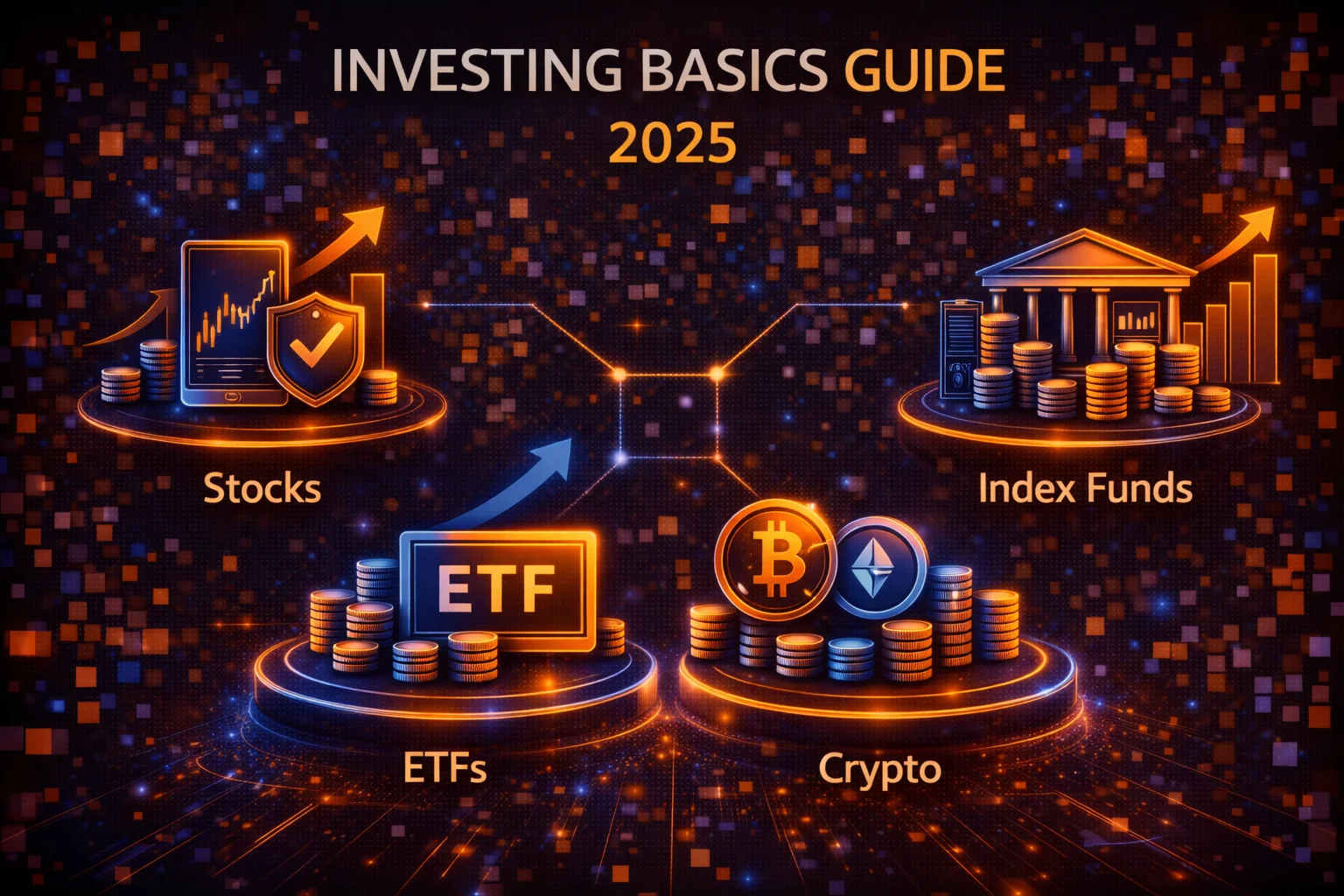
Index funds and Exchange-Traded Funds (ETFs) track a market benchmark -- the S&P 500, FTSE All-World, or a bond index -- and hold every security in that index automatically. A single purchase of the Vanguard FTSE Global All Cap fund gives you exposure to over 7,000 stocks across 50 countries for 0.23% per year. On a £10,000 investment, that is £23 annually. Compare that with the average actively managed fund charging 0.75-1.5%, or roughly £75-150 on the same amount, whilst statistically underperforming the index.
ETFs trade on the stock exchange like shares, so you can buy or sell during market hours at a known price. Index funds (the non-ETF variety) are priced once daily, which is fine for long-term investors setting up monthly direct debits. Both achieve the same goal: broad diversification at rock-bottom cost. If you do nothing else after reading this guide, buying one global index fund and contributing monthly will put you ahead of most investors.
Real Estate and REITs
Direct property ownership requires a deposit (typically 10-25% of the property price), mortgage affordability, and ongoing management effort. Real Estate Investment Trusts (REITs) offer a simpler alternative: you buy shares in a company that owns and manages property portfolios -- offices, warehouses, shopping centres, residential blocks. UK REITs must distribute at least 90% of rental income as dividends, typically yielding 3-6% annually plus potential capital growth. The iShares UK Property ETF (OCF 0.40%) provides diversified UK REIT exposure from a single purchase.
Cryptocurrency and Digital Assets
Bitcoin rose 160% in 2023 and fell 65% in 2022. That volatility profile makes cryptocurrency unsuitable as a core holding, but a small allocation (5-10% of your total portfolio) can boost returns if you are prepared for the swings. Treat crypto as a satellite position: money you would not need for at least five years, stored securely in a hardware wallet or on a reputable exchange.
For those interested in cryptocurrency investment, platforms like Binance and Kraken offer secure and user-friendly entry points. You can get started with Binance using our step-by-step guide. Learn more in our Complete Cryptocurrency Guide.
Commodities and Precious Metals
Commodities, including gold, silver, oil, and agricultural products, provide portfolio diversification and inflation protection. Precious metals particularly gold have historically served as safe-haven assets during economic uncertainty and market volatility. Investors can access commodities through physical ownership, commodity ETFs, futures contracts, or mining company stocks.
Gold and silver offer tangible value that exists independently of government currencies or corporate performance. During periods of high inflation or currency devaluation, precious metals typically maintain purchasing power better than cash holdings. However, commodities generate no income through dividends or interest, relying entirely on price appreciation for returns. This makes them suitable as portfolio diversifiers rather than core holdings.
Commodity investments carry unique risks, including storage costs for physical holdings, contango effects in futures markets, and high volatility driven by supply-demand dynamics. Agricultural commodities face weather-related risks, whilst energy commodities respond to geopolitical events and technological changes. Understanding these factors helps investors determine appropriate commodity allocations within diversified portfolios.
Alternative Investments and Private Equity
Alternative investments, including private equity, hedge funds, venture capital, and collectables, offer diversification beyond traditional stocks and bonds. These investments typically require higher minimum investments and longer holding periods but can provide enhanced returns and reduced correlation with public markets. Accredited investors with substantial capital can access private equity funds that invest in non-public companies.
Venture capital investments fund early-stage companies with high growth potential, offering substantial returns if successful but carrying significant risk of total loss. Angel investing allows individuals to invest directly in startups, providing both financial returns and personal involvement in entrepreneurial ventures. However, most startups fail, making diversification across multiple investments essential for managing risk in this asset class.
Collectables, including art, wine, classic cars, and rare coins, can appreciate significantly over time whilst providing personal enjoyment. However, these investments require specialised knowledge, lack liquidity, incur storage and insurance costs, and generate no income. Authentication challenges and market manipulation risks make collectibles suitable only for experienced investors with substantial capital and genuine interest in the asset category.
Getting Started: Step-by-Step
Step 1: Write Down Your Goal and Deadline
Vague goals produce vague results. Instead of "save for retirement," write "accumulate £500,000 by age 60 to fund £20,000 per year of living expenses." That single number tells you how much to invest monthly: at 7.5% annual growth, you need roughly £450 per month starting at age 30, or £950 per month starting at age 40. Use a compound interest calculator (Vanguard and Monevator both provide free ones) to work backwards from your target.
Step 2: Build a 3-Month Emergency Buffer
Before investing a penny, park 3 months of essential living costs (rent, food, utilities, transport) in an instant-access savings account. If your monthly essentials total £1,500, that means £4,500 in cash. This buffer prevents you from selling investments at the worst possible moment -- during a market crash that also triggers a job loss. Once the buffer is in place, every pound above it can go to work in the market.
Step 3: Open a Stocks and Shares ISA
A Stocks and Shares ISA shelters up to £20,000 per year from capital gains tax and dividend tax. Open one with a low-cost platform: Vanguard Investor charges 0.15% (capped at £375 per year), InvestEngine charges 0% for DIY portfolios, and Trading 212 charges 0% with no cap. The application takes 10-15 minutes and requires your National Insurance number and a bank account for direct debits. For detailed platform comparisons, see our broker comparison guide.
Step 4: Buy One Global Index Fund
For your first purchase, keep it simple: buy a single global equity index fund. The Vanguard FTSE Global All Cap Index (OCF 0.23%) or HSBC FTSE All-World Index (OCF 0.13%) both hold thousands of companies across developed and emerging markets. Set up a monthly direct debit of whatever you can afford -- £50, £100, £200 -- and automate the purchase. You now own a slice of the global economy. Wait at least 12 months before adding complexity like bonds, REITs, or individual stocks.
Step 5: Automate and Ignore
Set your monthly contribution to leave your bank account the day after payday. Vanguard, InvestEngine, and most ISA platforms support automatic monthly investing. This removes the temptation to time the market and ensures you buy more units when prices are low (your fixed amount buys more shares) and fewer when prices are high. Over a full market cycle, this pound-cost averaging typically outperforms lump-sum investing for people who would otherwise hesitate during dips.
Step 6: Review Once Per Year, Not Weekly
Check your portfolio annually to confirm your allocation still matches your goals. If equities have grown from 80% to 90% of your portfolio, sell enough to bring bonds back to 20% (or redirect new contributions). Beyond that yearly check, leave it alone. Research from Fidelity found that their best-performing client accounts belonged to people who forgot they had them. Constant monitoring encourages emotional trading that costs the average investor 1-2% per year in returns according to Dalbar studies.
Tax-Advantaged Investment Accounts
The UK Tax Wrapper Priority Order
The order in which you fill your tax-advantaged accounts matters more than which funds you pick. Follow this sequence: first, contribute enough to your workplace pension to capture the full employer match (typically 3-5% of salary -- this is an immediate 100% return on your contribution). Second, fill your Stocks and Shares ISA up to the £20,000 annual limit. Third, if you still have surplus capital, consider additional voluntary pension contributions for the income tax relief (20% for basic-rate taxpayers, 40% for higher-rate). Only after exhausting these wrappers should you invest in a general investment account.
Stocks and Shares ISA
The ISA is the most flexible tax shelter available to UK investors. All capital gains, dividends, and interest earned inside an ISA are completely tax-free, with no reporting required to HMRC. You can withdraw at any time without penalty (unlike a pension). The £20,000 annual allowance can be split between Cash ISA and Stocks and Shares ISA, but most long-term investors should prioritise the Stocks and Shares variant. On a £20,000 investment growing at 8% annually over 20 years, the ISA tax shelter saves roughly £15,000-25,000 in capital gains tax compared to holding the same investment outside an ISA.
Lifetime ISA (LISA) holders aged 18-39 can contribute up to £4,000 per year and receive a 25% government bonus (up to £1,000 per year). The LISA can be used for a first home purchase (property under £450,000) or accessed penalty-free from age 60. If you are under 40 and saving for a first home, the LISA bonus is the highest guaranteed return available from any investment product. The £4,000 LISA contribution counts within your overall £20,000 ISA allowance.
Workplace and Personal Pensions
Pension contributions receive income tax relief at your marginal rate: a basic-rate taxpayer investing £100 only pays £80 (the government adds £20), whilst a higher-rate taxpayer effectively pays just £60 for the same £100 contribution. With auto-enrolment, most employers contribute at least 3% of qualifying earnings when you contribute 5%. On a £30,000 salary, that is £1,500 per year in free employer contributions. The trade-off: pension funds are locked until age 57 (rising to 58 in 2028), and only 25% can be taken tax-free at retirement.
Self-employed workers and those wanting additional pension contributions can open a Self-Invested Personal Pension (SIPP) with providers like Vanguard (0.15% platform fee), AJ Bell (0.25%), or Interactive Investor (flat £9.99/month). SIPPs offer the same tax relief as workplace pensions with a wider range of investment options. Annual pension contributions are capped at £60,000 (2025/26) or your total earnings, whichever is lower. Unused allowance from the previous three tax years can be carried forward.
Junior ISA for Children
Parents can invest up to £9,000 per year per child in a Junior Stocks and Shares ISA, with all growth tax-free. The money belongs to the child and becomes accessible at age 18. Starting at birth with £100 per month invested in a global equity fund growing at 7.5% annually, the Junior ISA would be worth roughly £40,000 by age 18 -- enough for university costs or a house deposit contribution. Vanguard, Fidelity, and Interactive Investor all offer Junior ISAs with low fees and global index fund options.
Building Your Investment Portfolio
Asset Allocation: Three Starter Portfolios
Asset allocation -- how you split money between equities, bonds, property, and cash -- determines roughly 90% of your portfolio's behaviour over time, according to the widely cited Brinson, Hood, and Beebower study. The exact funds you pick matter far less than getting this split right for your timeframe and temperament.
Cautious starter (5-10 year horizon): 40% global equities ETF (Vanguard FTSE Global All Cap), 30% UK government bond index, 15% property REIT ETF, 10% inflation-linked gilts, 5% cash. Expected long-term return: 4-6% annually. Maximum historic drawdown for a similar mix: roughly 15-20%.
Balanced starter (10-20 year horizon): 60% global equities ETF, 20% bond index, 10% property REIT, 5% commodities (gold ETC), 5% crypto (Bitcoin/Ethereum via a regulated ETP). Expected long-term return: 6-8% annually. Maximum historic drawdown: roughly 25-30%.
Growth starter (20+ year horizon): 80% global equities ETF, 10% emerging markets ETF (for additional growth tilt), 5% property REIT, 5% crypto. Expected long-term return: 7-10% annually. Maximum historic drawdown: roughly 35-45%. Suitable only if you will not need this money for two decades and can stomach a 40% paper loss without selling.
Diversification: What Actually Protects You
Diversification works because different assets fall at different times. In 2022, global equities dropped 18% but UK gilts fell 24% as well -- the first time in decades both fell together, driven by aggressive interest rate rises. Adding gold (+0.4% in 2022) and commodities (+26% in 2022) to that portfolio would have cushioned the blow substantially. True diversification means holding assets with low correlation to each other, not just owning many funds that all track the same equity market.
- Geographic: A UK-only equity fund missed the US tech rally (2012-2024) that drove global returns. Hold at least 50% non-UK equities
- Asset class: Bonds, property, commodities, and cash each behave differently during recessions, rate cycles, and inflation spikes
- Sector: A global index fund already diversifies across technology, healthcare, financials, energy, and consumer sectors automatically
- Company size: Small-cap stocks have outperformed large-caps over long periods (Fama-French research) but with higher volatility -- a small-cap tilt of 10-20% adds growth potential
Rebalancing: Once Per Year Is Enough
After 12 months, your target 60/40 equity/bond split might have drifted to 70/30 if equities outperformed. Rebalancing means selling the winners and buying the laggards to restore your original allocation. This feels counter-intuitive but it forces you to sell high and buy low systematically. Vanguard research found annual rebalancing adds roughly 0.35% per year to risk-adjusted returns compared to never rebalancing. Set a calendar reminder for the same date each year and spend 15 minutes adjusting.
Tax-Efficient Structure
Use your £20,000 annual ISA allowance first -- all gains and income inside are completely tax-free. If you have a workplace pension, contribute enough to capture the full employer match (typically 3-5% of salary) before putting money into your ISA. Once both are maxed, a general investment account is the fallback -- you get a £3,000 annual capital gains allowance (2025/26) and a £500 dividend allowance. Place bond funds (which generate taxable interest) inside ISAs or pensions, and hold equity funds (which generate lower-taxed dividends) in general accounts when you must choose.
Understanding Market Analysis and Economic Indicators
Fundamental Analysis Principles
Fundamental analysis evaluates investments by examining financial statements, business models, competitive advantages, management quality, and industry trends. This approach focuses on intrinsic value rather than market price, seeking investments trading below their true worth. Understanding fundamental analysis helps investors identify quality companies with strong growth prospects and sustainable competitive advantages.
Key fundamental metrics include price-to-earnings ratios, earnings growth rates, profit margins, return on equity, debt levels, and free cash flow generation. Comparing these metrics across companies within the same industry reveals relative value and quality differences. Fundamental analysis requires patience and discipline, as markets may take years to recognise undervalued companies, but this approach has proven effective for long-term wealth building.
Technical Analysis and Chart Patterns
Technical analysis studies price movements, trading volumes, and chart patterns to identify trends and potential entry or exit points. Whilst controversial amongst fundamental investors, technical analysis can provide useful insights into market sentiment and momentum. Common technical indicators include moving averages, relative strength index, MACD, and support-resistance levels that help traders time their positions.
Chart patterns like head-and-shoulders, double tops, triangles, and flags signal potential trend reversals or continuations. However, technical analysis works best when combined with fundamental analysis rather than used in isolation. Understanding both approaches provides a more complete picture of investment opportunities and risks, helping investors make better-informed decisions about position sizing and timing.
Economic Indicators and Market Cycles
Economic indicators, including GDP growth, unemployment rates, inflation measures, interest rates, and consumer confidence surveys, provide insights into economic health and potential market direction. Understanding how these indicators affect different asset classes helps investors position portfolios appropriately for various economic environments. Leading indicators like manufacturing orders and building permits signal future economic trends before they appear in current data.
Market cycles typically follow economic cycles, with bull markets during economic expansions and bear markets during recessions. However, markets are forward-looking and often turn before economic data confirms cycle changes. Recognising cycle stages helps investors adjust asset allocations, with more aggressive positioning during early expansion phases and defensive positioning as cycles mature. Understanding that cycles are inevitable but unpredictable in timing helps maintain long-term perspective during market volatility.
Interest Rates and Monetary Policy Impact
Central bank monetary policy significantly influences investment returns across asset classes. Low interest rates typically support higher stock valuations by reducing discount rates and making bonds less attractive, whilst high rates pressure stock prices and increase bond yields. Understanding Federal Reserve policy decisions, interest rate trends, and quantitative easing programmes helps investors anticipate market reactions and position portfolios accordingly.
Rising interest rates particularly impact growth stocks, long-duration bonds, and real estate investments that rely on low borrowing costs. Conversely, financial sector stocks often benefit from higher rates through improved lending margins. Understanding these relationships helps investors adjust portfolios as monetary policy changes, protecting capital during rate increases whilst capturing opportunities in sectors that benefit from higher rates.
Global Economic Factors and Currency Effects
Global economic trends, international trade policies, and currency fluctuations affect investment returns, particularly for international investments and multinational companies. Strong domestic currency reduces returns from foreign investments when converted back to home currency, whilst weak domestic currency enhances foreign investment returns. Understanding currency effects helps investors evaluate international investment opportunities and decide whether to hedge currency exposure.
Geopolitical events, including elections, trade disputes, military conflicts, and policy changes, create market volatility and investment opportunities. Diversifying across geographic regions reduces exposure to any single country's political or economic risks. However, increasing global economic integration means that major events in one region often affect markets worldwide, making true geographic diversification more challenging than in previous decades.
Risk Management Strategies
Understanding Investment Risk With Real Numbers
Risk is not abstract -- it has a price tag. A 100% equity portfolio will typically drop 30-50% at some point during any 20-year holding period. The S&P 500 fell 34% between 19 February and 23 March 2020 (23 trading days). The FTSE 100 lost 48% during the 2007-2009 financial crisis and took until 2015 to recover in nominal terms. If your portfolio is worth £50,000 and you hold 80% equities, a 40% equity crash means your portfolio drops to roughly £34,000. Can you sleep through that without selling? If not, reduce your equity allocation until the worst-case loss feels tolerable.
A useful test: multiply your total portfolio value by 0.5 (representing a severe crash). If seeing that number on screen would make you panic-sell, you are holding too much equity for your temperament. Adjust your allocation until the worst-case scenario feels uncomfortable but manageable. Risk tolerance is personal -- it depends on your emergency buffer, job stability, other income sources, and how many years until you need the money.
Position Sizing and Risk Controls
Proper position sizing ensures no single asset can significantly damage your portfolio. General guidelines suggest limiting individual stock positions to 5-10% of your portfolio. Stop-loss orders can protect against significant declines in volatile assets.
Key Risk Control Techniques
- Trailing stop-loss: Automatically adjusts as asset price increases
- Fixed percentage stop: Sells when asset drops by set percentage
- Time-based stops: Exit positions after predetermined holding period
- Volatility-adjusted stops: Adapts to market volatility levels
Common Beginner Mistakes to Avoid
Trying to Time the Market
Between 2003 and 2023, the S&P 500 returned 9.8% annually for investors who stayed fully invested. Missing just the 10 best days reduced that to 5.6%. Missing the 20 best days brought it down to 2.8%. The problem: the best days almost always cluster around the worst days (seven of the ten best days in that period occurred within two weeks of one of the ten worst days). Sitting on the sidelines "waiting for a better entry" means you almost certainly miss the recovery. Set up automatic monthly investments and stay invested.
Emotional Decision Making
In March 2020, UK investors withdrew a net £4.1 billion from equity funds in a single month -- the largest outflow since the 2008 crisis. The FTSE All-World Index then rallied 75% over the following 12 months. Those who panic-sold locked in a 30% loss and missed the recovery. The fix is mechanical, not psychological: automate your contributions so they happen regardless of headlines, and write down your investment plan (including "what I will do if markets drop 30%") before the next crash, not during it.
Holding Too Few Positions
Putting half your portfolio into Tesla because it tripled last year is speculation, not investing. Individual stocks routinely lose 50-90% of their value -- even former giants like Nokia, Kodak, and Lehman Brothers went from market leaders to near-zero. A global index fund holding 7,000+ companies ensures that no single company failure materially damages your portfolio. If you want to pick individual stocks, limit stock-picking to 10% of your total portfolio and accept that you will probably underperform the index over 10 years.
Ignoring Fees
A 1% annual fee sounds trivial, but over 30 years it consumes roughly 26% of your final portfolio value. On a £200/month investment growing at 8% gross, the difference between a 0.2% fund (like a Vanguard index) and a 1.5% actively managed fund is approximately £67,000 after 30 years. Always check the Ongoing Charges Figure (OCF) before buying any fund. Anything above 0.5% needs a compelling reason. Most index funds charge 0.10-0.25%.
Chasing Last Year's Winners
The best-performing fund category in one year is frequently the worst in the next. UK smaller companies were the top category in 2020 (+23%) and amongst the worst in 2022 (-19%). Morningstar data consistently shows that investors who chase hot funds earn 1-2% less per year than the funds themselves, because they buy after the run-up and sell after the decline. Stick to your target allocation regardless of what is "hot" this quarter.
Over-Checking Your Portfolio
On any given day, global equity markets go down roughly 46% of the time. Over any given year, they go down about 27% of the time. Over any rolling 20-year period, they have never gone down. The more frequently you check, the more often you see losses, and the more tempted you are to tinker. Once-a-year rebalancing produces better outcomes than monthly adjustments for the vast majority of investors, with fewer transaction costs and less emotional stress.
Investment Psychology and Behavioural Finance
Understanding Cognitive Biases in Investing
Cognitive biases systematically affect investment decisions, often leading to suboptimal outcomes. Confirmation bias causes investors to seek information that supports existing beliefs while ignoring contradictory evidence. Recency bias overweights recent events when predicting future outcomes, leading to buying high after bull markets and selling low after bear markets. Recognising these biases helps investors make more rational decisions based on evidence rather than emotions.
Anchoring bias causes investors to fixate on specific price points, such as purchase prices or historical highs, affecting sell decisions. Loss aversion makes losses feel approximately twice as painful as equivalent gains feel pleasurable, leading to holding losing positions too long whilst selling winners too quickly. Understanding these psychological tendencies helps investors develop strategies to counteract their natural biases and improve decision-making.
Emotional Discipline and Market Volatility
Market volatility triggers emotional responses, including fear during declines and greed during rallies. These emotions drive poor decisions like panic selling at market bottoms or excessive risk-taking near market tops. Successful investors develop emotional discipline through education, experience, and predetermined investment plans that remove emotion from decision-making during stressful market periods.
Creating written investment plans with specific rules for buying, selling, and rebalancing helps maintain discipline during emotional market periods. Automatic investment plans remove timing decisions entirely, ensuring consistent contributions regardless of market conditions. Understanding that volatility is normal and temporary helps investors maintain long-term perspective rather than reacting to short-term market movements that often reverse quickly.
Overconfidence and Excessive Trading
Overconfidence causes investors to overestimate their knowledge and ability to predict market movements, leading to excessive trading and concentrated positions. Research shows that overconfident investors trade more frequently, incur higher costs, and achieve lower returns than those who acknowledge their limitations. Recognising the limits of your knowledge and the difficulty of consistently beating markets helps avoid overconfidence traps.
Excessive trading generates unnecessary costs through commissions, bid-ask spreads, and taxes, whilst rarely improving returns. Studies consistently show that investors who trade less frequently achieve better long-term results than active traders. Developing patience and resisting the urge to constantly adjust portfolios improves returns by reducing costs and avoiding poorly timed trades driven by short-term market noise.
Herd Mentality and Contrarian Thinking
Herd mentality drives investors to follow crowds, buying popular investments after significant price increases and avoiding unpopular investments after declines. This behaviour systematically leads to buying high and selling low, the opposite of successful investing. Understanding that maximum pessimism often creates best buying opportunities whilst maximum optimism signals potential tops helps investors think independently rather than following crowds.
Contrarian investing involves buying when others are fearful and selling when others are greedy, as Warren Buffett famously advised. However, contrarian thinking requires courage, conviction, and thorough analysis to distinguish genuine opportunities from value traps. Successful contrarians combine independent thinking with fundamental analysis, avoiding both blind crowd-following and reflexive contrarianism that ignores valid reasons for market movements.
Building Long-Term Investment Discipline
Investment discipline requires consistent adherence to predetermined strategies regardless of market conditions or emotional impulses. Creating systematic processes for investment decisions, regular portfolio reviews, and rebalancing removes emotion from investing. Documenting investment rationales when making purchases helps evaluate decisions objectively later, learning from both successes and mistakes.
Developing realistic expectations about investment returns and volatility prevents disappointment and emotional reactions during normal market fluctuations. Understanding that 10-15% annual declines occur frequently whilst 20%+ declines happen every few years helps investors prepare psychologically for inevitable volatility. Focusing on long-term goals rather than short-term performance reduces stress and improves decision-making during challenging market periods.
Conclusion
The single most important thing you can do after reading this guide is take one concrete action this week. Open a Stocks and Shares ISA if you do not have one. Set up a £50 or £100 monthly direct debit. Buy one global index fund. That 15-minute task, repeated automatically each month, puts you ahead of the roughly 60% of UK adults who hold no investments outside a workplace pension.
Everything else -- rebalancing, tax optimisation, adding bonds and REITs, exploring crypto -- can wait until your first annual portfolio review. Complexity is the enemy of getting started. A single global equity fund with automatic monthly contributions will outperform most professionally managed portfolios over 20 years, simply because of low fees and consistent contributions.
If you take away three numbers from this guide: start with 3 months of expenses in cash as an emergency buffer, invest within a £20,000-per-year ISA wrapper to eliminate tax drag, and expect your portfolio to drop 30-40% at least once per decade -- but recover. Investors who stayed fully invested through every crash since 1980 earned roughly 10% annually. Those who missed just the 10 best days in each decade earned under 5%. Patience is the only edge that compounds forever.
One honest warning before you begin: the hardest part of investing is not choosing funds or understanding tax wrappers -- it is sitting still when markets fall 25% and every instinct tells you to sell. Build your portfolio with that moment in mind. If a 30% drop on a £20,000 portfolio (a £6,000 paper loss) would cause you genuine financial stress or keep you up at night, reduce your equity allocation until the worst-case scenario feels tolerable. A portfolio you can hold through a crash will always outperform one you panic-sell at the bottom, regardless of how perfectly optimised the asset allocation looked on paper.
Sources & References
Frequently Asked Questions
- How do I start investing as a beginner?
- Start by setting clear financial goals, building an emergency fund, choosing a reputable broker, and beginning with diversified index funds or ETFs. Focus on learning the basics before attempting complex strategies.
- How much money do I need to start investing?
- You can start investing with as little as $1 through fractional shares or robo-advisors. Most modern brokers have no minimum account requirements, making investing accessible to everyone regardless of initial capital.
- What are the best investments for beginners?
- Index funds, ETFs, and target-date funds are ideal for beginners due to their diversification, low fees, and professional management. These investments provide broad market exposure without requiring extensive research or active management.
- Should beginners invest in cryptocurrency?
- Beginners can allocate 5-10% of their portfolio to cryptocurrency after understanding the risks and building a foundation with traditional investments. Cryptocurrency should be considered a high-risk, speculative investment suitable only for money you can afford to lose.
- How do I manage investment risk?
- Manage risk through diversification across different assets and sectors including domestic and international equities, fixed income securities, real estate, and alternative investments. Dollar-cost averaging reduces timing risk by spreading purchases over time. Investing for the long term helps ride out short-term volatility and market corrections. Only invest money you can afford to lose without affecting your financial security or emergency fund. Regular portfolio rebalancing maintains appropriate risk levels by selling appreciated assets and buying underperforming ones to maintain target allocations. Consider your personal risk tolerance, time horizon, and financial situation when determining appropriate risk levels for your portfolio.
Financial Disclaimer
This content is not financial advice. All information provided is for educational purposes only. Cryptocurrency investments carry significant investment risk, and past performance does not guarantee future results. Always do your own research and consult a qualified financial advisor before making investment decisions.