Developer Tools: Essential Software
The cryptocurrency and blockchain development landscape has evolved dramatically. Sophisticated tools are now available for building decentralised applications. Smart contracts and Web3 platforms benefit from these tools.
This comprehensive guide explores the essential developer tools for 2025. Coverage spans from IDEs to deployment platforms. Everything you need is included.
Introduction
Building a DApp in 2025 requires five categories of tools: a smart contract framework (Hardhat or Foundry), a node provider (Alchemy, Infura, or QuickNode), frontend libraries (ethers.js + wagmi), security analysis (Slither + professional audits), and deployment infrastructure. The core stack is free or cheap -- Hardhat is open source, Alchemy's free tier handles development and small projects, and OpenZeppelin's widely adopted contract libraries are battle-tested across $100B+ in TVL.
The unique challenge of blockchain development: deployed smart contracts are immutable. A bug in a web app gets hotfixed in minutes; a bug in a smart contract can drain millions before anyone reacts. This makes security tooling and testing infrastructure more important than in traditional development. The Wormhole ($320M), Ronin ($625M), and Euler ($197M) hacks all exploited code that passed basic testing but failed under adversarial conditions. Learn more about crypto security practices.
The landscape has shifted significantly since 2023. Foundry (written in Rust) has emerged as a serious alternative to Hardhat, offering 10-100x faster test execution and native Solidity scripting for deployments. Viem has largely replaced ethers.js for new projects, providing better TypeScript support and smaller bundle sizes. Wagmi v2 and RainbowKit have simplified wallet connection to a few lines of code. Meanwhile, L2 deployment has become the default for most new projects — deploying on Arbitrum or Base costs pennies per transaction versus dollars on mainnet, with no meaningful change to the existing development workflow.
The developer job market reflects this maturation. According to Electric Capital's 2024 developer report, the number of monthly active blockchain developers has stabilised at approximately 23,000 worldwide after peaking at 34,000 in 2022. Solidity remains the dominant smart contract language (85%+ of EVM development), followed by Rust for Solana and CosmWasm ecosystems. For developers coming from traditional web development, the learning curve is primarily about understanding gas optimisation, reentrancy patterns, and the economic implications of code that handles real money — a mental shift that no traditional development experience fully prepares you for. Every function you write is potentially an attack surface, and every state change costs real gas fees that your users pay.
This guide covers each tool category with specific pricing, honest limitations, and when to use each option. Understanding Ethereum architecture is helpful background for the framework comparisons. For broader crypto context, see our complete cryptocurrency guide.
Development Environment Setup
Integrated Development Environments (IDEs)
Visual Studio Code remains the most popular choice for blockchain development, offering extensive extension support and excellent integration with Web3 tools.
Essential VS Code extensions for crypto development:
- Solidity extension for smart contract development
- Hardhat extension for Ethereum development
- Rust Analyser for Solana and Substrate development
- GitLens for advanced Git integration
- Thunder Client for API testing
- Prettier for code formatting
Remix IDE is the go-to browser-based IDE specifically designed for Ethereum smart contract development. It offers built-in compilation, debugging, and deployment features.
Remix advantages:
- No installation required - runs in browser
- Built-in Solidity compiler and debugger
- Direct deployment to multiple networks
- Plugin ecosystem for extended functionality
- Integrated testing environment
Version Control and Collaboration
Git and GitHub remain essential for version control and collaboration in blockchain projects. Many projects also use GitHub Actions for continuous integration and deployment.
Best practices for crypto project version control:
- Never commit private keys or sensitive data
- Use .gitignore templates for blockchain projects
- Implement branch protection rules
- Use semantic versioning for releases
- Document deployment procedures
Smart Contract Development Frameworks
Ethereum Development
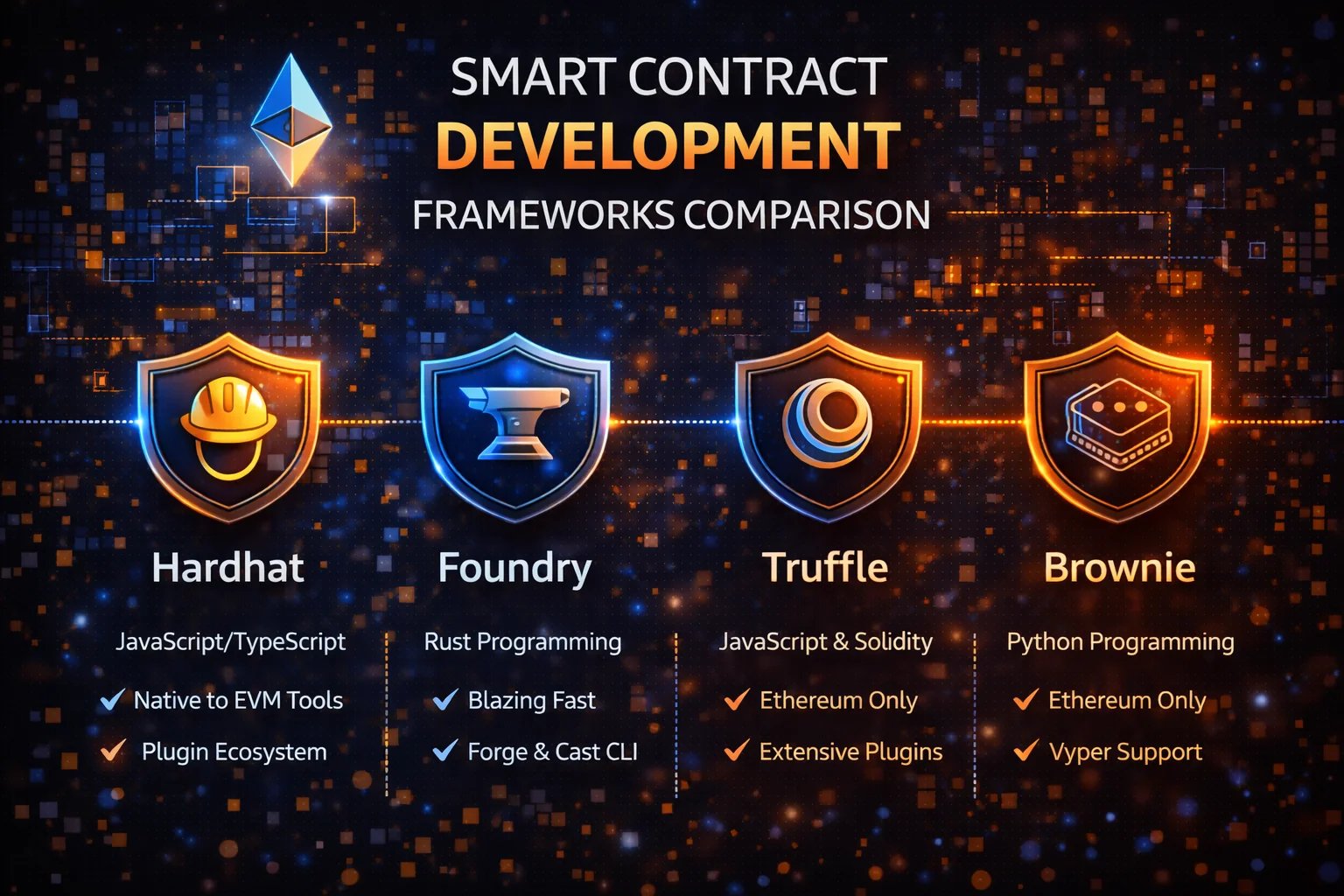
Hardhat (free, open source) is the most widely used Ethereum development framework with an estimated 70%+ market share amongst Solidity developers. It provides a complete local development environment with built-in Ethereum network, Solidity debugging (stack traces, console.log), and mainnet forking for testing against real state. The plugin ecosystem includes hardhat-ethers, hardhat-deploy, and hardhat-gas-reporter. Test execution speed: approximately 30-60 seconds for 200 unit tests. Best for: most projects, especially those using JavaScript/TypeScript workflows.
Hardhat features and honest limitations:
- Built-in local Ethereum network (Hardhat Network) with mainnet forking
- Advanced debugging: Solidity stack traces, console.log in contracts
- Flexible plugin architecture with 200+ community plugins
- Full TypeScript support out of the box
- Gas reporting and optimisation tools via plugins
- Limitation: Slower than Foundry for large test suites (JavaScript overhead)
- Limitation: Fuzzing capabilities are basic compared to Foundry
Foundry (free, open source) is a Rust-based toolkit gaining rapid adoption, particularly amongst security auditors and teams with large codebases. Its key advantage is speed: test execution is 10-100x faster than Hardhat because tests are written in Solidity (no JS bridge) and compiled to native code. Built-in fuzzing (forge fuzz) finds edge cases that unit tests miss. Best for: security-critical projects, large test suites, and teams comfortable writing tests in Solidity rather than JavaScript.
Foundry advantages and honest limitations:
- Compilation and testing 10-100x faster than Hardhat
- Solidity-native testing framework (no context switching to JS)
- Advanced property-based fuzzing built in (not available in Hardhat)
- Built-in deployment scripts (forge script) and contract verification
- Limitation: Smaller plugin ecosystem than Hardhat
- Limitation: Steeper learning curve if your team primarily writes JavaScript
- Limitation: Less mature frontend integration tooling
Multi-Chain Development
Truffle Suite continues to support multi-chain development with tools for Ethereum, Polygon, Binance Smart Chain, and other EVM-compatible networks.
OpenZeppelin provides secure, community-audited smart contract libraries and development tools that are essential for building secure DeFi applications.
OpenZeppelin offerings:
- Secure smart contract libraries
- Contract upgrade patterns
- Access control mechanisms
- Token standards implementation
- Security analysis tools
Blockchain-Specific Development Tools
Solana Development
Anchor Framework is the most popular framework for Solana program development, offering a Rust-based framework with TypeScript client generation capabilities.
Anchor features:
- Rust-based program development
- Automatic TypeScript client generation
- Built-in testing framework
- IDL (Interface Definition Language) support
- Local validator for testing
Solana CLI provides command-line tools for interacting with the Solana blockchain, including wallet management, program deployment, and network interaction.
Cosmos Ecosystem
Cosmos SDK enables developers to build application-specific blockchains with the Inter-Blockchain Communication (IBC) protocol.
Ignite CLI (formerly Starport) provides scaffolding and development tools for Cosmos-based blockchains.
Ignite CLI capabilities:
- Blockchain scaffolding and generation
- Module development tools
- Built-in relayer for IBC
- Frontend generation
- Local development network
Testing and Quality Assurance
Smart Contract Testing
Waffle provides a comprehensive testing framework for Ethereum smart contracts with TypeScript support and advanced mocking capabilities. However, in 2025 most projects have migrated away from Waffle to Hardhat's built-in Chai matchers or Foundry's native Solidity testing. Waffle is effectively in maintenance mode.
Chai and Mocha remain popular choices for JavaScript-based testing, often used in conjunction with Hardhat. The @nomicfoundation/hardhat-chai-matchers plugin extends Chai with Ethereum-specific assertions: expect(tx).to.emit(contract, "Transfer") for event testing, .to.be.revertedWith("error message") for failure cases, and .to.changeEtherBalance() for balance assertions. These matchers eliminate the boilerplate of manually checking events and balances.
Foundry's forge test offers a fundamentally different approach: tests are written in Solidity rather than JavaScript. This eliminates the JS-to-EVM bridge overhead and enables native property-based fuzzing. A typical fuzz test: function testFuzz_Deposit(uint256 amount) public — Foundry automatically generates hundreds of random inputs and checks your assertions hold for all of them. This catches edge cases (zero values, maximum uint256, overflow boundaries) that manual test cases miss. For context, the Euler Finance exploit ($197M) targeted a code path that would have been caught by basic fuzz testing — a function that behaved unexpectedly when called with a specific combination of parameters.
Testing best practices with concrete thresholds:
- Branch coverage target: 100% for any contract handling user funds. Use
npx hardhat coverageorforge coverageto measure. Any uncovered branch is a potential attack surface - Fuzz testing: minimum 10,000 runs per fuzzed function. Foundry defaults to 256 runs — increase this in foundry.toml with
[fuzz] runs = 10000for security-critical code - Fork testing: Test against real mainnet state using
hardhat forkorforge test --fork-url. This catches integration issues that unit tests with mocked contracts miss — for example, unexpected behaviour when interacting with the actual Uniswap V3 pool contracts rather than simplified mocks - Gas snapshot testing: Use
forge snapshotto record gas usage per test. Add this to CI so that any PR increasing gas costs by more than 10% requires explicit justification. Users pay for gas; unexpected increases directly affect adoption - Simulate mainnet conditions in tests, including realistic gas prices, block timestamps, and multi-transaction sequences that replicate actual user workflows
Security Analysis Tools
Slither (free, open source) is the most widely used static analysis framework for Solidity. It scans your codebase in seconds and produces findings categorised by severity (high, medium, low, informational). In practice, expect 30-50% false-positive rate — every finding needs manual review. The most valuable detectors: reentrancy (detects functions vulnerable to the classic reentrancy pattern), unprotected-upgrade (catches upgradeable contracts without proper access control), and arbitrary-send-eth (finds functions that send ETH to user-controlled addresses). Run Slither in CI on every pull request — it costs nothing and catches the low-hanging fruit that professional auditors charge thousands to identify.
Mythril (free, open source) uses symbolic execution — essentially exploring every possible execution path through your contract. This catches vulnerabilities that static analysis misses (integer overflows in complex arithmetic, state-dependent reentrancy). The trade-off: execution time. Mythril can take 10-60 minutes to analyse a complex contract, compared to seconds for Slither. Use Mythril as a pre-audit check rather than a CI gate.
Echidna (free, open source) is a property-based fuzzer specifically designed for smart contracts. Unlike Foundry's built-in fuzzer, Echidna uses coverage-guided fuzzing — it learns from each test run and generates increasingly targeted inputs to find edge cases. Echidna found critical vulnerabilities in production contracts that had passed multiple professional audits. Write invariant tests ("the total supply should never exceed X", "user balances should never be negative") and let Echidna try to break them.
Security analysis workflow for a £50,000+ TVL deployment:
- During development: Run Slither on every commit. Fix all high-severity findings immediately. Cost: £0, time: 2 seconds per run
- Pre-testnet: Run Mythril and Echidna. Address all genuine findings. Cost: £0, time: 1-4 hours including manual review
- Pre-mainnet: Engage a professional audit firm. Budget £30,000-200,000 depending on contract complexity. Trail of Bits, OpenZeppelin, Spearbit, and Cyfrin are the tier-1 firms. Code4rena and Sherlock offer competitive audit contests from £20,000 — multiple auditors compete to find bugs, which often surfaces issues a single audit team misses
- Post-deployment: Launch a bug bounty on Immunefi. Set the maximum payout at 10% of your protocol's TVL (industry standard). Monitor deployed contracts using Tenderly alerts or OpenZeppelin Defender
Frontend Development for DApps
Web3 Libraries
ethers.js has become the preferred library for interacting with Ethereum from JavaScript applications, offering a clean API and TypeScript support.
web3.js remains widely used and provides comprehensive Ethereum interaction capabilities.
Key features for DApp development:
- Wallet connection and management
- Smart contract interaction
- Transaction handling and monitoring
- Event listening and filtering
- ENS (Ethereum Name Service) support
React and Web3 Integration
wagmi provides React hooks for Ethereum, making it easier to build responsive DApps with wallet connectivity.
RainbowKit offers beautiful, customizable wallet connection components for React applications.
Popular React Web3 stack:
- React or Next.js for the frontend framework
- wagmi for Ethereum integration
- RainbowKit for wallet connections
- Tailwind CSS for styling
- TypeScript for type safety
API and Infrastructure Tools
Blockchain APIs
Alchemy is the most popular node provider with 300 million weekly compute units free, then $49/month (Growth) for 400M CUs or $199/month (Scale) for 1.5B CUs. Supports Ethereum, Polygon, Arbitrum, Optimism, Solana, and 30+ chains. Unique features: Alchemy Notify (webhooks for address activity), NFT API, and Transact (gas management). Best for: teams building production DApps who need reliable infrastructure and debugging tools.
Infura offers 100,000 requests/day free, then $50/month (Developer) for 200K requests/day or $225/month (Team) for 1M requests/day. Supports Ethereum, Polygon, Arbitrum, Optimism, and IPFS. Owned by Consensys, making it deeply integrated with MetaMask (which uses Infura by default). Best for: projects needing IPFS integration alongside blockchain APIs.
QuickNode starts at $10/month (Build) for 10M API credits, $49/month (Scale) for 40M credits, or $299/month (Business) for 200M credits. Supports 25+ chains including Ethereum, Solana, Avalanche, and Base. Unique feature: Streams (real-time blockchain data streaming) and marketplace add-ons. Best for: multi-chain projects needing low-latency global infrastructure.
Honest comparison: For a solo developer or small project, all three free tiers are sufficient -- Alchemy's free tier is the most generous. For production applications, Alchemy's debugging tools and Notify webhooks justify the price premium. QuickNode wins on multi-chain breadth and pricing transparency. Infura is the safe institutional choice but the most expensive per request. Running your own Ethereum node (via Geth or Nethermind on a $20-50/month VPS) is the cheapest option for high-volume applications but requires maintenance time.
Indexing and Data Services
The Graph provides decentralised indexing for blockchain data, enabling efficient querying of on-chain information.
Moralis offers comprehensive Web3 APIs for NFTs, DeFi, and blockchain data with easy integration.
Data indexing benefits:
- Fast querying of historical data
- Reduced blockchain node requirements
- Complex data aggregation capabilities
- Real-time event monitoring
- Cross-chain data integration
Deployment and DevOps
Smart Contract Deployment
Hardhat Deploy provides advanced deployment management with dependency resolution and upgrade support.
OpenZeppelin Upgrades enables secure smart contract upgrades using proxy patterns.
Deployment best practices:
- Use deterministic deployment addresses
- Implement proper access controls
- Test deployments on testnets first
- Verify contracts on block explorers
- Document deployment procedures
Frontend Deployment
Vercel and Netlify provide excellent hosting for DApp frontends with automatic deployments from Git repositories.
IPFS enables decentralised hosting for truly decentralised applications.
For backend infrastructure and API hosting, consider using DigitalOcean or AWS for scalable cloud solutions.
Frontend deployment considerations:
- Environment variable management
- Build optimisation for Web3 libraries
- CDN configuration for global performance
- SSL certificate management
- Monitoring and analytics setup
Monitoring and Analytics
Application Monitoring
Sentry provides error tracking and performance monitoring for DApps, helping identify and resolve issues quickly.
LogRocket offers session replay and monitoring specifically useful for debugging Web3 interactions.
Monitoring essentials:
- Error tracking and alerting
- Performance monitoring
- User behavior analytics
- Transaction success rates
- Wallet connection metrics
Blockchain Analytics
Dune Analytics enables custom blockchain data analysis and visualisation with SQL queries.
Nansen provides on-chain analytics and wallet tracking for DeFi and NFT projects.
Analytics use cases:
- Protocol usage and adoption metrics
- Token holder analysis
- Transaction volume tracking
- Competitive analysis
- User behavior patterns
Development Workflow optimisation
Package Management
npm and yarn remain the standard package managers, with pnpm gaining popularity for its efficiency.
Package management best practices:
- Lock dependency versions for reproducible builds
- Regularly audit packages for security vulnerabilities
- Use workspace features for monorepo management
- Implement automated dependency updates
- Document package selection rationale
Code Quality Tools
ESLint and Prettier ensure consistent code formatting and catch common errors.
Husky enables Git hooks for automated code quality checks before commits.
Quality assurance workflow:
- Automated linting and formatting
- Pre-commit hooks for quality checks
- Continuous integration testing
- Code coverage reporting
- Automated security scanning
Emerging Tools and Technologies
AI-Powered Development
GitHub Copilot and ChatGPT are increasingly used for code generation and debugging assistance in blockchain development.
Solidity-specific AI tools are emerging to help with smart contract development and security analysis.
AI tool applications:
- Code generation and completion
- Bug detection and fixing suggestions
- Documentation generation
- Test case creation
- Security vulnerability identification
Low-Code/No-Code Platforms
Thirdweb provides tools for building Web3 applications without extensive blockchain knowledge.
Moralis offers backend-as-a-service for Web3 applications with minimal coding required.
Low-code benefits:
- Faster prototyping and development
- Lower barrier to entry for Web3 development
- Reduced boilerplate code
- Built-in best practices and security
- Focus on business logic over infrastructure
Learning and Community Materials
Documentation and Tutorials
Ethereum.org (ethereum.org/developers) is the definitive starting point — structured learning paths from beginner to advanced, covering Solidity, smart contract security, and DApp architecture. The "Tutorials" section links to hands-on guides for deploying your first contract, building an ERC-20 token, and creating an NFT collection.
Solidity by Example (solidity-by-example.org) provides concise, copy-pasteable code patterns for common tasks: access control, voting contracts, multi-sig wallets, and gas optimisation techniques. Each example is tested and deployable — significantly faster than reading through the full Solidity documentation for specific patterns.
OpenZeppelin Wizard (wizard.openzeppelin.com) generates production-ready ERC-20, ERC-721, and Governor contract code through a visual interface. Select the features you need (mintable, burnable, pausable, access control), and the wizard outputs tested Solidity code importing from OpenZeppelin's audited libraries. This saves hours of boilerplate and eliminates common security mistakes.
Cyfrin Updraft (updraft.cyfrin.io, free) is the most comprehensive free smart contract security course available in 2025, taught by Patrick Collins. Covers Foundry, Solidity testing, and audit preparation. If you plan to handle user funds, this course is essential viewing before your first mainnet deployment.
Community Platforms
Ethereum Stack Exchange (ethereum.stackexchange.com) is more active and specialised than Stack Overflow for Solidity questions. The top answerers are often core contributors to the tools you are using (Hardhat developers, OpenZeppelin maintainers). Search here first before asking in Discord.
Protocol-specific Discord servers are the fastest way to get help with tool-specific issues. The Hardhat Discord, Foundry Telegram, and Alchemy Discord all have dedicated support channels where maintainers respond within hours. For security questions, the OpenZeppelin forum and Immunefi Discord (bug bounty platform) connect you with auditors and security researchers.
Monthly Tool Cost by Team Size
A realistic budget breakdown for blockchain development infrastructure in 2025:
- Solo developer / learning: £0/month. Hardhat (free), Alchemy free tier (300M compute units/month), The Graph hosted service (free), GitHub free tier. Sufficient for development, testing, and testnet deployment
- Startup (2-5 developers): £50-150/month. Alchemy Growth (£40/month), Tenderly free-to-starter (£0-80/month), GitHub Team (£3.30/user/month). Add £30,000-150,000 one-time for a professional security audit before mainnet launch
- Production DApp: £200-500/month. Alchemy Scale (£160/month) or QuickNode Business (£240/month) for redundant RPC, Tenderly Pro (£80/month) for debugging and simulation, The Graph decentralised network (usage-based, typically £20-100/month), monitoring and alerting tools (£50-100/month)
Tool Selection Strategy
Evaluation Criteria
When selecting development tools, consider:
- Community size and activity
- Documentation quality and completeness
- Integration with existing tools
- Performance and reliability
- Security track record
- Long-term maintenance and support
Building Your Toolkit
Start with essential tools and gradually expand based on project needs:
Beginner toolkit:
- VS Code with Solidity extension
- Remix IDE for learning
- Hardhat for development
- MetaMask for testing
- Etherscan for blockchain exploration
Advanced toolkit:
- Foundry for performance-critical projects
- The Graph for data indexing
- Alchemy or Infura for production APIs
- Slither for security analysis
- Dune Analytics for data analysis
Affiliate Disclosure: This article contains referral links to development platforms and tools. We may earn a commission if you sign up through our links, at no additional cost to you. We only recommend tools we have researched and believe offer genuine value to developers.
Practical Implementation Examples
From Zero to Deployed: A Concrete Hardhat Setup
Here is the exact sequence of commands to go from an empty directory to a testnet-deployed smart contract. This assumes Node.js 18+ is installed.
Step 1 — Initialise: mkdir my-dapp && cd my-dapp && npx hardhat init. Choose "Create a TypeScript project." This generates a project with hardhat.config.ts, a sample contract, and a test file. Install OpenZeppelin: npm install @openzeppelin/contracts.
Step 2 — Write your contract: Replace the sample contract in contracts/ with your Solidity code. Import from OpenZeppelin for standard functionality (ERC-20, access control, reentrancy guards). Hardhat auto-compiles on test runs.
Step 3 — Test: npx hardhat test runs all tests in test/ using Mocha + Chai + Ethers.js. Aim for 100% branch coverage on any contract handling user funds. Use npx hardhat coverage to generate a coverage report — any uncovered branch is a potential exploit.
Step 4 — Security scan: Install Slither (pip3 install slither-analyzer) and run slither . against your project. Expect 10-30 findings, most of which are informational. Focus on high-severity findings (reentrancy, unchecked external calls, access control issues). Fix these before deployment.
Step 5 — Deploy to testnet: Create a free Alchemy account, get a Sepolia API key, add it to hardhat.config.ts, fund your deployer address from a Sepolia faucet, and run npx hardhat run scripts/deploy.ts --network sepolia. Total cost: £0. Time from Step 1 to deployed testnet contract: 2-4 hours for an experienced developer, 1-2 days for a beginner.
Real-World CI/CD Pipeline
A production-grade GitHub Actions workflow for Solidity projects runs three stages on every pull request:
Stage 1 — Compile and test: npx hardhat compile && npx hardhat test. Fails the PR if any test fails. Runs in 30-120 seconds for most projects. On Foundry, the equivalent (forge build && forge test) runs 10-100x faster for large test suites.
Stage 2 — Security analysis: Run Slither in CI. Configure .slither.config.json to suppress known false positives. Any new high-severity finding blocks the merge. This catches common vulnerabilities (reentrancy, integer overflow, unprotected selfdestruct) automatically before code review.
Stage 3 — Gas reporting: Use hardhat-gas-reporter plugin to output gas costs per function in the test output. Compare against the previous commit to detect gas regressions. A function that suddenly costs 50% more gas deserves investigation before merging.
Total CI setup time: 1-2 hours. Monthly cost on GitHub Actions free tier: £0 for most projects (2,000 minutes/month). This pipeline prevents the two most expensive development mistakes: deploying untested code and deploying code with known vulnerabilities.
Gas Optimisation: Concrete Techniques
Gas costs directly affect user adoption. A Uniswap V3 swap costs approximately 120,000 gas (~£3-15 on Ethereum mainnet). Here are the highest-impact optimisation techniques:
- Storage is expensive: A SSTORE (writing to storage) costs 20,000 gas. Reading costs 2,100 gas. Use
memoryvariables for intermediate calculations and write to storage only once at the end of a function. Packing multiple values into a single 256-bit storage slot (e.g., two uint128s instead of two uint256s) halves storage costs - Events are cheap logging: Emitting an event costs roughly 375 gas + 256 gas per indexed topic + 8 gas per byte of data. Compared to storage (20,000 gas per 32 bytes), events are 50x cheaper for data that only needs to be readable off-chain. Use events for transaction history, notifications, and analytics data
- Batch operations: If users frequently call the same function multiple times (e.g., claiming rewards from 5 pools), implement a batch function that loops internally. This saves 21,000 base transaction gas per additional call, which adds up to significant savings for multi-step workflows
- Deploy on L2: The simplest gas optimisation is deploying on Arbitrum, Optimism, or Base instead of Ethereum mainnet. Gas costs drop 10-100x. If your application does not require mainnet settlement guarantees (most do not), L2 deployment eliminates gas as a user concern entirely
Multi-Chain Deployment: Practical Approach
Deploying the same contract on Ethereum, Arbitrum, and Polygon requires three separate deployments but can share identical Solidity code if you avoid chain-specific features. Hardhat supports multi-network configuration natively: add each network's RPC URL and deployer key to hardhat.config.ts, then run npx hardhat run scripts/deploy.ts --network arbitrum for each target chain.
The catch: different chains have different block times, gas models, and pre-deployed contract addresses (e.g., Uniswap router addresses differ per chain). Use a deployment config file that maps chain IDs to environment-specific addresses. Verify contracts on each chain's block explorer (Etherscan, Arbiscan, Polygonscan) using npx hardhat verify --network arbitrum CONTRACT_ADDRESS — verified source code builds user trust.
For cross-chain messaging (sending data or tokens between chains), LayerZero and Chainlink CCIP are the two main options in 2025. LayerZero supports 30+ chains with a simple lzSend() call pattern. Chainlink CCIP is newer but backed by Chainlink's oracle infrastructure. Both charge per-message fees ($0.10-1.00 depending on chain pair and message size). Bridge protocols carry inherent smart contract risk — the Wormhole ($325M), Ronin ($625M), and Nomad ($190M) exploits demonstrate that cross-chain infrastructure is the highest-risk component of any multi-chain architecture.
When to Use Each Tool: Decision Framework
Solo Developer / Hackathon
Hardhat + Alchemy free tier + Remix for quick prototyping. Total cost: $0. This stack handles 90% of projects up to testnet deployment. Switch to Foundry only if your test suite takes more than 60 seconds on Hardhat.
Startup / Small Team (2-5 Developers)
Hardhat or Foundry (team preference) + Alchemy Growth ($49/month) + The Graph (hosted service, free for small subgraphs) + Slither for automated security checks in CI. Budget: $50-100/month. Add a professional audit from Trail of Bits or OpenZeppelin ($50,000-200,000) before mainnet launch if your contracts handle user funds. Skipping the audit to save money is false economy -- a single exploit costs more than every audit firm combined.
Production DApp with Users
Foundry for performance-critical testing + Alchemy Scale ($199/month) or QuickNode Business ($299/month) for redundant RPC + Tenderly ($0-99/month) for transaction simulation and debugging + Sentry for frontend error tracking. Deploy on Arbitrum or Polygon for applications where gas costs matter to users. Use The Graph's decentralised network ($0.0001 per query) for production data indexing rather than the free hosted service, which has no uptime guarantee.
Honest Tool Limitations
- Hardhat: JavaScript overhead makes test suites 10-100x slower than Foundry for large projects (500+ tests)
- Foundry: Limited frontend tooling -- most teams still need Hardhat for deployment scripts that interact with off-chain systems
- The Graph: Subgraph indexing can lag 30-60 seconds behind real-time during high network activity
- Alchemy/Infura: Free tiers rate-limit aggressively during peak usage -- production apps need paid plans
- Slither: High false-positive rate (30-50%) -- useful for automated CI but every finding needs manual review
UK-Specific Considerations for Blockchain Developers
The UK's regulatory environment creates both opportunities and constraints for blockchain developers. The FCA's registration requirement for crypto businesses means that any DApp targeting UK users and handling their funds must consider whether it falls within the regulatory perimeter. A purely decentralised protocol with no UK legal entity may be outside FCA jurisdiction, but the moment you add a UK-domiciled company, employ UK staff, or actively market to UK consumers, you may need FCA registration under the Money Laundering Regulations. This affects tool selection: compliance-oriented projects benefit from tools like Chainalysis KYT or Elliptic for transaction screening, which add £500 to £2,000 per month to infrastructure costs but are necessary for regulated operations.
The crypto marketing rules introduced by the FCA in October 2023 affect frontend development directly. If your DApp interface is accessible to UK users and promotes crypto assets, your frontend must include prescribed risk warnings, cooling-off periods for first-time users, and client categorisation checks. These requirements translate into specific UI components that must be built and tested: risk warning modals that cannot be dismissed without acknowledgement, 24-hour cooling-off timers for new account registrations, and age verification flows. Tools like LaunchDarkly for feature flagging can help you toggle these compliance features by jurisdiction, showing them to UK users whilst keeping a cleaner interface for users in less regulated markets.
Data protection adds another dimension that UK-based developers must address from the outset. The UK GDPR applies to any application processing personal data of UK residents, and wallet addresses combined with IP addresses or transaction patterns can constitute personal data under the regulation. If your DApp logs user activity, uses analytics services, or stores any identifying information on centralised servers, you need a privacy policy, cookie consent mechanisms, and potentially a Data Protection Impact Assessment. On-chain data is inherently public and falls outside GDPR's right to erasure (you cannot delete blockchain records), but off-chain databases, API logs, and user profiles remain fully subject to UK data protection law. Building privacy-by-design from the start is significantly cheaper than retrofitting compliance after launch.
The UK developer talent market shapes practical hiring and team-building decisions. Average salaries for Solidity developers in London range from £80,000 to £150,000 as of early 2026, with senior security-focused roles commanding £120,000 to £200,000. Remote Solidity developers outside London typically command £60,000 to £120,000. These figures are lower than peak 2021-2022 levels (when senior Solidity developers could command £200,000+ anywhere in the UK) but remain significantly above traditional web development salaries. The talent pool is concentrated in London, with smaller clusters in Manchester, Edinburgh, and Bristol. For startups, hiring remote developers across Europe (particularly from Eastern Europe, where Solidity expertise is strong and salary expectations are 30-50% lower) can stretch budgets further whilst maintaining quality.
HMRC's treatment of tokens created by developers deserves particular attention. If you deploy a governance token as part of your protocol and allocate a portion to yourself or your team, HMRC may treat those tokens as employment income (subject to Income Tax and National Insurance) at the point they vest or become transferable, valued at market price. This can create substantial tax liabilities before you have any actual revenue. Token vesting schedules should be designed with UK tax advice, ideally using EMI (Enterprise Management Incentive) scheme structures where applicable to benefit from reduced CGT rates on disposal. Consulting a crypto-specialist accountant before token generation events can save thousands in unexpected tax bills.
The practical development workflow for UK teams should account for these regulatory and tax realities from project inception rather than treating them as afterthoughts. Build compliance hooks into your smart contract architecture (pausable functionality, address blacklisting for sanctions compliance, emergency withdrawal mechanisms), design your frontend with jurisdiction-aware feature flags, and document your token economics with tax-efficient vesting structures. These considerations may seem premature during early development, but retro-fitting them into a deployed protocol is orders of magnitude more expensive and disruptive than including them in the original design.
Conclusion
The blockchain development stack in 2025 has matured to the point where a competent web developer can build and deploy a DApp in a weekend using Hardhat + Alchemy + wagmi + RainbowKit. The barrier is no longer tooling -- it is understanding the security implications of immutable code and the economic design of token systems.
Start with Hardhat and the free tiers of Alchemy and The Graph. Master Solidity fundamentals and OpenZeppelin's battle-tested contract libraries before building custom logic. Invest in security tooling (Slither, professional audits) proportional to the value your contracts handle. Deploy on L2s (Arbitrum, Polygon) unless your application specifically requires Ethereum mainnet settlement guarantees. The tooling is genuinely good now — the challenge is building something people actually want to use.
For security, follow a graduated approach. Run Slither on every commit during development — it catches common vulnerabilities automatically and costs nothing. Before any testnet deployment, add fuzzing with Echidna or Foundry's built-in fuzzer to test edge cases your unit tests miss. Before mainnet deployment with real value, budget for a professional audit: firms like Trail of Bits ($50,000-200,000+), OpenZeppelin ($30,000-150,000), and Code4rena (competitive audits from $30,000) provide different price points depending on contract complexity. For contracts handling under $100,000, a competitive audit on Sherlock or Code4rena may be sufficient; above $1M, invest in a top-tier firm.
The path from idea to deployed DApp has never been more accessible. A developer comfortable with JavaScript can write their first Solidity contract, test it with Hardhat, deploy it on Arbitrum, and build a frontend with wagmi and RainbowKit in a single weekend. The real work begins after deployment: monitoring contract interactions, responding to potential vulnerabilities, and iterating based on actual user behaviour. Start building, but never stop thinking about what happens when your code encounters an adversary rather than a friendly user.
Sources & References
- Ethereum Foundation. (2025). Ethereum Developer Documentation. Official development resources and best practices.
- Hardhat. (2025). Hardhat Documentation. Smart contract development framework guide.
- OpenZeppelin. (2025). OpenZeppelin Contracts. Secure smart contract library and security standards.
- DigitalOcean. (2025). DigitalOcean Deployment Guide. Cloud infrastructure for blockchain applications.
Frequently Asked Questions
- What are the essential tools for blockchain development in 2025?
- Essential tools include Hardhat or Foundry for smart contract development, MetaMask for wallet integration, Alchemy or Infura for blockchain APIs, Ethers.js or Web3.js for frontend integration, and Slither for security analysis. These tools form the foundation of most blockchain development workflows.
- Which blockchain development framework is best for beginners?
- Hardhat is generally recommended for beginners due to its excellent documentation, built-in testing framework, and extensive plugin ecosystem. It provides a gentle learning curve while offering powerful features for advanced development as you progress.
- How do I choose between Alchemy and Infura for blockchain APIs?
- Both are excellent choices. Alchemy offers more advanced features, including enhanced APIs, debugging tools, and improved analytics, making it ideal for production applications. Infura is more straightforward, perfect for getting started quickly. Consider your project's complexity and budget when choosing.
- What security tools should I use for smart contract development?
- Essential security tools include Slither for static analysis, MythX for comprehensive security scanning, OpenZeppelin Contracts for secure implementations, and Tenderly for runtime monitoring. Always conduct professional audits before deploying contracts handling significant value.
- How vital is The Graph for DApp development?
- The Graph is crucial for DApps requiring efficient data querying. It indexes blockchain data and provides fast GraphQL APIs, significantly improving user experience. Whilst not mandatory for simple applications, it becomes essential for complex DApps with extensive data requirements.
- What's the difference between Hardhat and Foundry?
- Hardhat is JavaScript-based, with extensive plugins and an easier learning curve, making it ideal for full-stack developers. Foundry is Rust-based, offering superior performance and native Solidity testing, preferred by developers prioritising speed and efficiency. Choose based on your team's expertise and performance requirements.
- Do I need to learn multiple blockchain development tools?
- Start with one comprehensive framework (like Hardhat) and gradually expand your toolkit as needed. Focus on mastering core tools before adding specialised ones. Most successful developers use 5-10 core tools regularly rather than trying to learn everything at once.
← Back to Crypto Investing Blog Index
Financial Disclaimer
This content is not financial advice. All information provided is for educational purposes only. Cryptocurrency investments carry significant investment risk, and past performance does not guarantee future results. Always do your own research and consult a qualified financial advisor before making investment decisions.