How to Buy Bitcoin: Beginner Guide
Learn how to buy Bitcoin safely with our comprehensive beginner's guide
Introduction
Bitcoin has evolved from an experimental digital currency to a globally recognised store of value and investment asset, with institutional adoption reaching unprecedented levels in 2025. The process of buying Bitcoin has become significantly more accessible and secure, with regulated exchanges, comprehensive insurance coverage, and user-friendly interfaces making cryptocurrency investment available to mainstream investors worldwide.
The Bitcoin ecosystem in 2025 offers multiple pathways for acquiring the world's first cryptocurrency, from traditional centralised exchanges and peer-to-peer platforms to Bitcoin ETFs and automated investment services. Each method offers distinct advantages in cost, convenience, privacy, and security, enabling investors to choose approaches that align with their specific needs, technical expertise, and regulatory requirements.
Regulatory clarity has improved dramatically across major jurisdictions, with clear frameworks governing Bitcoin trading, taxation, and custody that provide consumer protection while enabling innovation. This regulatory maturation has brought institutional-grade security standards to retail platforms, including insurance coverage, professional custody solutions, and transparent reporting, that rival those of traditional financial services.
The technological infrastructure supporting Bitcoin purchases has matured considerably, with advances in user experience design, security protocols, and payment integration making Bitcoin acquisition as simple as online banking. Modern platforms offer features such as dollar-cost averaging, automated investing, and comprehensive portfolio tracking that simplify Bitcoin investment for users of all experience levels.
Market conditions in 2025 present unique opportunities for Bitcoin investment, with increased institutional participation providing greater price stability and liquidity compared to previous years. The approval of Bitcoin ETFs in major markets has created new avenues for traditional investors to gain exposure while maintaining familiar investment structures and regulatory protections.
The global economic environment continues to drive interest in Bitcoin as a hedge against currency debasement and inflation, with central bank monetary policies and geopolitical uncertainties reinforcing Bitcoin's value proposition as a decentralised store of value. This macroeconomic backdrop has contributed to sustained institutional and retail demand throughout 2025.
Security considerations remain paramount when buying Bitcoin, as the irreversible nature of cryptocurrency transactions and the responsibility for private key management require careful attention to platform selection, storage solutions, and operational security practices. Understanding these security fundamentals is essential for protecting your Bitcoin investment from theft, loss, or technical failures.
The investment landscape for Bitcoin has diversified significantly, with options ranging from direct ownership through self-custody wallets to exposure through regulated investment products such as ETFs and futures contracts. This diversity enables investors to gain Bitcoin exposure through methods that match their risk tolerance, technical capabilities, and regulatory preferences while maintaining appropriate portfolio allocation strategies.
This comprehensive guide provides step-by-step instructions for buying Bitcoin safely and efficiently in 2025, covering everything from platform selection and account setup to security best practices and long-term storage strategies. Whether you're a complete beginner making your first Bitcoin purchase or an experienced investor seeking to optimise your acquisition strategy, this guide provides the knowledge and practical tools necessary to navigate the Bitcoin market confidently and securely while maximising your investment potential.
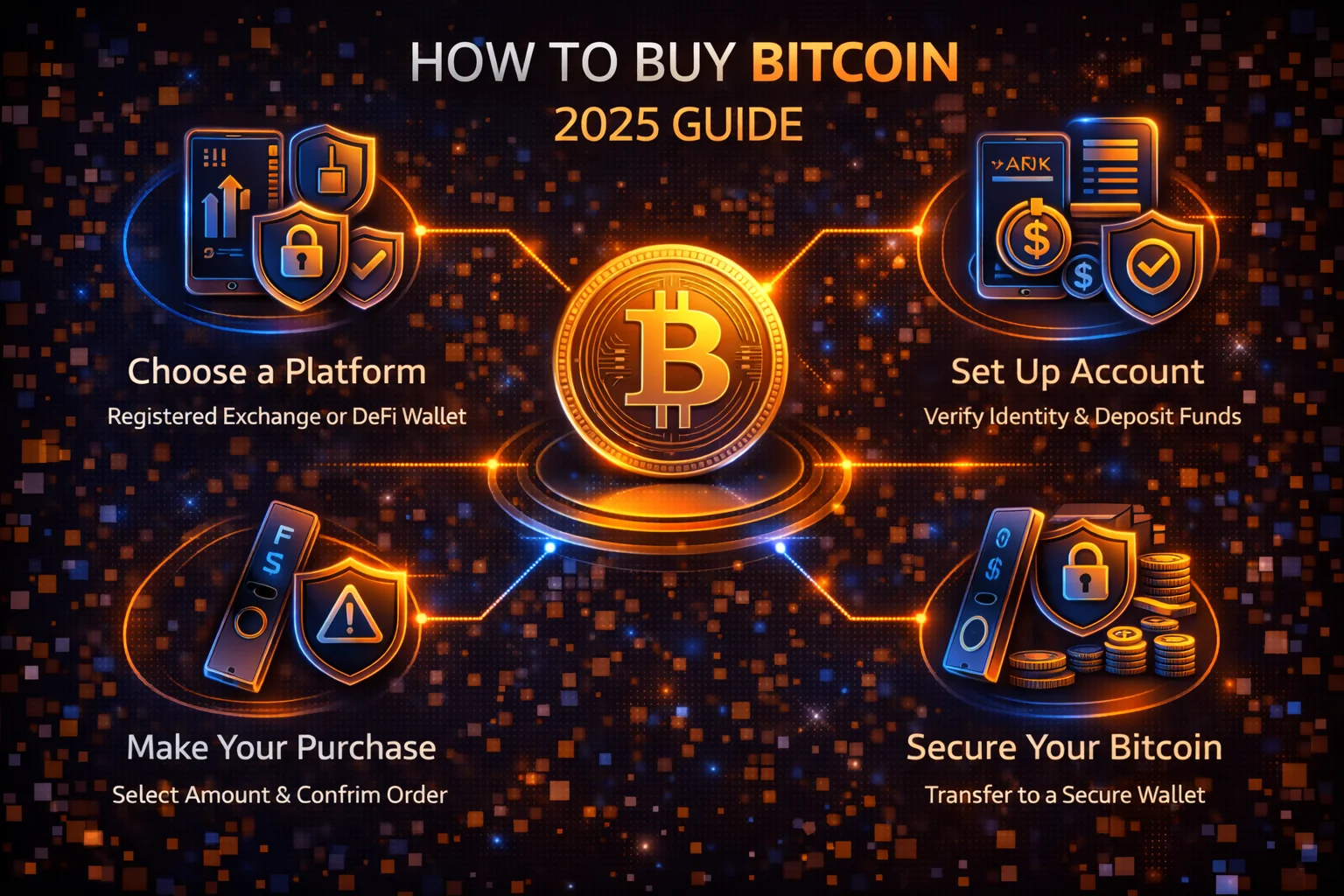
Why Buy Bitcoin?
Bitcoin remains the world's most popular and valuable cryptocurrency. As digital assets become more mainstream, Bitcoin continues to be seen as "digital gold" - a store of value and hedge against inflation. In 2025, buying Bitcoin is easier and safer than ever before.
Before we dive into the how-to guide, let's understand what Bitcoin is and why millions of people worldwide choose to invest in it.
Bitcoin Market Statistics
- Market Cap: $1.3+ trillion (largest cryptocurrency)
- Daily Volume: $15+ billion in trading volume
- Adoption: 100+ million users worldwide
- Institutional Holdings: $100+ billion held by institutions
- Network Security: 500+ exahash/s mining power
Best Places to Buy Bitcoin
Top Cryptocurrency Exchanges Comparison
| Exchange | Trading Fee | Payment Methods | Best For |
|---|---|---|---|
| Binance | 0.1% | Bank, Card, P2P | Low fees, advanced features |
| Coinbase | 1.49% | Bank, Card, PayPal | Beginners, US users |
| Kraken | 0.16-0.26% | Bank, Wire | Security, professionals |
Detailed Exchange Reviews
1. Binance - Best Overall
OKX is a leading cryptocurrency exchange, offering:
- Lowest trading fees (0.1% or less)
- Highest liquidity and trading volume
- Multiple payment methods
- Advanced trading features
- Strong security track record
2. Coinbase - Best for Beginners
Coinbase is perfect for first-time buyers:
- Extremely user-friendly interface
- Excellent customer support
- Regulated in the United States
- Insurance coverage for digital assets
- Educational resources
3. Kraken - Best for Security
Kraken offers top-tier security:
- Never been hacked in its history
- Strong regulatory compliance
- Advanced security features
- Professional trading tools
- 24/7 customer support
Complete Step-by-Step Bitcoin Buying Process
Quick Start Checklist
- Choose reputable exchange (Binance, Coinbase, Kraken)
- Complete identity verification (KYC)
- Add secure payment method
- Enable two-factor authentication
- Make your first Bitcoin purchase
- Transfer to secure wallet for storage
Step 1: Choose Your Bitcoin Exchange
For beginners, we recommend starting with Coinbase due to its simplicity. More experienced users might prefer Binance for lower fees.
Consider these factors when choosing:
- Fees: Trading fees, deposit/withdrawal fees
- Payment methods: Bank transfer, card, PayPal
- Security: Two-factor authentication, insurance
- Reputation: User reviews, regulatory compliance
- User interface: Ease of use for beginners
Step 2: Create Your Account
Visit your chosen exchange and click "Sign Up" or "Register":
- Enter your email address and create a strong password
- Verify your email address
- Enable two-factor authentication (2FA) immediately
- Use Google Authenticator or Authy for 2FA
Step 3: Complete Identity Verification (KYC)
All reputable exchanges require identity verification to comply with regulations:
- Personal Information: Full name, date of birth, address
- Government ID: Passport, driver's license, or national ID
- Proof of Address: Utility bill or bank statement (less than 3 months old)
- Selfie: Photo of yourself holding your ID
Verification usually takes 1-3 business days. Some exchanges offer instant verification for smaller amounts.
Step 4: Add a Payment Method
Link your preferred payment method to fund your account:
Bank Transfer (ACH) - Lowest Fees
- Fees: Usually free or very low (0.5%)
- Processing time: 1-5 business days
- Best for: Large purchases, regular investing
Debit/Credit Card - Instant
- Fees: Higher (2-4%)
- Processing time: Instant
- Best for: Small amounts, urgent purchases
Wire Transfer - Large Amounts
- Fees: $15-25 + exchange fees
- Processing time: Same day to 1 business day
- Best for: Very large purchases ($10,000+)
Step 5: Buy Your First Bitcoin
Now for the exciting part - making your first Bitcoin purchase:
- Navigate to the "Buy" or "Trade" section
- Select Bitcoin (BTC) from the list of cryptocurrencies
- Choose your payment method
- Enter the amount you want to buy (in USD or BTC)
- Review the transaction details and fees
- Confirm your purchase
Advanced Purchase Strategies
Beyond simple market purchases, consider these sophisticated buying strategies to optimise your Bitcoin acquisition:
- Dollar-Cost Averaging (DCA): Set up recurring purchases to buy Bitcoin regularly regardless of price, reducing the impact of volatility over time
- Limit Orders: Set specific price targets to buy Bitcoin when it reaches your desired level, potentially getting better prices than market orders
- Stop-Loss Orders: Protect your investment by automatically selling if Bitcoin drops below a certain price threshold
- Layered Buying: Split your investment across multiple price levels to average down during market dips
- Technical Analysis: Use chart patterns and indicators to time your purchases more effectively
Understanding Market Timing
Whilst timing the market perfectly is impossible, understanding Bitcoin's market cycles can help inform your buying decisions:
- Market Cycles: Bitcoin typically follows 4-year cycles related to halving events, with periods of accumulation, growth, distribution, and decline
- Seasonal Patterns: Historical data shows certain months tend to be more favorable for Bitcoin purchases
- News Impact: Major regulatory announcements, institutional adoption, and macroeconomic events can significantly affect Bitcoin prices
- Fear and Greed Index: Use market sentiment indicators to identify potential buying opportunities during periods of extreme fear
- On-Chain Metrics: Monitor blockchain data like active addresses, transaction volume, and miner behavior for market insights
Advanced Security Considerations
Protecting your Bitcoin investment requires understanding and implementing multiple layers of security beyond basic account protection:
Multi-Signature Security
- Multi-Sig Wallets: Require multiple signatures to authorize transactions, providing enhanced security for large holdings
- Threshold Schemes: Set up 2-of-3 or 3-of-5 signature requirements to balance security with accessibility
- Geographic Distribution: Store signature keys in different physical locations to prevent single points of failure
- Time Locks: Implement time-delayed transactions for additional security on large transfers
Privacy and Anonymity
- Coin Mixing: Use privacy-enhancing services to break the link between your identity and Bitcoin addresses
- Address Rotation: Generate new addresses for each transaction to maintain privacy
- VPN Usage: Protect your IP address when accessing exchanges and wallets
- Tor Browser: Use Tor for additional anonymity when conducting Bitcoin transactions
- Privacy Coins: Consider using privacy-focused cryptocurrencies for enhanced anonymity
Estate Planning and Inheritance
- Backup Strategies: Create comprehensive backup plans for your private keys and seed phrases
- Legal Documentation: Include Bitcoin holdings in your will and estate planning documents
- Trusted Contacts: Designate trusted individuals who can access your Bitcoin in case of emergency
- Time-Locked Inheritance: Set up smart contracts that automatically transfer Bitcoin to heirs after specified time periods
- Professional Services: Consider using cryptocurrency estate planning services for large holdings
Tax Implications and Compliance
Understanding the tax implications of Bitcoin purchases and ownership is crucial for legal compliance and financial planning:
Tax Treatment by Jurisdiction
- United States: Bitcoin treated as property, subject to capital gains tax on sales and exchanges
- European Union: Varies by country, with some treating Bitcoin as currency and others as assets
- United Kingdom: Capital gains tax applies to Bitcoin profits above annual exemption threshold
- Canada: Bitcoin transactions subject to capital gains tax, with business use potentially treated as income
- Australia: Personal use exemption for transactions under AUD $10,000, otherwise capital gains tax applies
Record Keeping Requirements
- Transaction Records: Maintain detailed records of all Bitcoin purchases, sales, and exchanges
- Cost Basis Tracking: Track the original purchase price and date for accurate capital gains calculations
- Exchange Records: Download and save all transaction history from exchanges before account closure
- Wallet Addresses: Keep records of all wallet addresses used for Bitcoin storage and transactions
- Professional Software: Use cryptocurrency tax software to automate record keeping and tax calculations
Long-Term Investment Strategies
Successful Bitcoin investing often requires a long-term perspective and strategic approach to building and managing your position:
Portfolio Allocation Strategies
- Conservative Allocation: 1-5% of total investment portfolio in Bitcoin for risk-averse investors
- Moderate Allocation: 5-15% allocation for balanced risk tolerance and growth potential
- Aggressive Allocation: 15-25% or higher for high-risk, high-reward investment strategies
- Core-Satellite Approach: Large Bitcoin position as core holding with smaller altcoin positions
- Rebalancing Strategy: Regularly adjust portfolio allocation to maintain target percentages
Risk Management Techniques
- Position Sizing: Never invest more than you can afford to lose completely
- Diversification: Spread risk across multiple asset classes and investment vehicles
- Hedging Strategies: Use derivatives or correlated assets to hedge Bitcoin price risk
- Profit Taking: Systematically take profits during bull markets to lock in gains
- Stop-Loss Discipline: Set and stick to predetermined exit points to limit losses
Pro Tip: Start with a small amount ($50-100) for your first purchase to get familiar with the process.
Bitcoin Storage Options: Security Comparison
Storage Security Levels
| Storage Type | Security Level | Convenience | Best For |
|---|---|---|---|
| Exchange Wallet | Low | High | Small amounts, trading |
| Software Wallet | Medium | Medium | Regular use, moderate amounts |
| Hardware Wallet | High | Low | Long-term storage, large amounts |
Exchange Wallet (Beginner)
Your Bitcoin is automatically stored in your exchange wallet after purchase. This is convenient but less secure for large amounts.
Pros:
- Easy to use
- No additional setup required
- Easy to trade or sell
Cons:
- Exchange controls your private keys
- Vulnerable to exchange hacks
- Not suitable for long-term storage
Software Wallet (Intermediate)
Software wallets give you control of your private keys:
- Electrum - Popular Bitcoin-only wallet
- Exodus - User-friendly multi-currency wallet
- Trust Wallet - Mobile wallet with DeFi features
Cold Storage Device (Advanced)
Cold storage devices offer the highest security for long-term storage:
- Ledger Nano S Plus - Most popular physical device
- Tangem - Card-style cold storage
- Trezor - Open-source cold storage
Learn more about cold storage security to protect your investment.
Bitcoin Investment Strategies
Strategy Performance Comparison
- Dollar-Cost Averaging: Reduces volatility impact by 40-60%
- Lump Sum: Higher potential returns but increased risk
- Buy the Dip: Requires timing skills, 50% success rate
- Hybrid Approach: Combines multiple strategies for balance
Dollar-Cost Averaging (DCA)
Instead of buying a large amount at once, invest a fixed amount regularly:
- Reduces impact of price volatility
- Removes emotion from investing
- Good for long-term wealth building
- Example: $100 every week or $500 every month
Lump Sum Investment
Buying a large amount at once can work if:
- You believe Bitcoin is undervalued
- You have a large amount to invest
- You can handle short-term volatility
Buy the Dip
Some investors wait for price drops to buy more Bitcoin:
- Requires market timing skills
- Risk of missing out on gains
- Can be stressful for beginners
Complete Fee Structure Analysis
Total Cost Breakdown Example
For a $1,000 Bitcoin purchase:
- Binance (Bank Transfer): $1 total cost (0.1%)
- Coinbase (Debit Card): $39 total cost (3.9%)
- Kraken (Bank Transfer): $2.60 total cost (0.26%)
- Bitcoin ATM: $50-150 total cost (5-15%)
Trading Fees
- Binance: 0.1% (can be lower with BNB)
- Coinbase Pro: 0.5% (Coinbase regular: 1.49%)
- Kraken: 0.16-0.26%
Payment Method Fees
- Bank transfer: Usually free
- Debit card: 2-4%
- Credit card: 2-4% + cash advance fees
Withdrawal Fees
- Bitcoin network fee: $1-10 (varies with network congestion)
- Exchange withdrawal fee: $0-25
- Total withdrawal cost: Combination of both fees, varies by exchange and timing
Essential Bitcoin Security Framework
Security Threat Assessment
- Exchange Hacks: $3+ billion stolen in 2022-2024
- Phishing Attacks: 90% of crypto thefts start with phishing
- SIM Swapping: Targets 2FA via SMS
- Malware: Clipboard hijackers and keyloggers
- Social Engineering: Fake support and impersonation
Account Security
- Use a unique, strong password
- Enable two-factor authentication (2FA)
- Use a hardware security key if available
- Never share your login credentials
Avoiding Scams
- Only use official exchange websites
- Beware of phishing emails and fake websites
- Never give your private keys to anyone
- Ignore "get rich quick" schemes
Backup and Recovery
- Write down your wallet seed phrase
- Store backups in multiple secure locations
- Test your backup recovery process
- Never store backups digitally
Bitcoin Tax Implications by Country
In most countries, buying Bitcoin is not a taxable event, but selling or trading it is:
Global Tax Treatment Overview
- United States: Capital gains tax (0-37% depending on income)
- Germany: Tax-free after 1 year holding period
- United Kingdom: Capital gains tax (10-20%)
- Canada: 50% of gains taxed as income
- Australia: Capital gains tax with 50% discount after 1 year
Tax Record Keeping Requirements
- Keep records of all transactions
- Track purchase prices and dates
- Calculate capital gains/losses when selling
- Consult with a tax professional
- Use crypto tax software for complex portfolios
Top Bitcoin Buying Mistakes and How to Avoid Them
Costly Mistake Statistics
- FOMO Buying: 70% of retail investors buy at peaks
- Exchange Storage: $15+ billion lost in exchange hacks
- Credit Card Purchases: Average 4% extra cost in fees
- Panic Selling: 80% of investors sell at losses
- Poor Security: 95% of losses due to user error
1. Buying During FOMO
Don't buy Bitcoin just because the price is rising rapidly. Stick to your investment plan.
2. Using Credit Cards
Avoid buying Bitcoin with credit cards due to high fees and cash advance charges.
3. Keeping Large Amounts on Exchanges
Move significant amounts to a cold storage device for better security.
4. Not Doing Research
Understand what you're buying. Read our cryptocurrency guide for beginners.
5. Panic Selling
Bitcoin is volatile. Avoid selling during temporary price drops if you're investing for the long term.
Alternative Ways to Buy Bitcoin
Bitcoin ATMs
- Available in many cities worldwide
- Higher fees (5-20%)
- Good for privacy and cash purchases
Peer-to-Peer (P2P) Platforms
- Buy directly from other individuals
- More payment options
- Higher risk of scams
Bitcoin ETFs
- Buy through traditional brokers
- No need to manage wallets
- Subject to management fees
What to Do After Buying Bitcoin
1. Secure Your Investment
Transfer your Bitcoin to a secure wallet, especially for amounts over $1,000.
2. Learn More
Continue your crypto education:
- Read about blockchain technology
- Learn about DeFi opportunities
- Explore Bitcoin staking alternatives
3. Consider Your Strategy
Decide whether you're:
- HODLing (holding long-term)
- Trading actively
- Using Bitcoin for payments
Advanced Bitcoin Buying Strategies
Market Timing Considerations
Whilst timing the market perfectly is impossible, understanding market patterns can help:
- Bitcoin Halving Cycles: Occurs every 4 years, historically bullish
- Market Sentiment Indicators: Fear & Greed Index, on-chain metrics
- Technical Analysis: Support/resistance levels, moving averages
- Macroeconomic Factors: Interest rates, inflation, global events
Advanced Order Types
Most exchanges offer sophisticated order types for experienced users:
- Limit Orders: Buy at specific price or better
- Stop-Loss Orders: Automatically sell if price drops
- Take-Profit Orders: Lock in gains at target price
- Trailing Stop: Dynamic stop-loss that follows price
International Bitcoin Buying Guide
United States
- Best Exchanges: Coinbase, Kraken, Gemini
- Regulations: Highly regulated, KYC required
- Tax Implications: Capital gains tax applies
- Payment Methods: Bank transfer, debit card, wire
European Union
- Best Exchanges: Binance, Kraken, Bitstamp
- Regulations: MiCA framework, varies by country
- SEPA Transfers: Low-cost EUR deposits
- Tax Treatment: Varies significantly by country
Asia-Pacific
- Japan: bitFlyer, Coincheck (regulated)
- Singapore: Binance, Coinhako
- Australia: CoinSpot, Swyftx
- India: WazirX, CoinDCX
Bitcoin Storage Deep Dive
Hot Wallets vs Cold Wallets
Hot Wallets (Internet Connected)
- Types: Exchange wallets, mobile apps, desktop software
- Pros: Convenient, easy to use, instant access
- Cons: Vulnerable to hacks, malware, phishing
- Best For: Small amounts, frequent trading
Cold Wallets (Offline Storage)
- Types: Physical devices, paper wallets, air-gapped computers
- Pros: Maximum security, immune to online attacks
- Cons: Less convenient, can be lost or damaged
- Best For: Long-term storage, large amounts
Multi-Signature Security
Advanced security setup requiring multiple signatures:
- 2-of-3 Setup: Requires 2 out of 3 keys to spend
- Benefits: No single point of failure
- Use Cases: Business accounts, inheritance planning
- Complexity: Requires technical knowledge
Bitcoin Investment Psychology
Emotional Challenges
- FOMO (Fear of Missing Out): Buying during price spikes
- FUD (Fear, Uncertainty, Doubt): Panic selling during crashes
- Confirmation Bias: Only seeking information that confirms beliefs
- Overconfidence: Taking excessive risks after early gains
Developing Discipline
- Set Clear Goals: Define investment objectives and timeline
- Stick to Strategy: Don't deviate from planned approach
- Regular Reviews: Assess performance and adjust if needed
- Emotional Detachment: Make decisions based on logic, not emotion
Bitcoin Technical Analysis Basics
Key Indicators for Beginners
- Moving Averages: 50-day and 200-day trends
- Support and Resistance: Price levels where Bitcoin bounces
- Volume: Trading activity confirms price movements
- RSI (Relative Strength Index): Overbought/oversold conditions
Chart Patterns
- Bull Flag: Continuation pattern in uptrends
- Head and Shoulders: Reversal pattern
- Triangle Patterns: Consolidation before breakout
- Double Top/Bottom: Reversal signals
Bitcoin and Portfolio Management
Asset Allocation Guidelines
- Conservative: 1-5% of total portfolio
- Moderate: 5-10% of total portfolio
- Aggressive: 10-20% of total portfolio
- Crypto-focused: 20%+ (high risk)
Rebalancing Strategies
- Time-based: Rebalance quarterly or annually
- Threshold-based: Rebalance when allocation deviates 5-10%
- Profit-taking: Sell portions during significant gains
- Accumulation: Buy more during significant dips
Bitcoin Mining and Network Fundamentals
Understanding Bitcoin Mining
- Purpose: Secures network and processes transactions
- Process: Miners compete to solve cryptographic puzzles
- Rewards: Block rewards + transaction fees
- Halving: Rewards cut in half every 4 years
Network Health Indicators
- Hash Rate: Total mining power securing network
- Difficulty Adjustment: Maintains 10-minute block times
- Transaction Fees: Network congestion indicator
- Active Addresses: Network usage and adoption
Bitcoin Regulatory Landscape
Current Regulatory Status
- Legal Tender: El Salvador, Central African Republic
- Regulated Asset: US, EU, Japan, Australia
- Restricted: China, India (partial), Russia
- Evolving: Most countries developing frameworks
Future Regulatory Trends
- Clearer Guidelines: More specific rules expected
- Institutional Framework: Rules for institutional adoption
- Consumer Protection: Enhanced investor safeguards
- Tax Clarity: Simplified tax reporting requirements
Bitcoin ETFs and Traditional Finance
Bitcoin ETF Options
- Spot ETFs: Direct Bitcoin exposure
- Futures ETFs: Bitcoin futures contracts
- Mining ETFs: Bitcoin mining companies
- Blockchain ETFs: Blockchain technology companies
ETF vs Direct Bitcoin Ownership
| Aspect | Bitcoin ETF | Direct Bitcoin |
|---|---|---|
| Custody | Professional custody | Self-custody required |
| Fees | Management fees (0.5-1%) | Exchange/withdrawal fees |
| Tax Treatment | Traditional securities | Property/capital gains |
| Accessibility | Traditional brokers | Crypto exchanges |
Bitcoin Security Incidents and Lessons
Major Exchange Hacks
- Mt. Gox (2014): 850,000 Bitcoin stolen, exchange bankruptcy
- Bitfinex (2016): 120,000 Bitcoin stolen, eventually repaid users
- Coincheck (2018): $530 million stolen, improved security
- FTX (2022): Mismanagement and fraud, not a hack
Security Lessons learnt
- Not Your Keys, Not Your Coins: Self-custody importance
- Exchange Selection: Choose reputable, regulated exchanges
- Insurance Coverage: Some exchanges offer insurance
- Diversification: Don't keep all Bitcoin in one place
Bitcoin's Environmental Impact
Energy Consumption Facts
- Current Usage: ~150 TWh annually (similar to Argentina)
- Renewable Energy: ~50% of mining uses renewable sources
- Efficiency Improvements: Mining hardware becoming more efficient
- Stranded Energy: Bitcoin mining utilises otherwise wasted energy
Sustainability Initiatives
- Bitcoin Mining Council: Promotes sustainable mining
- Carbon Neutral Mining: Some miners offset emissions
- Renewable Energy Projects: Mining driving clean energy adoption
- Efficiency Incentives: Economic incentives for efficiency
Building Your Bitcoin Knowledge
Essential Reading
- "The Bitcoin Standard" by Saifedean Ammous
- "Mastering Bitcoin" by Andreas Antonopoulos
- "The Internet of Money" by Andreas Antonopoulos
- Bitcoin Whitepaper by Satoshi Nakamoto
Ongoing Education Resources
- Podcasts: What Bitcoin Did, The Investors Podcast
- YouTube: Andreas Antonopoulos, Coin Bureau
- Newsletters: Bitcoin Magazine, The Pomp Letter
- Courses: MIT OpenCourseWare, Coursera blockchain courses
Advanced Bitcoin Investment Strategies and Professional Approaches
Dollar-Cost Averaging and Systematic Investment Plans
Dollar-cost averaging represents one of the most effective strategies for Bitcoin accumulation, enabling investors to reduce volatility impact through systematic purchases over extended periods. Professional DCA implementation includes automated purchase scheduling, strategic timing optimisation, and comprehensive performance tracking that maximises accumulation efficiency while minimising emotional decision-making and market timing risks that often impact cryptocurrency investment performance.
Advanced DCA strategies include implementation of dynamic allocation adjustments based on market conditions, systematic rebalancing procedures, and comprehensive tax optimisation techniques that enhance after-tax returns. Professional systematic investment includes development of sophisticated monitoring systems, implementation of performance benchmarking procedures, and creation of comprehensive reporting frameworks that track investment progress and optimise strategy parameters based on market conditions and personal financial objectives.
Bitcoin Storage and Security optimisation
Professional Bitcoin storage requires implementation of sophisticated security frameworks that balance accessibility with asset protection through multi-layered security approaches. Advanced storage strategies include implementation of multi-signature wallets, geographic distribution of private keys, and comprehensive backup procedures that protect against loss while maintaining operational accessibility for portfolio management and strategic rebalancing activities.
Security optimisation includes implementation of hardware wallet integration, development of comprehensive recovery procedures, and creation of sophisticated access control mechanisms that protect assets while enabling authorized transactions. Professional security frameworks include regular security audits, implementation of time-locked transactions, and development of comprehensive estate planning procedures that ensure asset accessibility for beneficiaries while maintaining security during the owner's lifetime.
Tax optimisation and Regulatory Compliance
Bitcoin investment requires comprehensive understanding of tax implications, regulatory requirements, and compliance procedures that vary across different jurisdictions and investment strategies. Professional tax optimisation includes implementation of systematic record-keeping procedures, strategic timing of transactions to optimise tax implications, and comprehensive understanding of local cryptocurrency tax regulations that minimise tax liability while maintaining compliance with regulatory requirements.
Compliance strategies include development of comprehensive documentation systems, implementation of automated reporting procedures, and regular consultation with qualified tax professionals who understand cryptocurrency taxation complexities. Advanced tax optimisation includes understanding of like-kind exchange regulations, implementation of tax-loss harvesting strategies, and strategic use of retirement accounts and other tax-advantaged investment vehicles where permitted by local regulations.
Portfolio Integration and Risk Management
Bitcoin integration within broader investment portfolios requires sophisticated analysis of correlation patterns, risk characteristics, and allocation strategies that optimise risk-adjusted returns while maintaining appropriate diversification. Professional portfolio integration includes systematic analysis of Bitcoin's correlation with traditional assets, implementation of dynamic allocation strategies, and comprehensive risk management procedures that account for Bitcoin's unique characteristics and volatility patterns.
Risk management frameworks include implementation of position sizing strategies, development of comprehensive monitoring systems, and creation of systematic rebalancing procedures that maintain target allocations while adapting to changing market conditions. Advanced risk management includes implementation of hedging strategies, development of stress testing procedures, and creation of comprehensive scenario analysis frameworks that evaluate portfolio performance under various market conditions and economic scenarios.
Institutional Investment Approaches and Professional Services
Institutional Bitcoin investment requires understanding of professional custody solutions, regulatory compliance frameworks, and sophisticated investment vehicles that meet fiduciary standards while providing exposure to Bitcoin's growth potential. Professional institutional approaches include evaluation of Bitcoin ETFs, implementation of direct custody solutions, and development of comprehensive governance frameworks that ensure appropriate oversight and risk management for institutional Bitcoin exposure.
Professional services include access to institutional-grade custody solutions, comprehensive reporting and analytics platforms, and sophisticated trading infrastructure that enables efficient Bitcoin investment and management. Institutional investment strategies include implementation of systematic investment procedures, development of comprehensive risk management frameworks, and creation of sophisticated performance measurement systems that meet institutional reporting and governance requirements.
Market Analysis and Investment Timing
Professional Bitcoin investment requires sophisticated market analysis capabilities that combine technical analysis, fundamental evaluation, and macroeconomic assessment to identify optimal investment opportunities and timing. Advanced market analysis includes implementation of quantitative models, development of comprehensive indicator systems, and creation of systematic decision-making frameworks that reduce emotional bias while optimising investment timing and allocation decisions.
Investment timing strategies include understanding of market cycles, implementation of systematic entry and exit procedures, and development of comprehensive monitoring systems that track market conditions and identify strategic opportunities. Professional market analysis includes evaluation of on-chain metrics, assessment of institutional adoption trends, and comprehensive analysis of regulatory developments that impact Bitcoin's long-term value proposition and investment attractiveness.
Long-Term Wealth Building and Estate Planning
Bitcoin's role in long-term wealth building requires strategic planning that considers generational wealth transfer, estate planning implications, and comprehensive succession procedures that ensure asset preservation and transfer according to investor intentions. Professional wealth building includes implementation of systematic accumulation strategies, development of comprehensive estate planning procedures, and creation of sophisticated inheritance frameworks that protect Bitcoin assets while ensuring appropriate access for beneficiaries.
Estate planning considerations include understanding of cryptocurrency inheritance laws, implementation of secure key management procedures for beneficiaries, and development of comprehensive documentation systems that enable asset recovery and transfer. Advanced estate planning includes creation of trust structures where appropriate, implementation of multi-generational investment strategies, and development of comprehensive education programs that prepare beneficiaries for responsible Bitcoin ownership and management.
Advanced Security Protocols and Professional Implementation
Professional Bitcoin security requires comprehensive frameworks that address multiple threat vectors while maintaining operational efficiency and user accessibility for legitimate Bitcoin operations. Advanced security implementations include multi-signature configurations, hardware security modules, and sophisticated backup strategies that protect against various attack vectors while maintaining operational convenience and strategic flexibility for professional Bitcoin management and institutional cryptocurrency operations.
Security optimisation includes implementation of comprehensive monitoring systems, development of systematic security procedures, and creation of advanced threat detection mechanisms that ensure optimal Bitcoin protection while maintaining operational efficiency and user experience. Professional security management utilises advanced security technologies, systematic security protocols, and comprehensive risk assessment frameworks that enable optimal Bitcoin security while maintaining operational flexibility and strategic positioning through professional security excellence and systematic Bitcoin protection designed for institutional cryptocurrency operations and professional digital asset management.
Regulatory Compliance and Professional Standards
Professional Bitcoin investment requires comprehensive understanding of regulatory frameworks, systematic compliance procedures, and strategic adaptation to evolving regulatory requirements that impact Bitcoin investment and custody operations. Regulatory compliance includes implementation of KYC/AML procedures, development of comprehensive reporting systems, and creation of systematic audit trails that ensure regulatory compliance while maintaining operational efficiency and investment performance through professional compliance excellence and systematic regulatory management designed for institutional Bitcoin operations.
Advanced Bitcoin Investment Strategies and Professional Implementation
Professional Investment Frameworks
Professional Bitcoin investment requires sophisticated frameworks that address institutional requirements, regulatory compliance, and operational efficiency while maintaining strategic advantages and competitive positioning. Advanced investment strategies include comprehensive risk management procedures, systematic portfolio optimisation, and professional execution frameworks that enable institutional-grade Bitcoin investment while maintaining appropriate oversight and control mechanisms through professional excellence and systematic implementation designed for enterprise investment operations and sustainable success.
Enterprise Bitcoin investment utilises advanced methodologies, comprehensive security procedures, and systematic optimisation approaches that maximise investment returns while managing complexity and operational requirements. Professional implementation includes sophisticated custody solutions, comprehensive transaction analysis, and systematic portfolio management procedures that ensure optimal Bitcoin investment performance while adapting to changing market conditions and regulatory requirements through professional excellence and systematic optimisation designed for sustainable competitive advantages and long-term investment success in the dynamic cryptocurrency ecosystem.
Technology Integration and Security Excellence
Professional Bitcoin investment operations require sophisticated technology infrastructure that enables secure custody, automated portfolio management, and comprehensive risk controls across multiple platforms and market conditions. Technology integration includes advanced security protocols, automated investment systems, and comprehensive monitoring capabilities that support institutional compliance and operational requirements while maintaining security standards and operational efficiency through technological excellence and systematic automation designed for professional Bitcoin investment operations and competitive advantages.
Conclusion
Buying Bitcoin in 2025 represents an opportunity to participate in the world's most established cryptocurrency ecosystem. Bitcoin has matured into a legitimate asset class. It now has institutional adoption, regulatory clarity, and robust infrastructure. The process has become significantly more accessible and secure compared to Bitcoin's early years. Multiple pathways are available to suit different investor preferences. These accommodate various risk tolerances and technical capabilities.
Success in Bitcoin investment requires careful platform selection. You need appropriate security measures. Understanding the risks and opportunities is essential. The most important decisions involve choosing between centralised exchanges for convenience and self-custody solutions for maximum security. You must implement proper backup and recovery procedures. Develop a long-term investment strategy that aligns with your financial goals and risk tolerance. Read our Bitcoin 2025 investment review for detailed analysis.
The regulatory environment continues to evolve. It favours greater consumer protection and institutional participation. This suggests that Bitcoin investment will become increasingly mainstream and accessible in the coming years. However, fundamental principles remain essential. Security, due diligence, and risk management protect your investment. They maximise your success in the dynamic cryptocurrency market.
The technological infrastructure supporting Bitcoin continues advancing rapidly. Improvements in user experience make Bitcoin investment more seamless. Security protocols are stronger. Integration with traditional financial systems is better. These developments combine with growing institutional adoption and regulatory clarity. Bitcoin is positioned as an increasingly important component of diversified investment portfolios.
You can start with a small investment through a regulated exchange. Or you can dive deeper into self-custody and advanced strategies. The key is to begin with proper education. Start conservatively. Gradually expand your knowledge and involvement as you gain experience. Build confidence in the Bitcoin ecosystem. The future of money is digital. Bitcoin remains at the forefront of this transformation.
Advanced Bitcoin Investment Strategies and Professional Implementation
Professional Bitcoin investment requires sophisticated strategies. These optimise acquisition costs and minimise tax implications. They maximise long-term returns through systematic approaches. Advanced portfolio management techniques are essential. Investment strategies include dollar-cost averaging optimisation. Strategic timing based on technical analysis helps. Comprehensive tax planning minimises capital gains obligations. This builds substantial Bitcoin positions over time.
Institutional Bitcoin investment encompasses comprehensive custody solutions. Regulatory compliance frameworks are necessary. Sophisticated risk management procedures enable traditional financial institutions to participate in Bitcoin markets. They maintain fiduciary responsibilities and operational standards. Professional implementations include multi-signature custody. Comprehensive insurance coverage is standard. Advanced reporting capabilities meet institutional requirements whilst accessing Bitcoin's growth potential.
Technology Integration and Operational Excellence
Professional Bitcoin operations require sophisticated technology infrastructure. This includes secure custody systems and comprehensive monitoring capabilities. Advanced analytics enable optimal investment performance. Security standards and operational efficiency are maintained. Advanced implementations utilise hardware security modules. Comprehensive backup procedures are essential. Sophisticated monitoring systems ensure reliable Bitcoin operations under various market conditions.
Operational excellence encompasses systematic performance monitoring. Comprehensive optimisation procedures are necessary. Advanced risk management frameworks ensure consistent Bitcoin investment success. Appropriate security controls and regulatory compliance are maintained. Professional Bitcoin management includes automated portfolio rebalancing. Comprehensive tax optimisation is standard. Advanced analytics maximise investment effectiveness whilst maintaining security standards.
Market Analysis and Strategic Decision Making
Professional Bitcoin investment requires comprehensive market analysis capabilities. These combine technical analysis, fundamental research, and macroeconomic assessment. They identify optimal investment opportunities whilst managing market risks. Timing considerations are important. Advanced analysis includes on-chain metrics evaluation. Institutional flow analysis provides insights. Comprehensive correlation studies reveal Bitcoin market dynamics and investment opportunities.
Strategic decision-making frameworks encompass comprehensive evaluation criteria. Systematic optimisation techniques are used. Advanced risk assessment procedures ensure optimal Bitcoin investment allocation. Appropriate risk management and performance objectives are maintained. Professional investors implement systematic research processes. Comprehensive evaluation frameworks support informed investment decisions. Advanced analytical tools maintain disciplined execution and strategic consistency.
Sources & References
Frequently Asked Questions
- How much Bitcoin should I buy?
- Only invest what you can afford to lose. Many experts recommend allocating 1-5% of your investment portfolio to cryptocurrency.
- Can I buy a fraction of a Bitcoin?
- Yes! You can buy as little as $1 worth of Bitcoin. You don't need to buy a whole Bitcoin.
- Is it safe to buy Bitcoin?
- Buying Bitcoin from reputable exchanges is generally safe, but cryptocurrency investments carry risks, including price volatility.
- What is the best time to buy Bitcoin?
- There's no perfect time to buy Bitcoin. Many investors use dollar-cost averaging (DCA) to buy regularly regardless of price, reducing the impact of volatility.
- Do I need to verify my identity to buy Bitcoin?
- Most regulated exchanges require KYC (Know Your Customer) verification, including ID documents and proof of address. This is required by law in most countries to prevent money laundering.
- How long does it take to buy Bitcoin?
- After account verification, you can buy Bitcoin instantly with a debit card or within 1-5 days with a bank transfer.
- What's the minimum amount I can buy?
- Most exchanges allow purchases as small as $1-10, making Bitcoin accessible to everyone.
← Back to Crypto Investing Blog Index
Financial Disclaimer
This content is not financial advice. All information provided is for educational purposes only. Cryptocurrency investments carry significant investment risk, and past performance does not guarantee future results. Always do your own research and consult a qualified financial advisor before making investment decisions.